Ice-Phobic Coatings for Offshore Wind Turbines Market
Ice-Phobic Coatings for Offshore Wind Turbines Market Size and Share Forecast Outlook 2026 to 2036
Ice-phobic coatings for offshore wind turbines market is projected to grow from USD 123.8 million in 2026 to USD 283.9 million by 2036, at a CAGR of 8.7%. Blade Surfaces (Leading Edge & Airfoil) will dominate with a 55.0% market share, while passive hydrophobic or ice-phobic polymeric coatings will lead the coating type segment with a 40.0% share.
Ice-Phobic Coatings for Offshore Wind Turbines Market Forecast and Outlook 2026 to 2036
The global ice-phobic coatings for offshore wind turbines market is projected to reach USD 283.90 million by 2036. The market is valued at USD 123.76 million in 2026 and is set to rise at a CAGR of 8.7% during the assessment period.
By application area, blade surfaces hold a dominant 55% share. Passive hydrophobic or ice-phobic polymeric coatings lead the market by type at 40%, while cold-climate offshore Europe represents the largest climate zone at 35.0%.
Key Takeaways from the Ice-Phobic Coatings for Offshore Wind Turbines Market
- Market Value for 2026: USD 123.76 Million
- Market Value for 2036: USD 283.90 Million
- Forecast CAGR (2026-2036): 8.7%
- Leading Application Area Share (2026): Blade Surfaces (55%)
- Leading Coating Type Share (2026): Passive Hydrophobic or Ice-Phobic Polymeric Coatings (40%)
- Leading Climate Zone Share (2026): Cold-Climate Offshore Europe (35.0%)
- Key Players in the Market: Phazebreak Coatings, Adaptive Surface Technologies, Zentek, Aerones (industrial blade coating), Other emerging ice-phobic suppliers
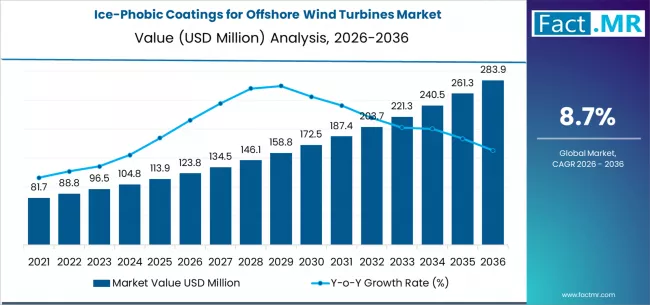
Defining trends involve the development of nanocomposite and advanced ceramic-based formulations designed to combine ice-shedding properties with the durability required for harsh offshore environments. Innovation is focused on creating multi-functional coatings that resist not only ice adhesion but also rain erosion, UV degradation, and salt corrosion. Integration of these coatings with active de-icing systems or as standalone passive solutions is becoming a key competitive strategy.
The primary market driver is the expansion of offshore wind farms into colder, higher-latitude regions to capture stronger wind resources, which simultaneously increases exposure to severe in-cloud and sea-spray icing conditions. The operational and economic imperative to prevent ice-induced power losses, ensure safety, and reduce maintenance downtime creates sustained demand for effective protective solutions.
Ice-Phobic Coatings for Offshore Wind Turbines Market
| Metric | Value |
|---|---|
| Market Value (2026) | USD 123.76 Million |
| Market Forecast Value (2036) | USD 283.90 Million |
| Forecast CAGR (2026-2036) | 8.7% |
Category
| Category | Segments |
|---|---|
| Application Area | Blade Surfaces (Leading Edge & Airfoil), Nacelle Housings, Tower & Structural Components, Others (Sensors, Instrumentation, Ancillary) |
| Coating Type | Passive Hydrophobic or Ice-Phobic Polymeric Coatings, Sol-Gel or Ceramic-Based Anti-Icing Coatings, Nanocomposite & Particle-Modified Coatings, Phase-Change or Low-Freezing-Point Surface Films, Others (Topcoats for Active De-Icing Systems, Specialty) |
| Climate or Installation Zone | Cold-Climate Offshore Europe, Cold-Climate Offshore North America, Cold-Climate Offshore Asia, Other Offshore Regions with Icing Events |
| Region | North America, Latin America, Western Europe, Eastern Europe, East Asia, South Asia & Pacific, MEA |
Segmental Analysis
By Application Area, Which Component is Most Critical for Maintaining Aerodynamic Performance?
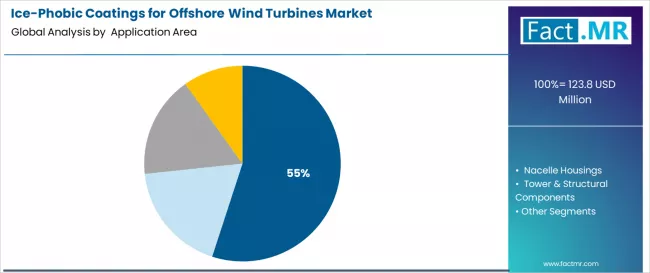
Blade surfaces lead decisively with a 55% share. This is because the leading edge and overall airfoil shape of the blade are paramount for energy capture. Ice accretion on these surfaces creates aerodynamic imbalance, increases load, and causes significant power loss. Protecting this high-value, performance-critical area from ice adhesion is the primary focus for operators, driving the majority of demand for ice-phobic technologies.
By Coating Type, Which Passive Solution Forms the Current Core of the Market?
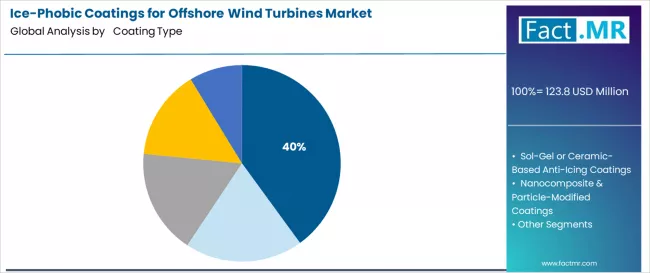
Passive hydrophobic or ice-phobic polymeric coatings command the largest segment share at 40%. This category, often based on silicones, polyurethanes, or fluoropolymers, is valued for its ability to reduce the surface energy and adhesion strength of ice. These coatings aim to prevent ice formation or allow it to be shed easily by wind or centrifugal force, providing a low-energy maintenance solution compared to active heating systems.
By Climate Zone, Which Region Combines a Mature Industry with Severe Operational Challenges?
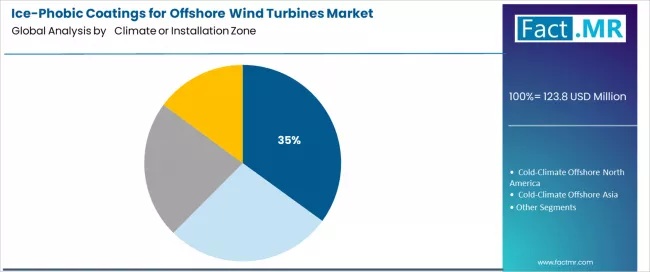
Cold-climate offshore Europe represents the leading climate zone at 35.0%. The North Sea, Baltic Sea, and emerging Arctic projects host a high density of offshore wind assets in regions prone to frequent and severe icing. The combination of a large installed base facing demonstrable icing-related revenue loss and downtime creates the most immediate and advanced market for ice protection solutions.
What are the Drivers, Restraints, and Key Trends of the Ice-Phobic Coatings for Offshore Wind Turbines Market?
The strategic push to develop offshore wind resources in colder regions to meet global renewable energy targets is the fundamental market driver. The substantial economic impact of icing-including production shortfalls, mechanical stress, and safety risks from ice throw-creates a compelling financial case for investment in protective coatings. The energy efficiency of passive coatings versus electrically heated systems also makes them an attractive option for improving net energy yield.
A significant restraint is the immense technical challenge of creating a coating that excels in ice-phobicity while also surviving 20+ years in an extreme offshore environment. Coatings must maintain their performance under UV exposure, salt spray, rain erosion at high tip speeds, and thermal cycling, which often leads to a performance durability trade-off. The high cost of qualification testing and the conservative nature of operator procurement processes can also slow the adoption of new technologies.
Key trends include the development of hybrid or multi-functional coating systems that address ice alongside other failure modes like leading-edge erosion. There is strong R&D focus on biomimetic and nanostructured surfaces that achieve super-hydrophobicity. The market is also moving towards integrated system approaches, where coatings are co-developed and tested alongside turbine blade designs and active de-icing strategies for optimal total lifecycle performance.
Analysis of the Ice-Phobic Coatings for Offshore Wind Turbines Market by Key Countries
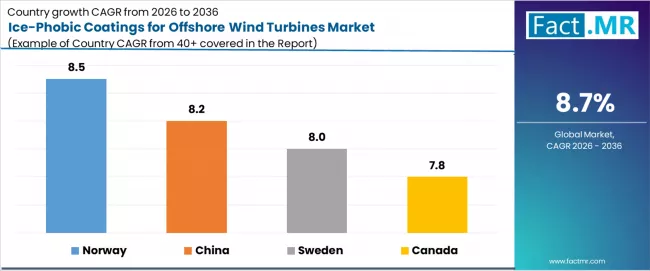
| Country | CAGR (2026-2036) |
|---|---|
| Norway | 8.50% |
| China | 8.20% |
| Sweden | 8.00% |
| Canada | 7.80% |
How does Norway's Arctic Ambition and Harsh-Environment Expertise Drive the Market?
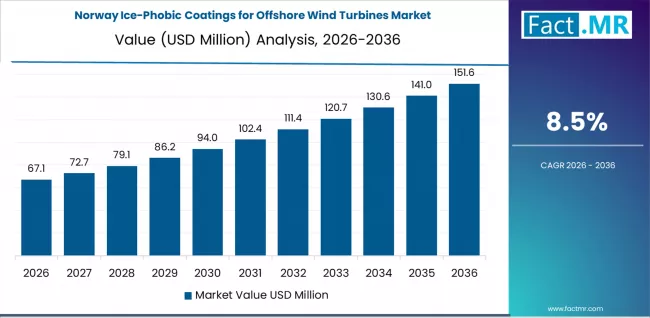
Norway's 8.50% CAGR is driven by its national strategy to develop offshore wind in the North Sea and Arctic waters. Its long history of offshore oil and gas operations in similar harsh, icy conditions provides transferable expertise and a strong focus on developing robust engineering solutions, including advanced materials for asset protection.
Why is China's Northern Offshore Expansion a Key Growth Factor?
China’s 8.20% growth is fueled by its massive offshore wind development pipeline, which is expanding from southern waters into the colder Bohai Sea and Yellow Sea regions. As projects move north, the icing risk increases, creating a large-scale, future market for ice mitigation technologies to protect its world-leading fleet capacity.
What Role does Sweden's Established Cold-Climate Wind Portfolio Play?
Sweden’s 8.00% growth is anchored in its significant installed capacity of onshore and offshore wind in sub-Arctic conditions. Swedish operators have direct, documented experience with icing losses, driving domestic demand for effective solutions and fostering local innovation in cold-climate technology.
How does Canada's Vast Coastal Potential and Research Focus Influence the Market?
Canada's 7.80% growth is supported by its extensive coastlines with high wind potential in cold climates, particularly in Atlantic Canada. The presence of world-leading cold-climate and icing research institutions supports the testing and development of new coating technologies tailored to severe environments.
Competitive Landscape of the Ice-Phobic Coatings for Offshore Wind Turbines Market
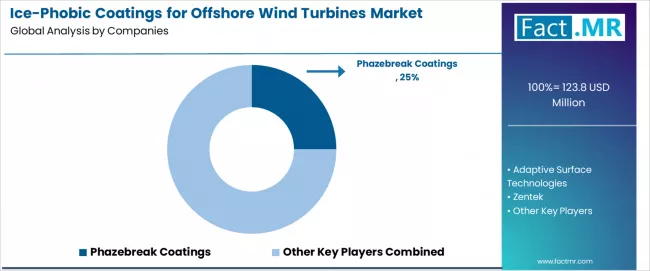
The competitive landscape features specialized technology startups and established industrial material suppliers entering the niche. Technology developers like Adaptive Surface Technologies and Zentek compete through proprietary material science, often focusing on advanced nanocomposite or surface-engineered chemistries. Service specialists like Aerones provide critical application expertise for coating large, complex blade structures in the field.
Competition centers on demonstrating validated long-term performance data from field trials, securing approvals or partnerships with major turbine original equipment manufacturers (OEMs), and proving cost-effectiveness over the full maintenance cycle. Success depends on the ability to scale production and provide global technical support for wind farm operators.
Key Players in the Ice-Phobic Coatings for Offshore Wind Turbines Market
- Phazebreak Coatings
- Adaptive Surface Technologies
- Zentek
- Aerones (industrial blade coating)
- Other emerging ice-phobic suppliers
Scope of Report
| Items | Values |
|---|---|
| Quantitative Units | USD Million |
| Application Area | Blade Surfaces, Nacelle Housings, Tower & Structural Components, Others |
| Coating Type | Passive Hydrophobic or Ice-Phobic Polymeric Coatings, Sol-Gel or Ceramic-Based Coatings, Nanocomposite Coatings, Phase-Change Films, Others |
| Climate or Installation Zone | Cold-Climate Offshore Europe, Cold-Climate Offshore North America, Cold-Climate Offshore Asia, Other Offshore Regions |
| Key Countries | Norway, China, Sweden, Canada |
| Key Companies | Phazebreak Coatings, Adaptive Surface Technologies, Zentek, Aerones, Other emerging suppliers |
| Additional Analysis | Analysis of ice adhesion strength testing protocols and performance benchmarks; durability testing against combined environmental stressors; total cost of ownership comparison with active de-icing; review of application methodologies for offshore environments; and regulatory and standards landscape for ice protection. |
Ice-Phobic Coatings for Offshore Wind Turbines Market by Segments
Application Area :
- Blade Surfaces (Leading Edge & Airfoil)
- Nacelle Housings
- Tower & Structural Components
- Others (Sensors, Instrumentation, Ancillary)
Coating Type :
- Passive Hydrophobic or Ice-Phobic Polymeric Coatings
- Sol-Gel or Ceramic-Based Anti-Icing Coatings
- Nanocomposite & Particle-Modified Coatings
- Phase-Change or Low-Freezing-Point Surface Films
- Others (Topcoats for Active De-Icing Systems, Specialty)
Climate or Installation Zone :
- Cold-Climate Offshore Europe
- Cold-Climate Offshore North America
- Cold-Climate Offshore Asia
- Other Offshore Regions with Icing Events
Region :
- North America
- USA
- Canada
- Latin America
- Brazil
- Mexico
- Argentina
- Rest of Latin America
- Western Europe
- Germany
- UK
- France
- Spain
- Italy
- BENELUX
- Rest of Western Europe
- Eastern Europe
- Russia
- Poland
- Czech Republic
- Rest of Eastern Europe
- East Asia
- China
- Japan
- South Korea
- Rest of East Asia
- South Asia & Pacific
- India
- ASEAN
- Australia
- Rest of South Asia & Pacific
- MEA
- Saudi Arabia
- UAE
- Turkiye
- Rest of MEA
Table of Content
- Executive Summary
- Global Market Outlook
- Demand to side Trends
- Supply to side Trends
- Technology Roadmap Analysis
- Analysis and Recommendations
- Market Overview
- Market Coverage / Taxonomy
- Market Definition / Scope / Limitations
- Market Background
- Market Dynamics
- Drivers
- Restraints
- Opportunity
- Trends
- Scenario Forecast
- Demand in Optimistic Scenario
- Demand in Likely Scenario
- Demand in Conservative Scenario
- Opportunity Map Analysis
- Product Life Cycle Analysis
- Supply Chain Analysis
- Investment Feasibility Matrix
- Value Chain Analysis
- PESTLE and Porter’s Analysis
- Regulatory Landscape
- Regional Parent Market Outlook
- Production and Consumption Statistics
- Import and Export Statistics
- Market Dynamics
- Global Market Analysis 2021 to 2025 and Forecast, 2026 to 2036
- Historical Market Size Value (USD Million) Analysis, 2021 to 2025
- Current and Future Market Size Value (USD Million) Projections, 2026 to 2036
- Y to o to Y Growth Trend Analysis
- Absolute $ Opportunity Analysis
- Global Market Pricing Analysis 2021 to 2025 and Forecast 2026 to 2036
- Global Market Analysis 2021 to 2025 and Forecast 2026 to 2036, By Application Area
- Introduction / Key Findings
- Historical Market Size Value (USD Million) Analysis By Application Area, 2021 to 2025
- Current and Future Market Size Value (USD Million) Analysis and Forecast By Application Area, 2026 to 2036
- Blade Surfaces (Leading Edge & Airfoil)
- Nacelle Housings
- Tower & Structural Components
- Others (Sensors, Instrumentation, Ancillary)
- Blade Surfaces (Leading Edge & Airfoil)
- Y to o to Y Growth Trend Analysis By Application Area, 2021 to 2025
- Absolute $ Opportunity Analysis By Application Area, 2026 to 2036
- Global Market Analysis 2021 to 2025 and Forecast 2026 to 2036, By Coating Type
- Introduction / Key Findings
- Historical Market Size Value (USD Million) Analysis By Coating Type, 2021 to 2025
- Current and Future Market Size Value (USD Million) Analysis and Forecast By Coating Type, 2026 to 2036
- Passive Hydrophobic or Ice-Phobic Polymeric Coatings
- Sol-Gel or Ceramic-Based Anti-Icing Coatings
- Nanocomposite & Particle-Modified Coatings
- Phase-Change or Low-Freezing-Point Surface Films
- Others (Topcoats for Active De-Icing Systems, Specialty)
- Passive Hydrophobic or Ice-Phobic Polymeric Coatings
- Y to o to Y Growth Trend Analysis By Coating Type, 2021 to 2025
- Absolute $ Opportunity Analysis By Coating Type, 2026 to 2036
- Global Market Analysis 2021 to 2025 and Forecast 2026 to 2036, By Climate or Installation Zone
- Introduction / Key Findings
- Historical Market Size Value (USD Million) Analysis By Climate or Installation Zone, 2021 to 2025
- Current and Future Market Size Value (USD Million) Analysis and Forecast By Climate or Installation Zone, 2026 to 2036
- Cold-Climate Offshore Europe
- Cold-Climate Offshore North America
- Cold-Climate Offshore Asia
- Other Offshore Regions with Icing Events
- Cold-Climate Offshore Europe
- Y to o to Y Growth Trend Analysis By Climate or Installation Zone, 2021 to 2025
- Absolute $ Opportunity Analysis By Climate or Installation Zone, 2026 to 2036
- Global Market Analysis 2021 to 2025 and Forecast 2026 to 2036, By Region
- Introduction
- Historical Market Size Value (USD Million) Analysis By Region, 2021 to 2025
- Current Market Size Value (USD Million) Analysis and Forecast By Region, 2026 to 2036
- North America
- Latin America
- Western Europe
- Eastern Europe
- East Asia
- South Asia and Pacific
- Middle East & Africa
- Market Attractiveness Analysis By Region
- North America Market Analysis 2021 to 2025 and Forecast 2026 to 2036, By Country
- Historical Market Size Value (USD Million) Trend Analysis By Market Taxonomy, 2021 to 2025
- Market Size Value (USD Million) Forecast By Market Taxonomy, 2026 to 2036
- By Country
- USA
- Canada
- Mexico
- By Application Area
- By Coating Type
- By Climate or Installation Zone
- By Country
- Market Attractiveness Analysis
- By Country
- By Application Area
- By Coating Type
- By Climate or Installation Zone
- Key Takeaways
- Latin America Market Analysis 2021 to 2025 and Forecast 2026 to 2036, By Country
- Historical Market Size Value (USD Million) Trend Analysis By Market Taxonomy, 2021 to 2025
- Market Size Value (USD Million) Forecast By Market Taxonomy, 2026 to 2036
- By Country
- Brazil
- Chile
- Rest of Latin America
- By Application Area
- By Coating Type
- By Climate or Installation Zone
- By Country
- Market Attractiveness Analysis
- By Country
- By Application Area
- By Coating Type
- By Climate or Installation Zone
- Key Takeaways
- Western Europe Market Analysis 2021 to 2025 and Forecast 2026 to 2036, By Country
- Historical Market Size Value (USD Million) Trend Analysis By Market Taxonomy, 2021 to 2025
- Market Size Value (USD Million) Forecast By Market Taxonomy, 2026 to 2036
- By Country
- Germany
- UK
- Italy
- Spain
- France
- Nordic
- BENELUX
- Rest of Western Europe
- By Application Area
- By Coating Type
- By Climate or Installation Zone
- By Country
- Market Attractiveness Analysis
- By Country
- By Application Area
- By Coating Type
- By Climate or Installation Zone
- Key Takeaways
- Eastern Europe Market Analysis 2021 to 2025 and Forecast 2026 to 2036, By Country
- Historical Market Size Value (USD Million) Trend Analysis By Market Taxonomy, 2021 to 2025
- Market Size Value (USD Million) Forecast By Market Taxonomy, 2026 to 2036
- By Country
- Russia
- Poland
- Hungary
- Balkan & Baltic
- Rest of Eastern Europe
- By Application Area
- By Coating Type
- By Climate or Installation Zone
- By Country
- Market Attractiveness Analysis
- By Country
- By Application Area
- By Coating Type
- By Climate or Installation Zone
- Key Takeaways
- East Asia Market Analysis 2021 to 2025 and Forecast 2026 to 2036, By Country
- Historical Market Size Value (USD Million) Trend Analysis By Market Taxonomy, 2021 to 2025
- Market Size Value (USD Million) Forecast By Market Taxonomy, 2026 to 2036
- By Country
- China
- Japan
- South Korea
- By Application Area
- By Coating Type
- By Climate or Installation Zone
- By Country
- Market Attractiveness Analysis
- By Country
- By Application Area
- By Coating Type
- By Climate or Installation Zone
- Key Takeaways
- South Asia and Pacific Market Analysis 2021 to 2025 and Forecast 2026 to 2036, By Country
- Historical Market Size Value (USD Million) Trend Analysis By Market Taxonomy, 2021 to 2025
- Market Size Value (USD Million) Forecast By Market Taxonomy, 2026 to 2036
- By Country
- India
- ASEAN
- Australia & New Zealand
- Rest of South Asia and Pacific
- By Application Area
- By Coating Type
- By Climate or Installation Zone
- By Country
- Market Attractiveness Analysis
- By Country
- By Application Area
- By Coating Type
- By Climate or Installation Zone
- Key Takeaways
- Middle East & Africa Market Analysis 2021 to 2025 and Forecast 2026 to 2036, By Country
- Historical Market Size Value (USD Million) Trend Analysis By Market Taxonomy, 2021 to 2025
- Market Size Value (USD Million) Forecast By Market Taxonomy, 2026 to 2036
- By Country
- Kingdom of Saudi Arabia
- Other GCC Countries
- Turkiye
- South Africa
- Other African Union
- Rest of Middle East & Africa
- By Application Area
- By Coating Type
- By Climate or Installation Zone
- By Country
- Market Attractiveness Analysis
- By Country
- By Application Area
- By Coating Type
- By Climate or Installation Zone
- Key Takeaways
- Key Countries Market Analysis
- USA
- Pricing Analysis
- Market Share Analysis, 2025
- By Application Area
- By Coating Type
- By Climate or Installation Zone
- Canada
- Pricing Analysis
- Market Share Analysis, 2025
- By Application Area
- By Coating Type
- By Climate or Installation Zone
- Mexico
- Pricing Analysis
- Market Share Analysis, 2025
- By Application Area
- By Coating Type
- By Climate or Installation Zone
- Brazil
- Pricing Analysis
- Market Share Analysis, 2025
- By Application Area
- By Coating Type
- By Climate or Installation Zone
- Chile
- Pricing Analysis
- Market Share Analysis, 2025
- By Application Area
- By Coating Type
- By Climate or Installation Zone
- Germany
- Pricing Analysis
- Market Share Analysis, 2025
- By Application Area
- By Coating Type
- By Climate or Installation Zone
- UK
- Pricing Analysis
- Market Share Analysis, 2025
- By Application Area
- By Coating Type
- By Climate or Installation Zone
- Italy
- Pricing Analysis
- Market Share Analysis, 2025
- By Application Area
- By Coating Type
- By Climate or Installation Zone
- Spain
- Pricing Analysis
- Market Share Analysis, 2025
- By Application Area
- By Coating Type
- By Climate or Installation Zone
- France
- Pricing Analysis
- Market Share Analysis, 2025
- By Application Area
- By Coating Type
- By Climate or Installation Zone
- India
- Pricing Analysis
- Market Share Analysis, 2025
- By Application Area
- By Coating Type
- By Climate or Installation Zone
- ASEAN
- Pricing Analysis
- Market Share Analysis, 2025
- By Application Area
- By Coating Type
- By Climate or Installation Zone
- Australia & New Zealand
- Pricing Analysis
- Market Share Analysis, 2025
- By Application Area
- By Coating Type
- By Climate or Installation Zone
- China
- Pricing Analysis
- Market Share Analysis, 2025
- By Application Area
- By Coating Type
- By Climate or Installation Zone
- Japan
- Pricing Analysis
- Market Share Analysis, 2025
- By Application Area
- By Coating Type
- By Climate or Installation Zone
- South Korea
- Pricing Analysis
- Market Share Analysis, 2025
- By Application Area
- By Coating Type
- By Climate or Installation Zone
- Russia
- Pricing Analysis
- Market Share Analysis, 2025
- By Application Area
- By Coating Type
- By Climate or Installation Zone
- Poland
- Pricing Analysis
- Market Share Analysis, 2025
- By Application Area
- By Coating Type
- By Climate or Installation Zone
- Hungary
- Pricing Analysis
- Market Share Analysis, 2025
- By Application Area
- By Coating Type
- By Climate or Installation Zone
- Kingdom of Saudi Arabia
- Pricing Analysis
- Market Share Analysis, 2025
- By Application Area
- By Coating Type
- By Climate or Installation Zone
- Turkiye
- Pricing Analysis
- Market Share Analysis, 2025
- By Application Area
- By Coating Type
- By Climate or Installation Zone
- South Africa
- Pricing Analysis
- Market Share Analysis, 2025
- By Application Area
- By Coating Type
- By Climate or Installation Zone
- USA
- Market Structure Analysis
- Competition Dashboard
- Competition Benchmarking
- Market Share Analysis of Top Players
- By Regional
- By Application Area
- By Coating Type
- By Climate or Installation Zone
- Competition Analysis
- Competition Deep Dive
- Phazebreak Coatings
- Overview
- Product Portfolio
- Profitability by Market Segments (Product/Age /Sales Channel/Region)
- Sales Footprint
- Strategy Overview
- Marketing Strategy
- Product Strategy
- Channel Strategy
- Adaptive Surface Technologies
- Zentek
- Aerones (industrial blade coating)
- Other emerging ice-phobic suppliers
- Phazebreak Coatings
- Competition Deep Dive
- Assumptions & Acronyms Used
- Research Methodology
List Of Table
- Table 1: Global Market Value (USD Million) Forecast by Region, 2021 to 2036
- Table 2: Global Market Value (USD Million) Forecast by Application Area, 2021 to 2036
- Table 3: Global Market Value (USD Million) Forecast by Coating Type, 2021 to 2036
- Table 4: Global Market Value (USD Million) Forecast by Climate or Installation Zone, 2021 to 2036
- Table 5: North America Market Value (USD Million) Forecast by Country, 2021 to 2036
- Table 6: North America Market Value (USD Million) Forecast by Application Area, 2021 to 2036
- Table 7: North America Market Value (USD Million) Forecast by Coating Type, 2021 to 2036
- Table 8: North America Market Value (USD Million) Forecast by Climate or Installation Zone, 2021 to 2036
- Table 9: Latin America Market Value (USD Million) Forecast by Country, 2021 to 2036
- Table 10: Latin America Market Value (USD Million) Forecast by Application Area, 2021 to 2036
- Table 11: Latin America Market Value (USD Million) Forecast by Coating Type, 2021 to 2036
- Table 12: Latin America Market Value (USD Million) Forecast by Climate or Installation Zone, 2021 to 2036
- Table 13: Western Europe Market Value (USD Million) Forecast by Country, 2021 to 2036
- Table 14: Western Europe Market Value (USD Million) Forecast by Application Area, 2021 to 2036
- Table 15: Western Europe Market Value (USD Million) Forecast by Coating Type, 2021 to 2036
- Table 16: Western Europe Market Value (USD Million) Forecast by Climate or Installation Zone, 2021 to 2036
- Table 17: Eastern Europe Market Value (USD Million) Forecast by Country, 2021 to 2036
- Table 18: Eastern Europe Market Value (USD Million) Forecast by Application Area, 2021 to 2036
- Table 19: Eastern Europe Market Value (USD Million) Forecast by Coating Type, 2021 to 2036
- Table 20: Eastern Europe Market Value (USD Million) Forecast by Climate or Installation Zone, 2021 to 2036
- Table 21: East Asia Market Value (USD Million) Forecast by Country, 2021 to 2036
- Table 22: East Asia Market Value (USD Million) Forecast by Application Area, 2021 to 2036
- Table 23: East Asia Market Value (USD Million) Forecast by Coating Type, 2021 to 2036
- Table 24: East Asia Market Value (USD Million) Forecast by Climate or Installation Zone, 2021 to 2036
- Table 25: South Asia and Pacific Market Value (USD Million) Forecast by Country, 2021 to 2036
- Table 26: South Asia and Pacific Market Value (USD Million) Forecast by Application Area, 2021 to 2036
- Table 27: South Asia and Pacific Market Value (USD Million) Forecast by Coating Type, 2021 to 2036
- Table 28: South Asia and Pacific Market Value (USD Million) Forecast by Climate or Installation Zone, 2021 to 2036
- Table 29: Middle East & Africa Market Value (USD Million) Forecast by Country, 2021 to 2036
- Table 30: Middle East & Africa Market Value (USD Million) Forecast by Application Area, 2021 to 2036
- Table 31: Middle East & Africa Market Value (USD Million) Forecast by Coating Type, 2021 to 2036
- Table 32: Middle East & Africa Market Value (USD Million) Forecast by Climate or Installation Zone, 2021 to 2036
List Of Figures
- Figure 1: Global Market Pricing Analysis
- Figure 2: Global Market Value (USD Million) Forecast 2021 to 2036
- Figure 3: Global Market Value Share and BPS Analysis by Application Area, 2026 and 2036
- Figure 4: Global Market Y to o to Y Growth Comparison by Application Area, 2026 to 2036
- Figure 5: Global Market Attractiveness Analysis by Application Area
- Figure 6: Global Market Value Share and BPS Analysis by Coating Type, 2026 and 2036
- Figure 7: Global Market Y to o to Y Growth Comparison by Coating Type, 2026 to 2036
- Figure 8: Global Market Attractiveness Analysis by Coating Type
- Figure 9: Global Market Value Share and BPS Analysis by Climate or Installation Zone, 2026 and 2036
- Figure 10: Global Market Y to o to Y Growth Comparison by Climate or Installation Zone, 2026 to 2036
- Figure 11: Global Market Attractiveness Analysis by Climate or Installation Zone
- Figure 12: Global Market Value (USD Million) Share and BPS Analysis by Region, 2026 and 2036
- Figure 13: Global Market Y to o to Y Growth Comparison by Region, 2026 to 2036
- Figure 14: Global Market Attractiveness Analysis by Region
- Figure 15: North America Market Incremental Dollar Opportunity, 2026 to 2036
- Figure 16: Latin America Market Incremental Dollar Opportunity, 2026 to 2036
- Figure 17: Western Europe Market Incremental Dollar Opportunity, 2026 to 2036
- Figure 18: Eastern Europe Market Incremental Dollar Opportunity, 2026 to 2036
- Figure 19: East Asia Market Incremental Dollar Opportunity, 2026 to 2036
- Figure 20: South Asia and Pacific Market Incremental Dollar Opportunity, 2026 to 2036
- Figure 21: Middle East & Africa Market Incremental Dollar Opportunity, 2026 to 2036
- Figure 22: North America Market Value Share and BPS Analysis by Country, 2026 and 2036
- Figure 23: North America Market Value Share and BPS Analysis by Application Area, 2026 and 2036
- Figure 24: North America Market Y to o to Y Growth Comparison by Application Area, 2026 to 2036
- Figure 25: North America Market Attractiveness Analysis by Application Area
- Figure 26: North America Market Value Share and BPS Analysis by Coating Type, 2026 and 2036
- Figure 27: North America Market Y to o to Y Growth Comparison by Coating Type, 2026 to 2036
- Figure 28: North America Market Attractiveness Analysis by Coating Type
- Figure 29: North America Market Value Share and BPS Analysis by Climate or Installation Zone, 2026 and 2036
- Figure 30: North America Market Y to o to Y Growth Comparison by Climate or Installation Zone, 2026 to 2036
- Figure 31: North America Market Attractiveness Analysis by Climate or Installation Zone
- Figure 32: Latin America Market Value Share and BPS Analysis by Country, 2026 and 2036
- Figure 33: Latin America Market Value Share and BPS Analysis by Application Area, 2026 and 2036
- Figure 34: Latin America Market Y to o to Y Growth Comparison by Application Area, 2026 to 2036
- Figure 35: Latin America Market Attractiveness Analysis by Application Area
- Figure 36: Latin America Market Value Share and BPS Analysis by Coating Type, 2026 and 2036
- Figure 37: Latin America Market Y to o to Y Growth Comparison by Coating Type, 2026 to 2036
- Figure 38: Latin America Market Attractiveness Analysis by Coating Type
- Figure 39: Latin America Market Value Share and BPS Analysis by Climate or Installation Zone, 2026 and 2036
- Figure 40: Latin America Market Y to o to Y Growth Comparison by Climate or Installation Zone, 2026 to 2036
- Figure 41: Latin America Market Attractiveness Analysis by Climate or Installation Zone
- Figure 42: Western Europe Market Value Share and BPS Analysis by Country, 2026 and 2036
- Figure 43: Western Europe Market Value Share and BPS Analysis by Application Area, 2026 and 2036
- Figure 44: Western Europe Market Y to o to Y Growth Comparison by Application Area, 2026 to 2036
- Figure 45: Western Europe Market Attractiveness Analysis by Application Area
- Figure 46: Western Europe Market Value Share and BPS Analysis by Coating Type, 2026 and 2036
- Figure 47: Western Europe Market Y to o to Y Growth Comparison by Coating Type, 2026 to 2036
- Figure 48: Western Europe Market Attractiveness Analysis by Coating Type
- Figure 49: Western Europe Market Value Share and BPS Analysis by Climate or Installation Zone, 2026 and 2036
- Figure 50: Western Europe Market Y to o to Y Growth Comparison by Climate or Installation Zone, 2026 to 2036
- Figure 51: Western Europe Market Attractiveness Analysis by Climate or Installation Zone
- Figure 52: Eastern Europe Market Value Share and BPS Analysis by Country, 2026 and 2036
- Figure 53: Eastern Europe Market Value Share and BPS Analysis by Application Area, 2026 and 2036
- Figure 54: Eastern Europe Market Y to o to Y Growth Comparison by Application Area, 2026 to 2036
- Figure 55: Eastern Europe Market Attractiveness Analysis by Application Area
- Figure 56: Eastern Europe Market Value Share and BPS Analysis by Coating Type, 2026 and 2036
- Figure 57: Eastern Europe Market Y to o to Y Growth Comparison by Coating Type, 2026 to 2036
- Figure 58: Eastern Europe Market Attractiveness Analysis by Coating Type
- Figure 59: Eastern Europe Market Value Share and BPS Analysis by Climate or Installation Zone, 2026 and 2036
- Figure 60: Eastern Europe Market Y to o to Y Growth Comparison by Climate or Installation Zone, 2026 to 2036
- Figure 61: Eastern Europe Market Attractiveness Analysis by Climate or Installation Zone
- Figure 62: East Asia Market Value Share and BPS Analysis by Country, 2026 and 2036
- Figure 63: East Asia Market Value Share and BPS Analysis by Application Area, 2026 and 2036
- Figure 64: East Asia Market Y to o to Y Growth Comparison by Application Area, 2026 to 2036
- Figure 65: East Asia Market Attractiveness Analysis by Application Area
- Figure 66: East Asia Market Value Share and BPS Analysis by Coating Type, 2026 and 2036
- Figure 67: East Asia Market Y to o to Y Growth Comparison by Coating Type, 2026 to 2036
- Figure 68: East Asia Market Attractiveness Analysis by Coating Type
- Figure 69: East Asia Market Value Share and BPS Analysis by Climate or Installation Zone, 2026 and 2036
- Figure 70: East Asia Market Y to o to Y Growth Comparison by Climate or Installation Zone, 2026 to 2036
- Figure 71: East Asia Market Attractiveness Analysis by Climate or Installation Zone
- Figure 72: South Asia and Pacific Market Value Share and BPS Analysis by Country, 2026 and 2036
- Figure 73: South Asia and Pacific Market Value Share and BPS Analysis by Application Area, 2026 and 2036
- Figure 74: South Asia and Pacific Market Y to o to Y Growth Comparison by Application Area, 2026 to 2036
- Figure 75: South Asia and Pacific Market Attractiveness Analysis by Application Area
- Figure 76: South Asia and Pacific Market Value Share and BPS Analysis by Coating Type, 2026 and 2036
- Figure 77: South Asia and Pacific Market Y to o to Y Growth Comparison by Coating Type, 2026 to 2036
- Figure 78: South Asia and Pacific Market Attractiveness Analysis by Coating Type
- Figure 79: South Asia and Pacific Market Value Share and BPS Analysis by Climate or Installation Zone, 2026 and 2036
- Figure 80: South Asia and Pacific Market Y to o to Y Growth Comparison by Climate or Installation Zone, 2026 to 2036
- Figure 81: South Asia and Pacific Market Attractiveness Analysis by Climate or Installation Zone
- Figure 82: Middle East & Africa Market Value Share and BPS Analysis by Country, 2026 and 2036
- Figure 83: Middle East & Africa Market Value Share and BPS Analysis by Application Area, 2026 and 2036
- Figure 84: Middle East & Africa Market Y to o to Y Growth Comparison by Application Area, 2026 to 2036
- Figure 85: Middle East & Africa Market Attractiveness Analysis by Application Area
- Figure 86: Middle East & Africa Market Value Share and BPS Analysis by Coating Type, 2026 and 2036
- Figure 87: Middle East & Africa Market Y to o to Y Growth Comparison by Coating Type, 2026 to 2036
- Figure 88: Middle East & Africa Market Attractiveness Analysis by Coating Type
- Figure 89: Middle East & Africa Market Value Share and BPS Analysis by Climate or Installation Zone, 2026 and 2036
- Figure 90: Middle East & Africa Market Y to o to Y Growth Comparison by Climate or Installation Zone, 2026 to 2036
- Figure 91: Middle East & Africa Market Attractiveness Analysis by Climate or Installation Zone
- Figure 92: Global Market - Tier Structure Analysis
- Figure 93: Global Market - Company Share Analysis
- FAQs -
How big is the ice-phobic coatings for offshore wind turbines market in 2026?
The global pfas-free powder coatings market is estimated to be valued at USD 0.9 billion in 2026.
What will be the size of ice-phobic coatings for offshore wind turbines market in 2036?
The market size for the pfas-free powder coatings market is projected to reach USD 1.6 billion by 2036.
How much will be the ice-phobic coatings for offshore wind turbines market growth between 2026 and 2036?
The pfas-free powder coatings market is expected to grow at a 6.2% CAGR between 2026 and 2036.
What are the key product types in the ice-phobic coatings for offshore wind turbines market?
The key product types in pfas-free powder coatings market are architectural & building, appliances , automotive & transportation , general industrial & heavy equipment and furniture & consumer goods .
Which coating type segment to contribute significant share in the ice-phobic coatings for offshore wind turbines market in 2026?
In terms of resin type , polyester segment to command 40.0% share in the pfas-free powder coatings market in 2026.