- Base Value(2025): 284.8 Bn
- Estimated Value(2026): 300.5 Bn
- Forecast Value (2036): 513.2 Bn
- CAGR (2026 - 2036): 5.5%
Coffee Market Analysis and Forecast by Fact.MR
- The global coffee market is estimated at USD 300.5 billion in 2026 and has been forecast to expand at a CAGR of 5.5% to reach USD 513.2 billion by 2036.
- The coffee market encompasses whole bean, ground, instant, pod and capsule, and ready-to-drink coffee formats spanning Arabica, Robusta, Liberica, and Excelsa bean types.
- Processing methods include washed, natural, honey, and decaffeination processes, with roast profiles covering light, medium, and dark roast categories. Growth is shaped by specialty coffee culture expansion, at-home premium brewing adoption, cold brew and RTD coffee innovation, cafe and food service channel expansion in emerging markets, and growing consumer demand for single-origin, sustainably sourced, and traceable coffee products.

Coffee Market Market Value Analysis | Source: Fact.MR
Summary of Coffee Market
- Market Snapshot
- In 2025, the global Coffee Market was valued at approximately USD 284.8 billion.
- The market is estimated to reach USD 300.5 billion in 2026 and is projected to attain USD 513.2 billion by 2036.
- The coffee market is likely to expand at a CAGR of 5.5% during the forecast period.
- The market is anticipated to create an absolute dollar opportunity of USD 212.7 billion between 2026 and 2036.
- Whole bean coffee accounts for 32.0% of product segment share in 2026, led by Arabica and single-origin specialty beans.
- India (7.2%) and China (6.8%) are the key growth markets during the forecast period.
- Demand and Growth Drivers
- Specialty coffee culture expansion, with growing consumer interest in single-origin, micro-lot, and traceable coffee, is driving premiumization across both retail and food service channels.
- At-home premium brewing adoption, supported by espresso machine, pour-over, and pod system penetration, is increasing per-cup spending and whole bean consumption in household settings.
- Cold brew and ready-to-drink coffee innovation is creating high-growth product categories that expand coffee consumption occasions beyond traditional hot brewing.
- Cafe and coffee shop expansion in emerging markets, particularly in China, India, and Southeast Asia, is introducing specialty coffee culture to new consumer populations.
- Sustainability and ethical sourcing certifications (Fair Trade, Rainforest Alliance, organic) are commanding price premiums and reshaping supply chain relationships.
- Product and Segment View
- Whole bean coffee accounts for 32.0% of the product segment in 2026, driven by specialty coffee consumer preference for freshly ground beans and the growing penetration of home espresso and grinder equipment.
- Arabica coffee represents 58.0% of the bean type segment in 2026, maintained by its flavor profile superiority and premium positioning across specialty retail and cafe channels.
- Household consumption holds 52.0% of the application segment in 2026, reflecting the dominant volume of coffee prepared and consumed at home across all global markets.
- Key segmentation includes:
- Product: Whole bean coffee (Arabica, Robusta, single-origin), Ground coffee (filter, espresso grind), Instant coffee (spray dried, freeze dried), Coffee pods and capsules, Ready-to-drink coffee (cold brew, canned)
- Bean Type: Arabica coffee (high-altitude, premium specialty), Robusta coffee (high-caffeine, commercial grade), Liberica coffee, Excelsa coffee
- Application: Household consumption (home brewing, instant), Food service industry (cafes, restaurants, QSR chains), Industrial use (food and beverage manufacturers, bakery flavoring)
- Roast Type: Light roast, Medium roast, Dark roast
- These systems enable:
- Daily caffeine delivery through multiple preparation methods suited to consumer preferences and occasions
- Premium flavor experiences through single-origin sourcing, specialty roasting, and artisanal preparation
- Convenient consumption formats spanning home brewing, cafe service, and on-the-go ready-to-drink options
- Geography and Competitive Outlook
- North America and Europe remain the largest coffee consumption regions, with mature but premiumizing markets driven by specialty coffee adoption and at-home brewing investment.
- Asia Pacific is the fastest-growing region, driven by rapid cafe expansion in China, India, and Southeast Asia, and the introduction of coffee culture to traditionally tea-drinking populations.
- Latin America maintains dual significance as both a major production region and a growing consumer market, with Brazil as the world's largest producer and a rapidly premiumizing domestic market.
- India (7.2%) and China (6.8%) lead country-level growth, while Vietnam (6.4%), USA (5.1%), Brazil (4.7%), Germany (3.9%), and Saudi Arabia (3.3%) maintain steady expansion.
- Leading companies include Nestle, Starbucks Coffee Company, JDE Peet's, Tchibo GmbH, Luigi Lavazza S.p.A., Strauss Coffee BV, The J.M. Smucker Company, Melitta Group, UCC Ueshima Coffee Co. Ltd., and Massimo Zanetti Beverage Group.
- Analyst Opinion
- Shambhu Nath Jha, Principal Consultant at Fact.MR, says 'The coffee market is undergoing its most significant structural shift in decades as premiumization, format innovation, and geographic expansion converge. The fastest absolute dollar growth is in at-home specialty consumption, where consumers are investing in equipment, whole bean subscriptions, and single-origin products that bring cafe-quality experiences home. The fastest percentage growth is in emerging markets where cafe culture is still nascent. Cold brew and RTD coffee are creating entirely new consumption occasions, particularly among younger consumers who view coffee as a lifestyle beverage. Companies that can serve both the premiumizing home consumer and the emerging market cafe expansion, while maintaining supply chain traceability and sustainability credentials, will capture the broadest commercial opportunity.'
Key Growth Drivers, Constraints, and Opportunities
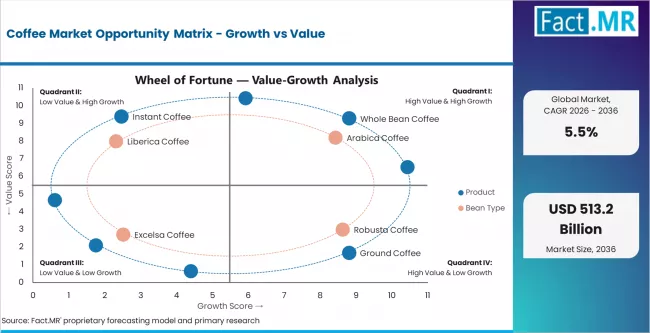
Coffee Market Opportunity Matrix Growth Vs Value | Source: Fact.MR
Key Factors Driving Growth
- Global coffee consumption continues to grow at approximately 2% annually by volume, with per-capita consumption increasing in emerging markets and per-cup value increasing in mature markets through premiumization.
- Specialty coffee and single-origin sourcing are commanding significant price premiums over commodity coffee, driving revenue growth that exceeds volume growth across both retail and food service channels.
- Cold brew and RTD coffee categories are among the fastest-growing product formats, expanding coffee consumption occasions beyond morning hot brewing into afternoon, evening, and on-the-go occasions.
Key Market Constraints
- Climate change-driven supply volatility, including rising temperatures in key Arabica growing regions, is creating long-term supply risk and contributing to green coffee price fluctuations that affect the entire value chain.
- Coffee price inflation at retail, driven by both green bean cost increases and premiumization, is approaching consumer price sensitivity thresholds in some markets, potentially moderating volume growth.
- Labor shortages in coffee farming regions, combined with the economic pressures facing smallholder farmers, create sustainability and supply chain resilience challenges.
Key Opportunity Areas
- Emerging market cafe expansion, particularly in China (projected to add tens of thousands of locations), India, and Southeast Asia, represents the largest absolute growth opportunity for food service coffee.
- Subscription-based direct-to-consumer coffee delivery models are creating premium, recurring revenue channels for specialty roasters and established brands alike.
- Sustainable and traceable coffee, supported by blockchain supply chain technology and consumer willingness to pay premiums for ethical sourcing, represents a growing premium product opportunity.
Segment-wise Analysis of the Coffee Market
- Whole bean coffee holds 32.0% of the product segment in 2026, driven by specialty consumer preference for freshly ground coffee and the growing installed base of home grinding and espresso equipment.
- Arabica coffee represents 58.0% of the bean type segment in 2026, maintained by its established flavor superiority and premium positioning across specialty retail and food service channels.
- Household consumption holds 52.0% of the application segment in 2026, reflecting the dominant volume base of home-prepared coffee across all global markets.
The coffee market is segmented by product type, bean type, processing type, roast type, application, and region. By product, the market covers whole bean, ground, instant, pods and capsules, and ready-to-drink coffee. By bean type, coverage includes Arabica, Robusta, Liberica, and Excelsa. Whole bean coffee leads by value driven by premiumization and specialty consumer demand, while instant coffee maintains significant volume, particularly in emerging markets and convenience-oriented consumer segments.
Which Product Segment Dominates the Coffee Market?
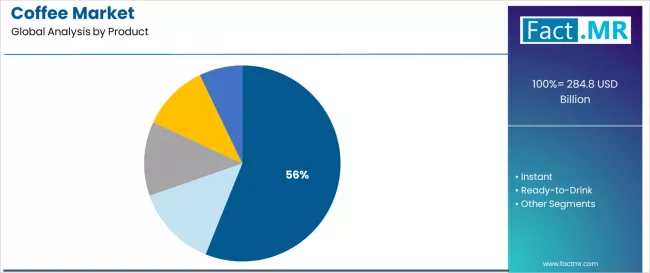
Coffee Market Analysis By Product | Source: Fact.MR
Whole bean coffee is expected to account for 32.0% of the product segment value in 2026. This leadership reflects the growing specialty coffee culture where consumers prefer freshly ground beans for optimal flavor extraction. The expanding installed base of home espresso machines, burr grinders, and pour-over equipment has made whole bean coffee more accessible to mainstream consumers who previously relied on pre-ground or instant formats.
Ground coffee maintains significant share through traditional filter and drip brewing, while instant coffee retains volume strength in price-sensitive and convenience-oriented markets. Coffee pods and capsules are among the fastest-growing product sub-segments, driven by single-serve convenience and the Nespresso and Keurig ecosystem effects. Ready-to-drink coffee, particularly cold brew, represents the fastest-growing format innovation, attracting younger consumers and expanding consumption occasions.
Which Bean Type Dominates the Coffee Market?
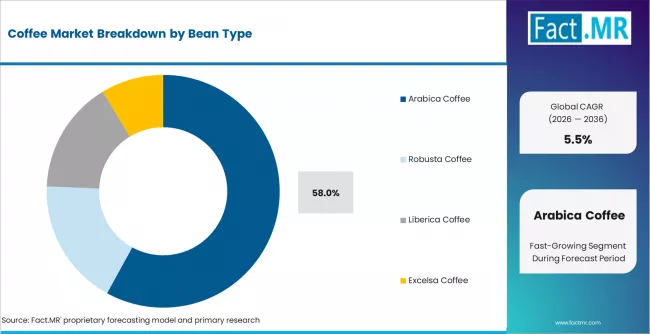
Coffee Market Analysis By Bean Type | Source: Fact.MR
Arabica coffee is expected to hold 58.0% of the bean type segment value in 2026. This dominance reflects Arabica's established flavor profile superiority, with its complex acidity, sweetness, and aromatic characteristics preferred by specialty coffee consumers and cafe operators. High-altitude Arabica and single-origin varieties command the highest premiums in the market.
Robusta coffee maintains significant volume through its use in instant coffee production, espresso blends, and commercial-grade applications where its higher caffeine content and lower cost provide economic advantages. The distinction between Arabica and Robusta is becoming less binary as specialty Robusta and fine Robusta initiatives elevate the quality perception and pricing of select Robusta origins.
Which Product Trend is Shaping the Next Phase of Growth in the Coffee Market?
Cold brew and ready-to-drink coffee innovation is the product trend with the greatest impact on expanding the total addressable coffee market. Cold brew coffee, once a niche cafe offering, has become a mainstream retail product category available in canned, bottled, and on-tap formats. RTD coffee bridges the gap between traditional brewed coffee and the convenience beverage category, attracting consumers who might not engage with traditional hot coffee preparation.
The commercial significance of RTD and cold brew extends beyond their direct sales. They are redefining coffee as an all-day, all-occasion beverage rather than a morning ritual, creating consumption moments in afternoon, evening, and on-the-go contexts that did not previously exist at scale. Major players including Nestle, Starbucks, and regional brands are investing in RTD portfolios, while grocery and convenience store shelf space allocated to RTD coffee continues to expand. As product innovation incorporates functional ingredients, plant-based milk options, and low-sugar formulations, the RTD coffee segment is positioned to capture significant incremental growth from both existing coffee consumers expanding their occasions and new consumers entering the category through convenient formats.
Regional Outlook Across Key Markets
.webp "Top Country Growth Comparison Coffee Market Cagr (2026 2036)")
Top Country Growth Comparison Coffee Market Cagr (2026 2036) | Source: Fact.MR
- India leads growth at 7.2%, supported by rapid cafe expansion, growing coffee culture among younger urban demographics, and domestic production strength in both Arabica and Robusta.
- China at 6.8% reflects explosive cafe expansion with major chains adding thousands of locations annually, combined with growing at-home specialty coffee adoption among urban consumers.
- Vietnam (6.4%) benefits from its position as the world's second-largest coffee producer and growing domestic consumption, while USA (5.1%) grows through continued premiumization and RTD innovation.
- Brazil (4.7%), Germany (3.9%), and Saudi Arabia (3.3%) maintain steady growth driven by domestic consumption premiumization and specialty coffee adoption.
CAGR Table
| Country | CAGR (%) |
|---|---|
| India | 7.2% |
| China | 6.8% |
| Vietnam | 6.4% |
| USA | 5.1% |
| Brazil | 4.7% |
| Germany | 3.9% |
| Saudi Arabia | 3.3% |
Source: Fact.MR analysis. Updated May 8, 2026
Source: Fact MR (FMR) analysis, based on proprietary forecasting model and primary research.
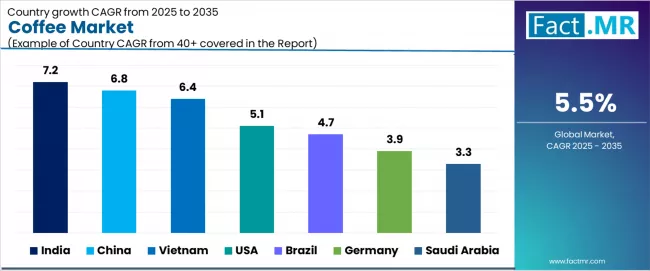
Coffee Market Cagr Analysis By Country | Source: Fact.MR
Market Outlook for Coffee in the United States
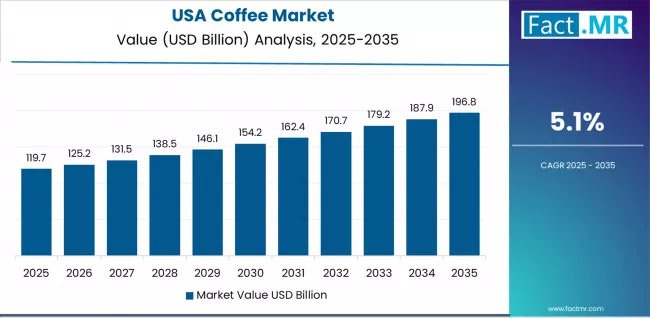
Coffee Market Country Value Analysis | Source: Fact.MR
The US coffee market is projected to grow at a CAGR of 5.1% through 2036. Demand is supported by the largest specialty coffee consumer base globally, strong RTD and cold brew innovation, and continued premiumization across both retail and food service channels.
- Specialty and single-origin coffee drive premiumization.
- RTD and cold brew innovation expands consumption occasions.
- Subscription and DTC models create recurring premium revenue.
Coffee Demand Trends in India
The India coffee market is projected to grow at a CAGR of 7.2% through 2036, the fastest among countries studied. Growth is driven by rapid cafe chain expansion, growing coffee culture among younger urban consumers, and domestic production strength in both Arabica and Robusta beans.
- Cafe chain expansion introduces specialty coffee to new consumers.
- Young urban demographics are adopting coffee as a lifestyle beverage.
- Domestic production supports both export and growing local consumption.
China Coffee Market Growth Assessment
The China coffee market is projected to grow at a CAGR of 6.8% through 2036. Growth is supported by explosive cafe expansion, growing consumer willingness to pay for specialty coffee, and rapid adoption of at-home brewing and RTD coffee formats.
- Cafe expansion continues at an extraordinary pace across tier 1 and tier 2 cities.
- Consumer premiumization drives per-cup value growth.
- RTD and instant specialty formats capture convenience-oriented demand.
Germany Coffee Market Outlook
The Germany coffee market is projected to grow at a CAGR of 3.9% through 2036. Demand is supported by the highest per-capita coffee consumption in Europe, strong specialty coffee roaster activity, and established pod and capsule system adoption.
- High per-capita consumption provides a large established demand base.
- Specialty roasters drive premiumization and quality awareness.
- Pod and capsule systems maintain strong household penetration.
Brazil Coffee Market Demand Analysis
The Brazil coffee market is projected to grow at a CAGR of 4.7% through 2036. Demand is supported by Brazil's position as the world's largest coffee producer and its rapidly premiumizing domestic consumption market.
- Domestic consumption premiumization is increasing per-cup value.
- World's largest production base supports broad consumer access.
- Growing specialty coffee awareness elevates domestic market quality.
Competitive Benchmarking and Company Positioning
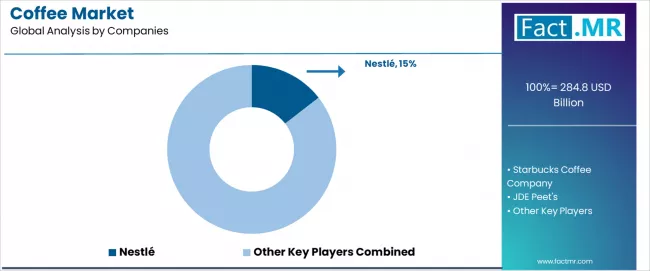
Coffee Market Analysis By Company | Source: Fact.MR
Coffee Market Analysis By Company
- Nestle, Starbucks Coffee Company, and JDE Peet's hold the strongest global positions through multi-format product portfolios, extensive retail and food service distribution, and strong brand equity across instant, roasted, pod, and RTD coffee categories.
- Tchibo GmbH, Luigi Lavazza S.p.A., and The J.M. Smucker Company compete across specific geographic markets and product categories, with differentiation shaped by roasting expertise, brand heritage, and channel specialization.
- Competition is increasingly defined by the ability to serve premium consumer demand through specialty sourcing, sustainable supply chains, and format innovation while maintaining mass-market distribution reach.
The competitive landscape is moderately concentrated at the global level, with Nestle maintaining an estimated 15% market share through its Nescafe instant coffee leadership, Nespresso pod system, and Starbucks at-home product licensing. Nestle's strength lies in its multi-format portfolio that spans commodity instant coffee in emerging markets through premium capsule systems in developed markets.
Starbucks competes primarily through its cafe network and branded retail products, with a growing presence in RTD coffee through partnerships and its own bottled and canned product lines. JDE Peet's (Jacobs Douwe Egberts) maintains strong positions in European and emerging market ground and instant coffee through brands including Jacobs, L'OR, and Senseo.
Regional players including Tchibo (Germany), Lavazza (Italy), UCC (Japan), and Strauss Coffee (emerging markets) maintain strong positions through local brand loyalty, roasting expertise, and distribution relationships. The specialty and third-wave coffee segment remains fragmented, with hundreds of regional roasters competing on quality, sourcing, and direct consumer relationships.
Strategic priorities include expanding RTD and cold brew product portfolios, investing in sustainable and traceable sourcing programs, building direct-to-consumer subscription capabilities, and extending premium product access into emerging market growth channels.
Key Companies in the Coffee Market
- Nestle, Starbucks Coffee Company, and JDE Peet's are among the leading players globally, supported by multi-format portfolios, global distribution, and strong brand equity.
- Tchibo GmbH, Luigi Lavazza S.p.A., and The J.M. Smucker Company hold established positions through regional brand strength and category specialization.
- Strauss Coffee BV, Melitta Group, UCC Ueshima Coffee Co. Ltd., and Massimo Zanetti Beverage Group compete through regional expertise and channel-specific positioning.
- Recent Industry Developments
- Nestle, Global Coffee Portfolio and Sustainability Investment (2025)
- Nestle continued expanding its global coffee portfolio across Nescafe, Nespresso, and Starbucks at-home brands, while advancing its Nescafe Plan sustainability program targeting responsible sourcing, regenerative agriculture, and farmer livelihood improvement.
- Starbucks Coffee Company, Global Store Expansion and RTD Growth (2025)
- Starbucks continued its global cafe expansion with particular focus on China and emerging markets, while growing its ready-to-drink coffee portfolio through retail distribution and new product format introductions targeting convenience and on-the-go consumption.
- JDE Peet's, Product Innovation and Market Expansion (2025)
- JDE Peet's advanced its product innovation agenda across instant, ground, and pod coffee categories, with particular focus on premium tier expansion and emerging market distribution growth through its L'OR, Jacobs, and Senseo brand portfolios.
Leading Companies Shaping the Coffee Market
- Nestle
- Starbucks Coffee Company
- JDE Peet's
- Tchibo GmbH
- Luigi Lavazza S.p.A.
- Strauss Coffee BV
- The J.M. Smucker Company
- Melitta Group
- UCC Ueshima Coffee Co., Ltd.
- Massimo Zanetti Beverage Group
Sources and Research References
- Nestle. Coffee portfolio financial data and sustainability program updates.
- Starbucks Coffee Company. Global store expansion and RTD product data.
- International Coffee Organization. Global coffee consumption and trade statistics.
- Specialty Coffee Association. Industry reports and consumer trend data.
- Primary interviews with roasters, retailers, cafe operators, importers, and industry associations.
This bibliography is provided for reader reference and is not exhaustive. The full report contains the complete reference list and detailed citations.
Key Questions This Report Addresses
What is the current and future size of the Coffee Market?
- How fast is it expected to grow?
- Which product type is likely to lead?
- How is specialty coffee reshaping the market?
- Which countries are projected to show the fastest growth?
- How is RTD coffee expanding consumption?
- Who are the key companies?
- How does Fact.MR estimate and validate the forecast?
Coffee Market Definition
The coffee market covers roasted, instant, and ready-to-drink coffee products across whole bean, ground, pod, capsule, and beverage formats, spanning Arabica, Robusta, and specialty bean types sold through retail, food service, and industrial channels globally.
Coffee Market Inclusions
- The scope covers global and regional market size and forecasts for 2026 to 2036 across product type, bean type, processing type, roast type, application, and region.
- It includes regional demand analysis based on coffee consumption per capita, cafe density, retail channel penetration, and premiumization trends.
- The report covers pricing analysis across coffee categories from commodity to specialty, including green bean pricing and retail margin structures.
- It includes supply chain analysis, sustainability trends, and the competitive landscape of leading coffee companies.
Coffee Market Exclusions
- The scope excludes coffee farming equipment, agricultural machinery, and green coffee bean trading markets prior to roasting.
- It excludes coffee-flavored products where coffee is not the primary ingredient, such as coffee-flavored ice cream or confectionery.
- The report excludes coffee shop real estate, furniture, and non-coffee food service revenue.
- It also excludes coffee substitute products such as chicory and barley-based alternatives marketed as coffee replacements.
Coffee Market Research Methodology
- The methodology combines secondary research, primary interviews, and forecast modelling.
- It draws on 180+ secondary sources and benchmarks 70+ company product portfolios.
- Market sizing covers 30+ countries through a demand-side model, supported by top-down validation.
- Key inputs include coffee consumption per capita, cafe count data, retail sales volumes, premiumization indices, and green coffee pricing.
- The model cross-checks demand with production data, import/export flows, and retail scanner statistics.
- Primary validation includes 30+ interviews across roasters, retailers, cafe operators, importers, and industry associations.
- Final estimates go through trade-flow checks, consumption-pattern review, and sensitivity testing.
Segmentation
Scope of Analysis
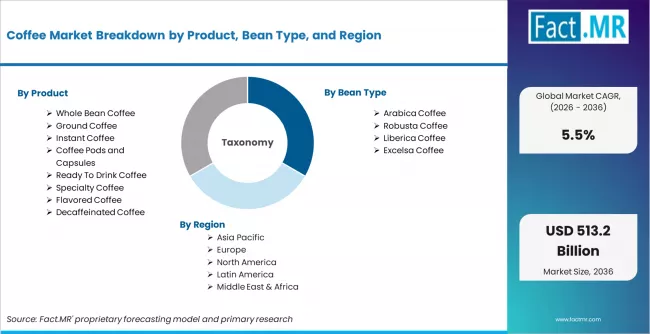
Coffee Market Breakdown By Product, Bean Type, And Region | Source: Fact.MR
| Parameter | Details |
|---|---|
| Quantitative Units | USD 300.5 billion to USD 513.2 billion, at a CAGR of 5.5% |
| Market Definition | The Coffee Market covers roasted, instant, and RTD coffee products across bean types, processing methods, and formats sold through retail, food service, and industrial channels. |
| Regions Covered | North America, Latin America, Europe, East Asia, South Asia and Pacific, Middle East and Africa |
| Countries Covered | USA, India, China, Vietnam, Brazil, Germany, Saudi Arabia, 30 plus countries |
| Key Companies | Nestle, Starbucks, JDE Peet's, Tchibo, Lavazza, Strauss Coffee, J.M. Smucker, Melitta, UCC, Massimo Zanetti |
| Forecast Period | 2026 to 2036 |
| Approach | Hybrid demand-side and top-down methodology built on coffee consumption volumes, cafe density, retail sales data, and primary interviews across roasters, retailers, cafe operators, and importers |
Source: Fact.MR analysis. Updated May 8, 2026
Coffee Market Segmentation
-
Coffee Market Segmented by Product:
- Whole Bean Coffee
- Arabica Beans
- Robusta Beans
- Single Origin Beans
- Ground Coffee
- Filter Coffee Grind
- Espresso Grind
- Instant Coffee
- Spray Dried Coffee
- Freeze Dried Coffee
- Coffee Pods and Capsules
- Single Serve Pods
- Espresso Capsules
- Ready To Drink Coffee
- Cold Brew Coffee
- Canned Coffee Beverages
- Specialty Coffee
- Single Origin Specialty Coffee
- Artisan Roasted Coffee
- Flavored Coffee
- Vanilla Coffee
- Hazelnut Coffee
- Caramel Coffee
- Decaffeinated Coffee
- Solvent Decaf Coffee
- Swiss Water Decaf Coffee
- Whole Bean Coffee
-
Coffee Market Segmented by Bean Type:
- Arabica Coffee
- High Altitude Arabica
- Premium Specialty Arabica
- Robusta Coffee
- High Caffeine Robusta
- Commercial Grade Robusta
- Liberica Coffee
- Exotic Coffee Varieties
- Excelsa Coffee
- Specialty Rare Coffee Beans
- Arabica Coffee
-
Coffee Market Segmented by Processing Type:
- Washed Process
- Wet Processed Coffee
- Clean Flavor Profile Coffee
- Natural Process
- Dry Processed Coffee
- Fruity Flavor Coffee
- Honey Process
- Semi Washed Coffee
- Sweet Balanced Coffee
- Decaffeination Process
- Solvent Based Decaf
- Water Process Decaf
- Washed Process
-
Coffee Market Segmented by Roast Type:
- Light Roast
- Acidic Flavor Profile
- Aromatic Specialty Roast
- Medium Roast
- Balanced Flavor Coffee
- Mainstream Roast Profile
- Dark Roast
- Strong Bitter Coffee
- Espresso Dark Roast
- Light Roast
-
Coffee Market Segmented by Application:
- Household Consumption
- Home Brewing Coffee
- Instant Coffee Consumption
- Food Service Industry
- Cafes and Coffee Shops
- Restaurants
- QSR Chains
- Industrial Use
- Food and Beverage Manufacturers
- Ice Cream and Bakery Flavoring
- Household Consumption
-
Coffee Market by Region:
- North America
- USA
- Canada
- Mexico
- Latin America
- Brazil
- Chile
- Rest of Latin America
- Western Europe
- Germany
- UK
- Italy
- Spain
- France
- Nordic
- BENELUX
- Rest of Western Europe
- Eastern Europe
- Russia
- Poland
- Hungary
- Balkan & Baltic
- Rest of Eastern Europe
- East Asia
- China
- Japan
- South Korea
- South Asia and Pacific
- India
- ASEAN
- Australia & New Zealand
- Rest of South Asia and Pacific
- Middle East & Africa
- Kingdom of Saudi Arabia
- Other GCC Countries
- Turkiye
- South Africa
- Other African Union
- Rest of Middle East & Africa
- North America
Frequently Asked Questions
How big is the coffee market in 2025?
What will be the size of the coffee market in 2036?
How much will the coffee market grow between 2026 and 2036?
What are the key product types in the coffee market?
Which are the fastest-growing countries in the coffee market?
Who worked on this report


Preview the report firsthand - request a free sample
Free SampleGet the brochure for pricing and purchase details
Download PDF