- Base Value(2025): 1.96 Bn
- Estimated Value(2026): 2.06 Bn
- Forecast Value (2036): 3.42 Bn
- CAGR (2026 - 2036): 5.2%
Car DVR Market Size, Market Forecast and Outlook By Fact.MR
The global car DVR market was valued at USD 1.96 billion in 2025, projected to reach USD 2.06 billion in 2026, and is forecast to expand to USD 3.42 billion by 2036 at a 5.2% CAGR. Single channel dash cameras hold 58.4% of the product segment in 2026, reflecting the dominance of forward-facing single-lens configurations in consumer purchasing decisions where front collision evidence recording satisfies the primary insurance claim documentation and personal safety awareness use cases that motivate initial dash camera adoption. The mid-priced category commands 46.7% of the price range segment, capturing the large consumer cohort that has moved beyond entry-level quality concerns but is not yet prepared to commit to premium dual-channel or 4K resolution configurations that carry substantially higher purchase prices.
The absolute dollar expansion of USD 1.36 billion over the forecast period reflects a gradual product mix migration toward dual-channel and multi-channel configurations as consumers who already own single-channel units upgrade on replacement cycles, and insurance industry incentive programmes in Europe and North America increasingly reward multi-directional recording capability with premium discount schemes that improve the payback calculation for premium device investment. The aftermarket channel accounts for 63.9% of sales, consistent with dash cameras as a consumer electronics purchase decision made independently of vehicle acquisition, driven by insurance experience, peer recommendation, and social media awareness of evidential recording value rather than OEM bundling arrangements.
China leads country growth at 5.6% CAGR through 2036, driven by both strong consumer demand in the large domestic vehicle market and the export manufacturing base for dash camera hardware that supplies global brands, creating dual demand and supply-side dynamics that sustain market development. The United States follows at 3.8% CAGR, where growing insurance premium discount programmes tied to dash camera usage and increasing consumer awareness of their evidential value in collision disputes are progressively normalising dash camera ownership across the vehicle parc. India registers 3.2% CAGR, with early-stage adoption growth supported by rising vehicle ownership rates and increasing consumer awareness of traffic incident documentation value in a market where road safety conditions motivate recording capability investment.
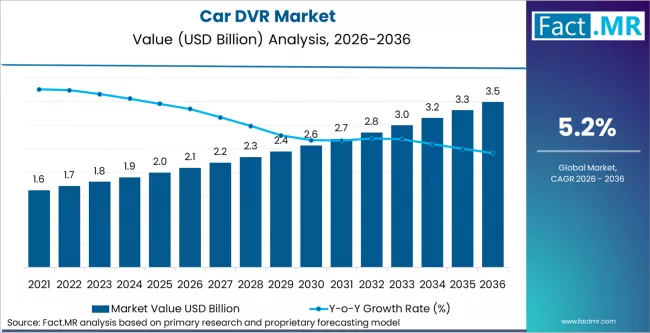
Car Dvr Market Market Value Analysis | Source: Fact.MR
Car DVR Market Key Takeaways
| Metric | Details |
|---|---|
| Industry Size (2026) | USD 2.06 Billion |
| Industry Value (2036) | USD 3.42 Billion |
| CAGR (2026-2036) | 5.2% |
Source: Fact.MR analysis. Updated Mar 11, 2026
Car DVR Market Definition
The car DVR market encompasses vehicle-mounted digital video recording devices that continuously capture forward, rearward, or interior camera footage during vehicle operation, storing compressed video files to onboard memory cards for insurance evidence, traffic incident documentation, and driver safety awareness purposes. The scope covers single-channel front-facing, dual-channel front-and-rear, and multi-channel configurations spanning entry-level, mid-range, and premium feature tiers sold through automotive accessories retail and e-commerce channels as well as OEM fitted or dealer-installed configurations.
Car DVR Market Inclusions
Market scope includes windshield-mounted single-channel front camera DVR units, dual-channel front and rear recording systems, multi-channel commercial vehicle interior and exterior recording systems, GPS-integrated dash cameras with speed and location overlay, and 4K ultra-high-definition recording devices. Geographic analysis covers North America, Latin America, Europe, East Asia, South Asia, Oceania, and Middle East and Africa. Forecast scope spans 2026 to 2036 with segment breakdowns by product type, price range, sales channel, and region.
Car DVR Market Exclusions
Professional fleet management telematics recording systems sold under managed service contracts rather than as standalone hardware, body-worn police and security personnel cameras, CCTV infrastructure recording systems, parking facility surveillance cameras, and driver monitoring systems whose primary function is fatigue and distraction detection rather than external incident recording fall outside this market scope.
Car DVR Market Research Methodology
- Primary Research: Fact.MR analysts conducted interviews with dash camera product category managers at consumer electronics retailers and e-commerce platform merchants, automotive accessories distributor procurement managers, and insurance industry telematics and risk assessment specialists to validate product preference trends, insurance incentive programme penetration rates, and channel dynamics across passenger car owner segments in key markets.
- Desk Research: Secondary research aggregated insurance industry telematics programme documentation from major carriers offering dash camera discount schemes, road traffic authority collision statistics that establish the evidential use case for recording devices, consumer electronics trade publication coverage of dash camera product specification evolution, and corporate revenue disclosures from listed dash camera manufacturers.
- Market-Sizing and Forecasting: Baseline market values derive from a bottom-up aggregation of dash camera unit sales by product type and price tier, multiplied by average retail prices across entry-level, mid-range, and premium configurations. Vehicle parc size and smartphone penetration rates in key markets were applied as awareness and accessibility scaling variables, with insurance incentive programme adoption rates modelled as an additional demand acceleration variable in mature markets.
- Data Validation and Update Cycle: Segment forecasts are cross-validated against revenue disclosures from publicly listed consumer electronics companies with dash camera product lines and e-commerce platform category gross merchandise value estimates. Annual updates incorporate actual insurance telematics programme adoption statistics and consumer electronics retail sell-through data.
Summary of Car DVR Market
- Car DVR Market Definition
- The car DVR market covers vehicle-mounted digital video recording devices for continuous incident documentation across single-channel, dual-channel, and multi-channel configurations, sold through aftermarket consumer electronics channels and OEM programmes to passenger vehicle owners globally.
- Demand Drivers in the Market
- Insurance Premium Discount Programmes Incentivising Adoption: Growing insurance carrier programmes in Europe, North America, and East Asia that offer premium reductions for policyholders installing certified dash camera systems are improving the financial payback calculation for dash camera investment, converting consumer interest from awareness to purchase action by providing a quantifiable monetary benefit beyond the speculative evidential value of incident footage.
- Rising Traffic Collision Rates in Emerging Markets Driving Evidence Documentation Demand: Increasing vehicle ownership rates combined with road infrastructure limitations and traffic enforcement gaps in India, Southeast Asia, and Latin America are elevating consumer awareness of the risk of traffic disputes without photographic evidence, motivating dash camera adoption as a personal risk management tool that reduces exposure to fraudulent third-party collision claims and traffic dispute liability without legal representation.
- Dual-Channel and Advanced Feature Adoption on Replacement Upgrade Cycles: The expanding installed base of consumers who purchased entry-level single-channel units in the 2018 to 2022 adoption wave are reaching device replacement cycles, with upgrade decisions migrating toward dual-channel front-and-rear configurations, integrated GPS overlay, and cloud connectivity features that justify higher replacement purchase prices and drive average selling price expansion beyond what unit volume growth alone would generate.
- Key Segments Analyzed in the Fact.MR Report
- Single Channel Product Segment: Commands 58.4% share in 2026 as the entry configuration that satisfies the primary forward-facing incident recording use case for the majority of consumer purchasers making their first dash camera acquisition, supported by the widest product availability, lowest entry price points, and the simplified installation that requires only a single windshield mounting and power cable connection.
- Mid-Priced Price Range: Holds 46.7% share in 2026, capturing the consumer segment that prioritises recording quality, loop recording reliability, and night vision performance over basic entry-level devices while remaining below the premium tier where 4K resolution and dual-channel configurations carry price points that require stronger purchase justification than casual safety awareness motivates.
- Aftermarket Sales Channel: Accounts for 63.9% of 2026 market value, reflecting the post-vehicle-purchase nature of dash camera acquisition driven by insurance experience, social media influence, and peer recommendation rather than vehicle purchase decision integration, sustaining aftermarket dominance across all markets regardless of OEM dash camera bundling programme expansion.
- Analyst Opinion at Fact.MR
- Fact.MR analysis indicates that the car DVR market is transitioning from a novelty product category into a mainstream vehicle safety accessory as evidential recording value becomes more broadly understood and insurance industry incentive structures formalise the financial benefit of ownership. The most significant demand catalyst over the forecast period is the institutionalisation of insurance premium discount programmes tied to certified dash camera installation, which in markets like the United Kingdom where such programmes are most developed has already converted dash camera ownership from a discretionary purchase to a near-rational financial decision for any driver concerned about premium cost management. The product technology trajectory is moving toward always-on cloud connectivity that allows footage to be remotely accessed and automatically uploaded following detected impact events, transforming the dash camera from a passive recording device into an active connected safety system whose value proposition extends beyond the vehicle owner to insurance carriers seeking real-time loss event documentation. Brands that position successfully in the connected dash camera ecosystem with carrier partnerships and automatic claim filing integration are building platform value that commodity hardware competitors cannot replicate through price competition alone.
- Strategic Implications / Executive Takeaways
- Insurance Carrier Partnership Development: Dash camera manufacturers should develop commercial partnership frameworks with major insurance carriers to achieve certified status within insurer-sponsored premium discount programmes, as carrier certification creates structured consumer purchase incentives that outperform conventional retail marketing in driving adoption decisions and establish a distribution channel advantage over non-certified competitors in the growing insurance-linked purchase segment.
- Cloud Connectivity and Automatic Incident Upload Feature Investment: Device manufacturers should invest in always-on cellular connectivity and automatic impact-triggered cloud upload capability as the primary premium feature differentiator, positioning connected dash cameras as insurance claim management tools rather than standalone recording devices to justify the premium price tier and recurring connectivity subscription revenue model that transforms transactional hardware sales into relationship-based service revenue.
- Dual-Channel Upgrade Programme Commercial Strategy: Brands with established single-channel consumer bases should develop trade-in and upgrade programme frameworks targeting their installed base approaching replacement cycles, as the conversion of existing single-channel owners to dual-channel upgrades represents a more efficient demand generation pathway than acquiring new first-time buyers in the now-competitive entry-level segment.
How is the Rise in Security Threats Driving Market Growth?
“Demand for Advanced Safety and Driver Assistance Features”
DVR technological advancements, as well as smartphone and Wi-Fi connectivity capabilities, are offering opportunities for growth in this market. Countries such as Germany, for example, have a significant growth potential for the car DVR market because the only law governing such cameras in Germany is that they cannot interfere with driving or obstruct the driver's field of vision, the country has also passed legislation allowing DVR footage to be used as evidence in the highest court.
Customers around the world are increasingly expecting advanced safety and driver assistance features in their vehicles, thus setting car DVR market trends. Lane departure warning and collision avoidance are two advanced driver-assistance system features that heavily rely on camera input. Consumers prioritize these features because they improve safety, convenience, and the driving experience. To meet rising consumer expectations for ADAS, automakers are increasingly integrating advanced camera systems into vehicles.
What are the Key Challenges Faced by Manufacturers of Vehicle DVR Systems?
“Vulnerability of Cameras to Cyberattacks and Stringent Regulations Restricting Car DVR Use”
Rise in data privacy concerns, as well as an increase in security threats and hacking, are impeding the growth of the car DVR market. Vehicle cameras are vulnerable to security concerns such as hacking, illegally recording car interior footage, and confidential conversations due to features such as motion sensors, smartphones, and Wi-Fi access to the DVR.
Many countries have strictly prohibited car DVRs in vehicles due to safety and owner privacy concerns. For example, the government strongly discouraged the use of DVR in Switzerland, and it is illegal in Austria, where users face hefty fines. As a result, privacy protection protocols in different countries are impeding car DVR market growth.
Country-wise Insights
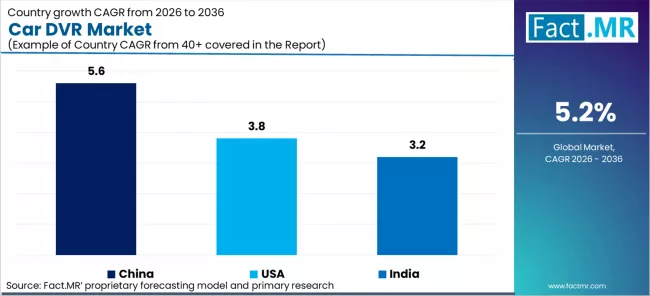
Car Dvr Market Cagr Analysis By Country | Source: Fact.MR
North America is expected to hold a car DVR market share of 27.8% in 2026. Asia Pacific is expected to hold a significant market share due to rising product popularity among new vehicle owners which is driving market expansion in the future. Furthermore, rising demand for high-quality car digital video recorders to record travel footage is also driving the market forward.
Rise in fraudulent insurance cases is boosting the adoption of car DVRs. These recorders capture footage in the event of an accident or irresponsible driving behavior by other drivers. The East Asia market is evaluated to expand at a CAGR of 5.5% from 2026 to 2036.
What are the Opportunities for Manufacturers of car DVRs in the United States?
“Insurance Companies Offering Discounts to Drivers Installing DVRs in Their Vehicles”
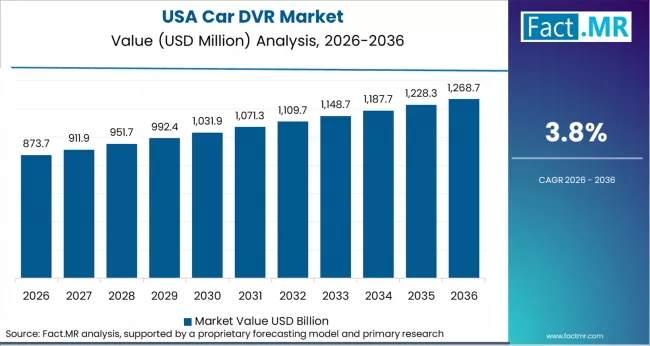
Car Dvr Market Country Value Analysis | Source: Fact.MR
| Attribute | United States |
|---|---|
| Market Value (2026E) | US$ 356.7 Million |
| Growth Rate (2026 to 2036) | 3.8% CAGR |
| Projected Value (2036F) | US$ 515.5 Million |
Source: Fact.MR analysis. Updated Mar 11, 2026
The United States is expected to account for 69.1% of the North America market in 2026. Drivers are becoming more aware of the benefits of installing a DVR in their vehicles for safety and security. DVR technology has advanced significantly, with high-definition recording, wide-angle lenses, and features such as GPS tracking becoming the norm in the United States. This has made DVRs more appealing to customers seeking dependable and high-quality recording solutions in the country.
Several insurance companies are also providing discounts to drivers who install DVRs in their vehicles because they aid in proving liability and reducing fraudulent claims. In some states, there is an increasing acceptance of DVR footage as evidence in legal proceedings, which is further pushing the demand for car DVRs.
Why are Conditions Favorable for Market Growth in China?
“Rising Adoption of Front-View Systems in Passenger Cars and Advancements in Computing Power”
| Attribute | China |
|---|---|
| Market Value (2026E) | US$ 269.9 Million |
| Growth Rate (2026 to 2036) | 5.6% CAGR |
| Projected Value (2036F) | US$ 466.7 Million |
Source: Fact.MR analysis. Updated Mar 11, 2026
With the advancement of computing power and the expansion of front-view system functions, as well as the relative cost advantage, it is estimated that more than a lot of passenger cars in China will be equipped with front-view systems in the years to come. Currently, the front-view monocular solution is the most common solution for Chinese passenger cars, but some companies are also investigating the use of front-view cameras such as binocular cameras.
- Huawei and DJI launched self-developed binocular cameras and solutions in 2021. Binocular cameras from Huawei have been used on the ARCFOX Alpha S. In addition, DJI intends to incorporate the binocular camera autonomous driving solution into Chinese models in 2021.
Category-wise Insights
The market for car DVRs is categorized into low-priced, mid-priced, and high-priced DVRs, of which the low-priced segment is estimated to hold half of the market share in 2026. By product, the market is segmented into single-channel and dual-channel, of which the single-channel segment is set to hold a market share of 55.6% in 2026 and the dual segment accounts for 44.6% share.
Which Price Range is Favored by More Customers?
“High Demand for Basic Recording Capabilities Without Heavy Investment”
| Attribute | Low-Priced Car DVRs |
|---|---|
| Segment Value (2026E) | US$ 839.3 Million |
| Growth Rate (2026 to 2036) | 6.3% CAGR |
| Projected Value (2036F) | US$ 1.54 Billion |
Source: Fact.MR analysis. Updated Mar 11, 2026
Low-priced car DVRs are set to hold a market share of 45.2% in 2026. Price is an important consideration for many consumers. Low-cost car DVRs are more affordable to a wider range of customers who do not want to invest heavily in a high-end model but still require basic recording capabilities. A lot of low-cost DVRs include essential features such as HD video recording, loop recording (continuous recording over old footage), and a simple display screen.
Many consumers find that these features are sufficient for their needs. Lower-cost DVRs are frequently designed to be simple to install and operate, making them appealing to consumers who are not tech-savvy or prefer a straightforward setup process.
Why are Single-Channel Car DVRs Preferred over Multi-Channel Variants?
“Simplicity of Design and Functionality Associated with Single-Channel DVRs”
| Attribute | Single Channel Car DVR |
|---|---|
| Segment Value (2026E) | US$ 1.03 Billion |
| Growth Rate (2026 to 2036) | 5.8% CAGR |
| Projected Value (2036F) | US$ 1.81 Billion |
Source: Fact.MR analysis. Updated Mar 11, 2026
Single-channel DVRs are generally more affordable than dual- or multi-channel systems, making them a cost-effective choice for many consumers. With a simpler design and functionality, they focus on recording the road ahead rather than multiple angles at once, which appeals to those looking for a straightforward and budget-friendly option. Installing a single-channel DVR is often simpler and less intrusive than multi-channel systems, which require more wiring and configuration. This simplicity is appealing to customers going for an easy installation process.
Competitive Landscape
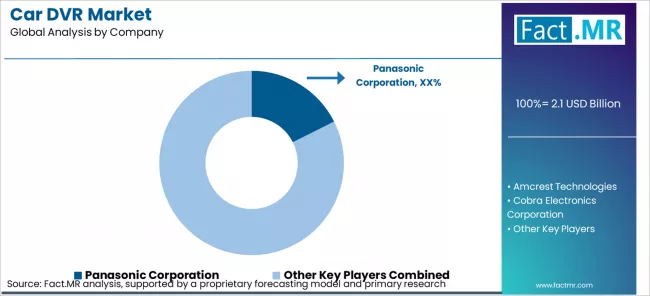
Car Dvr Market Analysis By Company | Source: Fact.MR
Key players in the car DVR market are focusing on introducing highly advanced product lines, complete with high-definition imaging and videography capabilities to provide crystal clear vision.
- Continental AG (Germany) introduced Face Authentication Display in January 2024, a two-stage access control system based on biometric user recognition that makes use of special camera systems mounted externally on the vehicle's B-pillar and behind the driver display console. With biometric face authentication, the vehicle unlocks and starts when a registered user is detected, while driver monitoring is enabled for increased safety.
- Robert Bosch GmbH (Germany) unveiled standalone camera heads at the IAA Mobility 2023 in September 2023. These products support ADAS functionality from SAE levels 0 to 4, with 3 and 8 MP versions that can be scaled up to 12 MP. The standalone camera heads include a tele camera, front and back cameras, a camera wing-back, a camera wing front, and a new range camera.
- Garmin Ltd. unveiled a new dashcam in January 2023 to help drivers keep an eye on their vehicles while they are parked. The Garmin Dash Cam Live is mounted on the inside of a vehicle's windshield and records the road ahead in 1440P resolution using a 140-degree FOV wide-angle lens, day or night.
Fact.MR provides detailed information about the price points of leading manufacturers of car DVRs positioned across the world, sales growth, production capacity, and technological advancements, in this recently updated market report.
Bibliography
- United Kingdom Department for Transport. (2024, March). Road Accident Statistics Great Britain 2023: Collision Causation and Evidence Documentation Analysis. Department for Transport.
- National Highway Traffic Safety Administration, United States. (2024, February). Traffic Safety Facts 2023: Motor Vehicle Crash Data and Emerging Evidence Technology Adoption. NHTSA.
- International Telecommunication Union. (2024, January). Measuring Digital Development: Connected Vehicle Device Penetration and Automotive IoT Adoption by Country 2024. ITU.
- Government of India, Ministry of Road Transport and Highways. (2024, June). Road Accidents in India 2023: Statistical Report on Collision Frequency, Causation, and Documentation Practices. MoRTH.
- European Commission, Directorate-General for Road Safety. (2024, April). Road Safety in the European Union: Statistics, Trends, and Technology Adoption for Incident Evidence Recording. European Commission.
- World Bank Group. (2024, March). Global Road Safety Facility: Road Traffic Injury Data and Technology Intervention Analysis for Emerging Economies. World Bank.
This bibliography is provided for reader reference. The full Fact.MR report contains the complete reference list with primary research documentation.
This Report Addresses
- Market sizing and quantitative forecast metrics: detailing precise revenue projections, absolute dollar growth, and compound annual growth rates across major car DVR segments and geographies through 2036.
- Segmentation analysis: mapping the adoption velocity of leading product, technology, and end-use categories and evaluating structural factors driving segment share transitions over the forecast period.
- Regional deployment intelligence: comparing growth dynamics in high-momentum Asia Pacific and emerging markets against the mature replacement and upgrade demand patterns prevalent in European and North American industry hubs.
- Regulatory compliance assessment: analyzing how evolving product safety standards, environmental directives, and sector-specific mandates are reshaping procurement decisions, material specifications, and supplier qualification criteria.
- Competitive posture evaluation: tracking consolidation trends, platform integration strategies, technology differentiation investments, and the resulting competitive dynamics among established market players and emerging challengers.
- Capital project strategic guidance: defining the procurement specifications, investment thresholds, and performance benchmarks required to support next-generation product adoption and facility modernization programs.
- Supply chain vulnerability analysis: identifying sourcing concentration risks, logistics bottlenecks, raw material price dependencies, and geographic exposure scenarios that affect market participant cost structures.
- Custom data delivery formats: encompassing interactive dashboards, raw Excel datasets, and comprehensive PDF narrative reports tailored for executive decision-making and analyst reference applications.
Segmentation
Scope of the Report
| Metric | Value |
|---|---|
| Quantitative Units | USD 2.06 billion to USD 3.42 billion, at a CAGR of 5.2% |
| Market Definition | Vehicle-mounted digital video recording devices for continuous incident documentation across single-channel, dual-channel, and multi-channel configurations sold through aftermarket and OEM channels to passenger vehicle owners globally. |
| Product Segmentation | Single Channel, Dual Channel, Multi-Channel |
| Price Range Segmentation | Budget, Mid-Priced, Premium |
| Sales Channel Segmentation | OEM, Aftermarket |
| Regions Covered | North America, Latin America, Europe, East Asia, South Asia, Oceania, Middle East and Africa |
| Countries Covered | China, USA, India, and 40 plus countries |
| Key Companies Profiled | Panasonic Corporation, Amcrest Technologies, Cobra Electronics Corporation, Honeywell International Inc., iTronics Group Ltd., WatchGuard Video, Pittasoft Co. Ltd., PAPAGO Inc., FINEDIGITAL Inc., DOD Tech, 70mai Co. Ltd., Thinkware |
| Forecast Period | 2026 to 2036 |
| Approach | Bottom-up aggregation of unit sales by product type and price tier with insurance incentive programme adoption and vehicle parc scaling |
Source: Fact.MR analysis. Updated Mar 11, 2026
Segmentation of Car DVR Market Research
-
By Product:
- Single Channel
- Dual Channel
-
By Price Range:
- Low-Priced
- Mid-Priced
- High-Priced
-
By Sales Channel:
- OEMs
- Aftermarket
-
By Region:
- North America
- Latin America
- East Asia
- South Asia & Pacific
- Western Europe
- Eastern Europe
- Middle East & Africa
Frequently Asked Questions
How large is the car DVR market in 2026?
What will the car DVR market size be by 2036?
What is the expected CAGR between 2026 and 2036?
Which product type leads the market in 2026?
Which price range segment holds the largest share?
Why does the aftermarket channel dominate with 63.9% share?
What is driving China's leading 5.6% CAGR?
How are insurance programmes shaping dash camera demand?
What is excluded from the scope of this report?
Who worked on this report


Preview the report firsthand - request a free sample
Free SampleGet the brochure for pricing and purchase details
Download PDF