- Base Value(2025): 1.9 Bn
- Forecast Value (2035): 3 Bn
- CAGR (2035): 4.6%
Car Wash System Market Outlook 2025 to 2035
The global car wash system market is projected to increase from USD 1.9 billion in 2025 to USD 3 billion by 2035, with a CAGR of 4.6% during the forecast period. Growth is driven by the increasing demand for convenience and time efficiency among consumers and expansion of urban populations. These systems are ideal for providing fast, consistent, eco-friendly, and convenient vehicle cleaning with efficient water and resource use, making them perfect for busy consumers and expanding urban populations.
2025-to-2035.webp "Us Car Wash System Market Market Value(usd Billion)2025 To 2035")
Us Car Wash System Market Market Value(usd Billion)2025 To 2035 | Source: Fact.MR
What are the Drivers of Car Wash System Market?
Market growth is primarily driven by growing consumer demand for convenience and time-saving services, expansion of urban populations, increased adoption of subscription-based and eco-friendly solutions, and rising vehicle ownership, especially in Asia Pacific. This leads with a substantial share of new vehicle registrations and over 1.45 billion passenger cars on the road in 2025.
Additionally, technological innovations such as water recycling equipment and touchless systems are enhancing operational efficiency and service appeal. Asia Pacific accounted for a substantial portion of new vehicle registrations, with the number of passenger cars on the road surpassing 1.45 billion in 2025, according to the International Energy Agency (IEA).
This expansion has generated a substantial addressable market for automotive aftercare services, particularly in swiftly urbanizing regions where at-home car washing is discouraged by environmental regulations, time constraints, and limited space.
Additionally, the demand for professional automotive care services is increasing due to the increasing consumer preference for these services. Consumers are transitioning from conventional manual washing to automated, express, and subscription-based models in mature markets like North America and Western Europe.
Industry reports from the International Carwash Association (ICA) indicate that over 77% of drivers now prefer professional car washes over at-home alternatives, compared to just 48% in the early 2000s. For instance, the U.S. has seen rapid adoption of conveyor and in-bay automatic car washes.
The emergence of subscription-based and membership models has revolutionized the predictability of revenue and consumer engagement. In the U.S., prominent operators such as Zips Car Wash and Mister Car Wash have experienced rapid growth by providing unlimited wash memberships, which provide convenience, cost savings, and loyalty incentives.
In the 2023 annual filing of Mister Car Wash, which operates over 450 locations, it was reported that over 70% of its revenue was generated through recurring membership services. This demonstrates the importance of customer loyalty and predictable cash flow in the evolving business model.
| Metric | Value |
|---|---|
| Industry Size (2025E) | USD 1.9 billion |
| Industry Size (2035F) | USD 3 billion |
| CAGR (2025-2035) | 4.6% |
Source: Fact.MR analysis. Updated Aug 13, 2025
What are the Regional Trends of the Car Wash System Market?
In 2025, the North American car wash service industry held the largest revenue share in the global market. This was primarily due to the extensive availability of automated car wash facilities, a high vehicle ownership per capita, and a highly developed automotive infrastructure.
The demand for professional car wash services has been stimulated by the region's emphasis on vehicle maintenance, as well as the increasing adoption of subscription-based unlimited wash programs and time-conscious consumer behavior.
In 2025, the car wash service industry in Europe represented a significant revenue share. Professional car wash services provide a practical alternative to traditional at-home cleansing as more individuals prioritize convenience and time efficiency. Moreover, the use of water for personal vehicle washing has been restricted in European countries due to the increased environmental regulations.
This has prompted consumers to choose environmentally friendly commercial options that adhere to legal standards. This growing demand is also influenced by the increasing adoption of electric vehicles that necessitate regular exterior maintenance, as well as the increase in car ownership, particularly in urban areas.
From 2025 to 2035, the Asia Pacific car wash service industry is anticipated to expand at a fastest compound annual growth rate. Car owners are increasingly pursuing time-saving, convenient solutions for vehicle maintenance as the number of vehicles on the road increases, particularly in densely populated cities.
Furthermore, the maintenance of the appearance and hygiene of vehicles is becoming increasingly important as automobile ownership becomes a symbol of social status. The sector's expansion in the region is being driven by the growing perception of car wash services as a convenient solution, particularly those that provide automated and high-quality results.
What are the challenges and restraining factors of the car wash system market?
The car wash system market faces several core challenges and restraining factors that impact its growth and profitability. One of the most significant barriers is the high initial investment required for installing and maintaining automated car wash systems, which includes costs for land, site work, paperwork, equipment, construction, marketing, and other related expenses.
These high upfront and operational costs deter new entrants, especially small businesses and those in less developed regions. Additionally, ongoing operational and maintenance expenses such as those for water, energy, labor, and equipment repairs can greatly affect profit margins and the long-term sustainability of market participants.
Another major challenge is space limitation, particularly in urban areas where premium real estate restricts the installation and expansion of car wash facilities. Environmental concerns and regulatory compliance around water usage, waste management, and sustainability also pose hurdles, as operators must invest in technologies and processes to meet increasingly strict requirements.
Factors like trade tariffs, regulatory restrictions, and production losses can further constrain growth and hinder market operations. These restraints high capital and operational expenditure, regulatory compliance, and space scarcity, challenge the expansion and entry of players in the car wash system market, even as consumer demand and vehicle ownership continue to rise.
Country-Wise Outlook
| Countries | CAGR (2025 to 2035) |
|---|---|
| United States | 4.1% |
| China | 4.7% |
| Japan | 3.9% |
Source: Fact.MR analysis. Updated Aug 13, 2025
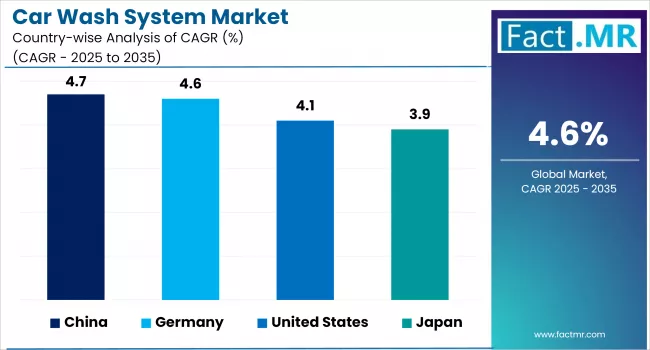
Car Wash System Market By Country | Source: Fact.MR
U.S. car wash system market sees growth driven by advanced automation & AI integration
The U.S. car wash service industry is anticipated to expand at a compound annual growth rate (CAGR) from 2025 to 2030. Different factors, including personal preferences, location, and weather, influence the frequency with which approximately 66% of vehicle owners in the U.S. cleanse their vehicles once or twice a month.
The result of this transition has been an increase in the number of express and automated car wash models, as well as on-demand mobile car wash services that are delivered directly to the residences or workplaces of customers. Many companies now provide subscription-based plans, which enable customers to pay a monthly charge for unlimited or multiple washes.
This option is more cost-effective and convenient for frequent users. Today's consumers prioritize reliability, quickness, and simplicity; consequently, these contemporary service models are well-suited to their expectations.
Companies like Kärcher and KKE now offer customizable automatic car wash solutions tailored to varying business sizes and throughput needs. New conveyor systems can clean 50-100+ cars/hour and allow flexible configurations of brushes, nozzles, and drying options.
China witnesses rapid market growth backed by urbanization and middle-class expansion
2025-to-2035.webp "Us Car Wash System Market Country Value(usd Billion)2025 To 2035")
Us Car Wash System Market Country Value(usd Billion)2025 To 2035 | Source: Fact.MR
The China rapid car wash system market growth is driven by several key factors. The rise in the number of vehicles on Chinese roads significantly expands the potential customer base. As car ownership grows, there is an increasing emphasis among consumers on vehicle care and aesthetics, with more people willing to pay for professional car washes to maintain their cars’ appearance and value.
Environmental concerns such as water scarcity have led to stricter government regulations on water usage, prompting the adoption of water-saving technologies and waterless car wash solutions. Urbanization, rising disposable incomes, and changing consumer lifestyles fuel demand for convenient, automated, and quick car wash options, especially in major cities where tunnel and conveyor systems are gaining popularity due to their efficiency and speed.
However, the market remains highly fragmented, with many small, independent operators, making it challenging for businesses to achieve economies of scale and invest in advanced automation. Labor costs are rising, increasing pressure to automate some services.
In January 2025, SunCar Technology Group secured a significant contract with Walmart China to operate the Sam’s Club Premium Membership Car Wash Project, delivering premium car wash services across 17 major cities including Shanghai, Shenzhen, and Guangzhou. This partnership emphasizes SunCar's use of advanced platform technology, efficient service processes, and high-quality solutions tailored for premium customers.
Japan market sees rising demand for compact and technologically advanced car wash systems
Japan is witnessing a significant rise in demand for car wash systems, driven by several factors, including urbanization, changing consumer preferences, and technological innovation. This growth is attributed to the cultural emphasis on car cleanliness, urban living with limited parking, and the need for convenient, efficient services for busy lifestyles.
Automatic car washes, membership programs, and express services are increasingly popular due to their speed and convenience. The Japanese market specializes in offering a wide range of wash packages, from basic cleaning to premium detailing, catering to diverse customer needs and budgets.
However, the industry also faces challenges such as a shrinking labor force and rising labor costs, which put pressure on traditional full-service car washes. To address these, operators are embracing automation, water-saving technologies, and subscription-based business models.
There is also a growing focus on eco-friendly practices to attract environmentally conscious customers. Ultimately, innovation in technology and services remains key for businesses in the Japan car wash market to remain competitive and meet evolving consumer demands.
Category-wise Analysis
Automatic to Exhibit Leading by System Type
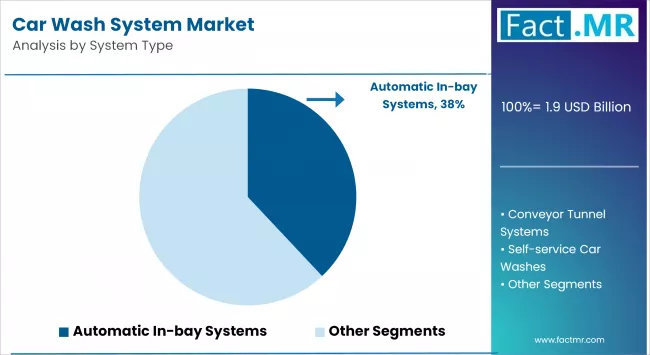
Car Wash System Market By Type | Source: Fact.MR
Automatic in-bay systems dominate the car wash system market, due to their space efficiency, low labor requirement, and integration into gas stations and service centers. These systems offer quick, convenient washes and cater to urban areas with high traffic. Their compact footprint and user-friendly operation make them ideal for both individual car owners and fleet vehicles. Growing consumer preference for convenience and technological upgrades like touchless and soft-cloth features continue to drive adoption of in-bay systems globally.
Conveyor tunnel systems are the fastest-growing due to their ability to handle high vehicle volumes efficiently. Ideal for commercial areas like malls and highways, these systems offer full-service features such as waxing, polishing, and drying. Although they require higher capital investment, they deliver strong returns through fast processing and subscription-based models. Their popularity is surging with the rise of express car wash chains and consumer preference for quick, premium, and seamless car wash experiences in high-traffic zones.
Cloth Friction to Exhibit Leading by Process
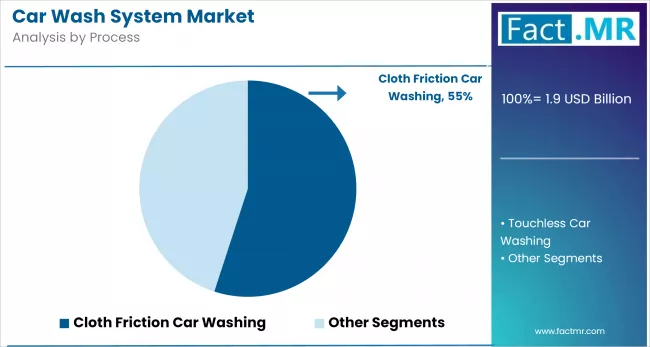
Car Wash System Market By Process | Source: Fact.MR
Cloth friction car washing leads the process segment in the car wash system market, due to its superior scrubbing capability, enabling thorough removal of dirt and grime. Soft cloth or foam materials used in these systems are gentle on vehicle surfaces, reducing the risk of scratches. Most in-bay and tunnel car washes use cloth friction methods, especially for compact and premium cars. The effectiveness of this method and continuous innovation in cloth materials reinforce its popularity across both standalone and integrated facilities.
Touchless car washing is the fastest-growing segment in the car wash system market, due to its appeal to owners of luxury and sensitive-painted vehicles. Utilizing high-pressure water jets and chemical detergents, this method eliminates physical contact, reducing surface damage risks. It is also easier to maintain and clean compared to cloth-based systems. Increasing demand for hygienic, scratch-free services and technology-driven washing methods is fueling adoption in urban centers and among premium car service providers.
Compact Cars to Exhibit Leading by Vehicle Type
Compact cars dominate the vehicle type segment in the car wash system market, due to their widespread ownership in urban and suburban areas. These vehicles frequently use automated car wash services, especially at gas stations and in-bay systems. Their small size reduces wash cycle time and cost, making them ideal for express car washes. As compact vehicles remain the top choice for city drivers globally, demand for efficient, affordable car wash solutions tailored to this segment continues to grow consistently.
Luxury cars are the fastest-growing segment, driven by rising ownership of high-end vehicles and emphasis on vehicle aesthetics. Owners prefer specialized, scratch-free washing such as touchless or ceramic-compatible systems. High-margin services like paint protection and detailing are commonly bundled. Demand is particularly strong in urban centers, business districts, and resort areas where luxury vehicle density is high. Car wash operators are investing in premium setups to cater to this growing market niche.
Gas Stations to Exhibit Leading by Location
Gas stations dominate the car wash system market, due to integration with in-bay systems and high vehicle footfall. Their strategic locations and bundling of fuel and wash services offer added convenience to customers. Franchises and independent fuel retailers benefit from quick ROI and low space requirements. The ability to process compact and premium vehicles efficiently ensures strong repeat usage and high equipment utilization.
Car wash systems on highways are the fastest-growing segment, due to increased long-distance travel and expansion of logistics fleets. Located near rest areas and fuel stops, they serve both passenger and commercial vehicles using gantry or tunnel systems. Their ability to handle high throughput efficiently appeals to truckers and fleet operators. With infrastructure upgrades, more rest stations now integrate car wash services, ensuring steady demand from both individual travelers and commercial transport fleets seeking quick and reliable cleaning.
Cash to Exhibit leading by Mode of Payment
Cash payments dominate the car wash system market, particularly in developing economies where digital infrastructure is limited. Many self-service and roadside setups depend on coin- or token-based systems due to low installation and maintenance costs. For informal operators, cash remains the easiest mode of transaction. Although its share is shrinking in urban areas, cash is still widely used in rural and small-town car wash setups, especially where traditional practices dominate over digital convenience.
Cashless payments are the fastest-growing mode, driven by digital wallet adoption, mobile apps, and UPI integration. Customers now prefer contactless and seamless transactions, particularly at premium and express car washes. Operators benefit from streamlined operations, automated billing, and loyalty programs. The shift to digital has been accelerated by health and hygiene concerns, especially post-COVID. Urban and semi-urban car wash businesses are rapidly adopting POS systems and app-based models to improve customer experience and expand their service reach.
OEMs to Exhibit Leading by Sales Channel
Original Equipment Manufacturers (OEMs) dominate the car wash system market, as they provide integrated, high-quality car wash systems directly to fuel chains, malls, and dealerships. These solutions include installation, technical support, and long-term servicing, appealing to large operators. OEM systems are preferred for their reliability, automation features, and durability. Established partnerships with corporate clients and automotive brands strengthen OEMs' position, making them the go-to providers for full-scale, standardized systems that meet commercial-scale demands.
The aftermarket segment is the fastest-growing, due to rising demand from small-scale operators, independent car wash businesses, and entrepreneurs. Offering flexible, cost-effective equipment and spare parts, aftermarket vendors allow easier customization and system upgrades. From water recycling units to app-based controllers, their solutions cater to evolving customer needs. Emerging markets, where affordability and ease of access are key, are driving this segment. Quick availability, localized support, and innovation are key factors fueling aftermarket growth.
Competitive Analysis
The car wash services market is becoming increasingly competitive, with both small independent operators and large chains vying for market share. The industry is experiencing steady growth, driven by factors such as increased vehicle ownership, consumer demand for convenience, and greater awareness of environmental sustainability.
Top competitors often differentiate themselves through service quality, eco-friendly practices, and technology adoption. For example, leading chains like Mister Car Wash, Zips Car Wash, and Quick Quack Car Wash are prominent due to their extensive networks, aggressive marketing, and willingness to invest in automation and customer loyalty programs.
At the local level, some competitors focus on sustainability, using waterless technologies and biodegradable products to appeal to environmentally conscious consumers. Others compete on pricing and convenience, offering a range of services from basic to full detailing at competitive rates.
Technological advancements such as touchless systems, water recycling equipment, and digital payment options are also reshaping competitive dynamics and improving operational efficiency. Additionally, there is a shift toward subscription-based models, which foster customer loyalty and stable recurring revenue.
Key players in the market include WashTec, Otto Christ, Daifuku, Istobal, D&S Car Wash Equipment Company, Ryko, Washworld Inc., MK Seiko Co. Ltd., Autoequip Lavaggi S.R.L., PECO Car Wash Systems., and other players.
Recent Development
- In February 2025, Shinewash Technology showcased its advanced AI-powered tunnel car wash systems (with energy- and water-saving features) to international delegations, highlighting their commitment to energy and water conservation.. The technology integrates sensors, PLCs, and advanced water recycling modules.
- In July 2024, Come In Wash, a company specializing in automated car wash systems, announced its rapid international expansion, driven by its patented "no-touch, no-brush" technology. The system is adaptable for various vehicle types and sizes and offers unmanned 24/7 operation.
Segmentation
Segmentation of Car Wash System Market
-
By System Type :
- Automatic In-bay Systems
- Self-service Car Washes
- Gantry Car Washes
- Conveyor Tunnel Systems
-
By Process :
- Cloth Friction Car Washing
- Touchless Car Washing
-
By Vehicle Type :
- Compact Cars
- Premium Cars
- Luxury Cars
- Light Commercial Vehicles
- Heavy Commercial Vehicles
-
By Location :
- Gas Stations
- Airports
- Hotels
- Resorts
- Highways
- Malls
- Service Stations
- Car Plants
-
By Mode of Payment :
- Cash Payment
- Cashless Payment
-
By Sales Channel :
- Original Equipment Manufacturers (OEMs)
- Aftermarket
-
By Region :
- North America
- Latin America
- Western Europe
- Eastern Europe
- East Asia
- South Asia & Pacific
- Middle East & Africa
Frequently Asked Questions
What is the global car wash system market size in 2025?
Who are the major players operating in the car wash system market?
What is the estimated valuation of the car wash system market by 2035?
What Value CAGR Did the car wash system market Exhibit over the Last Five Years?
Who worked on this report


Preview the report firsthand - request a free sample
Free SampleGet the brochure for pricing and purchase details
Download PDF