Automotive Rear Spoiler Market Size, Share, Growth and Forecast (2026 - 2036)
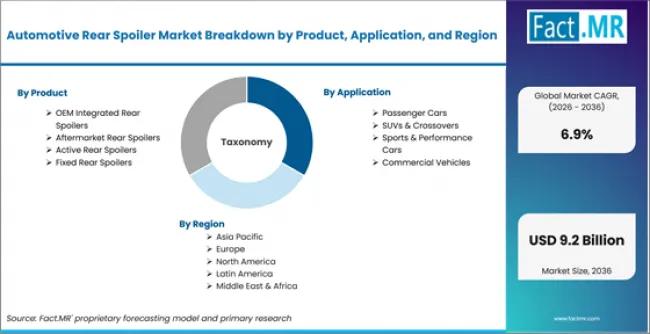
Automotive Rear Spoiler Market is segmented by Product (OEM Integrated Rear Spoilers, Aftermarket Rear Spoilers, Active Rear Spoilers, Fixed Rear Spoilers), Application (Passenger Cars, SUVs & Crossovers, Sports & Performance Cars, Commercial Vehicles), End Use (Automotive OEMs, Aftermarket Automotive Industry, Motorsport Industry, Automotive Dealership Networks), and Region. Forecasts from 2026 to 2036.
Automotive Rear Spoiler Market Analysis and Forecast by Fact.MR
- Automotive Rear Spoiler Market is estimated to grow at a CAGR of 6.9% to reach USD 9.2 billion by the year 2036 from USD 4.7 billion in 2026.
- The market growth is attributed to the increasing integration of aerodynamic components by OEMs to achieve emission and fuel efficiency targets, rising consumer demand for performance aesthetics across mass-market vehicle segments, and growing aftermarket customization activity.
- OEM integrated spoilers accounted for a 71.6% share in 2026. Passenger cars accounted for a 39.4% share in 2026.
- The market is being driven by the increasing integration of aerodynamic components by OEMs to meet emission and fuel efficiency targets, along with the rising consumer demand for performance aesthetics across mass-market vehicle segments, and the growing aftermarket customization activity.
Summary of Automotive Rear Spoiler Market
- Market Snapshot
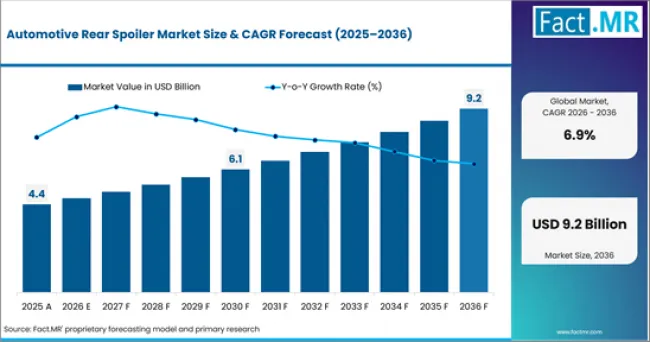
- In 2025, the global Automotive Rear Spoiler Market was valued at approximately USD 4.4 billion.
- The market is estimated to reach USD 4.7 billion in 2026 and is projected to attain USD 9.2 billion by 2036.
- The automotive rear spoiler market is likely to expand at a CAGR of 6.9% during the forecast period.
- The market is anticipated to create an absolute dollar opportunity of USD 4.5 billion between 2026 and 2036.
- OEM integrated rear spoilers account for 71.6% of the product segment share in 2026.
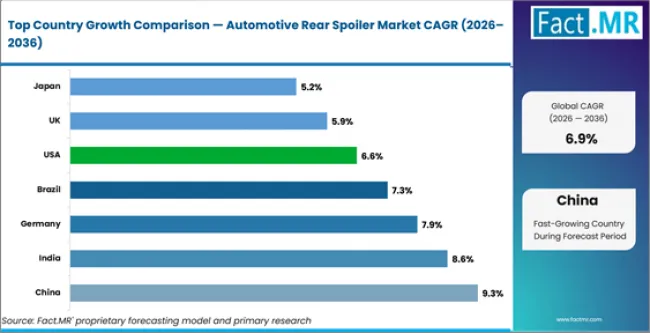
- China (9.3%) and India (8.6%) are the key growth markets during the forecast period.
- Demand and Growth Drivers
- OEM vehicle aerodynamic optimization programs are increasing use of spoiler integration across sedan, SUV and crossover platforms to reduce drag coefficients and comply with tightening emission standards.
- Performance-oriented demands have also influenced vehicle aesthetics, leading to the specification of spoilers on mass-market vehicles that have traditionally lacked aerodynamic body components.
- Active rear spoiler systems deployed at speed thresholds are being adopted on performance and luxury platforms and adding electronic actuator content and a higher per-unit value.
- Range optimization in EV manufacturing is calling for integrated rear spoilers as components, where modest drag reduction yields measurable battery efficiency at highway speeds.
- Carbon fiber and ABS plastic aftermarket options are available for both aesthetic and functional performance. The demand for aftermarket spoilers is supported by vehicle customization culture.
- Product and Segment View
- OEM integrated rear spoilers will account for 71.6% of the product segment in 2026, supported by first-fit installation on production vehicles of all major automotive brands.
- Passenger cars dominate the application segment in 2026, accounting for 39.4%, followed by SUVs and performance vehicles, where aerodynamic styling is getting more and more common.
- Composite material formulations dominate the formulation segment with a share of 76.9%. The demand for composite material formulations is driven by the preference of OEMs towards lightweight spoiler materials such as ABS, carbon fiber, and fiberglass over metal materials.
- Key segmentation includes:
- Product: OEM Rear Spoilers, Aftermarket Rear Spoilers, Active Rear Spoiler Systems, Lip Spoilers
- Application Passenger Cars SUVs and Crossovers Performance & Sports Cars Commercial Vehicles
- Final Use: Automotive OEMs, Aftermarket Installers, Custom Vehicle Builders, Motorsport Teams
- Distribution Channel OEM Direct Supply, Aftermarket Retail, Online Platforms, Specialty Performance Shops
- These components enable:
- Aerodynamic drag reduction increases fuel efficiency and EV battery range at highway speeds
- Generate rear-axle downforce for cornering grip and high-speed stability in performance vehicles
- Design differentiation through styling elements that communicate sportiness and premium positioning for vehicle lineups
- Geography and Competitive Outlook
- Demand growth led by Asia Pacific with China at 9.3% and India at 8.6% driven by increasing OEM spoiler integration rates and growing passenger vehicle production.
- Europe has seen steady growth with Germany at 7.9% driven by strong OEM premium production, active spoiler tech development and EU emissions standards that promote aerodynamic optimization.
- North America reflects growing demand at 6.6% for the USA, with SUV and crossover production volumes incorporating spoiler elements as standard aerodynamic and styling features.
- Key players include Magna International Inc., Plastic Omnium SA, POLYTEC Holding AG, SMP Deutschland GmbH, Albar Industries Inc., and Rehau Limited.
- Analyst Opinion
- Shambhu Nath Jha, Principal Consultant at Fact.MR, says 'The rear spoiler market is shifting from a styling accessory to a functional aerodynamic component with measurable impact on vehicle efficiency. The growth in EV production is accelerating this shift because every marginal drag reduction translates directly into range extension, a metric that EV buyers evaluate closely. Active spoiler systems on performance and luxury vehicles are adding electronic content and increasing per-unit value. OEMs that previously reserved spoilers for top-trim models are now integrating them across broader model ranges to meet fleet-average emission targets, expanding the addressable market beyond the performance segment.'
Key Growth Drivers, Constraints, and Opportunities
Key Factors Driving Growth
- EU CO2 emission targets for passenger vehicle fleets are compelling OEMs to integrate aerodynamic components including rear spoilers across broader model ranges to reduce fleet-average drag coefficients.
- EV manufacturers are specifying factory-fitted spoilers as range-extending components, where drag reduction can contribute to improved highway driving efficiency and range in electric vehicles.
- Active spoiler systems using electronic actuators that deploy at configurable speed thresholds are creating a premium product tier that adds electronic content value per vehicle.
Key Market Constraints
- The price volatility of raw materials in ABS plastic, carbon fiber and composite resins creates cost uncertainty for spoiler manufacturers competing for multi-year OEM supply contracts.
- High tooling costs for model-specific spoiler designs restrict the number of vehicle platforms that smaller manufacturers can serve at the same time.
- Consumer willingness to pay for aerodynamic components on economy vehicles is still limited, which limits the integration rates of spoilers on the lowest-priced vehicle segments.
Key Opportunity Areas
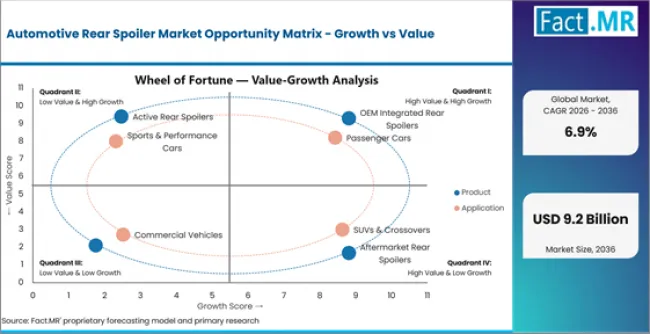
- Active rear spoilers integrated with vehicle dynamic control platforms are defining premium product positions. Per unit values are 3x to 5x higher than passive spoilers due to actuator and sensor content.
- As sustainability requirements for supply chains tighten across European automakers, OEMs are showing interest in sustainable material spoilers with recyclable composites and bio-based resins.
- Demand for aftermarket carbon fiber spoilers for performance vehicles and SUVs supports high-margin secondary market not tied to OEM production cycles.
Segment-wise Analysis of the Automotive Rear Spoiler Market
- The OEM integrated rear spoilers product segment will have a 71.6% share in 2026, indicating the dominance of factory-fitted aerodynamic components in total market value.
- In 2026, the application segment of passenger cars will be 39.4%, with more spoiler integration on sedan and hatchback platforms not previously included in aerodynamic styling.
- ABS plastic remains the dominant material category due to its balance of cost, durability and manufacturability, while carbon fiber continues to gain adoption in premium and performance vehicle applications.
The Automotive Rear Spoiler Market is segmented on the basis of Product Type, Application, End Use, Technology, Formulation, Distribution Channel and Region. OEM integrated spoilers are the leaders as they form the volume base of first-fit installations, while aftermarket spoilers add incremental revenue in the form of customization and upgrade demand.
Which Product Segment Dominates the Automotive Rear Spoiler Market?
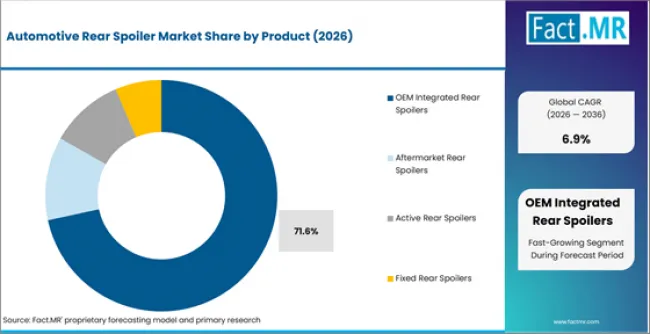
OEM integrated rear spoilers constitute 71.6% of the product segment in 2026. Their leadership is indicative of the increasing norm of aerodynamic elements being integrated onto passenger vehicle platforms driven by the compliance to emission regulation and the differentiation of designs. OEM integration has now become the main volume driver, with all of the major automotive brands offering variants with spoilers across sedan, SUV and crossover lineups.
Aftermarket rear spoilers address the need for customization and upgrades. Carbon fiber and ABS variants target performance enthusiasts and vehicle personalizers. Active spoiler systems, which are equipped with electronic actuators and speed-sensing trigger mechanisms, are the most valuable sub-segment. Spoiler spec rates are anticipated to increase across more vehicle models and trim levels, with OEM integration anticipated to remain dominant.
Which Application Segment Dominates the Automotive Rear Spoiler Market?
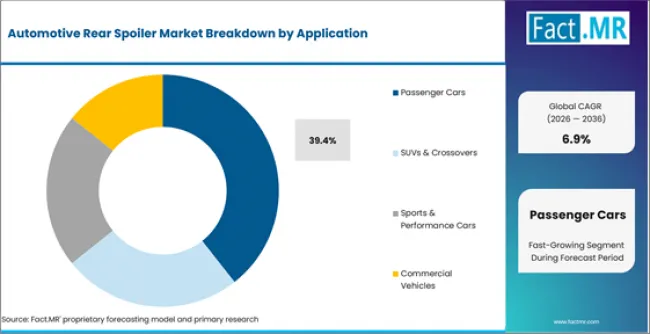
Passenger cars lead the way with 39.4% share in 2026, comprising sedans, hatchbacks and compact vehicles with growing use of spoilers beyond the traditional performance and luxury segments. The increasing use of spoilers on mass-market passenger cars is testimony to this as OEM’s try to lower drag coefficients across fleet portfolios, not just on individual high-performance models.
SUVs and crossovers are the second largest and fastest growing application segment, driven by the fast expansion of the production of these types of vehicles globally. Performance and sports vehicles generate high-value active spoiler demand, but smaller overall volumes. OEM integration rates are expected to continue to rise across a broader range of models, with passenger cars expected to continue to lead.
Which Product Trend is Shaping the Next Phase of Growth in the Automotive Rear Spoiler Market?
The biggest product innovation in the market is active rear spoiler systems with electronic controlled deployment. Unlike fixed passive spoilers, active systems employ electric actuators to raise and lower the spoiler element according to vehicle speed, driving mode, or stability control inputs. Spoiler deploys at highway speeds to provide downforce and reduce high-speed instability. At low speeds it retracts to minimize drag and keep the vehicle looking good. Per-unit values for active systems are typically higher than passive spoilers due to actuator, sensor, and electronic control module content.
OEMs are taking active spoiler technology from flagship sports cars and luxury sedans and moving it into mid-range performance variants and premium SUVs, thereby expanding the addressable market for these higher-value systems. With increasing electronics content per vehicle across the automotive industry, active spoilers are a natural extension of vehicle dynamic control platforms that already control suspension, steering and braking parameters
Regional Outlook Across Key Markets
- Driven by the world’s largest passenger vehicle production base, greater OEM spoiler integration on both domestic and multinational platforms, and increased EV production requiring aerodynamic optimization, China drives growth at 9.3%.
- India at 8.6% is indicative of fast growing vehicle production, increasing consumer liking for sporty vehicle aesthetics and slow OEM adoption of aerodynamic components on mass market platforms.
- Germany is projected to grow at 7.9%, supported by premium OEM production, active spoiler technology development, and fleet-wide aerodynamic optimization initiatives.
- USA 6.6% Strong SUV and crossover production with integrated spoilers as standard aerodynamic and styling features.
.webp)
| Country | CAGR (%) |
|---|---|
| China | 9.3% |
| India | 8.6% |
| Germany | 7.9% |
| Brazil | 7.3% |
| USA | 6.6% |
Source: Fact.MR analysis, based on proprietary forecasting model and primary research.
Market Outlook for Automotive Rear Spoilers in the United States
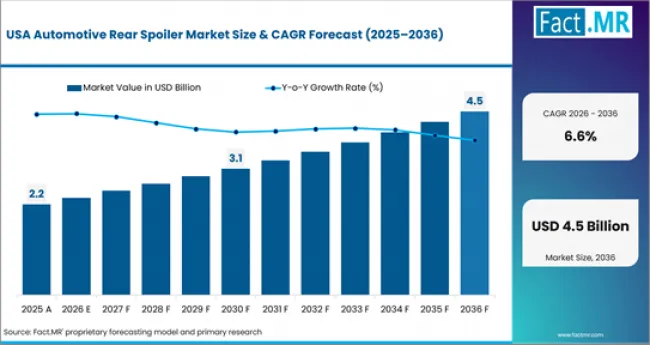
The U.S. automotive rear spoiler market is projected to grow at a CAGR of 6.6% through 2036. SUV and crossover production dominance creates sustained demand for integrated rear spoilers that serve both aerodynamic and styling functions. EPA fuel efficiency standards and California emissions requirements influence OEM specification decisions that favor aerodynamic body components. Aftermarket carbon fiber and ABS spoiler demand remains strong in the performance vehicle customization segment.
- SUV and crossover production volumes incorporate integrated spoilers as standard equipment on an increasing share of trim levels, expanding per-model spoiler penetration.
- Aftermarket performance spoiler demand sustains a parallel revenue channel independent of OEM specification cycles.
China Automotive Rear Spoiler Market Growth Assessment
The scale of China's passenger vehicle production, led by BYD, Geely, and multinational OEM assembly operations, positions the country at a 9.3% CAGR through 2036. EV platform production is driving aerodynamic spoiler specification as a range optimization component. Domestic spoiler manufacturers benefit from proximity to OEM assembly lines and cost-competitive composite material supply chains.
- EV platform production by domestic manufacturers is accelerating spoiler specification rates, as drag reduction directly translates to range extension.
- Domestic composite material supply chains enable cost-competitive spoiler production that serves both local OEM demand and export opportunities.
India Automotive Rear Spoiler Demand Trends
PLI scheme incentives for automotive component manufacturing are encouraging domestic spoiler production capacity development in India, projected at an 8.6% CAGR through 2036. Growing consumer preference for sporty vehicle aesthetics, particularly on SUV and compact SUV platforms produced by Maruti Suzuki, Hyundai, and Tata Motors, is increasing OEM spoiler integration rates on mass-market vehicles.
- Urbanization and rising disposable income among younger buyers are driving demand for vehicles with sporty exterior styling elements including integrated rear spoilers.
- Tier-2 and tier-3 city market expansion for compact SUVs is broadening the volume base for factory-fitted spoiler components.
Germany Automotive Rear Spoiler Market Analysis
EU and emission regulations define aerodynamic optimization requirements that directly influence spoiler specification for the German market, projected at a 7.9% CAGR through 2036. Active spoiler technology development by BMW, Porsche, and Mercedes-Benz positions Germany as the global center for premium and electronically controlled spoiler systems. DIN standards and IATF 16949 quality frameworks govern manufacturing specifications for OEM-supplied components.
- Active spoiler technology development concentrates in German premium OEMs, creating a high-value product sub-segment with strong domestic engineering and testing requirements.
- EU fleet emission targets are driving aerodynamic spoiler specification across mass-market Volkswagen Group platforms, expanding integration beyond premium-only applications.
Brazil Automotive Rear Spoiler Market Opportunity Analysis
Expanding vehicle production and growing consumer interest in SUV-class vehicles are supporting the Brazil rear spoiler market at a 7.2% CAGR through 2036. Import dependency for active spoiler systems creates pricing premiums, while domestic manufacturers serve the volume market for injection-molded ABS spoiler components. The aftermarket segment is developing as vehicle customization culture gains traction among younger vehicle owners.
- SUV and compact SUV production growth by Fiat, Volkswagen, and Chevrolet assembly operations is increasing the volume base for factory-fitted spoiler components.
- Import dependency for carbon fiber and active spoiler systems creates pricing structures that favor domestic ABS and composite spoiler production for mass-market applications.
Competitive Benchmarking and Company Positioning
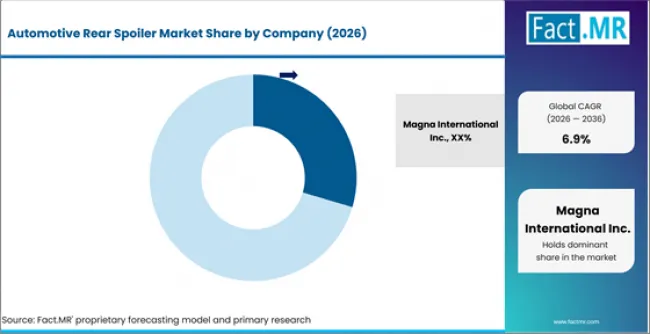
Automotive Rear Spoiler Market Analysis By Company
- Magna International Inc. and Plastic Omnium SA lead the global automotive rear spoiler market on the back of their robust OEM supply relationships, expertise in advanced composite materials, and their global production footprint.
- POLYTEC Holding AG, SMP Deutschland GmbH and Rehau Limited compete with regional OEM relationships, injection moulding capabilities and focused product portfolios for European automotive platforms.
- CFD simulation capability and active spoiler system engineering are providing competitive differentiation as manufacturers that combine aerodynamic design expertise with electronic integration capability are able to capture higher value OEM specifications.
The top tier suppliers with global OEM relationships are moderately consolidated in the competition. Magna International is a leader in cross-functional capabilities in exterior body systems, electronic actuation & aerodynamic design. Plastic Omnium’s competitive advantage is in lightweight material expertise and global production scale.
Active spoiler system competition is more concentrated, with tier-1 suppliers combining mechanical actuation with electronic control capability serving the premium vehicle segment. The aftermarket is fragmented with many regional and specialty brands that compete through design diversity, material choices and online retail distribution.
Key Companies in the Automotive Rear Spoiler Market
- Leading players include Magna International Inc., Plastic Omnium SA, POLYTEC Holding AG and SMP Deutschland GmbH, supported by global OEM relationships and advanced composite manufacturing capabilities.
- Albar Industries Inc., Rehau Limited, Inoac Corporation, Thai Rung Union Car PLC, Jiangnan Mould and AP Plasman compete in specific OEM programs, regional markets and aftermarket channels.
Recent Industry Developments
-
Bosch Unveils MEMS Tire Pressure Sensor Module with Bluetooth Connectivity (November 2024)
At Electronica 2024, Bosch introduced a new MEMS tire-pressure sensor module featuring Bluetooth Low Energy connectivity. The solution is designed to simplify vehicle electrical architectures while enhancing tire pressure monitoring capabilities, a key application area within automotive pressure sensors.
-
Infineon Launches New XENSIV Inductive Sensor for Automotive Chassis Applications (June 2025)
Infineon introduced the XENSIV™ TLE4802SC16-S0000 sensor for automotive steering, pedal, suspension, and chassis systems. The launch strengthens Infineon's automotive sensor portfolio and reflects growing demand for high-precision sensing technologies in modern vehicles.
-
STMicroelectronics Acquires Part of NXP's Sensor Business (July 2025)
STMicroelectronics announced an agreement to acquire part of NXP Semiconductors' sensor business for up to $950 million. The acquisition is intended to strengthen STMicro's MEMS sensor portfolio, including automotive safety and pressure-sensing applications, highlighting continued consolidation and investment in the automotive sensor market.
Leading Companies Shaping the Automotive Rear Spoiler Market
- Magna International Inc.
- Plastic Omnium SA
- POLYTEC Holding AG
- SMP Deutschland GmbH
- AP Plasman Inc.
- Albar Industries Inc.
Sources and Research References
- Bosch, R. (2025). Bosch sets standards for Bluetooth-based tire pressure sensors.
- Infineon Technologies AG. (2025). Market news and sensor technology developments.
- STMicroelectronics N.V. (2025). STMicroelectronics to strengthen position in sensors with acquisition of NXP's MEMS sensors business.
This bibliography is provided for reader reference and is not exhaustive. The full report contains the complete reference list and detailed citations.
Key Questions This Report Addresses
- What is the current and future size of the Automotive Rear Spoiler Market?
- How fast is the Automotive Rear Spoiler Market expected to grow between 2026 and 2036?
- Which product type is likely to lead the market by 2026?
- Which application segment is expected to account for the highest demand by 2026?
- What factors are driving demand for automotive rear spoilers globally?
- How are active spoiler systems reshaping the premium vehicle component market?
- Why are China and India emerging as the fastest-growing markets?
- How are EV aerodynamic requirements influencing spoiler specification rates?
- Which countries are projected to show the fastest growth through 2036?
- Who are the key companies active in the Automotive Rear Spoiler Market?
- How does Fact.MR estimate and validate the market forecast?
Automotive Rear Spoiler Market Definition
Passenger Cars, SUVs, Performance Vehicles and Commercial Applications The automotive rear spoiler market includes OEM integrated and aftermarket rear spoilers, active spoiler systems and lip spoilers. Spoilers are made of composite materials, ABS plastic, carbon fiber, fiberglass and polyurethane, and are sold through OEM direct supply, aftermarket retail, online and specialty performance shops.
Automotive Rear Spoiler Market Inclusions
- The scope covers global and regional market size and forecasts for 2026 to 2036 across product type, application, end use, technology, formulation, distribution channel, and region.
- It covers regional demand analysis by vehicle production volumes, OEM spoiler integration rates, aftermarket customization trends and emission regulation timelines.
- The report covers pricing analysis across OEM-supplied, aftermarket, and premium active spoiler system categories.
Automotive Rear Spoiler Market Exclusions
- The scope excludes front splitters, side skirts, rear diffusers, and other aerodynamic body components not classified as rear spoilers.
- It excludes roof-mounted spoilers and wing elements on heavy commercial vehicles designed solely for airflow management over trailer bodies.
- The report excludes motorsport-specific aerodynamic packages designed for competition use without road-legal applicability.
Automotive Rear Spoiler Market Research Methodology
- The methodology combines secondary research, primary interviews, and forecast modelling.
- It draws on 110+ secondary sources and benchmarks 50+ company product portfolios.
- Market sizing covers 30+ countries through a demand-side model, supported by top-down validation.
- Key inputs include vehicle production data, OEM feature specification rates, aftermarket spending and emission regulation compliance timelines.
- The model validates demand against OEM purchasing data, aftermarket shipment volumes and pricing trends.
- Primary validation includes 20+ interviews across component manufacturers, OEM procurement teams, and aftermarket distributors.
- Final estimates go through production-volume alignment, trade-flow analysis, and sensitivity testing.
Scope of Analysis

| Parameter | Details |
|---|---|
| Quantitative Units | USD 4.7 billion to USD 9.2 billion, at a CAGR of 6.9% |
| Market Definition | The Automotive Rear Spoiler Market covers OEM-integrated and aftermarket rear spoilers, active spoiler systems, and lip spoilers for passenger cars, SUVs, performance vehicles, and commercial applications. |
| Regions Covered | North America, Latin America, Europe, East Asia, South Asia and Pacific, Middle East and Africa |
| Countries Covered | USA, China, India, Germany, Brazil, 30 plus countries |
| Key Companies | Magna International Inc., Plastic Omnium SA, POLYTEC Holding AG, SMP Deutschland GmbH, Albar Industries Inc., Rehau Limited, Inoac Corporation, Thai Rung Union Car PLC, Jiangnan Mould, AP Plasman Inc. |
| Forecast Period | 2026 to 2036 |
| Approach | Hybrid demand-side and top-down methodology built on vehicle production data, OEM spoiler integration rates, aftermarket spending, emission regulation compliance timelines, and primary interviews across component manufacturers, OEM teams, and aftermarket distributors |
Automotive Rear Spoiler Market Segmentation
-
Automotive Rear Spoiler Market Segmented by Product:
- OEM Integrated Rear Spoilers
- Factory Installed Spoilers
- Sedan Integrated Spoilers
- SUV Factory Spoilers
- Vehicle Model Specific Spoilers
- Luxury Vehicle Spoilers
- Performance Vehicle Spoilers
- Factory Installed Spoilers
- Aftermarket Rear Spoilers
- Universal Fit Spoilers
- Adjustable Angle Spoilers
- Basic Clip On Spoilers
- Custom Performance Spoilers
- Racing Grade Spoilers
- Aerodynamic Tuned Spoilers
- Universal Fit Spoilers
- Active Rear Spoilers
- Electronic Adjustable Spoilers
- Speed Sensitive Spoilers
- Sensor Controlled Spoilers
- Retractable Spoilers
- Hydraulic Actuation Spoilers
- Electric Motor Driven Spoilers
- Electronic Adjustable Spoilers
- Fixed Rear Spoilers
- Carbon Fiber Fixed Spoilers
- Lightweight Racing Spoilers
- High Downforce Spoilers
- ABS Plastic Fixed Spoilers
- Cost Effective Spoilers
- Standard OEM Replacement Spoilers
- Carbon Fiber Fixed Spoilers
- OEM Integrated Rear Spoilers
-
Automotive Rear Spoiler Market Segmented by Application:
- Passenger Cars
- Sedan Applications
- Mid Size Sedan Aerodynamics
- Luxury Sedan Styling Systems
- Hatchback Applications
- Compact Car Aerodynamics
- Urban Mobility Styling
- Sedan Applications
- SUVs & Crossovers
- Compact SUV Applications
- Urban SUV Styling Enhancements
- Fuel Efficiency Aerodynamics
- Full Size SUV Applications
- Off Road Performance Styling
- High Stability Aerodynamic Systems
- Compact SUV Applications
- Sports & Performance Cars
- Sports Coupe Applications
- Track Performance Aerodynamics
- High Speed Stability Systems
- Supercar Applications
- Downforce Optimization Systems
- Racing Grade Aerodynamics
- Sports Coupe Applications
- Commercial Vehicles
- Light Commercial Vehicles
- Delivery Van Aerodynamics
- Fleet Efficiency Enhancements
- Pickup Truck Applications
- Load Stability Enhancements
- Off Road Performance Styling
- Light Commercial Vehicles
- Passenger Cars
-
Automotive Rear Spoiler Market Segmented by End Use:
- Automotive OEMs
- Passenger Vehicle OEMs
- Mass Market Car Manufacturers
- Premium Vehicle Manufacturers
- Commercial Vehicle OEMs
- Light Truck Manufacturers
- Van Manufacturers
- Passenger Vehicle OEMs
- Aftermarket Automotive Industry
- Auto Parts Retailers
- Performance Parts Distributors
- Styling Accessories Suppliers
- Customization Workshops
- Tuning Garages
- Body Modification Centers
- Auto Parts Retailers
- Motorsport Industry
- Racing Teams
- Professional Racing Teams
- Amateur Racing Clubs
- Performance Engineering Firms
- Aerodynamic Development Firms
- Vehicle Testing Agencies
- Racing Teams
- Automotive Dealership Networks
- Authorized Service Centers
- OEM Dealership Installations
- Accessory Upgrade Centers
- Independent Workshops
- Local Garage Installers
- Regional Service Networks
- Authorized Service Centers
- Automotive OEMs
-
Automotive Rear Spoiler Market Segmented by Technology:
- Aerodynamic Simulation Technology
- CFD Based Design Systems
- Wind Tunnel Simulation Software
- Virtual Aerodynamic Testing Platforms
- AI Based Design Optimization
- Machine Learning Aerodynamic Models
- Predictive Drag Reduction Systems
- CFD Based Design Systems
- Active Aero Control Technology
- Sensor Based Adjustment Systems
- Speed Adaptive Spoiler Systems
- Real Time Airflow Response Systems
- Electronic Control Units
- Vehicle Integrated Control Modules
- Dynamic Stability Control Integration
- Sensor Based Adjustment Systems
- Material Engineering Technology
- Carbon Fiber Manufacturing Systems
- Lightweight Composite Engineering
- High Strength Polymer Blending Systems
- Thermoplastic Forming Systems
- Injection Molded Spoiler Systems
- Cost Optimized Structural Design Systems
- Carbon Fiber Manufacturing Systems
- Additive Manufacturing Technology
- 3D Printing Systems
- Rapid Prototyping Spoiler Models
- Custom Design Manufacturing Systems
- Hybrid Manufacturing Systems
- CNC + Additive Combined Production
- Precision Surface Finishing Systems
- 3D Printing Systems
- Aerodynamic Simulation Technology
-
Automotive Rear Spoiler Market Segmented by Formulation:
- Composite Material Formulations
- Carbon Fiber Reinforced Polymers
- High Strength Lightweight Composites
- Racing Grade Composite Structures
- Glass Fiber Reinforced Polymers
- Cost Effective Structural Composites
- Durable Automotive Grade Materials
- Carbon Fiber Reinforced Polymers
- Thermoplastic Formulations
- ABS Based Compounds
- Impact Resistant Plastic Blends
- OEM Standard Polymer Grades
- Polycarbonate Blends
- High Clarity Structural Materials
- Heat Resistant Automotive Polymers
- ABS Based Compounds
- Metal Based Formulations
- Aluminum Alloy Systems
- Lightweight Structural Metal Spoilers
- Corrosion Resistant Metal Alloys
- Steel Reinforced Systems
- High Strength Support Frames
- Heavy Duty Performance Spoilers
- Aluminum Alloy Systems
- Hybrid Material Formulations
- Metal + Polymer Hybrids
- Structural Lightweight Hybrid Systems
- Enhanced Durability Composite Hybrids
- Carbon + Polymer Hybrids
- Performance Optimized Hybrid Spoilers
- Aerodynamic Efficiency Hybrid Systems
- Metal + Polymer Hybrids
- Composite Material Formulations
-
Automotive Rear Spoiler Market Segmented by Distribution Channel:
- OEM Direct Supply
- Automotive Manufacturer Contracts
- Vehicle Assembly Line Supply
- Platform Based OEM Integration
- Tier 1 Supplier Networks
- Automotive Component Suppliers
- System Integration Suppliers
- Automotive Manufacturer Contracts
- Aftermarket Retail Channels
- Auto Parts Retail Stores
- Regional Automotive Parts Shops
- National Auto Accessories Chains
- Online Automotive Platforms
- E Commerce Auto Parts Marketplaces
- Direct Consumer Automotive Stores
- Auto Parts Retail Stores
- Specialty Performance Dealers
- Tuning Product Distributors
- Motorsport Equipment Dealers
- Performance Upgrade Retailers
- Customization Service Networks
- Body Shop Supply Channels
- Garage Installation Partners
- Tuning Product Distributors
- Dealership Networks
- Authorized Dealer Installations
- OEM Certified Dealerships
- Accessory Upgrade Dealerships
- Independent Dealer Networks
- Regional Car Dealers
- Multi Brand Dealer Networks
- Authorized Dealer Installations
- OEM Direct Supply
-
Automotive Rear Spoiler Market by Region:
- North America
- USA
- Canada
- Mexico
- Latin America
- Brazil
- Chile
- Rest of Latin America
- Western Europe
- Germany
- UK
- Italy
- Spain
- France
- Nordic
- BENELUX
- Rest of Western Europe
- Eastern Europe
- Russia
- Poland
- Hungary
- Balkan & Baltic
- Rest of Eastern Europe
- East Asia
- China
- Japan
- South Korea
- South Asia and Pacific
- India
- ASEAN
- Australia & New Zealand
- Rest of South Asia and Pacific
- Middle East & Africa
- Kingdom of Saudi Arabia
- Other GCC Countries
- Turkiye
- South Africa
- Other African Union
- Rest of Middle East & Africa
- North America
- Frequently Asked Questions -
How big is the automotive rear spoiler market in 2026?
The global automotive rear spoiler market is estimated to be valued at USD 4.7 billion in 2026.
What will be the size of automotive rear spoiler market in 2036?
The market size for the automotive rear spoiler market is projected to reach USD 9.2 billion by 2036.
How much will be the automotive rear spoiler market growth between 2026 and 2036?
The automotive rear spoiler market is expected to grow at a 6.9% CAGR between 2026 and 2036.
What are the key products in the automotive rear spoiler market?
The key products in automotive rear spoiler market are OEM Integrated Rear Spoilers, Aftermarket Rear Spoilers, Active Rear Spoilers and Fixed Rear Spoilers.
Which application segment is expected to contribute significant share in the automotive rear spoiler market in 2026?
In terms of application, passenger cars segment is expected to command 39.4% share in the automotive rear spoiler market in 2026.
Table of Content
- Key Takeaways
- Market Size and CAGR
- Top Growth Driver
- Fastest Growing Segment
- Leading Region
- Key Companies
- Emerging Opportunities
- Executive Summary
- Global Market Outlook
- Demand-side Trends
- Supply-side Trends
- Technology Roadmap Analysis
- Analysis and Recommendations
- Analyst Perspective (What is happening? Why now? What should investors know?)
- Key Questions Answered
- How large is the market?
- What is the CAGR?
- What are key trends?
- Which region dominates?
- Who are the leaders?
- Market Overview
- Market Coverage / Taxonomy
- Market Definition / Scope / Limitations
- Research Methodology
- Chapter Orientation
- Analytical Lens and Working Hypotheses
- Market Structure, Signals, and Trend Drivers
- Benchmarking and Cross-market Comparability
- Market Sizing, Forecasting, and Opportunity Mapping
- Research Design and Evidence Framework
- Desk Research Programme (Secondary Evidence)
- Expert Input and Fieldwork (Primary Evidence)
- Tooling, Models, and Reference Databases
- Data Engineering and Model Build
- Quality Assurance and Audit Trail
- Market Background
- Market Dynamics (Drivers, Restraints, Opportunity, Trends)
- Scenario Forecast (Optimistic, Likely, Conservative)
- Impact Analysis
- AI Impact
- Sustainability Impact
- Regulatory Impact
- Technology Impact
- Consumer / Buyer Analysis
- Purchase Drivers
- Adoption Barriers
- Buyer Journey
- Opportunity Map Analysis
- Product Life Cycle Analysis
- Supply Chain Analysis
- Investment Feasibility Matrix
- Value Chain Analysis
- PESTLE and Porter's Analysis
- Regulatory Landscape
- Regional Parent Market Outlook
- Production and Consumption Statistics
- Import and Export Statistics
- Global Market Analysis and Forecast, 2021 to 2036
- Historical Market Size Value (USD Million) Analysis, 2021 to 2025
- Current and Future Market Size Value (USD Million) Projections, 2026 to 2036
- Y-o-Y Growth Trend Analysis
- Absolute $ Opportunity Analysis
- Global Market Pricing Analysis, 2021 to 2036
- Global Market Analysis and Forecast, By Product, 2021 to 2036
- Introduction / Key Findings
- Historical Market Size Value (USD Million) Analysis By Product, 2021 to 2025
- Current and Future Market Size Value (USD Million) Analysis and Forecast By Product, 2026 to 2036
- OEM Integrated Rear Spoilers
- Factory Installed Spoilers
- Vehicle Model Specific Spoilers
- Aftermarket Rear Spoilers
- Universal Fit Spoilers
- Custom Performance Spoilers
- Active Rear Spoilers
- Electronic Adjustable Spoilers
- Retractable Spoilers
- Fixed Rear Spoilers
- Carbon Fiber Fixed Spoilers
- ABS Plastic Fixed Spoilers
- OEM Integrated Rear Spoilers
- Y-o-Y Growth Trend Analysis By Product, 2021 to 2025
- Absolute $ Opportunity Analysis By Product, 2026 to 2036
- Global Market Analysis and Forecast, By Application, 2021 to 2036
- Introduction / Key Findings
- Historical Market Size Value (USD Million) Analysis By Application, 2021 to 2025
- Current and Future Market Size Value (USD Million) Analysis and Forecast By Application, 2026 to 2036
- Passenger Cars
- Sedan Applications
- Hatchback Applications
- SUVs & Crossovers
- Compact SUV Applications
- Full Size SUV Applications
- Sports & Performance Cars
- Sports Coupe Applications
- Supercar Applications
- Commercial Vehicles
- Light Commercial Vehicles
- Pickup Truck Applications
- Passenger Cars
- Y-o-Y Growth Trend Analysis By Application, 2021 to 2025
- Absolute $ Opportunity Analysis By Application, 2026 to 2036
- Global Market Analysis and Forecast, By End Use, 2021 to 2036
- Introduction / Key Findings
- Historical Market Size Value (USD Million) Analysis By End Use, 2021 to 2025
- Current and Future Market Size Value (USD Million) Analysis and Forecast By End Use, 2026 to 2036
- Automotive OEMs
- Passenger Vehicle OEMs
- Commercial Vehicle OEMs
- Aftermarket Automotive Industry
- Auto Parts Retailers
- Customization Workshops
- Motorsport Industry
- Racing Teams
- Performance Engineering Firms
- Automotive Dealership Networks
- Authorized Service Centers
- Independent Workshops
- Automotive OEMs
- Y-o-Y Growth Trend Analysis By End Use, 2021 to 2025
- Absolute $ Opportunity Analysis By End Use, 2026 to 2036
- Global Market Analysis and Forecast, By Technology, 2021 to 2036
- Introduction / Key Findings
- Historical Market Size Value (USD Million) Analysis By Technology, 2021 to 2025
- Current and Future Market Size Value (USD Million) Analysis and Forecast By Technology, 2026 to 2036
- Aerodynamic Simulation Technology
- CFD Based Design Systems
- AI Based Design Optimization
- Active Aero Control Technology
- Sensor Based Adjustment Systems
- Electronic Control Value (USD Million)s
- Material Engineering Technology
- Carbon Fiber Manufacturing Systems
- Thermoplastic Forming Systems
- Additive Manufacturing Technology
- 3D Printing Systems
- Hybrid Manufacturing Systems
- Aerodynamic Simulation Technology
- Y-o-Y Growth Trend Analysis By Technology, 2021 to 2025
- Absolute $ Opportunity Analysis By Technology, 2026 to 2036
- Global Market Analysis and Forecast, By Formulation, 2021 to 2036
- Introduction / Key Findings
- Historical Market Size Value (USD Million) Analysis By Formulation, 2021 to 2025
- Current and Future Market Size Value (USD Million) Analysis and Forecast By Formulation, 2026 to 2036
- Composite Material Formulations
- Carbon Fiber Reinforced Polymers
- Glass Fiber Reinforced Polymers
- Thermoplastic Formulations
- ABS Based Compounds
- Polycarbonate Blends
- Metal Based Formulations
- Aluminum Alloy Systems
- Steel Reinforced Systems
- Hybrid Material Formulations
- Metal + Polymer Hybrids
- Carbon + Polymer Hybrids
- Composite Material Formulations
- Y-o-Y Growth Trend Analysis By Formulation, 2021 to 2025
- Absolute $ Opportunity Analysis By Formulation, 2026 to 2036
- Global Market Analysis and Forecast, By Distribution Channel
- Introduction / Key Findings
- Historical Market Size Value (USD Million) Analysis By Distribution Channel, 2021 to 2025
- Current and Future Market Size Value (USD Million) Analysis and Forecast By Distribution Channel, 2026 to 2036
- OEM Direct Supply
- Automotive Manufacturer Contracts
- Tier 1 Supplier Networks
- Aftermarket Retail Channels
- Auto Parts Retail Stores
- Online Automotive Platforms
- Specialty Performance Dealers
- Tuning Product Distributors
- Customization Service Networks
- Dealership Networks
- Authorized Dealer Installations
- Independent Dealer Networks
- OEM Direct Supply
- Y-o-Y Growth Trend Analysis By Distribution Channel, 2021 to 2025
- Absolute $ Opportunity Analysis By Distribution Channel, 2026 to 2036
- Global Market Analysis and Forecast, By Region, 2021 to 2036
- Introduction
- Historical Market Size Value (USD Million) Analysis By Region, 2021 to 2025
- Current Market Size Value (USD Million) Analysis and Forecast By Region, 2026 to 2036
- North America
- Latin America
- Western Europe
- Eastern Europe
- East Asia
- South Asia and Pacific
- Middle East & Africa
- Market Attractiveness Analysis By Region
- North America Market Analysis and Forecast, By Country, 2021 to 2036
- Historical Market Size Value (USD Million) Trend Analysis By Market Taxonomy, 2021 to 2025
- Market Size Value (USD Million) Forecast By Market Taxonomy, 2026 to 2036
- By Country
- USA
- Canada
- Mexico
- By Product
- By Application
- By End Use
- By Technology
- By Formulation
- By Distribution Channel
- By Country
- Market Attractiveness Analysis
- By Country
- By Product
- By Application
- By End Use
- By Technology
- By Formulation
- By Distribution Channel
- Key Takeaways
- Latin America Market Analysis and Forecast, By Country
- Historical Market Size Value (USD Million) Trend Analysis By Market Taxonomy, 2021 to 2025
- Market Size Value (USD Million) Forecast By Market Taxonomy, 2026 to 2036
- By Country
- Brazil
- Chile
- Rest of Latin America
- By Product
- By Application
- By End Use
- By Technology
- By Formulation
- By Distribution Channel
- By Country
- Market Attractiveness Analysis
- By Country
- By Product
- By Application
- By End Use
- By Technology
- By Formulation
- By Distribution Channel
- Key Takeaways
- Western Europe Market Analysis and Forecast, By Country
- Historical Market Size Value (USD Million) Trend Analysis By Market Taxonomy, 2021 to 2025
- Market Size Value (USD Million) Forecast By Market Taxonomy, 2026 to 2036
- By Country
- Germany
- UK
- Italy
- Spain
- France
- Nordic
- BENELUX
- Rest of Western Europe
- By Product
- By Application
- By End Use
- By Technology
- By Formulation
- By Distribution Channel
- By Country
- Market Attractiveness Analysis
- By Country
- By Product
- By Application
- By End Use
- By Technology
- By Formulation
- By Distribution Channel
- Key Takeaways
- Eastern Europe Market Analysis and Forecast, By Country
- Historical Market Size Value (USD Million) Trend Analysis By Market Taxonomy, 2021 to 2025
- Market Size Value (USD Million) Forecast By Market Taxonomy, 2026 to 2036
- By Country
- Russia
- Poland
- Hungary
- Balkan & Baltic
- Rest of Eastern Europe
- By Product
- By Application
- By End Use
- By Technology
- By Formulation
- By Distribution Channel
- By Country
- Market Attractiveness Analysis
- By Country
- By Product
- By Application
- By End Use
- By Technology
- By Formulation
- By Distribution Channel
- Key Takeaways
- East Asia Market Analysis and Forecast, By Country
- Historical Market Size Value (USD Million) Trend Analysis By Market Taxonomy, 2021 to 2025
- Market Size Value (USD Million) Forecast By Market Taxonomy, 2026 to 2036
- By Country
- China
- Japan
- South Korea
- By Product
- By Application
- By End Use
- By Technology
- By Formulation
- By Distribution Channel
- By Country
- Market Attractiveness Analysis
- By Country
- By Product
- By Application
- By End Use
- By Technology
- By Formulation
- By Distribution Channel
- Key Takeaways
- South Asia and Pacific Market Analysis and Forecast, By Country
- Historical Market Size Value (USD Million) Trend Analysis By Market Taxonomy, 2021 to 2025
- Market Size Value (USD Million) Forecast By Market Taxonomy, 2026 to 2036
- By Country
- India
- ASEAN
- Australia & New Zealand
- Rest of South Asia and Pacific
- By Product
- By Application
- By End Use
- By Technology
- By Formulation
- By Distribution Channel
- By Country
- Market Attractiveness Analysis
- By Country
- By Product
- By Application
- By End Use
- By Technology
- By Formulation
- By Distribution Channel
- Key Takeaways
- Middle East & Africa Market Analysis and Forecast, By Country
- Historical Market Size Value (USD Million) Trend Analysis By Market Taxonomy, 2021 to 2025
- Market Size Value (USD Million) Forecast By Market Taxonomy, 2026 to 2036
- By Country
- Kingdom of Saudi Arabia
- Other GCC Countries
- Turkiye
- South Africa
- Other African Union
- Rest of Middle East & Africa
- By Product
- By Application
- By End Use
- By Technology
- By Formulation
- By Distribution Channel
- By Country
- Market Attractiveness Analysis
- By Country
- By Product
- By Application
- By End Use
- By Technology
- By Formulation
- By Distribution Channel
- Key Takeaways
- Key Countries Market Analysis
- USA
- Pricing Analysis
- Market Share Analysis, 2025
- By Product
- By Application
- By End Use
- By Technology
- By Formulation
- By Distribution Channel
- Canada
- Pricing Analysis
- Market Share Analysis, 2025
- By Product
- By Application
- By End Use
- By Technology
- By Formulation
- By Distribution Channel
- Mexico
- Pricing Analysis
- Market Share Analysis, 2025
- By Product
- By Application
- By End Use
- By Technology
- By Formulation
- By Distribution Channel
- Brazil
- Pricing Analysis
- Market Share Analysis, 2025
- By Product
- By Application
- By End Use
- By Technology
- By Formulation
- By Distribution Channel
- Chile
- Pricing Analysis
- Market Share Analysis, 2025
- By Product
- By Application
- By End Use
- By Technology
- By Formulation
- By Distribution Channel
- Germany
- Pricing Analysis
- Market Share Analysis, 2025
- By Product
- By Application
- By End Use
- By Technology
- By Formulation
- By Distribution Channel
- UK
- Pricing Analysis
- Market Share Analysis, 2025
- By Product
- By Application
- By End Use
- By Technology
- By Formulation
- By Distribution Channel
- Italy
- Pricing Analysis
- Market Share Analysis, 2025
- By Product
- By Application
- By End Use
- By Technology
- By Formulation
- By Distribution Channel
- Spain
- Pricing Analysis
- Market Share Analysis, 2025
- By Product
- By Application
- By End Use
- By Technology
- By Formulation
- By Distribution Channel
- France
- Pricing Analysis
- Market Share Analysis, 2025
- By Product
- By Application
- By End Use
- By Technology
- By Formulation
- By Distribution Channel
- India
- Pricing Analysis
- Market Share Analysis, 2025
- By Product
- By Application
- By End Use
- By Technology
- By Formulation
- By Distribution Channel
- ASEAN
- Pricing Analysis
- Market Share Analysis, 2025
- By Product
- By Application
- By End Use
- By Technology
- By Formulation
- By Distribution Channel
- Australia & New Zealand
- Pricing Analysis
- Market Share Analysis, 2025
- By Product
- By Application
- By End Use
- By Technology
- By Formulation
- By Distribution Channel
- China
- Pricing Analysis
- Market Share Analysis, 2025
- By Product
- By Application
- By End Use
- By Technology
- By Formulation
- By Distribution Channel
- Japan
- Pricing Analysis
- Market Share Analysis, 2025
- By Product
- By Application
- By End Use
- By Technology
- By Formulation
- By Distribution Channel
- South Korea
- Pricing Analysis
- Market Share Analysis, 2025
- By Product
- By Application
- By End Use
- By Technology
- By Formulation
- By Distribution Channel
- Russia
- Pricing Analysis
- Market Share Analysis, 2025
- By Product
- By Application
- By End Use
- By Technology
- By Formulation
- By Distribution Channel
- Poland
- Pricing Analysis
- Market Share Analysis, 2025
- By Product
- By Application
- By End Use
- By Technology
- By Formulation
- By Distribution Channel
- Hungary
- Pricing Analysis
- Market Share Analysis, 2025
- By Product
- By Application
- By End Use
- By Technology
- By Formulation
- By Distribution Channel
- Kingdom of Saudi Arabia
- Pricing Analysis
- Market Share Analysis, 2025
- By Product
- By Application
- By End Use
- By Technology
- By Formulation
- By Distribution Channel
- Turkiye
- Pricing Analysis
- Market Share Analysis, 2025
- By Product
- By Application
- By End Use
- By Technology
- By Formulation
- By Distribution Channel
- South Africa
- Pricing Analysis
- Market Share Analysis, 2025
- By Product
- By Application
- By End Use
- By Technology
- By Formulation
- By Distribution Channel
- USA
- Market Structure Analysis
- Competition Dashboard
- Competition Benchmarking
- Market Share Analysis of Top Players
- By Regional
- By Product
- By Application
- By End Use
- By Technology
- By Formulation
- By Distribution Channel
- Emerging Startups
- Innovation Benchmarking
- Competition Analysis
- Competition Deep Dive
- Magna International Inc.
- Overview
- Product Portfolio
- Profitability by Market Segments (Product/Age /Sales Channel/Region)
- Sales Footprint
- Strategy Overview
- Marketing Strategy
- Product Strategy
- Channel Strategy
- Plastic Omnium SA
- POLYTEC Holding AG
- SMP Deutschland GmbH
- Albar Industries Inc.
- Rehau Limited
- SRG Global
- Magna International Inc.
- Competition Deep Dive
- Case Studies
- Success Stories
- Recent Developments
- Assumptions & Acronyms Used
List Of Table
- Table 1: Global Market Value (USD Million) Forecast by Region, 2021 to 2036
- Table 2: Global Market Value (USD Million) Forecast by Product, 2021 to 2036
- Table 3: Global Market Value (USD Million) Forecast by Application, 2021 to 2036
- Table 4: Global Market Value (USD Million) Forecast by End Use, 2021 to 2036
- Table 5: Global Market Value (USD Million) Forecast by Technology, 2021 to 2036
- Table 6: Global Market Value (USD Million) Forecast by Formulation, 2021 to 2036
- Table 7: Global Market Value (USD Million) Forecast by Distribution Channel, 2021 to 2036
- Table 8: Global Market rma_anu Forecast by rma_anu, 2021 to 2036
- Table 9: North America Market Value (USD Million) Forecast by Country, 2021 to 2036
- Table 10: North America Market Value (USD Million) Forecast by Product, 2021 to 2036
- Table 11: North America Market Value (USD Million) Forecast by Application, 2021 to 2036
- Table 12: North America Market Value (USD Million) Forecast by End Use, 2021 to 2036
- Table 13: North America Market Value (USD Million) Forecast by Technology, 2021 to 2036
- Table 14: North America Market Value (USD Million) Forecast by Formulation, 2021 to 2036
- Table 15: North America Market Value (USD Million) Forecast by Distribution Channel, 2021 to 2036
- Table 16: Latin America Market Value (USD Million) Forecast by Country, 2021 to 2036
- Table 17: Latin America Market Value (USD Million) Forecast by Product, 2021 to 2036
- Table 18: Latin America Market Value (USD Million) Forecast by Application, 2021 to 2036
- Table 19: Latin America Market Value (USD Million) Forecast by End Use, 2021 to 2036
- Table 20: Latin America Market Value (USD Million) Forecast by Technology, 2021 to 2036
- Table 21: Latin America Market Value (USD Million) Forecast by Formulation, 2021 to 2036
- Table 22: Latin America Market Value (USD Million) Forecast by Distribution Channel, 2021 to 2036
- Table 23: Western Europe Market Value (USD Million) Forecast by Country, 2021 to 2036
- Table 24: Western Europe Market Value (USD Million) Forecast by Product, 2021 to 2036
- Table 25: Western Europe Market Value (USD Million) Forecast by Application, 2021 to 2036
- Table 26: Western Europe Market Value (USD Million) Forecast by End Use, 2021 to 2036
- Table 27: Western Europe Market Value (USD Million) Forecast by Technology, 2021 to 2036
- Table 28: Western Europe Market Value (USD Million) Forecast by Formulation, 2021 to 2036
- Table 29: Western Europe Market Value (USD Million) Forecast by Distribution Channel, 2021 to 2036
- Table 30: Eastern Europe Market Value (USD Million) Forecast by Country, 2021 to 2036
- Table 31: Eastern Europe Market Value (USD Million) Forecast by Product, 2021 to 2036
- Table 32: Eastern Europe Market Value (USD Million) Forecast by Application, 2021 to 2036
- Table 33: Eastern Europe Market Value (USD Million) Forecast by End Use, 2021 to 2036
- Table 34: Eastern Europe Market Value (USD Million) Forecast by Technology, 2021 to 2036
- Table 35: Eastern Europe Market Value (USD Million) Forecast by Formulation, 2021 to 2036
- Table 36: Eastern Europe Market Value (USD Million) Forecast by Distribution Channel, 2021 to 2036
- Table 37: East Asia Market Value (USD Million) Forecast by Country, 2021 to 2036
- Table 38: East Asia Market Value (USD Million) Forecast by Product, 2021 to 2036
- Table 39: East Asia Market Value (USD Million) Forecast by Application, 2021 to 2036
- Table 40: East Asia Market Value (USD Million) Forecast by End Use, 2021 to 2036
- Table 41: East Asia Market Value (USD Million) Forecast by Technology, 2021 to 2036
- Table 42: East Asia Market Value (USD Million) Forecast by Formulation, 2021 to 2036
- Table 43: East Asia Market Value (USD Million) Forecast by Distribution Channel, 2021 to 2036
- Table 44: South Asia and Pacific Market Value (USD Million) Forecast by Country, 2021 to 2036
- Table 45: South Asia and Pacific Market Value (USD Million) Forecast by Product, 2021 to 2036
- Table 46: South Asia and Pacific Market Value (USD Million) Forecast by Application, 2021 to 2036
- Table 47: South Asia and Pacific Market Value (USD Million) Forecast by End Use, 2021 to 2036
- Table 48: South Asia and Pacific Market Value (USD Million) Forecast by Technology, 2021 to 2036
- Table 49: South Asia and Pacific Market Value (USD Million) Forecast by Formulation, 2021 to 2036
- Table 50: South Asia and Pacific Market Value (USD Million) Forecast by Distribution Channel, 2021 to 2036
- Table 51: Middle East & Africa Market Value (USD Million) Forecast by Country, 2021 to 2036
- Table 52: Middle East & Africa Market Value (USD Million) Forecast by Product, 2021 to 2036
- Table 53: Middle East & Africa Market Value (USD Million) Forecast by Application, 2021 to 2036
- Table 54: Middle East & Africa Market Value (USD Million) Forecast by End Use, 2021 to 2036
- Table 55: Middle East & Africa Market Value (USD Million) Forecast by Technology, 2021 to 2036
- Table 56: Middle East & Africa Market Value (USD Million) Forecast by Formulation, 2021 to 2036
- Table 57: Middle East & Africa Market Value (USD Million) Forecast by Distribution Channel, 2021 to 2036
List Of Figures
- Figure 1: Global Market Pricing Analysis
- Figure 2: Global Market Value (USD Million) Forecast 2021 to 2036
- Figure 3: Global Market Value Share and BPS Analysis by Product, 2026 and 2036
- Figure 4: Global Market Y-o-Y Growth Comparison by Product, 2026 to 2036
- Figure 5: Global Market Attractiveness Analysis by Product
- Figure 6: Global Market Value Share and BPS Analysis by Application, 2026 and 2036
- Figure 7: Global Market Y-o-Y Growth Comparison by Application, 2026 to 2036
- Figure 8: Global Market Attractiveness Analysis by Application
- Figure 9: Global Market Value Share and BPS Analysis by End Use, 2026 and 2036
- Figure 10: Global Market Y-o-Y Growth Comparison by End Use, 2026 to 2036
- Figure 11: Global Market Attractiveness Analysis by End Use
- Figure 12: Global Market Value Share and BPS Analysis by Technology, 2026 and 2036
- Figure 13: Global Market Y-o-Y Growth Comparison by Technology, 2026 to 2036
- Figure 14: Global Market Attractiveness Analysis by Technology
- Figure 15: Global Market Value Share and BPS Analysis by Formulation, 2026 and 2036
- Figure 16: Global Market Y-o-Y Growth Comparison by Formulation, 2026 to 2036
- Figure 17: Global Market Attractiveness Analysis by Formulation
- Figure 18: Global Market Value Share and BPS Analysis by Distribution Channel, 2026 and 2036
- Figure 19: Global Market Y-o-Y Growth Comparison by Distribution Channel, 2026 to 2036
- Figure 20: Global Market Attractiveness Analysis by Distribution Channel
- Figure 21: Global Market Value (USD Million) Share and BPS Analysis by Region, 2026 and 2036
- Figure 22: Global Market Y-o-Y Growth Comparison by Region, 2026 to 2036
- Figure 23: Global Market Attractiveness Analysis by Region
- Figure 24: North America Market Incremental Dollar Opportunity, 2026 to 2036
- Figure 25: Latin America Market Incremental Dollar Opportunity, 2026 to 2036
- Figure 26: Western Europe Market Incremental Dollar Opportunity, 2026 to 2036
- Figure 27: Eastern Europe Market Incremental Dollar Opportunity, 2026 to 2036
- Figure 28: East Asia Market Incremental Dollar Opportunity, 2026 to 2036
- Figure 29: South Asia and Pacific Market Incremental Dollar Opportunity, 2026 to 2036
- Figure 30: Middle East & Africa Market Incremental Dollar Opportunity, 2026 to 2036
- Figure 31: North America Market Value Share and BPS Analysis by Country, 2026 and 2036
- Figure 32: North America Market Value Share and BPS Analysis by Product, 2026 and 2036
- Figure 33: North America Market Y-o-Y Growth Comparison by Product, 2026 to 2036
- Figure 34: North America Market Attractiveness Analysis by Product
- Figure 35: North America Market Value Share and BPS Analysis by Application, 2026 and 2036
- Figure 36: North America Market Y-o-Y Growth Comparison by Application, 2026 to 2036
- Figure 37: North America Market Attractiveness Analysis by Application
- Figure 38: North America Market Value Share and BPS Analysis by End Use, 2026 and 2036
- Figure 39: North America Market Y-o-Y Growth Comparison by End Use, 2026 to 2036
- Figure 40: North America Market Attractiveness Analysis by End Use
- Figure 41: North America Market Value Share and BPS Analysis by Technology, 2026 and 2036
- Figure 42: North America Market Y-o-Y Growth Comparison by Technology, 2026 to 2036
- Figure 43: North America Market Attractiveness Analysis by Technology
- Figure 44: North America Market Value Share and BPS Analysis by Formulation, 2026 and 2036
- Figure 45: North America Market Y-o-Y Growth Comparison by Formulation, 2026 to 2036
- Figure 46: North America Market Attractiveness Analysis by Formulation
- Figure 47: North America Market Value Share and BPS Analysis by Distribution Channel, 2026 and 2036
- Figure 48: North America Market Y-o-Y Growth Comparison by Distribution Channel, 2026 to 2036
- Figure 49: North America Market Attractiveness Analysis by Distribution Channel
- Figure 50: Latin America Market Value Share and BPS Analysis by Country, 2026 and 2036
- Figure 51: Latin America Market Value Share and BPS Analysis by Product, 2026 and 2036
- Figure 52: Latin America Market Y-o-Y Growth Comparison by Product, 2026 to 2036
- Figure 53: Latin America Market Attractiveness Analysis by Product
- Figure 54: Latin America Market Value Share and BPS Analysis by Application, 2026 and 2036
- Figure 55: Latin America Market Y-o-Y Growth Comparison by Application, 2026 to 2036
- Figure 56: Latin America Market Attractiveness Analysis by Application
- Figure 57: Latin America Market Value Share and BPS Analysis by End Use, 2026 and 2036
- Figure 58: Latin America Market Y-o-Y Growth Comparison by End Use, 2026 to 2036
- Figure 59: Latin America Market Attractiveness Analysis by End Use
- Figure 60: Latin America Market Value Share and BPS Analysis by Technology, 2026 and 2036
- Figure 61: Latin America Market Y-o-Y Growth Comparison by Technology, 2026 to 2036
- Figure 62: Latin America Market Attractiveness Analysis by Technology
- Figure 63: Latin America Market Value Share and BPS Analysis by Formulation, 2026 and 2036
- Figure 64: Latin America Market Y-o-Y Growth Comparison by Formulation, 2026 to 2036
- Figure 65: Latin America Market Attractiveness Analysis by Formulation
- Figure 66: Latin America Market Value Share and BPS Analysis by Distribution Channel, 2026 and 2036
- Figure 67: Latin America Market Y-o-Y Growth Comparison by Distribution Channel, 2026 to 2036
- Figure 68: Latin America Market Attractiveness Analysis by Distribution Channel
- Figure 69: Western Europe Market Value Share and BPS Analysis by Country, 2026 and 2036
- Figure 70: Western Europe Market Value Share and BPS Analysis by Product, 2026 and 2036
- Figure 71: Western Europe Market Y-o-Y Growth Comparison by Product, 2026 to 2036
- Figure 72: Western Europe Market Attractiveness Analysis by Product
- Figure 73: Western Europe Market Value Share and BPS Analysis by Application, 2026 and 2036
- Figure 74: Western Europe Market Y-o-Y Growth Comparison by Application, 2026 to 2036
- Figure 75: Western Europe Market Attractiveness Analysis by Application
- Figure 76: Western Europe Market Value Share and BPS Analysis by End Use, 2026 and 2036
- Figure 77: Western Europe Market Y-o-Y Growth Comparison by End Use, 2026 to 2036
- Figure 78: Western Europe Market Attractiveness Analysis by End Use
- Figure 79: Western Europe Market Value Share and BPS Analysis by Technology, 2026 and 2036
- Figure 80: Western Europe Market Y-o-Y Growth Comparison by Technology, 2026 to 2036
- Figure 81: Western Europe Market Attractiveness Analysis by Technology
- Figure 82: Western Europe Market Value Share and BPS Analysis by Formulation, 2026 and 2036
- Figure 83: Western Europe Market Y-o-Y Growth Comparison by Formulation, 2026 to 2036
- Figure 84: Western Europe Market Attractiveness Analysis by Formulation
- Figure 85: Western Europe Market Value Share and BPS Analysis by Distribution Channel, 2026 and 2036
- Figure 86: Western Europe Market Y-o-Y Growth Comparison by Distribution Channel, 2026 to 2036
- Figure 87: Western Europe Market Attractiveness Analysis by Distribution Channel
- Figure 88: Eastern Europe Market Value Share and BPS Analysis by Country, 2026 and 2036
- Figure 89: Eastern Europe Market Value Share and BPS Analysis by Product, 2026 and 2036
- Figure 90: Eastern Europe Market Y-o-Y Growth Comparison by Product, 2026 to 2036
- Figure 91: Eastern Europe Market Attractiveness Analysis by Product
- Figure 92: Eastern Europe Market Value Share and BPS Analysis by Application, 2026 and 2036
- Figure 93: Eastern Europe Market Y-o-Y Growth Comparison by Application, 2026 to 2036
- Figure 94: Eastern Europe Market Attractiveness Analysis by Application
- Figure 95: Eastern Europe Market Value Share and BPS Analysis by End Use, 2026 and 2036
- Figure 96: Eastern Europe Market Y-o-Y Growth Comparison by End Use, 2026 to 2036
- Figure 97: Eastern Europe Market Attractiveness Analysis by End Use
- Figure 98: Eastern Europe Market Value Share and BPS Analysis by Technology, 2026 and 2036
- Figure 99: Eastern Europe Market Y-o-Y Growth Comparison by Technology, 2026 to 2036
- Figure 100: Eastern Europe Market Attractiveness Analysis by Technology
- Figure 101: Eastern Europe Market Value Share and BPS Analysis by Formulation, 2026 and 2036
- Figure 102: Eastern Europe Market Y-o-Y Growth Comparison by Formulation, 2026 to 2036
- Figure 103: Eastern Europe Market Attractiveness Analysis by Formulation
- Figure 104: Eastern Europe Market Value Share and BPS Analysis by Distribution Channel, 2026 and 2036
- Figure 105: Eastern Europe Market Y-o-Y Growth Comparison by Distribution Channel, 2026 to 2036
- Figure 106: Eastern Europe Market Attractiveness Analysis by Distribution Channel
- Figure 107: East Asia Market Value Share and BPS Analysis by Country, 2026 and 2036
- Figure 108: East Asia Market Value Share and BPS Analysis by Product, 2026 and 2036
- Figure 109: East Asia Market Y-o-Y Growth Comparison by Product, 2026 to 2036
- Figure 110: East Asia Market Attractiveness Analysis by Product
- Figure 111: East Asia Market Value Share and BPS Analysis by Application, 2026 and 2036
- Figure 112: East Asia Market Y-o-Y Growth Comparison by Application, 2026 to 2036
- Figure 113: East Asia Market Attractiveness Analysis by Application
- Figure 114: East Asia Market Value Share and BPS Analysis by End Use, 2026 and 2036
- Figure 115: East Asia Market Y-o-Y Growth Comparison by End Use, 2026 to 2036
- Figure 116: East Asia Market Attractiveness Analysis by End Use
- Figure 117: East Asia Market Value Share and BPS Analysis by Technology, 2026 and 2036
- Figure 118: East Asia Market Y-o-Y Growth Comparison by Technology, 2026 to 2036
- Figure 119: East Asia Market Attractiveness Analysis by Technology
- Figure 120: East Asia Market Value Share and BPS Analysis by Formulation, 2026 and 2036
- Figure 121: East Asia Market Y-o-Y Growth Comparison by Formulation, 2026 to 2036
- Figure 122: East Asia Market Attractiveness Analysis by Formulation
- Figure 123: East Asia Market Value Share and BPS Analysis by Distribution Channel, 2026 and 2036
- Figure 124: East Asia Market Y-o-Y Growth Comparison by Distribution Channel, 2026 to 2036
- Figure 125: East Asia Market Attractiveness Analysis by Distribution Channel
- Figure 126: South Asia and Pacific Market Value Share and BPS Analysis by Country, 2026 and 2036
- Figure 127: South Asia and Pacific Market Value Share and BPS Analysis by Product, 2026 and 2036
- Figure 128: South Asia and Pacific Market Y-o-Y Growth Comparison by Product, 2026 to 2036
- Figure 129: South Asia and Pacific Market Attractiveness Analysis by Product
- Figure 130: South Asia and Pacific Market Value Share and BPS Analysis by Application, 2026 and 2036
- Figure 131: South Asia and Pacific Market Y-o-Y Growth Comparison by Application, 2026 to 2036
- Figure 132: South Asia and Pacific Market Attractiveness Analysis by Application
- Figure 133: South Asia and Pacific Market Value Share and BPS Analysis by End Use, 2026 and 2036
- Figure 134: South Asia and Pacific Market Y-o-Y Growth Comparison by End Use, 2026 to 2036
- Figure 135: South Asia and Pacific Market Attractiveness Analysis by End Use
- Figure 136: South Asia and Pacific Market Value Share and BPS Analysis by Technology, 2026 and 2036
- Figure 137: South Asia and Pacific Market Y-o-Y Growth Comparison by Technology, 2026 to 2036
- Figure 138: South Asia and Pacific Market Attractiveness Analysis by Technology
- Figure 139: South Asia and Pacific Market Value Share and BPS Analysis by Formulation, 2026 and 2036
- Figure 140: South Asia and Pacific Market Y-o-Y Growth Comparison by Formulation, 2026 to 2036
- Figure 141: South Asia and Pacific Market Attractiveness Analysis by Formulation
- Figure 142: South Asia and Pacific Market Value Share and BPS Analysis by Distribution Channel, 2026 and 2036
- Figure 143: South Asia and Pacific Market Y-o-Y Growth Comparison by Distribution Channel, 2026 to 2036
- Figure 144: South Asia and Pacific Market Attractiveness Analysis by Distribution Channel
- Figure 145: Middle East & Africa Market Value Share and BPS Analysis by Country, 2026 and 2036
- Figure 146: Middle East & Africa Market Value Share and BPS Analysis by Product, 2026 and 2036
- Figure 147: Middle East & Africa Market Y-o-Y Growth Comparison by Product, 2026 to 2036
- Figure 148: Middle East & Africa Market Attractiveness Analysis by Product
- Figure 149: Middle East & Africa Market Value Share and BPS Analysis by Application, 2026 and 2036
- Figure 150: Middle East & Africa Market Y-o-Y Growth Comparison by Application, 2026 to 2036
- Figure 151: Middle East & Africa Market Attractiveness Analysis by Application
- Figure 152: Middle East & Africa Market Value Share and BPS Analysis by End Use, 2026 and 2036
- Figure 153: Middle East & Africa Market Y-o-Y Growth Comparison by End Use, 2026 to 2036
- Figure 154: Middle East & Africa Market Attractiveness Analysis by End Use
- Figure 155: Middle East & Africa Market Value Share and BPS Analysis by Technology, 2026 and 2036
- Figure 156: Middle East & Africa Market Y-o-Y Growth Comparison by Technology, 2026 to 2036
- Figure 157: Middle East & Africa Market Attractiveness Analysis by Technology
- Figure 158: Middle East & Africa Market Value Share and BPS Analysis by Formulation, 2026 and 2036
- Figure 159: Middle East & Africa Market Y-o-Y Growth Comparison by Formulation, 2026 to 2036
- Figure 160: Middle East & Africa Market Attractiveness Analysis by Formulation
- Figure 161: Middle East & Africa Market Value Share and BPS Analysis by Distribution Channel, 2026 and 2036
- Figure 162: Middle East & Africa Market Y-o-Y Growth Comparison by Distribution Channel, 2026 to 2036
- Figure 163: Middle East & Africa Market Attractiveness Analysis by Distribution Channel
- Figure 164: Global Market - Tier Structure Analysis
- Figure 165: Global Market - Company Share Analysis