- Base Value(2025): 280 Bn
- Estimated Value(2026): 292 Bn
- Forecast Value (2036): 445 Bn
- CAGR (2026 - 2036): 4.3%
Plastic Anchors Market Forecast and Outlook By Fact.MR
In 2025, the plastic anchors market was valued at USD 280 billion. Based on Fact.MR analysis, demand for plastic anchors is estimated to grow to USD 292 billion in 2026 and USD 445 billion by 2036. FACT.MR projects a CAGR of 4.3% during the forecast period.
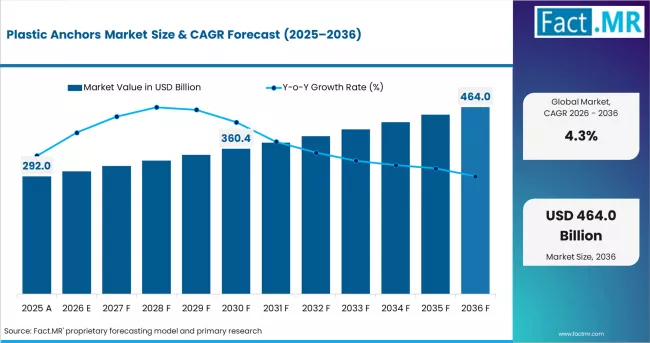
Plastic Anchors Market Market Value Analysis | Source: Fact.MR
| Metric | Value |
|---|---|
| Estimated Value in 2026 | USD 292 billion |
| Forecast Value in 2036 | USD 445 billion |
| Forecast CAGR (2026 to 2036) | 4.3% |
Source: Fact.MR analysis. Updated Apr 21, 2026
Summary of the Plastic Anchors Market
- Market Definition
- The market includes polymer-based fastening anchors in ribbed, sleeve, and conical formats supplying concrete, solid masonry, and hollow masonry substrate applications across residential, commercial, and industrial construction globally.
- Demand Drivers
- Rapid urbanization in India and Southeast Asia is expanding residential construction and driving volume demand for plastic anchor fastening solutions.
- Public infrastructure investment programmes in China and India are generating large-scale, specification-grade anchor procurement across civil and building projects.
- European building codes and energy efficiency retrofit programmes are increasing demand for precision-rated anchor systems in commercial renovation applications.
- Key Segments Analyzed
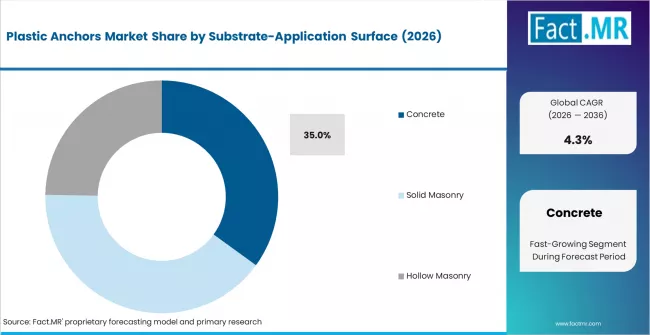
- By Substrate: Concrete leads 35% in 2026. Driven by dominant use in structural and commercial building fastening applications globally.
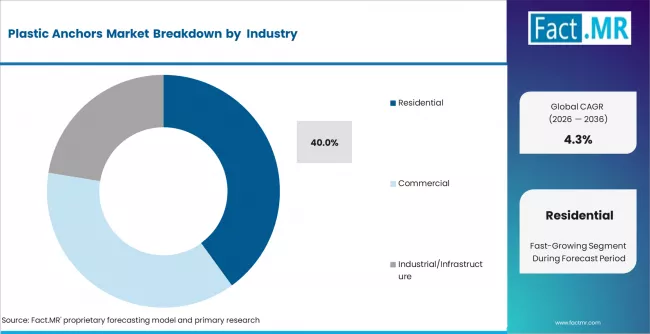
- By End Use: Residential leads 40% in 2026. Driven by high-volume housing construction and DIY installation activity in emerging markets.
- By Product Type: Ribbed Plastic Anchors lead 32% in 2026. Driven by wide substrate compatibility and cost advantage in residential and general construction.
- By Material: Nylon leads 45% in 2026. Driven by superior load performance, corrosion resistance, and broad building code acceptance.
- By Geography: India leads 6.3% CAGR through 2036. Driven by construction sector expansion and infrastructure programme procurement.
- Analyst Opinion at FACT.MR
- Shambhu Nath Jha, Principal Consultant at Fact.MR, opines, 'CXOs will find plastic anchor markets shifting toward load-certified, multi-substrate product platforms where building code compliance documentation, material grade consistency, and distributor channel depth define long-term supplier positioning.'
- Strategic Implications
- Invest in nylon anchor grade development with documented load-rating certification to qualify for infrastructure-grade and commercial building tender procurement in India and China.
- Strengthen distribution channel partnerships in residential construction markets across Asia Pacific to capture volume growth from urbanisation-driven housing demand.
- Expand multi-substrate anchor product portfolios with precision performance data to capture premium pricing in EU and U.S. commercial renovation and industrial construction segments.
- Methodology
- Market sizing based on construction output volumes and anchor penetration rates by substrate and material. Data validated using 2024-2025 manufacturer financials and distributor channel benchmarks.
- Country analysis supported by national construction programme investment data, building code update records, and hardware distribution channel sell-through volumes.
- Forecasts incorporate construction sector cycle data, material price benchmarks, and retail DIY adoption trends, supported by expert interviews with procurement managers.
The market is expected to generate an absolute dollar opportunity of USD 153 billion over the forecast period. Growth is structurally driven. Demand is supported by residential construction in emerging economies. Commercial renovation in mature markets also contributes. Infrastructure-grade fastening demand from public projects remains strong. However, raw material price volatility for nylon and polypropylene creates pressure. Competition from metal anchors in heavy-load applications limits volume growth.
Procurement in commercial and infrastructure segments is becoming more structured. Buyers rely on pre-approved supplier lists linked to building code compliance. Load-rating documentation is now essential. Large buyers are consolidating supplier relationships. Preference is shifting toward manufacturers with multi-substrate portfolios and certified performance data. Generic low-cost products face reduced acceptance.
India leads growth at 6.3% CAGR through 2036. Growth is driven by construction expansion, infrastructure investment, and rising DIY demand. China follows at 5.6% CAGR, supported by infrastructure and manufacturing construction. Japan records 5.0% CAGR, driven by high-quality standards and premium fastening demand. The United States grows at 5.0% CAGR, supported by renovation and DIY activity. Germany records 4.8% CAGR, driven by industrial construction and compliance requirements. Mature markets remain constrained by limited new construction growth.
Segmental Analysis
Plastic Anchors Market Analysis by Substrate/Application Surface
Plastic Anchors Market Analysis By Substrate Application Surface | Source: Fact.MR
Based on FACT.MR, concrete anchors hold 35% share in 2026. This segment leads due to structural fastening requirements. Load-rated fixing in concrete is mandatory under building codes.
- Hilti Distribution Expansion: Hilti Corporation expanded concrete anchor distribution in Asia in 2024. This targets infrastructure and commercial contractors. [1]
- Fischer Concrete Anchor Development: Fischer Group launched an upgraded FUR nylon anchor range in 2025. It offers higher load ratings and compliance documentation. [2]
- Concrete Construction Activity Trend: The European Construction Industry Federation reported 4.2% growth in 2024. This supports demand for certified concrete anchors. [4]
Plastic Anchors Market Analysis by End Use
Plastic Anchors Market Analysis By End Use | Source: Fact.MR
Based on FACT.MR, residential use holds 40% share in 2026. Growth is driven by housing construction and DIY activity. Demand is strong across new builds and renovation projects.
- Rawlplug Residential Portfolio Expansion: Rawlplug expanded its residential portfolio in 2024. It introduced anchors for hollow masonry and lightweight concrete. [5]
- Simpson Strong-Tie Product Development: Simpson Strong-Tie launched new residential anchor solutions in 2025. These target contractors and retail channels. [6]
- Residential Construction Volume Trend: The Ministry of Housing and Urban Affairs reported 7.2% growth in FY2024–25. This increases demand for plastic anchors in housing projects. [7]
Drivers, Restraints, and Opportunities
Plastic Anchors Market Opportunity Matrix Growth Vs Value | Source: Fact.MR
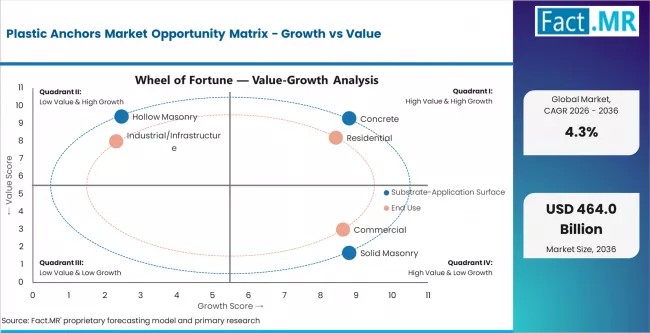
Fact.MR notes that the plastic anchors market is specification- and compliance-driven, with demand closely tied to construction activity and building safety standards. Growth is anchored in structural fastening applications where load reliability and certification are critical. These requirements are mandatory in commercial and infrastructure projects, ensuring consistent demand across construction cycles and renovation activity.
The market reflects a clear capability divide. Commodity-grade plastic anchors used in residential and DIY applications face strong pricing pressure and limited differentiation. In contrast, engineered anchors with certified load ratings, fire resistance, and seismic approvals are gaining share. Technical documentation, installation support, and compliance reporting are becoming essential. Advanced, certified products command noticeable price premiums, supporting margin stability in specification-driven segments.
- Certified Anchor Specification Demand: Increasing enforcement of building codes and safety standards is driving the use of approved anchoring systems. Products backed by ETA or ICC-ES documentation are now required in many structural applications. Companies like Hilti Corporation and Fischer Group have expanded certified portfolios. This creates structured, specifier-led procurement cycles.
- Europe Compliance and Retrofit Driver: Tightening construction regulations and retrofit requirements across Europe are increasing demand for compliant anchoring systems. Fire-rated and load-certified anchors are becoming standard in renovation projects. Fischer Group has strengthened its compliance-focused offerings. This supports steady replacement demand.
Asia Pacific Construction Expansion: Rapid urbanization and infrastructure development are driving anchor consumption across new construction projects. Countries like India are seeing growth in commercial and residential building activity. Illinois Tool Works expanded distribution networks in the region. This supports volume growth across both certified and commodity segments.
Regional Analysis
The plastic anchors market is assessed across Asia Pacific, North America, Europe, Latin America, and Middle East and Africa, covering 40+ countries with demand profiles shaped by construction output volume, building code stringency, infrastructure investment intensity, and distribution channel structure. The report provides detailed market attractiveness analysis by region and country.
.webp "Top Country Growth Comparison Plastic Anchors Market Cagr (2026 2036)")
Top Country Growth Comparison Plastic Anchors Market Cagr (2026 2036) | Source: Fact.MR
| Country | CAGR (2026 to 2036) |
|---|---|
| India | 6.3% |
| China | 5.6% |
| Japan | 5.0% |
| United States | 5.0% |
| Germany | 4.8% |
Source: Fact.MR analysis. Updated Apr 21, 2026
Source: Fact.MR (FACT.MR) analysis, based on proprietary forecasting model and primary research
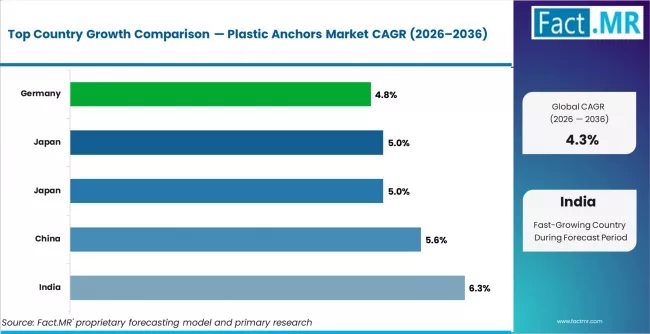
Plastic Anchors Market Cagr Analysis By Country | Source: Fact.MR
Asia Pacific Plastic Anchors Market Analysis
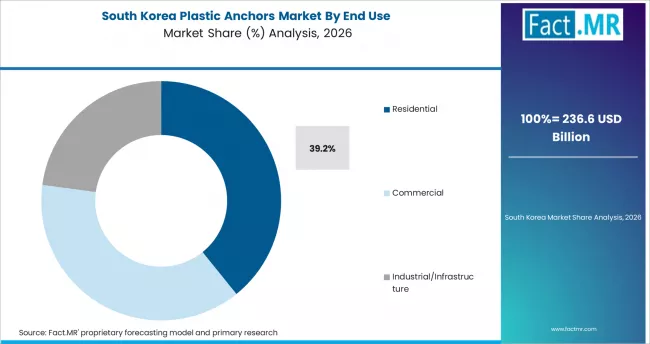
Plastic Anchors Market South Korea Market Share Analysis By End Use | Source: Fact.MR
Asia Pacific is the largest volume growth region. Growth is driven by residential construction and infrastructure projects. Government housing programmes support demand. Urbanisation is accelerating building activity. DIY retail penetration is also rising. Hilti Corporation and Fischer Group lead through project and distributor networks.
- India: India moves at 6.3% CAGR through 2036. Site activity is rising across housing and infrastructure corridors. The 2024 BIS IS 3076 update is tightening approval requirements. Contractors are shifting toward tested, load-rated anchors. Local production is scaling, supported by steady import inflows.
- China: China tracks at 5.6% CAGR through 2036. Project pipelines remain large across transport and commercial builds. Selection is typically locked at the design stage. Contractors prioritise reliability and cost balance. Illinois Tool Works operates alongside competitive domestic suppliers in bid-driven projects.
- South Korea: South Korea market grows at 4.5% CAGR through 2036. Build quality expectations are high across urban developments. KS certification frameworks shape material choice. Commercial builds account for most installations. International brands cater to engineered applications, while local firms supply standard use cases.
- Japan: Japan advances at 5.0% CAGR through 2036. Seismic code updates in 2024 are influencing fastening specifications. Engineering teams favour high-performance anchors in structural zones. Usage is concentrated in projects where compliance and durability carry higher weight.
Fact.MR covers India, China, South Korea, Japan, ASEAN, and ANZ. The analysis includes construction activity, compliance frameworks, and forecasts.
North America Plastic Anchors Market Analysis
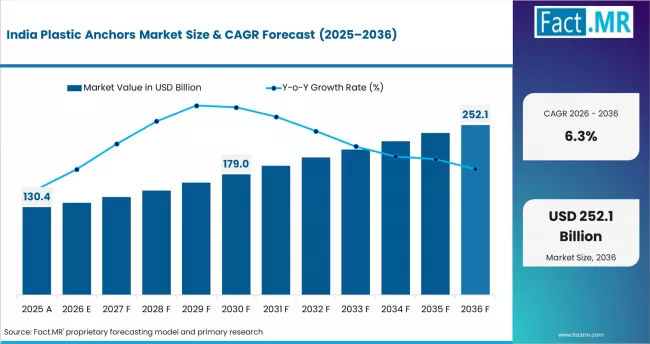
Plastic Anchors Market Country Value Analysis | Source: Fact.MR
North America runs on steady replacement cycles and renovation activity. Product choice is closely tied to code compliance and contractor familiarity. Simpson Strong-Tie and Illinois Tool Works remain widely specified across projects.
- United States: The United States holds at 5.0% CAGR through 2036. Renovation and repair jobs keep volumes consistent. The International Code Council code updates in 2024 reinforced certified product use. Contractors typically stay with approved systems to avoid revalidation risks.
Fact.MR covers the U.S., Canada, and Mexico. The analysis includes renovation cycles, compliance patterns, and forecasts.
Europe Plastic Anchors Market Analysis
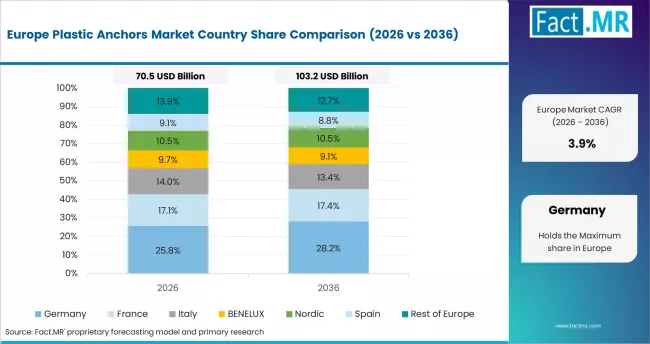
Plastic Anchors Market Europe Country Market Share Analysis, 2026 & 2036 | Source: Fact.MR
Europe operates within tightly defined certification systems. Product acceptance is linked to ETA approvals and documented performance. Fischer Group, Rawlplug, and Hilti Corporation are widely specified across projects.
- Germany: Germany moves at 4.8% CAGR through 2036. Industrial builds and retrofit activity support usage levels. The German Institute for Building Technology revisions in 2024 added stricter technical checks. Engineers are leaning toward certified anchor systems with proven load data. Würth Group expanded its offering to align with these requirements.
Fact.MR covers Germany, France, the UK, Italy, Spain, and Rest of Europe. The analysis includes certification frameworks and forecasts.
Competitive Aligners for Market Players
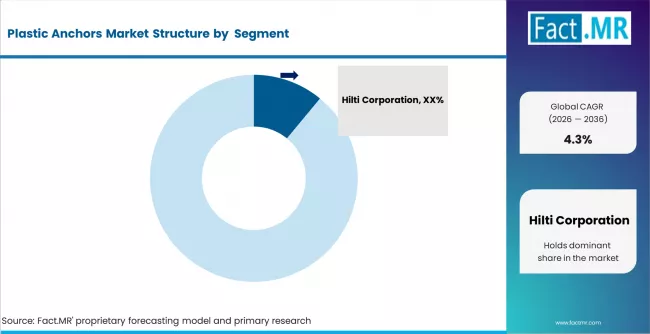
Plastic Anchors Market Analysis By Company | Source: Fact.MR
The plastic anchors market has a fairly balanced competitive landscape, where a handful of specialized players shape the high-performance end, while numerous smaller manufacturers compete in everyday applications. Companies like Hilti Corporation, Fischer Group, and Illinois Tool Works maintain strong positions in segments that demand certified, high-reliability fastening solutions. At the same time, a wide base of regional and private-label brands serves the more price-sensitive residential and retail markets.
What sets leading players apart is not just product quality, but their ability to meet strict certification and documentation requirements. As global construction standards become more demanding, buyers increasingly expect products backed by approvals such as European Technical Assessments or ICC Evaluation Service Reports. This shift naturally favors companies with established engineering capabilities and extensive certification portfolios. Firms like Fischer and Hilti benefit from deep technical expertise and close engagement with architects, engineers, and contractors. Their ability to provide load calculations, design assistance, and project-specific recommendations allows them to influence decisions early in the construction process. Once specified, these products are rarely replaced, giving them a clear advantage in commercial and infrastructure projects.
On the procurement side, large construction projects rely heavily on approved vendor lists and long-term supply agreements, ensuring consistency and compliance. In contrast, the residential and DIY segment is more driven by distribution reach, brand visibility, and pricing. This creates a clear two-tier structure in the market, where premium, certified segments enjoy stable margins, while retail-focused segments face stronger pricing pressure and competition.
Key Players
- Hilti Corporation
- Fischer Group
- Rawlplug
- Illinois Tool Works Inc.
- Würth Group
- Simpson Strong-Tie
- Ramset Fastening Systems
- Trutek Fasteners Pvt Ltd
Bibliography
- [1] Hilti Corporation. Annual Report 2024: Asia Pacific Distribution Expansion and Construction Anchor Product Programme Growth Across India and Southeast Asia. 2024. hilti.com/investor-relations
- [2] Fischer Group. Product Launch and ETA Certification Update: FUR Nylon Concrete Anchor Range and Glass-Fibre-Reinforced Nylon Production Capacity Investment Under EOTA European Technical Assessment Framework. 2024-2025. fischer-international.com
- [4] European Construction Industry Federation. Construction Activity Report 2024: Concrete Structure Building Starts Growth and Certified Fastening Product Demand Across EU Commercial and Industrial Building Projects. 2024. fiec.eu
- [5] Rawlplug Ltd. Product Certification Update: European Technical Assessment Extension for Nylon Anchor Range Under EAD 330076-00-0604 Standard Covering Concrete and Masonry Substrate Applications. January 2025. rawlplug.com
- [6] Simpson Strong-Tie. New Product Announcement: Expanded Residential Fastening Anchor Range for U.S. Construction Contractors and Home Improvement Retail Channel. January 2025. strongtie.com
- [7] Ministry of Housing and Urban Affairs, Government of India. Annual Report FY2024-25: Residential Construction Activity Growth Under Pradhan Mantri Awas Yojana Urban Programme Including Building Materials Procurement Volumes. 2025. mohua.gov.in
This Report Addresses
- Market sizing and quantitative forecast metrics detailing global and regional expenditure on plastic anchors through 2036.
- Segmentation analysis evaluating adoption patterns across substrate type, end use, product type, and material categories and their respective sub-segments.
- Regional deployment intelligence comparing growth trajectories, building code environments, and competitive dynamics across North America, Europe, Asia Pacific, Latin America, and the Middle East and Africa.
- Regulatory compliance assessment analysing how building code standards, CE certification, and load-rating requirements shape anchor procurement specifications and product development priorities.
- Competitive landscape evaluation tracking market structure, supplier positioning, and certification strategies among leading industry participants.
- Strategic investment guidance defining the product certification requirements, distribution channel strategies, and capacity allocation decisions required for market positioning through the forecast period.
- Supply chain risk analysis identifying raw material sourcing constraints, polymer price volatility, and logistics dependencies affecting market participants.
- Custom data delivery formats encompassing interactive dashboards, raw Excel datasets, and comprehensive PDF narrative reports.
Plastic Anchors Market Definition
The plastic anchors market includes polymer-based fastening devices used to fix objects to substrates such as concrete, solid masonry, and hollow masonry. Key products include ribbed, sleeve, and conical anchors. These are made from nylon, polyethylene, or polypropylene.
Plastic Anchors Market Inclusions
Includes global and regional forecasts from 2026 to 2036 by product type, substrate, material, and end use. Covers residential, commercial, and infrastructure applications. Includes both direct sales and distribution channels. Also covers load-rating benchmarks, material pricing trends, and construction-driven demand.
Plastic Anchors Market Exclusions
Excludes metal expansion anchors and chemical or adhesive fastening systems. Does not include finished assemblies using plastic anchors as components. Anchors used in pre-fabricated panels are also excluded. Focus remains on standalone plastic anchor products sold through construction and retail channels.
Plastic Anchors Market Research Methodology
- Primary Research: Interviews with construction contractors, anchor distributors, hardware retailers, and building materials procurement managers across key markets.
- Desk Research: Analysis of Hilti Corporation, Fischer Group, and Illinois Tool Works annual reports, national construction output data, and building code and fastening standard updates from 2024-2025.
- Market-Sizing and Forecasting: Hybrid top-down and bottom-up model using construction output volumes, anchor penetration rates by substrate and application, and average selling price benchmarks by material and product type.
- Data Validation and Update Cycle: Validated through manufacturer revenue disclosures, distributor sell-through data, and expert interviews with construction procurement and building materials specialists.
Segmentation
Scope of Report
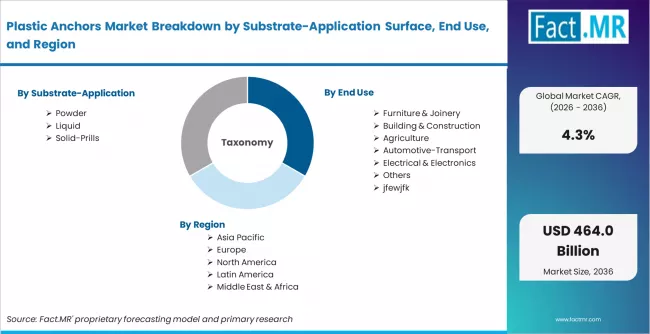
Plastic Anchors Market Breakdown By Substrate Application Surface, End Use, And Region | Source: Fact.MR
| Attribute | Details |
|---|---|
| Quantitative Units | USD 292 billion (2026) to USD 445 billion (2036), at a CAGR of 4.3% |
| Market Definition | Polymer-based fastening anchors in ribbed, sleeve, and conical formats for concrete, solid masonry, and hollow masonry substrate applications across residential, commercial, and industrial construction globally. |
| Substrate Segmentation | Concrete, Solid Masonry, Hollow Masonry |
| End Use Segmentation | Residential, Commercial, Industrial/Infrastructure |
| Product Type Segmentation | Ribbed Plastic Anchors, Sleeve Anchors, Conical Anchors |
| Material Segmentation | Nylon, Polyethylene, Polypropylene |
| Application Coverage | Structural and non-structural fixture installation in concrete and masonry buildings, residential renovation and DIY fastening, commercial building and industrial facility construction fastening, and infrastructure-grade load-bearing anchor applications. |
| Regions Covered | North America, Europe, Asia Pacific, Latin America, Middle East and Africa |
| Countries Covered | USA, Canada, Mexico, Germany, UK, France, Italy, Spain, Nordic, BENELUX, China, Japan, South Korea, India, ASEAN, Australia and New Zealand, Brazil, Argentina, Chile, Saudi Arabia, GCC, Turkey, South Africa, Rest of MEA |
| Key Companies Profiled | Hilti Corporation, Fischer Group, Rawlplug, Illinois Tool Works Inc., Würth Group, Simpson Strong-Tie, Ramset Fastening Systems, Trutek Fasteners Pvt Ltd |
| Forecast Period | 2026 to 2036 |
| Approach | Hybrid top-down and bottom-up model using construction output volumes, anchor penetration rates by substrate and material type, average selling price benchmarks, distributor channel sell-through data, and primary interviews with construction procurement managers and building materials specialists. |
Source: Fact.MR analysis. Updated Apr 21, 2026
Plastic Anchors Market by Segments
-
By Substrate/Application Surface:
- Concrete
- Solid Masonry
- Hollow Masonry
-
By End Use:
- Residential
- Commercial
- Industrial/Infrastructure
-
By Product Type:
- Ribbed Plastic Anchors
- Sleeve Anchors
- Conical Anchors
-
By Material:
- Nylon
- Polyethylene
- Polypropylene
-
By Region:
-
North America
- United States
- Canada
- Mexico
-
Latin America
- Brazil
- Mexico
- Argentina
- Chile
- Rest of Latin America
-
Western Europe
- Germany
- United Kingdom
- France
- Italy
- Spain
- Nordic Countries
- BENELUX
- Rest of Western Europe
-
Eastern Europe
- Russia
- Poland
- Hungary
- Balkan and Baltic
- Rest of Eastern Europe
-
East Asia
- China
- Japan
- South Korea
-
South Asia and Pacific
- India
- ASEAN
- Australia and New Zealand
- Rest of South Asia and Pacific
-
Middle East and Africa
- Kingdom of Saudi Arabia
- Other GCC Countries
- Turkey
- South Africa
- Rest of Middle East and Africa
-
Frequently Asked Questions
How large is the plastic anchors market in 2026?
What will the plastic anchors market size be by 2036?
What is the expected CAGR for the plastic anchors market between 2026 and 2036?
Which product type is poised to lead in 2026?
Which material segment holds the largest share?
Which country is the fastest-growing market?
What is the scope of this plastic anchors market report?
What methodology does Fact.MR use for this forecast?
Which companies are profiled in this report?
Who worked on this report


Preview the report firsthand - request a free sample
Free SampleGet the brochure for pricing and purchase details
Download PDF