- Base Value(2025): 23.9 Bn
- Estimated Value(2026): 25.5 Bn
- Forecast Value (2036): 45.4 Bn
- CAGR (2026 - 2036): 6.6%
Automotive Actuator Market Forecast 2026 to 2036
In 2025, the automotive actuator market was valued at USD 23.9 billion. Based on Fact MR analysis, demand for automotive actuators is estimated to grow to USD 25.5 billion in 2026 and USD 45.4 billion by 2036. FMR projects a CAGR of 6.6% during the forecast period.
The absolute dollar growth from 2026 to 2036 is USD 19.9 billion. This growth is driven by the increasing adoption of advanced technologies in automobiles, including electric vehicles (EVs), autonomous driving systems, and enhanced safety features. Automotive actuators, which control critical vehicle functions such as braking, steering, and climate control, are becoming increasingly essential as vehicles become more technologically advanced. However, challenges such as high production costs and supply chain disruptions may impact growth in certain regions.
As Trond Fiskum, President & Chief Executive Officer of Kongsberg Automotive, noted regarding strategic growth in automotive systems (including actuators) and future mobility technologies, ‘This acquisition aligns well with our strategic ambitions and capabilities and will enhance our offering in the electric and autonomous vehicle market.’
India leads with a CAGR of 8.0%, driven by the growing automotive manufacturing sector and increasing demand for advanced vehicle technologies. China follows with 7.8%, supported by the rapid growth of the EV market and expanding automotive production. South Korea grows at 6.2%, reflecting strong demand for automotive actuators in both traditional and electric vehicle production. Germany shows growth at 5.7%, benefiting from high demand in the automotive industry, especially in advanced vehicle systems. Mexico grows at 5.5%, supported by its growing automotive manufacturing sector and increasing production of electric vehicles.
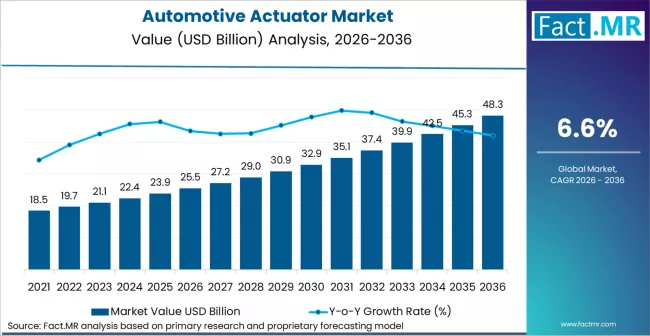
Automotive Actuator Market Market Value Analysis | Source: Fact.MR
Automotive Actuator Market
| Metric | Value |
|---|---|
| Estimated Value in (2026E) | USD 25.5 billion |
| Forecast Value in (2036F) | USD 45.4 billion |
| Forecast CAGR (2026 to 2036) | 6.6% |
Source: Fact.MR analysis. Updated Mar 6, 2026
Automotive Actuator Market Definition
The automotive actuator market involves the manufacture and sale of electromechanical and electronic devices that convert electrical signals into physical motion to control systems such as throttle, braking, steering, HVAC, and body functions in vehicles.
Market Inclusions
This report covers global and regional market sizes for automotive actuators over a defined forecast period, including actuator types (electric, pneumatic, hydraulic), vehicle segments (passenger cars, light commercial vehicles, heavy trucks), and application areas (powertrain, chassis, body electronics).
Market Exclusions
The scope excludes sensors, controllers, and other components not classified as actuators, and complete automotive systems where actuator data is not separately quantified.
Research Methodology
- Primary Research: Interviews were conducted with automotive engineers, component suppliers, and OEM procurement specialists.
- Desk Research: Data was sourced from industry reports, automotive production data, and trade association publications.
- Market‑Sizing and Forecasting: A hybrid model combining top‑down vehicle component demand forecasts with bottom‑up shipment and revenue data was used.
- Data Validation and Update Cycle: Findings were validated through expert review and aligned with recent production and trade figures.
Summary of the Automotive Actuator Market
- Market Definition
- The Automotive Actuator Market involves the manufacture and sale of electromechanical devices that convert electrical signals into mechanical movement to control vehicle systems such as throttle, braking, steering, HVAC, and power seats. These actuators are used in a variety of vehicle components to improve efficiency, safety, and comfort.
- Demand Drivers
- Increased Vehicle Automation: The growing adoption of autonomous driving systems requires reliable actuators for steering, braking, and other critical vehicle functions.
- Electrification and Efficiency: Electric vehicles (EVs) and hybrid vehicles require actuators for efficient power management, such as battery management and energy recovery systems.
- Rising Demand for Safety Features: Features such as advanced driver assistance systems (ADAS), automated parking, and lane-keeping assist are driving the need for actuators that ensure precise control and operation.
- Consumer Preference for Comfort: Actuators in power seats, adjustable mirrors, and HVAC systems are becoming standard in passenger vehicles, contributing to the growing demand for actuators in the automotive market.
- Key Segments Analyzed
- Product: Wastegate Actuators, VGT Actuators, Throttle Actuators, Brake Actuators, EGR Actuators, Power Seat Actuators, Grille Shutters, HVAC Actuators, Headlamp Actuators
- Vehicle Type: Passenger Cars, Commercial Vehicles, Heavy Commercial Vehicles
- Working Type: Pneumatic, Hydraulic, Electromagnetic, Gear Motors or Electric
- Sales Channel: OEMs, Aftermarket
- Geography: India, China, South Korea, Germany, Mexico
- Analyst Opinion at FMR
- Shambhu Nath Jha, Principal Consultant at Fact MR, comments, “The automotive actuator market is driven by rising vehicle electrification, automation, and demand for more sophisticated safety features. As technologies like electric and autonomous vehicles grow, actuators will play a key role in vehicle performance, safety, and comfort. The market will continue to expand as manufacturers integrate more actuators in response to stricter safety and emissions standards.”
- Strategic Implications/Executive Takeaways
- Prioritize Electrification and Smart Actuators: Focus on the development of electric actuators that are energy-efficient, precise, and suitable for advanced systems such as ADAS and autonomous vehicles.
- Invest in Emerging Markets: Expand production capacity and distribution networks in high-growth regions such as India and China where automotive production and demand for advanced vehicle systems are increasing.
- Collaborate with OEMs for Advanced Vehicle Systems: Strengthen partnerships with original equipment manufacturers (OEMs) to integrate actuators into new vehicle models, particularly for high-end safety and comfort features.
- Methodology
- Primary research conducted through interviews with automotive engineers, component suppliers, and OEM procurement specialists.
- Desk research using industry reports, automotive production data, and trade association publications.
- Market sizing and forecasting using a hybrid top-down and bottom-up approach validated with shipment, revenue, and adoption data.
Segmental Analysis
Automotive Actuator Market Analysis by Vehicle Type
Automotive Actuator Market Analysis By Vehicle Type | Source: Fact.MR
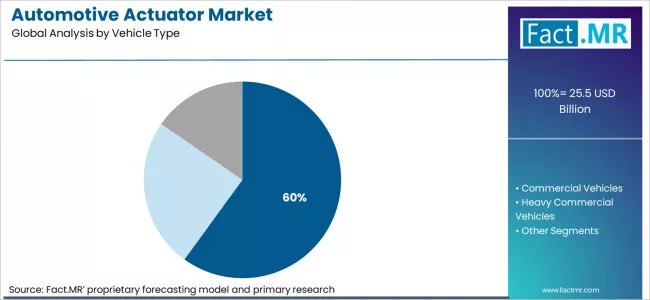
- Market Overview: Passenger cars are expected to capture 60% of the market share by 2026. The demand for automotive actuators in passenger vehicles is driven by the increasing use of advanced control systems, such as power steering, seat adjustments, and window regulators, which require reliable actuators for smooth operation.
- Demand Drivers:
- Growth of Advanced Features in Passenger Vehicles: The growing adoption of power-assisted systems and electric features in passenger vehicles is driving the demand for automotive actuators. These components are critical in enhancing comfort and convenience, such as automated seat adjustments and electric windows.
- Focus on Fuel Efficiency and Performance: Actuators play a crucial role in controlling engine components, improving vehicle performance, and optimizing fuel efficiency, contributing to their widespread use in passenger vehicles.
- Consumer Preference for Comfort and Safety: As safety and comfort become increasingly important in passenger vehicles, actuators that provide automated adjustments to seats, mirrors, and windows are in high demand.
Automotive Actuator Market Analysis by Working
Automotive Actuator Market Analysis By Working | Source: Fact.MR
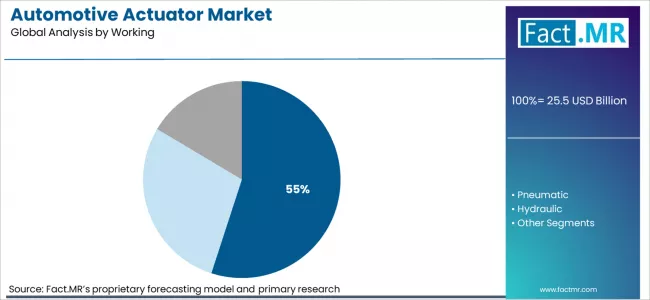
- Market Overview: Gear motors or electric actuators are projected to hold 55% of the market share by 2026. Electric actuators, driven by gear motors, are widely used in modern vehicles due to their precision, energy efficiency, and compatibility with electronic systems.
- Demand Drivers:
- Rising Adoption of Electric Systems in Vehicles: The increasing use of electric actuators in automotive systems, such as power steering, automated windows, and adjustable seats, is driving the growth of this segment.
- Energy Efficiency and Precision: Electric actuators provide high precision and energy efficiency compared to pneumatic and hydraulic systems, making them ideal for modern automotive applications.
- Integration with Advanced Driver-Assistance Systems (ADAS): As ADAS features such as lane-keeping assist and automated parking become more common, the need for precise and reliable actuators powered by gear motors or electric systems continues to rise.
Automotive Actuator Market Drivers, Restraints, and Opportunities
FMR analysts observe that the automotive actuator market is a growth‑aligned, technology‑driven segment supported by rising vehicle electrification, automation, and emissions control requirements. Historically, simple mechanical linkages and vacuum‑based actuators served basic functions; as vehicles adopt more electronic control systems-for throttle, braking, steering, HVAC, and ADAS-structural demand has shifted toward electrically actuated, precise, and networked devices. The 2026 valuation reflects this trend, with adoption tied to broader vehicle electrification and safety/comfort feature integration rather than legacy mechanical systems.
While basic actuators remain in cost‑sensitive applications, advanced electromechanical and smart actuators are gaining share because they support electronic control, diagnostics, and integration with vehicle networks. These higher‑performance units command premium pricing, contributing to net market value growth even as unit volumes grow with powertrain and system complexity.
- Electrification & Automation Demand: Growth of EVs, ADAS, and electronically controlled systems drives adoption of precise electrical actuators over vacuum or purely mechanical alternatives.
- Regulatory & Safety Standards: Fuel economy, emissions, and safety mandates push OEMs to adopt certified actuators that meet defined performance and reliability criteria.
- Regional Automotive Trends: In Asia‑Pacific and North America, strong vehicle production and rising content per vehicle drive higher uptake of advanced actuator technologies.
Regional Analysis
The market analysis covers key global regions, including South Asia, East Asia, Western Europe, North America. It is segmented geographically, with specific market dynamics for each region. The full report provides a detailed market attractiveness analysis.
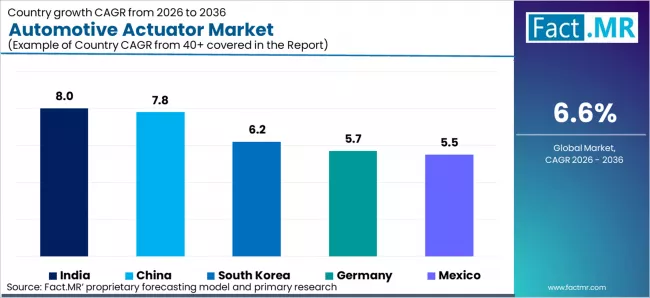
Automotive Actuator Market Cagr Analysis By Country | Source: Fact.MR
| Country | CAGR (2026-2036) |
|---|---|
| India | 8.0% |
| China | 7.8% |
| South Korea | 6.2% |
| Germany | 5.7% |
| Mexico | 5.5% |
Source: Fact.MR analysis. Updated Mar 6, 2026
Source: Fact MR (FMR) analysis, based on proprietary forecasting model and primary research.
South Asia:
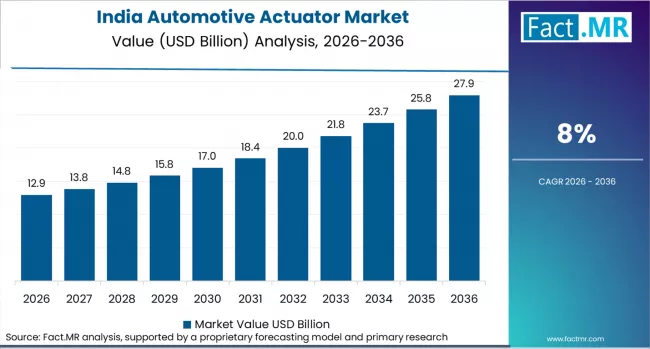
Automotive Actuator Market Country Value Analysis | Source: Fact.MR
In South Asia, India is the leading market for automotive actuators, driven by the country’s growing automotive manufacturing sector, rising demand for advanced automotive technologies, and increasing vehicle production.
- India: Demand for automotive actuators in India is projected to rise at 8.0% CAGR through 2036. India’s expanding automotive sector, increased vehicle production, and growing demand for advanced automotive technologies continue to drive market growth.
East Asia:
In East Asia, China and South Korea are key markets for automotive actuators, supported by strong automotive manufacturing industries, rising demand for vehicle automation, and increasing investments in electric vehicle (EV) technology.
- China: Demand for automotive actuators in China is projected to rise at 7.8% CAGR through 2036. China’s automotive sector growth, rising demand for electric and autonomous vehicles, and increased adoption of advanced automotive components contribute to market expansion.
- South Korea: Demand for automotive actuators in South Korea is projected to rise at 6.2% CAGR through 2036. South Korea’s strong automotive manufacturing base, demand for high-tech vehicle components, and increased adoption of actuators in electric vehicles continue to support market growth.
Western Europe:
In Western Europe, Germany is the leading market for automotive actuators, driven by the country’s automotive manufacturing strength, increased focus on electric and autonomous vehicles, and growing demand for advanced vehicle components.
- Germany: Demand for automotive actuators in Germany is projected to rise at 5.7% CAGR through 2036. Germany’s advanced automotive industry, increased focus on EVs and autonomous vehicles, and growing demand for energy-efficient actuators continue to fuel market growth.
North America:
In North America, Mexico stands out as a key market for automotive actuators, driven by the country’s strong manufacturing base, rising automotive production, and increasing demand for advanced vehicle technologies.
- Mexico: Demand for automotive actuators in Mexico is projected to rise at 5.5% CAGR through 2036. Mexico’s growing automotive manufacturing sector, demand for advanced vehicle components, and expanding focus on electric vehicles contribute to market growth.
Fact MR's analysis of the Automotive Actuator Market in South Asia, East Asia, Western Europe, North America consists of country-wise assessments that include India, China, South Korea, Germany, and Mexico. Readers can find detailed trends, regulatory updates, and company-specific investments shaping the market’s growth in these countries.
What is the Competitive Structure and Buyer Behavior in the Automotive Actuator Market?
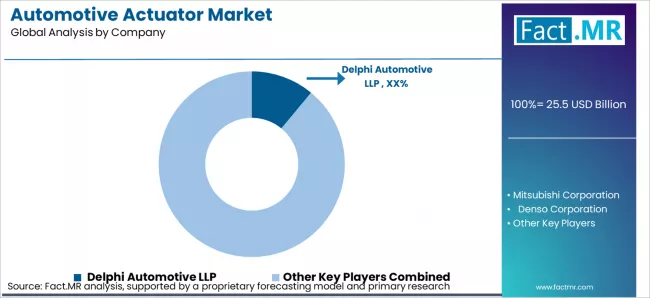
Automotive Actuator Market Analysis By Company | Source: Fact.MR
The automotive actuator market is moderately concentrated, with major global suppliers such as Denso Corporation, Robert Bosch GmbH, Continental AG, BorgWarner Inc., HELLA KGaA Hueck & Co., Hitachi, Ltd., and Johnson Electric Holdings Limited capturing a significant share alongside other established players like Mitsubishi Corporation, CTS Corporation, Magna International, Inc., Mahle GmbH, Marelli Holdings Co., Ltd., Actus Manufacturing, Inc., and Thermotion LLC. Product performance, durability, precision control, and integration with vehicle electronic systems are the primary competitive variables that influence purchasing decisions by original equipment manufacturers (OEMs) and tier‑1 suppliers. Firms with deep engineering expertise, broad automotive portfolios, and integrated supply chains hold structural advantages because they can support complex actuator designs, meet rigorous automotive quality standards, and ensure global production support. Large automotive OEMs exert notable buyer leverage by qualifying multiple suppliers, negotiating long‑term contracts tied to performance and warranty requirements, and standardizing technical specifications across platforms to manage supplier risk. To reduce dependency, these buyers diversify approved vendors and emphasize consistent quality and service reliability, which limits individual suppliers’ pricing power. As a result, competition centers on delivering robust performance, supply assurance, and technical support rather than price alone.
Recent Industry Developments
- "By-Wire" Architecture Shift: Market growth is primarily driven by the mass-market adoption of steer-by-wire and brake-by-wire systems in 2026 models, which utilize intelligent electric actuators to enable advanced ADAS functions and millisecond-level response times for autonomous maneuvers.
- Manufacturing Localization Deadline: Robert Bosch GmbH is completing its ₹1,200 crore expansion in Bangalore to produce next-generation actuators for electric and hybrid vehicles, aiming for a 50% localization rate by 2026 to serve the rapidly expanding Indian EV supply chain.
- Smart Actuator Connectivity: Manufacturers like Marelli and ZHAOWEI are scaling "smart" multifunctional actuators in early 2026 that feature embedded electronic modules, allowing the units to communicate directly with the vehicle's central electronic network for real-time self-diagnostics and over-the-air (OTA) calibration.
Key Players of the Automotive Actuator Market
- Delphi Automotive LLP (formerly Delphi Automotive; now part of BorgWarner)
- Mitsubishi Corporation
- Denso Corporation
- Robert Bosch GmbH
- Continental AG
- BorgWarner Inc.
- CTS Corporation
- Delphi Technologies PLC (brand/entity prior to BorgWarner acquisition)
- HELLA KGaA Hueck & Co.
- Hitachi, Ltd.
- Johnson Electric Holdings Limited
- Magna International, Inc.
- Magneti Marelli S.p.A. (now part of Marelli Holdings Co., Ltd.)
- Mahle GmbH
- Actus Manufacturing, Inc.
- Thermotion LLC
Marelli Holdings Co., Ltd.
Report Scope
| Metric | Value |
|---|---|
| Quantitative Units | USD 25.5 billion (2026) to USD 45.4 billion (2036), at a CAGR of 6.6% |
| Market Definition | The Automotive Actuator Market includes actuators used in various automotive applications such as wastegate, throttle, brake, and power seat actuators, across passenger, commercial, and heavy commercial vehicles. |
| By Product | Wastegate Actuators, VGT Actuators, Throttle Actuators, Brake Actuators, EGR Actuators, Power Seat Actuators, Grille Shutters, HVAC Actuators, Headlamp Actuators |
| By Vehicle | Passenger Cars, Commercial Vehicles, Heavy Commercial Vehicles |
| By Working | Pneumatic, Hydraulic, Electromagnetic, Gear Motors or Electric |
| By Sales Channel | OEMs, Aftermarket |
| Regions Covered | North America, Latin America, Europe, East Asia, South Asia, Oceania, Middle East and Africa |
| Countries Covered | United States, Canada, Mexico, Brazil, Argentina, Germany, France, United Kingdom, Italy, Spain, China, India, Japan, South Korea, Indonesia, Australia, and 40+ countries |
| Key Companies Profiled | Delphi Automotive LLP, Mitsubishi Corporation, Denso Corporation, Robert Bosch GmbH, Continental AG, BorgWarner Inc., CTS Corporation, Delphi Technologies PLC, HELLA KGaA Hueck & Co., Hitachi, Ltd., Johnson Electric Holdings Limited, Magna International, Inc., Magneti Marelli S.p.A., Mahle GmbH, Actus Manufacturing, Inc., Thermotion LLC, Marelli Holdings Co., Ltd. |
| Forecast Period | 2026 to 2036 |
| Approach | Hybrid top-down and bottom-up market modeling validated through primary interviews with manufacturers and supported by trade data benchmarking and market research. |
Source: Fact.MR analysis. Updated Mar 6, 2026
Bibliographies
- Denso Corporation. (2023). Automotive actuators for modern vehicle systems: Market insights and innovations.
- Robert Bosch GmbH. (2023). Advanced actuator technologies in automotive applications: Trends and developments.
- Continental AG. (2023). Automotive actuators in modern vehicles: Increasing adoption of electric and autonomous vehicle systems.
- BorgWarner Inc. (2023). The role of automotive actuators in improving vehicle performance and safety.
- EIN Presswire. (2026). "By-Wire" architecture shift: Automotive actuator market forecast 2026-2036: Market to reach USD 32.5 billion. EIN Presswire.
- P&S Intelligence. (2025). Manufacturing localization deadline: India automotive actuator market size & trends analysis 2032. P&S Intelligence.
- SkyQuest. (2026). Smart actuator connectivity: Automotive actuators market overview 2026-2033: Recent developments and trends. SkyQuest.
This report addresses
- Market intelligence enabling comprehensive assessment of leading countries and product segments across the Automotive Actuator Market globally.
- Market volume (sales units) estimates and 10-year revenue forecasts from 2026 to 2036, validated through manufacturer shipment data, channel partner surveys, and country-level demand modeling.
- Growth opportunity mapping across product types (Wastegate Actuators, VGT Actuators, Throttle Actuators, Brake Actuators, EGR Actuators, Power Seat Actuators, Grille Shutters, HVAC Actuators, Headlamp Actuators) and vehicle types (Passenger Cars, Commercial Vehicles, Heavy Commercial Vehicles).
- Segment and regional revenue forecasts by product type, vehicle type, sales channel, and geography across 40+ countries.
- Competition strategy analysis covering dealer network structure, recent developments, product portfolio, USPs, and market share analysis.
- Product and regulatory compliance tracking aligned with automotive safety standards, emissions regulations, and industry certification requirements.
- Regulatory impact analysis addressing vehicle performance standards, electronic control systems, and fuel efficiency mandates across key markets.
- Report delivery in PDF, Excel, PowerPoint, and interactive dashboard formats for executive, procurement, and operational planning use.
Segmentation
Automotive Actuator Market Key Segments
-
Product :
- Wastegate Actuators
- VGT Actuators
- Throttle Actuators
- Brake Actuators
- EGR Actuators
- Power Seat Actuators
- Grille Shutters
- HVAC Actuators
- Headlamp Actuators
-
Vehicle :
- Passenger Cars
- Commercial Vehicles
- Heavy Commercial Vehicles
-
Working :
- Pneumatic
- Hydraulic
- Electromagnetic
- Gear Motors or Electric
-
Sales Channel :
- OEMs
- Aftermarket
-
Region :
- North America
- USA
- Canada
- Mexico
- Europe
- Germany
- UK
- France
- Italy
- Spain
- Nordic Countries
- BENELUX
- Rest of Europe
- Asia Pacific
- China
- Japan
- South Korea
- India
- Australia
- Rest of Asia Pacific
- Latin America
- Brazil
- Argentina
- Rest of Latin America
- Middle East and Africa
- Kingdom of Saudi Arabia
- United Arab Emirates
- South Africa
- Rest of Middle East and Africa
- Other Regions
- Oceania
- Central Asia
- Other Markets
- North America
Frequently Asked Questions
How large is the demand for Automotive Actuators in the global market in 2026?
What will be the market size of Automotive Actuators in the global market by 2036?
What is the expected demand growth for Automotive Actuators in the global market between 2026 and 2036?
Which sales channel is expected to dominate the market?
Which region is expected to show the highest growth rate for Automotive Actuators?
How significant is the growth outlook for China in this market?
What is the growth outlook for South Korea in the Automotive Actuator market?
What is the growth forecast for Germany in the Automotive Actuator market?
What is the growth forecast for Mexico in the Automotive Actuator market?
Which company is identified as a leading player in the Automotive Actuator market?
What are Automotive Actuators used for?
What does the Automotive Actuator market include in this report?
How is the market forecast developed in this report?
What is meant by the Automotive Actuator market in this report?
Who worked on this report


Preview the report firsthand - request a free sample
Free SampleGet the brochure for pricing and purchase details
Download PDF