- Market Value (2025): USD 176.0 Mn
- Estimated Value (2026): USD 182.0 Mn
- Forecast Value (2036): USD 253.5 Mn
- CAGR (2026-2036): 3.4%
3-Methyl Pyridine Market Forecast and Outlook 2026 to 2036
The 3-Methyl Pyridine Market was valued at USD 176.0 million in 2025 and is valued at USD 182.0 million in 2026. It is projected to reach USD 253.5 million by 2036, growing at a CAGR of 3.4% during the forecast period.
Sales of 3-methyl pyridine depend on the amount of intermediate material purchased by manufacturers that convert it into higher-value compounds. Pharmaceutical-grade purchasing places particular weight on purity records and repeatable quality. Agrochemical plants place greater emphasis on process yield and dependable delivery schedules. Jubilant Ingrevia identifies beta-picoline as an intermediate in vitamin B3 and several agrochemical value chains, showing the importance of downstream conversion capacity. Buyers assess delivery continuity alongside a supplier’s stated product grade. Pyridine derivatives offer a useful comparison with other specialty chemical intermediates. Commercial value depends on how well the intermediate fits the next chemical reaction. Manufacturers compare purchasing prices with the work involved in testing each batch before use. A stable supply agreement helps them plan conversion runs and meet the timing requirements of their own customers.
Market Summary for the 3-Methyl Pyridine Market
- 3-Methyl Pyridine Market Value (2025): USD 176.0 million
- 3-Methyl Pyridine Market Value (2026): USD 182.0 million
- 3-Methyl Pyridine Market Forecast Value (2036): USD 253.5 million
- 3-Methyl Pyridine Market Forecast CAGR (2026-2036): 3.4%
- Leading Application: Pharmaceuticals (42.3%)
- Leading Purity Grade: High Purity (58.4%)
- Leading End-User: Pharmaceutical Industry (42.3%)
- Markets Analyzed: Germany, Brazil, USA, UK and Japan
- Companies Profiled: Jubilant Ingrevia Limited, Red Sun Group and Shandong Hongda Group
A firm making niacin or nicotinamide needs steady intermediate composition, while a pesticide producer must match batches to its reaction route. Shandong Hongda lists 3-methylpyridine for vitamin B3 and pesticide synthesis. Red Sun Group separately lists the compound under CAS 108-99-6, supporting the market’s distinction from other picoline isomers. Consistent composition across successive batches helps producers secure repeat orders. Similar supply considerations apply to other specialty chemical intermediates. Producers seeking alternative supply may request a sample batch and assess the result in an existing production process.
3-Methyl Pyridine Market
| Metric | Value |
|---|---|
| Estimated Value in (2026) | USD 182.0 million |
| Forecast Value in (2036) | USD 253.5 million |
| Forecast CAGR (2026 to 2036) | 3.4% |
Source: Fact.MR analysis. Updated Nov 17, 2026
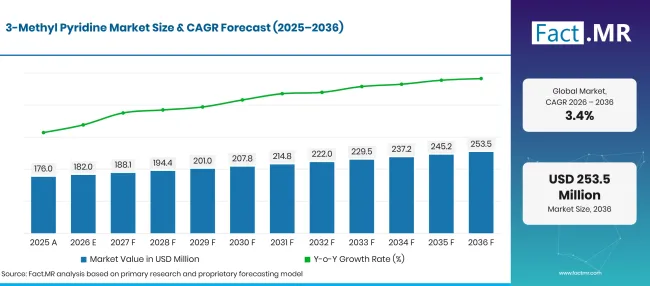
3 Methyl Pyridine Market Forecast Global | Source: Fact.MR
Category
| Category | Segments |
|---|---|
| Application | Pharmaceuticals, Agrochemicals, Chemical Intermediates, Others |
| Purity | High Purity, Low Purity |
| End-User Industry | Pharmaceutical Industry, Chemical Industry, Agricultural Industry, Others |
| Region | Germany, Brazil, USA, UK, Japan |
Source: Fact.MR analysis. Updated Nov 17, 2026
Segmental Analysis
Why do pharmaceuticals account for the largest application share in the 3-Methyl Pyridine Market?
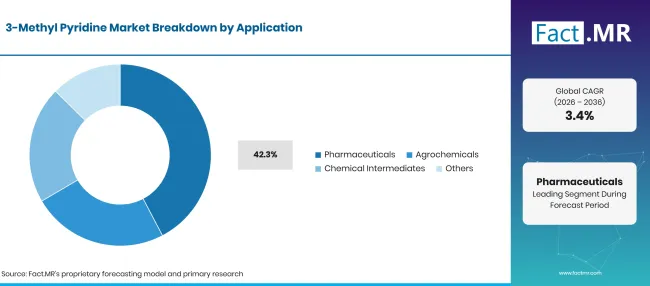
Methyl Pyridine Market Breakdown Application 1 | Source: Fact.MR
Pharmaceuticals account for 42.3% of application sales in 2026. Their purchasing requirements often start with batch identity, impurity control and process consistency. Beta-picoline is a chemical starting point for producing niacin and nicotinamide, among other derivatives. These downstream uses explain why pharmaceutical manufacturers assess suppliers by reliable output instead of price alone. Agrochemical demand follows a different buying cycle tied to crop-protection formulation and production. Chemical intermediate buyers also purchase beta-picoline for conversion into related compounds. Additional demand from industrial uses remains part of the broader application base. Purchases of pharmaceutical grades will continue to depend on approved manufacturing routes.
How does high purity shape purchasing in the 3-Methyl Pyridine Market?
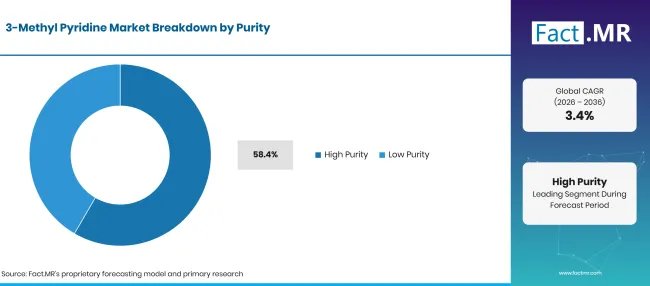
3 Methyl Pyridine Market Breakdown Purity | Source: Fact.MR
High purity represents 58.4% of the 2026 purity segment. Further chemical synthesis produces more consistent results when the starting material meets its impurity specifications. A pharmaceutical buyer may ask for certificates of analysis and a history of batch results before approving deliveries. Low-purity material remains relevant where downstream processing allows further separation or the specification is less restrictive. The price gap between grades is shaped by purification effort and testing requirements.
What makes the pharmaceutical industry a major end-user of 3-methyl pyridine?
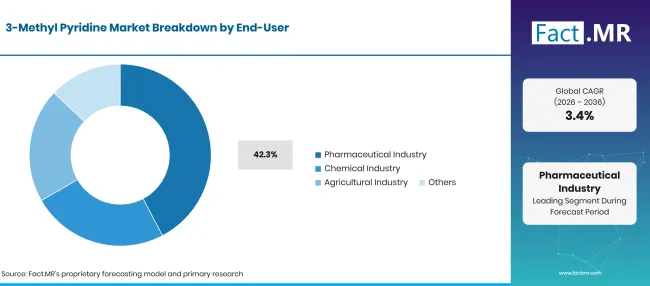
Methyl Pyridine Market Breakdown End User | Source: Fact.MR
The pharmaceutical industry represents 42.3% of end-user revenue in 2026. Firms purchasing beta-picoline often convert it into another intermediate before the final medicinal or nutritional ingredient is made. Their commercial risk lies in inconsistent input quality because a rejected lot can interrupt a sequence of chemical reactions. The chemical industry purchases the compound for wider organic synthesis. Agricultural users are linked to crop-protection chemistry and can follow different production cycles. Shipment-level documentation can help suppliers retain customers. Niacin and niacinamide form related downstream markets. Intermediate suppliers can support repeat purchases by giving manufacturers traceable batch records and clear handling information. The business case is especially practical when customers use the same conversion method for a long production program. Consistency reduces the work involved in reviewing each delivery.
3-Methyl Pyridine Market-Drivers, Restraints & Trends
- Drivers: Demand for 3-methyl pyridine follows the production needs of downstream pharmaceutical and nutrition chemical makers. Jubilant Ingrevia identifies beta-picoline as an important input for vitamin B3 production. That link makes supply reliability a buying factor because chemical converters need steady batches to keep later processing stages running. Rising downstream manufacturing activity is projected to support repeat purchases of qualified intermediate material. Order frequency will depend on conversion volumes and production schedules.
- Drivers: Chemical manufacturers buying beta-picoline often need a steady supply of material that meets the same processing specification across repeat orders. The qualification record and availability of stock are both relevant to the buying decision. Producers with clear batch data and reliable deliveries can retain an advantage among specialist industrial customers.
- Restraints: A chemical producer needs consistent raw materials and controlled process conditions to supply 3-methyl pyridine within a narrow specification. Changes in feedstock costs, transport charges or available plant capacity can affect quote validity and delivery terms. Buyers in regulated applications may be unwilling to change sources quickly because replacing an approved supplier requires new testing. These approval steps can limit near-term substitution even when another producer provides a lower price. Manufacturing consistency will remain a requirement for repeat orders even during shifts in feedstock prices.
- Trend: Buyers are separating high-purity requirements from general industrial purchasing. Suppliers with documented assay results and reliable shipment records are better placed to serve strict conversion processes. Jubilant Ingrevia describes an integrated pyridine and picoline production system that includes its own starting materials. Such integration provides a practical route to managing input availability, although customer-specific testing still decides whether a grade is accepted.
3-Methyl Pyridine Market by Analysis by Country
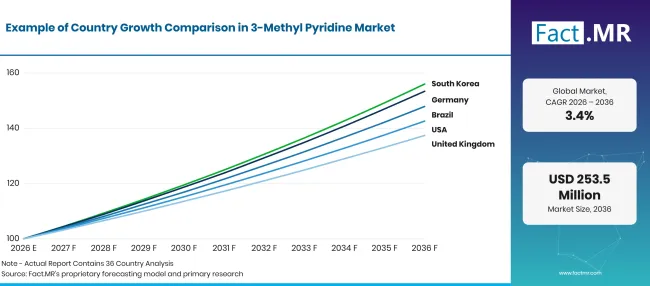
3 Methyl Pyridine Market Growth Index | Source: Fact.MR
| Country | CAGR (2026-2036) |
|---|---|
| Germany | 4.4% |
| Brazil | 4.0% |
| USA | 3.6% |
| UK | 3.2% |
| Japan | 2.9% |
Source: Fact.MR analysis. Updated Nov 17, 2026
How does Germany’s chemical manufacturing base shape 3-methyl pyridine demand?
German pharmaceutical and specialty chemical manufacturers place steady quality requirements on intermediate chemicals used in further synthesis.
Demand for 3-methyl pyridine in Germany is projected to expand at a 4.4% CAGR between 2026 and 2036, with the established network of chemical producers and pharmaceutical manufacturers. Germany Trade & Invest reported pharmaceutical industry revenue of EUR 67.9 billion in Germany in 2025. Companies converting beta-picoline into downstream compounds normally check the purity specification and the availability of supporting batch information before approving a supply source. German manufacturers also need stable delivery schedules to keep production matched with customer orders. Supplier performance is anticipated to depend on documented quality and dependable supply through the forecast period. Buyers are likely to place greater weight on established sourcing relationships where the conversion process has already been qualified.
What supports 3-methyl pyridine purchases in Brazil?
Brazil's pharmaceutical manufacturing activity provides a distinct customer base for specialty chemical intermediates, while its crop-protection industry provides a separate commercial outlet.
The 3-methyl pyridine market in Brazil is forecast to grow at a 4.0% CAGR from 2026 to 2036. In September 2026, Brazil's medicines regulator Anvisa published industry figures showing that the country's pharmaceutical market generated more than BRL 180 billion in sales during 2025. Pharmaceutical market sales measure downstream medicines instead of beta-picoline purchases, but they establish the scale of the industries served by pharmaceutical ingredient manufacturers. Domestic chemical converters and distributors are expected to assess imported intermediate grades according to batch consistency and delivery schedules.
How are US pharmaceutical supply chains influencing 3-methyl pyridine sales?
The USA has a broad pharmaceutical manufacturing base where intermediate suppliers compete on manufacturing records and the reliability of repeat shipments.
Sales of 3-methyl pyridine are projected to grow at a 3.6% CAGR between 2026 and 2036. In June 2026, the US Bureau of Labor Statistics reported USD 234.16 billion in US pharmaceutical and medicine manufacturing output for 2025. Buyers handling beta-picoline compare material specifications before using an alternative source in established manufacturing operations. A chemical that meets the required assay and handling conditions provides a more practical purchase option than one selected solely on unit price.
What is affecting the UK outlook for 3-methyl pyridine?
UK pharmaceutical manufacturers and chemical processors provide a defined market for intermediates that meet process-specific requirements.
Demand for 3-methyl pyridine in the UK is estimated to advance at a 3.2% CAGR through 2036. The Office for National Statistics reported in November 2026 that turnover from the manufacture of basic pharmaceutical products and preparations totaled GBP 46.77 billion during 2025. This is a measure of the downstream industry instead of direct beta-picoline purchases, giving a useful view of the customer environment. UK businesses sourcing the intermediate compare delivery arrangements with technical records that support use in subsequent reactions. Imported supply can form part of the sourcing plan when material meets an established manufacturing specification.
Why is Japan’s 3-methyl pyridine growth relatively measured?
Japan's specialty chemical manufacturers generally require consistent feedstock specifications to keep repeat synthesis processes within approved operating conditions.
The Japanese 3-methyl pyridine market is forecast to record a 2.9% CAGR between 2026 and 2036. In its June 2026 industrial production tables, the Ministry of Economy, Trade and Industry reported a 2025 chemical production index of 108.3 for chemicals excluding inorganic and organic chemical categories, using 2020 as the base year. This wider measure describes part of the domestic chemical production environment and is separate from beta-picoline output. Companies buying the intermediate for pharmaceutical-related processing assess assay results and the stability of delivery arrangements. Producers serving agricultural chemical customers may use separate specifications for later conversion steps. Suppliers with clear batch documentation are anticipated to retain a place in repeat purchasing programs.
Competitive Landscape for 3-Methyl Pyridine Market
Competition in the 3-methyl pyridine market depends on access to pyridine chemistry and control of downstream chemical quality. Jubilant Ingrevia lists beta-picoline in its current pyridine portfolio and identifies integration into vitamin B3 chemistry. Red Sun Group includes 3-methylpyridine in its product catalogue, while Shandong Hongda describes supply into pharmaceutical and pesticide synthesis. These companies present direct evidence of participation in the specified chemical. a supplier’s ability to match approved grades is forecast to influence commercial relationships in this specialty input category. Geographic reach is another point of difference because a supplier selling to overseas chemical plants must match documentation and delivery terms with local manufacturing arrangements. Buyers generally assess this alongside chemical specifications. Suppliers that maintain clear records across shipments are better placed for repeat business.
Manufacturers purchasing beta-picoline compare purity assurance with the practical cost of delivered material. Integrated production may help a supplier manage the availability of starting chemicals. Other producers can compete by meeting a customer’s accepted analytical specification and delivery timetable. The competitive outlook remains tied to the economics of niacin derivatives and agrochemical intermediates. Suppliers are evaluated on manufacturing continuity and the grade-specific requirements of each downstream customer.
Recent Developments
- In May 2026, Jubilant Ingrevia reported strong volume momentum in its Pyridine & Picolines business in its fourth-quarter financial announcement. The development relates to the same intermediate chemistry family as beta-picoline and places sales conditions within an active manufacturer’s reported operations.
Companies Operating in 3-Methyl Pyridine Market
Key companies profiled include Jubilant Ingrevia Limited; Red Sun Group; and Shandong Hongda Group.
- Jubilant Ingrevia Limited
- Red Sun Group
- Shandong Hongda Group
Bibliography
- Agência Nacional de Vigilância Sanitária. (2026, September 25). CMED publica o Anuário Estatístico do Mercado Farmacêutico – Edição 2025. Serviços e Informações do Brasil
- Germany Trade & Invest. (2026). The pharmaceutical industry in Germany. GTAI
- Germany Trade & Invest source
- Ministry of Economy, Trade and Industry. (2026, June). Indices of industrial production: April 2026 final report.
- Official METI source
- Office for National Statistics. (2026, November 12). UKProdTO: 21 – Manuf of basic pharmaceutical products & preparations TOTAL (£m). Office for National Statistics
- U.S. Bureau of Labor Statistics. (2026, June 29). Sectoral output for manufacturing: Pharmaceutical and medicine manufacturing (NAICS 3254) in the United States [Data set]. Federal Reserve Bank of St. Louis. FRED
- Jubilant Ingrevia Limited. (2026, May 26). Jubilant Ingrevia Limited – Q4’FY26 results [Press release]. NSE India Search Archives
- Jubilant Ingrevia Limited. (2026). Annual report 2025–26: Business overview. Jubilant Ingrevia
- Jubilant Ingrevia Limited. (2026). Pyridine and picolines.
- Official Jubilant Ingrevia product page
- Red Sun Group. (2026). Product category.
- Official Red Sun Group product page
- Shandong Hongda Group. (2026). 3-Methylpyridine. Hongda Bio
Segmentation
Scope of Report
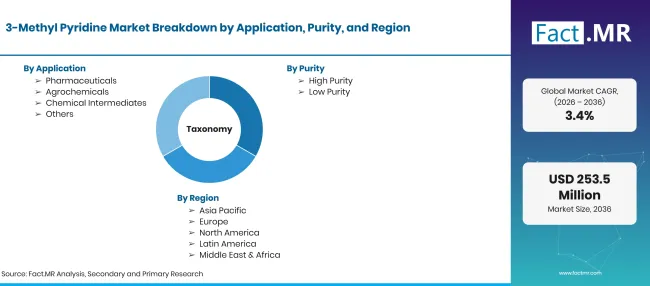
3 Methyl Pyridine Market Taxonomy | Source: Fact.MR
| Items | Values |
|---|---|
| Quantitative Units (2026) | USD 182.0 Million |
| Application | Pharmaceuticals, Agrochemicals, Chemical Intermediates, Others |
| Purity | High Purity, Low Purity |
| End-User Industry | Pharmaceutical Industry, Chemical Industry, Agricultural Industry, Others |
| Regions Covered | North America, Latin America, Europe, East Asia, South Asia and Pacific, Middle East & Africa |
| Countries Covered | Germany, Brazil, USA, UK, Japan, and other countries |
| Key Companies Profiled | Jubilant Ingrevia Limited, Red Sun Group, Shandong Hongda Group |
| Additional Attributes | Dollar revenue in the 3-Methyl Pyridine Market is segmented by application (pharmaceuticals, agrochemicals, chemical intermediates), purity (high purity, low purity), end-user industry (pharmaceutical industry, chemical industry, agricultural industry) and region. |
Source: Fact.MR analysis. Updated Nov 17, 2026
3-Methyl Pyridine Market by Segments
-
Application
- Pharmaceuticals
- Agrochemicals
- Chemical Intermediates
- Others
-
Purity
- High Purity
- Low Purity
-
End-User Industry
- Pharmaceutical Industry
- Chemical Industry
- Agricultural Industry
- Others
-
Region:
- North America
- Europe
- Asia Pacific
- Latin America
- Middle East & Africa
Frequently Asked Questions
How big is the global 3-Methyl Pyridine Market in 2026?
What is the projected size of the 3-Methyl Pyridine Market by 2036?
What CAGR is forecast for the 3-Methyl Pyridine Market?
Which application accounts for the greatest share?
Which purity segment has the greatest share?
Which end-user industry accounts for the greatest share?
Which country has the highest CAGR among the five analyzed?
Who worked on this report


Preview the report firsthand - request a free sample
Free SampleGet the brochure for pricing and purchase details
Download PDF