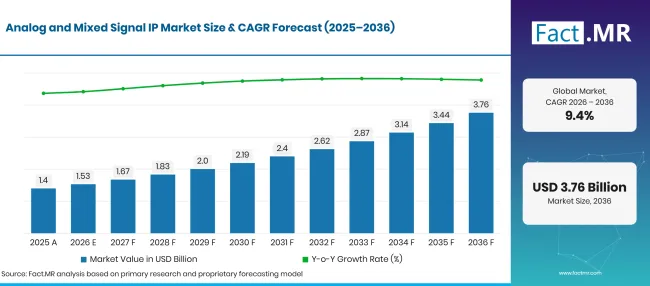
- Market Value (2025): USD 1.4 Bn
- Estimated Value (2026): USD 1.53 Bn
- Forecast Value (2036): USD 3.76 Bn
- CAGR (2026-2036): 9.4%
Analog and Mixed Signal IP Market Forecast and Outlook 2026 to 2036
The global analog and mixed signal IP market crossed a valuation of USD 1.4 billion in 2025 and stands at USD 1.53 billion in 2026. Revenue is forecast to reach USD 3.76 billion by 2036, growing at a CAGR of 9.4% during the forecast period.
Semiconductor teams increasingly license circuit blocks that have already been characterized for a specific manufacturing process. The approach saves early design effort, although engineers still check each block against the electrical needs of their chips. TSMC reported around 93,000 library and silicon IP titles in its 2025 annual report, published in 2026. That represented a 12% increase over 2024 and illustrates the breadth of established design resources.
Key Takeaways from the Analog and Mixed Signal IP Market
- Analog and Mixed Signal IP Market Value (2026): USD 1.4 billion
- Analog and Mixed Signal IP Market Value (2026): USD 1.53 billion
- Analog and Mixed Signal IP Market Forecast Value (2036): USD 3.76 billion
- Analog and Mixed Signal IP Market Forecast CAGR (2026–2036): 9.4%
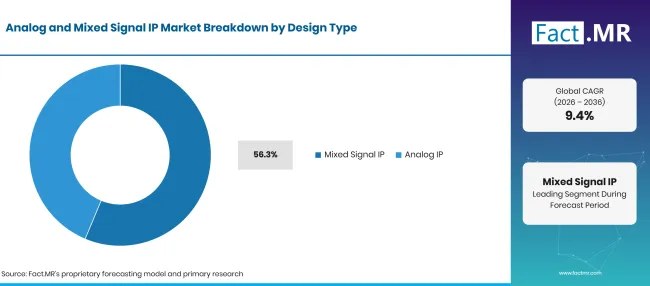
- Leading Design Type: Mixed Signal IP (56.3%)
- Companies Profiled: Synopsys, Cadence Design Systems, Arm Holdings Ltd., Broadcom, TSMC
- Key Growth Regions: Germany, USA, Brazil, UK, Japan
Analog and Mixed Signal IP Market
| Metric | Value |
|---|---|
| Estimated Value in (2026) | USD 1.53 billion |
| Forecast Value in (2036) | USD 3.76 billion |
| Forecast CAGR (2026 to 2036) | 9.4% |
Source: Fact.MR analysis. Updated Nov 17, 2026
Analog And Mixed Signal Ip Market Forecast Global | Source: Fact.MR
Category
| Category | Segments |
|---|---|
| Design Type | Mixed Signal IP, Analog IP |
| Application | Automotive, Consumer Electronics, Telecommunications, Industrial, Healthcare, Others |
| End-User | OEMs, Semiconductor Companies, Foundries, Others |
| Region | Germany, Brazil, USA, UK, Japan |
Source: Fact.MR analysis. Updated Nov 17, 2026
Segmental Analysis
What makes mixed signal blocks the larger design category?
Analog And Mixed Signal Ip Market Breakdown Design Type | Source: Fact.MR
Mixed signal IP represents 56.3% of the design-type market in 2026. These reusable blocks combine analog input or output circuitry with digital control. Their value lies in connecting signals from sensors and physical equipment to processors that handle digital information. In October 2026, the SEMI Electronic System Design Alliance reported that worldwide semiconductor IP revenue increased 20.4% year on year in the second quarter of 2026.
Where does automotive design create licensing opportunities?
Analog And Mixed Signal Ip Market Breakdown Application | Source: Fact.MR
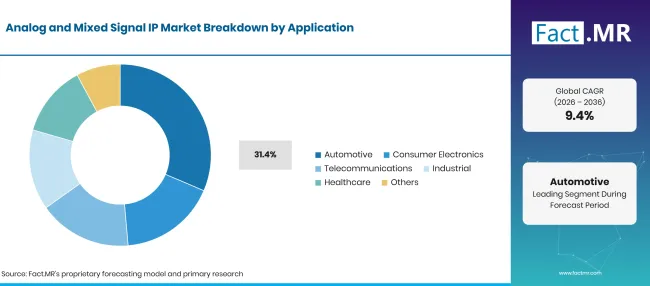
Automotive leads with 31.4% of application revenue in 2026. Vehicle electronics programs may remain an active source of design-IP licensing as engineers connect sensor signals to digital control units. In January 2026, the German Association of the Automotive Industry reported 545,100 battery-electric vehicle registrations in Germany during 2025. Semiconductor design teams may evaluate interface blocks that work across the electrical conditions required by their vehicle programs. Testing records and support for the selected manufacturing process may influence supplier selection. For automotive designers, a reusable block has greater commercial value when its electrical behavior is understood across operating conditions and supported by test files. Customer approvals may depend on repeatable results and the ability to reuse the design over a planned vehicle platform.
What leads OEMs to license analog interface designs?
Analog And Mixed Signal Ip Market Breakdown End User | Source: Fact.MR
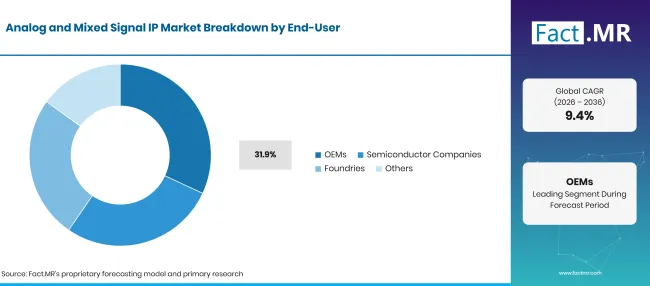
OEMs account for 31.9% of end-user revenue in 2026. Equipment makers developing custom integrated circuits may use analog and mixed signal IP when a reusable interface fits their hardware design. Their engineering groups assess circuit limits before including licensed blocks in a design. In September 2026, the UK Department for Science, Innovation and Technology found that 60% of dedicated semiconductor companies active in the UK mainly worked in research, design or IP-related activity. OEMs may prioritize circuit support that shortens integration work. These firms may work directly with semiconductor developers while keeping responsibility for the finished equipment. A licensing agreement may be easier to justify when the IP owner explains testing obligations and supplies documents suited to the customer's chip-development process.
Analog and Mixed Signal IP Market-Drivers, Restraints & Trends
- Drivers: Design teams may purchase reusable circuit IP when a new semiconductor project requires dependable interfaces and clear verification records. In October 2026, SEMI reported that the semiconductor intellectual property category recorded USD 2,199.0 million in worldwide revenue during the second quarter of 2026. The reported category extends beyond analog and mixed signal blocks. Companies with process-ready blocks and support documentation may benefit from the engineering effort needed to qualify new designs. A qualified analog circuit can save design time, yet teams still need to test connections to the digital sections of a chip. Design teams may prefer a familiar library when a new application has strict timing or power limits. Licensed IP becomes more attractive when its supplier maintains libraries that are compatible with a customer’s design tools. Engineers may spend less time preparing a known circuit for verification, making the source files and test guidance as relevant as the license cost.
- Restraints: A circuit tested on one manufacturing process cannot automatically be treated as qualified for another. Changes in device behavior and process design rules may require a new test program. Integration also depends on technical documentation and support from the IP owner. These checks create engineering expense even when an existing block reduces the original design effort. Customers may delay purchasing until the licensing terms and foundry compatibility are clear.
- Trend: Design teams increasingly compare reusable blocks on total engineering work instead of license price alone. A circuit with clear integration files and verified performance can reduce redesign activity. For automotive programs, qualification evidence can be decisive. For consumer electronics, power and area restrictions often shape selection. Supplier relationships tend to extend beyond the first contract into verification and later chip revisions.
Analog and Mixed Signal IP Market by Analysis by Key Country
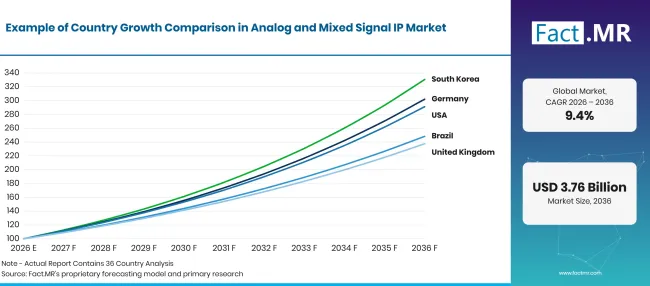
Analog And Mixed Signal Ip Market Growth Index | Source: Fact.MR
| Country | CAGR (2026–2036) |
|---|---|
| Germany | 11.7% |
| USA | 11.3% |
| Brazil | 9.5% |
| UK | 9.0% |
| Japan | 6.8% |
Source: Fact.MR analysis. Updated Nov 17, 2026
How are German vehicle electronics influencing licensing activity?
Germany's automotive chip designers may give greater weight to tested analog and mixed signal blocks that fit vehicle electronics programs.
In January 2026, the German Association of the Automotive Industry reported that domestic factories produced 4.15 million passenger cars in 2025. The scale of vehicle engineering provides a clear use for licensed interfaces that link sensors to digital control systems. Germany's analog and mixed signal IP market is forecast to expand at an 11.7% CAGR through 2036. Design groups may assess proven circuit performance alongside support from IP owners and manufacturing partners.
Why does the US remain a major design-IP customer?
US semiconductor businesses bring extensive chip-design expertise to the analog and mixed signal IP market.
Engineering teams can license established conversion and interface blocks while keeping their own design effort focused on the functions that distinguish a new chip. In July 2026, the Semiconductor Industry Association reported that US-headquartered semiconductor companies invested USD 76.8 billion in research and development during 2025. Such spending illustrates the breadth of the domestic design industry network without measuring licensed IP revenue directly. The US market is forecast to grow at an 11.3% CAGR from 2026 to 2036. Semiconductor businesses may compare license terms with their own engineering costs and check whether a block fits the chosen foundry process. Vendors providing dependable integration support may attract repeat licensing programs.
What shapes mixed signal IP opportunities in Brazil?
Brazil's efforts to build domestic chip-design skills are opening a route for local firms to evaluate reusable analog circuit libraries.
The Brazil Semicon program recognizes integrated-circuit design as part of the country's semiconductor value chain. In September 2026, the public innovation agency Finep described a semiconductor funding call worth R$ 100 million. This funding program addresses wider semiconductor research and does not represent confirmed spending on licensed analog IP. Demand in Brazil is forecast to increase at a 9.5% CAGR between 2026 and 2036. Design-service businesses may seek blocks that come with clear integration instructions and access to process libraries. Foreign manufacturing partnerships may remain relevant to chip projects that move from circuit design into tested silicon.
How do UK semiconductor designers use external circuit IP?
The UK's semiconductor sector includes specialist engineering firms whose business models place value on reusable design work and external IP libraries.
In September 2026, the Department for Science, Innovation and Technology identified 703 semiconductor companies operating in the UK. Its industry study describes a large role for design and intellectual property activities. UK demand for analog and mixed signal IP is forecast to rise at a 9.0% CAGR through 2036. Companies developing custom chips for industrial equipment and communications applications may select circuit blocks on electrical performance and documentation quality. Licensing also helps smaller teams control the amount of testing they must repeat during a new chip program.
Why does process qualification shape Japanese IP demand?
Japanese semiconductor developers place considerable weight on circuit reliability and fit with established manufacturing processes.
Licensed analog and mixed signal IP is useful when a chip project needs proven links between real-world signals and digital processing. In its January 2026 trade statistics, the Japan Electronics and Information Technology Industries Association recorded JPY 463.8 billion in integrated-circuit exports. This industry measure describes Japan's wider semiconductor trade and provides context for established chip design and manufacturing activity. The Japanese analog and mixed signal IP market is forecast to record a 6.8% CAGR from 2026 to 2036. Existing internal libraries may remain an option for established chip programs, making clear technical advantages essential for external IP suppliers.
Competitive Landscape for Analog and Mixed Signal IP Market
Competition differs between companies that license reusable semiconductor design blocks and manufacturers that primarily build finished chips. Synopsys and Cadence Design Systems provide broad IP and electronic design environments. Arm is principally associated with processor and system IP, making its role adjacent to dedicated analog and mixed signal licensing. Customers may look for a named circuit block that they can legally integrate into their own design. Manufacturing experience remains useful, but it does not by itself establish an external IP licensing business. Direct IP licensors earn revenue from the right to integrate documented circuit designs into other companies chips. Other companies in the wider semiconductor industry network contribute manufacturing processes or end-use circuit knowledge. Those distinctions help explain different positions in the value chain.
Broadcom provides semiconductor solutions but is not automatically a merchant analog IP licensor. TSMC mainly operates as a foundry and IP industry network organizer. Its 2025 annual report describes 37 IP Alliance partners. Customers assess license rights and silicon evidence alongside compatibility with the selected foundry.
Recent Developments
- In October 2026, the SEMI Electronic System Design Alliance reported that revenue across electronic system design products and services reached USD 5,710.8 million in the second quarter of 2026.
- In 2026, TSMC described design reference flows released during 2025 for analog migration from its N2 process to A16 technology.
Key Players in Analog and Mixed Signal IP Market
Key companies profiled include Synopsys; Cadence Design Systems; Arm Holdings Ltd.; Broadcom; and TSMC.
- Synopsys
- Cadence Design Systems
- Arm Holdings Ltd.
- Broadcom
- TSMC
Bibliography
- Department for Business, Innovation, Science and Trade, & Department for Science, Innovation and Technology. (2026, June 8). Semiconductor sector study 2026. GOV.UK. GOV.UK
- Japan Electronics and Information Technology Industries Association. (2026). January 2026 exports of electronics from Japan. jeita.or.jp
- German Association of the Automotive Industry. (2026, January 5). Passenger car production in 2025 slightly above previous year's level. vda.de
- SEMI Electronic System Design Alliance. (2026, October 19). Electronic system design industry posts $5.7 billion in revenue in Q2 2026, ESD Alliance reports. semi.org
- Semiconductor Industry Association. (2026, July 27). 2026 state of the industry report: Historic growth amid intensifying global competition. Semiconductor Industry Association
- Financiadora de Estudos e Projetos. (2026, September 3). Finep recebe propostas para inovação em semicondutores até 30/9. Finep
- Japan Electronics and Information Technology Industries Association. (2026). January 2026 production by the Japanese electronics industry. jeita.or.jp
- Taiwan Semiconductor Manufacturing Company Limited. (2026). 2025 annual report. TSMC
- Taiwan Semiconductor Manufacturing Company Limited. (2026). IP Alliance. TSMC
Segmentation
Scope of Report
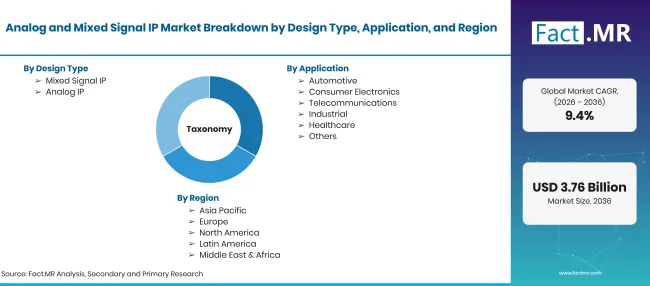
Analog And Mixed Signal Ip Market Taxonomy | Source: Fact.MR
| Items | Values |
|---|---|
| Quantitative Units (2026) | USD 1.5 Billion |
| Design Type | Mixed Signal IP, Analog IP |
| Application | Automotive, Consumer Electronics, Telecommunications, Industrial, Healthcare, Others |
| End-User | OEMs, Semiconductor Companies, Foundries, Others |
| Regions Covered | North America, Europe, Asia Pacific, Latin America, Middle East & Africa |
| Countries Covered | Germany, Brazil, USA, UK, Japan, and other countries |
| Key Companies Profiled | Synopsys, Cadence Design Systems, Arm Holdings Ltd., Broadcom, TSMC |
| Additional Attributes | Market revenue covers licensed analog and mixed signal circuit intellectual property. The coverage separates merchant IP licensing from finished semiconductor-device sales and foundry services. |
Source: Fact.MR analysis. Updated Nov 17, 2026
Analog and Mixed Signal IP Market by Segments
-
Design Type
- Mixed Signal IP
- Analog IP
-
Application
- Automotive
- Consumer Electronics
- Telecommunications
- Industrial
- Healthcare
- Others
-
End-User
- OEMs
- Semiconductor Companies
- Foundries
- Others
-
Region:
- North America
- USA
- Canada
- Mexico
- Europe
- Germany
- UK
- France
- Italy
- Spain
- Rest of Europe
- Asia Pacific
- Japan
- China
- India
- South Korea
- Australia
- Rest of Asia Pacific
- Latin America
- Brazil
- Mexico
- Argentina
- Rest of Latin America
- Middle East & Africa
- GCC Countries
- South Africa
- Rest of Middle East & Africa
- North America
Who worked on this report


Preview the report firsthand - request a free sample
Free SampleGet the brochure for pricing and purchase details
Download PDF