- Market Value (2025): USD 122.8 Mn
- Estimated Value (2026): USD 128.6 Mn
- Forecast Value (2036): USD 203.7 Mn
- CAGR (2026-2036): 4.7%
How Big Is the Cold Air Guns Market in 2026?
The global cold air guns market is valued at USD 128.6 million in 2026, up from USD 122.8 million in 2025, and is projected by Fact.MR to reach USD 203.7 million by 2036, expanding at a 4.7% CAGR from 2026 to 2036 and generating USD 75.1 million in incremental revenue over the 10-year forecast period.
| Market Metric | Valuation / Share / Forecast Benchmark |
|---|---|
| 2025 Market Size (Historical) | USD 122.8 million |
| 2026 Market Size (Estimated) | USD 128.6 million |
| 2036 Market Size (Projected) | USD 203.7 million |
| CAGR (2026 to 2036) | 4.7% |
| Incremental Dollar Opportunity (2026 to 2036) | USD 75.1 million (1.58x the 2026 base) |
| Dominant Product Type (2026 share) | Adjustable cold air guns, 60.0% (about USD 77.2 million) |
| Leading Application (2026 share) | Machining, 34.2% (about USD 44.0 million) |
| Leading Distribution Channel (2026 share) | Direct sales, 48.5% (about USD 62.4 million) |
| Largest Country Markets (2026 share) | United States 28.0%, Germany 18.0%, Japan 14.0% |
| Fastest-Growing Countries (CAGR, 2026 to 2036) | Germany 6.0%, Japan 5.1%, United States 4.3% |
| Leading Tier-1 Companies | Vortec (ITW Air Management), EXAIR, Nex Flow Air Products, Meech International |
Source: Fact.MR analysis. Updated Nov 13, 2026
Source: Fact.MR analysis of the cold air guns market, 2026.
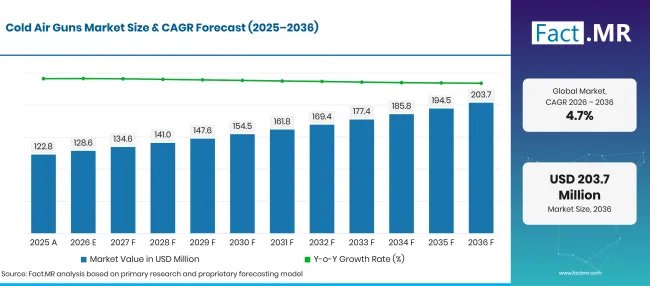
Cold Air Guns Market Forecast Global | Source: Fact.MR
Executive Market Overview
Demand for cold air guns comes mainly from dry or near-dry machining on grinders, mills, drills, band saws and plastic-machining stations. At these stations, heat at the tool shortens tool life, distorts parts and clogs grinding wheels. Manufacturing end users hold 38.1% of 2026 revenue (USD 49.0 million). Sales of cold air guns are concentrated in mature machine-tool economies: the United States (28.0%), Germany (18.0%) and Japan (14.0%) together account for 60.0% of 2026 revenue. The rest of the world holds 20.1% and grows close to the global rate, at 4.7%, as machining capacity expands in Asia and Mexico.
Prices of cold air guns are held down because the products are simple and long-lived, with no moving parts, and commodity vortex tubes can imitate them. Revenue per unit rises through adjustable temperature and flow, frost-free nozzles, dual outlets, magnetic mounting kits and the applications engineering bundled with direct sales. Germany (6.0% CAGR) and Japan (5.1% CAGR) are growing faster than the global 4.7% because of high-precision machining and tight tolerance requirements, while the United Kingdom (3.9%) and Brazil (3.4%) trail. Fact.MR sizes the market to include adjustable and fixed vortex-tube cold air guns, cold air guns sold as systems with filters, hoses and nozzles, and cold air pistols, while excluding standalone vortex tubes, enclosure and cabinet coolers, safety blow guns, mist-coolant systems and refrigerated chillers.
Analyst Perspective
"Cold air gun revenue will grow faster than unit volume, because plants are moving from fixed units to adjustable, application-engineered systems that replace mist coolant at specific machining stations. The main commercial risk is compressed-air cost: a standard Cold Gun draws 15 SCFM at 100 PSIG, so plants under energy-cost pressure will cap point-of-use cooling unless suppliers can prove payback in coolant disposal savings and longer tool life."
Shambhu Nath Jha, Principal Consultant, Fact.MR
Major Market Trends and Insights
- Adjustable Units Replace Fixed-Output Guns as Job Mixes Widen: Demand for adjustable cold air guns is rising as shops run mixed materials and short batches that need temperature and flow retuned between jobs, and adjustable units now account for 60.0% of 2026 revenue. EXAIR (October 2024) launched its Adjustable Spot Cooler System, which runs from −34°C to ambient with a single knob, ships with 15, 25 and 30 SCFM generators and is priced from USD 680. ITW Air Management (accessed November 2026) positions Vortec's Model 610 Adjustable Cold Air Gun as its most versatile model for machining and spot cooling.
- Machining Activity Rebounds in the United States and Japan: Sales of cold air guns follow spindle hours, because buyers treat them as a tool-life purchase alongside cutting tools. AMT – The Association For Manufacturing Technology (April 2026) reported US cutting tool shipments of USD 225.1 million in February 2026, up 12.8% year on year, with year-to-date shipments up 11.3%. The same release flags raw-material cost uncertainty that inflates part of the dollar growth. The Japan Machine Tool Builders' Association (May 2026) reported record March 2026 orders of ¥193.47 billion, up 31.8% year on year, which signals new spindle capacity that will need point-of-use cooling. Both figures are leading signals for the cutting tools market and the machine tools market.
- Dry Machining Replaces Coolant Mist at the Grinding Wheel: Adoption of cold air guns is growing at stations where flood coolant is not essential, as plants look to cut the cleanup, disposal and operator-exposure costs tied to the metalworking fluids market. EXAIR (accessed November 2026) specifies its Cold Gun Aircoolant System as delivering air about 30°C below supply temperature at 15 SCFM and 70 dBA, and positions it as an alternative to mist systems for grinding, drilling and milling. Japanese suppliers follow the same approach: Nihon Seiki (accessed November 2026) markets its Jet Cooler range at temperature drops of up to 60°C below supply air with no refrigerant or electricity.
What Are the Main Drivers, Restraints, and Opportunities?
Demand for cold air guns grows with machining activity and the move to dry cooling. Compressed-air energy cost is the main restraint, and adjustable systems for electronics, plastics and food processing are the main opportunity.
Driver: Tool Life and Tolerance Economics in Dry Machining
Demand for cold air guns is driven by the cost of heat damage in machining. Excess heat wears tools faster and makes parts expand out of tolerance, and in precision grinding and drilling a single rejected batch can cost more than a cold air gun system.
AMT – The Association For Manufacturing Technology (April 2026) reports double-digit growth in US cutting tool shipments in early 2026, and cold air guns are bought to protect that tooling spend. EXAIR (accessed November 2026) lists its standard Cold Gun at 15 SCFM and its High Power Cold Gun at 30 SCFM, both at 100 PSIG, so buyers can match capacity to the heat load of the wheel or tool.
Restraint: Compressed-Air Energy Cost and Supply Limits
Adoption of cold air guns is limited by compressed-air supply, because every unit needs a continuous flow of filtered air at about 80 to 100 PSIG from plant compressors.
A High Power Cold Gun drawing 30 SCFM, as specified by EXAIR (accessed November 2026), can need several kilowatts of compressor capacity when run through a full shift. Compressor makers are targeting this cost directly. BOGE (accessed November 2026) used EuroBLECH 2026 to promote its S-4 series oil-injected screw compressors (38 to 75 kW) for multi-shift sheet metal production and its airtelligence provis 3.0 network control for optimising compressed-air systems. Plants without spare capacity in the industrial air compressor market must add compressors before adding cold air guns, which delays purchases at smaller sites.
Opportunity: Adjustable, Frost-Free Systems for Non-Metal Applications
Demand for frost-free and adjustable cold air guns is opening up outside metalworking, as electronics, plastics, food and laboratory users need sub-zero air without condensation or contamination.
ITW Air Management (accessed November 2026) offers a frost-free Vortec Cold Air Gun for continuous duty without frost build-up, and a Mini Cold Air Gun for confined dry-grinding spaces. Nihon Seiki (accessed November 2026) offers Jet Cooler versions for food processing, vegetable pre-cooling and server-rack spot cooling. These applications widen the addressable base beyond metalworking and support higher unit values than plain machining units.
How Is the Cold Air Guns Market Segmented?
Fact.MR reports all segment values in USD million at the point of sale, so product type, application, channel, end-user industry and country can be compared on one revenue basis.
| Segmentation Axis | Sub-Segments Covered | 2026 Leading Segment & Share | Main Growth Benchmark (2026 to 2036) |
|---|---|---|---|
| Product Type | Adjustable cold air guns, fixed cold air guns | Adjustable, 60.0% (USD 77.2 million) | Global market 4.7% CAGR, USD 128.6 million to USD 203.7 million |
| Application | Machining, electronics, food and beverage, plastics, others | Machining, 34.2% (USD 44.0 million) | USD 75.1 million added across all applications |
| Distribution Channel | Direct sales, distributors, online retail | Direct sales, 48.5% (USD 62.4 million) | Global market grows 1.58x by 2036 |
| End-User Industry | Manufacturing, automotive, aerospace, electronics, others | Manufacturing, 38.1% (USD 49.0 million) | Germany 6.0% and Japan 5.1% CAGR outpace the global 4.7% |
| Region / Country | North America, Latin America, Europe, East Asia, South Asia and Pacific, Middle East and Africa | United States, 28.0% (USD 36.0 million) | Germany fastest at 6.0% CAGR; Brazil slowest named country at 3.4% |
Source: Fact.MR analysis. Updated Nov 13, 2026
Source: Fact.MR analysis of the cold air guns market, 2026.
Why Does the Adjustable Segment Lead by Product Type?
Cold Air Guns Market Breakdown Product Type | Source: Fact.MR
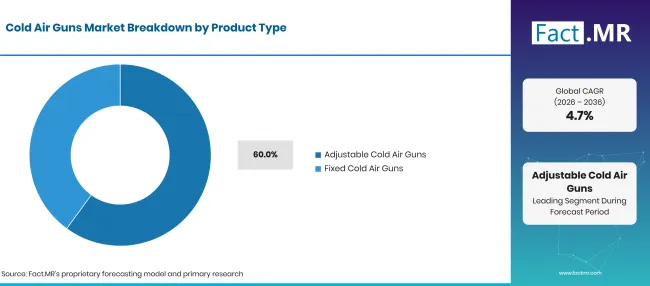
Sales of adjustable cold air guns account for 60.0% of 2026 revenue, about USD 77.2 million. One adjustable unit can be retuned for colder, lower-flow air on a small drill or higher-flow air on a grinding wheel, so a shop can standardise on one model across stations. EXAIR (October 2024) ships three interchangeable generators with its Adjustable Spot Cooler, and ITW Air Management (accessed November 2026) markets the Vortec 610 for a wide range of machining operations. Fixed units keep a role on dedicated lines where the heat load does not change.
Why Does the Machining Segment Lead by Application?
Cold Air Guns Market Breakdown Application | Source: Fact.MR
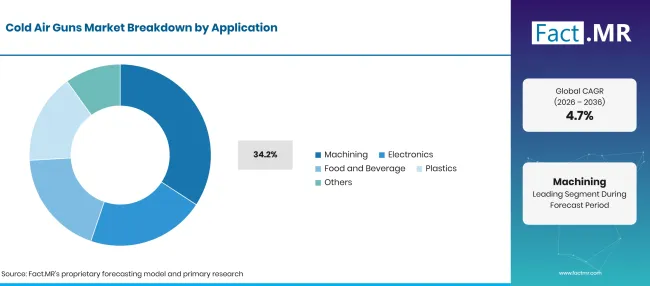
Demand for cold air guns in machining accounts for 34.2% of 2026 revenue, about USD 44.0 million. Grinding, drilling, milling, sawing and tool sharpening produce concentrated heat that cold air removes without the residue that must be cleaned off before coating or assembly. EXAIR (accessed November 2026) lists surface grinding, drilling, band sawing and plastic machining among Cold Gun applications. Electronics is the second-largest application, using cold air to set solder joints and test components thermally.
Why Does the Direct Sales Segment Lead by Distribution Channel?
Cold Air Guns Market Breakdown Distribution Channel | Source: Fact.MR
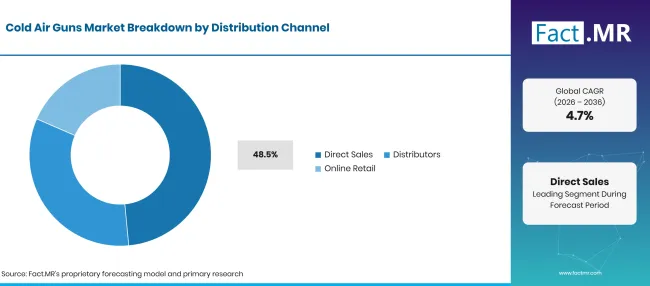
Direct sales of cold air guns account for 48.5% of 2026 revenue, about USD 62.4 million. Choosing the right unit means matching supply pressure, generator size, cold fraction and nozzle to the heat load, and a poorly matched unit wastes compressed air. Suppliers employ applications engineers to make that match before the order is placed. Distributors and online retail mainly handle repeat and replacement orders for standard models.
Cold Air Guns Market by Region and Country (2026 to 2036)
Sales of cold air guns in the five named countries account for 79.9% of 2026 revenue (USD 102.8 million), and Fact.MR projects their combined share at 80.0% in 2036. Germany gains the most share, rising from 18.0% to 20.4% on the strongest growth rate. The United States stays the largest market even as its share eases from 28.0% to 27.0%.
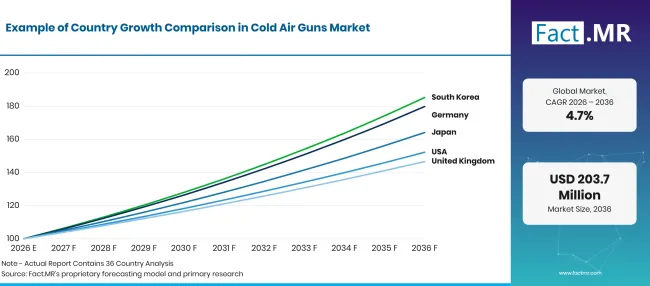
Cold Air Guns Market Growth Index | Source: Fact.MR
| Country | 2026 Revenue | 2036 Revenue | 10-Year Addition | 2026 to 2036 CAGR | Global Share (2026 → 2036) |
|---|---|---|---|---|---|
| United States | USD 36.0 million | USD 54.9 million | USD 18.9 million | 4.3% | 28.0% → 27.0% |
| Germany | USD 23.1 million | USD 41.5 million | USD 18.4 million | 6.0% | 18.0% → 20.4% |
| Japan | USD 18.0 million | USD 29.6 million | USD 11.6 million | 5.1% | 14.0% → 14.5% |
| United Kingdom | USD 15.4 million | USD 22.6 million | USD 7.2 million | 3.9% | 12.0% → 11.1% |
| Brazil | USD 10.3 million | USD 14.4 million | USD 4.1 million | 3.4% | 8.0% → 7.1% |
| Rest of world | USD 25.8 million | USD 40.7 million | USD 14.9 million | 4.7% | 20.1% → 20.0% |
| Global total | USD 128.6 million | USD 203.7 million | USD 75.1 million | 4.7% | 100.0% → 100.0% |
Source: Fact.MR analysis. Updated Nov 13, 2026
Source: Fact.MR analysis of the cold air guns market, 2026.
United States
Sales of cold air guns in the United States are projected to grow at a 4.3% CAGR from USD 36.0 million in 2026 to USD 54.9 million by 2036, adding the largest dollar increment, USD 18.9 million (1.52x), while its share eases from 28.0% to 27.0%. Demand is anchored by a large installed base in aerospace, automotive and job-shop machining, served directly by domestic suppliers such as EXAIR and Vortec. AMT – The Association For Manufacturing Technology (April 2026) reports that US cutting tool shipments rose 12.8% year on year in February 2026, which points to rising spindle hours, although part of that dollar growth reflects higher raw-material costs.
Germany
Demand for cold air guns in Germany is projected to expand at a 6.0% CAGR from USD 23.1 million in 2026 to USD 41.5 million by 2036, adding USD 18.4 million (1.80x) and gaining the most share, from 18.0% to 20.4%. The forecast assumes a recovery from a weak 2025. VDW (November 2025) reported that German machine tool orders fell 5% in the third quarter of 2025, with domestic orders down 15%, and said the decline appeared to be bottoming out. VDW (March 2026) then described the industry as showing first signs of stabilising. When German plants resume capital spending, adjustable units with documented process integration are best placed to win.
Japan
Sales of cold air guns in Japan are projected to grow at a 5.1% CAGR from USD 18.0 million in 2026 to USD 29.6 million by 2036, adding USD 11.6 million (1.64x) and lifting its share from 14.0% to 14.5%. The Japan Machine Tool Builders' Association (May 2026) reported record machine tool orders of ¥193.47 billion in March 2026, up 31.8% year on year. Domestic suppliers compete strongly in Japan. Nihon Seiki (accessed November 2026), a pneumatic equipment maker since 1955, sells Jet Cooler vortex units in three temperature-drop grades of 30°C, 40°C and 60°C. Overseas suppliers therefore need local distributors and compact, magnetic-base designs to win.
United Kingdom
Demand for cold air guns in the United Kingdom is projected to grow at a 3.9% CAGR from USD 15.4 million in 2026 to USD 22.6 million by 2036, adding USD 7.2 million (1.47x), while its share falls from 12.0% to 11.1%. UK demand follows equipment replacement in aerospace component machining, automotive supply and electronics assembly rather than new-plant investment. Meech International, a domestic supplier, competes with its Coldstream Air Gun range, while US brands reach UK buyers mainly through distributors.
Brazil
Sales of cold air guns in Brazil are projected to grow at a 3.4% CAGR from USD 10.3 million in 2026 to USD 14.4 million by 2036, adding USD 4.1 million (1.40x), while its share falls from 8.0% to 7.1%. Demand is concentrated in the automotive and component machining clusters around São Paulo and the electronics assembly base in the Manaus Free Trade Zone, where plants already run compressed-air networks. Most product is imported and sold through distributors, so landed cost and local stock limit faster uptake.
Rest of World
Sales of cold air guns in the rest of the world are projected to grow at a 4.7% CAGR from USD 25.8 million in 2026 to USD 40.7 million by 2036, adding USD 14.9 million (1.58x) and holding a stable share of about 20.0%. China, South Korea, India and Mexico account for most of this demand as machining and electronics capacity expands. Value-priced vortex tubes and domestic brands compete there with the US and European specialists.
Competitive Environment and Notable Companies
Supply of cold air guns is split into two tiers. Tier-1 consists of specialist compressed-air product companies with global distribution: Vortec (part of ITW Air Management), EXAIR, Nex Flow Air Products and Meech International. Tier-2 includes regional vortex-tube makers such as Vortex Italia, Nihon Seiki and Sanwa Enterprise, along with private-label vortex tubes sold through industrial distributors. Distributors often brand their own systems around licensed or bought-in vortex tubes, so brand share and manufacturing share differ.
How Are Companies Positioned in the Cold Air Guns Market?
Competition among cold air gun suppliers is led by Vortec and EXAIR, which cover the full range, from mini and standard to high-power, frost-free and dual-outlet units, backed by long warranties and applications engineering. ITW Air Management (accessed November 2026) offers a 10-year warranty on Vortec compressed-air products. Nex Flow competes with adjustable Frigid-X spot coolers. Meech sells its Coldstream range through its UK and European base. Japanese suppliers such as Nihon Seiki and Sanwa Enterprise serve domestic buyers with locally supported models.
What Matters When a Buyer Selects a Cold Air Gun Supplier?
Selection of a cold air gun supplier starts with cooling capacity at the plant's actual supply pressure, air consumption per unit of cooling, noise level, and the outlet temperature range the unit can reach. They also check filtration requirements and mounting options. EXAIR (accessed November 2026) publishes 70 dBA for its standard Cold Gun and 82 dBA for its High Power model, which matters where operators work beside the unit. Stock availability, same-day shipping and the availability of applications engineers often decide between technically similar offers.
Which Capabilities Distinguish Product Offers?
Differentiation among cold air gun products rests on temperature and flow adjustability, frost-free operation, dual outlets, interchangeable generators and the mounting kit. EXAIR (October 2024) ships three generators with its Adjustable Spot Cooler. ITW Air Management (accessed November 2026) offers frost-free and mini formats under the Vortec brand. Nihon Seiki (accessed November 2026) offers a resin-bodied BN-VT300R cooler for lightweight installations. Suppliers that also sell vortex tubes and enclosure coolers can cross-sell into the vortex tube market.
How Does Geographic Reach Affect Competition?
Sales reach in the cold air guns market depends on industrial distributor coverage and local stock, because many orders replace a failed or lost unit on a running line. US brands dominate North America through direct sales and national distributors. In Japan and Europe, domestic suppliers win on local service and short lead times. Suppliers without local partners in Brazil, India and Southeast Asia lose orders to value-priced vortex tubes.
| Verified Company Evidence (2026) | Commercial Effect | Buyer Action |
|---|---|---|
| 21 January 2026: EXAIR released the Model 5920 Air Cradle, a magnetic mount holding safety air guns and similar tools up to 4.5 kg at machine centres, priced from USD 30 (EXAIR, January 2026). | Shows EXAIR expanding low-cost accessories that strengthen its share of compressed-air tools at the machine. | Standardise on one supplier's point-of-use compressed-air accessories to simplify spares and mounting. |
| 14 April 2026: AMT and USCTI reported US cutting tool shipments of USD 225.1 million in February 2026, up 12.8% year on year, with year-to-date shipments up 11.3% (AMT – The Association For Manufacturing Technology, April 2026). | Rising spindle hours lift demand for tool-life protection such as cold air guns, but part of the dollar growth reflects raw-material inflation. | Use tool-life savings at current carbide prices to justify cold air gun purchases on high-wear stations. |
| 1 May 2026: Final JMTBA figures confirmed record Japanese machine tool orders of ¥193.4 billion for March 2026, supported by data-centre and semiconductor equipment investment (Seisanzai Japan, May 2026). | New spindle capacity coming on line in 2026 and 2027 creates point-of-use cooling demand at new machines. | Specify cold air cooling at machine-purchase stage so mounting and air supply are built in. |
| 20 October 2026: BOGE presented S-4 series 38 to 75 kW screw compressors and airtelligence provis 3.0 compressed-air management at EuroBLECH 2026 in Hanover (BOGE, accessed November 2026). | Compressor suppliers are marketing energy optimisation, which can either free capacity for cold air guns or raise scrutiny of point-of-use air use. | Audit compressed-air capacity and leak losses before adding cold air guns to existing lines. |
Source: Fact.MR analysis. Updated Nov 13, 2026
Source: Verified corporate disclosures and Fact.MR analysis, 2026.
| Company | Core Positioning | Verified Activity & Source Attribution |
|---|---|---|
| Vortec, ITW Air Management (Tier-1) | Full-range cold air guns: adjustable 610, frost-free, mini and pistol formats | Catalogue lists the 610 Adjustable Cold Air Gun, Frost-Free and Mini Cold Air Guns, with a 10-year warranty on compressed-air products (ITW Air Management, accessed November 2026). |
| EXAIR (Tier-1) | Cold Gun Aircoolant Systems, High Power Cold Gun and Adjustable Spot Cooler | Adjustable Spot Cooler launched with three generators from USD 680 (EXAIR, October 2024); Cold Gun rated 15 SCFM at 70 dBA (EXAIR, accessed November 2026). |
| Nex Flow Air Products (Tier-1) | Frigid-X adjustable spot coolers and vortex mist systems | Frigid-X Adjustable Spot Cooler listed in its current vortex cooling catalogue section (Nex Flow Air Products, accessed November 2026). |
| Meech International (Tier-1) | Coldstream Air Gun range for spot and process cooling | Large and small Coldstream Air Gun models listed with adjustable and non-adjustable options (Meech International, accessed November 2026). |
| Vortex Italia (Tier-2) | European supplier of standard and adjustable cold air gun systems | Lists an adjustable cold air gun system, Model 610, in its cold air gun range (Vortex Italia, accessed November 2026). |
| Nihon Seiki (Tier-2) | Japanese pneumatic equipment maker selling Jet Cooler vortex units | Jet Cooler R, N and K series rated at 30°C, 40°C and 60°C below supply air, with no refrigerant or electricity (Nihon Seiki, accessed November 2026). |
| Sanwa Enterprise (Tier-2) | Japanese pneumatic equipment distributor and maker | Markets the Kolder 190-75SV ultra-low-temperature spot cooler operating on compressed air alone (Sanwa Enterprise, accessed November 2026). |
| BOGE (adjacent supplier) | German compressed-air and gas systems maker | Presented S-4 screw compressors and airtelligence provis 3.0 at EuroBLECH 2026 (BOGE, accessed November 2026). |
Source: Fact.MR analysis. Updated Nov 13, 2026
Research Sources and Bibliography
- AMT – The Association For Manufacturing Technology. (2026, April 14). February 2026 US cutting tool shipments totaled $225.1M, up 12.8% from February 2025.
- BOGE. (Accessed 2026, November 11). Press release: EuroBLECH 2026.
- EXAIR. (Accessed 2026, November 11). Cold Gun Aircoolant System, Model 5215 and High Power Model 5230 specifications
- EXAIR. (2026, January 21). Air Cradle Safety Air Gun Mount offers magnetic tool storage.
- ITW Air Management. (Accessed 2026, November 11). Vortec Cold Air Guns catalogue.
- Japan Machine Tool Builders' Association. (2026, May). JMTBA Notes 2026-04: Monthly machine tool orders, March 2026
- Meech International. (Accessed 2026, November 11). Coldstream Air Gun.
- Nex Flow Air Products. (Accessed 2026, November 11). Section J: Frigid-X vortex tube spot cooling products.
- Nihon Seiki. (Accessed 2026, November 11). Cold air generation device Jet Cooler
- Sanwa Enterprise. (Accessed 2026, November 11). Ultra-low temperature air generator Kolder 190-75SV.
- Seisanzai Japan. (2026, May 1). Japan machine tool orders reach JPY 193.4 billion in March
- VDW. (2025, November 19). Decline in machine tool orders bottoming out./
- VDW. (2026, March 18). German machine tool industry levelling off: China further dominating production.
Segmentation
Cold Air Guns Market Report Scope and Research Methodology
Fact.MR sizes the global cold air guns market from the bottom up. The model starts with the installed base of machining centres, grinders and production stations in each covered country, applies cold-air adoption rates by application, and multiplies unit demand by average selling prices for fixed and adjustable systems. Replacement volumes are modelled from typical service life and loss rates. The results are triangulated against supplier catalogues and price lists, distributor stock data and machining activity indicators from AMT, USCTI, VDW and JMTBA. Country figures for the five named markets are modelled directly, and the rest of the world is derived as the residual of the global total.
| Coverage Field | Report Scope |
|---|---|
| Market definition | Compressed-air-powered vortex-tube devices that deliver a directed stream of cold air for industrial spot cooling, sold as guns or systems |
| Product types | Adjustable cold air guns and fixed cold air guns |
| Variants | Standard, high-power, mini, frost-free, dual-outlet and pistol-grip formats |
| Components included | Vortex tube, generator, muffler, cold-air hose and nozzles, filter-separator and magnetic base when sold as a system |
| Packaging formats | Gun-only units, complete systems with single- or dual-point hose kits, replacement generator kits |
| Distribution channels | Direct sales, industrial distributors, online retail |
| End users | Manufacturing, automotive, aerospace, electronics and other industries |
| Exclusions | Standalone vortex tubes, enclosure and cabinet coolers, safety blow guns, personal air conditioners, mist-coolant systems, refrigerated chillers |
| Quantitative units | USD million for value; percentage for share and CAGR |
| Volume basis | Units shipped to end users, counted once at first sale |
| Value basis | Manufacturer selling price revenue in the country of sale, constant 2026 USD |
| Regions covered | North America, Latin America, Europe, East Asia, South Asia and Pacific, Middle East and Africa |
| National coverage | United States, Germany, Japan, United Kingdom, Brazil, with the rest of the world as a residual |
| Companies covered | Vortec (ITW Air Management), EXAIR, Nex Flow Air Products, Meech International, Vortex Italia, Nihon Seiki, Sanwa Enterprise |
Source: Fact.MR analysis. Updated Nov 13, 2026
Frequently Asked Questions
How big is the cold air guns market in 2026?
How fast is the cold air guns market expected to grow through 2036?
Which product type leads the cold air guns market?
Which application leads the cold air guns market?
Which distribution channel leads the cold air guns market?
Which country is the largest cold air guns market?
Which countries are expected to grow fastest in the cold air guns market?
What limits adoption of cold air guns?
Who worked on this report


Preview the report firsthand - request a free sample
Free SampleGet the brochure for pricing and purchase details
Download PDF