- Base Value(2025): 4.81 Bn
- Estimated Value(2026): 5.23 Bn
- Forecast Value (2036): 11.93 Bn
- CAGR (2026 - 2036): 8.6%
Automotive Fog Lights Market Size, Market Forecast and Outlook By Fact.MR
The global automotive fog lights market was valued at USD 4.81 billion in 2025, projected to reach USD 5.23 billion in 2026, and is forecast to expand to USD 11.93 billion by 2036 at an 8.6% CAGR. Halogen fog light technology holds 42.7% of the product type segment in 2026, sustained by its position as the standard specification in volume passenger car and light commercial vehicle segments where halogen's lower unit cost relative to LED alternatives maintains OEM programme cost competitiveness, particularly in emerging market vehicle platforms where per-vehicle component cost targets are most constrained. Passenger vehicles account for 71.4% of the vehicle type segment, consistent with their production volume dominance and the universal fitment of front fog lights across passenger car body styles in markets where fog light fitment is either mandatory or expected as standard safety equipment.
The absolute dollar expansion of USD 6.70 billion over the forecast period reflects both unit volume growth from expanding vehicle production in emerging markets and a structural product mix migration from halogen toward LED fog light technology across mid-segment and premium passenger car platforms as LED system costs decline toward parity with halogen alternatives and the superior energy efficiency, longer operational life, and styling integration advantages of LED arrays justify the specification change. OEM channels account for 63.2% of the sales channel segment, reflecting fog light specification as a vehicle safety lighting component defined during platform development with regulatory compliance requirements that influence both light intensity distribution patterns and housing integration geometry within the bumper fascia.
China leads country growth at 9.5% CAGR through 2036, driven by large and growing domestic vehicle production, progressive LED technology adoption across Chinese domestic brand vehicle platforms, and the export orientation of Chinese automotive lighting manufacturers who supply both domestic and international vehicle programmes with competitive LED fog light systems. Japan follows at 9.4% CAGR, where established automotive lighting technology leadership from domestic manufacturers supports both domestic vehicle platform supply and strong export revenue from premium LED and adaptive fog light systems. The United States advances at 8.8% CAGR, supported by growing LED penetration in replacement aftermarket demand and new vehicle production incorporating LED fog light standard fitment across a broader range of model lines. South Korea registers 7.8% CAGR, driven by domestic OEM vehicle production expansion and lighting technology upgrades across Hyundai and Kia model ranges.
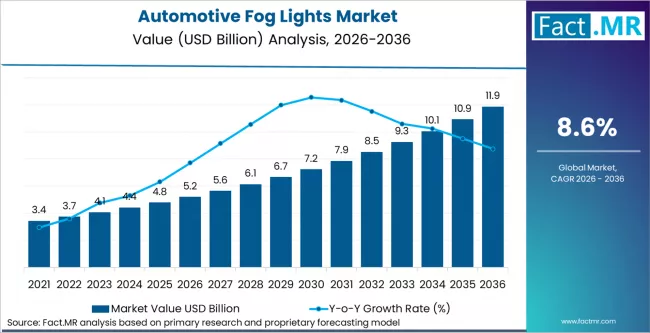
Automotive Fog Lights Market Market Value Analysis | Source: Fact.MR
Automotive Fog Lights Market Key Takeaways
| Metric | Details |
|---|---|
| Industry Size (2026) | USD 5.23 Billion |
| Industry Value (2036) | USD 11.93 Billion |
| CAGR (2026-2036) | 8.6% |
Source: Fact.MR analysis. Updated Mar 11, 2026
Automotive Fog Lights Market Definition
The automotive fog lights market encompasses front and rear fog light assemblies for passenger vehicles, light commercial vehicles, and heavy commercial vehicles, including halogen, LED, and HID/Xenon technology configurations. Front fog lights are positioned low on the vehicle front to project a wide, flat beam below the fog layer, while rear fog lights provide high-intensity red warning signals to following vehicles in low-visibility conditions. The scope covers fog light assemblies supplied to vehicle manufacturers through OEM production programmes and the aftermarket replacement and upgrade channel.
Automotive Fog Lights Market Inclusions
Market scope includes front fog light lamp and housing assemblies in halogen, LED array, and HID/Xenon configurations, rear fog light lamp and housing assemblies, integrated fog light and daytime running light combination units, and adaptive cornering fog light systems with steerable beam technology. Geographic analysis covers North America, Latin America, Europe, East Asia, South Asia, Oceania, and Middle East and Africa. Forecast scope spans 2026 to 2036 with segment breakdowns by type, vehicle type, sales channel, and region.
Automotive Fog Lights Market Exclusions
Main headlamp assemblies incorporating both primary low and high beam functions, daytime running light systems without fog light functionality, interior vehicle lighting, indicator and turn signal assemblies, auxiliary off-road light bars for non-road vehicle applications, and maritime and aviation fog signal lighting systems fall outside this market scope.
Automotive Fog Lights Market Research Methodology
- Primary Research: Fact.MR analysts conducted interviews with automotive lighting engineering managers at vehicle OEMs, fog light system product managers at tier-one lighting suppliers, and aftermarket automotive lighting category buyers at parts distribution networks to validate LED technology adoption timelines, regulatory compliance requirements for fog light intensity distribution, and replacement purchase patterns across passenger car and commercial vehicle segments.
- Desk Research: Secondary research aggregated fog light regulatory standards from UNECE Regulation 19 and national road traffic authority lighting requirements, vehicle production data from automotive industry associations, corporate product development announcements from listed automotive lighting manufacturers, and aftermarket lighting category sales data from automotive parts distributor publications.
- Market-Sizing and Forecasting: Baseline market values derive from a bottom-up aggregation of fog light unit volumes by vehicle type, multiplied by average unit prices across halogen, LED, and HID/Xenon technology tiers. LED technology adoption penetration curves by vehicle segment and market were applied as the primary product mix migration variable driving average selling price evolution across the forecast period.
- Data Validation and Update Cycle: Segment forecasts are cross-validated against revenue disclosures from publicly listed automotive lighting manufacturers and vehicle production statistics from automotive associations. Annual updates incorporate actual LED penetration rates by vehicle segment and updated vehicle production volume data by country.
Summary of Automotive Fog Lights Market
- Automotive Fog Lights Market Definition
- The automotive fog lights market covers front and rear fog light assemblies for passenger and commercial vehicles in halogen, LED, and HID/Xenon technology configurations, supplied through OEM vehicle production programmes and aftermarket replacement channels globally.
- Demand Drivers in the Market
- LED Technology Cost Reduction Enabling Mass Segment Specification: Declining LED component and module manufacturing costs are progressively closing the price gap between LED and halogen fog light configurations in volume passenger car segments, enabling OEM programme engineers to specify LED fog lights as standard equipment across mid-segment model lines where premium appearance and energy efficiency benefits justify the specification change at an acceptable cost premium over halogen alternatives.
- Mandatory Rear Fog Light Regulation in Expanding Market Set: Rear fog light fitment requirements under UNECE Regulation 48 and equivalent national standards are mandatory across EU member states, and expanding adoption of UNECE vehicle lighting standards in developing markets across Asia, Latin America, and Africa is progressively growing the vehicle base requiring compliant rear fog light installation, creating regulatory compliance-driven demand growth across emerging market vehicle production.
- Aftermarket Upgrade and Replacement Demand from Expanding Vehicle Parc: The combination of fog light failure replacement cycles driven by lamp burnout in halogen-specification vehicles and consumer upgrade demand for LED retrofitting of older halogen-equipped vehicles is generating consistent aftermarket revenue, with the growing installed base of fog-light-equipped passenger cars in emerging markets expanding the aftermarket replacement opportunity proportionally with vehicle parc growth.
- Key Segments Analyzed in the Fact.MR Report
- Halogen Type: Commands 42.7% share in 2026 as the incumbent technology specification for volume passenger car and light commercial vehicle fog lights where lower unit cost relative to LED alternatives maintains competitiveness in OEM programme cost-optimised configurations and aftermarket replacement demand from the large existing installed base of halogen-equipped vehicles sustains consistent replacement revenue.
- Passenger Vehicles Vehicle Type: Holds 71.4% share in 2026, reflecting universal front fog light fitment across passenger car body styles in most regulated markets and the concentration of LED technology upgrade investment in the passenger car segment where styling differentiation and energy efficiency benefits are most commercially valued relative to commercial vehicle fog light specifications.
- OEM Sales Channel: Accounts for 63.2% of 2026 market value, reflecting fog light specification as a vehicle lighting system component defined during platform development to meet regulatory intensity distribution requirements and bumper fascia integration geometry constraints that distinguish OEM-specified assemblies from generic aftermarket replacement units.
- Analyst Opinion at Fact.MR
- Fact.MR analysis indicates that the automotive fog lights market is in the intermediate phase of a technology transition from halogen to LED that is progressing faster in premium and mid-premium vehicle segments and more slowly in volume and entry-level segments where cost optimisation pressures maintain halogen specification relevance. The 8.6% CAGR reflects the combination of this technology upgrade cycle, which drives per-unit average selling price expansion, and underlying unit volume growth from vehicle production increases in emerging markets. The most structurally interesting development is the convergence of fog light and daytime running light functions into combination LED units that provide both functions from a single integrated assembly, reducing the per-vehicle component count while increasing the functional and aesthetic appeal of the integrated design. This convergence trend is being driven by OEM exterior lighting designers seeking a cleaner front fascia appearance and the regulatory clarity in EU markets that allows DRL and front fog light functions to be combined in a single unit subject to specific intensity and activation condition requirements. Aftermarket LED fog light retrofit demand from owners of halogen-equipped vehicles is creating a substantial replacement market opportunity that is largely being captured by lower-cost Asian manufacturers rather than OEM lighting specialists, creating a bifurcated market structure between the quality-assured OEM channel and the cost-competitive aftermarket upgrade segment.
- Strategic Implications / Executive Takeaways
- LED and DRL Combination Unit Development for Mid-Segment Platforms: Automotive lighting manufacturers should develop integrated LED fog and daytime running light combination assemblies targeting mid-segment passenger car platform nominations, as OEM exterior lighting designers are specifying combined units that reduce front fascia component count while improving visual appearance and meeting both fog light and DRL regulatory requirements from a single compact assembly.
- Aftermarket LED Retrofit Product Quality Differentiation: Established automotive lighting brands should develop certified LED fog light retrofit kits for high-volume halogen-equipped vehicle models that meet original equipment intensity distribution specifications and carry warranty commitments, differentiating quality-assured retrofit products from unverified imports that dominate the current aftermarket upgrade segment and carry regulatory non-compliance risks in markets with roadworthiness inspection requirements.
- China and Japan Manufacturing Partnership Strategy: Suppliers targeting 9.5% and 9.4% CAGR growth in China and Japan respectively should develop local manufacturing or assembly partnerships with established domestic automotive lighting manufacturers to serve OEM and aftermarket channels with locally produced product, as supply chain localisation advantages and OEM supplier qualification preferences favour domestically manufactured components in both markets.
Analysis of Automotive Fog Light Market (2020 to 2024) vs. Market Forecasts (2026 to 2036)
A predictive analysis was conducted on the market, for the forecast period of 2026 to 2036, with a historical growth rate of 7.4% from 2021 to 2026. The anticipated growth (2026 to 2036) will rise by 8.6% at a CAGR to reach an absolute dollar opportunity of US$ 5,682.9 million.
| Historical Report Attributes | Details |
|---|---|
| Market Size (2021A) | US$ 3,066.8 million |
| Market Size (2026A) | US$ 4,082.1 million |
| Historical CAGR (2021 to 2026) | 7.4% |
| Forecasted CAGR (2026 to 2036) | 8.6% |
Source: Fact.MR analysis. Updated Mar 11, 2026
- Short Term (2026 to 2027): In the short term, the vehicle fog light market is expected to remain stable, driven by growing awareness in regions prone to fog, heavy rain, or snow about the importance of road safety and visibility. While traditional halogen fog lights will still be in demand, LED fog lights will become more popular because they last longer, use less power, and work better in foggy conditions. Most vehicle owners replace their lighting systems for better visibility in bad weather. This could lead OEMs to make fog lights a standard feature in more midrange vehicles, rather than just an optional upgrade.
- Medium Term (2027 to 2030): From 2027 to 2030, the automotive fog light market will shift towards more advanced technologies. Adaptive and dynamic fog lights will become mainstream, adjusting light intensity and beam direction based on weather and road conditions, improving visibility and safety. Integration with other vehicle lighting systems, like adaptive headlights and automatic high beams, will enhance overall performance. LED fog lights will remain popular, but manufacturers will explore energy-efficient technologies such as laser and matrix fog lights. These innovations will deliver more precise lighting control and better energy efficiency. Regulatory safety and efficiency standards will push automakers to adopt these advanced systems, making them more affordable and widely available across various vehicle segments, thereby boosting overall market growth.
- Long Term (2030 to 2036): The automotive fog light market will undergo a major transformation, driven by the convergence of autonomous vehicle technology, advanced driver assistance systems (ADAS), and smarter, more sustainable lighting solutions. Fog light systems will no longer be standalone components but integrated into a larger ecosystem of smart vehicle lighting. These systems will adjust automatically to road conditions, weather changes, and vehicle speed, using sensors and AI to optimize visibility without requiring driver intervention. Fog light systems will certainly incorporate more functions and become indicators, turn signals, or automatic hazard lights in low-visibility scenarios.
On the back of the aforementioned facts, the automotive fog lights market is anticipated to grow at a CAGR of 8.6% during the forecast period from 2026 to 2036, According to the Fact.MR, a market research and competitive intelligence provider.
Market Dynamics
What driving forces influence the demand for Automotive Fog Light?
“Implementation of Stringent Road Safety Norms across Regions”
The improvement of road safety has recently been a concern to many governments, especially in adverse weather conditions like fog, heavy rain, and snow. They are enacting laws that force cars to have improved lighting systems. Fog lights are an important part of these regulations because they enable drivers to view the road clearly in low-visibility conditions, hence minimizing accidents.
With these new standards of safety, fog lights are becoming compulsory in many vehicles, not only for the new models but also in the existing ones too by retrofitting. As road safety norms become more rigorous, automakers are under increasing pressure to adopt advanced fog light technologies.
This trend is pushing the automotive fog light market to grow, as both manufacturers and consumers recognize the critical role of these lights in improving safety on the road.
“High Pollution & Rising Smog Levels Driving Demand for Fog Lamps”
Pollution levels across the world have risen substantially and are expected to rise further as climate changes become worse and these changes result in extreme weather. Fog lights provide illumination in bad weather conditions such as fog, smog and extreme rain, which helps in ensuring road safety in extreme conditions.
Fog lights are usually installed in the lower end of front bumpers that ensure illumination of road in extreme conditions to improve driver visibility and hence have become a crucial lighting element in automobiles. As pollution and smog levels increase, regions are facing more frequent low-visibility conditions, reinforcing the need for better lighting systems.
With growing awareness of air quality and road safety, governments are promoting the use of fog lights to help improve driving conditions. These factors are also expected to bolster sales of automotive fog lights across the forecast period.
What are the Primary Constraints Faced by the Competitors for Automotive Fog Lights?
“High Process of LED FOG Lamps & Rising Raw Material Costs”
Raw material pricing is expected to be a major concern for manufacturers of fog lights across the forecast period. Changing socio-economic landscape of the world and political influence on world trade are major factors that are expected to drive up costs of raw materials and negatively impact the automotive fog light market. Such high-priced advanced LED fog lamps associated with advanced technologies are likely going to restrict the overall market scope.
The fluctuation in the prices of raw materials like rare earth metals, plastics, and aluminum could further exacerbate production costs, especially with increased demand for more energy-efficient and durable lighting solutions.
Country-wise Insights
Country-wise Forecast CAGRs for the Automotive Fog Light Market
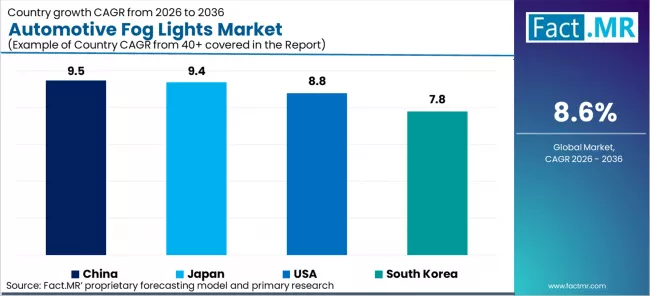
Automotive Fog Lights Market Cagr Analysis By Country | Source: Fact.MR
| Country | CAGR |
|---|---|
| U.S. | 8.8% |
| China | 9.5% |
| Japan | 9.4% |
| South Korea | 7.8% |
Source: Fact.MR analysis. Updated Mar 11, 2026
Why are Key Suppliers of Fog Lights Investing in China?
“Existence of a Strong Automotive Production Sector & Favorable Government Policies”
China is recognized for its strong manufacturing sector and has been a prominent producer of automobiles for an extended period. Both of the previously mentioned factors create an optimal market for various automotive parts and render it a profitable market for manufacturers of automotive fog lights too.
Supportive government programs aimed at enhancing economic growth, the existence of major automotive parts manufacturers, and increasing vehicle sales are additional elements expected to drive automotive fog light shipments in the nation and yield profitable returns for manufacturers and suppliers.
The country’s growing electric vehicle (EV) market, with a shift towards more energy-efficient and technologically advanced lighting systems, presents new opportunities for fog light manufacturers to integrate cutting-edge technologies, further boosting the demand.
The market in the China is estimated at US$ 769 million in 2026 and is projected to expand at a CAGR of 9.5% through 2036. This market is projected to generate a US$ 1,132.2 million absolute dollar opportunity from 2026 to 2036.
Category-wise Insights
Why is the LED Fog Lights Market Expected to Have a Bright Outlook?
“Low Cost & Energy Efficiency Driving Installation of LED Fog Light Kits”
Halogen fog lights were popular in the automotive sector in the past due to their low cost and accessibility. With the entry of LED fog lights, the automotive manufacturers have found an alternative, which is more efficient and cost effective, compared to standard halogen lamps. After this, the LED segment has held a dominant market share.
This dominant stance is anticipated to be maintained throughout the forecast period. LED fog lamp manufacturers are focusing on launching new lights with better illumination and efficiency to increase their sales potential and this is expected to favor sales of LED fog lamps through 2036.
Demand for LED fog Lights is projected to increase at a CAGR of 10.6% from 2026 to 2036 and generate a US$ 2,477.3 million absolute dollar opportunity.
How is the Aftermarket for Fog Lights?
“Frequent Replacements of Fog Lights Kits to Drive Aftermarket Sales”
The global automotive fog light market, based on sales channel, is segmented into OEMs and aftermarket.
Automotive fog lights generally have a reduced lifespan and usually require replacement more frequently than automotive headlights. The fog lights recommended by OEM are usually pricier than aftermarket options, leading many individuals to favor the latter. Aftermarket sales of automotive fog lights are projected to exceed OEM sales in the next ten years.
As cars get older, the demand for repairs and enhancements rises, prompting buyers to seek aftermarket options for cheaper and personalized fog light solutions. The ease of installation and cost-effectiveness of aftermarket fog light kits also make them a popular choice for consumers seeking to improve vehicle performance without high costs.
Competitive Landscape
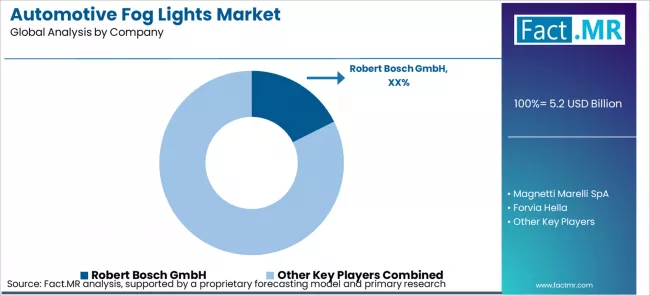
Automotive Fog Lights Market Analysis By Company | Source: Fact.MR
Companies devote a significant portion of their revenue to R&D to resolve problems and offer creative solutions to draw in new customers and stay competitive. Companies are developing customized offerings for issues that meet industry-specific needs to compete with other players.
- On November 2024, OSRAM has introduced the NIGHT BREAKER LED SMART retrofit front fog lamps (H8, H10, H16, and HB4), enabling vehicle owners to easily upgrade to advanced LED technology. These lamps improve visibility in foggy conditions with white light (up to 6000 Kelvin) and a wide beam. Compact, durable, and easy to install, they complement OSRAM's NIGHT BREAKER LED headlights, offering a cost-effective and safer lighting solution.
Fact.MR has provided detailed information about the price points of key manufacturers of Automotive Fog Light positioned across regions, sales growth, production capacity, and speculative technological expansion, in the recently published report.
Bibliography
- United Nations Economic Commission for Europe. (2024, February). UNECE Regulation No. 19: Uniform Provisions Concerning the Approval of Motor Vehicle Front Fog Lamps. UNECE.
- United Nations Economic Commission for Europe. (2024, February). UNECE Regulation No. 48: Uniform Provisions Concerning the Approval of Vehicles with Regard to the Installation of Lighting and Light-Signalling Devices. UNECE.
- European Commission, Directorate-General for Internal Market. (2024, March). EU Vehicle Lighting Regulation: LED Technology Performance Standards and DRL and Fog Light Combination Unit Requirements. European Commission.
- Government of China, National Standards Committee. (2024, January). GB 4660: Road Motor Vehicles - Front Fog Lamps - Technical Requirements and Test Methods. SAC China.
- Government of India, Ministry of Road Transport and Highways. (2024, May). AIS-012 Part 15: Automotive Industry Standard for Front and Rear Fog Lamps for Motor Vehicles. MoRTH.
- International Energy Agency. (2024, March). Energy Technology Perspectives: LED Lighting Cost and Efficiency Roadmap for Automotive Applications. IEA.
This bibliography is provided for reader reference. The full Fact.MR report contains the complete reference list with primary research documentation.
This Report Addresses
- Market sizing and quantitative forecast metrics: detailing precise revenue projections, absolute dollar growth, and compound annual growth rates across major automotive fog lights segments and geographies through 2036.
- Segmentation analysis: mapping the adoption velocity of leading product, technology, and end-use categories and evaluating structural factors driving segment share transitions over the forecast period.
- Regional deployment intelligence: comparing growth dynamics in high-momentum Asia Pacific and emerging markets against the mature replacement and upgrade demand patterns prevalent in European and North American industry hubs.
- Regulatory compliance assessment: analyzing how evolving product safety standards, environmental directives, and sector-specific mandates are reshaping procurement decisions, material specifications, and supplier qualification criteria.
- Competitive posture evaluation: tracking consolidation trends, platform integration strategies, technology differentiation investments, and the resulting competitive dynamics among established market players and emerging challengers.
- Capital project strategic guidance: defining the procurement specifications, investment thresholds, and performance benchmarks required to support next-generation product adoption and facility modernization programs.
- Supply chain vulnerability analysis: identifying sourcing concentration risks, logistics bottlenecks, raw material price dependencies, and geographic exposure scenarios that affect market participant cost structures.
- Custom data delivery formats: encompassing interactive dashboards, raw Excel datasets, and comprehensive PDF narrative reports tailored for executive decision-making and analyst reference applications.
Segmentation
Scope of the Report
| Metric | Value |
|---|---|
| Quantitative Units | USD 5.23 billion to USD 11.93 billion, at a CAGR of 8.6% |
| Market Definition | Front and rear fog light assemblies for passenger and commercial vehicles in halogen, LED, and HID/Xenon technology configurations, supplied through OEM production programmes and aftermarket replacement channels globally. |
| Type Segmentation | Halogen, LED, HID/Xenon |
| Vehicle Type Segmentation | Passenger Vehicles, LCVs, HCVs |
| Sales Channel Segmentation | OEMs, Aftermarket |
| Regions Covered | North America, Latin America, Europe, East Asia, South Asia, Oceania, Middle East and Africa |
| Countries Covered | China, Japan, USA, South Korea, and 40 plus countries |
| Key Companies Profiled | Robert Bosch GmbH, Magnetti Marelli SpA, Forvia Hella, OSRAM Light AG, Valeo SA, ZKW Group, Hyundai Mobis, General Electric, Phoenix Lamps Ltd., Guangzhou LED Auto Company Ltd., Royal Philips Electronics |
| Forecast Period | 2026 to 2036 |
| Approach | Bottom-up aggregation of fog light units by vehicle type with LED technology penetration curve and average selling price migration modeling |
Source: Fact.MR analysis. Updated Mar 11, 2026
Segmentation of Automotive Fog Light Market
-
By Type :
- Halogen
- Xenon
- HID
- LED
-
By Vehicle Type :
- Passenger Vehicles
- Light Commercial Vehicles
- Heavy Commercial Vehicles
-
By Sales Channels :
- OEMs
- Aftermarket
-
By Region :
- North America
- Latin America
- Western Europe
- Eastern Europe
- East Asia
- South Asia & Pacific
- Middle East & Africa
Frequently Asked Questions
How large is the automotive fog lights market in 2026?
What will the fog lights market size be by 2036?
What is the expected CAGR between 2026 and 2036?
Which technology type leads the market in 2026?
Which vehicle type accounts for the largest share?
What is driving China's 9.5% CAGR leadership?
How is the LED transition reshaping the fog lights market?
What is excluded from the scope of this report?
Who worked on this report


Preview the report firsthand - request a free sample
Free SampleGet the brochure for pricing and purchase details
Download PDF