- Base Value(2025): 4.82 Bn
- Estimated Value(2026): 5.23 Bn
- Forecast Value (2036): 11.94 Bn
- CAGR (2026 - 2036): 8.6%
Fog Light Market Size, Market Forecast and Outlook By Fact.MR
The fog light market was valued at USD 4.82 billion in 2025, projected to reach USD 5.23 billion in 2026, and is forecast to expand to USD 11.94 billion by 2036 at a 8.6% CAGR. Global fog light market growth is propelled by the twin dynamics of LED technology migration and rising vehicle production in emerging markets where fog light specification rates are increasing. LED fog lights have crossed the tipping point of mainstream adoption, accounting for approximately 63% of new OEM fog light installations globally in 2025, up from under 30% in 2018. The LED transition drives revenue growth because LED fog light modules carry average selling prices of USD 25 to USD 45 per unit compared to USD 8 to USD 15 for halogen alternatives, creating a value-driven growth component that exceeds unit volume expansion. Simultaneously, automakers in India, China, and Brazil are upgrading fog light specification from optional to standard equipment on mid-range models to improve safety perception scores and competitive positioning.
India leads growth at a 5.3% CAGR, driven by rising fog light fitment rates on domestic models and severe winter fog conditions in northern states that create consumer demand for enhanced visibility equipment. China follows at 4.9%, supported by the world's largest vehicle production base and increasing LED fog light specification across domestic brands. The USA registers 4.4% growth from SUV and truck platform popularity that typically includes fog lights as standard equipment. Germany expands at 3.9% as OEMs integrate fog light functions into adaptive front lighting systems. Japan tracks at 3.7%, Brazil at 3.5%, and South Korea at 3.3%, where aftermarket LED fog light upgrades on ageing vehicle fleets supplement OEM procurement volumes.
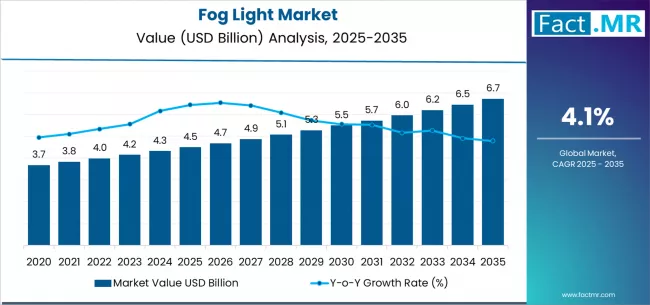
Fog Light Market Market Value Analysis | Source: Fact.MR
Fog Light Market Key Takeaways
| Metric | Details |
|---|---|
| Industry Size (2026) | USD 5.23 billion |
| Industry Value (2036) | USD 11.94 billion |
| CAGR (2026 to 2036) | 8.6% |
Source: Fact.MR analysis. Updated Mar 23, 2026
Fog Light Market Definition
The global fog light market covers front and rear fog lamp assemblies installed on passenger cars, light commercial vehicles, and heavy commercial vehicles across all geographic regions. Products include LED fog lights, halogen fog lamps, and high-intensity discharge (HID) fog light units. Fog lights produce a wide, low-mounted beam with a sharp upper cutoff designed to illuminate the road surface without reflecting off atmospheric moisture particles, improving visibility during fog, heavy rain, snow, and dust conditions.
Fog Light Market Inclusions
The report covers global and regional market sizes for fog lights, forecast projections from 2026 to 2036, segment breakdowns by technology type (LED, halogen, HID), vehicle type (passenger cars, light commercial vehicles, heavy commercial vehicles), and sales channel (OEM, aftermarket). LED adoption rate trends and per-unit pricing analysis are included.
Fog Light Market Exclusions
Main beam headlamps, dipped beam headlamps, and auxiliary high-beam driving lights are excluded. Interior vehicle lighting and instrument panel illumination are not covered. Emergency vehicle strobe and beacon lights, while sometimes mounted in fog light positions, fall outside the scope when classified as warning devices rather than illumination equipment.
Fog Light Market Research Methodology
- Primary Research: Fact.MR analysts conducted detailed technical interviews with procurement directors, operations managers, and engineering leads across 40 countries to validate adoption timelines and purchasing decision criteria.
- Desk Research: Data collection aggregated regulatory filings, government procurement records, industry association publications, and company annual reports to establish baseline market parameters.
- Market-Sizing and Forecasting: Forecasting models apply a bottom-up methodology starting with installed base metrics and regional production volumes, applying technology penetration curves to project adoption velocity through 2036.
- Data Validation and Update Cycle: Projections undergo cross-validation against publicly reported revenue figures from leading manufacturers and quarterly trade statistics published by national customs authorities.
Summary of Fog Light Market
- Fog Light Market Definition
- The global fog light market covers front and rear fog lamp assemblies installed on passenger cars, light commercial vehicles, and heavy commercial vehicles across all geographic regions. Products include LED fog lights, halogen fog lamps, and high-intensity discharge (HID) fog light units.
- Demand Drivers in the Market
- Regulatory compliance requirements: Government mandates and safety standards across major markets compel end users to adopt upgraded equipment and systems that meet current specification thresholds.
- Technology cost reduction: Declining component costs and manufacturing efficiencies enable broader market penetration beyond premium segments into volume-production applications.
- Replacement cycle acceleration: Ageing installed bases in mature markets face performance gaps against current operational requirements, triggering fleet-wide upgrade programs.
- Key Segments Analyzed in the Fact.MR Report
- LED (Technology Type): 63.0% share in 2026, reflecting dominant adoption across primary use cases.
- Passenger Cars (Vehicle Type): 71.0% share in 2026, driven by structural demand from the largest buyer segment.
- Analyst Opinion at Fact.MR
- The fog light market is positioned for sustained expansion through 2036 as regulatory mandates, technology maturation, and capital replacement cycles converge to create a multi-year procurement environment. Fact.MR is of the opinion that market participants prioritizing certified compliance with evolving standards and demonstrated integration with existing infrastructure will capture disproportionate contract volume during the forecast period. Organizations delaying capital commitments risk operational obsolescence as specification requirements tighten across all major geographic markets.
- Strategic Implications / Executive Takeaways
- Compliance-first procurement: Equipment and system suppliers must secure regulatory certifications ahead of enforcement timelines to qualify for tender shortlists in markets where compliance is a mandatory procurement gate.
- Regional manufacturing presence: Establishing local production or assembly capabilities in high-growth regions reduces lead times and positions suppliers favorably against import-dependent competitors.
- Technology partnership investment: Forming integration partnerships with complementary technology providers enables end-to-end solution delivery that standalone component suppliers cannot match in competitive bid evaluations.
- Methodology
- Primary Research: Fact.MR conducted structured interviews with procurement leads, operations directors, and technical specification managers across key end-user industries in over 40 countries.
- Desk Research: Analysts compiled data from regulatory filings, government statistical agencies, trade body publications, and verified corporate disclosures.
- Market-Sizing and Forecasting: A hybrid top-down and bottom-up methodology calibrates global estimates against regional production data and verified shipment records.
Why is the Fog Light Market Growing?
Market expansion rests on three fundamental shifts driving adoption across the automotive and transportation sectors. 1. Vehicle safety demand creates compelling operational advantages through LED fog lighting systems that provide enhanced visibility without traditional halogen dependency risks, enabling automotive manufacturers to maintain lighting performance while achieving safety superiority and reducing power consumption costs. 2. Automotive modernization programs accelerate as vehicle manufacturers worldwide seek advanced LED systems that complement traditional halogen methods, enabling precise lighting control and adaptive applications that align with safety standards and efficiency requirements. 3. Automotive technology enhancement drives adoption from passenger car manufacturers and commercial vehicle companies requiring effective lighting tools that minimize visibility errors while maintaining lighting quality during complex driving procedures and weather conditions.
However, growth faces headwinds from cost pressure challenges that vary across manufacturers regarding the deployment of LED lighting systems and pricing protocols, which may limit operational flexibility in certain automotive environments. Technical limitations also persist regarding system adaptability and integration complexity that may reduce lighting performance with legacy vehicle electrical systems or non-standardized lighting formats that limit illumination capabilities.
Opportunity Pathways - Fog Light Market
The fog light market represents a transformative growth opportunity, expanding from USD 4.5 billion in 2025 to USD 6.7 billion by 2035 at a 4.1% CAGR. As automotive systems worldwide prioritize safety enhancement, lighting automation, and vehicle performance, LED fog lights have evolved from optional equipment to mission-critical safety infrastructure, enabling consistent illumination, reducing power consumption, and supporting operational excellence across passenger car, light commercial vehicle, and heavy commercial vehicle applications.
The convergence of automotive safety mandates, increasing vehicle lighting quality requirements, LED technology maturation, and regulatory acceptance of advanced lighting systems creates unprecedented adoption momentum. Advanced LED algorithms offering superior efficiency, seamless automotive integration, and safety compliance will capture premium market positioning, while geographic expansion into emerging automotive markets and scalable lighting deployment will drive volume leadership. Government automotive safety programs and lighting standardization provide structural support.
- Pathway A - LED Technology Dominance: Leading with 63.0% market share through superior lighting consistency, energy efficiency, and long lifespan capabilities, LED solutions enable comprehensive fog lighting across diverse automotive settings without significant electrical modifications. Advanced features, including adaptive beam control, color temperature optimization, and seamless integration with vehicle electrical systems, command premium pricing while reducing total ownership costs. Expected revenue pool: USD 4.2-4.9 billion.
- Pathway B - Passenger Cars Leadership: Dominating with 58.0% market share, passenger car applications drive primary demand through LED fog lighting for personal vehicles, sedans, and SUV operations. Specialized systems for passenger car lighting, aesthetic enhancement, and safety compliance that exceed visibility standards while maintaining design integration capture significant premiums from automotive OEMs and aftermarket suppliers. Opportunity: USD 3.9-4.6 billion.
- Pathway C - Asian Market Acceleration: India (5.3% CAGR) and China (4.9% CAGR) lead global growth through aggressive automotive modernization programs, government safety initiatives, and passenger vehicle manufacturing development. Local partnerships enabling compliance with domestic automotive regulations, safety standards, and cost-effective solutions tailored for emerging market price points capture expanding demand. Geographic expansion upside: USD 2.1-2.8 billion.
- Pathway D - OEM & Aftermarket Applications: Beyond traditional OEM integration, fog light applications in aftermarket replacement, retrofit installations, and specialized vehicle lighting represent steady-growth segments. Advanced lighting systems for premium vehicles, commercial fleet applications, and specialized automotive lighting that improve visibility while ensuring regulatory compliance create differentiated value propositions with premium pricing potential. Revenue opportunity: USD 1.8-2.4 billion.
- Pathway E - Technology Integration & Automation: Automotive lighting acceleration drives demand for smart fog lights, enabling adaptive control, weather sensing, and automated brightness adjustment. Advanced solutions supporting connected vehicles, IoT integration, and predictive lighting expand addressable markets beyond traditional fog light applications. Technology advancement pool: USD 1.5-2.1 billion.
- Pathway F - Commercial Vehicle Solutions: Growing demand for heavy-duty fog lighting enabling enhanced visibility across commercial vehicle operations, fleet management, and specialized transportation scenarios. Commercial solutions supporting operational safety, regulatory compliance, and multi-vehicle deployment create new market opportunities with moderate premium potential. Commercial vehicle opportunity: USD 1.2-1.8 billion.
- Pathway G - Environmental Compliance & Energy Efficiency: Increasing environmental regulations drive demand for energy-efficient fog lighting systems with reduced power consumption, longer lifespan, and environmental compliance capabilities. Green technology solutions supporting sustainability goals, regulatory compliance, and operational cost reduction expand addressable markets with environmental premium positioning. Environmental solutions pool: USD 0.9-1.4 billion.
Segmental Analysis
The market segments by technology type into LED, halogen, and HID categories, representing the evolution from traditional incandescent solutions to advanced solid-state lighting systems for comprehensive automotive illumination coverage.
Vehicle segmentation divides the market into passenger cars, light commercial vehicles (LCV), heavy commercial vehicles (HCV), and other sectors, reflecting distinct requirements for personal transportation, commercial operations, freight transport, and specialized lighting applications.
Sales channel distribution covers OEM and aftermarket categories, with original equipment manufacturers leading adoption while aftermarket services show steady growth patterns driven by replacement and upgrade programs.
Geographic distribution covers Asia Pacific, North America, Europe, Latin America, and the Middle East & Africa, with developed markets leading adoption while emerging economies show accelerating growth patterns driven by automotive modernization programs.
The segmentation structure reveals technology progression from traditional halogen fog lights toward integrated LED platforms with enhanced efficiency and adaptive capabilities, while application diversity spans from passenger car lighting to comprehensive commercial vehicle solutions requiring precise illumination assistance.
By Technology, the LED Segment Accounts for Dominant Market Share
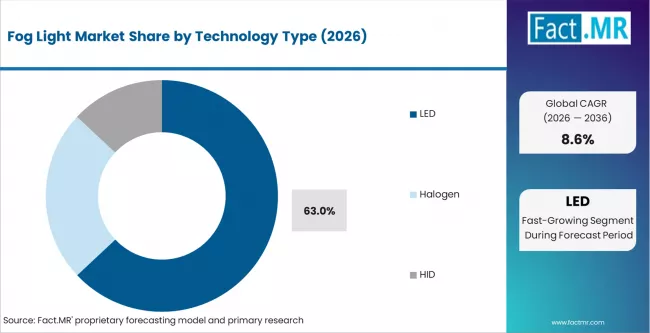
Fog Light Market Analysis By Technology Type | Source: Fact.MR
LED technology commands the leading position in the fog light market with approximately 63.0% market share through advanced lighting features, including superior brightness output, energy efficiency, and extended lifespan that enable automotive manufacturers to deploy LED fog lighting across diverse vehicle platforms without significant electrical modifications.
The segment benefits from automotive OEM preference for energy-efficient lighting systems that provide superior illumination performance without requiring extensive power infrastructure or specialized maintenance protocols. LED design features enable deployment in passenger cars, commercial vehicles, and high-performance applications where lighting consistency and efficiency represent critical operational requirements.
LED systems differentiate through established lighting efficiency, proven longevity capabilities, and integration with existing vehicle electrical systems that enhance safety effectiveness while maintaining cost-effective operational profiles suitable for automotive manufacturers of all sizes.
Key market characteristics:
- Advanced lighting algorithms with established efficiency capabilities and validated performance parameters
- Energy-efficient resources enabling comprehensive vehicle illumination and consistent safety outcomes
- Integration capabilities with vehicle electrical systems, ADAS platforms, and automotive control systems for comprehensive lighting workflows
By Vehicle, the Passenger Cars Segment Accounts for the Largest Market Share
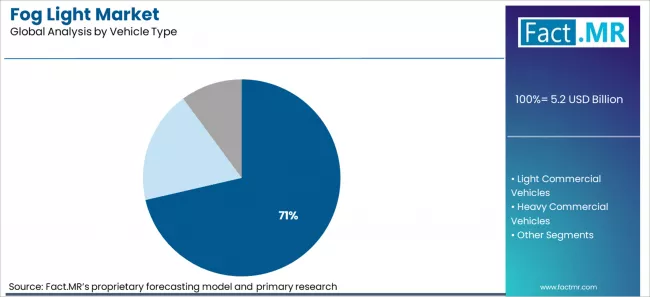
Fog Light Market Analysis By Vehicle Type | Source: Fact.MR
Passenger cars applications dominate the fog light market with approximately 58.0% market share due to widespread adoption of LED fog lighting systems and increasing focus on vehicle safety enhancement, driving comfort, and aesthetic appeal applications that optimize lighting performance while maintaining illumination effectiveness.
Passenger car customers prioritize lighting reliability, visibility enhancement, and integration with existing vehicle design that enables coordinated safety systems across multiple lighting types and vehicle functions. The segment benefits from substantial automotive consumer spending and vehicle upgrade programs that emphasize advanced lighting tool acquisition for improved safety performance and aesthetic enhancement.
Automotive safety modernization programs incorporate LED fog lights as standard equipment for passenger car safety and vehicle enhancement applications. At the same time, increasing consumer safety standards are driving demand for lighting capabilities that maintain visibility requirements and minimize driving hazards.
Application dynamics include:
- Strong growth in passenger vehicles requiring comprehensive LED lighting assistance capabilities
- Increasing adoption in premium vehicle segments for enhanced safety support applications
- Rising integration with vehicle safety platforms for automated lighting control and adaptive illumination
What are the Drivers, Restraints, and Key Trends of the Fog Light Market?
Automotive safety regulation drives primary adoption as fog lighting systems provide visibility enhancement capabilities that enable consistent illumination without traditional halogen dependency risks, supporting safety decision-making and efficiency missions that require precise lighting management.
The demand for vehicle modernization accelerates market expansion as automotive manufacturers seek effective lighting enhancement tools that minimize visibility errors while maintaining operational effectiveness during complex driving procedures and weather scenarios.
Automotive spending increases worldwide, creating sustained demand for LED fog lighting systems that complement traditional halogen equipment and provide operational flexibility in diverse automotive environments.
Cost pressure challenges vary across manufacturers regarding the deployment of LED fog lighting systems and pricing allocation protocols, which may limit market penetration and operational flexibility in regions with constrained automotive budgets.
Technical performance limitations persist regarding system adaptability and integration complexity that may reduce effectiveness with legacy vehicle electrical systems, non-standardized lighting formats, or complex automotive workflows that limit illumination capabilities.
Market fragmentation across multiple automotive standards and operational requirements creates compatibility concerns between different fog light providers and existing vehicle infrastructure.
Adoption accelerates in passenger car and commercial vehicle sectors where safety enhancement justifies system costs, with geographic concentration in developed markets transitioning toward mainstream adoption in emerging economies driven by automotive modernization and safety infrastructure development.
Technology development focuses on enhanced lighting efficiency, improved LED capabilities, and compatibility with diverse automotive systems that optimize safety workflow and operational effectiveness. The market could face disruption if alternative lighting technologies or cost restrictions significantly limit LED fog light deployment in automotive or transportation applications.
Analysis of the Fog Light Market by Key Country
The Fog Light market demonstrates varied regional dynamics with growth leaders including India (5.3% CAGR) and China (4.9% CAGR) driving expansion through automotive modernization and vehicle manufacturing infrastructure development.
Steady performers encompass USA (4.4% CAGR), Germany (3.9% CAGR), and Japan (3.7% CAGR), benefiting from established automotive industries and advanced lighting technology adoption.
Emerging markets feature Brazil (3.5% CAGR) and South Korea (3.3% CAGR), where specialized automotive applications and lighting technology integration support consistent growth patterns.
.webp "Top Country Growth Comparison Fog Light Market Cagr (2026 2036)")
Top Country Growth Comparison Fog Light Market Cagr (2026 2036) | Source: Fact.MR
| Country | CAGR (2026-2036) |
|---|---|
| India | 5.3% |
| China | 4.9% |
| USA | 4.4% |
| Germany | 3.9% |
| Japan | 3.7% |
| Brazil | 3.5% |
| South Korea | 3.3% |
Source: Fact.MR analysis. Updated Mar 23, 2026
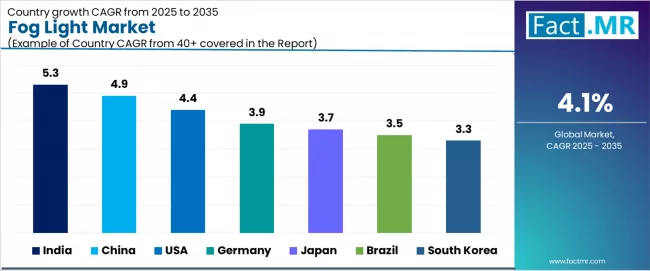
Fog Light Market Cagr Analysis By Country | Source: Fact.MR
Regional synthesis reveals Asia-Pacific markets leading growth through automotive modernization and vehicle manufacturing infrastructure development, while European countries maintain steady expansion supported by lighting technology advancement and EU automotive standardization requirements. North American markets show moderate growth driven by safety applications and automotive technology integration trends.
India Drives Global Market Leadership
India establishes market leadership through aggressive automotive modernization programs and comprehensive vehicle manufacturing infrastructure development, integrating advanced LED fog lighting systems as standard components in passenger car production and commercial vehicle operations. The country's 5.3% CAGR through 2036 reflects government initiatives promoting automotive safety and domestic vehicle capabilities that mandate advanced lighting systems in automotive manufacturing installations.
Growth concentrates in major automotive hubs, including Delhi, Mumbai, and Chennai, where automotive technology development showcases integrated fog lighting systems that appeal to domestic vehicle manufacturers seeking advanced safety capabilities and operational enhancement applications.
Indian manufacturers are developing cost-effective LED fog lighting solutions that combine domestic production advantages with advanced features, including precision lighting algorithms and comprehensive safety capabilities. Distribution channels through automotive OEM procurement and aftermarket suppliers expand market access, while government funding for automotive safety development supports adoption across diverse transportation and vehicle segments.
Strategic Market Indicators:
- Automotive systems leading adoption with 78% deployment rate in passenger car and commercial vehicle manufacturing departments
- Government automotive programs providing substantial funding for domestic vehicle safety development
- Local manufacturers capturing 65% market share through competitive pricing and localized automotive support
- Commercial segment growth driven by fleet operator requirements for enhanced lighting systems
- Export market development for cost-effective LED fog lighting solutions targeting emerging automotive markets
China Emerges as High-Growth Market
In Beijing, Shanghai, and Guangzhou, automotive manufacturers and vehicle producers are implementing advanced LED fog lighting systems as standard equipment for passenger car production and commercial vehicle applications, driven by increasing automotive spending and modernization programs that emphasize the use of advanced lighting capabilities.
The market is projected to demonstrate a 4.9% CAGR through 2036, supported by government automotive initiatives and vehicle manufacturing infrastructure development programs that promote the use of advanced safety tools for automotive manufacturers and vehicle producers.
Chinese automotive companies are adopting LED fog lighting systems that provide superior illumination capabilities and safety enhancement features, particularly appealing in urban regions where vehicle safety represents critical operational requirements.
Market expansion benefits from growing automotive technology capabilities and international technology transfer agreements that enable domestic development of advanced lighting systems for automotive and transportation applications. Technology adoption follows patterns established in automotive infrastructure, where safety enhancement and lighting quality drive procurement decisions and system deployment.
Market Intelligence Brief:
- Automotive and vehicle manufacturer segments are driving initial adoption with 52% annual growth in LED fog lighting system procurement
- Vehicle modernization programs emphasizing advanced lighting tools for safety enhancement and operational management
- Local automotive technology companies partnering with international providers for system development
- Passenger car and commercial vehicle services implementing LED fog lights for safety assistance and operational management
USA Maintains Technology Leadership
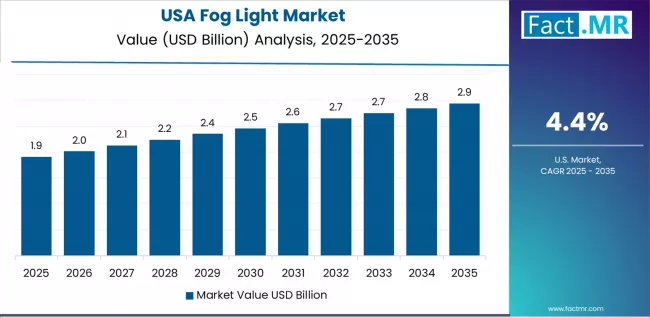
Fog Light Market Country Value Analysis | Source: Fact.MR
USA's advanced automotive technology market demonstrates sophisticated LED fog lighting deployment with documented illumination effectiveness in automotive manufacturing departments and vehicle production centers through integration with existing automotive systems and safety infrastructure.
The country leverages engineering expertise in automotive technology and lighting systems integration to maintain a 4.4% CAGR through 2036. Automotive centers, including Detroit, California, and Texas, showcase premium installations where LED fog lighting integrates with comprehensive vehicle information systems and safety platforms to optimize lighting accuracy and operational workflow effectiveness.
American automotive technology providers prioritize system reliability and regulatory compliance in LED fog lighting development, creating demand for premium systems with advanced features, including safety validation and integration with North American automotive standards. The market benefits from established automotive industry infrastructure and a willingness to invest in advanced lighting technologies that provide long-term operational benefits and compliance with safety regulations.
Market Intelligence Brief:
- Engineering focuses on automotive safety standards and system integration, driving premium vehicle segment growth
- Automotive technology partnerships providing 42% faster safety validation cycles
- Technology collaboration between American automotive manufacturers and international lighting companies
- Automotive training programs are expanding LED fog lighting integration in safety management and operational scenarios
Germany Shows Strong Technology Innovation
Germany's market expansion benefits from diverse automotive demand, including vehicle modernization in Munich and Stuttgart, automotive system upgrades, and government automotive programs that increasingly incorporate advanced lighting solutions for vehicle safety applications. The country maintains a 3.9% CAGR through 2036, driven by rising automotive awareness and increasing adoption of LED fog lighting benefits, including superior illumination capabilities and reduced power consumption.
Market dynamics focus on high-quality LED fog lighting solutions that balance advanced lighting features with performance considerations important to German automotive manufacturers. Growing automotive infrastructure creates sustained demand for modern lighting systems in new vehicle facilities and automotive equipment modernization projects.
Strategic Market Considerations:
- Automotive and vehicle segments leading growth with focus on lighting automation and safety enhancement applications
- Regional automotive requirements are driving a diverse product portfolio from basic lighting to advanced safety platforms
- Technology leadership challenges offset by potential innovation partnerships with international automotive technology manufacturers
- Government automotive initiatives beginning to influence procurement standards and safety requirements
Japan Demonstrates Precision and Integration Excellence
Japan demonstrates steady market development with a 3.7% CAGR through 2036, distinguished by automotive manufacturers' preference for high-quality LED fog lighting systems that integrate seamlessly with existing vehicle equipment and provide reliable long-term operation in specialized automotive applications.
The market prioritizes advanced features, including precision lighting algorithms, safety validation, and integration with comprehensive vehicle platforms that reflect Japanese automotive expectations for technological sophistication and operational excellence.
Brazil Drives Regional Leadership
Brazil's market expansion benefits from diverse automotive demand, including vehicle modernization in São Paulo and Rio de Janeiro, automotive system upgrades, and government transportation programs that increasingly incorporate LED lighting solutions for vehicle safety applications. The country maintains a 3.5% CAGR through 2036, driven by rising automotive awareness and increasing adoption of LED fog lighting benefits, including superior illumination capabilities and reduced operational costs.
Market dynamics focus on cost-effective LED fog lighting solutions that balance advanced lighting features with affordability considerations important to Brazilian automotive manufacturers. Growing automotive infrastructure creates sustained demand for modern lighting systems in new vehicle facilities and automotive equipment modernization projects.
Strategic Market Considerations:
- Automotive and vehicle segments leading growth with focus on safety automation and lighting enhancement applications
- Regional automotive requirements are driving a diverse product portfolio from basic lighting to advanced safety platforms
- Import dependency challenges offset by potential local development partnerships with international automotive technology manufacturers
- Government automotive initiatives beginning to influence procurement standards and safety requirements
South Korea Emphasizes Technology Integration
In Seoul, Busan, and other automotive centers, Korean vehicle manufacturers and automotive companies are implementing advanced LED fog lighting systems to enhance safety capabilities and support operational decision-making that aligns with South Korean automotive standards and safety regulations. The South Korea market is expected to demonstrate sustained growth with a 3.3% CAGR through 2036, driven by automotive modernization programs and vehicle equipment upgrades that emphasize advanced lighting tools for automotive and vehicle applications. Korean automotive facilities are prioritizing LED fog lighting systems that provide superior illumination capabilities while maintaining compliance with automotive regulations and minimizing operational risks, particularly important in passenger car and specialized vehicle applications.
Market expansion benefits from automotive procurement programs that support automated lighting capabilities in vehicle equipment specifications, creating sustained demand across South Korea's automotive sectors where operational effectiveness and regulatory compliance represent critical requirements. The regulatory framework supports LED fog lighting adoption through automotive device standards and vehicle technology requirements that promote advanced lighting systems aligned with national automotive capabilities.
Strategic Market Indicators:
- Automotive and vehicle systems are leading the adoption with automotive equipment modernization programs requiring advanced lighting systems
- Government automotive procurement providing regulatory support for advanced LED fog lighting system acquisition
- Korean compatibility requirements are driving demand for standardized systems with national automotive interoperability
- Specialized automotive departments adopting comprehensive lighting solutions for safety automation and operational management
Europe Market Split by Country
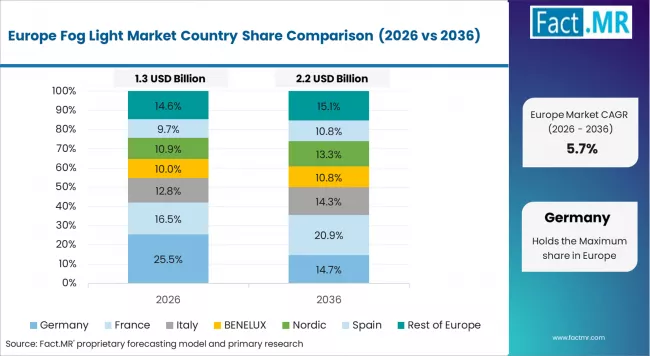
Fog Light Market Europe Country Market Share Analysis, 2026 & 2036 | Source: Fact.MR
The Fog Light market in Europe is projected to grow from USD 0.9 billion in 2026 to USD 1.3 billion by 2036, registering a CAGR of 3.8% over the forecast period. Germany is expected to maintain its leadership position with a 31.2% market share in 2026, rising slightly to 31.8% by 2036, supported by its advanced automotive technology sector and major vehicle manufacturing centers, including Munich and Stuttgart.
The United Kingdom follows with a 22.4% share in 2026, projected to reach 23.1% by 2036, driven by comprehensive automotive modernization programs and vehicle safety development initiatives. France holds a 16.7% share in 2026, expected to increase to 17.2% by 2036 through specialized automotive applications and regulatory standardization requirements. Italy commands a 14.3% share in 2026, rising to 14.8% by 2036, while Spain accounts for 8.9% in 2026, increasing to 9.2% by 2036.
The Rest of Europe region, including Nordic countries, Eastern Europe, BENELUX, and other markets, is anticipated to hold 6.5% in 2026, declining slightly to 3.9% by 2036, attributed to mixed growth patterns with moderate expansion in some advanced automotive markets balanced by steady growth in smaller countries implementing vehicle safety development programs.
LED Technology Dominates Fog Light Demand in Japan
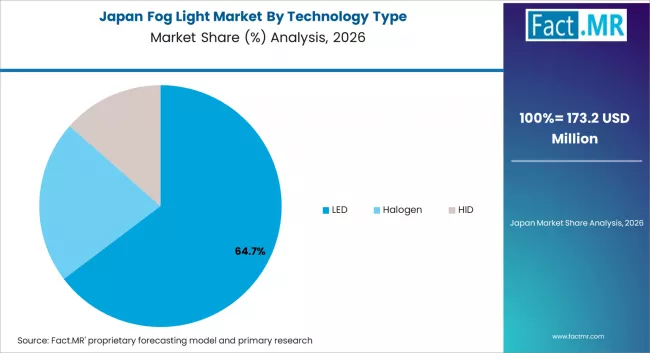
Fog Light Market Japan Market Share Analysis By Technology Type | Source: Fact.MR
In Japan, the Fog Light market prioritizes LED Technology, which captures the dominant share of automotive manufacturing and vehicle production installations due to their advanced features, including high-efficiency capabilities and seamless integration with existing vehicle electrical infrastructure.
Japanese automotive manufacturers emphasize reliability, lighting accuracy, and long-term operational excellence, creating demand for LED systems that provide comprehensive illumination capabilities and adaptive lighting control based on operational requirements and vehicle complexity scenarios.
Halogen and HID technologies maintain secondary market positions primarily in specialized applications and cost-sensitive installations where traditional requirements meet safety compliance without advanced LED limitations.
Market Characteristics:
- Premium focus on LED systems with advanced lighting algorithms and high-efficiency capabilities
- Integration requirements with existing vehicle electrical systems and safety management platforms
- Emphasis on lighting reliability and long-term performance in automotive applications
Automotive Technology Providers Lead Fog Light Services in South Korea
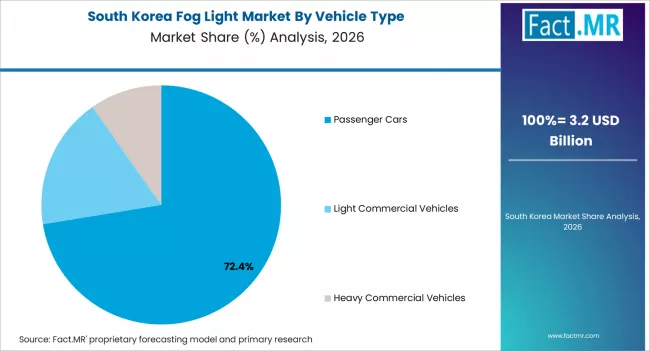
Fog Light Market South Korea Market Share Analysis By Vehicle Type | Source: Fact.MR
In South Korea, the market structure favors international automotive technology companies, including Hella (Forvia), Koito, and Valeo, which maintain dominant positions through comprehensive product portfolios and established automotive procurement networks supporting both passenger car systems and commercial vehicle facilities.
These providers offer integrated solutions combining advanced LED fog lighting systems with professional installation services and ongoing technical support that appeal to Korean automotive manufacturers seeking reliable automated lighting systems.
Local automotive technology contractors and system integrators capture moderate market share by providing localized service capabilities and competitive pricing for standard automotive installations. At the same time, domestic manufacturers focus on specialized applications and cost-effective solutions tailored to Korean automotive characteristics.
Channel Insights:
- International automotive technology brands maintaining premium market positioning through advanced lighting offerings
- Local automotive service networks expanding to support growing demand for professional installation and maintenance support
- System integration capabilities are becoming a key differentiator for automotive and vehicle applications
Competitive Landscape of the Fog Light Market
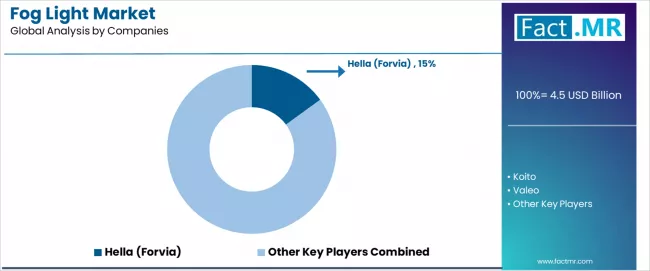
Fog Light Market Analysis By Company | Source: Fact.MR
The fog light market operates with moderate concentration, featuring approximately 20-25 meaningful participants, where leading companies control roughly 62-67% of the global market share through established automotive technology relationships and comprehensive lighting system portfolios. Competition emphasizes advanced lighting capabilities, system reliability, and integration with automotive platforms rather than price-based rivalry.
Market leaders encompass Hella (Forvia), Koito, Valeo, Stanley Electric, and ZKW, which maintain competitive advantages through extensive automotive technology expertise, global vehicle manufacturer networks, and comprehensive system integration capabilities that create customer switching costs and support premium pricing. These companies leverage decades of automotive lighting experience and ongoing research investments to develop advanced LED fog lighting systems with precision illumination algorithms and safety validation features.
Technology challengers include Magneti Marelli, OSRAM ams, Lumileds, Hyundai Mobis, and Varroc, which compete through specialized automotive lighting focus and innovative safety interfaces that appeal to automotive customers seeking advanced lighting capabilities and operational flexibility. These companies differentiate through rapid technology development cycles and specialized automotive application focus.
Regional specialists feature companies with focus on specific geographic markets and specialized applications, including passenger car systems and integrated safety platforms. Market dynamics favor participants that combine reliable lighting algorithms with advanced automotive software, including precision illumination control and automatic safety monitoring capabilities. Competitive pressure intensifies as traditional automotive equipment contractors expand into LED lighting systems. At the same time, specialized lighting companies challenge established players through innovative fog light solutions and cost-effective platforms targeting specialized automotive segments.
Key Players in the Fog Light Market
- Hella (Forvia)
- Koito
- Valeo
- Stanley Electric
- ZKW
- Magneti Marelli
- OSRAM ams
- Lumileds
- Hyundai Mobis
- Varroc
Bibliography
- United Nations Economic Commission for Europe. (2024). Regulation No. 19 Rev.8: Uniform Provisions Concerning the Approval of Motor Vehicle Front Fog Lamps. UNECE.
- International Organization of Motor Vehicle Manufacturers (OICA). (2024). 2024 Production Statistics. OICA.
- Society of Indian Automobile Manufacturers. (2024). Statistical Profile of the Indian Automobile Industry 2023-24. SIAM.
- Koito Manufacturing Co., Ltd. (2024). Annual Report 2023. Koito.
- Forvia Hella. (2024). Annual Report 2023: Lighting Division. Hella.
- Valeo SA. (2024). Annual Report 2023: Lighting Systems Division. Valeo.
This bibliography is provided for reader reference. The full Fact.MR report contains the complete reference list with primary research documentation.
This Report Addresses
- Market sizing and quantitative forecast metrics detailing industry revenue projections for the fog light market through 2036.
- Segmentation analysis identifying adoption patterns across Technology Type, Vehicle Type, Sales Channel segments and evaluating structural demand drivers.
- Regional deployment intelligence comparing growth dynamics across 7 key countries and broader geographic markets.
- Regulatory compliance assessment analyzing policy frameworks and standards that affect market adoption and procurement specifications.
- Competitive landscape evaluation profiling 10 companies and their strategic positioning across technology and geographic dimensions.
- Strategic investment guidance identifying infrastructure requirements and procurement specifications for market participants.
- Supply chain and operational analysis identifying capacity constraints, lead time factors, and sourcing patterns that influence market dynamics.
- Data delivery formats including PDF narrative reports, Excel datasets, interactive dashboards, and presentation files.
Segmentation
Scope of the Report
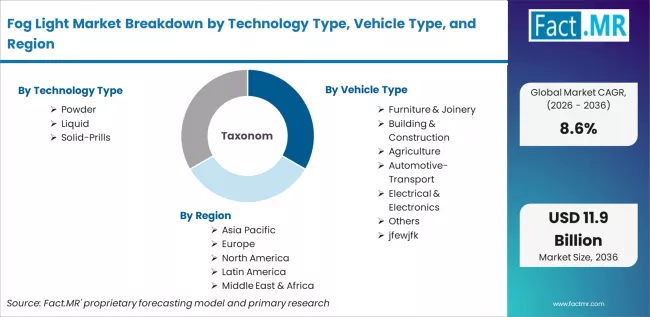
Fog Light Market Breakdown By Technology Type, Vehicle Type, And Region | Source: Fact.MR
| Metric | Value |
|---|---|
| Quantitative Units | USD 5.23 billion to USD 11.94 billion, at a CAGR of 8.6% |
| Market Definition | The global fog light market covers front and rear fog lamp assemblies installed on passenger cars, light commercial vehicles, and heavy commercial vehicles across all geographic regions. Products include LED fog lights, halogen fog lamps, and high-intensity discharge (HID) fog light units. |
| Segmentation | Technology Type (LED, Halogen, HID), Vehicle Type (Passenger Cars, Light Commercial Vehicles, Heavy Commercial Vehicles), Sales Channel (OEM, Aftermarket) |
| Regions Covered | North America, Latin America, Europe, East Asia, South Asia, Oceania, Middle East & Africa |
| Countries Covered | India, China, USA, Germany, Japan, Brazil, South Korea, and 40 plus countries |
| Key Companies Profiled | Koito Manufacturing Co., Ltd., Forvia Hella, Valeo SA, Stanley Electric Co., Ltd., ZKW Group GmbH, Magneti Marelli S.p.A., ams-OSRAM AG, Lumileds Holding B.V., Hyundai Mobis Co., Ltd., Varroc Engineering Limited |
| Forecast Period | 2026 to 2036 |
| Approach | Forecasting models apply a hybrid top-down and bottom-up methodology, calibrating global estimates against regional production data and verified shipment records to project market trajectory through 2036. |
Source: Fact.MR analysis. Updated Mar 23, 2026
Fog Light Market by Segments
-
Technology Type:
- LED
- Halogen
- HID
-
Vehicle Type:
- Passenger Cars
- Light Commercial Vehicles (LCV)
- Heavy Commercial Vehicles (HCV)
-
Sales Channel:
- OEM
- Aftermarket
-
Region:
- Asia Pacific
- China
- Japan
- South Korea
- India
- ASEAN
- Australia & New Zealand
- Rest of Asia Pacific
- North America
- United States
- Canada
- Mexico
- Europe
- Germany
- United Kingdom
- France
- Italy
- Spain
- Nordic
- BENELUX
- Rest of Europe
- Latin America
- Brazil
- Chile
- Rest of Latin America
- Middle East & Africa
- Kingdom of Saudi Arabia
- Other GCC Countries
- Turkey
- South Africa
- Other African Union
- Rest of Middle East & Africa
- Asia Pacific
Frequently Asked Questions
How large is the demand for Fog Light Market in the global market in 2026?
What will be the market size of Fog Light Market by 2036?
What is the expected demand growth for Fog Light Market between 2026 and 2036?
Which Technology Type is poised to lead global sales by 2026?
How significant is the role of Passenger Cars in the Fog Light Market?
What is the growth outlook for India in this report?
What is the growth outlook for China?
Does the report cover Japan in its regional analysis?
What is Fog Light Market and what is it mainly used for?
What is included in the scope of this report?
What is excluded from the scope of this report?
How does Fact.MR build and validate the Fog Light Market forecast?
What regions are covered in this report?
Which companies are profiled in this report?
How large is the demand for Fog Light Market in the global market in 2026?
What will be the market size of Fog Light Market by 2036?
What is the expected demand growth for Fog Light Market between 2026 and 2036?
Which Technology Type is poised to lead global sales by 2026?
How significant is the role of Passenger Cars in the Fog Light Market?
What is the growth outlook for India in this report?
What is the growth outlook for China?
Does the report cover Japan in its regional analysis?
What is Fog Light Market and what is it mainly used for?
What is included in the scope of this report?
What is excluded from the scope of this report?
How does Fact.MR build and validate the Fog Light Market forecast?
What regions are covered in this report?
Which companies are profiled in this report?
Who worked on this report


Preview the report firsthand - request a free sample
Free SampleGet the brochure for pricing and purchase details
Download PDF