- Market Value (2025): USD 100.7 Bn
- Estimated Value (2026): USD 114.0 Bn
- Forecast Value (2036): USD 393.9 Bn
- CAGR (2026-2036): 13.2%
What is the Free from Foods Market forecast to be worth by 2036?
USD 393.9 billion by 2036 at a 13.2% CAGR.
- The Free from Foods Market reached USD 100.7 billion in 2025.
- Demand is projected to increase from USD 114.0 billion in 2026 to USD 393.9 billion by 2036.
- The market is forecast to expand at a 13.2% CAGR from 2026 to 2036.
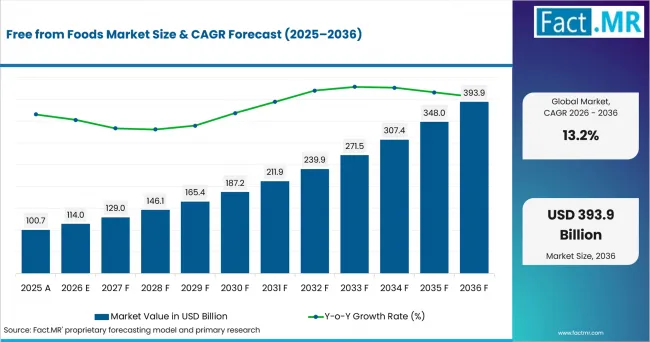
Free From Foods Market Value Analysis | Source: Fact.MR
What are the defining numbers behind Free from Foods Market growth?
An absolute opportunity of USD 279.9 billion is expected between 2026 and 2036.
- Demand Drivers in the Market
- Food-allergen and intolerance management creates repeat demand because affected consumers must consistently screen ingredient lists and replace conventional products with suitable alternatives. The U.S. FDA requires packaged foods to declare nine major food allergens, while EU rules require clear declaration of 14 allergens. These frameworks make absence claims and controlled formulations commercially important for brands serving consumers who avoid milk, wheat, soy and other ingredients.
- Defined absence claims reduce uncertainty at the point of purchase. The FDA requires foods using a “gluten-free” claim to contain less than 20 parts per million of gluten and to meet specific ingredient conditions. Manufacturers therefore need formulation control, supplier verification and cross-contact management before they can make a compliant claim, supporting demand for purpose-designed free-from ranges.
- Sugar reduction is widening the category beyond allergy-led purchasing. The FDA Nutrition Facts label identifies added sugars separately and uses a 50 gram Daily Value on a 2,000-calorie diet. This makes sugar content easier to compare across packaged foods and supports reformulation into sugar-free or reduced-sugar variants where taste and texture can be maintained.
- Organic positioning expands the addressable consumer base for free-from products. USDA ERS reports that consumer demand for organically produced goods has grown over several decades and that conventional grocery retailers are now the primary outlets for organic food sales. This allows certified organic free-from products to compete within ordinary grocery baskets rather than depend on specialist stores.
- Large food companies are broadening personalized-nutrition portfolios. General Mills reported that more than one in four of its North American product SKUs, over 1,200 SKUs as of October 2025, were labelled gluten-free. Portfolio breadth at this scale shows how exclusion-based formulations can move from isolated specialty products into multiple everyday food categories.
- Key Segments Analyzed
- GMO Free Food accounts for 36.8% of Product in 2026, supported by broad applicability across cereals, edible oils, meat and poultry, bakery, and packaged foods.
- Organic holds 77.2% of Nature in 2026 because certification gives buyers a recognized production standard that can sit alongside ingredient-exclusion and clean-label claims.
- Direct Sales represents 38.4% of Sales Channel in 2026 as manufacturers and large buyers use direct business-to-business supply to control specifications, certification documentation, volume planning, and allergen requirements.
- Analyst Opinion at Fact.MR
- Shambhu Nath Jha, Principal Consultant at Fact.MR, states, “Free-from purchasing depends on trust in the claim and repeatable product performance. Buyers compare ingredient exclusions, certification, taste, cross-contact controls and price before switching from a conventional product. Suppliers that can support several dietary requirements within one portfolio, while keeping labels clear and manufacturing controls consistent, are positioned to win repeat listings as the category expands.”
- Strategic Implications
- Manufacturers should design portfolio architecture around explicit exclusion claims such as gluten-free, lactose-free, sugar-free, GMO-free and artificial-ingredient-free rather than using one broad wellness message for all products.
- Allergen segregation, supplier documentation and change-control procedures should be treated as commercial capabilities because an ingredient substitution can affect label eligibility across several free-from claims.
- Organic free-from products need certification continuity across sourcing and processing. Buyers will place more value on traceability when an organic claim is combined with allergen or ingredient exclusions.
- Direct business-to-business accounts should receive specification sheets that clearly state excluded ingredients, relevant testing thresholds and cross-contact controls. This reduces qualification time for retailers, foodservice buyers and private-label customers.
- Product development should prioritize multi-attribute formulations where the exclusions are technically compatible. A gluten-free product that is also dairy-free or artificial-ingredient-free can serve more dietary occasions without multiplying SKU complexity at the same rate.
How does the Free from Foods Market break down by segment?
The market is segmented by Product, Nature and Sales Channel.
Why does GMO Free Food lead Product?
GMO Free Food is projected to account for a 36.8% share in 2026.
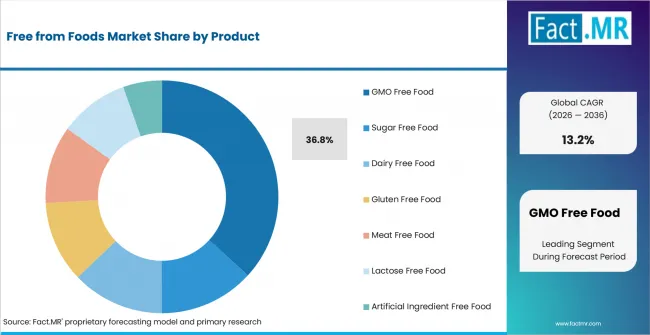
Free From Foods Market Analysis By Product | Source: Fact.MR
The category leads because the claim can be applied across a wide range of everyday foods, including cereals and grains, edible oils, meat and poultry, bakery products and packaged foods. This gives manufacturers more opportunities to extend a single exclusion attribute across several high-frequency purchase categories.
The operational requirement is traceability. Manufacturers need ingredient sourcing and identity-preservation controls that support the claim across upstream suppliers and finished products. That procurement discipline overlaps with the traceability expectations already used in certified free-from ingredients and other specialty food inputs, making documented supplier qualification a core purchasing criterion.
For retailers and food manufacturers, GMO-free products are also easier to merchandise across several aisles than a category tied to one product format. The breadth of eligible applications supports larger procurement programs and repeated line extensions.
Why does Organic lead Nature?
Organic is projected to account for a 77.2% share in 2026.
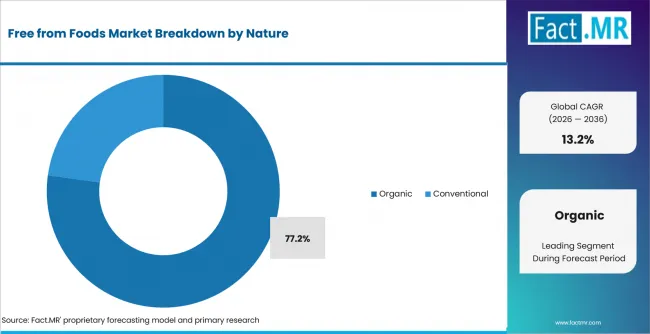
Free From Foods Market Analysis By Nature | Source: Fact.MR
Organic leads because it adds a recognized production and certification framework to the exclusion-based proposition. Buyers can evaluate a certified organic claim against defined farming and processing rules, while free-from attributes address separate dietary or ingredient concerns.
USDA ERS notes that conventional grocery retailers are the primary outlets for organic food sales in the USA. Germany’s federal Bio-Siegel can be used on products produced and controlled under EU organic rules, and 59% of respondents in the German Nutrition Report 2024 said they pay attention to the Bio-Siegel always or most of the time when shopping. These established certification cues reduce the explanation required at shelf level. Related demand for organic foods also gives manufacturers a broader certified supply base for free-from formulations.
Organic leadership therefore reflects buyer preference for claims that can be verified through an established certification system. For free-from brands, the combination supports product differentiation while keeping the label recognizable to consumers.
Why does Direct Sales lead Sales Channel?
Direct Sales is projected to account for a 38.4% share in 2026.
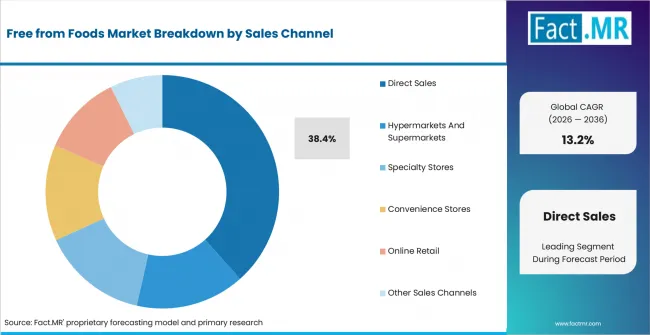
Free From Foods Market Analysis By Sales Channel | Source: Fact.MR
Direct sales lead because many free-from products are specified at business-to-business level before they reach a consumer shelf. Retail chains, foodservice operators and private-label owners may require exact allergen exclusions, organic certification, pack formats and documentation that are easier to manage through direct supply agreements.
The channel also supports volume planning for products that require segregated production or dedicated ingredient sourcing. A supplier can align batch sizes and delivery schedules with the buyer while keeping formulation and label specifications stable across repeated orders.
Specialty stores and online retail remain important for discovery and niche diets, but direct supply can concentrate larger contract volumes. It also gives manufacturers closer visibility into reformulation requests and compliance requirements from institutional buyers.
What is accelerating Free from Foods Market adoption, and what is holding it back?
Growth is being accelerated by dietary-risk management and mainstream reformulation, with multi-attribute products creating additional revenue opportunities; higher formulation costs and cross-contact controls remain the principal constraints.
Drivers Impact Analysis
| Factor | (~) % Impact on CAGR | Geographic Relevance | Impact Timeline |
|---|---|---|---|
| Allergen and intolerance-led product substitution | +2.4% | USA; U.K.; Europe; East Asia | Near term |
| Mainstream reformulation into free-from variants | +2.0% | Global | Near to mid term |
| Organic certification paired with exclusion claims | +1.6% | USA; France; Germany; Italy | Mid term |
| Retail and online assortment expansion | +1.3% | USA; U.K.; Europe; Japan; South Korea | Mid term |
| Sugar-content transparency and reformulation | +1.0% | USA; U.K.; Europe | Mid to long term |
Opportunity Impact Analysis
| Factor | (~) % Impact on CAGR | Geographic Relevance | Impact Timeline |
|---|---|---|---|
| Multi-attribute free-from formulations | +1.4% | Global | Mid term |
| Private-label and direct B2B supply programs | +1.1% | USA; U.K.; Germany; France | Near to mid term |
| Localized allergen-aware products for East Asia | +0.9% | Japan; South Korea | Mid term |
| Certified organic free-from extensions | +0.8% | USA; France; Germany; Italy | Mid to long term |
Restraints Impact Analysis
| Factor | (~) % Impact on CAGR | Geographic Relevance | Impact Timeline |
|---|---|---|---|
| Higher formulation and specialty-ingredient costs | -1.5% | Global | Near term |
| Cross-contact control and label-compliance complexity | -1.2% | USA; U.K.; Europe; East Asia | Near term |
| Taste and texture trade-offs after ingredient removal | -0.9% | Global | Mid term |
| Consumer confusion across overlapping absence claims | -0.6% | Global | Mid to long term |
Which countries are scaling the Free from Foods Market through 2036?
- USA: FDA allergen rules require clear declaration of nine major allergens, while the federal gluten-free rule sets a defined threshold for products using that claim. Clear legal definitions give manufacturers a basis for building product lines around wheat, milk and other ingredient exclusions.
- U.K.: Natasha’s Law requires prepacked-for-direct-sale foods in England, Wales and Northern Ireland to carry a full ingredients list with allergenic ingredients emphasized. This raises the value of controlled recipes and clear free-from positioning across grocery and foodservice channels.
- France: Organic food remains a meaningful part of household purchasing, with Agence BIO reporting that organic accounted for 5.8% of household food consumption in 2025. That certified-food base supports demand for organic free-from products across mainstream food categories.
- Germany: The federal Bio-Siegel gives shoppers a recognized organic cue and is used alongside the EU organic logo. Its established control system supports products that combine organic certification with exclusion claims such as dairy-free, gluten-free or artificial-ingredient-free.
- Italy: The Ministry of Health maintains a national register of gluten-free foods eligible for reimbursement through the national health system for people with celiac disease. This creates an institutional route for purpose-formulated gluten-free foods alongside ordinary retail demand.
- South Korea: MFDS requires allergen labeling for a broad list that includes milk, soybeans and wheat, and it requires a separate allergen declaration near the raw-material list. This makes precise formulation and label control important for packaged free-from foods.
- Japan: Japan’s Consumer Affairs Agency requires allergen labeling for specified ingredients including wheat, egg and milk, with additional allergens recommended for disclosure. The label system supports consumers who screen packaged foods before purchase and gives free-from brands a clear compliance framework.
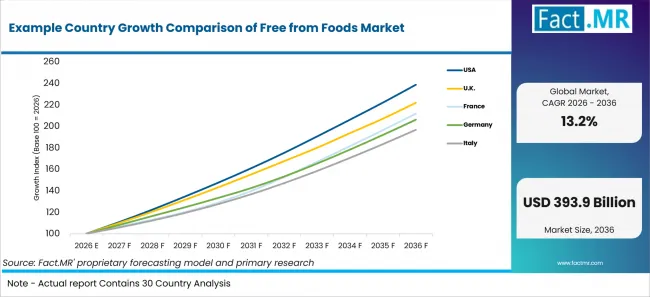
Country CAGR (2026-2036)
Example Country Growth Comparison Of Free From Foods Market | Source: Fact.MR
| Country | CAGR, 2026-2036 |
|---|---|
| USA | 9.1% |
| U.K. | 8.3% |
| France | 7.8% |
| Germany | 7.5% |
| Italy | 7.0% |
| South Korea | 7.4% |
| Japan | 6.9% |
What is driving USA’s growth through 2036?
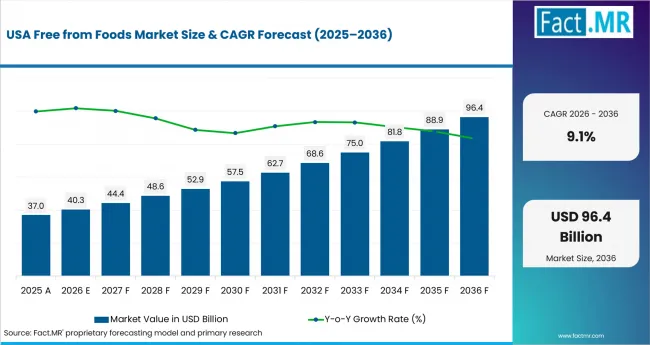
USA is forecast to expand at a 9.1% CAGR from 2026 to 2036.
Free From Foods Market Country Value Analysis | Source: Fact.MR
U.S. growth is anchored in regulated absence and allergen claims that reduce uncertainty for consumers making repeat purchases. The FDA requires packaged foods to identify major food allergens and defines “gluten-free” through ingredient restrictions and a limit below 20 ppm gluten. These rules create a clear commercial standard for manufacturers that invest in segregated production and claim verification.
USDA ERS also reports that organic products are sold primarily through conventional grocery channels. That distribution base allows organic, gluten-free, dairy-free and sugar-free products to reach mainstream shoppers rather than remain confined to specialty retail.
What is driving U.K.’s growth through 2036?
U.K. is forecast to expand at a 8.3% CAGR from 2026 to 2036.
The U.K. market is supported by stricter allergen information at the point of sale. Under Natasha’s Law, foods prepacked for direct sale must display the food name and a complete ingredients list, with allergens emphasized. This encourages food businesses to use recipes and packaging systems that make dietary exclusions easier to communicate.
For packaged brands, the same consumer expectation extends into supermarkets and online grocery. Products that combine clear allergen statements with established free-from claims can reduce purchase friction for households managing several dietary restrictions.
What is driving France’s growth through 2036?
France is forecast to expand at a 7.8% CAGR from 2026 to 2036.
France combines EU allergen rules with a developed organic-food market. Agence BIO reported that organic represented 5.8% of household food consumption in 2025, creating a broad base of shoppers already accustomed to certification-led food choices.
That behavior supports free-from products carrying organic certification alongside ingredient exclusions. Manufacturers can serve the market through bakery, grocery, dairy-alternative and beverage categories while using recognized organic controls to reinforce label trust.
What is driving Germany’s growth through 2036?
Germany is forecast to expand at a 7.5% CAGR from 2026 to 2036.
Germany’s growth is supported by strong recognition of organic certification and structured food labeling. The federal Bio-Siegel is tied to EU organic rules and requires controlled production and certification. The German government reported that 59% of respondents in its 2024 nutrition survey pay attention to the Bio-Siegel always or most of the time when shopping.
This creates a receptive environment for organic free-from foods where certification and ingredient exclusions appear together. Retailers can merchandise these products across mainstream grocery categories while specialist stores serve consumers with narrower dietary needs.
What is driving Italy’s growth through 2036?
Italy is forecast to expand at a 7.0% CAGR from 2026 to 2036.
Italy has an institutional framework that directly supports gluten-free purchasing by people with celiac disease. The Ministry of Health maintains a national register of specifically formulated gluten-free foods that can be provided through the national health system, subject to applicable eligibility rules.
This supports recurring demand for breads, pasta and other staple replacements that meet defined gluten requirements. Broader EU allergen labeling rules also support dairy-free and lactose-free products by making milk and other allergens visible in the ingredient list.
What is driving South Korea’s growth through 2036?
South Korea is forecast to expand at a 7.4% CAGR from 2026 to 2036.
South Korea’s labeling framework increases the value of clear ingredient exclusion. MFDS identifies a broad set of foods subject to allergen labeling, including eggs, milk, buckwheat, peanuts, soybeans and wheat, and requires allergens to be separately highlighted near raw-material information.
Food manufacturers therefore need reliable ingredient control when positioning products for allergy-aware consumers. The same labeling infrastructure can support dairy-free, gluten-free and selected artificial-ingredient-free products across packaged-food categories.
What is driving Japan’s growth through 2036?
Japan is forecast to expand at a 6.9% CAGR from 2026 to 2036.
Japan’s Consumer Affairs Agency requires packaged foods to disclose specified allergens including wheat, egg and milk, while recommending disclosure for additional ingredients. Consumers who rely on labels to manage food allergies can therefore screen products against clearly defined ingredient information.
For manufacturers, the opportunity lies in localized formulations that fit Japanese packaged-food formats while keeping allergen statements and nutrition information easy to read. Gluten-free, dairy-free and lactose-free products can build on this established label-checking behavior.
Who Leads the Free from Foods Market?
Nestlé SA, Groupe Danone, Reckitt Benckiser Group Plc (RB), Abbott Laboratories Inc., Vitasoy International Holdings Ltd, The Coca-Cola Co., General Mills Inc., Blue Diamond Growers, Kikkoman Corporation, Dr. Schär AG/SpA, Valio Oy, Post Holdings Inc., and Inner Mongolia Yili Industrial Group Co Ltd
Nestlé competes through a broad packaged-food portfolio and established allergen-management processes. The company states that major allergens are listed in ingredient information in line with local legislation and that precautionary “may contain” statements are used when cross-contact cannot be ruled out. This capability matters in free-from categories where label trust can determine repeat purchase.
General Mills also demonstrates portfolio scale in exclusion-based foods. Its 2026 Global Responsibility Report states that more than 1,200 North American product SKUs were labelled gluten-free as of October 2025. This breadth strengthens competition across cereal, snacks, baking and other everyday categories and links the market with the wider gluten-free food segment.
Sugar reduction adds another competitive field. Companies with formulation expertise in sweeteners, texture and taste can extend familiar brands into sugar-free confectionery and adjacent categories without relying on unfamiliar product formats. Dairy-free and lactose-free competition likewise depends on protein systems, flavor masking and nutritional equivalence.
The supplier field also intersects with broader healthy foods portfolios because consumers may combine allergen avoidance with organic, plant-based or lower-sugar preferences. This favors companies that can manage several claim systems while maintaining sensory quality and retail availability.
Corporate status should be read in current terms. Groupe Danone operates today as Danone S.A. Reckitt Benckiser Group Plc introduced the Reckitt corporate brand in 2021, while the legal group name continues to appear in company filings. These naming changes do not alter their competitive presence in the market.
Which companies are the key providers?
Key companies include Nestlé SA; Groupe Danone; Reckitt Benckiser Group Plc (RB); Abbott Laboratories Inc.; Vitasoy International Holdings Ltd; The Coca-Cola Co.; General Mills Inc.; Blue Diamond Growers; Kikkoman Corporation; Dr. Schär AG/SpA; Valio Oy; Post Holdings Inc.; and Inner Mongolia Yili Industrial Group Co Ltd.
- Nestlé SA
- Groupe Danone
- Reckitt Benckiser Group Plc (RB)
- Abbott Laboratories Inc.
- Vitasoy International Holdings Ltd
- The Coca-Cola Co.
- General Mills Inc.
- Blue Diamond Growers
- Kikkoman Corporation
- Dr. Schär AG/SpA
- Valio Oy
- Post Holdings Inc.
- Inner Mongolia Yili Industrial Group Co Ltd
How is the market segmented?
-
By Product:
- GMO Free Food
- Cereals And Grains
- Edible Oil
- Meat And Poultry
- Bakery
- Packaged Food
- Other GMO Free Food
- Sugar Free Food
- Sugar Free Beverages
- Sugar Free Dairy Products
- Sugar Free Confectionery
- Sugar Free Ice Cream
- Sugar Free Bakery Products
- Dairy Free Food
- Soy Based Dairy Free Products
- Almond Based Dairy Free Products
- Oat Based Dairy Free Products
- Hemp Based Dairy Free Products
- Coconut Based Dairy Free Products
- Rice Based Dairy Free Products
- Other Dairy Free Products
- Gluten Free Food
- Gluten Free Bakery Products
- Gluten Free Pasta
- Gluten Free Baby Food
- Gluten Free Ready Meals
- Meat Free Food
- Textured Vegetable Protein
- Tofu
- Tempeh
- Seitan
- Natto
- Other Meat Free Products
- Lactose Free Food
- Milk
- Condensed Milk
- Milk Powder
- Yogurt
- Ice Cream
- Desserts
- Butter And Cheese
- Infant Formula
- Processed Milk Products
- Artificial Ingredient Free Food
- Clean Label Food
- Clean Label Beverages
- Clean Label Snacks
- GMO Free Food
-
By Nature:
- Organic
- Certified Organic
- Conventional
- Standard Products
- Organic
-
By Sales Channel:
- Direct Sales
- Business To Business Sales
- Hypermarkets And Supermarkets
- Modern Retail Chains
- Specialty Stores
- Health Food Stores
- Diet Specific Stores
- Convenience Stores
- Independent Stores
- Chain Convenience Stores
- Online Retail
- E Commerce Marketplaces
- Other Sales Channels
- Pharmacies And Drug Stores
- Foodservice Channels
- Direct Sales
-
By Region:
- North America
- Latin America
- Western Europe
- Eastern Europe
- East Asia
- South Asia and Pacific
- Middle East & Africa
Bibliography
- U.S. Food and Drug Administration. (2026). Food Allergies. U.S. Department of Health and Human Services.
- U.S. Food and Drug Administration. (2026). Questions and Answers on the Gluten-Free Food Labeling Final Rule. U.S. Department of Health and Human Services.
- U.S. Food and Drug Administration. (2026). Added Sugars on the Nutrition Facts Label. U.S. Department of Health and Human Services.
- U.S. Department of Agriculture, Economic Research Service. (2026). Organic Agriculture. U.S. Department of Agriculture.
- European Commission. (2026). Allergies: Allergen Labelling in the EU. European Commission.
- European Commission. (2026). Food Information to Consumers - Legislation. European Commission.
- Food Standards Agency. (2026). Allergen Labelling Changes for Prepacked for Direct Sale Food. UK Government.
- Agence BIO. (2026). Observatoire de la consommation bio: Chiffres 2025. French Agency for Organic Agriculture.
- Federal Ministry of Food and Agriculture, Germany. (2024). Bio-Siegel. Federal Government of Germany.
- Ministry of Health, Italy. (2026). National Register of Gluten-Free Foods and Foods for Specific Groups. Government of Italy.
- Ministry of Food and Drug Safety, Republic of Korea. (2026). Food Labeling System. Government of the Republic of Korea.
- Consumer Affairs Agency, Japan. (2026). Important Food Labelling in Japan. Government of Japan.
- Nestlé. (2026). What About Allergens in Nestlé Products? Nestlé S.A.
- General Mills. (2026). Global Responsibility Report 2026. General Mills, Inc.
- Reckitt. (2021). Welcome to Reckitt. Reckitt Benckiser Group plc.
- Danone. (2026). About Danone. Danone S.A.
This Report Answers
- How are exclusion claims changing product development across packaged food categories?
- Why do certified organic products hold a central role within free-from positioning?
- How do direct business-to-business supply relationships support specification control?
- Which label and allergen rules shape product design in the key country markets?
- What operating capabilities differentiate suppliers in formulation, certification and cross-contact control?
- Where can multi-attribute products create incremental demand without broadening the market beyond the defined taxonomy?
What does the Free from Foods Market cover?
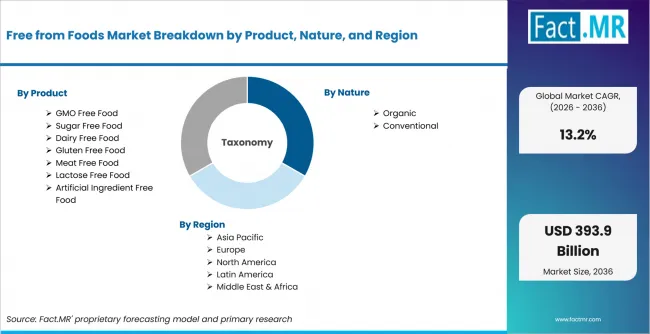
The Free from Foods Market covers commercial food and beverage products formulated, manufactured or marketed to exclude defined ingredients, allergens, components or processing attributes represented in the Product taxonomy. Revenue is counted for finished foods sold as GMO-free, sugar-free, dairy-free, gluten-free, meat-free, lactose-free or artificial-ingredient-free products.
The market includes consumer products sold through direct sales, hypermarkets and supermarkets, specialty stores, convenience stores, online retail and other specified channels. It includes organic and conventional nature classifications without extending into unrelated dietary supplements or ingredient-only markets.
What is included in the scope?
Included products span GMO-free cereals and grains, edible oils, meat and poultry, bakery products and packaged foods; sugar-free beverages, dairy products, confectionery, ice cream and bakery products; dairy-free products based on soy, almond, oat, hemp, coconut and rice; gluten-free bakery, pasta, baby food and ready meals; meat-free foods such as textured vegetable protein, tofu, tempeh, seitan and natto; lactose-free milk and related dairy categories; and clean-label foods, beverages and snacks within artificial-ingredient-free foods.
The scope includes certified organic and conventional products. Buyers include retailers, foodservice operators, private-label owners and other business customers using the listed sales channels. Geographic analysis focuses on the USA, U.K., France, Germany, Italy, South Korea and Japan within a global market context.
What is excluded from the scope?
The scope excludes dietary supplements, pharmaceuticals and medical nutrition products sold primarily as therapeutic products rather than foods, unless they fall directly within a listed food category such as infant formula. Standalone free-from ingredients sold only for industrial formulation are outside the finished-food market.
Products that make general wellness, natural or plant-based claims without fitting one of the defined Product categories are excluded. Conventional foods without a relevant exclusion claim, testing basis or formulation characteristic are outside the market. Restaurant meals are excluded unless commercialized through a listed packaged-food or sales-channel category.
How Was the Analysis Built?
The analysis combines primary industry interviews with desk research and market-specific sizing variables. Validation focuses on the purchasing mechanisms that determine whether a free-from claim can be commercialized at scale.
- Primary Research:
- Primary research covers packaged-food manufacturers, private-label suppliers, organic-certified processors, retail category buyers, foodservice procurement teams, specialty distributors, ingredient sourcing managers, quality and regulatory teams, and technical experts involved in allergen and formulation control.
- Desk Research:
- Desk research reviews government food-labeling rules, allergen standards, organic certification requirements, national food registries, nutrition-label guidance, company filings, first-party product documentation and public information on retail channel development.
- Market Sizing and Forecasting:
- Market sizing uses finished-product sales, category penetration, channel mix, certified organic share, direct contract volumes, average selling prices and country-level adoption of the defined free-from categories. Forecasting also considers reformulation activity, retail assortment, product launches and regulatory requirements affecting claim eligibility.
- Data Validation and Update Cycle:
- Findings are cross-checked against public regulations, company activity and primary interviews. Updates review allergen-label changes, organic certification rules, formulation shifts, retail listings, company portfolio changes and new products that affect the defined market categories.
What is the report's scope and coverage?
Free From Foods Market Breakdown By Product, Nature, And Region | Source: Fact.MR
| Attribute | Details |
|---|---|
| Quantitative Units | USD billion |
| Market Definition | Finished foods and beverages formulated or positioned within the defined free-from Product categories |
| Segments Covered | Product; Nature; Sales Channel |
| Regions Covered | North America; Latin America; Europe; East Asia; South Asia & Oceania; Middle East & Africa |
| Countries Covered | USA; U.K.; France; Germany; Italy; South Korea; Japan |
| Key Companies Profiled | Nestlé SA; Groupe Danone; Reckitt Benckiser Group Plc (RB); Abbott Laboratories Inc.; Vitasoy International Holdings Ltd; The Coca-Cola Co.; General Mills Inc.; Blue Diamond Growers; Kikkoman Corporation; Dr. Schär AG/SpA; Valio Oy; Post Holdings Inc.; Inner Mongolia Yili Industrial Group Co Ltd |
| Forecast Period | 2026 to 2036 |
| Market Value, 2026 | USD 114.0 billion |
| Market Value, 2036 | USD 393.9 billion |
| CAGR, 2026-2036 | 13.2% |
| Absolute Opportunity | USD 279.9 billion |
| Approach | Hybrid top-down and bottom-up analysis using finished-product sales, segment mix, channel volumes, pricing and country adoption |