- Market Value (2025): USD 205.3 Mn
- Estimated Value (2026): USD 218.6 Mn
- Forecast Value (2036): USD 410.3 Mn
- CAGR (2026-2036): 6.5%
What is the Freekeh Market forecast to be worth by 2036?
USD 218.6 million in 2026 to USD 410.3 million by 2036 at 6.5% CAGR.
- The freekeh market reached USD 205.3 million in 2025 as retail packs and ingredient use created a base for wider category planning.
- Demand is projected to increase from USD 218.6 million in 2026 to USD 410.3 million by 2036.
- The market is forecast to record 6.5% CAGR from 2026 to 2036.
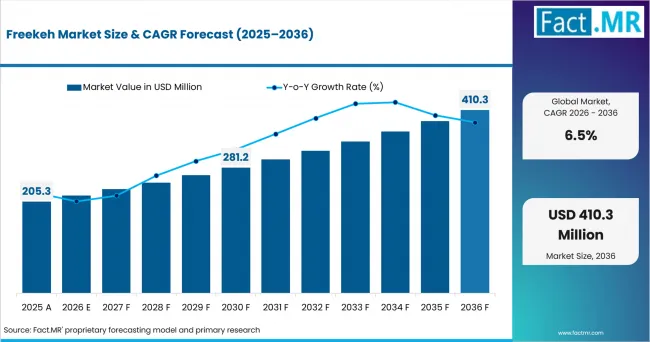
Freekeh Market Value Analysis | Source: Fact.MR
What are the defining numbers behind Freekeh Market growth?
USD 191.7 million absolute opportunity is expected by 2036.
- Demand Drivers in the Market
- Whole Grain Freekeh is expected to support repeat purchase when shoppers want a visible grain form and simple cooking use.
- Bakery Products are anticipated to widen demand when bread and crispbread makers use freekeh for grain identity and texture.
- Household and Retail demand is likely to remain central as freekeh moves from trial packs into regular pantry use.
- Supermarkets and Hypermarkets are projected to improve visibility when freekeh is placed near grains and health-focused food lines.
- Key Segments Analyzed
- By Product Type: Whole Grain Freekeh is expected to hold 42.0% share in 2026 due to its intact grain form and clear cooking identity.
- By Application: Bakery Products are projected to account for 34.0% share in 2026 since bread and crispbread uses create repeat ingredient demand.
- By End Use: Household and Retail is anticipated to represent 47.0% share in 2026 when pantry use leads everyday product trial.
- By Distribution Channel: Supermarkets and Hypermarkets are estimated to hold 41.0% share in 2026 as shelf placement helps unfamiliar grains gain attention.
- By Nature: Organic is forecast to capture 38.0% share in 2026 where certified positioning supports premium grain selection.
- Analyst Opinion at Fact.MR
- Shambhu Nath Jha, Principal Consultant at Fact.MR, states, “Freekeh demand depends on clear product form and cooking purpose. Whole Grain Freekeh carries the clearest household identity. Bakery Products give processors a repeat-use route. Supermarket visibility and organic claims help buyers compare freekeh with familiar grains.”
- Strategic Implications
- Retail teams can use clear pack guidance to explain how Whole Grain Freekeh differs from cracked or flour formats.
- Bakery suppliers can build stronger conversations when they show how freekeh affects texture and product identity.
- Channel planners need separate shelf and online messages since each route creates a different first-purchase barrier.
The USA leads at 6.9% CAGR through retail reach and bakery use. Australia follows at 6.8% as wellness-focused pantry demand supports specialty retail sales. The UK reaches 6.6% through premium grain positioning and supermarket availability. Germany records 6.5% through bakery applications. Canada posts 6.3%, while the UAE reaches 6.1% through foodservice demand and premium grocery visibility.
How does the Freekeh Market break down by segment?
Whole Grain Freekeh leads Product Type with 42.0% share in 2026. Bakery Products lead Application with 34.0% share.
Which product type dominates?
Whole Grain Freekeh is expected to account for 42.0% share in 2026.
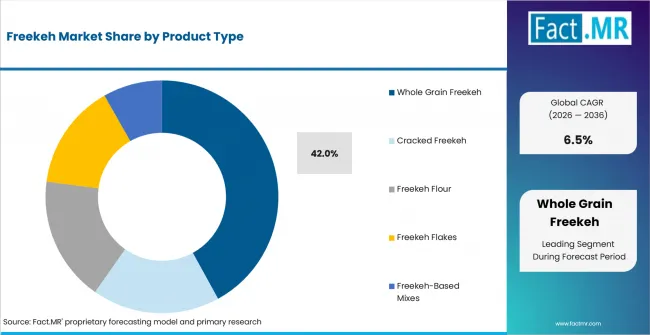
Freekeh Market Analysis By Product Type | Source: Fact.MR
Whole Grain Freekeh leads because the product is easy to recognise as a complete grain. Household buyers can use it in bowls and side dishes without changing the ingredient form. Green Wheat Freekeh and Durum Wheat Freekeh support origin positioning. Cracked Freekeh and flour formats serve faster cooking and processed applications.
What leads the Application segment?
Bakery Products are projected to hold 34.0% share in 2026.
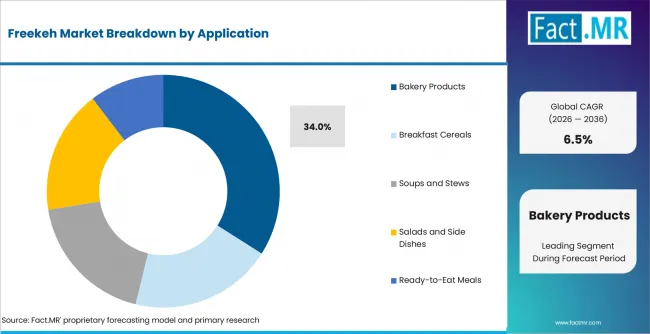
Freekeh Market Analysis By Application | Source: Fact.MR
Bakery Products create steady demand because freekeh can be used in breads and crispbread formats. Consumers can try freekeh through familiar bakery items before buying it as a pantry grain. Breakfast Cereals and Soups and Stews support other meals. Salads and Side Dishes keep the product visible in prepared food use.
Why does Household and Retail lead End Use?
Household and Retail is anticipated to represent 47.0% share in 2026.
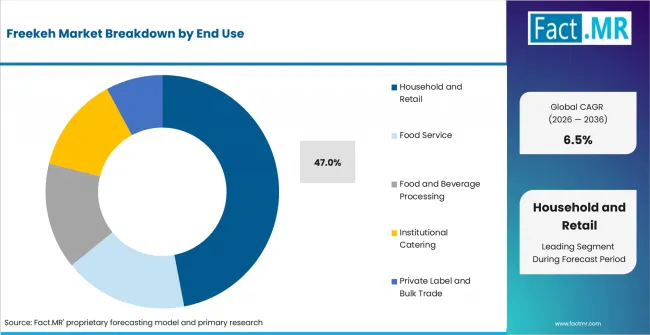
Freekeh Market Analysis By End Use | Source: Fact.MR
Household and Retail leads because shoppers can buy freekeh for direct cooking and repeat pantry use. Individual Consumers and Health-Conscious Households support this route when the product has a clear grain identity. Food Service and Institutional Catering broaden use outside the home. Food and Beverage Processing adds demand through finished products.
Which distribution channel leads?
Supermarkets and Hypermarkets are estimated to account for 41.0% share in 2026.
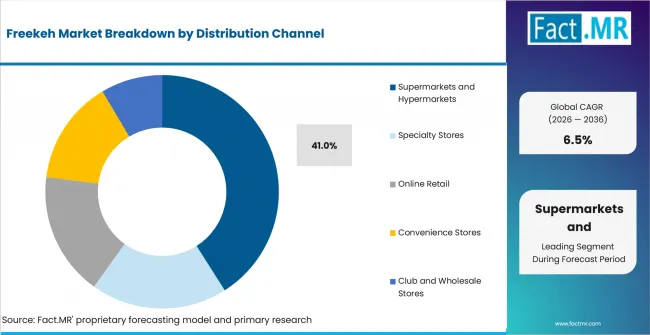
Freekeh Market Analysis By Distribution Channel | Source: Fact.MR
Supermarkets and Hypermarkets lead because they give freekeh shelf visibility beside familiar grains and health foods. This placement helps shoppers compare pack size and use notes during purchase. Specialty Stores and Online Retail remain important for discovery. Convenience Stores and Club and Wholesale Stores serve narrower buying missions.
What supports Organic within Nature?
Organic is forecast to capture 38.0% share in 2026.
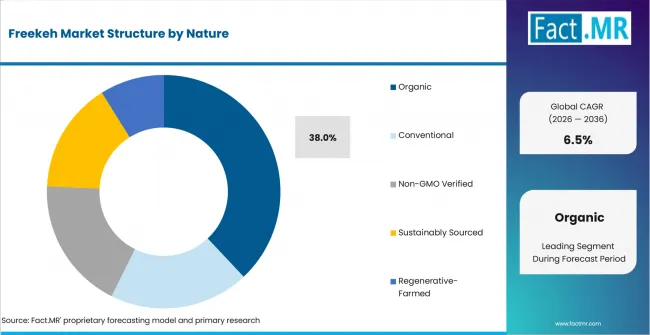
Freekeh Market Analysis By Nature | Source: Fact.MR
Organic leads when certification gives buyers a simple quality cue. USDA Certified Organic and EU Certified Organic claims help products fit premium shelves. Conventional formats remain relevant for price-sensitive buyers. Non-GMO Verified and Sustainably Sourced products support buyers who compare farming language.
What is accelerating Freekeh Market adoption, and what is holding it back?
Demand is expected to rise through clearer grain identity and stronger retail placement. Growth may face pressure when shoppers do not know how to cook freekeh or compare it with rice and wheat products.
Drivers Impact Analysis
| DRIVER | (~) % IMPACT ON CAGR | GEOGRAPHIC RELEVANCE | IMPACT TIMELINE |
|---|---|---|---|
| Whole Grain Freekeh visibility | +1.4% | USA, Australia, UK | Short term (<= 2 years) |
| Bakery product use | +1.2% | USA and Germany | Short term (<= 2 years) |
| Household and Retail demand | +1.0% | USA, Canada, Australia | Medium term (2-4 years) |
| Supermarket shelf access | +0.8% | UK and Germany | Medium term (2-4 years) |
| Organic positioning | +0.6% | USA, Canada, UAE | Long term (>= 4 years) |
Source: Fact.MR analysis. Updated Aug 5, 2026
- Whole Grain Freekeh visibility: The leading product type is expected to support trial when buyers want a grain that looks familiar and cooks as a clear whole-grain option.
- Bakery product use: Bakery Products are likely to create repeat ingredient demand because breads and crispbreads can carry freekeh without asking buyers to cook a new grain at home.
- Household and Retail demand: Household buying is anticipated to keep the market grounded in regular meals where texture and cooking guidance decide repeat purchase.
Opportunity Impact Analysis
| OPPORTUNITY | (~) % IMPACT ON CAGR | GEOGRAPHIC RELEVANCE | IMPACT TIMELINE |
|---|---|---|---|
| Organic shelf positioning | +1.1% | USA and Canada | Medium term (2-4 years) |
| Brand website education | +0.9% | USA, Australia, UK | Medium term (2-4 years) |
| Foodservice recipe trial | +0.7% | Australia and UAE | Long term (>= 4 years) |
| Private label bulk trade | +0.6% | Germany and UK | Long term (>= 4 years) |
Source: Fact.MR analysis. Updated Aug 5, 2026
- Organic shelf positioning: Organic freekeh is expected to gain room where certification helps retailers explain premium pricing and ingredient origin in a direct way.
- Brand website education: Brand Websites can reduce hesitation by showing cooking steps and use ideas before shoppers commit to a pack.
- Foodservice recipe trial: Restaurants and cafes are likely to introduce freekeh through prepared meals where diners experience the texture before home purchase.
Restraints Impact Analysis
| RESTRAINT | (~) % IMPACT ON CAGR | GEOGRAPHIC RELEVANCE | IMPACT TIMELINE |
|---|---|---|---|
| Low product familiarity | -1.0% | Canada, Germany, UAE | Short term (<= 2 years) |
| Shelf competition | -0.8% | Supermarkets and Hypermarkets | Short term (<= 2 years) |
| Organic price sensitivity | -0.6% | USA and UK | Medium term (2-4 years) |
| Supply consistency checks | -0.5% | Global | Long term (>= 4 years) |
Source: Fact.MR analysis. Updated Aug 5, 2026
- Low product familiarity: Some shoppers may pause before buying freekeh because the grain needs cooking guidance and a clear meal use.
- Shelf competition: Supermarket listings can be difficult when freekeh must compete with rice and established ancient grains for limited space.
- Organic price sensitivity: Organic positioning can support premium demand but may slow conversion when buyers compare freekeh with lower-priced conventional grains.
Which countries are scaling Freekeh Market fastest?
- The country comparison spans 0.8 percentage point from the USA to the UAE across the forecast period.
- The USA remains 0.1 percentage point above Australia as retail reach and bakery use support wider product testing.
- Australia records 0.2 percentage point above the UK through wellness pantry use and specialty retail acceptance.
- The UK stays 0.1 percentage point above Germany when premium grain placement supports measured but steady buying.
- Germany matches the global rate as mature retail channels help freekeh grow without sharply changing the demand base.
- Canada remains 0.2 percentage point above the UAE due to broader household retail demand and natural-food access.
- The UAE completes the displayed range with demand shaped by foodservice use and premium grocery placement.
Comparable CAGRs can create different entry conditions due to retail depth and product awareness. Full report coverage spans North America and Europe. It also includes East Asia, South Asia and Pacific, Latin America, Middle East and Africa.
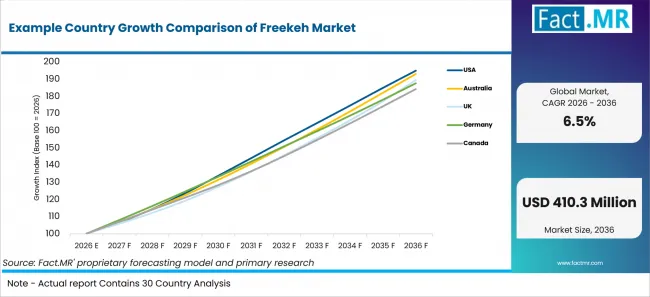
Example Country Growth Comparison Of Freekeh Market | Source: Fact.MR
| Country | CAGR (2026-2036) |
|---|---|
| USA | 6.9% |
| Australia | 6.8% |
| UK | 6.6% |
| Germany | 6.5% |
| Canada | 6.3% |
| UAE | 6.1% |
Source: Fact.MR analysis. Updated Aug 5, 2026
What supports USA adoption?
6.9% CAGR, supported by retail reach and bakery application use.
USA growth reflects a market where freekeh can move through household packs and bakery use. Supermarkets give the product physical visibility. Online retail helps brands explain cooking steps. Bakery Products add a second route before consumers buy the grain for home cooking.
How is Australia scaling demand?
6.8% CAGR, backed by wellness pantry demand and specialty retail access.
Australia is expected to build demand through shoppers who already use grain bowls and prepared salads. Whole Grain Freekeh fits that use because it carries texture and grain identity. Specialty retailers can support first purchase with simple pack guidance. Foodservice use may add trial through warm sides and bowl formats.
What is driving the UK from 2026 to 2036?
6.6% CAGR, led by premium grain positioning and supermarket availability.
The UK route depends on clear retail placement and price communication. Organic and premium grain claims can position freekeh near health-focused foods. Supermarkets and Hypermarkets are expected to matter when shoppers compare freekeh with familiar grains. Brand websites can support the shelf message with texture and cooking notes.
How is Germany converting demand?
6.5% CAGR, shaped by bakery use and mature retail channels.
Germany matches the global rate because demand is likely to expand through careful product testing. Bakery Products offer a practical route since freekeh can be built into breads and crispbreads. Retail buyers may still need proof that packs can move beyond occasional trial. Clear cooking notes are expected to help new listings perform better.
What supports Canada adoption?
6.3% CAGR, supported by household retail buying and natural-food placement.
Canada develops through selective retail use and household cooking. Natural-food stores give freekeh an entry point among shoppers who compare grain options. Household and Retail demand is expected to stay central because pantry use builds repeat purchase. Organic positioning may help premium packs stand apart.
How is the UAE building demand?
6.1% CAGR, helped by foodservice use and premium grocery visibility.
The UAE is expected to develop through foodservice menus and premium grocery channels. Restaurants and cafes can introduce freekeh through prepared meals. Supermarkets and specialty stores then give the product a route into home use. Organic and sustainably sourced options may appeal to premium shoppers.
Who leads the Freekeh Market?
GreenWheat Freekeh Pty Ltd shows direct relevance because the company name and product focus are centered on freekeh. Bob's Red Mill Natural Foods, Inc. adds retail grain visibility. Canaan Palestine strengthen the field through dedicated grain products. These suppliers are reviewed in the wider specialty food ingredients market context.
Competition is expected to depend on product identity and supply clarity. Merchant Gourmet and Burgol Company broaden the field through grain and natural food lines. Freekeh Harvest widen the provider set. Buyers are likely to compare availability and pack communication before expanding orders.
Which companies are the key providers?
Key companies include GreenWheat Freekeh Pty Ltd, Bob's Red Mill Natural Foods, Inc., Canaan Palestine, Merchant Gourmet, Burgol Company, Freekeh Harvest.
- GreenWheat Freekeh Pty Ltd
- Bob's Red Mill Natural Foods, Inc.
- Canaan Palestine
- Merchant Gourmet
- Burgol Company
- Freekeh Harvest
Bibliography
- National Agricultural Statistics Service. (2025, September 30). Small grains 2025 summary. U.S. Department of Agriculture.
- Food and Agriculture Organization of the United Nations. (2025). Food outlook: Biannual report on global food markets-June 2025.
- U.S. Food and Drug Administration. (2025, January 6). FDA releases allergen, food safety, and plant-based alternative labeling guidances.
- U.S. Census Bureau. (2026, May 18). Quarterly retail e-commerce sales: First quarter 2026. U.S. Department of Commerce.
This Report Answers
- The report provides strategic intelligence on the Freekeh Market across Product Type and Application choices that shape buying decisions within the food and beverage market.
- Segment analysis covers Whole Grain Freekeh and Bakery Products as share leaders within the 2026 market alongside wider bakery products market context.
- End-use assessment covers Household and Retail while Food Service and Food and Beverage Processing complete the demand view.
- Channel analysis covers Supermarkets and Hypermarkets alongside Specialty Stores and Online Retail within the broader retail market setting.
- Country outlook evaluates the USA and Australia alongside the UK and Germany. Canada and the UAE complete the growth comparison.
- Competitive analysis profiles GreenWheat Freekeh Pty Ltd and Bob's Red Mill Natural Foods, Inc.
What does the Freekeh Market cover?
The Freekeh Market covers freekeh products sold by product type and use case.
Coverage includes Whole Grain Freekeh, Cracked Freekeh, Freekeh Flour, Freekeh Flakes and Freekeh-Based Mixes. The market also covers bakery products and household retail use. Distribution coverage includes supermarkets and online retail. Specialty stores and wholesale channels are included. Nature coverage includes Organic and Conventional products. Non-GMO Verified and Sustainably Sourced products are also included. Related views from the organic food market apply only when freekeh remains the named product.
What is included in the scope?
The scope includes freekeh products sold to households and retailers. Foodservice buyers are also included.
It includes Whole Grain Freekeh and Green Wheat Freekeh alongside cracked, flour and flake formats. Bakery Products and Breakfast Cereals are included when freekeh is a named ingredient. Soups and Stews, Salads and Ready-to-Eat Meals follow the same rule. The scope also covers company participation when the provider sells freekeh or a directly relevant grain product. Adjacent views from the healthy snack market and the foodservice market are used only for category context.
What is excluded from the scope?
Products that do not identify freekeh as the grain or product base remain outside the scope.
The scope excludes unrelated wheat products and generic grain blends that do not name freekeh. It excludes restaurant meals where freekeh is not a meaningful ingredient. Broad plant-based food market demand is excluded when the purchase is not tied to freekeh. General food grain market coverage is excluded when the product is not sold as freekeh.
How Was the Analysis Built?
The analysis draws on 120+ sources, 35+ company portfolios, 25+ countries, and more than 20 industry interviews.
- Primary Research: Primary research includes discussions with manufacturers, service providers, technology developers, distributors, end users, procurement teams, and subject-matter experts. These conversations examine purchasing priorities, product adoption, operational challenges, approval requirements, competitive positioning, and the factors that influence wider market acceptance.
- Desk Research: Desk research covers government statistics, regulatory publications, company filings, trade data, technical studies, industry associations, standards, public policy, and other authoritative sources. Every source used in the analysis is documented in the bibliography.
- Market Sizing and Forecasting: Market estimates combine historical performance, demand indicators, pricing and volume trends, segment shares, company participation, country-level growth, adoption patterns, investment activity, and barriers to market expansion.
- Data Validation and Update Cycle: Findings are validated by comparing primary interviews with public data, company activity, regulatory changes, trade patterns, and industry developments. Regular updates review new product launches, capacity changes, partnerships, approvals, procurement trends, and shifts in commercial adoption.
Segmentation
What is the report’s scope and coverage?
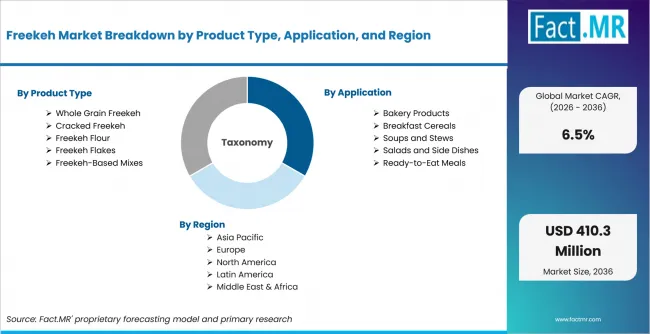
Freekeh Market Breakdown By Product Type, Application, And Region | Source: Fact.MR
| Attribute | Details |
|---|---|
| Quantitative Units | USD million |
| Market Definition | Commercial sale of freekeh products by Product Type, Application, End Use, Distribution Channel and Nature where freekeh is the named grain or product base |
| Product Type | Whole Grain Freekeh; Green Wheat Freekeh; Durum Wheat Freekeh; Cracked Freekeh; Coarse Cracked Freekeh; Fine Cracked Freekeh; Freekeh Flour; Stone-Ground Freekeh Flour; Freekeh Flakes; Freekeh-Based Mixes |
| Application | Bakery Products; Breads and Flatbreads; Crackers and Crispbreads; Breakfast Cereals; Hot Cereals and Porridges; Granola and Muesli; Soups and Stews; Instant Soup Mixes; Salads and Side Dishes; Ready-to-Eat Meals |
| End Use | Household and Retail; Individual Consumers; Health-Conscious Households; Food Service; Restaurants and Cafes; Hotels and Catering; Food and Beverage Processing; Snack Manufacturers; Institutional Catering; Private Label and Bulk Trade |
| Distribution Channel | Supermarkets and Hypermarkets; Hypermarkets; Supermarket Chains; Specialty Stores; Health Food Stores; Gourmet Food Stores; Online Retail; Brand Websites; Convenience Stores; Club and Wholesale Stores |
| Nature | Organic; USDA Certified Organic; EU Certified Organic; Conventional; Conventionally Farmed Whole Grain; Conventionally Farmed Cracked; Non-GMO Verified; Identity-Preserved Non-GMO; Sustainably Sourced; Regenerative-Farmed |
| Regions Covered | North America; Latin America; Europe; East Asia; South Asia and Pacific; Middle East and Africa |
| Countries Covered | USA; Australia; UK; Germany; Canada; UAE |
| Key Companies Profiled | GreenWheat Freekeh Pty Ltd; Bob's Red Mill Natural Foods, Inc.; Canaan Palestine; Merchant Gourmet; Burgol Company; Freekeh Harvest |
| Forecast Period | 2026 to 2036 |
| Approach | Hybrid top-down and bottom-up approach using product type demand; application use; end-use adoption; distribution activity; nature positioning; supplier participation; country growth patterns and company portfolio review |
Source: Fact.MR analysis. Updated Aug 5, 2026
How is the market segmented?
-
By Product Type:
- Whole Grain Freekeh
- Green Wheat Freekeh
- Durum Wheat Freekeh
- Cracked Freekeh
- Coarse Cracked Freekeh
- Fine Cracked Freekeh
- Freekeh Flour
- Stone-Ground Freekeh Flour
- Freekeh Flakes
- Freekeh-Based Mixes
- Whole Grain Freekeh
-
By Application:
- Bakery Products
- Breads and Flatbreads
- Crackers and Crispbreads
- Breakfast Cereals
- Hot Cereals and Porridges
- Granola and Muesli
- Soups and Stews
- Instant Soup Mixes
- Salads and Side Dishes
- Ready-to-Eat Meals
- Bakery Products
-
By End Use:
- Household and Retail
- Individual Consumers
- Health-Conscious Households
- Food Service
- Restaurants and Cafes
- Hotels and Catering
- Food and Beverage Processing
- Snack Manufacturers
- Institutional Catering
- Private Label and Bulk Trade
- Household and Retail
-
By Distribution Channel:
- Supermarkets and Hypermarkets
- Hypermarkets
- Supermarket Chains
- Specialty Stores
- Health Food Stores
- Gourmet Food Stores
- Online Retail
- Brand Websites
- Convenience Stores
- Club and Wholesale Stores
- Supermarkets and Hypermarkets
-
By Nature:
- Organic
- USDA Certified Organic
- EU Certified Organic
- Conventional
- Conventionally Farmed Whole Grain
- Conventionally Farmed Cracked
- Non-GMO Verified
- Identity-Preserved Non-GMO
- Sustainably Sourced
- Regenerative-Farmed
- Organic
-
By Region:
- North America
- Latin America
- Europe
- East Asia
- South Asia and Oceania
- Middle East and Africa
Frequently Asked Questions
How big is the freekeh market in 2026?
The freekeh market is valued at USD 218.6 million in 2026 and is forecast to reach USD 410.3 million by 2036.
Which product type leads the freekeh market?
Which end-use segment leads the freekeh market?
Who are the leading companies in the freekeh market?
Who worked on this report


Preview the report firsthand - request a free sample
Free SampleGet the brochure for pricing and purchase details
Download PDF