Automotive Filter Market (2026 - 2036)
The Automotive Filter Market is segmented by Vehicle Type (Passenger Cars, LCVs, HCVs), Product Type (Oil Filter, Air Filter, Fuel Filter, Cabin Air Filter, Transmission Filter), Filter Media (Synthetic, Cellulose, Glass Fibre, Metal), Sales Channel (OEM, IAM - Independent Aftermarket), and Region. Forecast for 2026 to 2036.
Core Findings
Automotive Filter Market Size, Market Forecast and Outlook By Fact.MR
The global automotive filter market was valued at USD 20.12 billion in 2025, projected to reach USD 21.09 billion in 2026, and is forecast to expand to USD 33.70 billion by 2036 at a 4.8% CAGR. Oil filters command 33.8% of the product type segment in 2026, anchored by their mandatory replacement at every engine oil service interval across all internal combustion vehicle types, generating the highest filter replacement frequency of any automotive filter category and sustaining consistent demand from the global vehicle parc independent of new vehicle production volumes. Synthetic filter media holds 57.2% of the media type segment, reflecting the superior particle capture efficiency, extended service life, and low-temperature flow resistance of synthetic microfibre constructions relative to cellulose alternatives, supporting the progressive specification upgrade in both OEM and aftermarket channels toward synthetic media filters that justify higher retail prices through measurably better engine protection performance.
The absolute dollar expansion of USD 12.61 billion over the forecast period reflects the combination of vehicle fleet growth in emerging markets generating additional oil, air, and fuel filter replacement demand and a structural filter media quality upgrade cycle as independent aftermarket consumers progressively adopt synthetic and glass fibre media products over the cellulose alternatives that dominated the previous generation of aftermarket filter purchasing. The independent aftermarket channel accounts for 46.9% of sales, representing the largest individual channel share and reflecting the competitive multi-brand aftermarket ecosystem where consumers and independent service centres purchase filters from specialty automotive parts retailers, e-commerce platforms, and wholesale distributors rather than exclusively through OEM dealer service networks.
China leads country growth at 6.3% CAGR through 2036, driven by the world's largest vehicle fleet generating consistent high-volume filter replacement demand across passenger car and commercial vehicle segments alongside the growing electric vehicle fleet creating new cabin air filter replacement demand from HVAC system maintenance. Japan follows at 5.3% CAGR, where established domestic filter manufacturers supply both the global Japanese OEM vehicle base and a sophisticated consumer aftermarket that pays premium prices for high-specification synthetic media filter products. The United States advances at 4.4% CAGR, supported by the large vehicle parc replacement cycle and growing consumer adoption of extended-life synthetic oil filters that sustain per-event revenue even as service interval extension reduces replacement frequency. India registers 3.8% CAGR, driven by expanding vehicle ownership rates and improving consumer awareness of the protective value of quality filter maintenance in a market where road dust and air quality conditions make air and cabin filter service particularly impactful on engine and occupant health.
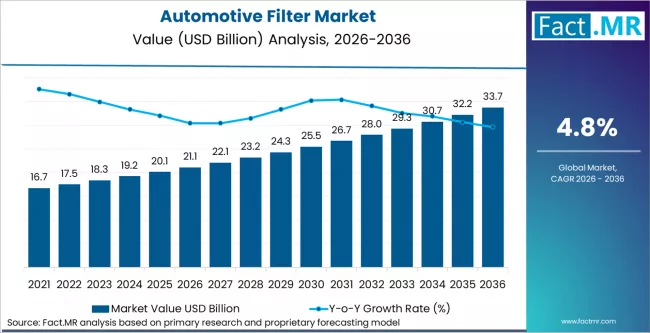
Automotive Filter Market Key Takeaways
| Metric | Details |
|---|---|
| Industry Size (2026) | USD 21.09 Billion |
| Industry Value (2036) | USD 33.70 Billion |
| CAGR (2026-2036) | 4.8% |
Automotive Filter Market Definition
The automotive filter market encompasses filtration devices that remove contaminant particles, aerosols, and chemical impurities from engine oil, intake air, fuel, cabin ventilation air, and transmission fluid streams in passenger vehicles, light commercial vehicles, and heavy commercial vehicles. The scope covers oil filters, engine air intake filters, fuel filters, cabin air filters including particulate and combination particulate plus activated carbon variants, and transmission fluid filters, supplied through OEM vehicle production fill programmes and the aftermarket service replacement channel.
Automotive Filter Market Inclusions
Market scope includes spin-on and cartridge oil filter elements, panel and cylindrical engine air intake filter elements in cellulose and synthetic media, in-line and in-tank fuel filter assemblies, cabin particulate and combination cabin air filter elements, and automatic transmission fluid filters. Geographic analysis covers North America, Latin America, Europe, East Asia, South Asia, Oceania, and Middle East and Africa. Forecast scope spans 2026 to 2036 with segment breakdowns by vehicle type, product type, filter media, sales channel, and region.
Automotive Filter Market Exclusions
Industrial hydraulic filtration systems, aviation filter systems covered under separate aerospace filtration classification, motorcycle-specific filter configurations classified under two-wheeler categories, water treatment filters for vehicle wash systems, and fuel filtration infrastructure for refuelling stations fall outside this market scope. Coolant filters for engine cooling system maintenance are also excluded.
Automotive Filter Market Research Methodology
- Primary Research: Fact.MR analysts conducted interviews with automotive filter product managers at tier-one filtration manufacturers, independent aftermarket parts category managers at automotive parts distribution chains, and vehicle service interval engineering managers at OEM aftersales organisations to validate oil filter replacement frequency trends, synthetic media adoption rates in the independent aftermarket, and cabin air filter specification evolution for electric vehicle HVAC system requirements.
- Desk Research: Secondary research aggregated vehicle service interval documentation from OEM owner manuals specifying oil and filter change frequencies, engine oil specification updates from automotive technical societies including ACEA and API standards bodies, vehicle registration statistics from national transport agencies, and corporate revenue disclosures from listed automotive filter manufacturers.
- Market-Sizing and Forecasting: Baseline market values derive from a bottom-up aggregation of filter replacement unit volumes by product type and vehicle category, multiplied by average filter prices across cellulose and synthetic media tiers and OEM and aftermarket channel pricing. Vehicle fleet size projections and average oil service interval assumptions by market were applied as primary demand scaling variables with synthetic media adoption curves modelled as a per-unit value uplift driver.
- Data Validation and Update Cycle: Segment forecasts are cross-validated against revenue disclosures from publicly listed automotive filter manufacturers and vehicle registration and fleet size statistics from national transport registries. Annual updates incorporate actual vehicle production volumes and updated service interval data from OEM service documentation revisions.
Summary of Automotive Filter Market
- Automotive Filter Market Definition
- The automotive filter market covers filtration devices for engine oil, intake air, fuel, cabin ventilation air, and transmission fluid in passenger and commercial vehicles across cellulose and synthetic media configurations, supplied through OEM production programmes and independent aftermarket replacement channels globally.
- Demand Drivers in the Market
- Oil Filter Mandatory Replacement at Every Service Interval Generating Structural Demand: Engine oil filter replacement at every oil change event, mandated by OEM service documentation across all internal combustion vehicle types regardless of extended-drain oil specification, generates the highest filter replacement frequency of any automotive consumable category, creating consistent demand from the global vehicle parc that is directly proportional to accumulated vehicle fleet kilometres driven rather than sensitive to consumer discretionary spending patterns.
- Synthetic Filter Media Upgrade Cycle Expanding Average Revenue Per Replacement Event: Progressive independent aftermarket consumer migration from cellulose to synthetic microfibre oil and air filter media, driven by automotive media coverage of engine wear comparison data and synthetic filter brand marketing communicating particle capture efficiency differentials, is expanding average revenue per filter replacement event beyond what volume growth alone generates as higher-priced synthetic products displace lower-priced cellulose alternatives on equivalent replacement cycles.
- Urban Air Quality Concern Driving Cabin Air Filter Adoption and Replacement Frequency: Rising consumer awareness of particulate matter and NOx pollution in urban environments is expanding cabin air filter adoption in markets where cabin filters were previously rarely changed and increasing replacement frequency in established markets, as consumers motivated by allergy management and urban air quality concerns are replacing cabin filters at shorter intervals than OEM service documentation specifies, generating additional replacement events beyond the standard service cycle.
- Key Segments Analyzed in the Fact.MR Report
- Oil Filters Product Type: Commands 33.8% share in 2026 as the filter category with the highest replacement frequency across the vehicle fleet, with mandatory replacement at every engine oil change event generating demand volumes that exceed air, fuel, and cabin filter replacement frequency by factors of two to four depending on market-specific service interval patterns and driving intensity distributions.
- Synthetic Filter Media: Holds 57.2% share in 2026, reflecting the structural shift from cellulose to synthetic microfibre media across both OEM factory-fill specifications and independent aftermarket replacement products, driven by OEM engine specification requirements for extended drain interval compatibility and consumer demand for filter media that demonstrably captures smaller particle sizes and maintains lower flow restriction across longer service intervals.
- Independent Aftermarket Sales Channel: Accounts for 46.9% of 2026 market value, representing the largest channel share in a competitive multi-brand ecosystem where consumers and independent service centres purchase filters from specialty automotive parts retailers, e-commerce platforms, and wholesale distributors, creating pricing pressure that benefits filter brands with strong consumer recognition and quality certification credentials.
- Analyst Opinion at Fact.MR
- Fact.MR analysis indicates that the automotive filter market faces an interesting structural challenge from the long-term electrification of the vehicle fleet that will progressively eliminate demand for oil and fuel filters in battery electric vehicles, while simultaneously creating new cabin air filter demand from EV HVAC systems whose occupants are particularly sensitive to cabin air quality given the absence of engine noise that might otherwise mask awareness of air quality discomfort. The near and medium-term picture remains firmly positive for filter manufacturers: internal combustion vehicles will constitute the majority of the global vehicle parc through 2036, and the replacement filter demand from the accumulated fleet is structurally independent of new vehicle production levels in a way that provides a durable revenue base even if new vehicle production mix shifts toward electric. The independent aftermarket competitive dynamics are intensifying as e-commerce platform growth in China, India, and Southeast Asia creates direct-to-consumer distribution channels that allow lower-cost Asian filter manufacturers to compete for replacement demand previously served by established branded filter products through traditional distribution channels, creating margin pressure that rewards manufacturers with strong consumer brand recognition and quality certification programmes over commodity price competitors.
- Strategic Implications / Executive Takeaways
- Electric Vehicle Cabin Air Filter Product Line Development: Automotive filter manufacturers should develop cabin air filter configurations specifically validated for electric vehicle HVAC system flow rates, filter housing dimensions, and occupant air quality requirements, positioning EV-specific cabin filters as a premium replacement category that addresses the gap left by declining oil and fuel filter demand in the growing battery electric vehicle segment of the fleet.
- Synthetic Media Quality Certification and Consumer Communication Investment: Filter brands should invest in certified independent particle capture efficiency testing and public communication of test results as a consumer purchase influence strategy in the independent aftermarket, as data-supported quality differentiation is becoming the primary competitive battleground in a market where e-commerce platforms are reducing the visibility advantages that traditional retail shelf positioning provided to established brands.
- Extended Drain Interval Synthetic Filter Product Development for Emerging Markets: Manufacturers should develop extended-service-interval synthetic oil filters validated for the longer oil change periods that OEMs are specifying in newer vehicle service documentation, as service interval extension is reducing annual replacement event frequency in mature markets and the development of premium extended-drain filter products can compensate per-vehicle annual revenue through higher per-unit pricing that justifies the longer replacement cycle to cost-conscious consumers.
Historic Analysis (2021 to 2025) and Future (2026 to 2036) Pathway Analysis for the Automotive Filter Market
The market for automotive filters grew at a growth rate of 4.0% from 2021 to 2026, and by the end of 2026, it was valued at USD 19.2 billion. Another key factor that is anticipated to accelerate the expansion of the automotive filter market in the near future is the growing number of automobiles in emerging nations.
| Historical Report Attributes | Details |
|---|---|
| Market Size (2021A) | USD 16.3 billion |
| Market Size (2026A) | USD 19.2 billion |
| Historical CAGR (2021 to 2026) | 4.0% |
| Forecasted CAGR (2026 to 2036) | 4.8% |
- Short Term (2025 to 2028): The automotive filter market is expected to grow due to increasing regulatory pressures on vehicle emissions, rising demand for fuel-efficient and electric vehicles, and heightened consumer awareness of environmental sustainability. Technological advancements in filter design and performance will also play a crucial role, as manufacturers focus on innovation to meet evolving market needs.
- Medium Term (2028 to 2032): The market is expected to expand considerably driven by factors like enhanced environmental laws, improvements in filtration technology, and a growing consumer awareness about sustainability. As the manufacture of vehicles rises, the need for premium filters, especially cabin air filters, will also grow.
- Long Term (2030 to 2035): The rising demand for advanced filtration solutions that enhance engine performance and reduce environmental impact is set to experience significant growth as sustainability and efficiency become priorities. The rise of electric and hybrid vehicles will necessitate specialized filters, while consumer awareness of eco-friendly options continues to increase. Innovations in filter technology, such as nanofibers, will improve effectiveness.
On the back of the aforementioned facts, the automotive filter market is anticipated to grow at a CAGR of 4.8% during the forecast period from 2026 to 2036, According to the Fact.MR, a market research and competitive intelligence provider.
Market Dynamics
What are the Factors Propelling Global Sales of Automotive Filter Market?
“Government Initiatives Across the Globe is Driving the Market for Automotive Filter”
One of the main reasons driving worldwide sales in the automotive filter market during the forecast period is government programs targeted at lowering vehicle emissions, boosting environmental sustainability, and also encouraging deep localization. This is greatly aided by a number of incentives and regulations put in place by governments around the globe.
For instance, the PLI-Auto Scheme with an estimated USD 3.1 billion budget, seeks to improve the production of advanced automotive technology (AAT) goods. Indian automakers will become more competitive as a result of this program, which will encourage deep localization and make it easier to establish both domestic and international supply chains. Over the following five years, the program is anticipated to significantly boost the automobile industry.
What are the Challenges Encountered by Manufacturers of Automotive filters?
“High Expense of Filter Media - Reducing Growth for Automotive Filter Manufacturers”
The high expense of filter media in the automotive filter market presents a serious obstacle that could limit market expansion. Expensive initial components and intricate manufacturing procedures are often required to produce advanced filtration materials, which raises production costs. Smaller manufacturers or startups find it difficult to compete with established firms.
Additionally, high consumer retail prices may discourage potential buyers, in order limiting market growth. Manufacturers must maintain a balance between competitive pricing and the demand for high-quality filtration solutions, which makes it hard for smaller businesses to afford these expenses and prevents them from entering or expanding in the automotive filter industry.
Country-wise Insights
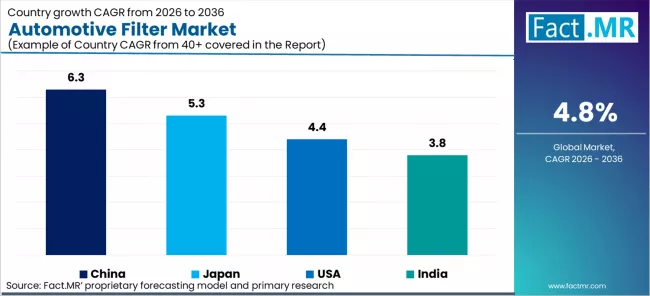
Why is Adoption of Automotive Filters high in the United States?
“Increased Focus on Fuel Efficiency Enhancement to Promote U.S. Market Growth”
The market in the United States is estimated at USD 5.2 billion in 2026 and is projected to expand at a CAGR of 4.4% through 2036. This market is projected to generate a USD 2.8 billion absolute $ opportunity from 2026 to 2036.
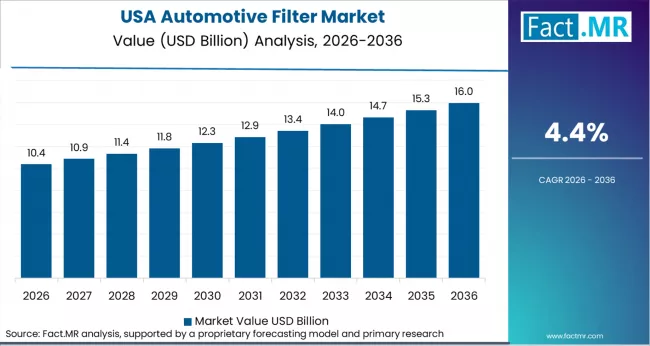
An increased focus on improving fuel efficiency is driving a significant change in the U.S. automobile industry. Leading companies operating in the country are reacting to the growing reliance on automobiles as a result of the lack of public transportation options by developing lighter filters that increase fuel efficiency.
By taking advantage of the need for effective automotive solutions, the interconnected North American market also offers chances for American filter suppliers to enter Canada and Mexico. Considering the emphasis on fuel economy, it is anticipated to propel considerable market expansion, establishing the United States as a pioneer in advanced automobile filtration technology.
Why is China a Lucrative Market for Automotive Filters?
“Expanding Partnerships to Improve Market Opportunities”
The market in the China is estimated to reach USD 4.1 billion in 2036 at a CAGR of 6.3%. This market is projected to generate a USD 1.9 billion absolute $ opportunity from 2026 to 2036.
China is estimated to have a 52% share of the overall East Asia automobile filter market by 2026, making it the market leader in the region. The migration of production facilities from North America and Europe, which enables companies to take advantage of cheaper operating costs, is the factor that is driving this growth. Throughout the estimated period, new market efforts and strategic alliances are anticipated to further boost growth.
The need for automobile filters is also being driven by government infrastructure spending and the growing potential for Foreign Direct Investment (FDI). China is positioned to be a major participant in the automotive filter market, propelling innovation and growth in the upcoming years as these aspects continue to develop.
Category-wise Insights
Which product type segment is expected to hold the lead?
“Cabin Air Filters to Improve Growth Prospects”
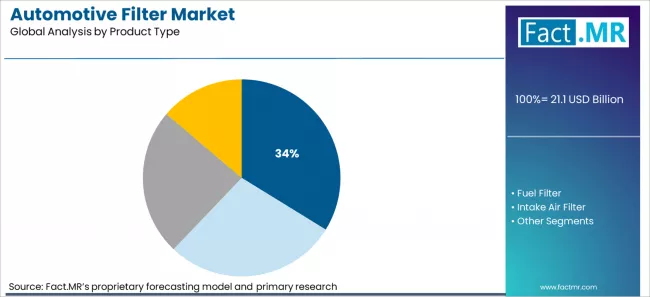
Demand for Cabin air filters is projected to increase at a CAGR of 4.9% from 2025 to 2035. The requirement for high-efficiency cars and rising pollution levels, particularly in cities, contribute to the increasing demand for cabin air filters. These filters are very common in luxury cars since they are crucial for improving air quality by capturing dust, pollen, and smog.
Additionally, the need for efficient filtration systems is being driven by consumers' increased health consciousness. The market for cabin air filters is anticipated to grow greatly as health and air quality concerns continue to develop, guaranteeing healthier air for both drivers and passengers.
Competitive Landscape
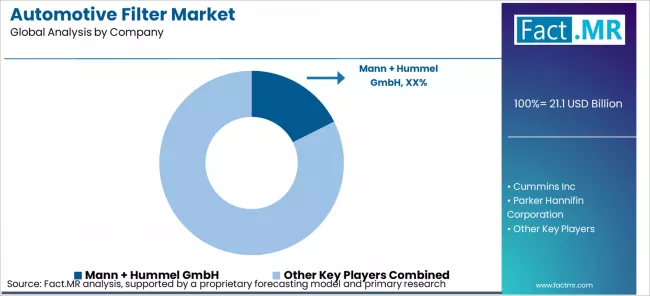
Key players in the automotive filter industry are Mann+Hummel GmbH, Cummins Inc, Parker Hannifin Corporation, K&N Engineering Inc, Toyota Boshoku Corporation, Donaldson Company Inc, Hollingsworth and Vose Company, ALCO Filters Ltd, MAHLE GmbH, Denso Corporation, Roki Co. Ltd
Companies devote a significant portion of their revenue to R&D to resolve problems and offer creative solutions to draw in new customers and stay competitive. To compete with other players, companies are developing customized offerings for issues that meet industry-specific needs.
- On January 13, 2025, MANN+HUMMEL launched the MANN-FILTER fuel filter PU 10 023/1 z KIT for pickups, featuring a patented disassembly tool that simplifies maintenance. This filter achieves over 96% particle separation efficiency for particles as small as four micrometers and effectively removes over 95% of water from diesel fuel through a three-stage filtration process. Designed for easy handling, the filter is compatible with standard diesel, biodiesel, and synthetic fuels like hydrogenated vegetable oils (HVO).
- On April 12, 2023, FRAM launched its new premium oil filter, FRAM Synthetic Endurance™, exclusively at Walmart. This high-flow synthetic oil filter offers maximum protection for up to 25,000 miles when paired with the right synthetic motor oil. Designed with a heavier steel construction, it features 99% filtration efficiency, a 360° textured grip for easy handling, and a Perfect Seal® No-Stick Gasket for enhanced durability. FRAM Synthetic Endurance™ is available in the United States, meeting the performance needs of modern vehicles.
Fact.MR has provided detailed information about the price points of key manufacturers of automotive filter positioned across regions, sales growth, production capacity, and speculative technological expansion, in the recently published report.
Scope of the Report
| Metric | Value |
|---|---|
| Quantitative Units | USD 21.09 billion to USD 33.70 billion, at a CAGR of 4.8% |
| Market Definition | Filtration devices for engine oil, intake air, fuel, cabin ventilation air, and transmission fluid in passenger and commercial vehicles across cellulose and synthetic media configurations, supplied through OEM and aftermarket channels. |
| Vehicle Type Segmentation | Passenger Cars, LCVs, HCVs |
| Product Type Segmentation | Oil Filter, Air Filter, Fuel Filter, Cabin Air Filter, Transmission Filter |
| Filter Media Segmentation | Synthetic, Cellulose, Glass Fibre, Metal |
| Sales Channel Segmentation | OEM, IAM (Independent Aftermarket) |
| Regions Covered | North America, Latin America, Europe, East Asia, South Asia, Oceania, Middle East and Africa |
| Countries Covered | China, Japan, USA, India, and 40 plus countries |
| Key Companies Profiled | Mann and Hummel GmbH, Cummins Inc., Parker Hannifin Corporation, K and N Engineering Inc., Toyota Boshoku Corporation, Donaldson Company Inc., Hollingsworth and Vose Company, ALCO Filters Ltd., MAHLE GmbH, Denso Corporation, Roki Co. Ltd. |
| Forecast Period | 2026 to 2036 |
| Approach | Bottom-up aggregation of filter replacement units by product type and vehicle category with synthetic media adoption penetration curve and fleet size scaling |
Segmentation of Automotive Filter Market Research
-
By Vehicle Type :
- PC (Passenger Cars)
- LCV (Light Commercial Vehicles)
- HCV (Heavy Commercial Vehicles)
- Off-Road Vehicles
- Lawn Mowers
-
By Product Type :
- Fuel Filter
- Oil Filter
- Intake Air Filter
- Cabin Air Filter
-
By Filter Media :
- Synthetic
- Cellulose
-
By Sales Channel :
- OEM (Original Equipment Manufacturing)
- OES (Original Equipment Supplier)
- IAM (Independent Aftermarket)
-
By Region :
- North America
- Latin America
- Western Europe
- Eastern Europe
- East Asia
- South Asia & Pacific
- Middle East & Africa
Bibliography
- American Petroleum Institute. (2024, January). API Service Category SP: Motor Oil Standards and Filter Performance Requirements for Gasoline Engine Applications. API.
- Association des Constructeurs Européens d'Automobiles. (2024, February). ACEA Oil Sequences 2024: Passenger Car and Light Duty Truck Engine Oil and Filter Compatibility Standards. ACEA.
- ISO International Organization for Standardization. (2023). ISO 4548-12: Methods of Test for Full-Flow Lubricating Oil Filters for Internal Combustion Engines - Filtration Efficiency Using Particle Counting. ISO.
- Government of India, Ministry of Road Transport and Highways. (2024, May). AIS-040: Automotive Industry Standard for Air, Oil, and Fuel Filter Performance Requirements for Passenger and Commercial Vehicles. MoRTH.
- World Health Organization. (2024, March). Ambient Air Quality Guidelines: Particulate Matter, Ozone, Nitrogen Dioxide, and Sulfur Dioxide - Global Update and Urban Exposure Assessment. WHO.
- World Bank Group. (2024, April). Vehicle Fleet Growth and Maintenance Market Development in Emerging Economies: Automotive Filter Aftermarket Consumption Analysis. World Bank.
This bibliography is provided for reader reference. The full Fact.MR report contains the complete reference list with primary research documentation.
This Report Addresses
- Market sizing and quantitative forecast metrics: detailing precise revenue projections, absolute dollar growth, and compound annual growth rates across major automotive filter segments and geographies through 2036.
- Segmentation analysis: mapping the adoption velocity of leading product, technology, and end-use categories and evaluating structural factors driving segment share transitions over the forecast period.
- Regional deployment intelligence: comparing growth dynamics in high-momentum Asia Pacific and emerging markets against the mature replacement and upgrade demand patterns prevalent in European and North American industry hubs.
- Regulatory compliance assessment: analyzing how evolving product safety standards, environmental directives, and sector-specific mandates are reshaping procurement decisions, material specifications, and supplier qualification criteria.
- Competitive posture evaluation: tracking consolidation trends, platform integration strategies, technology differentiation investments, and the resulting competitive dynamics among established market players and emerging challengers.
- Capital project strategic guidance: defining the procurement specifications, investment thresholds, and performance benchmarks required to support next-generation product adoption and facility modernization programs.
- Supply chain vulnerability analysis: identifying sourcing concentration risks, logistics bottlenecks, raw material price dependencies, and geographic exposure scenarios that affect market participant cost structures.
- Custom data delivery formats: encompassing interactive dashboards, raw Excel datasets, and comprehensive PDF narrative reports tailored for executive decision-making and analyst reference applications.
Table of Content
- Executive Summary
- Global Market Outlook
- Demand to side Trends
- Supply to side Trends
- Technology Roadmap Analysis
- Analysis and Recommendations
- Market Overview
- Market Coverage / Taxonomy
- Market Definition / Scope / Limitations
- Research Methodology
- Chapter Orientation
- Analytical Lens and Working Hypotheses
- Market Structure, Signals, and Trend Drivers
- Benchmarking and Cross-market Comparability
- Market Sizing, Forecasting, and Opportunity Mapping
- Research Design and Evidence Framework
- Desk Research Programme (Secondary Evidence)
- Company Annual and Sustainability Reports
- Peer-reviewed Journals and Academic Literature
- Corporate Websites, Product Literature, and Technical Notes
- Earnings Decks and Investor Briefings
- Statutory Filings and Regulatory Disclosures
- Technical White Papers and Standards Notes
- Trade Journals, Industry Magazines, and Analyst Briefs
- Conference Proceedings, Webinars, and Seminar Materials
- Government Statistics Portals and Public Data Releases
- Press Releases and Reputable Media Coverage
- Specialist Newsletters and Curated Briefings
- Sector Databases and Reference Repositories
- FMR Internal Proprietary Databases and Historical Market Datasets
- Subscription Datasets and Paid Sources
- Social Channels, Communities, and Digital Listening Inputs
- Additional Desk Sources
- Expert Input and Fieldwork (Primary Evidence)
- Primary Modes
- Qualitative Interviews and Expert Elicitation
- Quantitative Surveys and Structured Data Capture
- Blended Approach
- Why Primary Evidence is Used
- Field Techniques
- Interviews
- Surveys
- Focus Groups
- Observational and In-context Research
- Social and Community Interactions
- Stakeholder Universe Engaged
- C-suite Leaders
- Board Members
- Presidents and Vice Presidents
- R&D and Innovation Heads
- Technical Specialists
- Domain Subject-matter Experts
- Scientists
- Physicians and Other Healthcare Professionals
- Governance, Ethics, and Data Stewardship
- Research Ethics
- Data Integrity and Handling
- Primary Modes
- Tooling, Models, and Reference Databases
- Desk Research Programme (Secondary Evidence)
- Data Engineering and Model Build
- Data Acquisition and Ingestion
- Cleaning, Normalisation, and Verification
- Synthesis, Triangulation, and Analysis
- Quality Assurance and Audit Trail
- Market Background
- Market Dynamics
- Drivers
- Restraints
- Opportunity
- Trends
- Scenario Forecast
- Demand in Optimistic Scenario
- Demand in Likely Scenario
- Demand in Conservative Scenario
- Opportunity Map Analysis
- Product Life Cycle Analysis
- Supply Chain Analysis
- Investment Feasibility Matrix
- Value Chain Analysis
- PESTLE and Porter’s Analysis
- Regulatory Landscape
- Regional Parent Market Outlook
- Production and Consumption Statistics
- Import and Export Statistics
- Market Dynamics
- Global Market Analysis 2021 to 2025 and Forecast, 2026 to 2036
- Historical Market Size Value (USD Million) Analysis, 2021 to 2025
- Current and Future Market Size Value (USD Million) Projections, 2026 to 2036
- Y to o to Y Growth Trend Analysis
- Absolute $ Opportunity Analysis
- Global Market Pricing Analysis 2021 to 2025 and Forecast 2026 to 2036
- Global Market Analysis 2021 to 2025 and Forecast 2026 to 2036, By Vehicle Type
- Introduction / Key Findings
- Historical Market Size Value (USD Million) Analysis By Vehicle Type , 2021 to 2025
- Current and Future Market Size Value (USD Million) Analysis and Forecast By Vehicle Type , 2026 to 2036
- PC
- LCV
- HCV
- Off-Road Vehicles
- Lawn Mowers
- PC
- Y to o to Y Growth Trend Analysis By Vehicle Type , 2021 to 2025
- Absolute $ Opportunity Analysis By Vehicle Type , 2026 to 2036
- Global Market Analysis 2021 to 2025 and Forecast 2026 to 2036, By Product Type
- Introduction / Key Findings
- Historical Market Size Value (USD Million) Analysis By Product Type, 2021 to 2025
- Current and Future Market Size Value (USD Million) Analysis and Forecast By Product Type, 2026 to 2036
- Oil Filter
- Fuel Filter
- Intake Air Filter
- Cabin Air Filter
- Oil Filter
- Y to o to Y Growth Trend Analysis By Product Type, 2021 to 2025
- Absolute $ Opportunity Analysis By Product Type, 2026 to 2036
- Global Market Analysis 2021 to 2025 and Forecast 2026 to 2036, By Filter Media
- Introduction / Key Findings
- Historical Market Size Value (USD Million) Analysis By Filter Media, 2021 to 2025
- Current and Future Market Size Value (USD Million) Analysis and Forecast By Filter Media, 2026 to 2036
- Synthetic
- Cellulose
- Synthetic
- Y to o to Y Growth Trend Analysis By Filter Media, 2021 to 2025
- Absolute $ Opportunity Analysis By Filter Media, 2026 to 2036
- Global Market Analysis 2021 to 2025 and Forecast 2026 to 2036, By Sales Channel
- Introduction / Key Findings
- Historical Market Size Value (USD Million) Analysis By Sales Channel, 2021 to 2025
- Current and Future Market Size Value (USD Million) Analysis and Forecast By Sales Channel, 2026 to 2036
- IAM
- OEM
- OES
- IAM
- Y to o to Y Growth Trend Analysis By Sales Channel, 2021 to 2025
- Absolute $ Opportunity Analysis By Sales Channel, 2026 to 2036
- Global Market Analysis 2021 to 2025 and Forecast 2026 to 2036, By Region
- Introduction
- Historical Market Size Value (USD Million) Analysis By Region, 2021 to 2025
- Current Market Size Value (USD Million) Analysis and Forecast By Region, 2026 to 2036
- North America
- Latin America
- Western Europe
- Eastern Europe
- East Asia
- South Asia and Pacific
- Middle East & Africa
- Market Attractiveness Analysis By Region
- North America Market Analysis 2021 to 2025 and Forecast 2026 to 2036, By Country
- Historical Market Size Value (USD Million) Trend Analysis By Market Taxonomy, 2021 to 2025
- Market Size Value (USD Million) Forecast By Market Taxonomy, 2026 to 2036
- By Country
- USA
- Canada
- Mexico
- By Vehicle Type
- By Product Type
- By Filter Media
- By Sales Channel
- By Country
- Market Attractiveness Analysis
- By Country
- By Vehicle Type
- By Product Type
- By Filter Media
- By Sales Channel
- Key Takeaways
- Latin America Market Analysis 2021 to 2025 and Forecast 2026 to 2036, By Country
- Historical Market Size Value (USD Million) Trend Analysis By Market Taxonomy, 2021 to 2025
- Market Size Value (USD Million) Forecast By Market Taxonomy, 2026 to 2036
- By Country
- Brazil
- Chile
- Rest of Latin America
- By Vehicle Type
- By Product Type
- By Filter Media
- By Sales Channel
- By Country
- Market Attractiveness Analysis
- By Country
- By Vehicle Type
- By Product Type
- By Filter Media
- By Sales Channel
- Key Takeaways
- Western Europe Market Analysis 2021 to 2025 and Forecast 2026 to 2036, By Country
- Historical Market Size Value (USD Million) Trend Analysis By Market Taxonomy, 2021 to 2025
- Market Size Value (USD Million) Forecast By Market Taxonomy, 2026 to 2036
- By Country
- Germany
- UK
- Italy
- Spain
- France
- Nordic
- BENELUX
- Rest of Western Europe
- By Vehicle Type
- By Product Type
- By Filter Media
- By Sales Channel
- By Country
- Market Attractiveness Analysis
- By Country
- By Vehicle Type
- By Product Type
- By Filter Media
- By Sales Channel
- Key Takeaways
- Eastern Europe Market Analysis 2021 to 2025 and Forecast 2026 to 2036, By Country
- Historical Market Size Value (USD Million) Trend Analysis By Market Taxonomy, 2021 to 2025
- Market Size Value (USD Million) Forecast By Market Taxonomy, 2026 to 2036
- By Country
- Russia
- Poland
- Hungary
- Balkan & Baltic
- Rest of Eastern Europe
- By Vehicle Type
- By Product Type
- By Filter Media
- By Sales Channel
- By Country
- Market Attractiveness Analysis
- By Country
- By Vehicle Type
- By Product Type
- By Filter Media
- By Sales Channel
- Key Takeaways
- East Asia Market Analysis 2021 to 2025 and Forecast 2026 to 2036, By Country
- Historical Market Size Value (USD Million) Trend Analysis By Market Taxonomy, 2021 to 2025
- Market Size Value (USD Million) Forecast By Market Taxonomy, 2026 to 2036
- By Country
- China
- Japan
- South Korea
- By Vehicle Type
- By Product Type
- By Filter Media
- By Sales Channel
- By Country
- Market Attractiveness Analysis
- By Country
- By Vehicle Type
- By Product Type
- By Filter Media
- By Sales Channel
- Key Takeaways
- South Asia and Pacific Market Analysis 2021 to 2025 and Forecast 2026 to 2036, By Country
- Historical Market Size Value (USD Million) Trend Analysis By Market Taxonomy, 2021 to 2025
- Market Size Value (USD Million) Forecast By Market Taxonomy, 2026 to 2036
- By Country
- India
- ASEAN
- Australia & New Zealand
- Rest of South Asia and Pacific
- By Vehicle Type
- By Product Type
- By Filter Media
- By Sales Channel
- By Country
- Market Attractiveness Analysis
- By Country
- By Vehicle Type
- By Product Type
- By Filter Media
- By Sales Channel
- Key Takeaways
- Middle East & Africa Market Analysis 2021 to 2025 and Forecast 2026 to 2036, By Country
- Historical Market Size Value (USD Million) Trend Analysis By Market Taxonomy, 2021 to 2025
- Market Size Value (USD Million) Forecast By Market Taxonomy, 2026 to 2036
- By Country
- Kingdom of Saudi Arabia
- Other GCC Countries
- Turkiye
- South Africa
- Other African Union
- Rest of Middle East & Africa
- By Vehicle Type
- By Product Type
- By Filter Media
- By Sales Channel
- By Country
- Market Attractiveness Analysis
- By Country
- By Vehicle Type
- By Product Type
- By Filter Media
- By Sales Channel
- Key Takeaways
- Key Countries Market Analysis
- USA
- Pricing Analysis
- Market Share Analysis, 2025
- By Vehicle Type
- By Product Type
- By Filter Media
- By Sales Channel
- Canada
- Pricing Analysis
- Market Share Analysis, 2025
- By Vehicle Type
- By Product Type
- By Filter Media
- By Sales Channel
- Mexico
- Pricing Analysis
- Market Share Analysis, 2025
- By Vehicle Type
- By Product Type
- By Filter Media
- By Sales Channel
- Brazil
- Pricing Analysis
- Market Share Analysis, 2025
- By Vehicle Type
- By Product Type
- By Filter Media
- By Sales Channel
- Chile
- Pricing Analysis
- Market Share Analysis, 2025
- By Vehicle Type
- By Product Type
- By Filter Media
- By Sales Channel
- Germany
- Pricing Analysis
- Market Share Analysis, 2025
- By Vehicle Type
- By Product Type
- By Filter Media
- By Sales Channel
- UK
- Pricing Analysis
- Market Share Analysis, 2025
- By Vehicle Type
- By Product Type
- By Filter Media
- By Sales Channel
- Italy
- Pricing Analysis
- Market Share Analysis, 2025
- By Vehicle Type
- By Product Type
- By Filter Media
- By Sales Channel
- Spain
- Pricing Analysis
- Market Share Analysis, 2025
- By Vehicle Type
- By Product Type
- By Filter Media
- By Sales Channel
- France
- Pricing Analysis
- Market Share Analysis, 2025
- By Vehicle Type
- By Product Type
- By Filter Media
- By Sales Channel
- India
- Pricing Analysis
- Market Share Analysis, 2025
- By Vehicle Type
- By Product Type
- By Filter Media
- By Sales Channel
- ASEAN
- Pricing Analysis
- Market Share Analysis, 2025
- By Vehicle Type
- By Product Type
- By Filter Media
- By Sales Channel
- Australia & New Zealand
- Pricing Analysis
- Market Share Analysis, 2025
- By Vehicle Type
- By Product Type
- By Filter Media
- By Sales Channel
- China
- Pricing Analysis
- Market Share Analysis, 2025
- By Vehicle Type
- By Product Type
- By Filter Media
- By Sales Channel
- Japan
- Pricing Analysis
- Market Share Analysis, 2025
- By Vehicle Type
- By Product Type
- By Filter Media
- By Sales Channel
- South Korea
- Pricing Analysis
- Market Share Analysis, 2025
- By Vehicle Type
- By Product Type
- By Filter Media
- By Sales Channel
- Russia
- Pricing Analysis
- Market Share Analysis, 2025
- By Vehicle Type
- By Product Type
- By Filter Media
- By Sales Channel
- Poland
- Pricing Analysis
- Market Share Analysis, 2025
- By Vehicle Type
- By Product Type
- By Filter Media
- By Sales Channel
- Hungary
- Pricing Analysis
- Market Share Analysis, 2025
- By Vehicle Type
- By Product Type
- By Filter Media
- By Sales Channel
- Kingdom of Saudi Arabia
- Pricing Analysis
- Market Share Analysis, 2025
- By Vehicle Type
- By Product Type
- By Filter Media
- By Sales Channel
- Turkiye
- Pricing Analysis
- Market Share Analysis, 2025
- By Vehicle Type
- By Product Type
- By Filter Media
- By Sales Channel
- South Africa
- Pricing Analysis
- Market Share Analysis, 2025
- By Vehicle Type
- By Product Type
- By Filter Media
- By Sales Channel
- USA
- Market Structure Analysis
- Competition Dashboard
- Competition Benchmarking
- Market Share Analysis of Top Players
- By Regional
- By Vehicle Type
- By Product Type
- By Filter Media
- By Sales Channel
- Competition Analysis
- Competition Deep Dive
- Mann + Hummel GmbH
- Overview
- Product Portfolio
- Profitability by Market Segments (Product/Age /Sales Channel/Region)
- Sales Footprint
- Strategy Overview
- Marketing Strategy
- Product Strategy
- Channel Strategy
- Cummins Inc
- Parker Hannifin Corporation
- K&N Engineering Inc
- Toyota Boshoku Corporation
- Donaldson Company Inc
- Hollingsworth and Vose Company
- ALCO Filters Ltd
- MAHLE GmbH
- Denso Corporation
- Roki Co. Ltd.
- Mann + Hummel GmbH
- Competition Deep Dive
- Assumptions & Acronyms Used
List Of Table
- Table 1: Global Market Value (USD Million) Forecast by Region, 2021 to 2036
- Table 2: Global Market Value (USD Million) Forecast by Vehicle Type , 2021 to 2036
- Table 3: Global Market Value (USD Million) Forecast by Product Type, 2021 to 2036
- Table 4: Global Market Value (USD Million) Forecast by Filter Media, 2021 to 2036
- Table 5: Global Market Value (USD Million) Forecast by Sales Channel, 2021 to 2036
- Table 6: North America Market Value (USD Million) Forecast by Country, 2021 to 2036
- Table 7: North America Market Value (USD Million) Forecast by Vehicle Type , 2021 to 2036
- Table 8: North America Market Value (USD Million) Forecast by Product Type, 2021 to 2036
- Table 9: North America Market Value (USD Million) Forecast by Filter Media, 2021 to 2036
- Table 10: North America Market Value (USD Million) Forecast by Sales Channel, 2021 to 2036
- Table 11: Latin America Market Value (USD Million) Forecast by Country, 2021 to 2036
- Table 12: Latin America Market Value (USD Million) Forecast by Vehicle Type , 2021 to 2036
- Table 13: Latin America Market Value (USD Million) Forecast by Product Type, 2021 to 2036
- Table 14: Latin America Market Value (USD Million) Forecast by Filter Media, 2021 to 2036
- Table 15: Latin America Market Value (USD Million) Forecast by Sales Channel, 2021 to 2036
- Table 16: Western Europe Market Value (USD Million) Forecast by Country, 2021 to 2036
- Table 17: Western Europe Market Value (USD Million) Forecast by Vehicle Type , 2021 to 2036
- Table 18: Western Europe Market Value (USD Million) Forecast by Product Type, 2021 to 2036
- Table 19: Western Europe Market Value (USD Million) Forecast by Filter Media, 2021 to 2036
- Table 20: Western Europe Market Value (USD Million) Forecast by Sales Channel, 2021 to 2036
- Table 21: Eastern Europe Market Value (USD Million) Forecast by Country, 2021 to 2036
- Table 22: Eastern Europe Market Value (USD Million) Forecast by Vehicle Type , 2021 to 2036
- Table 23: Eastern Europe Market Value (USD Million) Forecast by Product Type, 2021 to 2036
- Table 24: Eastern Europe Market Value (USD Million) Forecast by Filter Media, 2021 to 2036
- Table 25: Eastern Europe Market Value (USD Million) Forecast by Sales Channel, 2021 to 2036
- Table 26: East Asia Market Value (USD Million) Forecast by Country, 2021 to 2036
- Table 27: East Asia Market Value (USD Million) Forecast by Vehicle Type , 2021 to 2036
- Table 28: East Asia Market Value (USD Million) Forecast by Product Type, 2021 to 2036
- Table 29: East Asia Market Value (USD Million) Forecast by Filter Media, 2021 to 2036
- Table 30: East Asia Market Value (USD Million) Forecast by Sales Channel, 2021 to 2036
- Table 31: South Asia and Pacific Market Value (USD Million) Forecast by Country, 2021 to 2036
- Table 32: South Asia and Pacific Market Value (USD Million) Forecast by Vehicle Type , 2021 to 2036
- Table 33: South Asia and Pacific Market Value (USD Million) Forecast by Product Type, 2021 to 2036
- Table 34: South Asia and Pacific Market Value (USD Million) Forecast by Filter Media, 2021 to 2036
- Table 35: South Asia and Pacific Market Value (USD Million) Forecast by Sales Channel, 2021 to 2036
- Table 36: Middle East & Africa Market Value (USD Million) Forecast by Country, 2021 to 2036
- Table 37: Middle East & Africa Market Value (USD Million) Forecast by Vehicle Type , 2021 to 2036
- Table 38: Middle East & Africa Market Value (USD Million) Forecast by Product Type, 2021 to 2036
- Table 39: Middle East & Africa Market Value (USD Million) Forecast by Filter Media, 2021 to 2036
- Table 40: Middle East & Africa Market Value (USD Million) Forecast by Sales Channel, 2021 to 2036
List Of Figures
- Figure 1: Global Market Pricing Analysis
- Figure 2: Global Market Value (USD Million) Forecast 2021-2036
- Figure 3: Global Market Value Share and BPS Analysis by Vehicle Type, 2026 and 2036
- Figure 4: Global Market Y to o to Y Growth Comparison by Vehicle Type, 2026 to 2036
- Figure 5: Global Market Attractiveness Analysis by Vehicle Type
- Figure 6: Global Market Value Share and BPS Analysis by Product Type, 2026 and 2036
- Figure 7: Global Market Y to o to Y Growth Comparison by Product Type, 2026 to 2036
- Figure 8: Global Market Attractiveness Analysis by Product Type
- Figure 9: Global Market Value Share and BPS Analysis by Filter Media, 2026 and 2036
- Figure 10: Global Market Y to o to Y Growth Comparison by Filter Media, 2026 to 2036
- Figure 11: Global Market Attractiveness Analysis by Filter Media
- Figure 12: Global Market Value Share and BPS Analysis by Sales Channel, 2026 and 2036
- Figure 13: Global Market Y to o to Y Growth Comparison by Sales Channel, 2026 to 2036
- Figure 14: Global Market Attractiveness Analysis by Sales Channel
- Figure 15: Global Market Value (USD Million) Share and BPS Analysis by Region, 2026 and 2036
- Figure 16: Global Market Y to o to Y Growth Comparison by Region, 2026 to 2036
- Figure 17: Global Market Attractiveness Analysis by Region
- Figure 18: North America Market Incremental Dollar Opportunity, 2026 to 2036
- Figure 19: Latin America Market Incremental Dollar Opportunity, 2026 to 2036
- Figure 20: Western Europe Market Incremental Dollar Opportunity, 2026 to 2036
- Figure 21: Eastern Europe Market Incremental Dollar Opportunity, 2026 to 2036
- Figure 22: East Asia Market Incremental Dollar Opportunity, 2026 to 2036
- Figure 23: South Asia and Pacific Market Incremental Dollar Opportunity, 2026 to 2036
- Figure 24: Middle East & Africa Market Incremental Dollar Opportunity, 2026 to 2036
- Figure 25: North America Market Value Share and BPS Analysis by Country, 2026 and 2036
- Figure 26: North America Market Value Share and BPS Analysis by Vehicle Type, 2026 and 2036
- Figure 27: North America Market Y to o to Y Growth Comparison by Vehicle Type, 2026 to 2036
- Figure 28: North America Market Attractiveness Analysis by Vehicle Type
- Figure 29: North America Market Value Share and BPS Analysis by Product Type, 2026 and 2036
- Figure 30: North America Market Y to o to Y Growth Comparison by Product Type, 2026 to 2036
- Figure 31: North America Market Attractiveness Analysis by Product Type
- Figure 32: North America Market Value Share and BPS Analysis by Filter Media, 2026 and 2036
- Figure 33: North America Market Y to o to Y Growth Comparison by Filter Media, 2026 to 2036
- Figure 34: North America Market Attractiveness Analysis by Filter Media
- Figure 35: North America Market Value Share and BPS Analysis by Sales Channel, 2026 and 2036
- Figure 36: North America Market Y to o to Y Growth Comparison by Sales Channel, 2026 to 2036
- Figure 37: North America Market Attractiveness Analysis by Sales Channel
- Figure 38: Latin America Market Value Share and BPS Analysis by Country, 2026 and 2036
- Figure 39: Latin America Market Value Share and BPS Analysis by Vehicle Type, 2026 and 2036
- Figure 40: Latin America Market Y to o to Y Growth Comparison by Vehicle Type, 2026 to 2036
- Figure 41: Latin America Market Attractiveness Analysis by Vehicle Type
- Figure 42: Latin America Market Value Share and BPS Analysis by Product Type, 2026 and 2036
- Figure 43: Latin America Market Y to o to Y Growth Comparison by Product Type, 2026 to 2036
- Figure 44: Latin America Market Attractiveness Analysis by Product Type
- Figure 45: Latin America Market Value Share and BPS Analysis by Filter Media, 2026 and 2036
- Figure 46: Latin America Market Y to o to Y Growth Comparison by Filter Media, 2026 to 2036
- Figure 47: Latin America Market Attractiveness Analysis by Filter Media
- Figure 48: Latin America Market Value Share and BPS Analysis by Sales Channel, 2026 and 2036
- Figure 49: Latin America Market Y to o to Y Growth Comparison by Sales Channel, 2026 to 2036
- Figure 50: Latin America Market Attractiveness Analysis by Sales Channel
- Figure 51: Western Europe Market Value Share and BPS Analysis by Country, 2026 and 2036
- Figure 52: Western Europe Market Value Share and BPS Analysis by Vehicle Type, 2026 and 2036
- Figure 53: Western Europe Market Y to o to Y Growth Comparison by Vehicle Type, 2026 to 2036
- Figure 54: Western Europe Market Attractiveness Analysis by Vehicle Type
- Figure 55: Western Europe Market Value Share and BPS Analysis by Product Type, 2026 and 2036
- Figure 56: Western Europe Market Y to o to Y Growth Comparison by Product Type, 2026 to 2036
- Figure 57: Western Europe Market Attractiveness Analysis by Product Type
- Figure 58: Western Europe Market Value Share and BPS Analysis by Filter Media, 2026 and 2036
- Figure 59: Western Europe Market Y to o to Y Growth Comparison by Filter Media, 2026 to 2036
- Figure 60: Western Europe Market Attractiveness Analysis by Filter Media
- Figure 61: Western Europe Market Value Share and BPS Analysis by Sales Channel, 2026 and 2036
- Figure 62: Western Europe Market Y to o to Y Growth Comparison by Sales Channel, 2026 to 2036
- Figure 63: Western Europe Market Attractiveness Analysis by Sales Channel
- Figure 64: Eastern Europe Market Value Share and BPS Analysis by Country, 2026 and 2036
- Figure 65: Eastern Europe Market Value Share and BPS Analysis by Vehicle Type, 2026 and 2036
- Figure 66: Eastern Europe Market Y to o to Y Growth Comparison by Vehicle Type, 2026 to 2036
- Figure 67: Eastern Europe Market Attractiveness Analysis by Vehicle Type
- Figure 68: Eastern Europe Market Value Share and BPS Analysis by Product Type, 2026 and 2036
- Figure 69: Eastern Europe Market Y to o to Y Growth Comparison by Product Type, 2026 to 2036
- Figure 70: Eastern Europe Market Attractiveness Analysis by Product Type
- Figure 71: Eastern Europe Market Value Share and BPS Analysis by Filter Media, 2026 and 2036
- Figure 72: Eastern Europe Market Y to o to Y Growth Comparison by Filter Media, 2026 to 2036
- Figure 73: Eastern Europe Market Attractiveness Analysis by Filter Media
- Figure 74: Eastern Europe Market Value Share and BPS Analysis by Sales Channel, 2026 and 2036
- Figure 75: Eastern Europe Market Y to o to Y Growth Comparison by Sales Channel, 2026 to 2036
- Figure 76: Eastern Europe Market Attractiveness Analysis by Sales Channel
- Figure 77: East Asia Market Value Share and BPS Analysis by Country, 2026 and 2036
- Figure 78: East Asia Market Value Share and BPS Analysis by Vehicle Type, 2026 and 2036
- Figure 79: East Asia Market Y to o to Y Growth Comparison by Vehicle Type, 2026 to 2036
- Figure 80: East Asia Market Attractiveness Analysis by Vehicle Type
- Figure 81: East Asia Market Value Share and BPS Analysis by Product Type, 2026 and 2036
- Figure 82: East Asia Market Y to o to Y Growth Comparison by Product Type, 2026 to 2036
- Figure 83: East Asia Market Attractiveness Analysis by Product Type
- Figure 84: East Asia Market Value Share and BPS Analysis by Filter Media, 2026 and 2036
- Figure 85: East Asia Market Y to o to Y Growth Comparison by Filter Media, 2026 to 2036
- Figure 86: East Asia Market Attractiveness Analysis by Filter Media
- Figure 87: East Asia Market Value Share and BPS Analysis by Sales Channel, 2026 and 2036
- Figure 88: East Asia Market Y to o to Y Growth Comparison by Sales Channel, 2026 to 2036
- Figure 89: East Asia Market Attractiveness Analysis by Sales Channel
- Figure 90: South Asia and Pacific Market Value Share and BPS Analysis by Country, 2026 and 2036
- Figure 91: South Asia and Pacific Market Value Share and BPS Analysis by Vehicle Type, 2026 and 2036
- Figure 92: South Asia and Pacific Market Y to o to Y Growth Comparison by Vehicle Type, 2026 to 2036
- Figure 93: South Asia and Pacific Market Attractiveness Analysis by Vehicle Type
- Figure 94: South Asia and Pacific Market Value Share and BPS Analysis by Product Type, 2026 and 2036
- Figure 95: South Asia and Pacific Market Y to o to Y Growth Comparison by Product Type, 2026 to 2036
- Figure 96: South Asia and Pacific Market Attractiveness Analysis by Product Type
- Figure 97: South Asia and Pacific Market Value Share and BPS Analysis by Filter Media, 2026 and 2036
- Figure 98: South Asia and Pacific Market Y to o to Y Growth Comparison by Filter Media, 2026 to 2036
- Figure 99: South Asia and Pacific Market Attractiveness Analysis by Filter Media
- Figure 100: South Asia and Pacific Market Value Share and BPS Analysis by Sales Channel, 2026 and 2036
- Figure 101: South Asia and Pacific Market Y to o to Y Growth Comparison by Sales Channel, 2026 to 2036
- Figure 102: South Asia and Pacific Market Attractiveness Analysis by Sales Channel
- Figure 103: Middle East & Africa Market Value Share and BPS Analysis by Country, 2026 and 2036
- Figure 104: Middle East & Africa Market Value Share and BPS Analysis by Vehicle Type, 2026 and 2036
- Figure 105: Middle East & Africa Market Y to o to Y Growth Comparison by Vehicle Type, 2026 to 2036
- Figure 106: Middle East & Africa Market Attractiveness Analysis by Vehicle Type
- Figure 107: Middle East & Africa Market Value Share and BPS Analysis by Product Type, 2026 and 2036
- Figure 108: Middle East & Africa Market Y to o to Y Growth Comparison by Product Type, 2026 to 2036
- Figure 109: Middle East & Africa Market Attractiveness Analysis by Product Type
- Figure 110: Middle East & Africa Market Value Share and BPS Analysis by Filter Media, 2026 and 2036
- Figure 111: Middle East & Africa Market Y to o to Y Growth Comparison by Filter Media, 2026 to 2036
- Figure 112: Middle East & Africa Market Attractiveness Analysis by Filter Media
- Figure 113: Middle East & Africa Market Value Share and BPS Analysis by Sales Channel, 2026 and 2036
- Figure 114: Middle East & Africa Market Y to o to Y Growth Comparison by Sales Channel, 2026 to 2036
- Figure 115: Middle East & Africa Market Attractiveness Analysis by Sales Channel
- Figure 116: Global Market - Tier Structure Analysis
- Figure 117: Global Market - Company Share Analysis
- FAQs -
How large is the automotive filter market in 2026?
The global automotive filter market is estimated to be valued at USD 21.09 billion in 2026.
What will the automotive filter market size be by 2036?
The market is projected to reach USD 33.70 billion by 2036.
What is the expected CAGR between 2026 and 2036?
The automotive filter market is expected to grow at a CAGR of 4.8% between 2026 and 2036.
Which product type leads the market in 2026?
Oil filters command 33.8% share in 2026 as the filter category with the highest replacement frequency, with mandatory replacement at every oil change event generating demand volumes that exceed other filter categories by factors of two to four depending on market-specific service interval patterns.
Which filter media type holds the largest share?
Synthetic media holds 57.2% share in 2026, reflecting the structural shift from cellulose alternatives driven by OEM extended drain interval compatibility requirements and consumer demand for media that captures smaller particles and maintains lower flow restriction across longer service intervals.
Why does the independent aftermarket account for 46.9% of sales?
IAM dominance reflects the competitive multi-brand ecosystem where consumers and independent service centres purchase filters through specialty retail, e-commerce, and wholesale channels rather than exclusively through OEM dealer networks, creating the largest individual channel in a market defined by recurring consumer maintenance purchasing decisions.
What is driving China's leading 6.3% CAGR?
China's growth is driven by the world's largest vehicle fleet generating consistent high-volume filter replacement demand across passenger car and commercial vehicle segments, combined with growing cabin air filter replacement demand from EV HVAC system maintenance as the Chinese electric vehicle fleet expands.
How will EV adoption affect the automotive filter market?
Battery electric vehicles eliminate demand for oil and fuel filters while creating new cabin air filter demand from HVAC systems, creating a product mix shift that rewards manufacturers with strong cabin air filter product lines as the fleet electrification share grows while reducing the structural importance of oil filter volume in the long-term revenue mix.
What is excluded from the scope of this report?
Industrial hydraulic filtration, aerospace filter systems, motorcycle-specific filter configurations, vehicle wash water treatment filters, refuelling station fuel filters, and coolant filters for engine cooling maintenance fall outside this market scope.