Food Marking Inks Market Size, Share, Growth and Forecast (2026 - 2036)
The Food Marking Inks Market is analyzed by product, including solvent-based, water-based, UV-curable and specialty inks, along with application, end use, and region, forecast 2026 to 2036.
Food Marking Inks Market Analysis and Forecast by Fact.MR
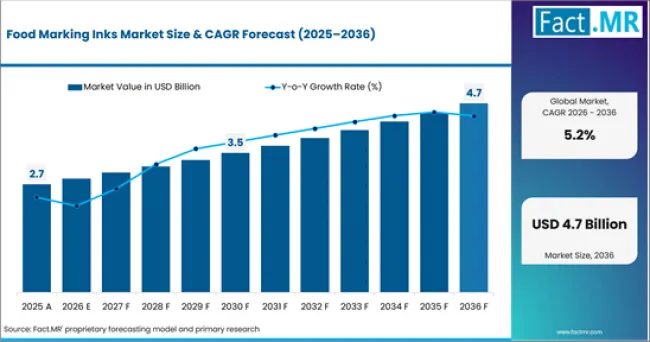
- The Food Marking Inks Market is expected to grow from USD 2.8 billion in 2026 to USD 4.7 billion by 2036, at a 5.2% CAGR.
- Growth is supported by rising packaged food production, stricter traceability rules, and wider use of coding inks for batch codes, expiry dates, and authentication marks.
- The food processing industry is expected to contribute 46.1% of end-use demand in 2026 as manufacturers prioritize coding durability, food-contact compliance, and line-speed compatibility.
Summary of the Food Marking Inks Market
- Market Snapshot
- In 2025, the global Food Marking Inks Market was valued at approximately USD 2.7 billion.
- The market is estimated to reach USD 2.8 billion in 2026 and is projected to attain USD 4.7 billion by 2036.
- The market is likely to expand at a CAGR of 5.2% during the forecast period.
- The market is anticipated to create an absolute dollar opportunity of USD 1.9 billion between 2026 and 2036.
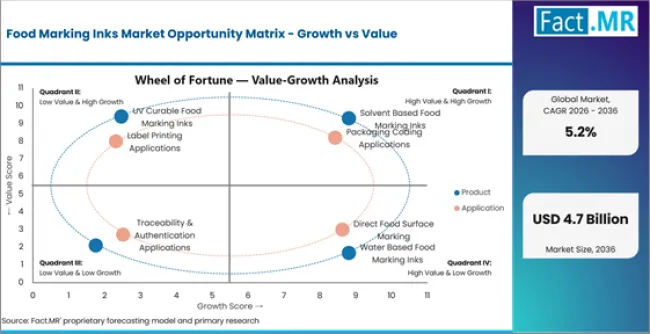
- Solvent Based Food Marking Inks accounts for 34.7% of product segment share in 2026.
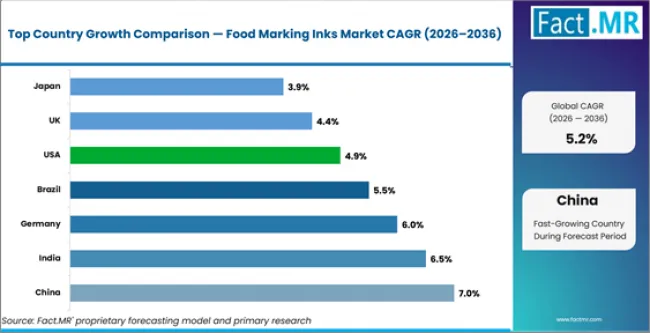
- China (7.0%) and India (6.5%) are the key growth markets during the forecast period.
- Demand and Growth Drivers
- Packaged food and beverage production creates steady demand for food marking inks that meet traceability, migration, adhesion, and readability requirements.
- Regulatory mandates including food safety labeling, nutritional claim standards, and packaging compliance create structured procurement favoring products with certified quality documentation.
- Product formulation advancement improves performance characteristics, expands application scope, and strengthens positioning against conventional alternatives in health-conscious and clean-label consumer segments.
- Growing food safety and traceability requirements support adoption of inks with documented food-contact suitability, low migration performance, and substrate compatibility.
- Product and Segment View
- Solvent-based food marking inks account for 34.7% of the product segment in 2026, supported by fast drying, strong adhesion, and compatibility with high-speed packaging lines.
- The food processing industry represents 46.1% of end-use demand in 2026, reflecting heavy use of inks for date codes, batch numbers, lot tracking, and packaging identification.
- Fast-drying ink formulations lead the formulation segment with 31.8% share in 2026, supported by high-speed filling, sealing, and packaging lines.
- Key segmentation includes:
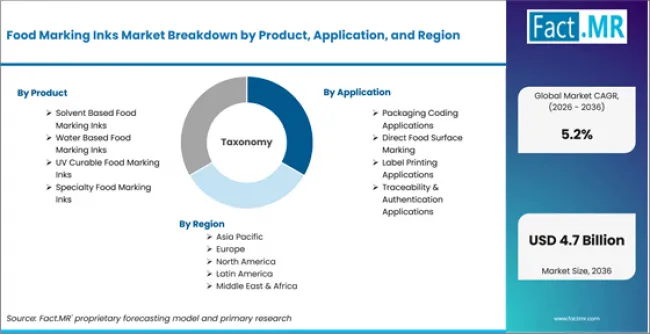
- Product Type: Solvent-Based Food Marking Inks, Water-Based Food Marking Inks, UV-Curable Food Marking Inks, and Specialty Food Marking Inks
- End Use: Food Processing Industry, Beverage Industry, Dairy Industry, and Meat & Seafood Industry
- Formulation: Fast-Drying Ink Formulations, Food-Safe Ink Formulations, High-Durability Formulations, and Sustainable Ink Formulations
- These systems enable:
- Primary product functionality addressing core consumer and industrial requirements across end-use applications.
- Processing compatibility and formulation flexibility supporting broad application across product categories.
- Regulatory compliance and quality documentation supporting market access across regulated food and consumer goods markets.
- Geography and Competitive Outlook
- North America maintains a significant share supported by established consumer demand, retailer sustainability requirements, and brand differentiation investment.
- Asia Pacific is the fastest-growing region, with China (7.0%) and India (6.5%) leading through urbanization, organized retail expansion, and growing health-conscious consumption.
- Europe maintains steady demand with Germany supported by EU regulatory compliance, retailer consolidation, and premium product specifications.
- Key companies include Acorn Digital Inks, ADCO Stamps and Inc., Birko Corporation among others.
- Analyst Opinion
- Shambhu Nath Jha, Principal Consultant at Fact.MR, says "The food marking inks market reflects the intersection of consumer health awareness, regulatory evolution, and retail channel transformation. Growth is not driven by a single factor but by the convergence of urbanization expanding the consumer base in emerging markets, clean-label requirements reshaping formulation priorities in developed markets, and e-commerce distribution removing geographic barriers to specialty product access. Companies that align product development with these converging trends across their primary markets will capture disproportionate share of the incremental opportunity."
Key Growth Drivers, Constraints, and Opportunities

Key Factors Driving Growth
- End-use industry consumption growth creates sustained procurement demand across primary application segments in both developed and emerging market channels.
- Regulatory evolution in food labeling, nutritional claims, and packaging sustainability creates compliance-driven procurement favoring products with certified quality documentation.
- Consumer preference shifts toward health-positioned, clean-label products expand the addressable market beyond traditional consumer segments into mainstream grocery distribution.
Key Market Constraints
- Price premium compared to conventional alternatives limits adoption in cost-sensitive consumer segments and emerging markets where affordability is the primary purchase criterion.
- Distribution infrastructure gaps in emerging markets constrain product availability outside tier-1 cities, limiting penetration into the broader consumer base.
- Consumer taste acceptance barriers require continued formulation investment to match conventional product sensory profiles while maintaining health-positioned ingredient specifications.
Key Opportunity Areas
- E-commerce and direct-to-consumer channels create new distribution pathways that bypass traditional retail infrastructure constraints, enabling faster market penetration in underserved geographies.
- Private-label and retailer brand programs create volume procurement opportunities for manufacturers with production scale and formulation flexibility.
- Functional health positioning that combines nutritional benefits with taste optimization creates premium product categories with higher margins and stronger brand loyalty.
Segment-wise Analysis of the Food Marking Inks Market
- Solvent Based Food Marking Inks holds 34.7% of the product segment in 2026 through established consumer acceptance and distribution presence.
- Food Processing Industry accounts for 46.1% of end use demand in 2026, reflecting primary buyer procurement concentration.
- Emerging product categories grow faster as health trends and formulation innovation expand the consumer addressable market.
The market is segmented by product type, end use, formulation, and region. Lead segments maintain dominant positions through established consumer acceptance, while emerging categories grow faster driven by health trends and formulation innovation.
Which Product Segment Dominates the Food Marking Inks Market?
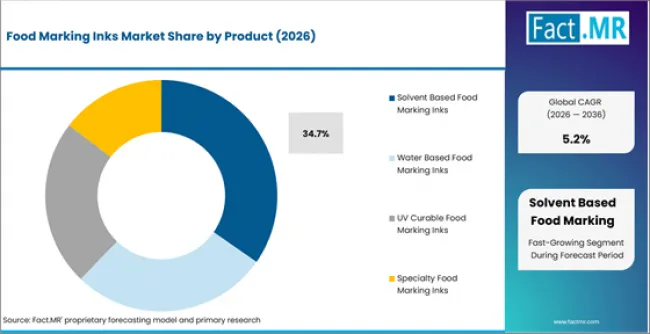
Solvent Based Food Marking Inks accounts for 34.7% of the product segment in 2026. Its leadership reflects established consumer acceptance, broad retail distribution, and proven formulation performance across the primary consumption base. The segment benefits from recognized product positioning and established supply chain relationships.
Supporting segments hold growing positions as health trends, dietary preferences, and formulation innovation create demand for specialized product variants targeting specific consumer requirements.
Which End-Use Segment Dominates the Food Marking Inks Market?
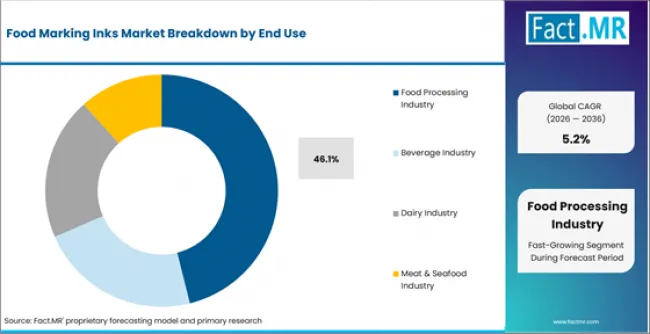
Food Processing Industry is expected to lead the end use segment with a 46.1% share in 2026. This reflects procurement concentration among primary buyers managing the largest consumption volumes across retail and food service channels.
Secondary channels hold growing positions as food service, e-commerce, and specialty retail create new procurement pathways beyond the primary distribution base.
Which Product Trend is Shaping the Next Phase of Growth in the Food Marking Inks Market?
Low-migration inks, water-based formulations, UV-curable systems, and food-contact-compliant coding solutions are the major trends shaping market growth. Manufacturers are developing formulations with simplified ingredient lists, documented nutritional benefits, and transparent supply chain sourcing that meet evolving consumer expectations and retailer procurement specifications across both developed and emerging market channels.
The second dimension is distribution channel diversification through e-commerce, direct-to-consumer, and specialty retail that creates new consumer access pathways for premium and health-positioned product variants, enabling market penetration that traditional retail infrastructure constraints previously limited.
Regional Outlook Across Key Markets
- China leads growth at 7.0%, supported by the largest food manufacturing base, e-commerce distribution expansion, and growing health-conscious consumer demand across urban and tier-2 city markets.
- India follows at 6.5%, driven by urbanization, organized retail expansion, and rising consumer health awareness creating new demand for food marking inks products.
- North America maintains a significant share through established consumer demand, retailer sustainability requirements, and brand differentiation across mainstream and premium grocery distribution.
- Germany leads European growth at 6.0%, supported by EU regulatory compliance, retailer consolidation, and premium product specifications.
.webp)
CAGR Table
| Country | CAGR (%) |
|---|---|
| China | 7.0% |
| India | 6.5% |
| Germany | 6.0% |
| Brazil | 5.5% |
| USA | 4.9% |
Source: Fact MR analysis, based on proprietary forecasting model and primary research.
Food Marking Inks Demand Trends in the United States
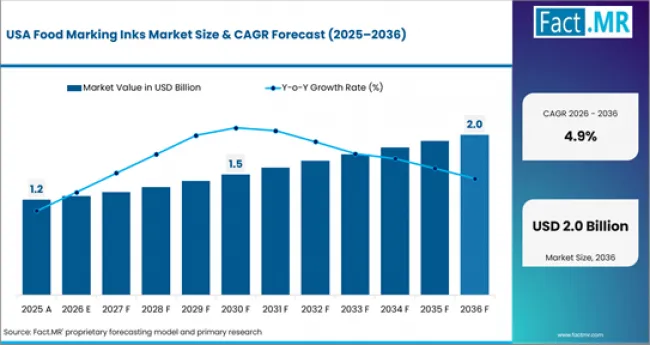
FDA food contact compliance and retailer traceability requirements shape procurement specifications for solvent-based and water-based food marking inks in the United States. Sustainability mandates from major grocery chains and food service operators are driving transition from solvent-based to water-based and UV-curable ink systems that meet recyclability targets for marked packaging surfaces. Brand differentiation through variable date coding, lot tracking, and promotional marking on food cartons supports growing adoption of digital inkjet marking systems.
- Retailer packaging sustainability requirements accelerate conversion from solvent-based to low-VOC food marking ink systems across processed food and packaged goods categories.
- FDA food contact notification compliance creates structured procurement specifications that favor established ink manufacturers with documented migration testing data.
China Food Marking Inks Growth Assessment
The scale of food processing and packaged food manufacturing in China generates the largest regional procurement volumes for food marking inks globally. Domestic ink manufacturers hold cost advantages through local raw material sourcing and proximity to major food processing clusters in Shandong, Henan, and Guangdong provinces. E-commerce food delivery logistics are expanding marking requirements as traceability codes and batch identification become mandatory across cold chain and ambient food distribution networks.
- Domestic food marking ink manufacturers provide cost-competitive supply to the largest food processing base globally, supported by local raw material sourcing and production scale.
- E-commerce food delivery expansion creates new marking requirements for traceability codes and batch identification across packaged food distribution channels.
India Food Marking Inks Market Opportunity Outlook
Demand for food marking inks is shaped by the rapid expansion of organized food processing and packaged food manufacturing across tier-2 and tier-3 cities, where urbanization and rising disposable incomes are shifting consumer purchasing toward branded and date-coded products. FSSAI food safety labeling requirements mandate batch coding, manufacturing date marking, and expiry date printing on all packaged food products, creating compliance-driven procurement demand for reliable marking ink systems at food processing facilities nationwide.
- FSSAI mandatory labeling requirements for batch coding and date marking on packaged food products create compliance-driven ink procurement across the Indian food processing industry.
- Tier-2 and tier-3 city organized retail expansion is broadening the packaged food base requiring food marking ink systems for production line coding and traceability compliance.
Germany Food Marking Inks Demand Analysis
EU food contact material regulation (EC) No 1935/2004 and German BfR recommendations define migration limits and compositional requirements for food marking inks used on primary packaging surfaces. Extended producer responsibility (EPR) frameworks under the German VerpackG are adding recyclability assessment requirements that influence ink formulation specifications, as marking inks must not compromise the recyclability of paper, carton, and plastic food packaging substrates. Retailer consolidation among Aldi, Lidl, Rewe, and Edeka creates concentrated procurement influence over ink specification standards across German food supply chains.
- EU food contact regulation and BfR compliance requirements create technical barriers favoring established ink manufacturers with documented migration testing across food packaging substrates.
- German VerpackG extended producer responsibility requirements influence ink formulation to ensure compatibility with packaging recycling streams.
Competitive Benchmarking and Company Positioning

Food Marking Inks Market Analysis By Company
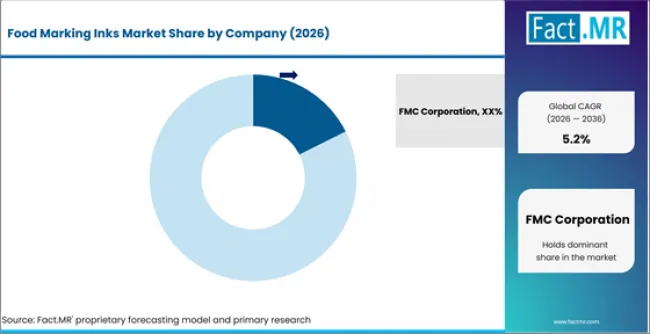
- Leading companies hold strong positions through comprehensive product portfolios, established retail distribution relationships, and sustained investment in health-positioned product innovation.
- Mid-tier competitors differentiate through focused product categories, regional manufacturing strength, and specialized application expertise.
- Clean-label formulation capability, retailer compliance documentation, and e-commerce channel presence are increasingly important competitive differentiators.
The competitive landscape combines coding and marking system suppliers, industrial ink producers, and specialty food-contact ink formulators. Leading companies compete through broad product portfolios and established retail relationships while mid-tier competitors differentiate through focused health positioning and regional formulation expertise.
Strategic priorities include expanding clean-label product portfolios, strengthening e-commerce distribution capability, and building retailer compliance documentation for sustainability and recyclability requirements.
Key Companies in the Food Marking Inks Market
- Acorn Digital Inks, ADCO Stamps and Inc. are among the leading participants with established product portfolios and distribution networks.
- Birko Corporation, Kao Collins hold established positions through focused product categories and regional strength.
- compete through specialized offerings and competitive positioning.
Recent Industry Developments
- Markem-Imaje, MB2253 Beverage Packaging Ink Launch (June 2025)
- Markem-Imaje launched MB2253 in June 2025 as a black MEK ink for beverage packaging. The ink is designed for plastics, metals, glass, and returnable glass bottles. It is relevant to the Food Marking Inks Market because Markem-Imaje states that MB2253 complies with indirect food-contact legislation and supports durable beverage package coding.
- Videojet Technologies, PACK EXPO Coding and Marking Innovations (September 2025)
- Videojet presented CIJ, laser, and thermal transfer coding technologies at PACK EXPO Las Vegas 2025. The company highlighted CIJ systems for production-speed variable data printing, including the Videojet 1880 UHS for high-throughput coding.
- Domino Printing Sciences, MEK-Free Low-VOC Food Packaging Ink Development (November 2025)
- Domino highlighted MEK-free and low-VOC ink systems for product packaging in November 2025. The company described 1BK108 as a black MEK-free formulation developed with food and pharma requirements in mind.
Leading Companies Shaping the Food Marking Inks Market
- Acorn Digital Inks
- ADCO Stamps and Inc.
- Birko Corporation
- Kao Collins
Sources and Research References
- Markem-Imaje. (2025, June 5). The new ink fits all covers all beverage containers.
- Videojet Technologies Inc. (2025, September 18). Videojet brings cutting-edge coding and marking innovations to PACK EXPO Las Vegas.
- Domino Printing Sciences. (2025, November 14). Domino’s MEK-free low-VOC inks for product packaging.
Key Questions This Report Addresses
- What is the current and future size of the Food Marking Inks Market?
- How fast is the market expected to grow between 2026 and 2036?
- Which product type leads by 2026?
- Which end-use accounts for highest demand?
- What are the primary growth drivers?
- How is clean-label reformulation influencing the market?
- Which countries show the fastest growth?
- Who are the key companies?
- How does Fact.MR validate the forecast?
Food Marking Inks Market Definition
The Food Marking Inks Market covers specialized products and formulations serving food, beverage, and consumer goods applications across commercial, retail, and food service distribution channels.
Food Marking Inks Market Inclusions
- The scope covers global and regional market size and forecasts for 2026 to 2036 across product type, end use, formulation, and region.
- It includes all major product grades and formulations for primary and secondary end-use applications.
- The report covers technology, regulatory, and consumer trends and the competitive landscape of leading producers.
Food Marking Inks Market Exclusions
- The scope excludes general-purpose products not classified within this specific market category.
- It excludes raw ingredient supply chains and processing equipment sold independently.
- The report excludes downstream food service meals and assembled retail products.
Food Marking Inks Market Research Methodology
- The methodology combines secondary research, primary interviews, and forecast modelling.
- It draws on 90+ secondary sources and benchmarks 45+ company portfolios.
- Market sizing covers 30+ countries through a demand-side model, supported by top-down validation.
- Key inputs include food industry production data, consumer spending trends, and regulatory tracking.
- Primary validation includes 25+ interviews across producers, food manufacturers, retailers, and regulatory specialists.
Scope of Analysis

| Parameter | Details |
|---|---|
| Quantitative Units | USD 2.8 billion to USD 4.7 billion, at a CAGR of 5.2% |
| Market Definition | The food marking inks market covers inks used for coding, date marking, batch identification, traceability, authentication, and direct or indirect food-contact marking across food and beverage packaging lines. |
| Regions Covered | North America, Latin America, Europe, East Asia, South Asia and Pacific, Middle East and Africa |
| Countries Covered | USA, Canada, UK, Germany, China, India, Brazil, 30 plus countries |
| Key Companies | Acorn Digital Inks, ADCO Stamps and Inc., Birko Corporation, Kao Collins |
| Forecast Period | 2026 to 2036 |
| Approach | Hybrid demand-side methodology built on food industry data, consumer trends, regulatory tracking, and primary interviews. |
Food Marking Inks Market Segmentation
-
Food Marking Inks Market Segmented by Product:
- Solvent Based Food Marking Inks
- Alcohol Based Inks
- Fast Drying Ethanol Inks
- High Adhesion Isopropanol Inks
- Ketone Based Inks
- MEK Industrial Coding Inks
- Low Residue Ketone Inks
- Alcohol Based Inks
- Water Based Food Marking Inks
- Dye Based Water Inks
- High Visibility Dye Inks
- Low VOC Coding Inks
- Pigment Based Water Inks
- Opaque Food Packaging Inks
- High Durability Pigment Inks
- Dye Based Water Inks
- UV Curable Food Marking Inks
- Free Radical UV Inks
- Instant Cure Packaging Inks
- High Speed Conveyor Inks
- Cationic UV Inks
- Chemical Resistant UV Inks
- High Gloss UV Marking Inks
- Free Radical UV Inks
- Specialty Food Marking Inks
- Edible Marking Inks
- Direct Food Contact Inks
- Bakery Product Coding Inks
- Temperature Resistant Inks
- Retort Packaging Inks
- Frozen Food Coding Inks
- Edible Marking Inks
- Solvent Based Food Marking Inks
-
Food Marking Inks Market Segmented by Application:
- Packaging Coding Applications
- Flexible Packaging Coding
- Plastic Film Coding Systems
- Pouch Packaging Printing
- Rigid Packaging Coding
- Bottle Coding Applications
- Can Surface Marking Systems
- Flexible Packaging Coding
- Direct Food Surface Marking
- Bakery Product Marking
- Bread Surface Coding
- Cake Decoration Printing
- Produce Surface Marking
- Fruit Skin Coding
- Vegetable Traceability Printing
- Bakery Product Marking
- Label Printing Applications
- Pressure Sensitive Label Printing
- Barcode Label Printing
- Variable Data Label Coding
- Shrink Sleeve Printing
- Beverage Sleeve Coding
- Full Body Container Printing
- Pressure Sensitive Label Printing
- Traceability & Authentication Applications
- Batch Coding Systems
- Manufacturing Date Coding
- Expiry Date Printing
- Anti Counterfeit Applications
- Invisible Security Marking
- Serialized Product Authentication
- Batch Coding Systems
- Packaging Coding Applications
-
Food Marking Inks Market Segmented by End Use:
- Food Processing Industry
- Packaged Food Manufacturers
- Snack Food Processing Plants
- Ready Meal Production Facilities
- Bakery Processing Companies
- Commercial Bread Manufacturers
- Industrial Dessert Producers
- Packaged Food Manufacturers
- Beverage Industry
- Alcoholic Beverage Producers
- Beer Bottling Facilities
- Wine Packaging Operations
- Non Alcoholic Beverage Producers
- Soft Drink Manufacturing Plants
- Juice Processing Facilities
- Alcoholic Beverage Producers
- Dairy Industry
- Milk Processing Companies
- Pasteurized Milk Packaging Plants
- Flavored Milk Production Facilities
- Cultured Dairy Manufacturers
- Yogurt Packaging Units
- Cheese Processing Facilities
- Milk Processing Companies
- Meat & Seafood Industry
- Processed Meat Companies
- Sausage Packaging Operations
- Frozen Meat Production Plants
- Seafood Processing Companies
- Frozen Fish Packaging Units
- Shellfish Processing Facilities
- Processed Meat Companies
- Food Processing Industry
-
Food Marking Inks Market Segmented by Technology:
- Continuous Inkjet Technology
- Small Character Inkjet Systems
- High Speed Bottle Coding Systems
- Flexible Film Coding Platforms
- Large Character Inkjet Systems
- Corrugated Box Printing Systems
- Outer Carton Coding Platforms
- Small Character Inkjet Systems
- Thermal Inkjet Technology
- Cartridge Based TIJ Systems
- Disposable Ink Cartridge Systems
- Portable Coding Printers
- Bulk Ink TIJ Systems
- High Volume Packaging Printers
- Industrial Production Line Coders
- Cartridge Based TIJ Systems
- Laser Marking Technology
- CO2 Laser Systems
- Paperboard Packaging Markers
- PET Bottle Laser Coders
- Fiber Laser Systems
- Metal Can Marking Platforms
- High Precision Surface Markers
- CO2 Laser Systems
- Thermal Transfer Technology
- Ribbon Based TTO Systems
- Flexible Packaging Transfer Printers
- High Resolution Label Coders
- Direct Thermal Systems
- Heat Sensitive Surface Printers
- Compact Thermal Coding Systems
- Ribbon Based TTO Systems
- Continuous Inkjet Technology
-
Food Marking Inks Market Segmented by Formulation:
- Fast Drying Ink Formulations
- Quick Evaporation Systems
- High Speed Conveyor Inks
- Instant Surface Bonding Inks
- Low Smudge Formulations
- Abrasion Resistant Ink Systems
- Rapid Cure Packaging Inks
- Quick Evaporation Systems
- Food Safe Ink Formulations
- Low Migration Systems
- Indirect Food Contact Inks
- Regulatory Compliant Packaging Inks
- Non Toxic Ink Systems
- Heavy Metal Free Inks
- Low Odor Food Coding Inks
- Low Migration Systems
- High Durability Formulations
- Chemical Resistant Systems
- Oil Resistant Packaging Inks
- Moisture Resistant Coding Inks
- Temperature Stable Systems
- Frozen Food Stable Inks
- Retort Resistant Ink Formulations
- Chemical Resistant Systems
- Sustainable Ink Formulations
- Bio Based Ink Systems
- Plant Derived Pigment Inks
- Renewable Solvent Ink Systems
- Low Emission Formulations
- Reduced VOC Packaging Inks
- Eco Compliant Printing Inks
- Bio Based Ink Systems
- Fast Drying Ink Formulations
-
Food Marking Inks Market Segmented by Distribution Channel:
- Direct Industrial Sales
- OEM Packaging Partnerships
- Integrated Packaging Line Contracts
- Food Plant Equipment Supply Agreements
- Bulk Ink Supply Programs
- Large Volume Ink Deliveries
- Long Term Industrial Procurement Contracts
- OEM Packaging Partnerships
- Specialty Chemical Distributors
- Regional Ink Distributors
- Industrial Printing Ink Suppliers
- Food Packaging Ink Traders
- Technical Solution Providers
- Coding System Support Providers
- Industrial Printing Consultants
- Regional Ink Distributors
- Online B2B Platforms
- Digital Procurement Platforms
- Industrial Ink Ordering Portals
- Packaging Consumables Marketplaces
- Manufacturer Direct Platforms
- Subscription Ink Delivery Services
- Cloud Based Procurement Systems
- Digital Procurement Platforms
- Third Party Packaging Suppliers
- Contract Packaging Suppliers
- Private Label Ink Suppliers
- Custom Packaging Ink Providers
- Integrated Supply Networks
- Cross Border Packaging Distributors
- Global Industrial Supply Chains
- Contract Packaging Suppliers
- Direct Industrial Sales
-
Food Marking Inks Market by Region:
- North America
- USA
- Canada
- Mexico
- Latin America
- Brazil
- Chile
- Rest of Latin America
- Western Europe
- Germany
- UK
- Italy
- Spain
- France
- Nordic
- BENELUX
- Rest of Western Europe
- Eastern Europe
- Russia
- Poland
- Hungary
- Balkan & Baltic
- Rest of Eastern Europe
- East Asia
- China
- Japan
- South Korea
- South Asia and Pacific
- India
- ASEAN
- Australia & New Zealand
- Rest of South Asia and Pacific
- Middle East & Africa
- Kingdom of Saudi Arabia
- Other GCC Countries
- Turkiye
- South Africa
- Other African Union
- Rest of Middle East & Africa
- North America
- Frequently Asked Questions -
How big is the food marking inks market in 2026?
The global food marking inks market is estimated to be valued at USD 2.8 billion in 2026.
What will be the size of the food marking inks market in 2036?
The market size for the food marking inks market is projected to reach USD 4.7 billion by 2036.
How much will the food marking inks market grow between 2026 and 2036?
The food marking inks market is expected to grow at a 5.2% CAGR between 2026 and 2036.
What are the key products in the food marking inks market?
The key products in the food marking inks market are solvent-based food marking inks, water-based food marking inks, UV-curable food marking inks, and specialty food marking inks.
Which application segment is expected to contribute a significant share in the food marking inks market in 2026?
In terms of application, the packaging coding applications segment is expected to command 78.6% share in the food marking inks market in 2026.
Table of Content
- Key Takeaways
- Market Size and CAGR
- Top Growth Driver
- Fastest Growing Segment
- Leading Region
- Key Companies
- Emerging Opportunities
- Executive Summary
- Global Market Outlook
- Demand-side Trends
- Supply-side Trends
- Technology Roadmap Analysis
- Analysis and Recommendations
- Analyst Perspective (What is happening? Why now? What should investors know?)
- Key Questions Answered
- How large is the market?
- What is the CAGR?
- What are key trends?
- Which region dominates?
- Who are the leaders?
- Market Overview
- Market Coverage / Taxonomy
- Market Definition / Scope / Limitations
- Research Methodology
- Chapter Orientation
- Analytical Lens and Working Hypotheses
- Market Structure, Signals, and Trend Drivers
- Benchmarking and Cross-market Comparability
- Market Sizing, Forecasting, and Opportunity Mapping
- Research Design and Evidence Framework
- Desk Research Programme (Secondary Evidence)
- Expert Input and Fieldwork (Primary Evidence)
- Tooling, Models, and Reference Databases
- Data Engineering and Model Build
- Quality Assurance and Audit Trail
- Market Background
- Market Dynamics (Drivers, Restraints, Opportunity, Trends)
- Scenario Forecast (Optimistic, Likely, Conservative)
- Impact Analysis
- AI Impact
- Sustainability Impact
- Regulatory Impact
- Technology Impact
- Consumer / Buyer Analysis
- Purchase Drivers
- Adoption Barriers
- Buyer Journey
- Opportunity Map Analysis
- Product Life Cycle Analysis
- Supply Chain Analysis
- Investment Feasibility Matrix
- Value Chain Analysis
- PESTLE and Porter's Analysis
- Regulatory Landscape
- Regional Parent Market Outlook
- Production and Consumption Statistics
- Import and Export Statistics
- Global Market Analysis and Forecast, 2021 to 2036
- Historical Market Size Value (USD Million) Analysis, 2021 to 2025
- Current and Future Market Size Value (USD Million) Projections, 2026 to 2036
- Y-o-Y Growth Trend Analysis
- Absolute $ Opportunity Analysis
- Global Market Pricing Analysis, 2021 to 2036
- Global Market Analysis and Forecast, By Product, 2021 to 2036
- Introduction / Key Findings
- Historical Market Size Value (USD Million) Analysis By Product, 2021 to 2025
- Current and Future Market Size Value (USD Million) Analysis and Forecast By Product, 2026 to 2036
- Solvent Based Food Marking Inks
- Alcohol Based Inks
- Ketone Based Inks
- Water Based Food Marking Inks
- Dye Based Water Inks
- Pigment Based Water Inks
- UV Curable Food Marking Inks
- Free Radical UV Inks
- Cationic UV Inks
- Specialty Food Marking Inks
- Edible Marking Inks
- Temperature Resistant Inks
- Solvent Based Food Marking Inks
- Y-o-Y Growth Trend Analysis By Product, 2021 to 2025
- Absolute $ Opportunity Analysis By Product, 2026 to 2036
- Global Market Analysis and Forecast, By Application, 2021 to 2036
- Introduction / Key Findings
- Historical Market Size Value (USD Million) Analysis By Application, 2021 to 2025
- Current and Future Market Size Value (USD Million) Analysis and Forecast By Application, 2026 to 2036
- Packaging Coding Applications
- Flexible Packaging Coding
- Rigid Packaging Coding
- Direct Food Surface Marking
- Bakery Product Marking
- Produce Surface Marking
- Label Printing Applications
- Pressure Sensitive Label Printing
- Shrink Sleeve Printing
- Traceability & Authentication Applications
- Batch Coding Systems
- Anti Counterfeit Applications
- Packaging Coding Applications
- Y-o-Y Growth Trend Analysis By Application, 2021 to 2025
- Absolute $ Opportunity Analysis By Application, 2026 to 2036
- Global Market Analysis and Forecast, By End Use, 2021 to 2036
- Introduction / Key Findings
- Historical Market Size Value (USD Million) Analysis By End Use, 2021 to 2025
- Current and Future Market Size Value (USD Million) Analysis and Forecast By End Use, 2026 to 2036
- Food Processing Industry
- Packaged Food Manufacturers
- Bakery Processing Companies
- Beverage Industry
- Alcoholic Beverage Producers
- Non Alcoholic Beverage Producers
- Dairy Industry
- Milk Processing Companies
- Cultured Dairy Manufacturers
- Meat & Seafood Industry
- Processed Meat Companies
- Seafood Processing Companies
- Food Processing Industry
- Y-o-Y Growth Trend Analysis By End Use, 2021 to 2025
- Absolute $ Opportunity Analysis By End Use, 2026 to 2036
- Global Market Analysis and Forecast, By Technology, 2021 to 2036
- Introduction / Key Findings
- Historical Market Size Value (USD Million) Analysis By Technology, 2021 to 2025
- Current and Future Market Size Value (USD Million) Analysis and Forecast By Technology, 2026 to 2036
- Continuous Inkjet Technology
- Small Character Inkjet Systems
- Large Character Inkjet Systems
- Thermal Inkjet Technology
- Cartridge Based TIJ Systems
- Bulk Ink TIJ Systems
- Laser Marking Technology
- CO2 Laser Systems
- Fiber Laser Systems
- Thermal Transfer Technology
- Ribbon Based TTO Systems
- Direct Thermal Systems
- Continuous Inkjet Technology
- Y-o-Y Growth Trend Analysis By Technology, 2021 to 2025
- Absolute $ Opportunity Analysis By Technology, 2026 to 2036
- Global Market Analysis and Forecast, By Formulation, 2021 to 2036
- Introduction / Key Findings
- Historical Market Size Value (USD Million) Analysis By Formulation, 2021 to 2025
- Current and Future Market Size Value (USD Million) Analysis and Forecast By Formulation, 2026 to 2036
- Fast Drying Ink Formulations
- Quick Evaporation Systems
- Low Smudge Formulations
- Food Safe Ink Formulations
- Low Migration Systems
- Non Toxic Ink Systems
- High Durability Formulations
- Chemical Resistant Systems
- Temperature Stable Systems
- Sustainable Ink Formulations
- Bio Based Ink Systems
- Low Emission Formulations
- Fast Drying Ink Formulations
- Y-o-Y Growth Trend Analysis By Formulation, 2021 to 2025
- Absolute $ Opportunity Analysis By Formulation, 2026 to 2036
- Global Market Analysis and Forecast, By Distribution Channel
- Introduction / Key Findings
- Historical Market Size Value (USD Million) Analysis By Distribution Channel, 2021 to 2025
- Current and Future Market Size Value (USD Million) Analysis and Forecast By Distribution Channel, 2026 to 2036
- Direct Industrial Sales
- OEM Packaging Partnerships
- Bulk Ink Supply Programs
- Specialty Chemical Distributors
- Regional Ink Distributors
- Technical Solution Providers
- Online B2B Platforms
- Digital Procurement Platforms
- Manufacturer Direct Platforms
- Third Party Packaging Suppliers
- Contract Packaging Suppliers
- Integrated Supply Networks
- Direct Industrial Sales
- Y-o-Y Growth Trend Analysis By Distribution Channel, 2021 to 2025
- Absolute $ Opportunity Analysis By Distribution Channel, 2026 to 2036
- Global Market Analysis and Forecast, By Region, 2021 to 2036
- Introduction
- Historical Market Size Value (USD Million) Analysis By Region, 2021 to 2025
- Current Market Size Value (USD Million) Analysis and Forecast By Region, 2026 to 2036
- North America
- Latin America
- Western Europe
- Eastern Europe
- East Asia
- South Asia and Pacific
- Middle East & Africa
- Market Attractiveness Analysis By Region
- North America Market Analysis and Forecast, By Country, 2021 to 2036
- Historical Market Size Value (USD Million) Trend Analysis By Market Taxonomy, 2021 to 2025
- Market Size Value (USD Million) Forecast By Market Taxonomy, 2026 to 2036
- By Country
- USA
- Canada
- Mexico
- By Product
- By Application
- By End Use
- By Technology
- By Formulation
- By Distribution Channel
- By Country
- Market Attractiveness Analysis
- By Country
- By Product
- By Application
- By End Use
- By Technology
- By Formulation
- By Distribution Channel
- Key Takeaways
- Latin America Market Analysis and Forecast, By Country
- Historical Market Size Value (USD Million) Trend Analysis By Market Taxonomy, 2021 to 2025
- Market Size Value (USD Million) Forecast By Market Taxonomy, 2026 to 2036
- By Country
- Brazil
- Chile
- Rest of Latin America
- By Product
- By Application
- By End Use
- By Technology
- By Formulation
- By Distribution Channel
- By Country
- Market Attractiveness Analysis
- By Country
- By Product
- By Application
- By End Use
- By Technology
- By Formulation
- By Distribution Channel
- Key Takeaways
- Western Europe Market Analysis and Forecast, By Country
- Historical Market Size Value (USD Million) Trend Analysis By Market Taxonomy, 2021 to 2025
- Market Size Value (USD Million) Forecast By Market Taxonomy, 2026 to 2036
- By Country
- Germany
- UK
- Italy
- Spain
- France
- Nordic
- BENELUX
- Rest of Western Europe
- By Product
- By Application
- By End Use
- By Technology
- By Formulation
- By Distribution Channel
- By Country
- Market Attractiveness Analysis
- By Country
- By Product
- By Application
- By End Use
- By Technology
- By Formulation
- By Distribution Channel
- Key Takeaways
- Eastern Europe Market Analysis and Forecast, By Country
- Historical Market Size Value (USD Million) Trend Analysis By Market Taxonomy, 2021 to 2025
- Market Size Value (USD Million) Forecast By Market Taxonomy, 2026 to 2036
- By Country
- Russia
- Poland
- Hungary
- Balkan & Baltic
- Rest of Eastern Europe
- By Product
- By Application
- By End Use
- By Technology
- By Formulation
- By Distribution Channel
- By Country
- Market Attractiveness Analysis
- By Country
- By Product
- By Application
- By End Use
- By Technology
- By Formulation
- By Distribution Channel
- Key Takeaways
- East Asia Market Analysis and Forecast, By Country
- Historical Market Size Value (USD Million) Trend Analysis By Market Taxonomy, 2021 to 2025
- Market Size Value (USD Million) Forecast By Market Taxonomy, 2026 to 2036
- By Country
- China
- Japan
- South Korea
- By Product
- By Application
- By End Use
- By Technology
- By Formulation
- By Distribution Channel
- By Country
- Market Attractiveness Analysis
- By Country
- By Product
- By Application
- By End Use
- By Technology
- By Formulation
- By Distribution Channel
- Key Takeaways
- South Asia and Pacific Market Analysis and Forecast, By Country
- Historical Market Size Value (USD Million) Trend Analysis By Market Taxonomy, 2021 to 2025
- Market Size Value (USD Million) Forecast By Market Taxonomy, 2026 to 2036
- By Country
- India
- ASEAN
- Australia & New Zealand
- Rest of South Asia and Pacific
- By Product
- By Application
- By End Use
- By Technology
- By Formulation
- By Distribution Channel
- By Country
- Market Attractiveness Analysis
- By Country
- By Product
- By Application
- By End Use
- By Technology
- By Formulation
- By Distribution Channel
- Key Takeaways
- Middle East & Africa Market Analysis and Forecast, By Country
- Historical Market Size Value (USD Million) Trend Analysis By Market Taxonomy, 2021 to 2025
- Market Size Value (USD Million) Forecast By Market Taxonomy, 2026 to 2036
- By Country
- Kingdom of Saudi Arabia
- Other GCC Countries
- Turkiye
- South Africa
- Other African Union
- Rest of Middle East & Africa
- By Product
- By Application
- By End Use
- By Technology
- By Formulation
- By Distribution Channel
- By Country
- Market Attractiveness Analysis
- By Country
- By Product
- By Application
- By End Use
- By Technology
- By Formulation
- By Distribution Channel
- Key Takeaways
- Key Countries Market Analysis
- USA
- Pricing Analysis
- Market Share Analysis, 2025
- By Product
- By Application
- By End Use
- By Technology
- By Formulation
- By Distribution Channel
- Canada
- Pricing Analysis
- Market Share Analysis, 2025
- By Product
- By Application
- By End Use
- By Technology
- By Formulation
- By Distribution Channel
- Mexico
- Pricing Analysis
- Market Share Analysis, 2025
- By Product
- By Application
- By End Use
- By Technology
- By Formulation
- By Distribution Channel
- Brazil
- Pricing Analysis
- Market Share Analysis, 2025
- By Product
- By Application
- By End Use
- By Technology
- By Formulation
- By Distribution Channel
- Chile
- Pricing Analysis
- Market Share Analysis, 2025
- By Product
- By Application
- By End Use
- By Technology
- By Formulation
- By Distribution Channel
- Germany
- Pricing Analysis
- Market Share Analysis, 2025
- By Product
- By Application
- By End Use
- By Technology
- By Formulation
- By Distribution Channel
- UK
- Pricing Analysis
- Market Share Analysis, 2025
- By Product
- By Application
- By End Use
- By Technology
- By Formulation
- By Distribution Channel
- Italy
- Pricing Analysis
- Market Share Analysis, 2025
- By Product
- By Application
- By End Use
- By Technology
- By Formulation
- By Distribution Channel
- Spain
- Pricing Analysis
- Market Share Analysis, 2025
- By Product
- By Application
- By End Use
- By Technology
- By Formulation
- By Distribution Channel
- France
- Pricing Analysis
- Market Share Analysis, 2025
- By Product
- By Application
- By End Use
- By Technology
- By Formulation
- By Distribution Channel
- India
- Pricing Analysis
- Market Share Analysis, 2025
- By Product
- By Application
- By End Use
- By Technology
- By Formulation
- By Distribution Channel
- ASEAN
- Pricing Analysis
- Market Share Analysis, 2025
- By Product
- By Application
- By End Use
- By Technology
- By Formulation
- By Distribution Channel
- Australia & New Zealand
- Pricing Analysis
- Market Share Analysis, 2025
- By Product
- By Application
- By End Use
- By Technology
- By Formulation
- By Distribution Channel
- China
- Pricing Analysis
- Market Share Analysis, 2025
- By Product
- By Application
- By End Use
- By Technology
- By Formulation
- By Distribution Channel
- Japan
- Pricing Analysis
- Market Share Analysis, 2025
- By Product
- By Application
- By End Use
- By Technology
- By Formulation
- By Distribution Channel
- South Korea
- Pricing Analysis
- Market Share Analysis, 2025
- By Product
- By Application
- By End Use
- By Technology
- By Formulation
- By Distribution Channel
- Russia
- Pricing Analysis
- Market Share Analysis, 2025
- By Product
- By Application
- By End Use
- By Technology
- By Formulation
- By Distribution Channel
- Poland
- Pricing Analysis
- Market Share Analysis, 2025
- By Product
- By Application
- By End Use
- By Technology
- By Formulation
- By Distribution Channel
- Hungary
- Pricing Analysis
- Market Share Analysis, 2025
- By Product
- By Application
- By End Use
- By Technology
- By Formulation
- By Distribution Channel
- Kingdom of Saudi Arabia
- Pricing Analysis
- Market Share Analysis, 2025
- By Product
- By Application
- By End Use
- By Technology
- By Formulation
- By Distribution Channel
- Turkiye
- Pricing Analysis
- Market Share Analysis, 2025
- By Product
- By Application
- By End Use
- By Technology
- By Formulation
- By Distribution Channel
- South Africa
- Pricing Analysis
- Market Share Analysis, 2025
- By Product
- By Application
- By End Use
- By Technology
- By Formulation
- By Distribution Channel
- USA
- Market Structure Analysis
- Competition Dashboard
- Competition Benchmarking
- Market Share Analysis of Top Players
- By Regional
- By Product
- By Application
- By End Use
- By Technology
- By Formulation
- By Distribution Channel
- Emerging Startups
- Innovation Benchmarking
- Competition Analysis
- Competition Deep Dive
- Acorn Digital Inks
- Overview
- Product Portfolio
- Profitability by Market Segments (Product/Age /Sales Channel/Region)
- Sales Footprint
- Strategy Overview
- Marketing Strategy
- Product Strategy
- Channel Strategy
- ADCO Stamps and Inc.
- Birko Corporation
- Kao Collins
- Others
- Acorn Digital Inks
- Competition Deep Dive
- Case Studies
- Success Stories
- Recent Developments
- Assumptions & Acronyms Used
List Of Table
- Table 1: Global Market Value (USD Million) Forecast by Region, 2021 to 2036
- Table 2: Global Market Value (USD Million) Forecast by Product, 2021 to 2036
- Table 3: Global Market Value (USD Million) Forecast by Application, 2021 to 2036
- Table 4: Global Market Value (USD Million) Forecast by End Use, 2021 to 2036
- Table 5: Global Market Value (USD Million) Forecast by Technology, 2021 to 2036
- Table 6: Global Market Value (USD Million) Forecast by Formulation, 2021 to 2036
- Table 7: Global Market Value (USD Million) Forecast by Distribution Channel, 2021 to 2036
- Table 8: Global Market rma_anu Forecast by rma_anu, 2021 to 2036
- Table 9: North America Market Value (USD Million) Forecast by Country, 2021 to 2036
- Table 10: North America Market Value (USD Million) Forecast by Product, 2021 to 2036
- Table 11: North America Market Value (USD Million) Forecast by Application, 2021 to 2036
- Table 12: North America Market Value (USD Million) Forecast by End Use, 2021 to 2036
- Table 13: North America Market Value (USD Million) Forecast by Technology, 2021 to 2036
- Table 14: North America Market Value (USD Million) Forecast by Formulation, 2021 to 2036
- Table 15: North America Market Value (USD Million) Forecast by Distribution Channel, 2021 to 2036
- Table 16: Latin America Market Value (USD Million) Forecast by Country, 2021 to 2036
- Table 17: Latin America Market Value (USD Million) Forecast by Product, 2021 to 2036
- Table 18: Latin America Market Value (USD Million) Forecast by Application, 2021 to 2036
- Table 19: Latin America Market Value (USD Million) Forecast by End Use, 2021 to 2036
- Table 20: Latin America Market Value (USD Million) Forecast by Technology, 2021 to 2036
- Table 21: Latin America Market Value (USD Million) Forecast by Formulation, 2021 to 2036
- Table 22: Latin America Market Value (USD Million) Forecast by Distribution Channel, 2021 to 2036
- Table 23: Western Europe Market Value (USD Million) Forecast by Country, 2021 to 2036
- Table 24: Western Europe Market Value (USD Million) Forecast by Product, 2021 to 2036
- Table 25: Western Europe Market Value (USD Million) Forecast by Application, 2021 to 2036
- Table 26: Western Europe Market Value (USD Million) Forecast by End Use, 2021 to 2036
- Table 27: Western Europe Market Value (USD Million) Forecast by Technology, 2021 to 2036
- Table 28: Western Europe Market Value (USD Million) Forecast by Formulation, 2021 to 2036
- Table 29: Western Europe Market Value (USD Million) Forecast by Distribution Channel, 2021 to 2036
- Table 30: Eastern Europe Market Value (USD Million) Forecast by Country, 2021 to 2036
- Table 31: Eastern Europe Market Value (USD Million) Forecast by Product, 2021 to 2036
- Table 32: Eastern Europe Market Value (USD Million) Forecast by Application, 2021 to 2036
- Table 33: Eastern Europe Market Value (USD Million) Forecast by End Use, 2021 to 2036
- Table 34: Eastern Europe Market Value (USD Million) Forecast by Technology, 2021 to 2036
- Table 35: Eastern Europe Market Value (USD Million) Forecast by Formulation, 2021 to 2036
- Table 36: Eastern Europe Market Value (USD Million) Forecast by Distribution Channel, 2021 to 2036
- Table 37: East Asia Market Value (USD Million) Forecast by Country, 2021 to 2036
- Table 38: East Asia Market Value (USD Million) Forecast by Product, 2021 to 2036
- Table 39: East Asia Market Value (USD Million) Forecast by Application, 2021 to 2036
- Table 40: East Asia Market Value (USD Million) Forecast by End Use, 2021 to 2036
- Table 41: East Asia Market Value (USD Million) Forecast by Technology, 2021 to 2036
- Table 42: East Asia Market Value (USD Million) Forecast by Formulation, 2021 to 2036
- Table 43: East Asia Market Value (USD Million) Forecast by Distribution Channel, 2021 to 2036
- Table 44: South Asia and Pacific Market Value (USD Million) Forecast by Country, 2021 to 2036
- Table 45: South Asia and Pacific Market Value (USD Million) Forecast by Product, 2021 to 2036
- Table 46: South Asia and Pacific Market Value (USD Million) Forecast by Application, 2021 to 2036
- Table 47: South Asia and Pacific Market Value (USD Million) Forecast by End Use, 2021 to 2036
- Table 48: South Asia and Pacific Market Value (USD Million) Forecast by Technology, 2021 to 2036
- Table 49: South Asia and Pacific Market Value (USD Million) Forecast by Formulation, 2021 to 2036
- Table 50: South Asia and Pacific Market Value (USD Million) Forecast by Distribution Channel, 2021 to 2036
- Table 51: Middle East & Africa Market Value (USD Million) Forecast by Country, 2021 to 2036
- Table 52: Middle East & Africa Market Value (USD Million) Forecast by Product, 2021 to 2036
- Table 53: Middle East & Africa Market Value (USD Million) Forecast by Application, 2021 to 2036
- Table 54: Middle East & Africa Market Value (USD Million) Forecast by End Use, 2021 to 2036
- Table 55: Middle East & Africa Market Value (USD Million) Forecast by Technology, 2021 to 2036
- Table 56: Middle East & Africa Market Value (USD Million) Forecast by Formulation, 2021 to 2036
- Table 57: Middle East & Africa Market Value (USD Million) Forecast by Distribution Channel, 2021 to 2036
List Of Figures
- Figure 1: Global Market Pricing Analysis
- Figure 2: Global Market Value (USD Million) Forecast 2021 to 2036
- Figure 3: Global Market Value Share and BPS Analysis by Product, 2026 and 2036
- Figure 4: Global Market Y-o-Y Growth Comparison by Product, 2026 to 2036
- Figure 5: Global Market Attractiveness Analysis by Product
- Figure 6: Global Market Value Share and BPS Analysis by Application, 2026 and 2036
- Figure 7: Global Market Y-o-Y Growth Comparison by Application, 2026 to 2036
- Figure 8: Global Market Attractiveness Analysis by Application
- Figure 9: Global Market Value Share and BPS Analysis by End Use, 2026 and 2036
- Figure 10: Global Market Y-o-Y Growth Comparison by End Use, 2026 to 2036
- Figure 11: Global Market Attractiveness Analysis by End Use
- Figure 12: Global Market Value Share and BPS Analysis by Technology, 2026 and 2036
- Figure 13: Global Market Y-o-Y Growth Comparison by Technology, 2026 to 2036
- Figure 14: Global Market Attractiveness Analysis by Technology
- Figure 15: Global Market Value Share and BPS Analysis by Formulation, 2026 and 2036
- Figure 16: Global Market Y-o-Y Growth Comparison by Formulation, 2026 to 2036
- Figure 17: Global Market Attractiveness Analysis by Formulation
- Figure 18: Global Market Value Share and BPS Analysis by Distribution Channel, 2026 and 2036
- Figure 19: Global Market Y-o-Y Growth Comparison by Distribution Channel, 2026 to 2036
- Figure 20: Global Market Attractiveness Analysis by Distribution Channel
- Figure 21: Global Market Value (USD Million) Share and BPS Analysis by Region, 2026 and 2036
- Figure 22: Global Market Y-o-Y Growth Comparison by Region, 2026 to 2036
- Figure 23: Global Market Attractiveness Analysis by Region
- Figure 24: North America Market Incremental Dollar Opportunity, 2026 to 2036
- Figure 25: Latin America Market Incremental Dollar Opportunity, 2026 to 2036
- Figure 26: Western Europe Market Incremental Dollar Opportunity, 2026 to 2036
- Figure 27: Eastern Europe Market Incremental Dollar Opportunity, 2026 to 2036
- Figure 28: East Asia Market Incremental Dollar Opportunity, 2026 to 2036
- Figure 29: South Asia and Pacific Market Incremental Dollar Opportunity, 2026 to 2036
- Figure 30: Middle East & Africa Market Incremental Dollar Opportunity, 2026 to 2036
- Figure 31: North America Market Value Share and BPS Analysis by Country, 2026 and 2036
- Figure 32: North America Market Value Share and BPS Analysis by Product, 2026 and 2036
- Figure 33: North America Market Y-o-Y Growth Comparison by Product, 2026 to 2036
- Figure 34: North America Market Attractiveness Analysis by Product
- Figure 35: North America Market Value Share and BPS Analysis by Application, 2026 and 2036
- Figure 36: North America Market Y-o-Y Growth Comparison by Application, 2026 to 2036
- Figure 37: North America Market Attractiveness Analysis by Application
- Figure 38: North America Market Value Share and BPS Analysis by End Use, 2026 and 2036
- Figure 39: North America Market Y-o-Y Growth Comparison by End Use, 2026 to 2036
- Figure 40: North America Market Attractiveness Analysis by End Use
- Figure 41: North America Market Value Share and BPS Analysis by Technology, 2026 and 2036
- Figure 42: North America Market Y-o-Y Growth Comparison by Technology, 2026 to 2036
- Figure 43: North America Market Attractiveness Analysis by Technology
- Figure 44: North America Market Value Share and BPS Analysis by Formulation, 2026 and 2036
- Figure 45: North America Market Y-o-Y Growth Comparison by Formulation, 2026 to 2036
- Figure 46: North America Market Attractiveness Analysis by Formulation
- Figure 47: North America Market Value Share and BPS Analysis by Distribution Channel, 2026 and 2036
- Figure 48: North America Market Y-o-Y Growth Comparison by Distribution Channel, 2026 to 2036
- Figure 49: North America Market Attractiveness Analysis by Distribution Channel
- Figure 50: Latin America Market Value Share and BPS Analysis by Country, 2026 and 2036
- Figure 51: Latin America Market Value Share and BPS Analysis by Product, 2026 and 2036
- Figure 52: Latin America Market Y-o-Y Growth Comparison by Product, 2026 to 2036
- Figure 53: Latin America Market Attractiveness Analysis by Product
- Figure 54: Latin America Market Value Share and BPS Analysis by Application, 2026 and 2036
- Figure 55: Latin America Market Y-o-Y Growth Comparison by Application, 2026 to 2036
- Figure 56: Latin America Market Attractiveness Analysis by Application
- Figure 57: Latin America Market Value Share and BPS Analysis by End Use, 2026 and 2036
- Figure 58: Latin America Market Y-o-Y Growth Comparison by End Use, 2026 to 2036
- Figure 59: Latin America Market Attractiveness Analysis by End Use
- Figure 60: Latin America Market Value Share and BPS Analysis by Technology, 2026 and 2036
- Figure 61: Latin America Market Y-o-Y Growth Comparison by Technology, 2026 to 2036
- Figure 62: Latin America Market Attractiveness Analysis by Technology
- Figure 63: Latin America Market Value Share and BPS Analysis by Formulation, 2026 and 2036
- Figure 64: Latin America Market Y-o-Y Growth Comparison by Formulation, 2026 to 2036
- Figure 65: Latin America Market Attractiveness Analysis by Formulation
- Figure 66: Latin America Market Value Share and BPS Analysis by Distribution Channel, 2026 and 2036
- Figure 67: Latin America Market Y-o-Y Growth Comparison by Distribution Channel, 2026 to 2036
- Figure 68: Latin America Market Attractiveness Analysis by Distribution Channel
- Figure 69: Western Europe Market Value Share and BPS Analysis by Country, 2026 and 2036
- Figure 70: Western Europe Market Value Share and BPS Analysis by Product, 2026 and 2036
- Figure 71: Western Europe Market Y-o-Y Growth Comparison by Product, 2026 to 2036
- Figure 72: Western Europe Market Attractiveness Analysis by Product
- Figure 73: Western Europe Market Value Share and BPS Analysis by Application, 2026 and 2036
- Figure 74: Western Europe Market Y-o-Y Growth Comparison by Application, 2026 to 2036
- Figure 75: Western Europe Market Attractiveness Analysis by Application
- Figure 76: Western Europe Market Value Share and BPS Analysis by End Use, 2026 and 2036
- Figure 77: Western Europe Market Y-o-Y Growth Comparison by End Use, 2026 to 2036
- Figure 78: Western Europe Market Attractiveness Analysis by End Use
- Figure 79: Western Europe Market Value Share and BPS Analysis by Technology, 2026 and 2036
- Figure 80: Western Europe Market Y-o-Y Growth Comparison by Technology, 2026 to 2036
- Figure 81: Western Europe Market Attractiveness Analysis by Technology
- Figure 82: Western Europe Market Value Share and BPS Analysis by Formulation, 2026 and 2036
- Figure 83: Western Europe Market Y-o-Y Growth Comparison by Formulation, 2026 to 2036
- Figure 84: Western Europe Market Attractiveness Analysis by Formulation
- Figure 85: Western Europe Market Value Share and BPS Analysis by Distribution Channel, 2026 and 2036
- Figure 86: Western Europe Market Y-o-Y Growth Comparison by Distribution Channel, 2026 to 2036
- Figure 87: Western Europe Market Attractiveness Analysis by Distribution Channel
- Figure 88: Eastern Europe Market Value Share and BPS Analysis by Country, 2026 and 2036
- Figure 89: Eastern Europe Market Value Share and BPS Analysis by Product, 2026 and 2036
- Figure 90: Eastern Europe Market Y-o-Y Growth Comparison by Product, 2026 to 2036
- Figure 91: Eastern Europe Market Attractiveness Analysis by Product
- Figure 92: Eastern Europe Market Value Share and BPS Analysis by Application, 2026 and 2036
- Figure 93: Eastern Europe Market Y-o-Y Growth Comparison by Application, 2026 to 2036
- Figure 94: Eastern Europe Market Attractiveness Analysis by Application
- Figure 95: Eastern Europe Market Value Share and BPS Analysis by End Use, 2026 and 2036
- Figure 96: Eastern Europe Market Y-o-Y Growth Comparison by End Use, 2026 to 2036
- Figure 97: Eastern Europe Market Attractiveness Analysis by End Use
- Figure 98: Eastern Europe Market Value Share and BPS Analysis by Technology, 2026 and 2036
- Figure 99: Eastern Europe Market Y-o-Y Growth Comparison by Technology, 2026 to 2036
- Figure 100: Eastern Europe Market Attractiveness Analysis by Technology
- Figure 101: Eastern Europe Market Value Share and BPS Analysis by Formulation, 2026 and 2036
- Figure 102: Eastern Europe Market Y-o-Y Growth Comparison by Formulation, 2026 to 2036
- Figure 103: Eastern Europe Market Attractiveness Analysis by Formulation
- Figure 104: Eastern Europe Market Value Share and BPS Analysis by Distribution Channel, 2026 and 2036
- Figure 105: Eastern Europe Market Y-o-Y Growth Comparison by Distribution Channel, 2026 to 2036
- Figure 106: Eastern Europe Market Attractiveness Analysis by Distribution Channel
- Figure 107: East Asia Market Value Share and BPS Analysis by Country, 2026 and 2036
- Figure 108: East Asia Market Value Share and BPS Analysis by Product, 2026 and 2036
- Figure 109: East Asia Market Y-o-Y Growth Comparison by Product, 2026 to 2036
- Figure 110: East Asia Market Attractiveness Analysis by Product
- Figure 111: East Asia Market Value Share and BPS Analysis by Application, 2026 and 2036
- Figure 112: East Asia Market Y-o-Y Growth Comparison by Application, 2026 to 2036
- Figure 113: East Asia Market Attractiveness Analysis by Application
- Figure 114: East Asia Market Value Share and BPS Analysis by End Use, 2026 and 2036
- Figure 115: East Asia Market Y-o-Y Growth Comparison by End Use, 2026 to 2036
- Figure 116: East Asia Market Attractiveness Analysis by End Use
- Figure 117: East Asia Market Value Share and BPS Analysis by Technology, 2026 and 2036
- Figure 118: East Asia Market Y-o-Y Growth Comparison by Technology, 2026 to 2036
- Figure 119: East Asia Market Attractiveness Analysis by Technology
- Figure 120: East Asia Market Value Share and BPS Analysis by Formulation, 2026 and 2036
- Figure 121: East Asia Market Y-o-Y Growth Comparison by Formulation, 2026 to 2036
- Figure 122: East Asia Market Attractiveness Analysis by Formulation
- Figure 123: East Asia Market Value Share and BPS Analysis by Distribution Channel, 2026 and 2036
- Figure 124: East Asia Market Y-o-Y Growth Comparison by Distribution Channel, 2026 to 2036
- Figure 125: East Asia Market Attractiveness Analysis by Distribution Channel
- Figure 126: South Asia and Pacific Market Value Share and BPS Analysis by Country, 2026 and 2036
- Figure 127: South Asia and Pacific Market Value Share and BPS Analysis by Product, 2026 and 2036
- Figure 128: South Asia and Pacific Market Y-o-Y Growth Comparison by Product, 2026 to 2036
- Figure 129: South Asia and Pacific Market Attractiveness Analysis by Product
- Figure 130: South Asia and Pacific Market Value Share and BPS Analysis by Application, 2026 and 2036
- Figure 131: South Asia and Pacific Market Y-o-Y Growth Comparison by Application, 2026 to 2036
- Figure 132: South Asia and Pacific Market Attractiveness Analysis by Application
- Figure 133: South Asia and Pacific Market Value Share and BPS Analysis by End Use, 2026 and 2036
- Figure 134: South Asia and Pacific Market Y-o-Y Growth Comparison by End Use, 2026 to 2036
- Figure 135: South Asia and Pacific Market Attractiveness Analysis by End Use
- Figure 136: South Asia and Pacific Market Value Share and BPS Analysis by Technology, 2026 and 2036
- Figure 137: South Asia and Pacific Market Y-o-Y Growth Comparison by Technology, 2026 to 2036
- Figure 138: South Asia and Pacific Market Attractiveness Analysis by Technology
- Figure 139: South Asia and Pacific Market Value Share and BPS Analysis by Formulation, 2026 and 2036
- Figure 140: South Asia and Pacific Market Y-o-Y Growth Comparison by Formulation, 2026 to 2036
- Figure 141: South Asia and Pacific Market Attractiveness Analysis by Formulation
- Figure 142: South Asia and Pacific Market Value Share and BPS Analysis by Distribution Channel, 2026 and 2036
- Figure 143: South Asia and Pacific Market Y-o-Y Growth Comparison by Distribution Channel, 2026 to 2036
- Figure 144: South Asia and Pacific Market Attractiveness Analysis by Distribution Channel
- Figure 145: Middle East & Africa Market Value Share and BPS Analysis by Country, 2026 and 2036
- Figure 146: Middle East & Africa Market Value Share and BPS Analysis by Product, 2026 and 2036
- Figure 147: Middle East & Africa Market Y-o-Y Growth Comparison by Product, 2026 to 2036
- Figure 148: Middle East & Africa Market Attractiveness Analysis by Product
- Figure 149: Middle East & Africa Market Value Share and BPS Analysis by Application, 2026 and 2036
- Figure 150: Middle East & Africa Market Y-o-Y Growth Comparison by Application, 2026 to 2036
- Figure 151: Middle East & Africa Market Attractiveness Analysis by Application
- Figure 152: Middle East & Africa Market Value Share and BPS Analysis by End Use, 2026 and 2036
- Figure 153: Middle East & Africa Market Y-o-Y Growth Comparison by End Use, 2026 to 2036
- Figure 154: Middle East & Africa Market Attractiveness Analysis by End Use
- Figure 155: Middle East & Africa Market Value Share and BPS Analysis by Technology, 2026 and 2036
- Figure 156: Middle East & Africa Market Y-o-Y Growth Comparison by Technology, 2026 to 2036
- Figure 157: Middle East & Africa Market Attractiveness Analysis by Technology
- Figure 158: Middle East & Africa Market Value Share and BPS Analysis by Formulation, 2026 and 2036
- Figure 159: Middle East & Africa Market Y-o-Y Growth Comparison by Formulation, 2026 to 2036
- Figure 160: Middle East & Africa Market Attractiveness Analysis by Formulation
- Figure 161: Middle East & Africa Market Value Share and BPS Analysis by Distribution Channel, 2026 and 2036
- Figure 162: Middle East & Africa Market Y-o-Y Growth Comparison by Distribution Channel, 2026 to 2036
- Figure 163: Middle East & Africa Market Attractiveness Analysis by Distribution Channel
- Figure 164: Global Market - Tier Structure Analysis
- Figure 165: Global Market - Company Share Analysis