- Base Value(2025): 18.50 Bn
- Estimated Value(2026): 19.35 Bn
- Forecast Value (2036): 30.34 Bn
- CAGR (2026 - 2036): 4.6%
Automotive Pumps Market Size, Market Forecast and Outlook By Fact.MR
The global automotive pumps market was valued at USD 18.50 billion in 2025, projected to reach USD 19.35 billion in 2026, and is forecast to expand to USD 30.34 billion by 2036 at a 4.6% CAGR. Electric pump technology holds 57.8% of the technology segment in 2026, reflecting the broad migration from mechanically driven belt or chain pump configurations to electrically driven alternatives across water pump, oil pump, and power steering pump applications that enables on-demand operation, eliminating the parasitic power losses of mechanical drive at engine speeds where pump output is not required. Fuel injection pumps command 24.6% of the pump type segment, anchored by the mandatory precision high-pressure fuel delivery requirements of gasoline direct injection and diesel common rail engine systems whose adoption is expanding across emerging market passenger car platforms as emissions regulations tighten.
The absolute dollar expansion of USD 10.99 billion over the forecast period reflects both volume growth from expanding vehicle production in emerging markets and significant per-unit value increases from the electrification of pump drive systems and the pressure specification increases in fuel injection pump applications demanded by Euro 7 and equivalent emission standards. Electric water pumps for battery thermal management in hybrid and electric vehicles represent an additional growth vector beyond conventional engine cooling pump replacement, as EV and HEV battery pack cooling circuits require dedicated electric pump assemblies that are additive to rather than substitutive of the conventional engine cooling pump content in hybrid powertrains. Passenger cars hold 69.3% of vehicle type share, consistent with their production volume dominance and the concentration of fuel injection and electric coolant pump adoption in the passenger car segment.
India leads country growth at 5.6% CAGR through 2036, driven by expanding passenger car production volume, tightening BS VI Phase 2 emission standards requiring higher-specification fuel injection pump systems, and growing electric vehicle production increasing demand for battery thermal management electric pump assemblies. China follows at 5.3% CAGR, where the world's largest vehicle production base combined with rapid EV fleet growth is creating simultaneous demand across conventional fuel injection pump replacement volumes and new electric coolant pump categories for battery thermal management circuits. Japan registers 4.3% CAGR, where domestic automotive pump manufacturers supply the global Japanese OEM base with high-precision fuel injection and electric pump systems. The United States advances at 4.1% CAGR, supported by a large aftermarket replacement cycle from the extensive passenger car and light truck fleet and growing EV thermal management pump demand.
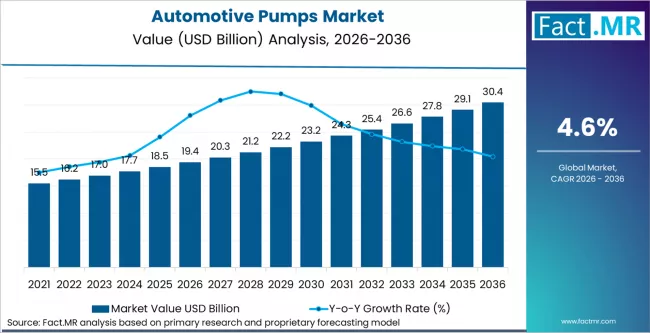
Automotive Pumps Market Market Value Analysis | Source: Fact.MR
Automotive Pumps Market Key Takeaways
| Metric | Details |
|---|---|
| Industry Size (2026) | USD 19.35 Billion |
| Industry Value (2036) | USD 30.34 Billion |
| CAGR (2026-2036) | 4.6% |
Source: Fact.MR analysis. Updated Mar 10, 2026
Automotive Pumps Market Definition
The automotive pumps market encompasses fluid-handling pump assemblies integrated into passenger vehicle, light commercial vehicle, and heavy commercial vehicle powertrain and chassis systems, including high-pressure fuel injection pumps for gasoline direct injection and diesel common rail systems, coolant water pumps for engine and battery thermal management, engine oil pumps, power steering hydraulic pumps, and electric vacuum pumps for brake booster actuation in vehicles without intake manifold vacuum. The scope covers pump assemblies supplied to vehicle manufacturers and the aftermarket replacement channel.
Automotive Pumps Market Inclusions
Market scope includes high-pressure fuel injection pumps for GDI and common rail diesel systems, mechanical and electric engine coolant water pumps, engine oil pumps and variable displacement oil pump assemblies, hydraulic power steering pumps, electric power steering assist pumps, electric vacuum pumps for brake booster systems, and battery thermal management electric coolant pumps for EV and HEV applications. Geographic analysis covers North America, Latin America, Europe, East Asia, South Asia, Oceania, and Middle East and Africa. Forecast scope spans 2026 to 2036 with segment breakdowns by pump type, technology, vehicle type, sales channel, and region.
Automotive Pumps Market Exclusions
Windshield washer fluid pumps, air conditioning refrigerant compressors, HVAC blower fan motors, fuel tank transfer pumps for refuelling infrastructure, and pump systems for off-highway agricultural and construction vehicles fall outside this market scope. Hydraulic pump systems for industrial applications and marine engine fluid handling systems are also excluded.
Automotive Pumps Market Research Methodology
- Primary Research: Fact.MR analysts conducted interviews with powertrain fluid system engineering managers at vehicle OEMs, pump product development engineers at tier-one automotive fluid system suppliers, and aftermarket automotive parts category managers to validate electric pump technology adoption timelines, fuel injection pressure specification trends, and EV battery thermal management pump configuration requirements across key passenger car and commercial vehicle platforms.
- Desk Research: Secondary research aggregated emission regulation updates from EU, US EPA, China MIIT, and India MoRTH specifying fuel injection system performance requirements, EV production statistics from national energy and transport agencies, corporate product launch announcements from listed automotive pump manufacturers, and SAE technical publications covering electric pump system development for hybrid and electric vehicle thermal management.
- Market-Sizing and Forecasting: Baseline market values derive from a bottom-up aggregation of pump unit volumes by type and vehicle category, multiplied by average unit prices across mechanical and electric technology specifications and OEM and aftermarket channel tiers. EV battery thermal management pump volumes were modelled as incremental demand added to the conventional pump base proportional to electric vehicle production growth.
- Data Validation and Update Cycle: Segment forecasts are cross-validated against revenue disclosures from publicly listed automotive pump and fluid system manufacturers and vehicle production data from automotive associations. Annual updates incorporate actual EV production volumes and updated fuel injection pressure regulation implementation schedules.
Summary of Automotive Pumps Market
- Automotive Pumps Market Definition
- The automotive pumps market covers fluid-handling pump assemblies for vehicle powertrain and chassis applications across fuel injection, engine cooling, engine lubrication, power steering, vacuum, and battery thermal management categories, supplied through OEM vehicle production and aftermarket replacement channels globally.
- Demand Drivers in the Market
- Emission Standards Requiring Higher-Pressure Fuel Injection Pump Systems: Tightening gasoline particulate emission limits under Euro 7, China 6b, and BS VI Phase 2 regulations are driving OEM engineers to increase gasoline direct injection fuel pressure specifications from the current 200 to 350 bar range toward 500 bar and above in next-generation GDI systems, requiring higher-specification fuel injection pump assemblies that command premium pricing relative to the lower-pressure systems they replace across the passenger car production base.
- Electric Pump Technology Adoption Reducing Parasitic Powertrain Losses: The migration from mechanically driven to electrically driven water pump, oil pump, and power steering pump configurations is being driven by OEM fuel economy optimisation programmes seeking to eliminate the constant-speed mechanical pump operation that consumes engine power at crank speeds where pump output is not needed, with electric pump on-demand operation delivering 1 to 3% fuel economy improvements that contribute to fleet average CO2 target compliance in regulated markets.
- EV Battery Thermal Management Creating New Electric Pump Revenue Category: Battery electric and hybrid vehicle production growth is generating demand for dedicated battery cooling circuit electric pump assemblies that manage coolant flow through battery pack heat exchanger networks, power electronics cooling circuits, and on-board charger thermal management systems, establishing a new pump revenue category that grows proportionally with EV production volumes and is additive to conventional engine pump content in hybrid vehicle architectures.
- Key Segments Analyzed in the Fact.MR Report
- Fuel Injection Pumps Type: Commands 24.6% share in 2026 as the pump category carrying the highest per-unit value in the automotive pump market, serving the mandatory high-pressure fuel delivery requirements of gasoline direct injection and diesel common rail systems whose adoption is expanding across emerging market passenger car platforms responding to tightening emission standards that cannot be met with port fuel injection alternatives.
- Electric Technology: Holds 57.8% share in 2026, reflecting the broad adoption of electrically driven pump configurations across water pump, oil pump, and power steering pump applications where on-demand electric operation eliminates the parasitic power losses of mechanical belt-drive systems and contributes measurably to fleet average fuel economy compliance in markets with CO2 emission targets.
- OEM Sales Channel: Accounts for 74.1% of 2026 market value, reflecting automotive pumps as integrated powertrain system components whose fluid pressure, flow rate, and drive system specifications are fixed during vehicle platform development and validated through powertrain calibration and emission homologation testing before any aftermarket replacement channel demand is generated.
- Analyst Opinion at Fact.MR
- Fact.MR analysis indicates that the automotive pumps market is experiencing a technology transition that is simultaneously increasing per-unit product complexity and value while creating structural uncertainty about the long-term demand trajectory for certain pump categories as vehicle powertrain electrification progresses. The near-term growth driver is clear and well-established: emission regulation tightening across major markets is forcing fuel injection pressure increases, electric pump technology adoption is expanding as OEM engineers optimise powertrain efficiency, and EV battery thermal management is adding a new pump revenue category. The medium-term structural question is the rate at which full battery electric vehicle production displaces internal combustion engine vehicles, as BEVs eliminate demand for fuel injection pumps, engine oil pumps, and intake vacuum pumps entirely while requiring new electric coolant pump categories. Pump manufacturers who are actively developing electric coolant pump product lines for EV thermal management applications are building the portfolio breadth required to sustain revenue growth through the powertrain transition, while those reliant primarily on internal combustion pump categories face progressive volume headwinds as BEV market share expands beyond its current minority position in global vehicle production.
- Strategic Implications / Executive Takeaways
- EV Thermal Management Electric Pump Portfolio Expansion: Automotive pump manufacturers should prioritise engineering resources toward battery thermal management electric coolant pump development and qualification, securing OEM programme nominations in electric vehicle and plug-in hybrid platforms that establish the product platform and application validation experience needed to compete for the growing EV pump volume as electrification progresses across all vehicle segments.
- High-Pressure GDI Pump Technology Investment for Near-Term Regulatory Demand: Fuel injection pump suppliers should invest in 500 bar and above GDI pump technology development ahead of OEM programme nomination cycles driven by Euro 7 and China 6b particulate emission limit compliance requirements, as the transition to ultra-high-pressure direct injection systems is creating a defined near-term technology upgrade demand cycle that rewards early technical capability readiness.
- Aftermarket Electric Pump Servicing Network Development: As electric pump failures in the expanding installed base of vehicles with electric water pump and oil pump systems begin generating aftermarket replacement demand, pump manufacturers should develop authorised service network training programmes and replacement part availability strategies that capture electric pump aftermarket revenue ahead of the extended lead time that typically separates OEM specification adoption from aftermarket demand maturation.
What are the Drivers of Automotive Pumps Market?
The growth of the automotive pumps market is primarily driven by the rising adoption of electric and hybrid vehicles globally. Unlike internal combustion engine (ICE) vehicles that rely on belt-driven mechanical pumps, electric vehicles (EVs) require various electrically driven pumps to handle battery cooling, cabin heating/cooling, brake vacuum assistance, and lubrication. This transition is creating new demand for advanced pump technologies that are energy-efficient, compact, and electronically controlled. As governments across regions such as Europe, China, and the U.S. increase incentives and mandates for EV production and adoption, the demand for electric pumps is set to grow rapidly.
Stringent emission and fuel-efficiency regulations are another major driving force. Regulatory bodies worldwide are enforcing tighter norms such as Euro 6/7, CAFE, and Bharat Stage VI (BS-VI) to reduce greenhouse gas emissions and combat air pollution. Automakers are therefore pressured to enhance vehicle efficiency, which includes optimizing powertrain performance using advanced pumping solutions. Electric and variable displacement pumps help reduce energy losses, improve fuel delivery precision, and contribute to lower overall emissions. Their ability to operate independently of engine RPM also ensures better performance under a wide range of operating conditions.
In addition to regulatory pressures, global vehicle production, especially in developing economies, is contributing to steady market demand. Emerging markets like India, Southeast Asia, and Latin America are witnessing a surge in automotive manufacturing, both for domestic consumption and export. This is fueling demand for conventional mechanical pumps used in ICE vehicles, particularly in budget and mid-range segments where ICE vehicles still dominate. As production volumes grow, so does the need for essential components like fuel pumps, oil pumps, and coolant pumps.
Lastly, technological innovation in powertrain and vehicle design is spurring the replacement of older mechanical systems with smart, electrically controlled pump technologies. As more vehicles are equipped with turbocharged engines, automatic transmissions, and start-stop systems, the need for high-performance and adaptive pump systems is increasing. In luxury and performance vehicles, electric pumps are also being used to enhance comfort and performance, such as in active suspension and thermal management systems. These trends are collectively shaping a dynamic market landscape with growing opportunities for innovation and integration.
What are the Regional Trends of Automotive Pumps Market?
The Asia-Pacific region dominates the global automotive pumps market, both in terms of volume and growth rate. Countries like China, India, Japan, and South Korea lead the charge due to their massive automotive manufacturing bases, rising vehicle ownership, and supportive government policies. China, in particular, is a global hub for electric vehicles, and its aggressive push toward electrification has significantly increased the demand for electric pumps such as coolant and vacuum pumps.
India is also emerging as a key contributor, especially with the enforcement of BS-VI emission norms and the rapid development of its passenger car and light commercial vehicle segments. Moreover, the region benefits from a strong supplier ecosystem and low production costs, making it favorable for pump manufacturers.
In Europe, the market is driven by stringent environmental regulations and technological innovation. The adoption of Euro 6 and upcoming Euro 7 norms has compelled automakers to shift toward more efficient, emission-compliant powertrains, which in turn increases demand for advanced pump solutions.
Countries like Germany, France, and the Netherlands are rapidly transitioning toward electric and hybrid vehicles, necessitating the use of electric pumps for battery cooling, cabin heating, and regenerative braking systems. Furthermore, Europe is home to major OEMs and component manufacturers that are leading in R&D investments, accelerating the region’s transition toward electrified and intelligent pump systems.
North America shows moderate but consistent growth in the automotive pumps market. The region’s demand is primarily fueled by the increasing popularity of large vehicles such as SUVs and trucks, which require more powerful and durable pump systems. The U.S. government’s push for reducing greenhouse gas emissions, along with tax credits for electric vehicle buyers, has spurred a gradual shift toward EVs and hybrids.
This trend is supporting the growth of electric and smart pumps across applications like thermal management and brake assistance. Moreover, the presence of leading automotive players such as Ford, GM, and Tesla in North America contributes to steady pump innovation and adoption.
Latin America, the Middle East, and Africa (LAMEA) are emerging markets with lower penetration but growing potential. In Latin America, countries such as Brazil and Mexico have well-established automotive industries that continue to rely heavily on internal combustion engines, driving demand for mechanical fuel and oil pumps. Meanwhile, the Middle East & Africa are experiencing a rise in vehicle demand due to infrastructure development and urbanization.
However, the lack of strong regulatory enforcement and limited adoption of electric vehicles slows the growth of advanced pump technologies. Nonetheless, as OEMs expand operations in these regions and emission norms gradually tighten, the demand for modern pump systems is expected to increase in the long term.
What are the Challenges and Restraining Factors of Automotive Pumps Market?
The growth of the automotive pumps market is being restrained by the high cost of advanced pump technologies, especially electric and smart pumps. Unlike traditional mechanical pumps, these systems often come with integrated sensors, ECUs, and control modules that significantly increase their cost.
This becomes a major barrier to adoption in developing countries and in low-cost vehicle segments, where price sensitivity is high and automakers seek cost-effective solutions. As a result, the penetration of high-end electric pumps is often limited to premium and mid-to-high-end vehicle models, slowing widespread market growth.
Another significant challenge is the complexity of integration with modern powertrains. As vehicles increasingly adopt hybrid and electric architectures, the requirement for advanced thermal and fluid management systems grows. However, ensuring that electric pumps function efficiently within complex vehicle control systems poses technical hurdles.
Integrating pumps with electronic control units (ECUs), ensuring real-time responsiveness, and avoiding system conflicts require substantial engineering effort and validation time. This complexity increases R&D costs and extends development cycles for OEMs and Tier 1 suppliers, especially when working across multiple powertrain platforms.
Slower electric vehicle adoption in certain regions also acts as a growth inhibitor for the market. While EV sales are rapidly increasing in North America, Europe, and China, many parts of Asia, Africa, and Latin America continue to rely predominantly on internal combustion engine (ICE) vehicles. Factors such as limited charging infrastructure, higher upfront costs of EVs, and a lack of government incentives contribute to this disparity. Since many electric pump applications are exclusive to EVs and hybrids (e.g., battery cooling, electric vacuum pumps), the pace of their market growth remains uneven across regions.
Additionally, the market faces challenges from global supply chain disruptions and raw material price volatility. The aftermath of the COVID-19 pandemic and geopolitical tensions have disrupted the availability of semiconductors, plastics, aluminum, and other components critical to pump manufacturing. This has led to production delays, increased costs, and challenges in meeting OEM delivery timelines. Such disruptions hinder market stability and complicate production planning for pump manufacturers, especially those operating on just-in-time manufacturing models.
Country-Wise Outlook
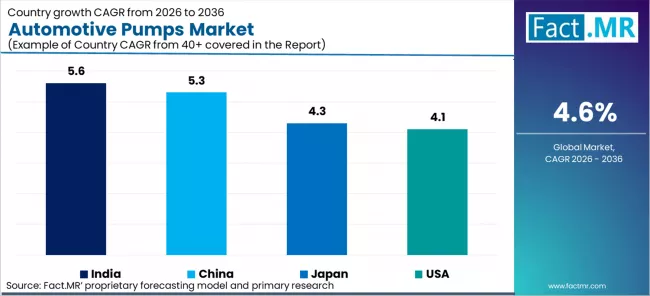
Automotive Pumps Market Cagr Analysis By Country | Source: Fact.MR
U.S. Automotive Pumps Market sees Growth Driven by Electrification of Vehicles
The automotive pumps market in the U.S. is experiencing steady and diversified growth, driven by both the ongoing electrification of vehicles and the continued presence of internal combustion engine (ICE) platforms. One of the most notable trends is the increasing demand for electric coolant pumps, which are essential in managing thermal loads in electric and hybrid vehicles. With the U.S. expanding its EV infrastructure and offering federal incentives for electric vehicle adoption, the demand for electric pumps, particularly for battery cooling, inverter regulation, and cabin conditioning, is rising rapidly.
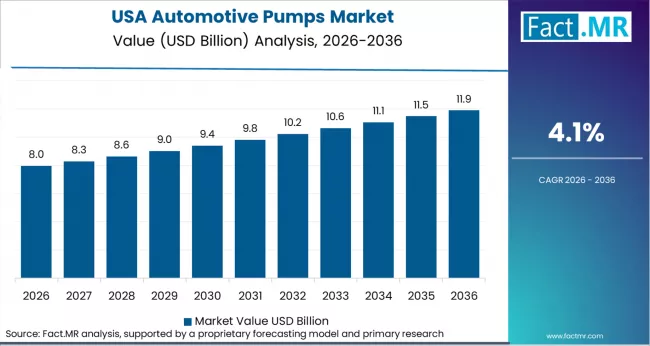
Automotive Pumps Market Country Value Analysis | Source: Fact.MR
Despite the growing EV market, traditional mechanical and fuel-feed pumps continue to hold a significant share of the U.S. market. This is largely due to the vast existing fleet of ICE vehicles and a sustained demand for SUVs, pickup trucks, and performance vehicles. Furthermore, the aftermarket segment for mechanical pumps remains robust, supported by routine maintenance and vehicle longevity trends in the U.S.
The thermal management system segment, including both electric and mechanical coolant pumps, is another key growth area. As fuel efficiency and emissions standards tighten, automakers are increasingly relying on advanced coolant pumps to maintain optimal engine and powertrain temperatures. These systems are especially critical for hybrid models, which operate in dual powertrain environments and require flexible and responsive thermal control.
Overall, the U.S. automotive pumps market reflects a dual growth trajectory, where next-generation electric pump technologies are expanding quickly alongside continued investment in traditional pump systems. The transition to electric and hybrid vehicles is accelerating, but ICE vehicles still dominate the country’s automotive landscape, particularly in rural and long-haul segments. This creates opportunities for pump manufacturers to diversify their portfolios, focusing both on innovation for emerging platforms and volume-based production for legacy systems.
China witnesses Rapid Market Growth Backed by Growing Automotive Pump Sector
China is the world’s largest and most dynamic automotive market, playing a pivotal role in driving the growth of the automotive pumps sector. The country’s aggressive push toward vehicle electrification, supported by government subsidies, infrastructure investments, and emissions mandates, has accelerated the adoption of electric pumps, particularly coolant, vacuum, and oil pumps. These are critical for managing battery temperature, inverter cooling, and brake systems in electric vehicles (EVs) and plug-in hybrids.
The electric fuel pump segment in China is experiencing steady growth due to rising production of both ICE and hybrid vehicles. While EV-specific pumps are gaining ground rapidly, conventional mechanical pumps continue to see strong demand due to the country’s large base of existing ICE vehicles and the growth of the aftermarket repair sector.
Another notable trend in China is the increasing adoption of electric coolant pumps in commercial vehicles, especially buses and trucks. China accounts for nearly 99% of the world’s electric bus fleet, and the country is leading in deployment of electric heavy-duty trucks. These vehicles require advanced thermal and energy management systems, which has significantly boosted demand for 24V electric coolant and oil pumps. The expansion of battery-swapping infrastructure and electrified logistics fleets in urban areas further strengthens this trend.
In summary, the China automotive pumps market is being shaped by a dual growth dynamic: continued high-volume production of traditional ICE vehicles and an aggressive, government-backed shift toward electrification. This creates robust demand across both mechanical and electric pump categories. With a well-established automotive supply chain, strong R&D investment, and rapid EV deployment, China is not only a major consumer but also a global leader in pump innovation and manufacturing.
Category-wise Analysis
Fuel Injection to Exhibit Leading by Pump Type
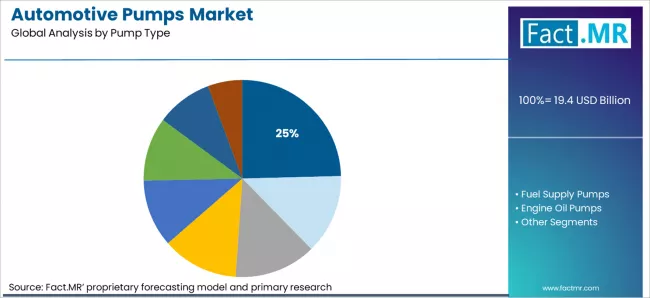
Automotive Pumps Market Analysis By Pump Type | Source: Fact.MR
Fuel injection pumps segment dominates the automotive pumps market due to the widespread use of internal combustion engine (ICE) vehicles globally, particularly in regions like Asia-Pacific and North America. Fuel injection pumps are crucial for delivering the precise amount of fuel at the right pressure to the engine, ensuring optimal combustion and performance. Their adoption is supported by the increasing penetration of turbocharged and direct-injection engines, which require high-pressure injection systems for improved fuel efficiency and emissions compliance. Additionally, stricter emission regulations (such as Euro 6/7 and BS-VI) have led to the incorporation of more advanced fuel injection systems, further reinforcing the dominance of this segment.
Coolant pumps segment is the fastest-growing segment in the automotive pumps market, driven by the rapid expansion of electric and hybrid vehicles. These vehicles rely heavily on electric coolant pumps to maintain battery and inverter temperatures within optimal ranges, thereby ensuring safety and efficiency. Unlike ICE vehicles where coolant pumps are mechanically driven, EVs use electric pumps that offer better energy efficiency and can operate independently of engine speed. The rising production of EVs across China, Europe, and the U.S., along with increased adoption of thermal management solutions in modern vehicles, is significantly boosting demand for electric coolant pumps. Technological advancements in multi-circuit cooling systems and integrated pump modules are also contributing to the segment’s accelerated growth trajectory.
Electric Automotive Pumps to Exhibit Leading by Technology
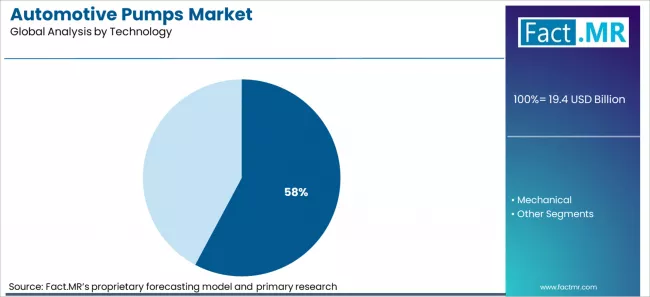
Automotive Pumps Market Analysis By Technology | Source: Fact.MR
Mechanical segment dominates the automotive pumps market in terms of overall volume and widespread application. This dominance is attributed to their extensive use in conventional internal combustion engine (ICE) vehicles, particularly for fuel injection, oil circulation, and coolant management. Mechanical pumps are cost-effective, have a simple design, and are relatively easy to manufacture and integrate into traditional powertrains. Their high penetration across mid-range and economy vehicle segments, especially in developing countries where ICE vehicles still dominate, further supports their leading position. Additionally, many commercial vehicles and aftermarket applications continue to rely on mechanical pump systems due to their durability and low maintenance requirements
Electric segment is the fastest-growing in the automotive pumps market, driven by the global shift toward electrification and vehicle efficiency. Electric pumps are increasingly preferred in hybrid and electric vehicles due to their ability to operate independently of engine speed, offering enhanced control, reduced energy loss, and improved fuel economy. They are essential for battery cooling, electric brake vacuum systems, and transmission fluid management in electrified powertrains. The rising adoption of electric vehicles, coupled with tightening fuel efficiency and emission regulations across regions like Europe, China, and North America, is accelerating the demand for smart, electronically controlled pump solutions. Additionally, the integration of electric pumps in premium ICE vehicles for features like start-stop systems and variable oil pressure is further fueling their market expansion.
Passenger Cars to Exhibit Leading by Vehicle Type
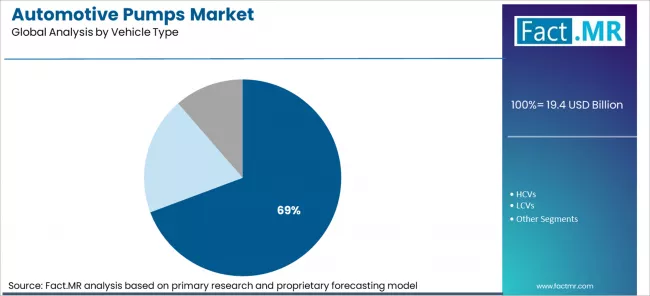
Automotive Pumps Market Analysis By Vehicle Type | Source: Fact.MR
Passenger cars dominate the automotive pumps market due to their high global production volumes and increasing integration of advanced thermal and fuel systems. These vehicles require a variety of pumps, including fuel pumps, oil pumps, water pumps, and vacuum pumps, to meet performance, emission, and efficiency standards. Growing adoption of turbocharged engines and hybrid systems in passenger vehicles further boosts demand for precise and efficient pump technologies.
HCVs are the fastest-growing segment, driven by increasing industrialization, logistics expansion, and cross-border freight movement. These vehicles require high-performance pumps to support power steering, fuel injection, lubrication, and cooling under demanding conditions. As emission norms tighten and fuel efficiency becomes a priority in commercial fleets, OEMs and fleet operators are upgrading to high-efficiency and electric pump systems. Additionally, rising production and sales of HCVs in emerging economies are accelerating growth.
OEMs to Exhibit Leading by Sales Channel
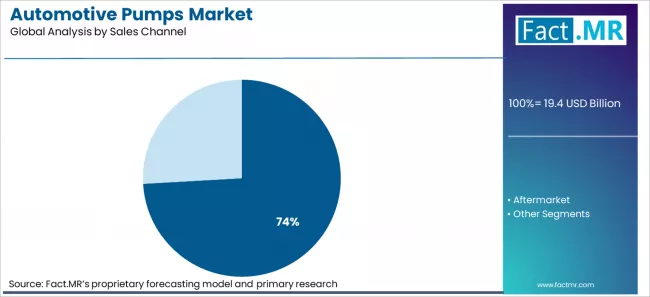
Automotive Pumps Market Analysis By Sales Channel | Source: Fact.MR
OEMs dominate the sales channel in terms of revenue share, as most automotive pumps are integrated during vehicle manufacturing to meet specific engine design and regulatory requirements. OEMs collaborate closely with pump manufacturers to ensure product reliability, compliance, and performance, particularly in fuel, oil, and water systems. With the shift toward lightweight, electric, and variable displacement pumps, OEM-fitted systems remain critical for achieving efficiency and emissions goals.
The aftermarket segment is the fastest-growing due to the replacement demand for pumps in aging vehicles and commercial fleets. As pumps are prone to wear and failure over time, especially in high-mileage vehicles, repair and maintenance needs drive aftermarket sales. Growth in e-commerce auto parts platforms, improved distribution networks, and rising consumer awareness of vehicle maintenance-especially in Asia-Pacific and Latin America-are further fueling this segment's expansion.
Competitive Analysis
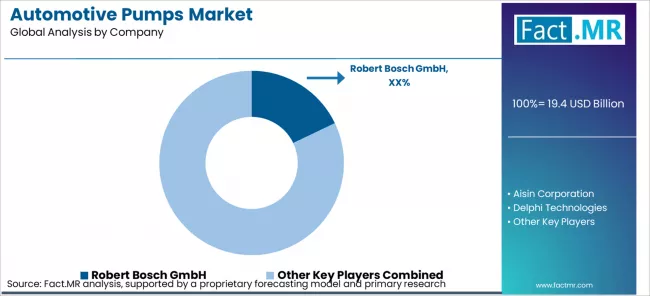
Automotive Pumps Market Analysis By Company | Source: Fact.MR
The global automotive pumps market is becoming increasingly competitive, featuring a mix of well-established multinational corporations and regional players. Major companies compete based on technological innovation, cost efficiency, product performance, and the ability to supply across both ICE and electric vehicle platforms.
Key players in the automotive pumps industry, such as Robert Bosch GmbH, Denso Corporation, Aisin Seiki Co., Ltd., Continental AG, and Valeo S.A., have established strong global footprints by offering diversified pump portfolios, including fuel injection, coolant, oil, and steering pumps. Their success is often backed by long-standing partnerships with leading OEMs and extensive investments in R&D to support the shift toward electrification and energy-efficient systems.
Robert Bosch GmbH and Denso Corporation are recognized for their strong presence in fuel and oil pump technologies and for advancing electric pump solutions for hybrid and EV powertrains. Bosch, for instance, is a key supplier of electric coolant and vacuum pumps, leveraging its deep electronics and control systems expertise.
Similarly, Aisin Seiki and Continental AG offer high-performance transmission and steering pumps and have ramped up efforts to integrate electric pump modules tailored for next-generation vehicles. These companies benefit from vertical integration and the ability to produce both core components and control electronics, enhancing their value proposition in the evolving automotive ecosystem.
Meanwhile, companies like Hitachi Astemo, Mahle GmbH, and Delphi Technologies focus on high-efficiency mechanical and variable displacement pumps, especially for emerging markets where ICE vehicles still dominate. These players are also expanding their electric pump portfolios to remain relevant in markets like China and Europe, where demand for EV-compatible components is rapidly rising. Startups and specialized players are also emerging, particularly in the electric coolant and vacuum pump space, introducing modular, lightweight, and IoT-enabled solutions for new-age vehicles. This is fostering both innovation and pricing pressure across the value chain.
To stay competitive, market leaders are focusing on strategic collaborations, acquisitions, and joint ventures to enhance their product capabilities and geographic reach. For instance, pump manufacturers are increasingly aligning with EV startups and mobility solution providers to co-develop thermal and fluid management systems.
Key players in the market include Aisin Corporation, Delphi Technologies, Denso Corporation, TRW Automotive, Mikuni Corporation, Continental AG, Johnson Electric, MAHLE GmbH, Magna International, KSPG Group, Robert Bosch GmbH, SHW AG, Davies Craig, and other players.
Recent Development
- In February 2025, TI Fluid Systems unveiled its latest innovation, a 12V Electric Coolant Pump (eCP), specifically designed for battery electric vehicles (BEVs). This pump, manufactured at the company's Tianjin facility in China, aims to address the critical thermal management needs of BEVs by providing precise temperature regulation, enhanced energy efficiency, and an environmentally conscious design.
Bibliography
- 1. European Commission, Directorate-General for Climate Action. (2024, June). Euro 7 Regulation: Fuel Injection System Performance Requirements and Gasoline Particulate Filter Integration for Light and Heavy Duty Vehicles. European Commission.
- 2. Government of India, Ministry of Road Transport and Highways. (2024, April). Bharat Stage VI Phase 2: Real Driving Emission Standards and Fuel Injection System Technical Requirements. MoRTH.
- 3. SAE International. (2024, January). SAE J2030: High Pressure Fuel Injection Pump Performance and Endurance Testing Standard for Gasoline Direct Injection Applications. SAE International.
- 4. International Energy Agency. (2024, May). Global EV Outlook 2024: Battery Thermal Management System Architecture and Coolant Pump Specification Requirements. IEA.
- 5. International Organization for Standardization. (2023). ISO 4413: Hydraulic Fluid Power - General Rules and Safety Requirements for Systems and Their Components. ISO.
- 6. World Bank Group. (2024, March). Automotive Component Manufacturing Investment in South Asia: Fuel System and Fluid Handling Supplier Development Trends. World Bank.
This bibliography is provided for reader reference. The full Fact.MR report contains the complete reference list with primary research documentation.
This Report Addresses
- Market sizing and quantitative forecast metrics: detailing precise revenue projections, absolute dollar growth, and compound annual growth rates across major automotive pumps segments and geographies through 2036.
- Segmentation analysis: mapping the adoption velocity of leading product, technology, and end-use categories and evaluating structural factors driving segment share transitions over the forecast period.
- Regional deployment intelligence: comparing growth dynamics in high-momentum Asia Pacific and emerging markets against the mature replacement and upgrade demand patterns prevalent in European and North American industry hubs.
- Regulatory compliance assessment: analyzing how evolving product safety standards, environmental directives, and sector-specific mandates are reshaping procurement decisions, material specifications, and supplier qualification criteria.
- Competitive posture evaluation: tracking consolidation trends, platform integration strategies, technology differentiation investments, and the resulting competitive dynamics among established market players and emerging challengers.
- Capital project strategic guidance: defining the procurement specifications, investment thresholds, and performance benchmarks required to support next-generation product adoption and facility modernization programs.
- Supply chain vulnerability analysis: identifying sourcing concentration risks, logistics bottlenecks, raw material price dependencies, and geographic exposure scenarios that affect market participant cost structures.
- Custom data delivery formats: encompassing interactive dashboards, raw Excel datasets, and comprehensive PDF narrative reports tailored for executive decision-making and analyst reference applications.
Segmentation
Scope of the Report
| Metric | Value |
|---|---|
| Quantitative Units | USD 19.35 billion to USD 30.34 billion, at a CAGR of 4.6% |
| Market Definition | Fluid-handling pump assemblies for vehicle powertrain and chassis applications across fuel injection, engine cooling, lubrication, power steering, vacuum, and battery thermal management categories, supplied through OEM and aftermarket channels. |
| Pump Type Segmentation | Fuel Injection Pumps, Water Pumps, Oil Pumps, Power Steering Pumps, Vacuum Pumps |
| Technology Segmentation | Electric, Mechanical |
| Vehicle Type Segmentation | Passenger Cars, LCVs, HCVs |
| Sales Channel Segmentation | OEMs, Aftermarket |
| Regions Covered | North America, Latin America, Europe, East Asia, South Asia, Oceania, Middle East and Africa |
| Countries Covered | India, China, Japan, USA, and 40 plus countries |
| Key Companies Profiled | Robert Bosch GmbH, Aisin Corporation, Delphi Technologies, Denso Corporation, TRW Automotive, Mikuni Corporation, Continental AG, Johnson Electric, MAHLE GmbH, Magna International, KSPG Group, SHW AG, Davies Craig |
| Forecast Period | 2026 to 2036 |
| Approach | Bottom-up aggregation of pump units by type and vehicle category with EV battery thermal management pump incremental demand modeling and electric technology adoption curve adjustment |
Source: Fact.MR analysis. Updated Mar 10, 2026
Segmentation of Automotive Pumps Market
-
By Pump Type :
- Fuel Injection Pumps
- Fuel Supply Pumps
- Engine Oil Pumps
- Transmission Oil Pumps
- Coolant Pumps
- Steering Pumps
- Vacuum Pumps
- Windshield Washer Pumps
-
By Technology :
- Electric
- Mechanical
-
By Vehicle Type :
- Passenger Cars
- HCVs
- LCVs
-
By Sales Channel :
- OEMs
- Aftermarket
-
By Region :
- North America
- Latin America
- Western Europe
- Eastern Europe
- East Asia
- South Asia & Pacific
- Middle East & Africa
Frequently Asked Questions
How large is the automotive pumps market in 2026?
What will the pumps market size be by 2036?
What is the expected CAGR between 2026 and 2036?
Which pump type leads the market in 2026?
Which technology segment holds the largest share?
What is driving India's leading 5.6% CAGR?
How is EV growth creating new pump market opportunities?
What is excluded from the scope of this report?
Who worked on this report


Preview the report firsthand - request a free sample
Free SampleGet the brochure for pricing and purchase details
Download PDF