Automotive Metal Wheel Market Size, Share, Growth and Forecast (2026 - 2036)
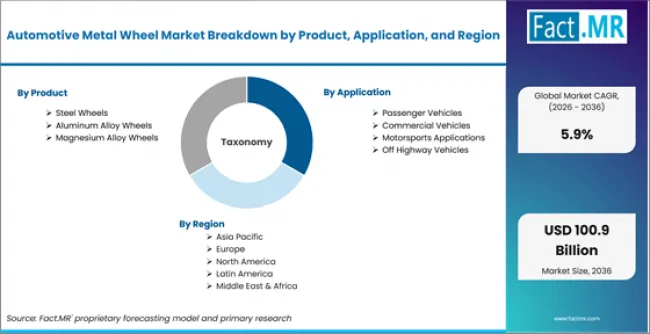
Automotive Metal Wheel Market is segmented by Product (Steel Wheels, Aluminum Alloy Wheels, Magnesium Alloy Wheels), Application (Passenger Vehicles, Commercial Vehicles, Motorsports Applications, Off Highway Vehicles), End Use (Automotive OEMs, Aftermarket Suppliers, Wheel Manufacturers, Automotive Service Centers), and Region. Forecasts from 2026 to 2036.
Automotive Metal Wheel Market Analysis and Forecast by Fact.MR
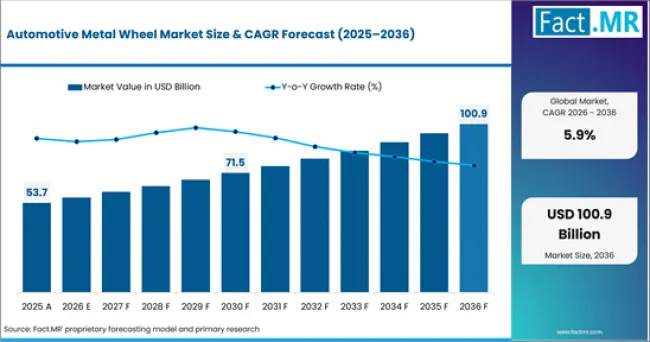
- The Automotive Metal Wheel Market is expected to grow from USD 56.8 billion in 2026 to USD 100.9 billion by 2036, at a 5.9% CAGR.
- driven by expanding global vehicle production volumes, increasing adoption of lightweight aluminum alloy wheels to improve fuel efficiency and EV range, and growing aftermarket customization demand across passenger and commercial vehicle segments, with steel wheels accounting 58.7% share and passenger vehicles contributing 46.2% share as manufacturers prioritize weight reduction, corrosion resistance, and design differentiation.
Summary of Automotive Metal Wheel Market
- Market Snapshot
- In 2025, the global Automotive Metal Wheel Market was valued at approximately USD 53.7 billion.
- The market is estimated to reach USD 56.8 billion in 2026 and is projected to attain USD 100.9 billion by 2036.
- The automotive metal wheel market is likely to expand at a CAGR of 5.9% during the forecast period.
- The market is anticipated to create an absolute dollar opportunity of USD 44.1 billion between 2026 and 2036.
- Steel wheels account for 58.7% of product segment share in 2026.
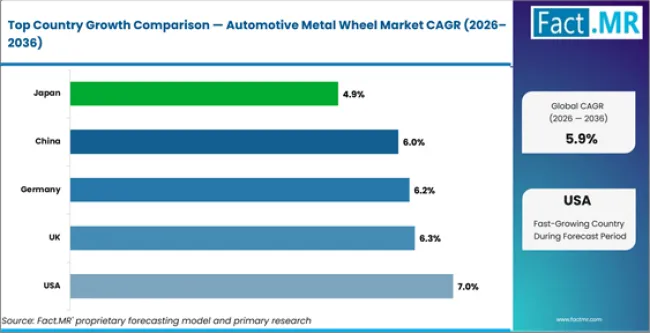
- USA (7.0%) and UK (6.3%) are the key growth markets during the forecast period.
- Demand and Growth Drivers
- The recovery of global vehicle production and expansion across passenger car, SUV and commercial vehicle platforms in Asia Pacific, North America and Europe support high-volume OEM wheel procurement.
- Growth in electric vehicle (EV) production is fueling demand for lightweight aluminum alloy wheels to decrease unsprung mass and improve battery range, causing a structural shift in material mix within OEM specifications.
- In the aftermarket, particularly of alloy wheels on passenger vehicles and SUVs, customization is providing incremental revenue beyond OEM first-fit procurement.
- Emission and fuel efficiency regulations are forcing OEMs to specify lighter wheel options, driving trade-up from standard steel to alloy and forged wheel solutions.
- Corrosion resistant aluminum wheels are being purchased by commercial fleet operators to achieve lower maintenance needs and higher payload capacity due to their weight savings.
- Product and Segment View
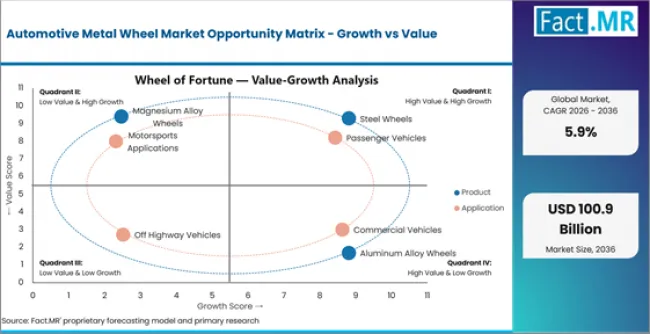
- Steel wheels will hold the volume dominance in 2026 with a 58.7% share of the product segment, owing to cost efficiency, durability and applicability across economy and commercial vehicle platforms.
- Passenger vehicles hold the highest market share of 46.2% in 2026 in the application segment due to the production of sedans, SUVs, and crossovers on automobile assembly lines across the world.
- Automotive OEMs make up 62.9% of end-use demand in 2026, indicative of the dominance of first-fit procurement in total market volumes.
- Key segmentation includes:
- Products : Steel Wheels , Forged Wheels , Aluminum Alloy Wheels , Magnesium Alloy Wheels
- Application : Passenger Cars, Light Commercial Vehicles, Heavy Commercial Vehicles, Off-Highway Vehicles
- Use End: Automotive OEMs, Aftermarket Dealers, Fleet Operators, Custom Vehicle Builders
- Distribution Channel: OEM Direct Sales, Aftermarket Retail, E-commerce Channels, Wholesale Dealers
- These products enable:
- Wheel structural support for vehicle bearing and transmission of braking torque, road surface contact
- Aluminum alloy & forged wheel options & EV range: Light-weighted and fuel-efficient
- Spoke pattern, finish and diameter options for design differentiation that support brand identity and consumer preference
- Geography and Competitive Outlook
- China remains the largest production region in Asia Pacific at 6.0%, driven by the world’s largest vehicle manufacturing base, domestic alloy wheel production capacity and increasing EV platform demand.
- North America The USA experiences strong growth of 7.0% as SUV and pickup truck production calls for larger diameter and higher-value wheel specifications.
- Europe remains a strong growth market at 6.2% in Germany and 6.3% in UK, driven by premium vehicle production, aftermarket alloy demand and EU emission standards promoting the use of lightweight wheels.
- Important companies are CITIC Dicastal, Iochpe-Maxion, Borbet, Superior Industries, Topy, Accuride, Ronal Group, Enkei Corporation, Alcoa Corporation.
- Analyst Opinion
- Shambhu Nath Jha, Principal Consultant at Fact.MR, says 'The automotive metal wheel market is undergoing a material composition shift that will reshape competitive positioning over the next decade. Steel wheels retain volume leadership in economy and commercial segments, but aluminum alloy is capturing an increasing share of OEM specifications as vehicle manufacturers target weight reduction to meet emission targets and extend EV range. The aftermarket is adding a premium revenue layer, particularly in North America and Europe where wheel customization is embedded in consumer vehicle ownership culture. Manufacturers that invest in flow-forming and forging capabilities alongside casting operations are better positioned to capture both OEM and aftermarket demand.'
Key Growth Drivers, Constraints, and Opportunities
Key Factors Driving Growth
- Growth in global vehicle production, particularly in China, India and south-east Asia, is providing steady OEM wheel procurement volumes across economy, mass-market and premium vehicle platforms.
- To maximize battery range, EV manufacturers are specifying lightweight aluminum alloy and forged wheels as standard equipment, creating a structural material mix shift away from steel in new platform designs.
- Demand for alloy wheels in the North America and Europe aftermarket is growing as consumers spend on vehicle customization, with larger diameter and premium finish options commanding a significant price premium.
Key Market Constraints
- The procurement cost uncertainty for wheel manufacturers operating on very slim margins in competitive OEM bidding environments is created by the volatility of aluminum and steel raw material prices.
- Procurement risk for forged wheel manufacturers tied to few metal suppliers Supply chain concentration of high purity aluminum alloy billets.
- Competition from low-cost manufacturers in China and India is growing and squeezing the margins of mid-tier producers that can’t set themselves apart on design or material.
Key Opportunity Areas
- Flow-forming technology is expanding the addressable market for performance-grade lightweight wheels across OEM and aftermarket channels, delivering wheels with near-forged strength at cast-wheel pricing.
- A large volume procurement opportunity is the replacement of steel wheels with aluminum wheels by commercial fleet operators in the truck and trailer segment to increase payload capacity and reduce brake wear.
- The EV-specific wheel design that is optimized for aerodynamic drag reduction and weight saving is creating a new product category commanding pricing premiums on electric vehicle platforms.
Segment-wise Analysis of the Automotive Metal Wheel Market
- The product segment will remain dominated by steel wheels in 2026, with a share of 58.7%, supported by its cost-effectiveness, simplicity in manufacturing and universal application across economy passenger vehicles and commercial platforms.
- The passenger vehicle application segment is projected to account for 46.2% of the market share in 2026, with the growth driven by the global production volumes across sedan, SUV, crossover, and hatchback platforms.
- The lightweight wheel design Configurationsegment accounts for 71.5% of the formulation segment due to OEM specification trends for reducing unsprung mass for fuel efficiency and EV range optimization.
The automotive metal wheel market is segmented on the basis of product type, application, end use, technology, formulation and distribution channel. Steel wheels dominate volume and value, due to cost advantage and universal OEM applicability. Aluminum alloy wheels are the fastest growing segment, due to lightweighting mandates and premium vehicle specifications.
Which Product Segment Dominates the Automotive Metal Wheel Market?
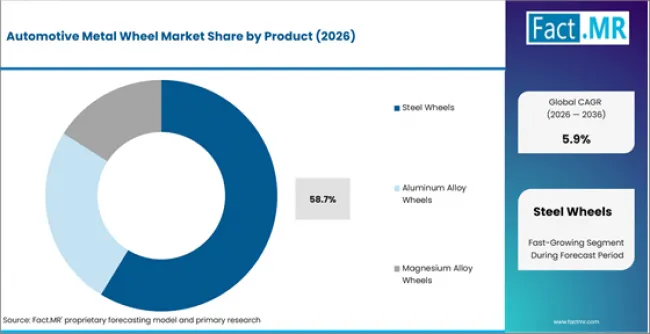
Steel wheels will hold 58.7% of the product segment in 2026. Their leadership suggests durability, cost effectiveness and universal application in economy passenger vehicles, commercial trucks and fleet applications. Steel wheels are cheaper to make per unit than their aluminum counterparts and can withstand rough road conditions that would damage alloy wheels, making them the default spec for price-sensitive vehicle segments.
Aluminum alloy wheels are the second largest, fastest growing segment driven by OEM lightweighting requirements, consumer demand for visual design differentiation and aftermarket customization demand. Premium performance cars get forged wheels, but magnesium alloy remains a niche material for motorsport and hypercar use.
Which Application Segment Dominates the Automotive Metal Wheel Market?
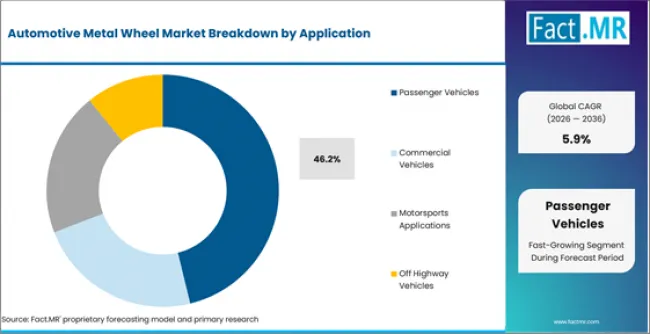
Passenger vehicles will hold the largest share in 2026, 46.2%, attributed to large production volumes of sedans, SUVs, crossovers and hatchbacks on global assembly lines. In passenger vehicles the first fit is four wheels per vehicle. Therefore, volume is directly related to production output. The trend toward bigger wheel sizes on SUVs and crossovers is increasing the per vehicle wheel value, since bigger wheels have higher unit prices.
Light commercial vehicles and heavy commercial vehicles help volume while fleet replacement cycles and payload optimization drive industry demand for durable steel and lightweight aluminum options. There’s a smaller, more specialized class of off-road vehicles. Passenger vehicles are likely to continue to dominate as production increases throughout the world.
Which Product Trend is Shaping the Next Phase of Growth in the Automotive Metal Wheel Market?
The most important trend in product development on the market is aerodynamic wheel design for electric cars. EV makers are turning away from traditional spoke-pattern looks and designing wheels that are partially enclosed or flat-faced to reduce aerodynamic drag at highway speeds. These designs can add 3 to 5% to EV range over open-spoke designs, a noticeable performance difference for range-conscious consumers and fleet operators.
Beyond design, there’s a commercial impact. The production of aero-optimized wheels requires different tooling and finishing processes than traditional alloy wheels, creating a product category that requires dedicated production investment. OEMs will pay a premium for wheels that can be shown to impact vehicle range specs, creating margin opportunity for manufacturers that develop aero-specific wheel platforms early on. EVs ramping to production levels will make aero-optimized wheels a standard spec category alongside traditional styling options.
Regional Outlook Across Key Markets
- The USA leads growth at 7.0%, driven by SUV and pickup truck production volumes requiring larger diameter and higher-specification wheels, alongside strong aftermarket customization demand.
- UK at 6.3% reflects premium and performance vehicle production, strong aftermarket alloy wheel demand, and commercial fleet modernization programs.
- Germany at 6.2% is supported by premium OEM production by BMW, Mercedes-Benz, and Volkswagen Group, with EU emission standards driving lightweight wheel specification adoption.
- China at 6.0% reflects the world's largest vehicle production base, domestic alloy wheel manufacturing scale, and growing EV platform demand from both domestic and multinational OEMs.
.webp)
| Country | CAGR (%) |
|---|---|
| USA | 7.0% |
| UK | 6.3% |
| Germany | 6.2% |
| China | 6.0% |
| Japan | 4.9% |
Source: Fact.MR analysis, based on proprietary forecasting model and primary research.
Market Outlook for Automotive Metal Wheels in the United States
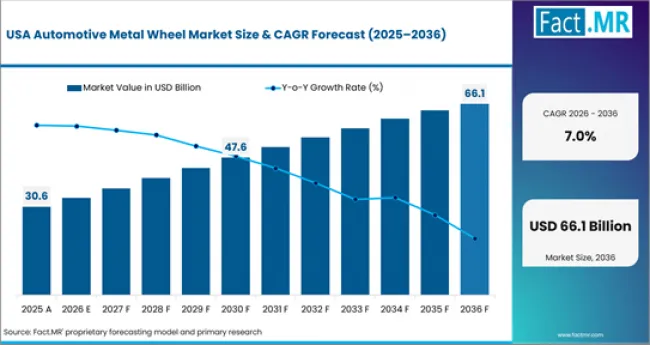
The U.S. automotive metal wheel market is expected to grow at a CAGR of 7.0% through 2036. The production of SUVs and pickup trucks, which demand a higher per-unit value and larger diameter wheels, supports premium OEM sourcing. Supporting reshoring investment to expand domestic wheel manufacturing capacity supported by IRA provisions. The aftermarket spend on alloy wheels is still strong as consumers upgrade from factory steel wheels to larger alloys and forged wheels.
- The production volumes for SUVs and full-size pickups drive wheel specifications with larger diameters and higher value, which increase the cost of OEM wheel procurement per vehicle.
- The aftermarket alloy wheel customisation continues to fuel a significant secondary demand channel, which is independent of the new vehicle production cycle.
China Automotive Metal Wheel Market Growth Assessment
China will have a 6.0% CAGR through 2036. CITIC Dicastal, the world’s largest alloy wheel manufacturer, leads domestic manufacturing capacity. EVs from BYD, NIO and multinational OEMs with assembly lines in China are based on platforms that require lightweight aluminum alloy and aero-optimized wheel specs. Export competitiveness allows Chinese wheel makers to support domestic and global OEM programs.
- CITIC Dicastal’s global production scale and OEM relationship network enable the cost-competitive supply of alloy wheels to Chinese and international vehicle programs.
- New platform designs are driving a shift in material specification from steel to aluminum alloy as EV production expands across multiple domestic brands.
Germany Automotive Metal Wheel Market Analysis
DIN and EU CE performance standards define wheel specifications for the German market, projected at a CAGR of 6.2% through 2036. OEM premium production continues to drive demand for high-spec forged and flow-formed wheels from BMW, Mercedes-Benz, Audi and Porsche. EU emission standards are also driving lightweight wheels on mass-market vehicle platforms produced by Volkswagen Group. Industry 4.0 in wheel manufacturing allows automated quality inspection and production traceability.
- Premium OEM production demands high spec forged and flow formed wheels with demanding quality and finish requirements that command price premiums.
- EU emissions regulations are forcing mass-market OEMs to specify lightweight alloy wheels on volume platforms, bringing the addressable alloy market beyond premium segments.
United Kingdom Automotive Metal Wheel Market Outlook
Post-Brexit trade frameworks will impact import sourcing patterns for wheels coming into the UK market, which is forecast to expand at a CAGR of 6.3% through 2036. Demand remains strong in premium and performance vehicle assembly, including Jaguar Land Rover and Bentley, underpinned by high-value forged and alloy wheel specifications. The aftermarket alloy wheel sector is a mature one, with UK consumers eager to invest in wheel upgrades for both aesthetic and performance reasons.
- The production of premium vehicles consolidates demand for high-specification alloy and forged wheels that adhere to brand-specific quality and design requirements.
- The recent building and environmental regulations are indirectly affecting the specifications of the fleet vehicles, and the lighter wheels are contributing to the emission compliance across the fleets.
Japan Automotive Metal Wheel Market Demand Analysis
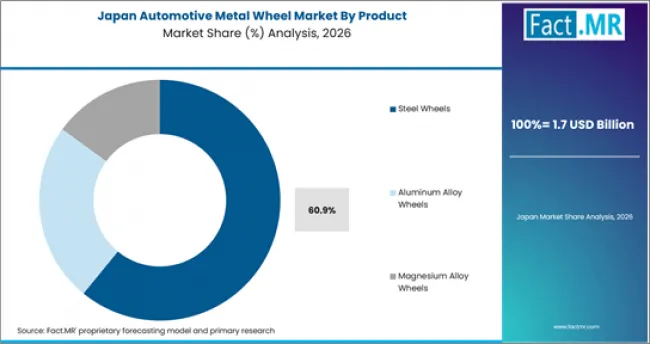
The procurement in Japan is based on the JIS compliance standards and stringent quality requirements of OEMs, with an estimated CAGR of 4.9% through 2036. Domestic makers such as Enkei and Topy have strong positions through precision manufacturing and long-term OEM relationships. Aging vehicle fleet demographics support aftermarket replacement demand, and Japanese automakers’ global production operations create international wheel supply chain requirements.
- Automotive OEM relationships at home produce stable, long-cycle procurement patterns, emphasizing quality consistency and delivery reliability rather than price competition.
- Automated wheel production and inspection are helping to overcome the labor shortage, increasing manufacturing efficiency and providing competitive output at domestic plants.
Competitive Benchmarking and Company Positioning
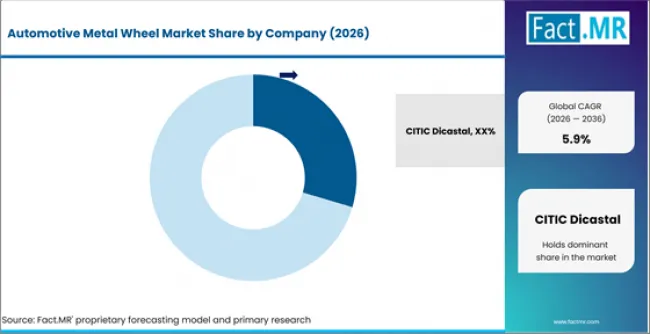
Automotive Metal Wheel Market Analysis By Company
- CITIC Dicastal, Iochpe-Maxion, and Superior Industries hold leading global positions through production scale, multi-regional manufacturing footprints, and deep OEM supply relationships across passenger and commercial vehicle platforms.
- Borbet, Ronal Group, and Enkei Corporation compete strongly in premium and performance wheel segments, supported by design capability, material expertise, and brand positioning.
- Flow-forming and forging technology capabilities create competitive differentiation, as manufacturers that offer near-forged performance at lower price points capture OEM specifications that bridge the gap between cast alloy and fully forged wheel categories.
The competitive landscape is moderately consolidated at the top tier, with CITIC Dicastal holding the largest global production capacity for alloy wheels and Iochpe-Maxion leading in steel wheel manufacturing through its Maxion Wheels division. Superior Industries competes through North American and European alloy production scale.
Competition is intensifying around EV-specific wheel design, where aerodynamic optimization and weight reduction create new specification requirements. Manufacturers investing in aero-wheel development, dedicated EV platform tooling, and multi-material capabilities are capturing the fastest-growing OEM demand segments.
Key Companies in the Automotive Metal Wheel Market
- CITIC Dicastal, Iochpe-Maxion, Superior Industries, Borbet, and Topy are among the leading players globally, supported by production scale, OEM supply agreements, and multi-regional manufacturing operations.
- Accuride, Ronal Group, Enkei Corporation, Alcoa Corporation, Wanfeng Auto, and Steel Strips Wheels compete across specific vehicle segments, material categories, and regional markets.
Recent Industry Developments
- CITIC Dicastal – Strategic Agreements with Global Automakers (2024)
- In 2024, CITIC Dicastal announced that its aluminum wheel business secured strategic agreements with multiple domestic and international automakers, strengthening its position in global OEM wheel supply and expanding its presence in overseas markets.
- RONAL Group – Sustainability Progress and Low-Carbon Wheel Production (2025)
- In 2025, RONAL Group reported progress under its sustainability roadmap, including reduced wheel carbon footprint and continued implementation of low-carbon aluminum wheel production initiatives. The company maintained targets for a 50% reduction in CO₂ emissions by 2030 and carbon neutrality by 2050.
- Bosch Mobility – MEMS Tire Pressure Sensor Launch (June 2025)
- In June 2025, Bosch launched the SMP290 MEMS tire-pressure sensor featuring Bluetooth Low Energy connectivity for next-generation TPMS applications. The launch supports growing demand for connected wheel and tire monitoring systems in passenger and commercial vehicles.
Leading Companies Shaping the Automotive Metal Wheel Market
- CITIC Dicastal
- Iochpe-Maxion
- Borbet
- Superior Industries
- Ronal Group
- Enkei Corporation
- Wanfeng Auto
Sources and Research References
- CITIC Group. (2024). CITIC Dicastal: Advanced intelligent manufacturing.
- RONAL Group. (2025). Sustainability report 2023/24.
- Robert Bosch GmbH. (2025) The SMP290: Bosch's new Bluetooth Low Energy tire pressure sensor.
This bibliography is provided for reader reference and is not exhaustive. The full report contains the complete reference list and detailed citations.
Key Questions This Report Addresses
- What is the current and future size of the Automotive Metal Wheel Market?
- How fast is the Automotive Metal Wheel Market expected to grow between 2026 and 2036?
- Which product type is likely to lead the market by 2026?
- Which application segment is expected to account for the highest demand by 2026?
- What factors are driving demand for automotive metal wheels globally?
- How is EV adoption influencing wheel material mix and design specifications?
- Why is the USA emerging as the fastest-growing market?
- How are aerodynamic wheel designs reshaping product development for electric vehicles?
- Which countries are projected to show the fastest growth through 2036?
- Who are the key companies active in the Automotive Metal Wheel Market?
- How does Fact.MR estimate and validate the market forecast?
Automotive Metal Wheel Market Definition
The automotive metal wheel market includes steel, aluminum alloy, forged and magnesium alloy wheels manufactured for passenger cars, light commercial vehicles, heavy commercial vehicles and off-highway applications. It includes OEM first-fit supply and aftermarket replacement and customization demand distributed through direct OEM contracts, aftermarket retail, online platforms and wholesale channels.
Automotive Metal Wheel Market Inclusions
- The scope covers global and regional market size and forecasts for 2026 to 2036 across product type, application, end use, technology, formulation, distribution channel, and region.
- It comprises regional demand analysis based on vehicle production volume, EV adoption rate, aftermarket spending trends, and emission regulation timelines.
- The report covers pricing analysis across steel, cast alloy, flow-formed, and forged wheel categories for OEM and aftermarket channels.
Automotive Metal Wheel Market Exclusions
- The scope excludes tire products, tire pressure monitoring systems, and wheel balance weights sold independently of wheel assemblies.
- It excludes wheel bearings, hub assemblies, and brake components not integrated into wheel manufacturing.
- The report excludes carbon fiber composite wheels in limited production for hypercar applications without meaningful commercial volume.
Automotive Metal Wheel Market Research Methodology
- The methodology combines secondary research, primary interviews, and forecast modelling.
- It draws on 140+ secondary sources and benchmarks 60+ company product portfolios.
- Market sizing covers 30+ countries through a demand-side model, supported by top-down validation.
- Key inputs include vehicle production data, material specification trends, aftermarket spending and EV platform adoption rates.
- The model cross-verifies demand with OEM procurement data, aftermarket shipment volumes and pricing trends.
- Initial validation will comprise 25+ interviews with wheel manufacturers, OEM procurement teams, aftermarket distributors and fleet operators.
- Final estimates go through production-volume checks, trade-flow analysis, and sensitivity testing.
Scope of Analysis

| Parameter | Details |
|---|---|
| Quantitative Units | USD 56.8 billion to USD 100.9 billion, at a CAGR of 5.9% |
| Market Definition | The Automotive Metal Wheel Market covers steel, aluminum alloy, forged, and magnesium alloy wheels for passenger vehicles, commercial vehicles, and off-highway applications across OEM and aftermarket channels. |
| Regions Covered | North America, Latin America, Europe, East Asia, South Asia and Pacific, Middle East and Africa |
| Countries Covered | USA, UK, Germany, China, Japan, 30 plus countries |
| Key Companies | CITIC Dicastal, Iochpe-Maxion, Borbet, Superior Industries, Topy, Accuride, Ronal Group, Enkei Corporation, Alcoa Corporation, Wanfeng Auto |
| Forecast Period | 2026 to 2036 |
| Approach | Hybrid demand-side and top-down methodology built on vehicle production data, material specification trends, aftermarket spending patterns, and primary interviews across wheel manufacturers, OEM procurement teams, and aftermarket distributors |
Automotive Metal Wheel Market Segmentation
-
Automotive Metal Wheel Market Segmented by Product:
- Steel Wheels
- Stamped Steel Wheels
- Single Piece Steel Wheels
- Multi Piece Steel Wheels
- Forged Steel Wheels
- High Strength Forged Wheels
- Lightweight Steel Alloy Wheels
- Stamped Steel Wheels
- Aluminum Alloy Wheels
- Cast Aluminum Wheels
- Low Pressure Casting Wheels
- Gravity Casting Wheels
- Forged Aluminum Wheels
- Monoblock Forged Wheels
- Performance Forged Wheels
- Cast Aluminum Wheels
- Magnesium Alloy Wheels
- Die Cast Magnesium Wheels
- Ultra Lightweight Wheels
- High Performance Racing Wheels
- Hybrid Metal Wheels
- Steel Aluminum Composite Wheels
- Multi Material Structural Wheels
- Die Cast Magnesium Wheels
- Steel Wheels
-
Automotive Metal Wheel Market Segmented by Application:
- Passenger Vehicles
- Sedan Applications
- Compact Sedan Wheels
- Mid Size Sedan Wheels
- SUV Applications
- Compact SUV Wheels
- Full Size SUV Wheels
- Sedan Applications
- Commercial Vehicles
- Light Commercial Vehicles
- Pickup Truck Wheels
- Van Wheels
- Heavy Commercial Vehicles
- Truck Trailer Wheels
- Bus Wheels
- Light Commercial Vehicles
- Motorsports Applications
- Racing Vehicles
- Track Performance Wheels
- Off Road Racing Wheels
- Performance Tuning Vehicles
- Modified Car Wheels
- High Speed Performance Wheels
- Racing Vehicles
- Off Highway Vehicles
- Construction Vehicles
- Loader & Excavator Wheels
- Mining Vehicle Wheels
- Agricultural Vehicles
- Tractor Wheels
- Harvester Wheels
- Construction Vehicles
- Passenger Vehicles
-
Automotive Metal Wheel Market Segmented by End Use:
- Automotive OEMs
- Passenger Vehicle OEMs
- Mass Market Car Manufacturers
- Luxury Car Manufacturers
- Commercial Vehicle OEMs
- Truck Manufacturers
- Bus Manufacturers
- Passenger Vehicle OEMs
- Aftermarket Suppliers
- Wheel Replacement Market
- Retail Auto Parts Suppliers
- Online Auto Parts Retailers
- Performance Upgrade Market
- Tuning Workshops
- Racing Equipment Suppliers
- Wheel Replacement Market
- Wheel Manufacturers
- Tier 1 Suppliers
- Global Wheel Producers
- Regional Wheel Manufacturers
- Tier 2 Suppliers
- Component Casting Firms
- Metal Processing Companies
- Tier 1 Suppliers
- Automotive Service Centers
- Authorized Service Workshops
- OEM Service Networks
- Franchise Auto Workshops
- Independent Garages
- Local Repair Shops
- Fleet Maintenance Centers
- Authorized Service Workshops
- Automotive OEMs
-
Automotive Metal Wheel Market Segmented by Technology:
- Casting Technology
- Gravity Casting
- Low Pressure Gravity Casting
- High Precision Gravity Casting
- Die Casting
- High Pressure Die Casting
- Vacuum Die Casting Systems
- Gravity Casting
- Forging Technology
- Hot Forging Systems
- Closed Die Forging
- Open Die Forging
- Cold Forging Systems
- Precision Cold Forming
- High Strength Cold Forging
- Hot Forging Systems
- Alloy Engineering Technology
- Aluminum Alloy Processing
- Heat Treated Aluminum Alloys
- High Strength Aluminum Composites
- Magnesium Alloy Processing
- Lightweight Structural Magnesium
- Corrosion Resistant Magnesium Systems
- Aluminum Alloy Processing
- Surface Treatment Technology
- Coating Technologies
- Anti Corrosion Coatings
- Protective Polymer Coatings
- Finishing Technologies
- Polishing & Finishing Systems
- Nano Surface Treatment Systems
- Coating Technologies
- Casting Technology
-
Automotive Metal Wheel Market Segmented by Formulation:
- Lightweight Wheel Formulations
- Structural Weight Reduction Designs
- Thin Wall Wheel Structures
- Optimized Load Distribution Designs
- Performance Optimization Formulations
- High Speed Stability Designs
- Thermal Resistance Wheel Structures
- Structural Weight Reduction Designs
- Reinforced Wheel Formulations
- Heavy Duty Reinforcement Designs
- Load Bearing Enhanced Wheels
- Industrial Strength Wheel Systems
- Impact Resistant Designs
- Shock Absorbing Wheel Structures
- Rough Terrain Reinforced Wheels
- Heavy Duty Reinforcement Designs
- Hybrid Metal Formulations
- Composite Metal Structures
- Steel Aluminum Hybrid Wheels
- Multi Alloy Structural Wheels
- Advanced Material Blends
- Nano Reinforced Metal Wheels
- High Durability Alloy Blends
- Composite Metal Structures
- Corrosion Resistant Formulations
- Protective Alloy Systems
- Anti Rust Metal Coatings
- Weather Resistant Wheel Systems
- Surface Hardened Structures
- Chemical Resistant Finishes
- Salt Spray Resistant Wheels
- Protective Alloy Systems
- Lightweight Wheel Formulations
-
Automotive Metal Wheel Market Segmented by Distribution Channel:
- OEM Direct Supply
- Automotive Manufacturer Contracts
- Passenger Vehicle OEM Deals
- Commercial Vehicle OEM Deals
- Tier 1 Supplier Networks
- Global Wheel Supplier Contracts
- Automotive Component Agreements
- Automotive Manufacturer Contracts
- Aftermarket Distribution
- Auto Parts Retail Chains
- Brick & Mortar Auto Stores
- Regional Spare Parts Dealers
- Online Automotive Retail
- E-commerce Auto Platforms
- Direct Consumer Wheel Stores
- Auto Parts Retail Chains
- Wholesale Distributors
- National Wholesale Networks
- Bulk Automotive Distributors
- Industrial Supply Wholesalers
- Regional Wholesale Channels
- Local Automotive Wholesalers
- Fleet Supply Distributors
- National Wholesale Networks
- Service & Workshop Channels
- Authorized Service Networks
- OEM Service Centers
- Franchise Workshop Chains
- Independent Workshops
- Local Repair Garages
- Fleet Maintenance Workshops
- Authorized Service Networks
- OEM Direct Supply
-
Automotive Metal Wheel Market by Region:
- North America
- USA
- Canada
- Mexico
- Latin America
- Brazil
- Chile
- Rest of Latin America
- Western Europe
- Germany
- UK
- Italy
- Spain
- France
- Nordic
- BENELUX
- Rest of Western Europe
- Eastern Europe
- Russia
- Poland
- Hungary
- Balkan & Baltic
- Rest of Eastern Europe
- East Asia
- China
- Japan
- South Korea
- South Asia and Pacific
- India
- ASEAN
- Australia & New Zealand
- Rest of South Asia and Pacific
- Middle East & Africa
- Kingdom of Saudi Arabia
- Other GCC Countries
- Turkiye
- South Africa
- Other African Union
- Rest of Middle East & Africa
- North America
- Frequently Asked Questions -
How big is the automotive metal wheel market in 2026?
The global automotive metal wheel market is estimated to be valued at USD 56.8 billion in 2026.
What will be the size of automotive metal wheel market in 2036?
The market size for the automotive metal wheel market is projected to reach USD 100.9 billion by 2036.
How much will be the automotive metal wheel market growth between 2026 and 2036?
The automotive metal wheel market is expected to grow at a 5.9% CAGR between 2026 and 2036.
What are the key products in the automotive metal wheel market?
The key products in automotive metal wheel market are Steel Wheels, Aluminum Alloy Wheels and Magnesium Alloy Wheels.
Which application segment is expected to contribute significant share in the automotive metal wheel market in 2026?
In terms of application, passenger vehicles segment is expected to command 46.2% share in the automotive metal wheel market in 2026.
Table of Content
- Key Takeaways
- Market Size and CAGR
- Top Growth Driver
- Fastest Growing Segment
- Leading Region
- Key Companies
- Emerging Opportunities
- Executive Summary
- Global Market Outlook
- Demand-side Trends
- Supply-side Trends
- Technology Roadmap Analysis
- Analysis and Recommendations
- Analyst Perspective (What is happening? Why now? What should investors know?)
- Key Questions Answered
- How large is the market?
- What is the CAGR?
- What are key trends?
- Which region dominates?
- Who are the leaders?
- Market Overview
- Market Coverage / Taxonomy
- Market Definition / Scope / Limitations
- Research Methodology
- Chapter Orientation
- Analytical Lens and Working Hypotheses
- Market Structure, Signals, and Trend Drivers
- Benchmarking and Cross-market Comparability
- Market Sizing, Forecasting, and Opportunity Mapping
- Research Design and Evidence Framework
- Desk Research Programme (Secondary Evidence)
- Expert Input and Fieldwork (Primary Evidence)
- Tooling, Models, and Reference Databases
- Data Engineering and Model Build
- Quality Assurance and Audit Trail
- Market Background
- Market Dynamics (Drivers, Restraints, Opportunity, Trends)
- Scenario Forecast (Optimistic, Likely, Conservative)
- Impact Analysis
- AI Impact
- Sustainability Impact
- Regulatory Impact
- Technology Impact
- Consumer / Buyer Analysis
- Purchase Drivers
- Adoption Barriers
- Buyer Journey
- Opportunity Map Analysis
- Product Life Cycle Analysis
- Supply Chain Analysis
- Investment Feasibility Matrix
- Value Chain Analysis
- PESTLE and Porter's Analysis
- Regulatory Landscape
- Regional Parent Market Outlook
- Production and Consumption Statistics
- Import and Export Statistics
- Global Market Analysis and Forecast, 2021 to 2036
- Historical Market Size Value (USD Million) Analysis, 2021 to 2025
- Current and Future Market Size Value (USD Million) Projections, 2026 to 2036
- Y-o-Y Growth Trend Analysis
- Absolute $ Opportunity Analysis
- Global Market Pricing Analysis, 2021 to 2036
- Global Market Analysis and Forecast, By Product, 2021 to 2036
- Introduction / Key Findings
- Historical Market Size Value (USD Million) Analysis By Product, 2021 to 2025
- Current and Future Market Size Value (USD Million) Analysis and Forecast By Product, 2026 to 2036
- Steel Wheels
- Stamped Steel Wheels
- Forged Steel Wheels
- Aluminum Alloy Wheels
- Cast Aluminum Wheels
- Forged Aluminum Wheels
- Magnesium Alloy Wheels
- Die Cast Magnesium Wheels
- Hybrid Metal Wheels
- Steel Wheels
- Y-o-Y Growth Trend Analysis By Product, 2021 to 2025
- Absolute $ Opportunity Analysis By Product, 2026 to 2036
- Global Market Analysis and Forecast, By Application, 2021 to 2036
- Introduction / Key Findings
- Historical Market Size Value (USD Million) Analysis By Application, 2021 to 2025
- Current and Future Market Size Value (USD Million) Analysis and Forecast By Application, 2026 to 2036
- Passenger Vehicles
- Sedan Applications
- SUV Applications
- Commercial Vehicles
- Light Commercial Vehicles
- Heavy Commercial Vehicles
- Motorsports Applications
- Racing Vehicles
- Performance Tuning Vehicles
- Off Highway Vehicles
- Construction Vehicles
- Agricultural Vehicles
- Passenger Vehicles
- Y-o-Y Growth Trend Analysis By Application, 2021 to 2025
- Absolute $ Opportunity Analysis By Application, 2026 to 2036
- Global Market Analysis and Forecast, By End Use, 2021 to 2036
- Introduction / Key Findings
- Historical Market Size Value (USD Million) Analysis By End Use, 2021 to 2025
- Current and Future Market Size Value (USD Million) Analysis and Forecast By End Use, 2026 to 2036
- Automotive OEMs
- Passenger Vehicle OEMs
- Commercial Vehicle OEMs
- Aftermarket Suppliers
- Wheel Replacement Market
- Performance Upgrade Market
- Wheel Manufacturers
- Tier 1 Suppliers
- Tier 2 Suppliers
- Automotive Service Centers
- Authorized Service Workshops
- Independent Garages
- Automotive OEMs
- Y-o-Y Growth Trend Analysis By End Use, 2021 to 2025
- Absolute $ Opportunity Analysis By End Use, 2026 to 2036
- Global Market Analysis and Forecast, By Technology, 2021 to 2036
- Introduction / Key Findings
- Historical Market Size Value (USD Million) Analysis By Technology, 2021 to 2025
- Current and Future Market Size Value (USD Million) Analysis and Forecast By Technology, 2026 to 2036
- Casting Technology
- Gravity Casting
- Die Casting
- Forging Technology
- Hot Forging Systems
- Cold Forging Systems
- Alloy Engineering Technology
- Aluminum Alloy Processing
- Magnesium Alloy Processing
- Surface Treatment Technology
- Coating Technologies
- Finishing Technologies
- Casting Technology
- Y-o-Y Growth Trend Analysis By Technology, 2021 to 2025
- Absolute $ Opportunity Analysis By Technology, 2026 to 2036
- Global Market Analysis and Forecast, By Formulation, 2021 to 2036
- Introduction / Key Findings
- Historical Market Size Value (USD Million) Analysis By Formulation, 2021 to 2025
- Current and Future Market Size Value (USD Million) Analysis and Forecast By Formulation, 2026 to 2036
- Lightweight Wheel Formulations
- Structural Weight Reduction Designs
- Performance Optimization Formulations
- Reinforced Wheel Formulations
- Heavy Duty Reinforcement Designs
- Impact Resistant Designs
- Hybrid Metal Formulations
- Composite Metal Structures
- Advanced Material Blends
- Corrosion Resistant Formulations
- Protective Alloy Systems
- Surface Hardened Structures
- Lightweight Wheel Formulations
- Y-o-Y Growth Trend Analysis By Formulation, 2021 to 2025
- Absolute $ Opportunity Analysis By Formulation, 2026 to 2036
- Global Market Analysis and Forecast, By Distribution Channel
- Introduction / Key Findings
- Historical Market Size Value (USD Million) Analysis By Distribution Channel, 2021 to 2025
- Current and Future Market Size Value (USD Million) Analysis and Forecast By Distribution Channel, 2026 to 2036
- OEM Direct Supply
- Automotive Manufacturer Contracts
- Tier 1 Supplier Networks
- Aftermarket Distribution
- Auto Parts Retail Chains
- Online Automotive Retail
- Wholesale Distributors
- National Wholesale Networks
- Regional Wholesale Channels
- Service & Workshop Channels
- Authorized Service Networks
- Independent Workshops
- OEM Direct Supply
- Y-o-Y Growth Trend Analysis By Distribution Channel, 2021 to 2025
- Absolute $ Opportunity Analysis By Distribution Channel, 2026 to 2036
- Global Market Analysis and Forecast, By Region, 2021 to 2036
- Introduction
- Historical Market Size Value (USD Million) Analysis By Region, 2021 to 2025
- Current Market Size Value (USD Million) Analysis and Forecast By Region, 2026 to 2036
- North America
- Latin America
- Western Europe
- Eastern Europe
- East Asia
- South Asia and Pacific
- Middle East & Africa
- Market Attractiveness Analysis By Region
- North America Market Analysis and Forecast, By Country, 2021 to 2036
- Historical Market Size Value (USD Million) Trend Analysis By Market Taxonomy, 2021 to 2025
- Market Size Value (USD Million) Forecast By Market Taxonomy, 2026 to 2036
- By Country
- USA
- Canada
- Mexico
- By Product
- By Application
- By End Use
- By Technology
- By Formulation
- By Distribution Channel
- By Country
- Market Attractiveness Analysis
- By Country
- By Product
- By Application
- By End Use
- By Technology
- By Formulation
- By Distribution Channel
- Key Takeaways
- Latin America Market Analysis and Forecast, By Country
- Historical Market Size Value (USD Million) Trend Analysis By Market Taxonomy, 2021 to 2025
- Market Size Value (USD Million) Forecast By Market Taxonomy, 2026 to 2036
- By Country
- Brazil
- Chile
- Rest of Latin America
- By Product
- By Application
- By End Use
- By Technology
- By Formulation
- By Distribution Channel
- By Country
- Market Attractiveness Analysis
- By Country
- By Product
- By Application
- By End Use
- By Technology
- By Formulation
- By Distribution Channel
- Key Takeaways
- Western Europe Market Analysis and Forecast, By Country
- Historical Market Size Value (USD Million) Trend Analysis By Market Taxonomy, 2021 to 2025
- Market Size Value (USD Million) Forecast By Market Taxonomy, 2026 to 2036
- By Country
- Germany
- UK
- Italy
- Spain
- France
- Nordic
- BENELUX
- Rest of Western Europe
- By Product
- By Application
- By End Use
- By Technology
- By Formulation
- By Distribution Channel
- By Country
- Market Attractiveness Analysis
- By Country
- By Product
- By Application
- By End Use
- By Technology
- By Formulation
- By Distribution Channel
- Key Takeaways
- Eastern Europe Market Analysis and Forecast, By Country
- Historical Market Size Value (USD Million) Trend Analysis By Market Taxonomy, 2021 to 2025
- Market Size Value (USD Million) Forecast By Market Taxonomy, 2026 to 2036
- By Country
- Russia
- Poland
- Hungary
- Balkan & Baltic
- Rest of Eastern Europe
- By Product
- By Application
- By End Use
- By Technology
- By Formulation
- By Distribution Channel
- By Country
- Market Attractiveness Analysis
- By Country
- By Product
- By Application
- By End Use
- By Technology
- By Formulation
- By Distribution Channel
- Key Takeaways
- East Asia Market Analysis and Forecast, By Country
- Historical Market Size Value (USD Million) Trend Analysis By Market Taxonomy, 2021 to 2025
- Market Size Value (USD Million) Forecast By Market Taxonomy, 2026 to 2036
- By Country
- China
- Japan
- South Korea
- By Product
- By Application
- By End Use
- By Technology
- By Formulation
- By Distribution Channel
- By Country
- Market Attractiveness Analysis
- By Country
- By Product
- By Application
- By End Use
- By Technology
- By Formulation
- By Distribution Channel
- Key Takeaways
- South Asia and Pacific Market Analysis and Forecast, By Country
- Historical Market Size Value (USD Million) Trend Analysis By Market Taxonomy, 2021 to 2025
- Market Size Value (USD Million) Forecast By Market Taxonomy, 2026 to 2036
- By Country
- India
- ASEAN
- Australia & New Zealand
- Rest of South Asia and Pacific
- By Product
- By Application
- By End Use
- By Technology
- By Formulation
- By Distribution Channel
- By Country
- Market Attractiveness Analysis
- By Country
- By Product
- By Application
- By End Use
- By Technology
- By Formulation
- By Distribution Channel
- Key Takeaways
- Middle East & Africa Market Analysis and Forecast, By Country
- Historical Market Size Value (USD Million) Trend Analysis By Market Taxonomy, 2021 to 2025
- Market Size Value (USD Million) Forecast By Market Taxonomy, 2026 to 2036
- By Country
- Kingdom of Saudi Arabia
- Other GCC Countries
- Turkiye
- South Africa
- Other African Union
- Rest of Middle East & Africa
- By Product
- By Application
- By End Use
- By Technology
- By Formulation
- By Distribution Channel
- By Country
- Market Attractiveness Analysis
- By Country
- By Product
- By Application
- By End Use
- By Technology
- By Formulation
- By Distribution Channel
- Key Takeaways
- Key Countries Market Analysis
- USA
- Pricing Analysis
- Market Share Analysis, 2025
- By Product
- By Application
- By End Use
- By Technology
- By Formulation
- By Distribution Channel
- Canada
- Pricing Analysis
- Market Share Analysis, 2025
- By Product
- By Application
- By End Use
- By Technology
- By Formulation
- By Distribution Channel
- Mexico
- Pricing Analysis
- Market Share Analysis, 2025
- By Product
- By Application
- By End Use
- By Technology
- By Formulation
- By Distribution Channel
- Brazil
- Pricing Analysis
- Market Share Analysis, 2025
- By Product
- By Application
- By End Use
- By Technology
- By Formulation
- By Distribution Channel
- Chile
- Pricing Analysis
- Market Share Analysis, 2025
- By Product
- By Application
- By End Use
- By Technology
- By Formulation
- By Distribution Channel
- Germany
- Pricing Analysis
- Market Share Analysis, 2025
- By Product
- By Application
- By End Use
- By Technology
- By Formulation
- By Distribution Channel
- UK
- Pricing Analysis
- Market Share Analysis, 2025
- By Product
- By Application
- By End Use
- By Technology
- By Formulation
- By Distribution Channel
- Italy
- Pricing Analysis
- Market Share Analysis, 2025
- By Product
- By Application
- By End Use
- By Technology
- By Formulation
- By Distribution Channel
- Spain
- Pricing Analysis
- Market Share Analysis, 2025
- By Product
- By Application
- By End Use
- By Technology
- By Formulation
- By Distribution Channel
- France
- Pricing Analysis
- Market Share Analysis, 2025
- By Product
- By Application
- By End Use
- By Technology
- By Formulation
- By Distribution Channel
- India
- Pricing Analysis
- Market Share Analysis, 2025
- By Product
- By Application
- By End Use
- By Technology
- By Formulation
- By Distribution Channel
- ASEAN
- Pricing Analysis
- Market Share Analysis, 2025
- By Product
- By Application
- By End Use
- By Technology
- By Formulation
- By Distribution Channel
- Australia & New Zealand
- Pricing Analysis
- Market Share Analysis, 2025
- By Product
- By Application
- By End Use
- By Technology
- By Formulation
- By Distribution Channel
- China
- Pricing Analysis
- Market Share Analysis, 2025
- By Product
- By Application
- By End Use
- By Technology
- By Formulation
- By Distribution Channel
- Japan
- Pricing Analysis
- Market Share Analysis, 2025
- By Product
- By Application
- By End Use
- By Technology
- By Formulation
- By Distribution Channel
- South Korea
- Pricing Analysis
- Market Share Analysis, 2025
- By Product
- By Application
- By End Use
- By Technology
- By Formulation
- By Distribution Channel
- Russia
- Pricing Analysis
- Market Share Analysis, 2025
- By Product
- By Application
- By End Use
- By Technology
- By Formulation
- By Distribution Channel
- Poland
- Pricing Analysis
- Market Share Analysis, 2025
- By Product
- By Application
- By End Use
- By Technology
- By Formulation
- By Distribution Channel
- Hungary
- Pricing Analysis
- Market Share Analysis, 2025
- By Product
- By Application
- By End Use
- By Technology
- By Formulation
- By Distribution Channel
- Kingdom of Saudi Arabia
- Pricing Analysis
- Market Share Analysis, 2025
- By Product
- By Application
- By End Use
- By Technology
- By Formulation
- By Distribution Channel
- Turkiye
- Pricing Analysis
- Market Share Analysis, 2025
- By Product
- By Application
- By End Use
- By Technology
- By Formulation
- By Distribution Channel
- South Africa
- Pricing Analysis
- Market Share Analysis, 2025
- By Product
- By Application
- By End Use
- By Technology
- By Formulation
- By Distribution Channel
- USA
- Market Structure Analysis
- Competition Dashboard
- Competition Benchmarking
- Market Share Analysis of Top Players
- By Regional
- By Product
- By Application
- By End Use
- By Technology
- By Formulation
- By Distribution Channel
- Emerging Startups
- Innovation Benchmarking
- Competition Analysis
- Competition Deep Dive
- CITIC Dicastal
- Overview
- Product Portfolio
- Profitability by Market Segments (Product/Age /Sales Channel/Region)
- Sales Footprint
- Strategy Overview
- Marketing Strategy
- Product Strategy
- Channel Strategy
- Iochpe-Maxion
- Borbet
- Superior Industries
- Topy
- Accuride
- Lizhong Group
- Jingu Group
- ALCAR
- Enkei Wheels
- CITIC Dicastal
- Competition Deep Dive
- Case Studies
- Success Stories
- Recent Developments
- Assumptions & Acronyms Used
List Of Table
- Table 1: Global Market Value (USD Million) Forecast by Region, 2021 to 2036
- Table 2: Global Market Value (USD Million) Forecast by Product, 2021 to 2036
- Table 3: Global Market Value (USD Million) Forecast by Application, 2021 to 2036
- Table 4: Global Market Value (USD Million) Forecast by End Use, 2021 to 2036
- Table 5: Global Market Value (USD Million) Forecast by Technology, 2021 to 2036
- Table 6: Global Market Value (USD Million) Forecast by Formulation, 2021 to 2036
- Table 7: Global Market Value (USD Million) Forecast by Distribution Channel, 2021 to 2036
- Table 8: Global Market rma_anu Forecast by rma_anu, 2021 to 2036
- Table 9: North America Market Value (USD Million) Forecast by Country, 2021 to 2036
- Table 10: North America Market Value (USD Million) Forecast by Product, 2021 to 2036
- Table 11: North America Market Value (USD Million) Forecast by Application, 2021 to 2036
- Table 12: North America Market Value (USD Million) Forecast by End Use, 2021 to 2036
- Table 13: North America Market Value (USD Million) Forecast by Technology, 2021 to 2036
- Table 14: North America Market Value (USD Million) Forecast by Formulation, 2021 to 2036
- Table 15: North America Market Value (USD Million) Forecast by Distribution Channel, 2021 to 2036
- Table 16: Latin America Market Value (USD Million) Forecast by Country, 2021 to 2036
- Table 17: Latin America Market Value (USD Million) Forecast by Product, 2021 to 2036
- Table 18: Latin America Market Value (USD Million) Forecast by Application, 2021 to 2036
- Table 19: Latin America Market Value (USD Million) Forecast by End Use, 2021 to 2036
- Table 20: Latin America Market Value (USD Million) Forecast by Technology, 2021 to 2036
- Table 21: Latin America Market Value (USD Million) Forecast by Formulation, 2021 to 2036
- Table 22: Latin America Market Value (USD Million) Forecast by Distribution Channel, 2021 to 2036
- Table 23: Western Europe Market Value (USD Million) Forecast by Country, 2021 to 2036
- Table 24: Western Europe Market Value (USD Million) Forecast by Product, 2021 to 2036
- Table 25: Western Europe Market Value (USD Million) Forecast by Application, 2021 to 2036
- Table 26: Western Europe Market Value (USD Million) Forecast by End Use, 2021 to 2036
- Table 27: Western Europe Market Value (USD Million) Forecast by Technology, 2021 to 2036
- Table 28: Western Europe Market Value (USD Million) Forecast by Formulation, 2021 to 2036
- Table 29: Western Europe Market Value (USD Million) Forecast by Distribution Channel, 2021 to 2036
- Table 30: Eastern Europe Market Value (USD Million) Forecast by Country, 2021 to 2036
- Table 31: Eastern Europe Market Value (USD Million) Forecast by Product, 2021 to 2036
- Table 32: Eastern Europe Market Value (USD Million) Forecast by Application, 2021 to 2036
- Table 33: Eastern Europe Market Value (USD Million) Forecast by End Use, 2021 to 2036
- Table 34: Eastern Europe Market Value (USD Million) Forecast by Technology, 2021 to 2036
- Table 35: Eastern Europe Market Value (USD Million) Forecast by Formulation, 2021 to 2036
- Table 36: Eastern Europe Market Value (USD Million) Forecast by Distribution Channel, 2021 to 2036
- Table 37: East Asia Market Value (USD Million) Forecast by Country, 2021 to 2036
- Table 38: East Asia Market Value (USD Million) Forecast by Product, 2021 to 2036
- Table 39: East Asia Market Value (USD Million) Forecast by Application, 2021 to 2036
- Table 40: East Asia Market Value (USD Million) Forecast by End Use, 2021 to 2036
- Table 41: East Asia Market Value (USD Million) Forecast by Technology, 2021 to 2036
- Table 42: East Asia Market Value (USD Million) Forecast by Formulation, 2021 to 2036
- Table 43: East Asia Market Value (USD Million) Forecast by Distribution Channel, 2021 to 2036
- Table 44: South Asia and Pacific Market Value (USD Million) Forecast by Country, 2021 to 2036
- Table 45: South Asia and Pacific Market Value (USD Million) Forecast by Product, 2021 to 2036
- Table 46: South Asia and Pacific Market Value (USD Million) Forecast by Application, 2021 to 2036
- Table 47: South Asia and Pacific Market Value (USD Million) Forecast by End Use, 2021 to 2036
- Table 48: South Asia and Pacific Market Value (USD Million) Forecast by Technology, 2021 to 2036
- Table 49: South Asia and Pacific Market Value (USD Million) Forecast by Formulation, 2021 to 2036
- Table 50: South Asia and Pacific Market Value (USD Million) Forecast by Distribution Channel, 2021 to 2036
- Table 51: Middle East & Africa Market Value (USD Million) Forecast by Country, 2021 to 2036
- Table 52: Middle East & Africa Market Value (USD Million) Forecast by Product, 2021 to 2036
- Table 53: Middle East & Africa Market Value (USD Million) Forecast by Application, 2021 to 2036
- Table 54: Middle East & Africa Market Value (USD Million) Forecast by End Use, 2021 to 2036
- Table 55: Middle East & Africa Market Value (USD Million) Forecast by Technology, 2021 to 2036
- Table 56: Middle East & Africa Market Value (USD Million) Forecast by Formulation, 2021 to 2036
- Table 57: Middle East & Africa Market Value (USD Million) Forecast by Distribution Channel, 2021 to 2036
List Of Figures
- Figure 1: Global Market Pricing Analysis
- Figure 2: Global Market Value (USD Million) Forecast 2021 to 2036
- Figure 3: Global Market Value Share and BPS Analysis by Product, 2026 and 2036
- Figure 4: Global Market Y-o-Y Growth Comparison by Product, 2026 to 2036
- Figure 5: Global Market Attractiveness Analysis by Product
- Figure 6: Global Market Value Share and BPS Analysis by Application, 2026 and 2036
- Figure 7: Global Market Y-o-Y Growth Comparison by Application, 2026 to 2036
- Figure 8: Global Market Attractiveness Analysis by Application
- Figure 9: Global Market Value Share and BPS Analysis by End Use, 2026 and 2036
- Figure 10: Global Market Y-o-Y Growth Comparison by End Use, 2026 to 2036
- Figure 11: Global Market Attractiveness Analysis by End Use
- Figure 12: Global Market Value Share and BPS Analysis by Technology, 2026 and 2036
- Figure 13: Global Market Y-o-Y Growth Comparison by Technology, 2026 to 2036
- Figure 14: Global Market Attractiveness Analysis by Technology
- Figure 15: Global Market Value Share and BPS Analysis by Formulation, 2026 and 2036
- Figure 16: Global Market Y-o-Y Growth Comparison by Formulation, 2026 to 2036
- Figure 17: Global Market Attractiveness Analysis by Formulation
- Figure 18: Global Market Value Share and BPS Analysis by Distribution Channel, 2026 and 2036
- Figure 19: Global Market Y-o-Y Growth Comparison by Distribution Channel, 2026 to 2036
- Figure 20: Global Market Attractiveness Analysis by Distribution Channel
- Figure 21: Global Market Value (USD Million) Share and BPS Analysis by Region, 2026 and 2036
- Figure 22: Global Market Y-o-Y Growth Comparison by Region, 2026 to 2036
- Figure 23: Global Market Attractiveness Analysis by Region
- Figure 24: North America Market Incremental Dollar Opportunity, 2026 to 2036
- Figure 25: Latin America Market Incremental Dollar Opportunity, 2026 to 2036
- Figure 26: Western Europe Market Incremental Dollar Opportunity, 2026 to 2036
- Figure 27: Eastern Europe Market Incremental Dollar Opportunity, 2026 to 2036
- Figure 28: East Asia Market Incremental Dollar Opportunity, 2026 to 2036
- Figure 29: South Asia and Pacific Market Incremental Dollar Opportunity, 2026 to 2036
- Figure 30: Middle East & Africa Market Incremental Dollar Opportunity, 2026 to 2036
- Figure 31: North America Market Value Share and BPS Analysis by Country, 2026 and 2036
- Figure 32: North America Market Value Share and BPS Analysis by Product, 2026 and 2036
- Figure 33: North America Market Y-o-Y Growth Comparison by Product, 2026 to 2036
- Figure 34: North America Market Attractiveness Analysis by Product
- Figure 35: North America Market Value Share and BPS Analysis by Application, 2026 and 2036
- Figure 36: North America Market Y-o-Y Growth Comparison by Application, 2026 to 2036
- Figure 37: North America Market Attractiveness Analysis by Application
- Figure 38: North America Market Value Share and BPS Analysis by End Use, 2026 and 2036
- Figure 39: North America Market Y-o-Y Growth Comparison by End Use, 2026 to 2036
- Figure 40: North America Market Attractiveness Analysis by End Use
- Figure 41: North America Market Value Share and BPS Analysis by Technology, 2026 and 2036
- Figure 42: North America Market Y-o-Y Growth Comparison by Technology, 2026 to 2036
- Figure 43: North America Market Attractiveness Analysis by Technology
- Figure 44: North America Market Value Share and BPS Analysis by Formulation, 2026 and 2036
- Figure 45: North America Market Y-o-Y Growth Comparison by Formulation, 2026 to 2036
- Figure 46: North America Market Attractiveness Analysis by Formulation
- Figure 47: North America Market Value Share and BPS Analysis by Distribution Channel, 2026 and 2036
- Figure 48: North America Market Y-o-Y Growth Comparison by Distribution Channel, 2026 to 2036
- Figure 49: North America Market Attractiveness Analysis by Distribution Channel
- Figure 50: Latin America Market Value Share and BPS Analysis by Country, 2026 and 2036
- Figure 51: Latin America Market Value Share and BPS Analysis by Product, 2026 and 2036
- Figure 52: Latin America Market Y-o-Y Growth Comparison by Product, 2026 to 2036
- Figure 53: Latin America Market Attractiveness Analysis by Product
- Figure 54: Latin America Market Value Share and BPS Analysis by Application, 2026 and 2036
- Figure 55: Latin America Market Y-o-Y Growth Comparison by Application, 2026 to 2036
- Figure 56: Latin America Market Attractiveness Analysis by Application
- Figure 57: Latin America Market Value Share and BPS Analysis by End Use, 2026 and 2036
- Figure 58: Latin America Market Y-o-Y Growth Comparison by End Use, 2026 to 2036
- Figure 59: Latin America Market Attractiveness Analysis by End Use
- Figure 60: Latin America Market Value Share and BPS Analysis by Technology, 2026 and 2036
- Figure 61: Latin America Market Y-o-Y Growth Comparison by Technology, 2026 to 2036
- Figure 62: Latin America Market Attractiveness Analysis by Technology
- Figure 63: Latin America Market Value Share and BPS Analysis by Formulation, 2026 and 2036
- Figure 64: Latin America Market Y-o-Y Growth Comparison by Formulation, 2026 to 2036
- Figure 65: Latin America Market Attractiveness Analysis by Formulation
- Figure 66: Latin America Market Value Share and BPS Analysis by Distribution Channel, 2026 and 2036
- Figure 67: Latin America Market Y-o-Y Growth Comparison by Distribution Channel, 2026 to 2036
- Figure 68: Latin America Market Attractiveness Analysis by Distribution Channel
- Figure 69: Western Europe Market Value Share and BPS Analysis by Country, 2026 and 2036
- Figure 70: Western Europe Market Value Share and BPS Analysis by Product, 2026 and 2036
- Figure 71: Western Europe Market Y-o-Y Growth Comparison by Product, 2026 to 2036
- Figure 72: Western Europe Market Attractiveness Analysis by Product
- Figure 73: Western Europe Market Value Share and BPS Analysis by Application, 2026 and 2036
- Figure 74: Western Europe Market Y-o-Y Growth Comparison by Application, 2026 to 2036
- Figure 75: Western Europe Market Attractiveness Analysis by Application
- Figure 76: Western Europe Market Value Share and BPS Analysis by End Use, 2026 and 2036
- Figure 77: Western Europe Market Y-o-Y Growth Comparison by End Use, 2026 to 2036
- Figure 78: Western Europe Market Attractiveness Analysis by End Use
- Figure 79: Western Europe Market Value Share and BPS Analysis by Technology, 2026 and 2036
- Figure 80: Western Europe Market Y-o-Y Growth Comparison by Technology, 2026 to 2036
- Figure 81: Western Europe Market Attractiveness Analysis by Technology
- Figure 82: Western Europe Market Value Share and BPS Analysis by Formulation, 2026 and 2036
- Figure 83: Western Europe Market Y-o-Y Growth Comparison by Formulation, 2026 to 2036
- Figure 84: Western Europe Market Attractiveness Analysis by Formulation
- Figure 85: Western Europe Market Value Share and BPS Analysis by Distribution Channel, 2026 and 2036
- Figure 86: Western Europe Market Y-o-Y Growth Comparison by Distribution Channel, 2026 to 2036
- Figure 87: Western Europe Market Attractiveness Analysis by Distribution Channel
- Figure 88: Eastern Europe Market Value Share and BPS Analysis by Country, 2026 and 2036
- Figure 89: Eastern Europe Market Value Share and BPS Analysis by Product, 2026 and 2036
- Figure 90: Eastern Europe Market Y-o-Y Growth Comparison by Product, 2026 to 2036
- Figure 91: Eastern Europe Market Attractiveness Analysis by Product
- Figure 92: Eastern Europe Market Value Share and BPS Analysis by Application, 2026 and 2036
- Figure 93: Eastern Europe Market Y-o-Y Growth Comparison by Application, 2026 to 2036
- Figure 94: Eastern Europe Market Attractiveness Analysis by Application
- Figure 95: Eastern Europe Market Value Share and BPS Analysis by End Use, 2026 and 2036
- Figure 96: Eastern Europe Market Y-o-Y Growth Comparison by End Use, 2026 to 2036
- Figure 97: Eastern Europe Market Attractiveness Analysis by End Use
- Figure 98: Eastern Europe Market Value Share and BPS Analysis by Technology, 2026 and 2036
- Figure 99: Eastern Europe Market Y-o-Y Growth Comparison by Technology, 2026 to 2036
- Figure 100: Eastern Europe Market Attractiveness Analysis by Technology
- Figure 101: Eastern Europe Market Value Share and BPS Analysis by Formulation, 2026 and 2036
- Figure 102: Eastern Europe Market Y-o-Y Growth Comparison by Formulation, 2026 to 2036
- Figure 103: Eastern Europe Market Attractiveness Analysis by Formulation
- Figure 104: Eastern Europe Market Value Share and BPS Analysis by Distribution Channel, 2026 and 2036
- Figure 105: Eastern Europe Market Y-o-Y Growth Comparison by Distribution Channel, 2026 to 2036
- Figure 106: Eastern Europe Market Attractiveness Analysis by Distribution Channel
- Figure 107: East Asia Market Value Share and BPS Analysis by Country, 2026 and 2036
- Figure 108: East Asia Market Value Share and BPS Analysis by Product, 2026 and 2036
- Figure 109: East Asia Market Y-o-Y Growth Comparison by Product, 2026 to 2036
- Figure 110: East Asia Market Attractiveness Analysis by Product
- Figure 111: East Asia Market Value Share and BPS Analysis by Application, 2026 and 2036
- Figure 112: East Asia Market Y-o-Y Growth Comparison by Application, 2026 to 2036
- Figure 113: East Asia Market Attractiveness Analysis by Application
- Figure 114: East Asia Market Value Share and BPS Analysis by End Use, 2026 and 2036
- Figure 115: East Asia Market Y-o-Y Growth Comparison by End Use, 2026 to 2036
- Figure 116: East Asia Market Attractiveness Analysis by End Use
- Figure 117: East Asia Market Value Share and BPS Analysis by Technology, 2026 and 2036
- Figure 118: East Asia Market Y-o-Y Growth Comparison by Technology, 2026 to 2036
- Figure 119: East Asia Market Attractiveness Analysis by Technology
- Figure 120: East Asia Market Value Share and BPS Analysis by Formulation, 2026 and 2036
- Figure 121: East Asia Market Y-o-Y Growth Comparison by Formulation, 2026 to 2036
- Figure 122: East Asia Market Attractiveness Analysis by Formulation
- Figure 123: East Asia Market Value Share and BPS Analysis by Distribution Channel, 2026 and 2036
- Figure 124: East Asia Market Y-o-Y Growth Comparison by Distribution Channel, 2026 to 2036
- Figure 125: East Asia Market Attractiveness Analysis by Distribution Channel
- Figure 126: South Asia and Pacific Market Value Share and BPS Analysis by Country, 2026 and 2036
- Figure 127: South Asia and Pacific Market Value Share and BPS Analysis by Product, 2026 and 2036
- Figure 128: South Asia and Pacific Market Y-o-Y Growth Comparison by Product, 2026 to 2036
- Figure 129: South Asia and Pacific Market Attractiveness Analysis by Product
- Figure 130: South Asia and Pacific Market Value Share and BPS Analysis by Application, 2026 and 2036
- Figure 131: South Asia and Pacific Market Y-o-Y Growth Comparison by Application, 2026 to 2036
- Figure 132: South Asia and Pacific Market Attractiveness Analysis by Application
- Figure 133: South Asia and Pacific Market Value Share and BPS Analysis by End Use, 2026 and 2036
- Figure 134: South Asia and Pacific Market Y-o-Y Growth Comparison by End Use, 2026 to 2036
- Figure 135: South Asia and Pacific Market Attractiveness Analysis by End Use
- Figure 136: South Asia and Pacific Market Value Share and BPS Analysis by Technology, 2026 and 2036
- Figure 137: South Asia and Pacific Market Y-o-Y Growth Comparison by Technology, 2026 to 2036
- Figure 138: South Asia and Pacific Market Attractiveness Analysis by Technology
- Figure 139: South Asia and Pacific Market Value Share and BPS Analysis by Formulation, 2026 and 2036
- Figure 140: South Asia and Pacific Market Y-o-Y Growth Comparison by Formulation, 2026 to 2036
- Figure 141: South Asia and Pacific Market Attractiveness Analysis by Formulation
- Figure 142: South Asia and Pacific Market Value Share and BPS Analysis by Distribution Channel, 2026 and 2036
- Figure 143: South Asia and Pacific Market Y-o-Y Growth Comparison by Distribution Channel, 2026 to 2036
- Figure 144: South Asia and Pacific Market Attractiveness Analysis by Distribution Channel
- Figure 145: Middle East & Africa Market Value Share and BPS Analysis by Country, 2026 and 2036
- Figure 146: Middle East & Africa Market Value Share and BPS Analysis by Product, 2026 and 2036
- Figure 147: Middle East & Africa Market Y-o-Y Growth Comparison by Product, 2026 to 2036
- Figure 148: Middle East & Africa Market Attractiveness Analysis by Product
- Figure 149: Middle East & Africa Market Value Share and BPS Analysis by Application, 2026 and 2036
- Figure 150: Middle East & Africa Market Y-o-Y Growth Comparison by Application, 2026 to 2036
- Figure 151: Middle East & Africa Market Attractiveness Analysis by Application
- Figure 152: Middle East & Africa Market Value Share and BPS Analysis by End Use, 2026 and 2036
- Figure 153: Middle East & Africa Market Y-o-Y Growth Comparison by End Use, 2026 to 2036
- Figure 154: Middle East & Africa Market Attractiveness Analysis by End Use
- Figure 155: Middle East & Africa Market Value Share and BPS Analysis by Technology, 2026 and 2036
- Figure 156: Middle East & Africa Market Y-o-Y Growth Comparison by Technology, 2026 to 2036
- Figure 157: Middle East & Africa Market Attractiveness Analysis by Technology
- Figure 158: Middle East & Africa Market Value Share and BPS Analysis by Formulation, 2026 and 2036
- Figure 159: Middle East & Africa Market Y-o-Y Growth Comparison by Formulation, 2026 to 2036
- Figure 160: Middle East & Africa Market Attractiveness Analysis by Formulation
- Figure 161: Middle East & Africa Market Value Share and BPS Analysis by Distribution Channel, 2026 and 2036
- Figure 162: Middle East & Africa Market Y-o-Y Growth Comparison by Distribution Channel, 2026 to 2036
- Figure 163: Middle East & Africa Market Attractiveness Analysis by Distribution Channel
- Figure 164: Global Market - Tier Structure Analysis
- Figure 165: Global Market - Company Share Analysis