- Base Value(2024): 24.11 Bn
- Estimated Value(2026): 30.0 Bn
- Forecast Value (2036): 89.0 Bn
- CAGR (2026 - 2036): 11.5%
3D Animation Market Size, Market Forecast and Outlook by Fact.MR
- The 3D animation market was valued at USD 24.11 billion in 2024.
- Demand is expected to rise from USD 30.0 billion in 2026 to USD 89.0 billion by 2036.
- The market is forecast to record 11.5% CAGR from 2026 to 2036 as media studios and enterprises use more 3D visual content.
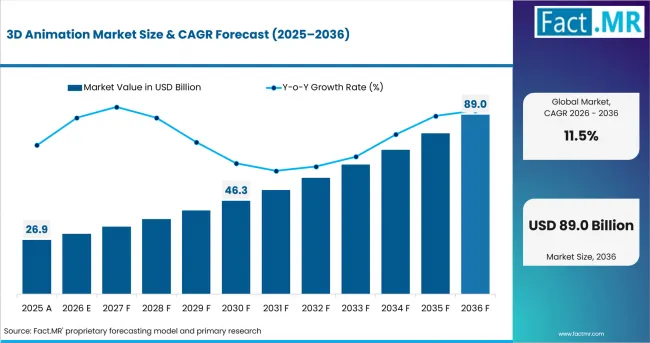
3d Animation Market Value Analysis | Source: Fact.MR
| Metric | Details |
|---|---|
| Industry Size 2026 | USD 30.0 billion |
| Industry Value 2036 | USD 89.0 billion |
| CAGR 2026 to 2036 | 11.5% |
Source: Fact.MR analysis. Updated Jun 9, 2026
Summary of 3D Animation Market
- Demand Drivers in the Market
- Streaming Content: Streaming platforms need animated programs and visual effects to support original content libraries.
- Production Software: Autodesk Maya supports modeling and rendering workflows used by film artists and game developers.
- Visual Computing: NVIDIA’s annual review highlights Omniverse and neural rendering activity across advanced 3D workflows. [3]
- Key Segments Analyzed
- By Component: Hardware is expected to hold 47.0% share in 2026 because rendering requires graphics and processing capacity.
- By Technology: 3D Modeling leads digital content creation with 37.0% share in 2026 across characters and scenes.
- By Deployment Model: Cloud deployment is projected to hold 54.0% share in 2026 because distributed teams need shared production access.
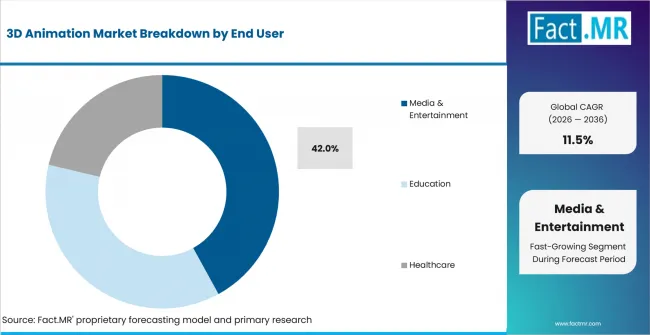
- By End User: Media & entertainment leads end-user demand with 42.0% share in 2026 due to film and streaming use.
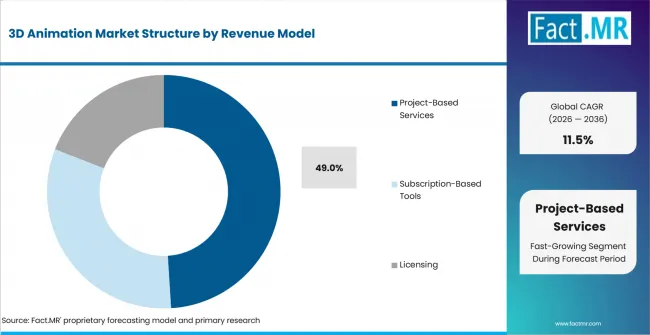
- By Revenue Model: Project-based services are expected to hold 49.0% share in 2026 because animation work is commissioned by content package.
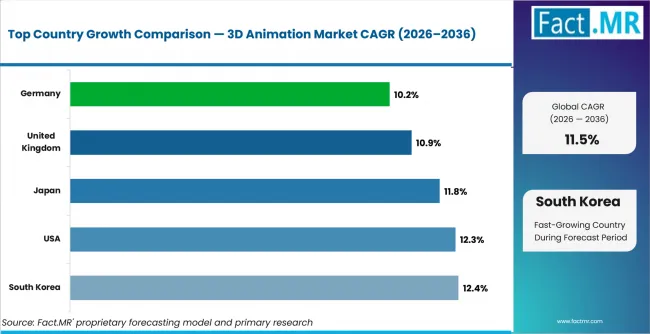
- By Geography: South Korea leads the country outlook with 12.4% CAGR through 2036 as gaming demand expands.
- Analyst Opinion at Fact.MR
- Shambhu Nath Jha, Principal Consultant at Fact.MR, notes, “3D animation is becoming a production quality market. Buyers now look beyond visual realism. Faster rendering and predictable delivery are needed before companies scale animation work.”
- Strategic Implications
- Pipeline Control: Studios need asset tracking systems that reduce revision delays during complex animation projects.
- Rendering Capacity: Animation firms should plan compute resources before accepting high-resolution content work.
- Talent Planning: Production houses need trained artists across modeling and rendering workflows.
3D animation demand is becoming more production-led. Studios need tools that improve modeling and review workflows. Autodesk states that Maya provides 3D modeling, animation, effects, rendering, and compositing solutions for film artists and game developers. [1] This keeps production software central to studio tool selection.
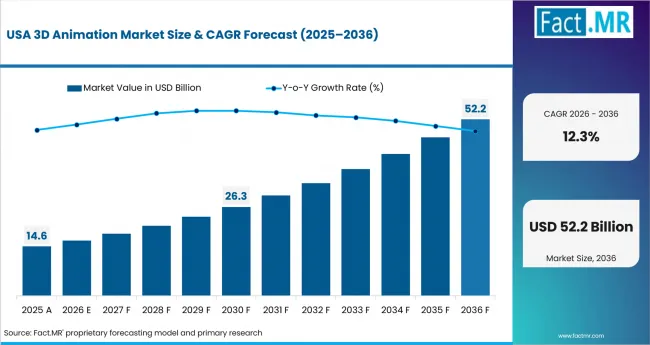
The United States is projected to record 12.3% CAGR from 2026 to 2036 as streaming content and game development support demand. South Korea is likely to post 12.4% CAGR as gaming and digital content production expand. Japan is expected to register 11.8% CAGR by 2036 anime-adjacent digital pipelines and game studios use more 3D tools. The United Kingdom is forecast to advance at 10.9% CAGR as tax relief supports animation production. Germany is set to record 10.2% CAGR as architecture and industrial visualization support adoption.
Segmental Analysis
3D Animation Market Analysis by Component
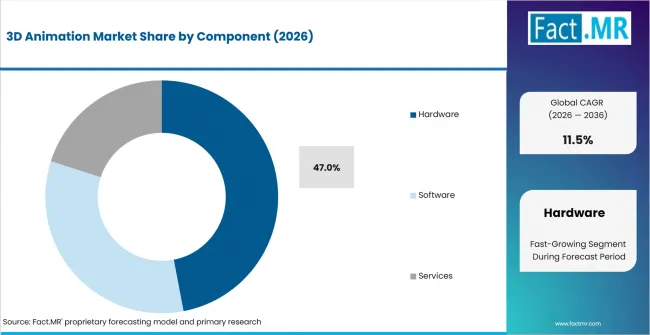
3d Animation Market Analysis By Component | Source: Fact.MR
Hardware is expected to hold 47.0% share in 2026 because rendering and simulation need graphics processors and workstations. Software supports modeling and compositing. Services support production work and project delivery.
- Hardware Base: Graphics systems and workstations help studios render complex scenes with shorter production wait times.
- Software Control: Animation software manages models and textures through structured production pipelines.
- Service Support: Production services help studios manage overflow work and delivery schedules.
3D Animation Market Analysis by Technology
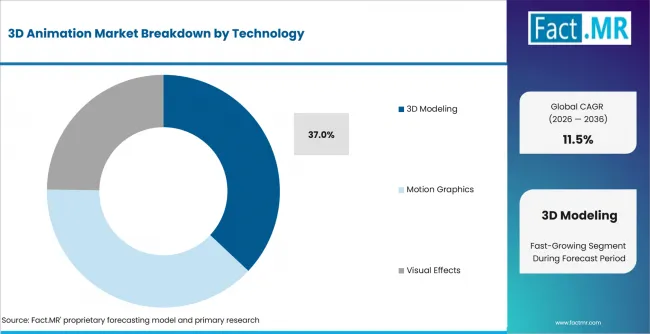
3d Animation Market Analysis By Technology | Source: Fact.MR
3D Modeling leads the workflow because characters and objects need digital structure before animation. Rendering turns model data into final visuals. 3D Modeling is likely to account for 37.0% share in 2026 as studios build more detailed digital assets. Motion graphics and visual effects support advertising and live-action work.
- Model Creation: 3D modeling creates characters and environments before animation teams add motion.
- Rendering Output: Rendering turns digital scenes into finished visuals for films and games.
- VFX Support: Visual effects help creators blend digital assets with live-action footage.
3D Animation Market Analysis by Deployment Model
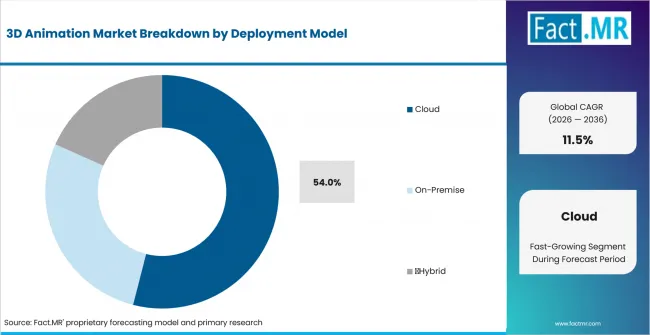
3d Animation Market Analysis By Deployment Model | Source: Fact.MR
Cloud deployment supports distributed production because artists often work across different locations and time zones. On-premise systems stay important for secure studio pipelines. Cloud deployment is projected to hold 54.0% share in 2026 as collaboration and rendering needs shift toward flexible infrastructure. Netflix reports that it acquires, licenses and produces content including original programming. [4]
- Cloud Collaboration: Cloud platforms help artists review files and share production assets across locations.
- On-Premise Security: Studio-owned systems support sensitive content and high-control workflows.
- Hybrid Pipelines: Hybrid models balance secure local work with scalable rendering support.
3D Animation Market Analysis by End User
3d Animation Market Analysis By End User | Source: Fact.MR
Media & entertainment remains the main demand base because streaming shows and games rely on 3D content. Education uses animation to explain complex topics. Media & entertainment is anticipated to capture 42.0% share in 2026 as content owners keep investing in animated visuals and CGI.
- Studio Demand: Film and streaming studios use 3D animation for characters and visual scenes.
- Learning Content: Education providers use animated visuals to explain complex concepts.
- Healthcare Training: Medical users apply 3D animation for procedure education and patient explanation.
3D Animation Market Analysis by Revenue Model
3d Animation Market Analysis By Revenue Model | Source: Fact.MR
Project-based services dominate because animation work is often commissioned for game assets or brand campaigns. Subscription-based tools support smaller studios and independent creators. Licensing helps content owners monetize animated characters and content libraries. Project-based services are expected to hold 49.0% share in 2026 as production work stays tied to client briefs and delivery milestones.
- Project Billing: Project contracts match animation work with fixed deliverables and timeline commitments.
- Tool Subscriptions: Subscription tools help smaller studios access professional software without heavy upfront cost.
- License Revenue: Character and content licensing support long-term value after production release.
3D Animation Market Drivers, Restraints, and Opportunities
3d Animation Market Opportunity Matrix Growth Vs Value | Source: Fact.MR
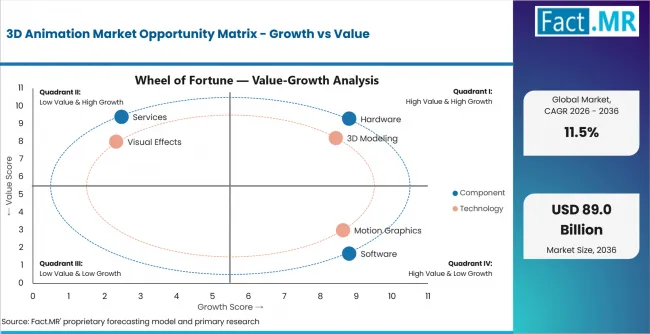
Content production demand is the main driver for 3D animation. Maxon stated in December 2025 that Maxon One expanded creator workflows for 3D design and VFX work. [5] Streaming platforms and advertisers need realistic visuals that work across screens.
Skill pressure can limit market expansion. 3D animation needs modelers and rendering specialists. Production timelines can stretch when revisions arrive late. Hardware and rendering costs affect smaller studios. Cloud tools reduce some pressure, yet skill needs stay important.
Opportunities in the 3D Animation Market
- Cloud Rendering: Vendors can serve smaller studios that need scalable rendering without major hardware investment.
- Healthcare Animation: Studios can build medical visuals for training and product explanation.
- Game Assets: Production firms can support game developers with characters and cinematic sequences.
Regional Analysis
Based on regional analysis, the 3D animation market is segmented into North America, Latin America, Europe, East Asia, South Asia & Oceania and Middle East and Africa.
.webp "Top Country Growth Comparison 3d Animation Market Cagr (2026 2036)")
Top Country Growth Comparison 3d Animation Market Cagr (2026 2036) | Source: Fact.MR
| Country | CAGR 2026 to 2036 |
|---|---|
| South Korea | 12.4% |
| United States | 12.3% |
| Japan | 11.8% |
| United Kingdom | 10.9% |
| Germany | 10.2% |
Source: Fact.MR analysis. Updated Jun 9, 2026
3d Animation Market Cagr Analysis By Country | Source: Fact.MR
East Asia 3D Animation Market Analysis
East Asia demand comes from digital content and character-led entertainment. South Korea leads the country outlook as gaming and online content production need high-quality 3D assets.
- South Korea: South Korea is projected to record 12.4% CAGR from 2026 to 2036 as gaming and immersive content support demand. Game developers need 3D characters and cinematic assets. Local studios serve digital platform content. Talent quality and rendering capacity will guide supplier selection.
- Japan: Japan has steady demand from gaming and character-led media production. Digital pipelines support 3D asset use across entertainment formats. Japan is expected to register 11.8% CAGR through 2036 as studios combine traditional storytelling with 3D workflows. Production quality will remain an important selection factor.
North America 3D Animation Market Analysis
3d Animation Market Country Value Analysis | Source: Fact.MR
North America demand is led by the United States as entertainment studios and game developers operate at scale.
- United States: The United States is forecast to register 12.3% CAGR by 2036 as streaming and game production support 3D animation demand. Studios need modeling and visual effects capacity. Software vendors benefit from large creative teams. Cloud workflows support distributed production.
Europe 3D Animation Market Analysis
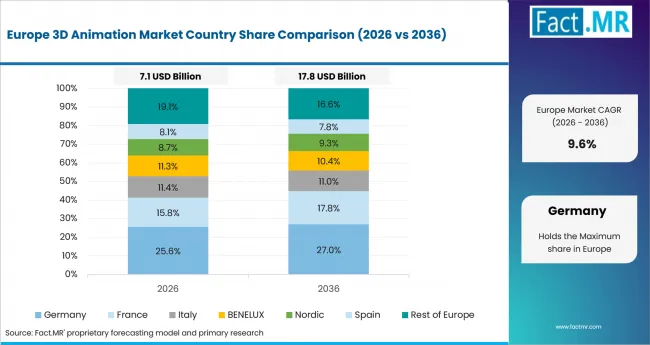
3d Animation Market Europe Country Market Share Analysis, 2026 & 2036 | Source: Fact.MR
Europe demand comes from creative funding and studio co-production models. Public support for audiovisual production helps animation studios develop films and immersive media projects. Co-production networks across major European markets support cross-border studio work and shared production resources.
- United Kingdom: The United Kingdom animation market benefits from creative tax relief and studio production activity. Demand is likely to post 10.9% CAGR over the forecast period as animation houses serve media and brand work. Users need reliable delivery and clear creative supervision. Co-production access will support mid-sized studios.
- Germany: Germany architecture and industrial visualization base supports 3D animation demand. Manufacturers use animation for product explanation and design review. A 10.2% CAGR is forecast from 2026 to 2036 as engineering visualization use expands. Studios with technical content skills will gain better accounts.
Competitive Aligners for Market Suppliers
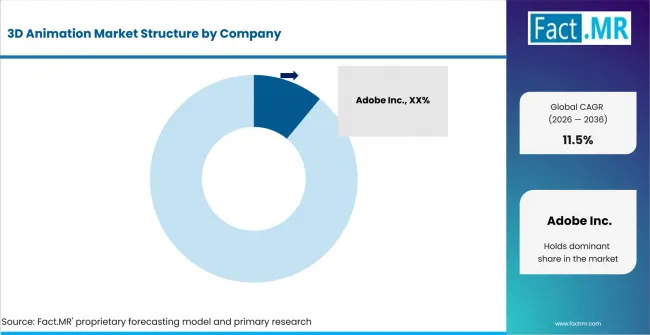
3d Animation Market Analysis By Company | Source: Fact.MR
The 3D animation market has two main supplier groups. One group provides software and rendering tools. Adobe Inc. and Autodesk Inc. give artists tools for modeling and animation work. NVIDIA Corporation supports the rendering power needed for advanced 3D scenes. DeepMotion adds AI-based motion capture that helps turn movement into character animation. LOCUS Animation Studios provides the production skill needed to create finished content.
Media companies will look for smoother project delivery through 2036. Entertainment studios need clear character work and visual effects that stay consistent across scenes. Enterprise users need simple storyboards and fewer revision delays. Rendering capacity and software compatibility will matter as large files can slow production across platforms.
Competition will favor companies that make animation work easier from concept to final delivery. Software providers can gain through tools that artists use every day. Studios can hold trust through clean visual output and reliable timelines. AI can reduce repeated manual work. Trained artists will still decide the final creative quality.
Key Companies in 3D Animation Market
- Adobe Inc.
- Autodesk Inc.
- NVIDIA Corporation
- DeepMotion
- LOCUS Animation Studios
Bibliography
- [1] Autodesk, Inc. (2026, March 3). Form 10-K for the fiscal year ended January 31, 2026.
- [2] The Walt Disney Company. (2025, November 13). Fiscal year 2025 annual financial report.
- [3] NVIDIA Corporation. (2025, May 13). 2025 NVIDIA Corporation annual review: Notice of 2025 Annual Meeting, proxy statement, and Form 10-K.
- [4] Netflix, Inc. (2026, January 23). Annual report on Form 10-K for the year ended December 31, 2025.
- [5] Maxon. (2025, December 3). Maxon expands creative power across its ecosystem with the December 2025 release.
This Report Addresses
- Strategic intelligence on 3D animation demand across component, technology, deployment model, end user and revenue model.
- Forecast mapping from USD 30.0 billion in 2026 to USD 89.0 billion by 2036.
- Segment analysis covering hardware, 3D modeling, cloud deployment, media & entertainment and project-based services.
- Regional outlook covering South Korea, the United States, Japan, the United Kingdom and Germany.
- Competitive analysis of Adobe Inc., Autodesk Inc., NVIDIA Corporation, DeepMotion, LOCUS Animation Studios.
- Production assessment covering modeling, rigging, rendering, motion graphics and visual effects workflows.
- Primary interviews, supplier checks, official source review and studio workflow validation support the forecast.
3D Animation Market Definition
The 3D animation market covers the creation of moving digital visuals built through three-dimensional models. It includes modeling and visual effects. The market is different from 2D animation because output uses digital geometry and simulated camera movement.
3D Animation Market Inclusions
The scope includes 3D animation software and production services. It includes animation hardware used for rendering and production work. Media and architecture applications are included. Disney states that production costs include internally produced live-action and animated films. [2]
3D Animation Market Exclusions
The scope excludes pure 2D animation. It excludes live-action production without 3D work. It also excludes static graphic design and simple video editing. Finished consumer merchandise is outside scope because the market tracks 3D animation production and tools.
3D Animation Market Research Methodology
- Primary Research
- Primary research includes interviews with animation studio heads and 3D production managers across media production workflows.
- Desk Research
- Desk research reviews company filings and official software documentation with production platform evidence.
- Market-Sizing and Forecasting
- Forecasting uses component demand and technology adoption with end user spending across key countries.
- Data Validation and Update Cycle
- Forecasts are validated through studio checks and supplier feedback with content production evidence.
Segmentation
Scope of the Report
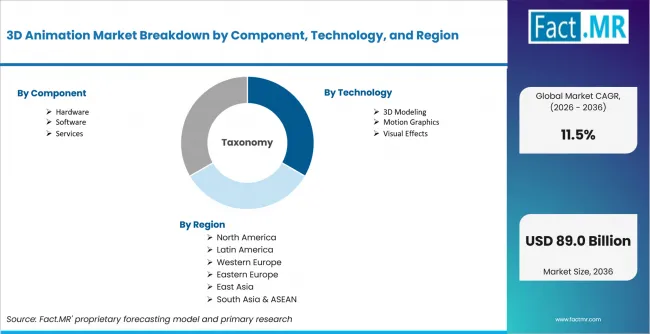
3d Animation Market Breakdown By Component, Technology, And Region | Source: Fact.MR
| Attribute | Details |
|---|---|
| Quantitative Units | USD 30.0 billion in 2026 to USD 89.0 billion by 2036 at 11.5% CAGR |
| Market Definition | Three-dimensional animated content production, tools, services and workflow systems |
| Component | Hardware, Software, Services |
| Technology | 3D Modeling, Motion Graphics, 3D Rendering, Visual Effects |
| Deployment Model | On-Premise, Cloud, Hybrid |
| End User | Media & Entertainment, Education, Healthcare, Architecture, Gaming |
| Revenue Model | Project-Based Services, Subscription-Based Tools, Licensing, Studio Retainers |
| Regions Covered | North America, Latin America, Europe, East Asia, South Asia & Oceania, Middle East and Africa |
| Countries Covered | South Korea, United States, Japan, United Kingdom, Germany |
| Key Companies Profiled | Adobe Inc., Autodesk Inc., NVIDIA Corporation, DeepMotion, LOCUS Animation Studios |
| Forecast Period | 2026 to 2036 |
| Approach | Hybrid top-down and bottom-up approach using component demand, technology use, deployment model, end-user adoption and revenue model validation |
Source: Fact.MR analysis. Updated Jun 9, 2026
3D Animation Market Analysis by Segments
-
By Component:
- Hardware
- Software
- Services
-
By Technology:
- 3D Modeling
- Motion Graphics
- 3D Rendering
- Visual Effects
-
By Deployment Model:
- On-Premise
- Cloud
- Hybrid
-
By End User:
- Media & Entertainment
- Education
- Healthcare
- Architecture
- Gaming
-
By Revenue Model:
- Project-Based Services
- Subscription-Based Tools
- Licensing
- Studio Retainers
-
Region:
- North America
- United States
- Canada
- Europe
- Germany
- United Kingdom
- France
- Italy
- Spain
- Asia Pacific
- China
- Japan
- South Korea
- Taiwan
- Singapore
- Latin America
- Brazil
- Mexico
- Argentina
- Middle East & Africa
- GCC Countries
- South Africa
- Israel
- North America
Frequently Asked Questions
What is the 3D Animation Market size in 2026?
What will the 3D Animation Market be worth by 2036?
What CAGR is projected for the 3D Animation Market?
Which component leads the 3D Animation Market?
Which country expands faster in the market?
How does the United States perform in the market?
How does Japan perform in the market?
What is the main driver in the 3D Animation Market?
What is the main restraint in the market?
Why is 3D modeling important?
Why is cloud deployment important?
Who worked on this report


Preview the report firsthand - request a free sample
Free SampleGet the brochure for pricing and purchase details
Download PDF