3D Radar Market Size, Share, Growth and Forecast (2026 - 2036)

The 3D Radar Market is segmented by Product (Ground Based 3D Radar Systems, Airborne 3D Radar Systems, Naval 3D Radar Systems, Space Based Radar Systems), by Application (Defense Surveillance Applications, Naval Operations Applications, Aerospace Applications, Civil Aviation Applications), by End Use, and by Region. Forecast for 2026 to 2036.

3D Radar Market Analysis and Forecast by Fact.MR

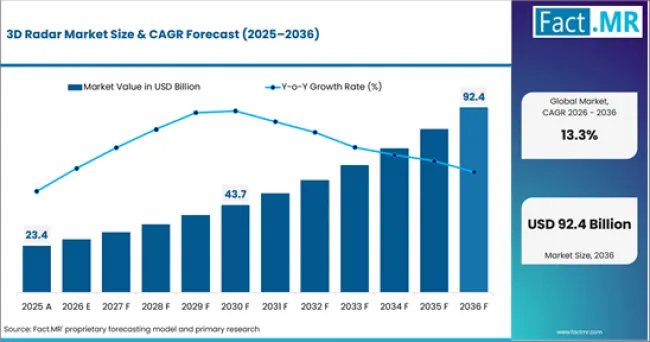
  • The 3D Radar Market is expected to grow from USD 26.5 billion in 2026 to USD 92.4 billion by 2036, at a 13.3% CAGR.
  • Demand is driven by accelerating defense modernization programs across NATO and allied nations, growing demand for counter-drone and hypersonic threat detection capabilities, and expanding civil applications in air traffic management and weather monitoring.
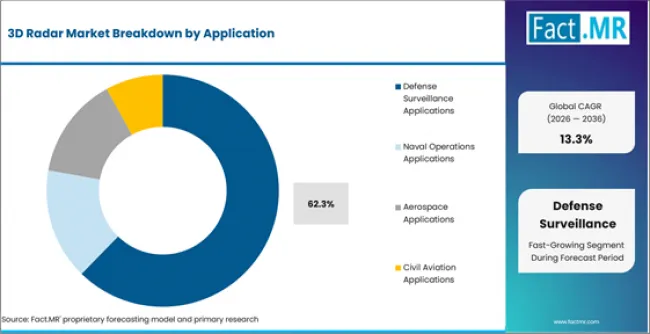
  • Ground-based 3D radar systems account for 46.8% of the product segment, while defense surveillance contributes 62.3% of application share as governments prioritize integrated air and missile defense, spectrum-efficient radar operations, and multi-domain situational awareness.
3d Radar Market Value Analysis

Summary of 3D Radar Market

  • Market Snapshot
    • In 2025, the global 3D Radar Market was valued at approximately USD 23.4 billion.
    • The market is estimated to reach USD 26.5 billion in 2026 and is projected to attain USD 92.4 billion by 2036.
    • The 3D radar market is likely to expand at a CAGR of 13.3% during the forecast period.
    • The market is anticipated to create an absolute dollar opportunity of USD 65.9 billion between 2026 and 2036.
    • Ground based 3D radar systems account for 46.8% of the product segment share in 2026.
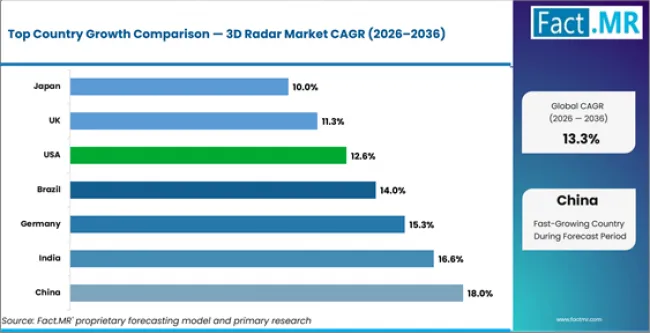
    • China (18.0%) and India (16.6%) are the key growth markets during the forecast period.
  • Demand and Growth Drivers
    • Defense modernization programs across NATO allies, Indo-Pacific partners, and Middle Eastern states are generating multi-year procurement pipelines for advanced 3D surveillance and fire-control radar systems.
    • Growing hypersonic and cruise missile threats are pushing defense agencies to invest in radar platforms capable of simultaneous tracking across multiple altitude layers and trajectory profiles.
    • Counter-drone operations are creating demand for compact, rapidly deployable 3D radar systems that can detect low-altitude, low-radar-cross-section unmanned aerial vehicles in contested airspace.
    • Civil aviation growth and increasing air traffic density are driving procurement of 3D radar for air traffic management, particularly at congested airports and in regions building new aviation infrastructure.
  • Product and Segment View
    • Ground based 3D radar systems account for 46.8% of the product segment in 2026, supported by their role in territorial air defense, airfield protection, border surveillance, and ground-based fire-control applications.
    • Defense surveillance applications represent 62.3% of the application segment in 2026, with air defense networks, battlefield awareness, missile tracking, and maritime monitoring acting as the primary demand channels.
    • Phased array radar technology holds 71.6% of the technology segment in 2026, reflecting its advantages in electronic beam steering, rapid target switching, and multi-function operation within a single aperture.
    • Key segmentation includes:
      • Product Type: Ground Based 3D Radar Systems, Shipborne 3D Radar Systems, Airborne 3D Radar Systems, Space Based 3D Radar Systems
      • Application: Defense Surveillance Applications, Air Traffic Management, Weather Monitoring, Maritime Security
      • End Use: Defense Forces, Civil Aviation Authorities, Coast Guard and Maritime Agencies, Weather Services
      • Technology: Phased Array Radar Technology, Pulse Doppler Radar Technology, Continuous Wave Radar Technology
    • These systems enable:
      • Simultaneous tracking of multiple airborne targets across range, azimuth, and elevation for comprehensive three-dimensional situational awareness
      • Electronic beam steering and rapid scan patterns that enable multi-function operation including surveillance, tracking, and fire-control guidance within a single aperture
      • Integration with command and control networks for real-time threat data sharing across joint and coalition force operations
  • Geography and Competitive Outlook
    • North America maintains the largest installed base of advanced 3D radar systems, supported by the US defense budget for air and missile defense modernization and growing investment in next-generation software-defined radar platforms.
    • Europe shows strong demand driven by NATO collective defense requirements, with Germany (15.3%) and the UK (11.3%) reflecting procurement tied to multinational defense programs and air policing obligations.
    • Asia Pacific is the fastest-growing region, led by China (18.0%) and India (16.6%), where defense modernization programs, territorial security concerns, and domestic radar manufacturing capabilities are generating sustained procurement.
    • China (18.0%) and India (16.6%) are the key growth markets, followed by Germany (15.3%), Brazil (14.0%), and the USA (12.6%).
    • Key companies include HENSOLDT AG, BAE Systems plc, L3Harris Technologies, Inc., Honeywell International Inc., Leonardo S.p.A., Northrop Grumman Corporation, RTX Corporation / Raytheon, Thales Group, Lockheed Martin Corporation, and Saab AB.
  • Analyst Opinion
    • Shambhu Nath Jha, Principal Consultant at Fact.MR, says "The 3D radar market is entering a period of accelerated procurement driven by the convergence of rising defense budgets, evolving threat profiles, and hypersonic tracking. The competitive landscape is shaped by a small number of prime defense contractors with the integration capabilities and security clearances needed to deliver mission-critical radar systems. Radar systems are transitioning from single-mission platforms to multi-function, software-defined architectures that can perform surveillance, tracking, and fire-control functions within a single aperture. This transition is creating both replacement demand for legacy systems and new procurement for capabilities that did not previously exist, such as counter-drone and mission-critical radar systems for government buyers."

Key Growth Drivers, Constraints, and Opportunities

3d Radar Market Opportunity Matrix Growth Vs Value

Key Factors Driving Growth

  • Rising hypersonic missile and advanced cruise missile threats are pushing defense agencies to procure 3D radar systems capable of detecting, tracking, and cueing interceptors against high-speed targets operating at variable altitude profiles and with reduced radar cross-sections compared to legacy ballistic missiles.
  • Counter-drone mission requirements are expanding the addressable market for 3D radar beyond traditional air defense, creating demand for compact, rapidly deployable systems that can detect small unmanned aerial vehicles at low altitudes in contested electromagnetic environments.
  • AESA technology maturation is reducing the lifecycle cost of 3D radar systems while improving reliability, scan rate, and electronic counter-countermeasure capability, making advanced radar platforms accessible to a wider range of defense customers including mid-tier military forces and allied nations.

Key Market Constraints

  • Long procurement cycles in defense markets, typically spanning five to ten years from requirement definition to system delivery, create revenue timing uncertainty for radar manufacturers and limit the speed at which new technologies can be fielded.
  • Electromagnetic spectrum congestion from expanding 5G networks and commercial communication systems is creating interference management challenges for radar operations, particularly in coastal and urban environments where spectrum sharing is most complex.
  • Export control restrictions on advanced radar technologies limit the addressable market for top-tier systems, as prime defense contractors must navigate ITAR and EAR compliance requirements when competing for international defense radar opportunities.

Key Opportunity Areas

  • Software-defined radar architectures that enable multi-mission operation within a single aperture are creating upgrade pathways for existing installed bases, generating both new procurement and lifecycle extension revenue for manufacturers with modular platform designs.
  • Urban air mobility infrastructure development is creating a new civil demand channel for 3D radar systems capable of managing low-altitude air traffic from drones, air taxis, and cargo delivery vehicles in metropolitan airspace.
  • Space-based radar constellations for persistent global surveillance are generating long-term program opportunities for manufacturers with the capability to integrate radar payloads into satellite platforms for defense and civil earth observation missions.

Segment-wise Analysis of the 3D Radar Market

  • Ground based 3D radar systems hold 46.8% of the product type segment in 2026, supported by their role in territorial air defense, airfield surveillance, border monitoring, and integration with ground-based air defense weapon systems.
  • Defense surveillance applications represent 62.3% of the application segment in 2026, with air and missile defense, battlefield situational awareness, maritime domain awareness, and border security accounting for the majority of procurement spending.
  • Solid-state radar formulations account for 44.7% of the formulation segment in 2026, reflecting their advantages in reliability, maintainability, and reduced lifecycle cost compared to tube-based radar transmitter architectures.

The 3D radar market is segmented by product type, application, end use, technology, formulation, and distribution channel. By product type, the market covers ground based, shipborne, airborne, and space based 3D radar systems. By application, coverage includes defense surveillance, air traffic management, weather monitoring, and maritime security. Ground based systems lead by value due to the scale of territorial air defense programs, while airborne and shipborne systems are growing as naval and aerial platforms receive upgraded radar capabilities.

Which Product Type Segment Dominates the 3D Radar Market?

3d Radar Market Analysis By Product

Ground based 3D radar systems account for 46.8% of the product type segment in 2026. Their leadership is built on the foundational role they play in territorial air defense architectures, where fixed and mobile radar installations provide persistent surveillance coverage for detecting and tracking airborne threats. These systems form the sensor backbone of integrated air defense systems and are deployed by defense forces globally for both early warning and fire-control guidance missions.

Shipborne 3D radar systems hold the second-largest share, driven by naval modernization programs that are equipping surface combatants, frigates, and destroyers with multi-function phased array radar systems. Airborne 3D radar, including airborne early warning and control (AEW&C) platforms, represents a high-value segment with growing demand from air forces seeking extended surveillance coverage beyond ground-based radar horizons. Space based radar is the smallest segment currently but holds long-term growth potential as persistent global surveillance requirements increase.

Which Application Segment Dominates the 3D Radar Market?
3d Radar Market Analysis By Application

Defense surveillance is expected to lead the application segment with a 62.3% share in 2026. Demand is supported by the ongoing modernization of air defense networks across major and mid-tier military forces, growing procurement of multi-mission radar systems capable of simultaneous surveillance and fire-control operations, and increasing investment in counter-drone and hypersonic threat detection.

Air traffic management holds the second-largest share, driven by rising commercial air traffic and the need for accurate three-dimensional tracking at congested airports and in expanding airspace. Weather monitoring represents a smaller but stable segment supported by national meteorological agencies investing in next-generation weather radar networks for improved severe weather prediction and aviation safety.

Which Product Trend is Shaping the Next Phase of Growth in the 3D Radar Market?

Software-defined radar architecture is the most consequential product trend shaping the 3D radar market. These systems treat radar building blocks as independently controllable software-defined apertures, allowing a single radar to perform multiple missions simultaneously and to adapt its beam patterns, waveforms, and scan schedules in response to changing operational needs. This represents a fundamental shift from hardware-defined radar platforms where function changes require physical modification.

The shift toward software-defined radar is driven by the increasing congestion of the electromagnetic spectrum and the need for radar systems to coexist with expanding 5G and commercial communication networks. By enabling precise, software-driven control over transmission parameters, these radars can share spectrum more effectively while maintaining detection performance. The trend is also aligned with the broader military push toward open-architecture systems that can receive capability upgrades through software updates rather than hardware replacement, extending platform life and reducing total ownership costs.

Regional Outlook Across Key Markets

  • China leads growth at 18.0%, driven by domestic radar manufacturing expansion, defense modernization programs, and growing procurement of AESA-equipped 3D radar systems for territorial air defense and maritime surveillance.
  • India follows at 16.6%, supported by defense budget increases, domestic radar development under the Defence Acquisition Procedure, and procurement of air defense radar systems for both conventional and counter-drone missions.
  • North America maintains the largest installed base, with the USA at 12.6% reflecting ongoing air and missile defense modernization, next-generation radar development, and growing investment in software-defined radar platforms.
  • European demand is shaped by NATO collective defense requirements, with Germany at 15.3% driven by Bundeswehr modernization and multinational defense radar programs.

Top Country Growth Comparison 3d Radar Market Cagr (2026 2036)

CAGR Table

Country CAGR (%)
China 18.0%
India 16.6%
Germany 15.3%
Brazil 14.0%
USA 12.6%
United Kingdom 11.3%
Japan 10.0%

Source: Fact MR analysis, based on proprietary forecasting model and primary research.
3d Radar Market Cagr Analysis By Country

Market Outlook for 3D Radar in the United States
3d Radar Market Country Value Analysis

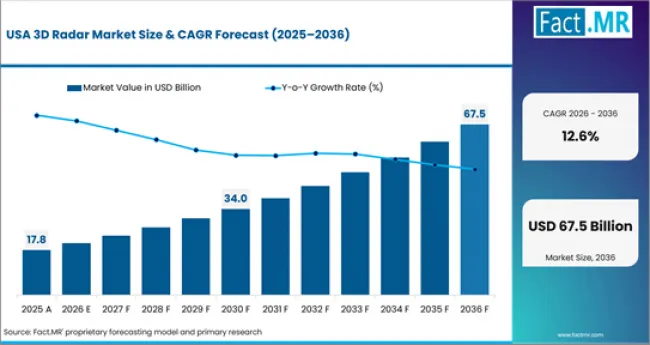
The US 3D radar market is projected to grow at a CAGR of 12.6% through 2036. Demand is concentrated in air and missile defense modernization, where programs such as LTAMDS and SPY-6 are generating multi-billion-dollar procurement and sustainment contracts. The transition to software-defined radar architectures for multi-mission operation and spectrum sharing with 5G networks is a defining feature of the US market.

  • LTAMDS and SPY-6 programs generate sustained procurement and lifecycle support demand for advanced 3D radar systems.
  • Software-defined radar development contracts from the Office of Naval Research support next-generation capability investment.

China 3D Radar Market Growth Assessment

Domestic radar manufacturing capacity and government support for defense technology self-sufficiency are the primary forces driving the Chinese 3D radar market. State-owned defense enterprises are expanding production of AESA-equipped radar systems for both ground-based air defense and naval applications, while also developing export variants for allied nations in Southeast Asia and Africa.

  • Defense self-sufficiency policies drive domestic AESA radar production capacity expansion across ground and naval platforms.
  • Export-oriented radar programs support revenue diversification beyond domestic procurement.

India 3D Radar Market Opportunity Outlook

Defence Acquisition Procedure requirements for increasing domestic content in military radar procurement and growing investment by HAL and DRDO in indigenous 3D radar development are shaping the Indian market. Fleet expansion by domestic carriers and increasing air traffic density are also creating civil demand for air traffic management radar systems.

  • Defence Acquisition Procedure mandates for domestic content drive indigenous radar development programs.
  • Civil aviation growth creates additional demand for 3D air traffic management radar at expanding airports.

Germany 3D Radar Market Demand Analysis

Bundeswehr modernization programs and NATO collective defense obligations shape radar procurement priorities in Germany. EASA and Eurocontrol standards govern civil radar specifications, while the European Air Transport Command framework drives multinational interoperability requirements for military surveillance radar systems deployed across European theater.

  • Bundeswehr modernization creates procurement cycles for ground-based air defense and surveillance radar.
  • NATO interoperability requirements drive standardization of radar data-sharing protocols across allied systems.

Competitive Benchmarking and Company Positioning
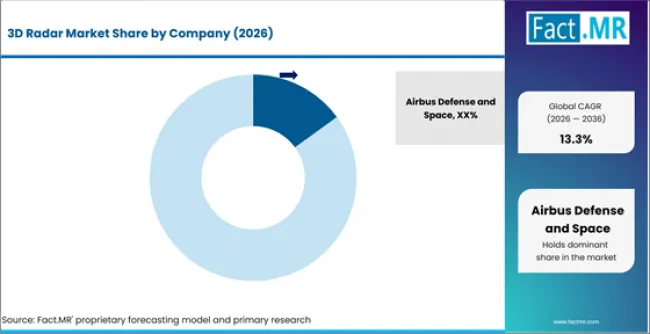
3d Radar Market Analysis By Company

3D Radar Market Analysis By Company

  • RTX Corporation / Raytheon, Northrop Grumman, and Lockheed Martin hold dominant positions through large-scale defense program contracts, established integration capabilities, and growing investment in software-defined and AESA radar platforms for US and allied forces.
  • Thales Group, BAE Systems, Leonardo, and HENSOLDT AG compete strongly across European and international markets, supported by multinational defense program participation, NATO-standard radar portfolios, and growing positions in counter-drone and multi-mission radar systems.
  • Contract award visibility provides competitive advantage, as long-cycle defense programs create multi-year revenue certainty and installed-base leverage for sustainment, upgrade, and follow-on procurement opportunities.

The competitive landscape is concentrated among a small number of prime defense contractors with the integration capabilities, security clearances, and program management scale required to deliver complex radar systems to government buyers. RTX Corporation / Raytheon, Northrop Grumman, and Lockheed Martin compete for US and allied defense radar contracts through platform performance, technology maturity, and lifecycle cost positioning.

European defense contractors including Thales Group, BAE Systems, Leonardo, and HENSOLDT AG maintain strong positions through participation in multinational European defense programs and international export opportunities. These companies compete on interoperability with NATO systems, radar modularity, and the ability to offer integrated air defense solutions.

Key Companies in the 3D Radar Market

RTX Corporation / Raytheon, Northrop Grumman Corporation, and Lockheed Martin Corporation are among the leading players in the 3D radar market globally, supported by major US and allied defense program contracts and growing positions in next-generation radar development.

Thales Group, BAE Systems plc, Leonardo S.p.A., HENSOLDT AG, Honeywell International Inc., L3Harris Technologies, Inc., and Saab AB hold established positions across European, Asia Pacific, and international defense markets, supported by multinational program participation and specialized radar system capabilities.

Recent Industry Developments

  • RTX Corporation / Raytheon, Software-Defined Radar Development Contract (May 2026)
  • Raytheon received a USD 22.6 million contract from the U.S. Office of Naval Research to advance software for next-generation naval radar systems. The work supports the STORM program and enables radar building blocks to operate independently for multi-mission operation and spectrum-sharing applications. This is relevant to the 3D radar market because it strengthens software-defined aperture capability for SPY-6-class radar systems.
  • RTX Corporation / Raytheon, SPY-6 Radar Production Support Contract (June 2026)
  • Raytheon received a USD 515 million U.S. Navy contract for the SPY-6 family of radars. The award supports continued integration and test activity and includes upgrades for Flight IIA destroyers with the SPY-6(V)4 variant. This is highly relevant because SPY-6 provides 360-degree maritime sensing across air, surface, ballistic missile, and electronic warfare threat environments.
  • RTX Corporation / Raytheon, LTAMDS Production Contract Modification (August 2025)
  • The U.S. Army awarded Raytheon a USD 1.7 billion modification for low-rate initial production of Lower Tier Air and Missile Defense Systems. The award increased the cumulative contract value to USD 3.7894 billion and supports production through December 2029. This is directly relevant because LTAMDS is a 360-degree ground-based air and missile defense radar designed for advanced threats including hypersonic weapons.

Leading Companies Shaping the 3D Radar Market

  • HENSOLDT AG
  • BAE Systems plc
  • L3Harris Technologies, Inc.
  • Honeywell International Inc.
  • Leonardo S.p.A.
  • Northrop Grumman Corporation
  • RTX Corporation / Raytheon
  • Thales Group
  • Lockheed Martin Corporation
  • Saab AB

Sources and Research References

  • RTX Corporation / Raytheon. SPY-6, LTAMDS, and software-defined radar program announcements.
  • Northrop Grumman Corporation. Advanced radar system development and contract updates.
  • Defense procurement databases, contract award records, and military modernization program documentation.
  • International Air Transport Association air traffic statistics and civil aviation radar procurement data.
  • Primary interviews with defense contractors, military procurement agencies, civil aviation authorities, and radar system integrators.

This bibliography is provided for reader reference and is not exhaustive. The full report contains the complete reference list and detailed citations.

Key Questions This Report Addresses

  • What is the current and future size of the 3D Radar Market?
  • How fast is the 3D radar market expected to grow between 2026 and 2036?
  • Which product type is likely to lead the market by 2026?
  • Which application segment is expected to account for the highest demand by 2026?
  • What factors are driving demand for 3D radar systems globally?
  • How is the shift toward software-defined radar architectures influencing the market?
  • Why are China and India emerging as the fastest-growing markets?
  • How are counter-drone and hypersonic threats supporting radar procurement?
  • Which countries are projected to show the fastest growth through 2036?
  • Who are the key companies active in the 3D Radar Market?
  • How does Fact.MR estimate and validate the market forecast?

3D Radar Market Definition

The 3D radar market covers ground-based, shipborne, airborne, and space-based radar systems that provide three-dimensional target tracking by measuring range, azimuth, and elevation. It includes phased array, pulse Doppler, and continuous wave radar technologies used across defense surveillance, air traffic management, weather monitoring, maritime security, and emerging counter-drone applications.

3D Radar Market Inclusions

  • The scope covers global and regional market size and forecasts for 2026 to 2036 across product type, application, end use, technology, platform, and region.
  • It includes regional demand analysis across major geographies, based on factors such as defense spending, air traffic growth, maritime security requirements, and weather monitoring investment.
  • The report covers technology trends, market drivers and constraints, and the competitive landscape, including defense contract portfolios, radar system specifications, geographic deployment, and program pipeline visibility of leading players.
  • It includes pricing and procurement analysis across military-grade, commercial, and dual-use radar platforms, including lifecycle cost considerations and upgrade path economics.

3D Radar Market Exclusions

  • The scope excludes two-dimensional radar systems that measure range and azimuth only without elevation tracking capability.
  • It excludes automotive radar sensors, industrial process radar instruments, and ground-penetrating radar systems designed for subsurface imaging rather than airborne target detection.
  • The report excludes radar signal processing software sold without hardware integration, standalone electronic warfare systems, and communication relay equipment.
  • It also excludes classified defense programs with no publicly available procurement or contract information.

3D Radar Market Research Methodology

  • The methodology combines secondary research, primary interviews, and forecast modelling.
  • It draws on 120+ secondary sources and benchmarks 50+ company product portfolios.
  • Market sizing covers 30+ countries through a demand-side model, supported by top-down validation using defense budget allocations.
  • Key inputs include defense spending trends, air traffic growth, maritime security requirements, weather monitoring budgets, and technology maturation timelines.
  • The model cross-checks demand with contract awards, program schedules, delivery timelines, and installed base replacement cycles.
  • Primary validation includes 20+ interviews across defense contractors, military procurement agencies, civil aviation authorities, and radar system integrators.
  • Final estimates go through defense budget correlation checks, delivery-pattern review, and sensitivity testing.

Scope of Analysis

3d Radar Market Breakdown By Product, Application, And Region

Parameter Details
Quantitative Units USD 26.5 billion to USD 92.4 billion, at a CAGR of 13.3%
Market Definition The 3D Radar Market covers ground-based, shipborne, airborne, and space-based radar systems providing three-dimensional target tracking across defense, air traffic management, weather monitoring, and maritime security applications.
Regions Covered North America, Latin America, Europe, East Asia, South Asia and Pacific, Middle East and Africa
Countries Covered USA, China, India, Germany, Brazil, UK, Japan, 30 plus countries
Key Companies HENSOLDT AG, BAE Systems plc, L3Harris Technologies, Inc., Honeywell International Inc., Leonardo S.p.A., Northrop Grumman Corporation, RTX Corporation / Raytheon, Thales Group, Lockheed Martin Corporation, Saab AB
Forecast Period 2026 to 2036
Approach Hybrid demand-side and top-down methodology built on defense budget analysis, contract award tracking, air traffic growth data, product benchmarking, and primary interviews across defense contractors, military procurement agencies, civil aviation authorities, and radar system integrators

3D Radar Market Segmentation

  • 3D Radar Market Segmented by Product:

    • Ground Based 3D Radar Systems
      • Long Range Surveillance Radars
        • High Altitude Detection Radars
        • Border Surveillance Radar Systems
      • Short Range Tactical Radars
        • Mobile Battlefield Radar Units
        • Perimeter Security Radar Systems
    • Airborne 3D Radar Systems
      • Aircraft Mounted Radar Systems
        • Fighter Jet Radar Systems
        • Transport Aircraft Radar Systems
      • Helicopter Mounted Radar Systems
        • Rotary Wing Surveillance Radars
        • Low Altitude Detection Radars
    • Naval 3D Radar Systems
      • Shipborne Surveillance Radars
        • Destroyer Class Radar Systems
        • Frigate Class Radar Systems
      • Coastal Defense Radars
        • Harbor Surveillance Systems
        • Maritime Intrusion Detection Radars
    • Space Based Radar Systems
      • Satellite Radar Systems
        • Earth Observation Radars
        • Synthetic Aperture Radar Systems
      • Orbital Surveillance Radars
        • Deep Space Tracking Radars
        • Object Detection Radar Systems
  • 3D Radar Market Segmented by Application:

    • Defense Surveillance Applications
      • Border Security Systems
        • Land Border Monitoring Systems
        • Coastal Surveillance Systems
      • Air Defense Systems
        • Missile Detection Systems
        • Airspace Monitoring Systems
    • Naval Operations Applications
      • Fleet Tracking Systems
        • Ship Movement Monitoring
        • Naval Threat Detection Systems
      • Maritime Security Systems
        • Anti Piracy Radar Systems
        • Harbor Protection Systems
    • Aerospace Applications
      • Aircraft Navigation Systems
        • Collision Avoidance Systems
        • Weather Detection Radar Systems
      • Flight Safety Systems
        • Terrain Mapping Radars
        • Air Traffic Monitoring Systems
    • Civil Aviation Applications
      • Airport Surveillance Systems
        • Runway Monitoring Radars
        • Air Traffic Control Systems
      • Flight Path Management Systems
        • Airspace Optimization Radars
        • Aircraft Sequencing Systems
  • 3D Radar Market Segmented by End Use:

    • Defense Forces
      • Army Defense Units
        • Ground Surveillance Divisions
        • Combat Intelligence Units
      • Air Force Units
        • Airborne Surveillance Squadrons
        • Radar Reconnaissance Divisions
    • Navy Defense Forces
      • Surface Fleet Operations
        • Warship Radar Units
        • Coastal Defense Squadrons
      • Submarine Surveillance Units
        • Underwater Detection Command
        • Maritime Intelligence Units
    • Homeland Security Agencies
      • Border Protection Units
        • Immigration Surveillance Divisions
        • Internal Security Forces
      • Critical Infrastructure Protection
        • Airport Security Agencies
        • Energy Facility Protection Units
    • Space & Research Agencies
      • Space Observation Institutes
        • Satellite Monitoring Centers
        • Aerospace Research Labs
      • Defense Research Organizations
        • Radar Development Institutes
        • Advanced Sensor Research Centers
  • 3D Radar Market Segmented by Technology:

    • Phased Array Radar Technology
      • Active Electronically Scanned Arrays
        • Digital Beam Steering Systems
        • Multi Target Tracking Systems
      • Passive Phased Arrays
        • Signal Processing Radar Arrays
        • Frequency Agile Radar Systems
    • Synthetic Aperture Radar Technology
      • Airborne SAR Systems
        • High Resolution Imaging Radars
        • Terrain Mapping Radar Systems
      • Spaceborne SAR Systems
        • Earth Observation Radar Platforms
        • Weather Monitoring Radar Systems
    • Doppler Radar Technology
      • Velocity Detection Systems
        • Moving Target Indicator Radars
        • Speed Measurement Radar Systems
      • Weather Doppler Systems
        • Storm Tracking Radar Systems
        • Precipitation Monitoring Systems
    • 3D Imaging Radar Technology
      • Volumetric Imaging Systems
        • Real Time Spatial Mapping Radars
        • High Definition 3D Scanning Radars
      • AI Enhanced Radar Systems
        • Automated Threat Detection Systems
        • Predictive Tracking Algorithms
  • 3D Radar Market Segmented by Formulation:

    • Solid-State Radar Formulations
      • Phased Array Solid-State Systems
        • Active Electronically Scanned Arrays (AESA)
        • Passive Electronically Scanned Arrays (PESA)
      • Gallium Nitride (GaN) Based Systems
        • High Power GaN Modules
        • Thermal Efficient GaN Architectures
    • Hybrid Radar Formulations
      • Mechanical + Digital Hybrid Systems
        • Rotating Antenna Hybrid Radars
        • Digitally Assisted Tracking Systems
      • Software Defined Radar Systems
        • Reconfigurable Signal Processing Units
        • Adaptive Waveform Generation Systems
    • Multi Static Radar Formulations
      • Distributed Sensor Networks
        • Cooperative Target Detection Nodes
        • Networked Radar Clusters
      • Passive Radar Systems
        • Ambient Signal Exploitation Systems
        • Non Emissive Detection Platforms
    • Imaging Radar Formulations
      • Synthetic Aperture Radar (SAR)
        • Airborne SAR Systems
        • Spaceborne SAR Systems
      • Inverse Synthetic Aperture Radar (ISAR)
        • Target Motion Imaging Systems
        • High Resolution Tracking Systems
  • 3D Radar Market Segmented by Distribution Channel:

    • Direct OEM & Defense Contracts
      • Government Defense Procurement
        • Military Radar Procurement Programs
        • National Defense Modernization Contracts
      • Aerospace OEM Partnerships
        • Aircraft Radar Integration Contracts
        • Satellite System Supply Agreements
    • Defense & Aerospace Integrators
      • Prime Defense Contractors
        • Radar System Integrator Networks
        • Multi Domain Defense Suppliers
      • Aerospace System Integrators
        • Avionics Integration Firms
        • Space System Integration Providers
    • Specialized Radar Distributors
      • Regional Defense Distributors
        • Radar Equipment Authorized Dealers
        • Industrial Surveillance System Suppliers
      • Technology Solution Distributors
        • Sensor Fusion Solution Providers
        • Radar Software Integration Vendors
    • Online & Digital Procurement Channels
      • Defense E Procurement Platforms
        • Secure Government Tender Portals
        • Military Equipment Digital Platforms
      • Manufacturer Direct Digital Sales
        • OEM Radar Configuration Platforms
        • Subscription Based Radar Software Sales
  • 3D Radar Market by Region:

    • North America
      • USA
      • Canada
      • Mexico
    • Latin America
      • Brazil
      • Chile
      • Rest of Latin America
    • Western Europe
      • Germany
      • UK
      • Italy
      • Spain
      • France
      • Nordic
      • BENELUX
      • Rest of Western Europe
    • Eastern Europe
      • Russia
      • Poland
      • Hungary
      • Balkan & Baltic
      • Rest of Eastern Europe
    • East Asia
      • China
      • Japan
      • South Korea
    • South Asia and Pacific
      • India
      • ASEAN
      • Australia & New Zealand
      • Rest of South Asia and Pacific
    • Middle East & Africa
      • Kingdom of Saudi Arabia
      • Other GCC Countries
      • Turkiye
      • South Africa
      • Other African Union
      • Rest of Middle East & Africa

- Frequently Asked Questions -

How big is the 3D radar market in 2026?

The global 3D radar market is estimated to be valued at USD 26.5 billion in 2026.

What will be the size of the 3D radar market in 2036?

The market size for the 3D radar market is projected to reach USD 92.4 billion by 2036.

How fast will the 3D radar market grow between 2026 and 2036?

The 3D radar market is expected to grow at a 13.3% CAGR between 2026 and 2036.

What are the key products in the 3D radar market?

The key products in the 3D radar market are Ground Based 3D Radar Systems, Airborne 3D Radar Systems, Naval 3D Radar Systems and Space Based Radar Systems.

Which application segment is expected to contribute a significant share in the 3D radar market in 2026?

In terms of application, defense surveillance applications segment is expected to command 62.3% share in the 3D radar market in 2026.

Table of Content

  1. Key Takeaways
    • Market Size and CAGR
    • Top Growth Driver
    • Fastest Growing Segment
    • Leading Region
    • Key Companies
    • Emerging Opportunities
  2. Executive Summary
    • Global Market Outlook
    • Demand-side Trends
    • Supply-side Trends
    • Technology Roadmap Analysis
    • Analysis and Recommendations
    • Analyst Perspective (What is happening? Why now? What should investors know?)
    • Key Questions Answered
      • How large is the market?
      • What is the CAGR?
      • What are key trends?
      • Which region dominates?
      • Who are the leaders?
  3. Market Overview
    • Market Coverage / Taxonomy
    • Market Definition / Scope / Limitations
  4. Research Methodology
    • Chapter Orientation
    • Analytical Lens and Working Hypotheses
      • Market Structure, Signals, and Trend Drivers
      • Benchmarking and Cross-market Comparability
      • Market Sizing, Forecasting, and Opportunity Mapping
    • Research Design and Evidence Framework
      • Desk Research Programme (Secondary Evidence)
      • Expert Input and Fieldwork (Primary Evidence)
      • Tooling, Models, and Reference Databases
    • Data Engineering and Model Build
    • Quality Assurance and Audit Trail
  5. Market Background
    • Market Dynamics (Drivers, Restraints, Opportunity, Trends)
    • Scenario Forecast (Optimistic, Likely, Conservative)
    • Impact Analysis
      • AI Impact
      • Sustainability Impact
      • Regulatory Impact
      • Technology Impact
    • Consumer / Buyer Analysis
      • Purchase Drivers
      • Adoption Barriers
      • Buyer Journey
    • Opportunity Map Analysis
    • Product Life Cycle Analysis
    • Supply Chain Analysis
    • Investment Feasibility Matrix
    • Value Chain Analysis
    • PESTLE and Porter's Analysis
    • Regulatory Landscape
    • Regional Parent Market Outlook
    • Production and Consumption Statistics
    • Import and Export Statistics
  6. Global Market Analysis and Forecast, 2021 to 2036
    • Historical Market Size Value (USD Million) Analysis, 2021 to 2025
    • Current and Future Market Size Value (USD Million) Projections, 2026 to 2036
      • Y-o-Y Growth Trend Analysis
      • Absolute $ Opportunity Analysis
  7. Global Market Pricing Analysis, 2021 to 2036
  8. Global Market Analysis and Forecast, By Product, 2021 to 2036
    • Introduction / Key Findings
    • Historical Market Size Value (USD Million) Analysis By Product, 2021 to 2025
    • Current and Future Market Size Value (USD Million) Analysis and Forecast By Product, 2026 to 2036
      • Ground Based 3D Radar Systems
        • Long Range Surveillance Radars
        • Short Range Tactical Radars
      • Airborne 3D Radar Systems
        • Aircraft Mounted Radar Systems
        • Helicopter Mounted Radar Systems
      • Naval 3D Radar Systems
        • Shipborne Surveillance Radars
        • Coastal Defense Radars
      • Space Based Radar Systems
        • Satellite Radar Systems
        • Orbital Surveillance Radars
    • Y-o-Y Growth Trend Analysis By Product, 2021 to 2025
    • Absolute $ Opportunity Analysis By Product, 2026 to 2036
  9. Global Market Analysis and Forecast, By Application, 2021 to 2036
    • Introduction / Key Findings
    • Historical Market Size Value (USD Million) Analysis By Application, 2021 to 2025
    • Current and Future Market Size Value (USD Million) Analysis and Forecast By Application, 2026 to 2036
      • Defense Surveillance Applications
        • Border Security Systems
        • Air Defense Systems
      • Naval Operations Applications
        • Fleet Tracking Systems
        • Maritime Security Systems
      • Aerospace Applications
        • Aircraft Navigation Systems
        • Flight Safety Systems
      • Civil Aviation Applications
        • Airport Surveillance Systems
        • Flight Path Management Systems
    • Y-o-Y Growth Trend Analysis By Application, 2021 to 2025
    • Absolute $ Opportunity Analysis By Application, 2026 to 2036
  10. Global Market Analysis and Forecast, By End Use, 2021 to 2036
    • Introduction / Key Findings
    • Historical Market Size Value (USD Million) Analysis By End Use, 2021 to 2025
    • Current and Future Market Size Value (USD Million) Analysis and Forecast By End Use, 2026 to 2036
      • Defense Forces
        • Army Defense Value (USD Million)s
        • Air Force Value (USD Million)s
      • Navy Defense Forces
        • Surface Fleet Operations
        • Submarine Surveillance Value (USD Million)s
      • Homeland Security Agencies
        • Border Protection Value (USD Million)s
        • Critical Infrastructure Protection
      • Space & Research Agencies
        • Space Observation Institutes
        • Defense Research Organizations
    • Y-o-Y Growth Trend Analysis By End Use, 2021 to 2025
    • Absolute $ Opportunity Analysis By End Use, 2026 to 2036
  11. Global Market Analysis and Forecast, By Technology, 2021 to 2036
    • Introduction / Key Findings
    • Historical Market Size Value (USD Million) Analysis By Technology, 2021 to 2025
    • Current and Future Market Size Value (USD Million) Analysis and Forecast By Technology, 2026 to 2036
      • Phased Array Radar Technology
        • Active Electronically Scanned Arrays
        • Passive Phased Arrays
      • Synthetic Aperture Radar Technology
        • Airborne SAR Systems
        • Spaceborne SAR Systems
      • Doppler Radar Technology
        • Velocity Detection Systems
        • Weather Doppler Systems
      • 3D Imaging Radar Technology
        • Volumetric Imaging Systems
        • AI Enhanced Radar Systems
    • Y-o-Y Growth Trend Analysis By Technology, 2021 to 2025
    • Absolute $ Opportunity Analysis By Technology, 2026 to 2036
  12. Global Market Analysis and Forecast, By Formulation, 2021 to 2036
    • Introduction / Key Findings
    • Historical Market Size Value (USD Million) Analysis By Formulation, 2021 to 2025
    • Current and Future Market Size Value (USD Million) Analysis and Forecast By Formulation, 2026 to 2036
      • Solid-State Radar Formulations
        • Phased Array Solid-State Systems
        • Gallium Nitride (GaN) Based Systems
      • Hybrid Radar Formulations
        • Mechanical + Digital Hybrid Systems
        • Software Defined Radar Systems
      • Multi Static Radar Formulations
        • Distributed Sensor Networks
        • Passive Radar Systems
      • Imaging Radar Formulations
        • Synthetic Aperture Radar (SAR)
        • Inverse Synthetic Aperture Radar (ISAR)
    • Y-o-Y Growth Trend Analysis By Formulation, 2021 to 2025
    • Absolute $ Opportunity Analysis By Formulation, 2026 to 2036
  13. Global Market Analysis and Forecast, By Distribution Channel
    • Introduction / Key Findings
    • Historical Market Size Value (USD Million) Analysis By Distribution Channel, 2021 to 2025
    • Current and Future Market Size Value (USD Million) Analysis and Forecast By Distribution Channel, 2026 to 2036
      • Direct OEM & Defense Contracts
        • Government Defense Procurement
        • Aerospace OEM Partnerships
      • Defense & Aerospace Integrators
        • Prime Defense Contractors
        • Aerospace System Integrators
      • Specialized Radar Distributors
        • Regional Defense Distributors
        • Technology Solution Distributors
      • Online & Digital Procurement Channels
        • Defense E Procurement Platforms
        • Manufacturer Direct Digital Sales
    • Y-o-Y Growth Trend Analysis By Distribution Channel, 2021 to 2025
    • Absolute $ Opportunity Analysis By Distribution Channel, 2026 to 2036
  14. Global Market Analysis and Forecast, By Region, 2021 to 2036
    • Introduction
    • Historical Market Size Value (USD Million) Analysis By Region, 2021 to 2025
    • Current Market Size Value (USD Million) Analysis and Forecast By Region, 2026 to 2036
      • North America
      • Latin America
      • Western Europe
      • Eastern Europe
      • East Asia
      • South Asia and Pacific
      • Middle East & Africa
    • Market Attractiveness Analysis By Region
  15. North America Market Analysis and Forecast, By Country, 2021 to 2036
    • Historical Market Size Value (USD Million) Trend Analysis By Market Taxonomy, 2021 to 2025
    • Market Size Value (USD Million) Forecast By Market Taxonomy, 2026 to 2036
      • By Country
        • USA
        • Canada
        • Mexico
      • By Product
      • By Application
      • By End Use
      • By Technology
      • By Formulation
      • By Distribution Channel
    • Market Attractiveness Analysis
      • By Country
      • By Product
      • By Application
      • By End Use
      • By Technology
      • By Formulation
      • By Distribution Channel
    • Key Takeaways
  16. Latin America Market Analysis and Forecast, By Country
    • Historical Market Size Value (USD Million) Trend Analysis By Market Taxonomy, 2021 to 2025
    • Market Size Value (USD Million) Forecast By Market Taxonomy, 2026 to 2036
      • By Country
        • Brazil
        • Chile
        • Rest of Latin America
      • By Product
      • By Application
      • By End Use
      • By Technology
      • By Formulation
      • By Distribution Channel
    • Market Attractiveness Analysis
      • By Country
      • By Product
      • By Application
      • By End Use
      • By Technology
      • By Formulation
      • By Distribution Channel
    • Key Takeaways
  17. Western Europe Market Analysis and Forecast, By Country
    • Historical Market Size Value (USD Million) Trend Analysis By Market Taxonomy, 2021 to 2025
    • Market Size Value (USD Million) Forecast By Market Taxonomy, 2026 to 2036
      • By Country
        • Germany
        • UK
        • Italy
        • Spain
        • France
        • Nordic
        • BENELUX
        • Rest of Western Europe
      • By Product
      • By Application
      • By End Use
      • By Technology
      • By Formulation
      • By Distribution Channel
    • Market Attractiveness Analysis
      • By Country
      • By Product
      • By Application
      • By End Use
      • By Technology
      • By Formulation
      • By Distribution Channel
    • Key Takeaways
  18. Eastern Europe Market Analysis and Forecast, By Country
    • Historical Market Size Value (USD Million) Trend Analysis By Market Taxonomy, 2021 to 2025
    • Market Size Value (USD Million) Forecast By Market Taxonomy, 2026 to 2036
      • By Country
        • Russia
        • Poland
        • Hungary
        • Balkan & Baltic
        • Rest of Eastern Europe
      • By Product
      • By Application
      • By End Use
      • By Technology
      • By Formulation
      • By Distribution Channel
    • Market Attractiveness Analysis
      • By Country
      • By Product
      • By Application
      • By End Use
      • By Technology
      • By Formulation
      • By Distribution Channel
    • Key Takeaways
  19. East Asia Market Analysis and Forecast, By Country
    • Historical Market Size Value (USD Million) Trend Analysis By Market Taxonomy, 2021 to 2025
    • Market Size Value (USD Million) Forecast By Market Taxonomy, 2026 to 2036
      • By Country
        • China
        • Japan
        • South Korea
      • By Product
      • By Application
      • By End Use
      • By Technology
      • By Formulation
      • By Distribution Channel
    • Market Attractiveness Analysis
      • By Country
      • By Product
      • By Application
      • By End Use
      • By Technology
      • By Formulation
      • By Distribution Channel
    • Key Takeaways
  20. South Asia and Pacific Market Analysis and Forecast, By Country
    • Historical Market Size Value (USD Million) Trend Analysis By Market Taxonomy, 2021 to 2025
    • Market Size Value (USD Million) Forecast By Market Taxonomy, 2026 to 2036
      • By Country
        • India
        • ASEAN
        • Australia & New Zealand
        • Rest of South Asia and Pacific
      • By Product
      • By Application
      • By End Use
      • By Technology
      • By Formulation
      • By Distribution Channel
    • Market Attractiveness Analysis
      • By Country
      • By Product
      • By Application
      • By End Use
      • By Technology
      • By Formulation
      • By Distribution Channel
    • Key Takeaways
  21. Middle East & Africa Market Analysis and Forecast, By Country
    • Historical Market Size Value (USD Million) Trend Analysis By Market Taxonomy, 2021 to 2025
    • Market Size Value (USD Million) Forecast By Market Taxonomy, 2026 to 2036
      • By Country
        • Kingdom of Saudi Arabia
        • Other GCC Countries
        • Turkiye
        • South Africa
        • Other African Union
        • Rest of Middle East & Africa
      • By Product
      • By Application
      • By End Use
      • By Technology
      • By Formulation
      • By Distribution Channel
    • Market Attractiveness Analysis
      • By Country
      • By Product
      • By Application
      • By End Use
      • By Technology
      • By Formulation
      • By Distribution Channel
    • Key Takeaways
  22. Key Countries Market Analysis
    • USA
      • Pricing Analysis
      • Market Share Analysis, 2025
        • By Product
        • By Application
        • By End Use
        • By Technology
        • By Formulation
        • By Distribution Channel
    • Canada
      • Pricing Analysis
      • Market Share Analysis, 2025
        • By Product
        • By Application
        • By End Use
        • By Technology
        • By Formulation
        • By Distribution Channel
    • Mexico
      • Pricing Analysis
      • Market Share Analysis, 2025
        • By Product
        • By Application
        • By End Use
        • By Technology
        • By Formulation
        • By Distribution Channel
    • Brazil
      • Pricing Analysis
      • Market Share Analysis, 2025
        • By Product
        • By Application
        • By End Use
        • By Technology
        • By Formulation
        • By Distribution Channel
    • Chile
      • Pricing Analysis
      • Market Share Analysis, 2025
        • By Product
        • By Application
        • By End Use
        • By Technology
        • By Formulation
        • By Distribution Channel
    • Germany
      • Pricing Analysis
      • Market Share Analysis, 2025
        • By Product
        • By Application
        • By End Use
        • By Technology
        • By Formulation
        • By Distribution Channel
    • UK
      • Pricing Analysis
      • Market Share Analysis, 2025
        • By Product
        • By Application
        • By End Use
        • By Technology
        • By Formulation
        • By Distribution Channel
    • Italy
      • Pricing Analysis
      • Market Share Analysis, 2025
        • By Product
        • By Application
        • By End Use
        • By Technology
        • By Formulation
        • By Distribution Channel
    • Spain
      • Pricing Analysis
      • Market Share Analysis, 2025
        • By Product
        • By Application
        • By End Use
        • By Technology
        • By Formulation
        • By Distribution Channel
    • France
      • Pricing Analysis
      • Market Share Analysis, 2025
        • By Product
        • By Application
        • By End Use
        • By Technology
        • By Formulation
        • By Distribution Channel
    • India
      • Pricing Analysis
      • Market Share Analysis, 2025
        • By Product
        • By Application
        • By End Use
        • By Technology
        • By Formulation
        • By Distribution Channel
    • ASEAN
      • Pricing Analysis
      • Market Share Analysis, 2025
        • By Product
        • By Application
        • By End Use
        • By Technology
        • By Formulation
        • By Distribution Channel
    • Australia & New Zealand
      • Pricing Analysis
      • Market Share Analysis, 2025
        • By Product
        • By Application
        • By End Use
        • By Technology
        • By Formulation
        • By Distribution Channel
    • China
      • Pricing Analysis
      • Market Share Analysis, 2025
        • By Product
        • By Application
        • By End Use
        • By Technology
        • By Formulation
        • By Distribution Channel
    • Japan
      • Pricing Analysis
      • Market Share Analysis, 2025
        • By Product
        • By Application
        • By End Use
        • By Technology
        • By Formulation
        • By Distribution Channel
    • South Korea
      • Pricing Analysis
      • Market Share Analysis, 2025
        • By Product
        • By Application
        • By End Use
        • By Technology
        • By Formulation
        • By Distribution Channel
    • Russia
      • Pricing Analysis
      • Market Share Analysis, 2025
        • By Product
        • By Application
        • By End Use
        • By Technology
        • By Formulation
        • By Distribution Channel
    • Poland
      • Pricing Analysis
      • Market Share Analysis, 2025
        • By Product
        • By Application
        • By End Use
        • By Technology
        • By Formulation
        • By Distribution Channel
    • Hungary
      • Pricing Analysis
      • Market Share Analysis, 2025
        • By Product
        • By Application
        • By End Use
        • By Technology
        • By Formulation
        • By Distribution Channel
    • Kingdom of Saudi Arabia
      • Pricing Analysis
      • Market Share Analysis, 2025
        • By Product
        • By Application
        • By End Use
        • By Technology
        • By Formulation
        • By Distribution Channel
    • Turkiye
      • Pricing Analysis
      • Market Share Analysis, 2025
        • By Product
        • By Application
        • By End Use
        • By Technology
        • By Formulation
        • By Distribution Channel
    • South Africa
      • Pricing Analysis
      • Market Share Analysis, 2025
        • By Product
        • By Application
        • By End Use
        • By Technology
        • By Formulation
        • By Distribution Channel
  23. Market Structure Analysis
    • Competition Dashboard
    • Competition Benchmarking
    • Market Share Analysis of Top Players
      • By Regional
      • By Product
      • By Application
      • By End Use
      • By Technology
      • By Formulation
      • By Distribution Channel
      • Emerging Startups
      • Innovation Benchmarking
    • Competition Analysis
      • Competition Deep Dive
        • HENSOLDT AG
          • Overview
          • Product Portfolio
          • Profitability by Market Segments (Product/Age /Sales Channel/Region)
          • Sales Footprint
          • Strategy Overview
            • Marketing Strategy
            • Product Strategy
            • Channel Strategy
        • BAE Systems plc
        • L3Harris Technologies, Inc.
        • Honeywell International Inc
        • Leonardo S.p.A.
        • Lockheed Martin
        • Northrop Grumman Corporation
        • Rockwell Collins
        • SAAB Group
        • Thales Group
        • Company Name
        • HENSOLDT AG
    • Case Studies
    • Success Stories
    • Recent Developments
  24. Assumptions & Acronyms Used

List Of Table

  • Table 1: Global Market Value (USD Million) Forecast by Region, 2021 to 2036
  • Table 2: Global Market Value (USD Million) Forecast by Product, 2021 to 2036
  • Table 3: Global Market Value (USD Million) Forecast by Application, 2021 to 2036
  • Table 4: Global Market Value (USD Million) Forecast by End Use, 2021 to 2036
  • Table 5: Global Market Value (USD Million) Forecast by Technology, 2021 to 2036
  • Table 6: Global Market Value (USD Million) Forecast by Formulation, 2021 to 2036
  • Table 7: Global Market Value (USD Million) Forecast by Distribution Channel, 2021 to 2036
  • Table 8: Global Market rma_anu Forecast by rma_anu, 2021 to 2036
  • Table 9: North America Market Value (USD Million) Forecast by Country, 2021 to 2036
  • Table 10: North America Market Value (USD Million) Forecast by Product, 2021 to 2036
  • Table 11: North America Market Value (USD Million) Forecast by Application, 2021 to 2036
  • Table 12: North America Market Value (USD Million) Forecast by End Use, 2021 to 2036
  • Table 13: North America Market Value (USD Million) Forecast by Technology, 2021 to 2036
  • Table 14: North America Market Value (USD Million) Forecast by Formulation, 2021 to 2036
  • Table 15: North America Market Value (USD Million) Forecast by Distribution Channel, 2021 to 2036
  • Table 16: Latin America Market Value (USD Million) Forecast by Country, 2021 to 2036
  • Table 17: Latin America Market Value (USD Million) Forecast by Product, 2021 to 2036
  • Table 18: Latin America Market Value (USD Million) Forecast by Application, 2021 to 2036
  • Table 19: Latin America Market Value (USD Million) Forecast by End Use, 2021 to 2036
  • Table 20: Latin America Market Value (USD Million) Forecast by Technology, 2021 to 2036
  • Table 21: Latin America Market Value (USD Million) Forecast by Formulation, 2021 to 2036
  • Table 22: Latin America Market Value (USD Million) Forecast by Distribution Channel, 2021 to 2036
  • Table 23: Western Europe Market Value (USD Million) Forecast by Country, 2021 to 2036
  • Table 24: Western Europe Market Value (USD Million) Forecast by Product, 2021 to 2036
  • Table 25: Western Europe Market Value (USD Million) Forecast by Application, 2021 to 2036
  • Table 26: Western Europe Market Value (USD Million) Forecast by End Use, 2021 to 2036
  • Table 27: Western Europe Market Value (USD Million) Forecast by Technology, 2021 to 2036
  • Table 28: Western Europe Market Value (USD Million) Forecast by Formulation, 2021 to 2036
  • Table 29: Western Europe Market Value (USD Million) Forecast by Distribution Channel, 2021 to 2036
  • Table 30: Eastern Europe Market Value (USD Million) Forecast by Country, 2021 to 2036
  • Table 31: Eastern Europe Market Value (USD Million) Forecast by Product, 2021 to 2036
  • Table 32: Eastern Europe Market Value (USD Million) Forecast by Application, 2021 to 2036
  • Table 33: Eastern Europe Market Value (USD Million) Forecast by End Use, 2021 to 2036
  • Table 34: Eastern Europe Market Value (USD Million) Forecast by Technology, 2021 to 2036
  • Table 35: Eastern Europe Market Value (USD Million) Forecast by Formulation, 2021 to 2036
  • Table 36: Eastern Europe Market Value (USD Million) Forecast by Distribution Channel, 2021 to 2036
  • Table 37: East Asia Market Value (USD Million) Forecast by Country, 2021 to 2036
  • Table 38: East Asia Market Value (USD Million) Forecast by Product, 2021 to 2036
  • Table 39: East Asia Market Value (USD Million) Forecast by Application, 2021 to 2036
  • Table 40: East Asia Market Value (USD Million) Forecast by End Use, 2021 to 2036
  • Table 41: East Asia Market Value (USD Million) Forecast by Technology, 2021 to 2036
  • Table 42: East Asia Market Value (USD Million) Forecast by Formulation, 2021 to 2036
  • Table 43: East Asia Market Value (USD Million) Forecast by Distribution Channel, 2021 to 2036
  • Table 44: South Asia and Pacific Market Value (USD Million) Forecast by Country, 2021 to 2036
  • Table 45: South Asia and Pacific Market Value (USD Million) Forecast by Product, 2021 to 2036
  • Table 46: South Asia and Pacific Market Value (USD Million) Forecast by Application, 2021 to 2036
  • Table 47: South Asia and Pacific Market Value (USD Million) Forecast by End Use, 2021 to 2036
  • Table 48: South Asia and Pacific Market Value (USD Million) Forecast by Technology, 2021 to 2036
  • Table 49: South Asia and Pacific Market Value (USD Million) Forecast by Formulation, 2021 to 2036
  • Table 50: South Asia and Pacific Market Value (USD Million) Forecast by Distribution Channel, 2021 to 2036
  • Table 51: Middle East & Africa Market Value (USD Million) Forecast by Country, 2021 to 2036
  • Table 52: Middle East & Africa Market Value (USD Million) Forecast by Product, 2021 to 2036
  • Table 53: Middle East & Africa Market Value (USD Million) Forecast by Application, 2021 to 2036
  • Table 54: Middle East & Africa Market Value (USD Million) Forecast by End Use, 2021 to 2036
  • Table 55: Middle East & Africa Market Value (USD Million) Forecast by Technology, 2021 to 2036
  • Table 56: Middle East & Africa Market Value (USD Million) Forecast by Formulation, 2021 to 2036
  • Table 57: Middle East & Africa Market Value (USD Million) Forecast by Distribution Channel, 2021 to 2036

List Of Figures

  • Figure 1: Global Market Pricing Analysis
  • Figure 2: Global Market Value (USD Million) Forecast 2021 to 2036
  • Figure 3: Global Market Value Share and BPS Analysis by Product, 2026 and 2036
  • Figure 4: Global Market Y-o-Y Growth Comparison by Product, 2026 to 2036
  • Figure 5: Global Market Attractiveness Analysis by Product
  • Figure 6: Global Market Value Share and BPS Analysis by Application, 2026 and 2036
  • Figure 7: Global Market Y-o-Y Growth Comparison by Application, 2026 to 2036
  • Figure 8: Global Market Attractiveness Analysis by Application
  • Figure 9: Global Market Value Share and BPS Analysis by End Use, 2026 and 2036
  • Figure 10: Global Market Y-o-Y Growth Comparison by End Use, 2026 to 2036
  • Figure 11: Global Market Attractiveness Analysis by End Use
  • Figure 12: Global Market Value Share and BPS Analysis by Technology, 2026 and 2036
  • Figure 13: Global Market Y-o-Y Growth Comparison by Technology, 2026 to 2036
  • Figure 14: Global Market Attractiveness Analysis by Technology
  • Figure 15: Global Market Value Share and BPS Analysis by Formulation, 2026 and 2036
  • Figure 16: Global Market Y-o-Y Growth Comparison by Formulation, 2026 to 2036
  • Figure 17: Global Market Attractiveness Analysis by Formulation
  • Figure 18: Global Market Value Share and BPS Analysis by Distribution Channel, 2026 and 2036
  • Figure 19: Global Market Y-o-Y Growth Comparison by Distribution Channel, 2026 to 2036
  • Figure 20: Global Market Attractiveness Analysis by Distribution Channel
  • Figure 21: Global Market Value (USD Million) Share and BPS Analysis by Region, 2026 and 2036
  • Figure 22: Global Market Y-o-Y Growth Comparison by Region, 2026 to 2036
  • Figure 23: Global Market Attractiveness Analysis by Region
  • Figure 24: North America Market Incremental Dollar Opportunity, 2026 to 2036
  • Figure 25: Latin America Market Incremental Dollar Opportunity, 2026 to 2036
  • Figure 26: Western Europe Market Incremental Dollar Opportunity, 2026 to 2036
  • Figure 27: Eastern Europe Market Incremental Dollar Opportunity, 2026 to 2036
  • Figure 28: East Asia Market Incremental Dollar Opportunity, 2026 to 2036
  • Figure 29: South Asia and Pacific Market Incremental Dollar Opportunity, 2026 to 2036
  • Figure 30: Middle East & Africa Market Incremental Dollar Opportunity, 2026 to 2036
  • Figure 31: North America Market Value Share and BPS Analysis by Country, 2026 and 2036
  • Figure 32: North America Market Value Share and BPS Analysis by Product, 2026 and 2036
  • Figure 33: North America Market Y-o-Y Growth Comparison by Product, 2026 to 2036
  • Figure 34: North America Market Attractiveness Analysis by Product
  • Figure 35: North America Market Value Share and BPS Analysis by Application, 2026 and 2036
  • Figure 36: North America Market Y-o-Y Growth Comparison by Application, 2026 to 2036
  • Figure 37: North America Market Attractiveness Analysis by Application
  • Figure 38: North America Market Value Share and BPS Analysis by End Use, 2026 and 2036
  • Figure 39: North America Market Y-o-Y Growth Comparison by End Use, 2026 to 2036
  • Figure 40: North America Market Attractiveness Analysis by End Use
  • Figure 41: North America Market Value Share and BPS Analysis by Technology, 2026 and 2036
  • Figure 42: North America Market Y-o-Y Growth Comparison by Technology, 2026 to 2036
  • Figure 43: North America Market Attractiveness Analysis by Technology
  • Figure 44: North America Market Value Share and BPS Analysis by Formulation, 2026 and 2036
  • Figure 45: North America Market Y-o-Y Growth Comparison by Formulation, 2026 to 2036
  • Figure 46: North America Market Attractiveness Analysis by Formulation
  • Figure 47: North America Market Value Share and BPS Analysis by Distribution Channel, 2026 and 2036
  • Figure 48: North America Market Y-o-Y Growth Comparison by Distribution Channel, 2026 to 2036
  • Figure 49: North America Market Attractiveness Analysis by Distribution Channel
  • Figure 50: Latin America Market Value Share and BPS Analysis by Country, 2026 and 2036
  • Figure 51: Latin America Market Value Share and BPS Analysis by Product, 2026 and 2036
  • Figure 52: Latin America Market Y-o-Y Growth Comparison by Product, 2026 to 2036
  • Figure 53: Latin America Market Attractiveness Analysis by Product
  • Figure 54: Latin America Market Value Share and BPS Analysis by Application, 2026 and 2036
  • Figure 55: Latin America Market Y-o-Y Growth Comparison by Application, 2026 to 2036
  • Figure 56: Latin America Market Attractiveness Analysis by Application
  • Figure 57: Latin America Market Value Share and BPS Analysis by End Use, 2026 and 2036
  • Figure 58: Latin America Market Y-o-Y Growth Comparison by End Use, 2026 to 2036
  • Figure 59: Latin America Market Attractiveness Analysis by End Use
  • Figure 60: Latin America Market Value Share and BPS Analysis by Technology, 2026 and 2036
  • Figure 61: Latin America Market Y-o-Y Growth Comparison by Technology, 2026 to 2036
  • Figure 62: Latin America Market Attractiveness Analysis by Technology
  • Figure 63: Latin America Market Value Share and BPS Analysis by Formulation, 2026 and 2036
  • Figure 64: Latin America Market Y-o-Y Growth Comparison by Formulation, 2026 to 2036
  • Figure 65: Latin America Market Attractiveness Analysis by Formulation
  • Figure 66: Latin America Market Value Share and BPS Analysis by Distribution Channel, 2026 and 2036
  • Figure 67: Latin America Market Y-o-Y Growth Comparison by Distribution Channel, 2026 to 2036
  • Figure 68: Latin America Market Attractiveness Analysis by Distribution Channel
  • Figure 69: Western Europe Market Value Share and BPS Analysis by Country, 2026 and 2036
  • Figure 70: Western Europe Market Value Share and BPS Analysis by Product, 2026 and 2036
  • Figure 71: Western Europe Market Y-o-Y Growth Comparison by Product, 2026 to 2036
  • Figure 72: Western Europe Market Attractiveness Analysis by Product
  • Figure 73: Western Europe Market Value Share and BPS Analysis by Application, 2026 and 2036
  • Figure 74: Western Europe Market Y-o-Y Growth Comparison by Application, 2026 to 2036
  • Figure 75: Western Europe Market Attractiveness Analysis by Application
  • Figure 76: Western Europe Market Value Share and BPS Analysis by End Use, 2026 and 2036
  • Figure 77: Western Europe Market Y-o-Y Growth Comparison by End Use, 2026 to 2036
  • Figure 78: Western Europe Market Attractiveness Analysis by End Use
  • Figure 79: Western Europe Market Value Share and BPS Analysis by Technology, 2026 and 2036
  • Figure 80: Western Europe Market Y-o-Y Growth Comparison by Technology, 2026 to 2036
  • Figure 81: Western Europe Market Attractiveness Analysis by Technology
  • Figure 82: Western Europe Market Value Share and BPS Analysis by Formulation, 2026 and 2036
  • Figure 83: Western Europe Market Y-o-Y Growth Comparison by Formulation, 2026 to 2036
  • Figure 84: Western Europe Market Attractiveness Analysis by Formulation
  • Figure 85: Western Europe Market Value Share and BPS Analysis by Distribution Channel, 2026 and 2036
  • Figure 86: Western Europe Market Y-o-Y Growth Comparison by Distribution Channel, 2026 to 2036
  • Figure 87: Western Europe Market Attractiveness Analysis by Distribution Channel
  • Figure 88: Eastern Europe Market Value Share and BPS Analysis by Country, 2026 and 2036
  • Figure 89: Eastern Europe Market Value Share and BPS Analysis by Product, 2026 and 2036
  • Figure 90: Eastern Europe Market Y-o-Y Growth Comparison by Product, 2026 to 2036
  • Figure 91: Eastern Europe Market Attractiveness Analysis by Product
  • Figure 92: Eastern Europe Market Value Share and BPS Analysis by Application, 2026 and 2036
  • Figure 93: Eastern Europe Market Y-o-Y Growth Comparison by Application, 2026 to 2036
  • Figure 94: Eastern Europe Market Attractiveness Analysis by Application
  • Figure 95: Eastern Europe Market Value Share and BPS Analysis by End Use, 2026 and 2036
  • Figure 96: Eastern Europe Market Y-o-Y Growth Comparison by End Use, 2026 to 2036
  • Figure 97: Eastern Europe Market Attractiveness Analysis by End Use
  • Figure 98: Eastern Europe Market Value Share and BPS Analysis by Technology, 2026 and 2036
  • Figure 99: Eastern Europe Market Y-o-Y Growth Comparison by Technology, 2026 to 2036
  • Figure 100: Eastern Europe Market Attractiveness Analysis by Technology
  • Figure 101: Eastern Europe Market Value Share and BPS Analysis by Formulation, 2026 and 2036
  • Figure 102: Eastern Europe Market Y-o-Y Growth Comparison by Formulation, 2026 to 2036
  • Figure 103: Eastern Europe Market Attractiveness Analysis by Formulation
  • Figure 104: Eastern Europe Market Value Share and BPS Analysis by Distribution Channel, 2026 and 2036
  • Figure 105: Eastern Europe Market Y-o-Y Growth Comparison by Distribution Channel, 2026 to 2036
  • Figure 106: Eastern Europe Market Attractiveness Analysis by Distribution Channel
  • Figure 107: East Asia Market Value Share and BPS Analysis by Country, 2026 and 2036
  • Figure 108: East Asia Market Value Share and BPS Analysis by Product, 2026 and 2036
  • Figure 109: East Asia Market Y-o-Y Growth Comparison by Product, 2026 to 2036
  • Figure 110: East Asia Market Attractiveness Analysis by Product
  • Figure 111: East Asia Market Value Share and BPS Analysis by Application, 2026 and 2036
  • Figure 112: East Asia Market Y-o-Y Growth Comparison by Application, 2026 to 2036
  • Figure 113: East Asia Market Attractiveness Analysis by Application
  • Figure 114: East Asia Market Value Share and BPS Analysis by End Use, 2026 and 2036
  • Figure 115: East Asia Market Y-o-Y Growth Comparison by End Use, 2026 to 2036
  • Figure 116: East Asia Market Attractiveness Analysis by End Use
  • Figure 117: East Asia Market Value Share and BPS Analysis by Technology, 2026 and 2036
  • Figure 118: East Asia Market Y-o-Y Growth Comparison by Technology, 2026 to 2036
  • Figure 119: East Asia Market Attractiveness Analysis by Technology
  • Figure 120: East Asia Market Value Share and BPS Analysis by Formulation, 2026 and 2036
  • Figure 121: East Asia Market Y-o-Y Growth Comparison by Formulation, 2026 to 2036
  • Figure 122: East Asia Market Attractiveness Analysis by Formulation
  • Figure 123: East Asia Market Value Share and BPS Analysis by Distribution Channel, 2026 and 2036
  • Figure 124: East Asia Market Y-o-Y Growth Comparison by Distribution Channel, 2026 to 2036
  • Figure 125: East Asia Market Attractiveness Analysis by Distribution Channel
  • Figure 126: South Asia and Pacific Market Value Share and BPS Analysis by Country, 2026 and 2036
  • Figure 127: South Asia and Pacific Market Value Share and BPS Analysis by Product, 2026 and 2036
  • Figure 128: South Asia and Pacific Market Y-o-Y Growth Comparison by Product, 2026 to 2036
  • Figure 129: South Asia and Pacific Market Attractiveness Analysis by Product
  • Figure 130: South Asia and Pacific Market Value Share and BPS Analysis by Application, 2026 and 2036
  • Figure 131: South Asia and Pacific Market Y-o-Y Growth Comparison by Application, 2026 to 2036
  • Figure 132: South Asia and Pacific Market Attractiveness Analysis by Application
  • Figure 133: South Asia and Pacific Market Value Share and BPS Analysis by End Use, 2026 and 2036
  • Figure 134: South Asia and Pacific Market Y-o-Y Growth Comparison by End Use, 2026 to 2036
  • Figure 135: South Asia and Pacific Market Attractiveness Analysis by End Use
  • Figure 136: South Asia and Pacific Market Value Share and BPS Analysis by Technology, 2026 and 2036
  • Figure 137: South Asia and Pacific Market Y-o-Y Growth Comparison by Technology, 2026 to 2036
  • Figure 138: South Asia and Pacific Market Attractiveness Analysis by Technology
  • Figure 139: South Asia and Pacific Market Value Share and BPS Analysis by Formulation, 2026 and 2036
  • Figure 140: South Asia and Pacific Market Y-o-Y Growth Comparison by Formulation, 2026 to 2036
  • Figure 141: South Asia and Pacific Market Attractiveness Analysis by Formulation
  • Figure 142: South Asia and Pacific Market Value Share and BPS Analysis by Distribution Channel, 2026 and 2036
  • Figure 143: South Asia and Pacific Market Y-o-Y Growth Comparison by Distribution Channel, 2026 to 2036
  • Figure 144: South Asia and Pacific Market Attractiveness Analysis by Distribution Channel
  • Figure 145: Middle East & Africa Market Value Share and BPS Analysis by Country, 2026 and 2036
  • Figure 146: Middle East & Africa Market Value Share and BPS Analysis by Product, 2026 and 2036
  • Figure 147: Middle East & Africa Market Y-o-Y Growth Comparison by Product, 2026 to 2036
  • Figure 148: Middle East & Africa Market Attractiveness Analysis by Product
  • Figure 149: Middle East & Africa Market Value Share and BPS Analysis by Application, 2026 and 2036
  • Figure 150: Middle East & Africa Market Y-o-Y Growth Comparison by Application, 2026 to 2036
  • Figure 151: Middle East & Africa Market Attractiveness Analysis by Application
  • Figure 152: Middle East & Africa Market Value Share and BPS Analysis by End Use, 2026 and 2036
  • Figure 153: Middle East & Africa Market Y-o-Y Growth Comparison by End Use, 2026 to 2036
  • Figure 154: Middle East & Africa Market Attractiveness Analysis by End Use
  • Figure 155: Middle East & Africa Market Value Share and BPS Analysis by Technology, 2026 and 2036
  • Figure 156: Middle East & Africa Market Y-o-Y Growth Comparison by Technology, 2026 to 2036
  • Figure 157: Middle East & Africa Market Attractiveness Analysis by Technology
  • Figure 158: Middle East & Africa Market Value Share and BPS Analysis by Formulation, 2026 and 2036
  • Figure 159: Middle East & Africa Market Y-o-Y Growth Comparison by Formulation, 2026 to 2036
  • Figure 160: Middle East & Africa Market Attractiveness Analysis by Formulation
  • Figure 161: Middle East & Africa Market Value Share and BPS Analysis by Distribution Channel, 2026 and 2036
  • Figure 162: Middle East & Africa Market Y-o-Y Growth Comparison by Distribution Channel, 2026 to 2036
  • Figure 163: Middle East & Africa Market Attractiveness Analysis by Distribution Channel
  • Figure 164: Global Market - Tier Structure Analysis
  • Figure 165: Global Market - Company Share Analysis

3D Radar Market

About The Report

down arrow