- Base Value(2025): 70.4 Bn
- Estimated Value(2026): 78.2 Bn
- Forecast Value (2036): 222.1 Bn
- CAGR (2026 - 2036): 11.0%
What is the 3D imaging distance service market forecast to be worth by 2036?
- In 2025, the 3D imaging distance service market was valued at USD 70.4 billion.
- Based on Fact.MR analysis, demand for 3D imaging distance services is estimated to grow to USD 78.2 billion in 2026 and USD 222.1 billion by 2036.
- Fact.MR projects a CAGR of 11.0% during the forecast period.
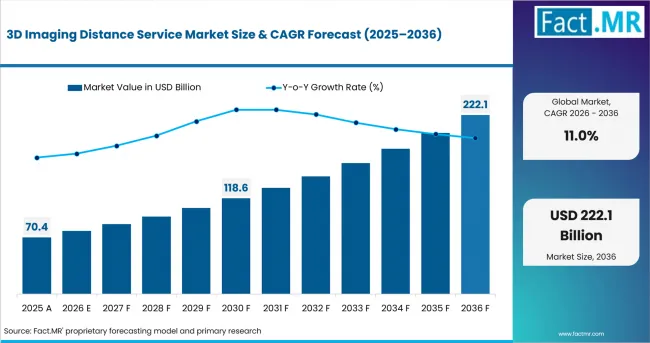
3d Imaging Distance Service Market Value Analysis | Source: Fact.MR
Summary of 3D Imaging Distance Service Market
- Demand Drivers
- Infrastructure Digitization: Asset owners are investing more in digital documentation programs. Accurate spatial data improves project planning. Infrastructure managers are building digital records to track assets and improve maintenance visibility.
- Industrial Inspection Requirements: Manufacturing facilities are using more precision measurement services. Quality control needs support service demand. Production sites require accurate dimensional checks for equipment and components.
- Digital Twin Development: Organizations are expanding virtual asset management initiatives. Spatial intelligence requirements support market expansion. Digital twin platforms require detailed three-dimensional data to replicate physical assets accurately.
- Key Segments Analyzed
- By Service Type: 3D Imaging Measurement Services account for 31.0% share in 2026 due to widespread use across industrial measurement projects.
- By Technology: Laser Scanning registers 34.0% share in 2026 supported by high accuracy and operational efficiency.
- By Deployment Mode: On-site Services capture 52.0% share in 2026 attributable to field-based measurement requirements.
- By End-use Industry: Construction & Infrastructure holds 27.0% share in 2026 due to project planning and asset documentation demand.
- By Application: Site Surveying & Mapping accounts for 29.0% share in 2026 supported by increasing infrastructure development activity.
- By Geography: India is projected to record CAGR at 13.2% through 2036 supported by infrastructure modernization programs.
- Analyst Opinion at Fact.MR
- Shambhu Nath Jha, Principal Consultant at Fact.MR, opines, "Organizations are using high-accuracy spatial intelligence services to improve project planning and asset visibility. Precision measurement capability and data quality will guide future service demand."
- Strategic Implications
- Service providers should expand high-accuracy measurement capability across infrastructure and industrial projects. Technical differentiation improves commercial positioning.
- Engineering consultants should strengthen digital twin integration services to meet rising spatial data needs. Value-added analytics improve project engagement.
- Infrastructure operators should connect imaging services with asset management systems. Better data quality improves operational decision making.
The market is projected to create nearly USD 143.9 billion in additional revenue between 2026 and 2036. Growth is linked to wider use of digital measurement technologies across infrastructure and industrial operations. High equipment costs and the need for skilled personnel may limit adoption. Demand is supported by rising investment in digital asset documentation and precision measurement services.
India records the leading CAGR at 13.2% from 2026 to 2036 due to infrastructure digitization initiatives. China follows at 12.8% CAGR by 2036 supported by industrial modernization programs. Saudi Arabia is projected to expand at 12.4% CAGR through 2036 due to large construction developments. The United States is forecast to grow at 11.1% CAGR by 2036 supported by digital twin deployment activity. Germany is estimated to witness 10.6% CAGR from 2026 to 2036 due to industrial measurement requirements.
How does the 3D imaging distance service market break down by segment?
3D Imaging Distance Service Market Analysis by Service Type
3D Imaging Measurement Services are estimated to account for 31.0% share in 2026. The segment leads the market as precise distance checks are important across industrial facilities and infrastructure projects. FARO Technologies, Inc. launched the FARO Blink reality capture platform. It combines imaging laser scanning with automated workflows and makes 3D spatial data collection easier across construction and engineering projects.
- Infrastructure Assessment Activity: Engineering firms are using more precision measurement services across transportation and utility projects. Accurate data improves project execution.
- Industrial Quality Verification: Manufacturers need more dimensional checks across production environments. Precision standards support service demand.
- Asset Documentation Needs: Facility operators are digitizing physical assets through advanced measurement services. Digital records improve maintenance planning.
3D Imaging Distance Service Market Analysis by Technology
Laser Scanning is projected to register 34.0% share in 2026. The segment leads because it delivers high accuracy across large environments and complex structures. Fast data collection improves field project efficiency. Topcon Positioning Systems announced new construction technology solutions for Bauma 2025, including Capture Reality systems and laser scanning technologies. These systems support large-scale infrastructure measurement and site documentation projects.
- High-Speed Data Capture: Service providers are using more advanced laser scanning systems across industrial projects. Faster collection improves productivity.
- Accuracy Requirements: Infrastructure projects need detailed spatial information for planning and maintenance. Measurement precision supports adoption.
- Complex Site Mapping: Large facilities need detailed spatial models across wide operating areas. Scanning capability improves project outcomes.
3D Imaging Distance Service Market Analysis by Deployment Mode
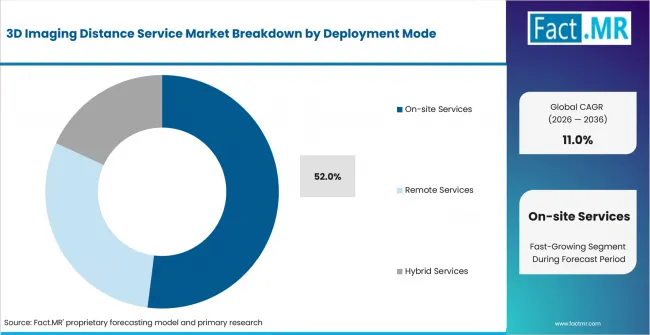
3d Imaging Distance Service Market Analysis By Deployment Mode | Source: Fact.MR
On-site Services capture 52.0% share in 2026. Most imaging and measurement projects need direct access to physical assets and operating sites. Field deployment is needed for accurate spatial data collection. Develon expanded deployment of the Leica MC1 3D machine control platform across next-generation excavators. This strengthens digital construction measurement and site positioning capability.
- Project Site Access: Infrastructure assessments need direct measurement across construction and utility locations. Physical presence improves data quality.
- Industrial Inspection Activity: Manufacturing facilities need on-site measurement and verification services. Operational requirements support segment demand.
- Surveying Requirements: Land development projects rely on field-based spatial data collection. Site access is a core service requirement.
3D Imaging Distance Service Market Analysis by End-use Industry
Construction & Infrastructure hold 27.0% share in 2026. The segment reflects rising demand for site planning, asset documentation, and project monitoring services. Infrastructure modernization programs increase need for accurate spatial intelligence. Hexagon acquired the Geomagic software portfolio from 3D Systems. The acquisition strengthens Hexagon’s capabilities in 3D scanner processing, reverse engineering, inspection, and digital model generation, expanding service offerings for industrial 3D imaging and measurement applications.
- Infrastructure Development: Public and private construction projects need detailed measurement services. Planning accuracy improves project efficiency.
- Asset Lifecycle Management: Infrastructure owners are using digital documentation across operating assets. Better records improve maintenance planning.
- Site Planning Activity: Project engineers need detailed spatial information before execution. Measurement services support better decisions.
3D Imaging Distance Service Market Analysis by Application
Site Surveying & Mapping is projected to account for 29.0% share in 2026. The segment leads demand as infrastructure development and land assessment need accurate geographic information. Survey outputs support planning and compliance needs.
- Land Development Projects: Surveying is essential across commercial and public infrastructure developments. Spatial accuracy supports approvals.
- Utility Network Planning: Operators need mapping services before expansion projects begin. Detailed site information improves execution.
- Geographic Documentation: Organizations are using digital mapping for asset management programs. Better visibility improves operational planning.
What is accelerating 3D imaging distance service adoption, and what is holding it back?
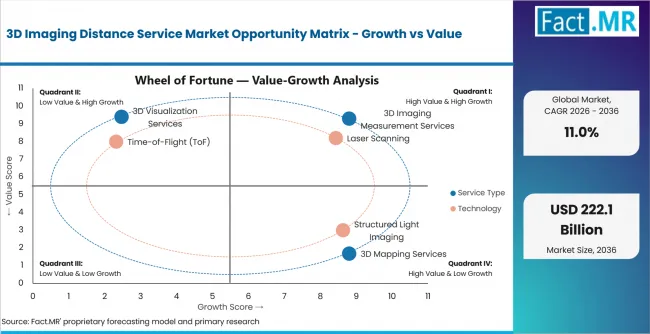
3d Imaging Distance Service Market Opportunity Matrix Growth Vs Value | Source: Fact.MR
Fact.MR analysts observe that infrastructure digitization is increasing demand for high-accuracy spatial intelligence services. Asset owners are moving toward digital documentation and virtual asset management. Reliable measurement data improves planning quality and operational visibility. Bentley Systems acquired Cesium to strengthen its digital twin and 3D geospatial services. Cesium’s 3D Tiles platform and cloud-based geospatial technology support large-scale 3D visualization and infrastructure imaging projects.
- Infrastructure Digitization Programs: Public agencies and private operators are investing more in digital asset records. Modernization initiatives create service demand.
- Industrial Automation Growth: Manufacturing companies need accurate measurement data across production environments. Precision requirements support market expansion.
- Equipment Cost Constraints: Advanced imaging systems require high capital spending. Cost concerns limit adoption across smaller organizations.
Which countries are scaling 3D imaging distance service demand fastest?
The 3D imaging distance service market is assessed across North America, Europe, Asia Pacific, Latin America, and the Middle East & Africa by service type, technology, deployment mode, end-use industry, and application. The full report offers market analysis by region and country.
| Country | CAGR (2026 to 2036) |
|---|---|
| India | 13.2% |
| China | 12.8% |
| Saudi Arabia | 12.4% |
| United States | 11.1% |
| Germany | 10.6% |
Source: Fact.MR analysis. Updated Jun 10, 2026
Source: Fact.MR analysis, based on proprietary forecasting model and primary research.
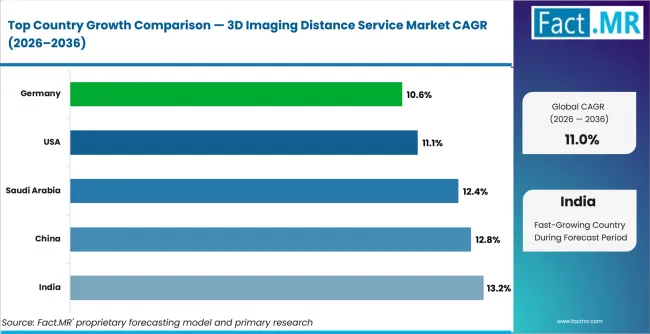
3d Imaging Distance Service Market Cagr Analysis By Country | Source: Fact.MR
Asia Pacific 3D Imaging Distance Service Market Analysis
Asia Pacific records faster growth due to rising infrastructure development and industrial digitization. Organizations are using advanced measurement services to improve project planning and operational efficiency. Large construction programs create strong demand for spatial intelligence solutions.
- India: India is projected to expand at 13.2% CAGR through 2036 as transportation corridors and smart city projects increase demand for accurate surveying services. Utility modernization adds another source of demand. Infrastructure planning needs are strengthening adoption of advanced measurement technologies. Digital asset documentation is rising across public projects.
- China: China records 12.8% CAGR from 2026 to 2036 due to industrial modernization programs and large infrastructure investments. Manufacturing facilities are using more precision measurement services to improve operational planning. Demand is rising across industrial parks and infrastructure projects.
North America 3D Imaging Distance Service Market Analysis
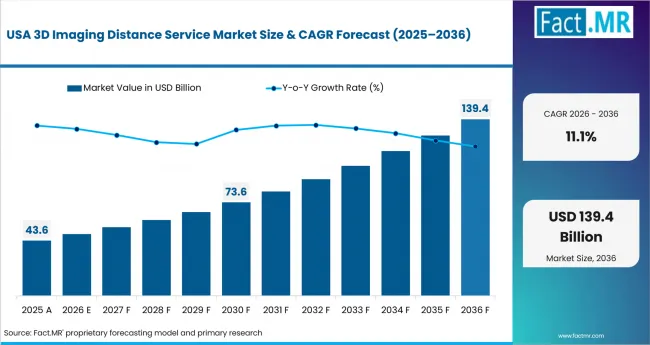
3d Imaging Distance Service Market Country Value Analysis | Source: Fact.MR
North America benefits from digital twin adoption and rising investment in infrastructure assessment programs. Asset owners are using advanced imaging services to improve planning accuracy and maintenance efficiency. Spatial data integration supports long-term asset management.
- United States: The United States is forecast to grow at 11.1% CAGR by 2036 due to digital twin deployment and infrastructure modernization initiatives. Engineering firms are using advanced imaging services across transportation and industrial projects. Asset documentation needs support continued market expansion.
Europe 3D Imaging Distance Service Market Analysis
Europe is supported by industrial engineering needs and rising investment in digital asset management systems. Organizations are adding advanced measurement services to maintenance planning and operating workflows. Precision engineering needs strengthen market demand.
- Germany: Germany is estimated to witness 10.6% CAGR through 2036 due to strong manufacturing activity and wider use of precision measurement technologies. Industrial operators are expanding digital documentation programs across production facilities. Engineering quality standards support adoption of advanced imaging services.
Middle East & Africa 3D Imaging Distance Service Market Analysis
Large infrastructure projects and urban development programs are increasing demand for advanced surveying services across the region. Asset owners are adopting digital planning tools to improve project execution and operational visibility.
- Saudi Arabia: Saudi Arabia is projected to register 12.4% CAGR by 2036 as major urban development projects require extensive surveying and spatial documentation services. Construction activity is creating strong demand for accurate measurement solutions. Large-scale infrastructure programs support market expansion.
Who leads the 3D imaging distance service market landscape?
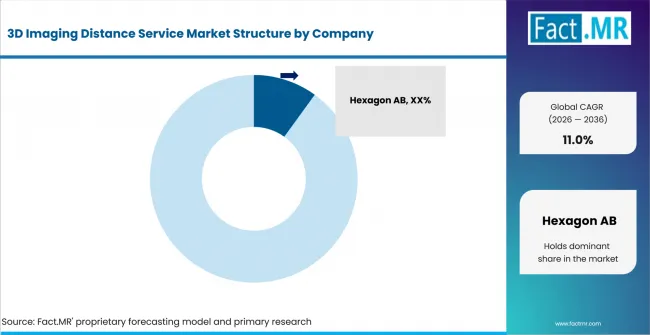
3d Imaging Distance Service Market Analysis By Company | Source: Fact.MR
The market is moderately concentrated among surveying specialists and digital engineering firms. Accuracy, project turnaround time, and data quality influence competitive positioning across infrastructure and industrial applications. Companies with advanced imaging capability gain better acceptance in large-scale projects.
Infrastructure owners prefer service providers that combine measurement services with digital asset management. Integrated reporting improves project planning and asset documentation quality. Technology capability strengthens differentiation across engineering contracts.
Service providers are investing in automation and cloud-based data processing. Companies with established project portfolios have better access across infrastructure and industrial sectors. Technical expertise improves execution across complex measurement assignments.
Engineering consultants are adding spatial intelligence services to project planning work. Digital documentation and virtual asset development improve customer engagement. Data integration capability strengthens long-term client relationships.
Technology providers are developing advanced scanning systems and imaging solutions. Higher accuracy and faster data collection improve project efficiency. Product innovation supports adoption across construction, manufacturing, and utility environments.
Which companies are the key players?
- Hexagon AB
- FARO Technologies, Inc.
- Trimble Inc.
- Topcon Corporation
Bibliography
- FARO Technologies, Inc. (2025, April 15). FARO® Technologies introduces Blink: Reality capture reimagined.
- Topcon Positioning Systems. (2025, March 20). Topcon to showcase new construction technology solutions at Bauma 2025 in Munich.
- Leica Geosystems. (2025, October 30). Develon and Leica Geosystems expand 3D machine control availability to all 9 Series Crawler Excavators.
- Hexagon AB. (2024, December 12). Hexagon acquires inspection and 3D modelling software capabilities from 3D Systems.
- Bentley Systems, Incorporated. (2024, September 6). Bentley Systems acquires 3D geospatial company Cesium.
This Report Addresses
- Analysis of 3D imaging distance service demand across infrastructure, industrial inspection, surveying, and digital documentation applications.
- Opportunity assessment across engineering firms, infrastructure operators, industrial facilities, and asset management organizations.
- Segment analysis covering service type, technology, deployment mode, application, and end-use industry forecasts.
- Regional assessment across India, China, Saudi Arabia, the United States, and Germany.
- Competitive analysis of Hexagon, FARO, Trimble, and Topcon.
- Technology assessment covering laser scanning, photogrammetry, structured light imaging, and spatial intelligence solutions.
- Report delivery through PDF and Excel formats supported by primary interviews and project activity analysis.
What does the 3D imaging distance service market cover?
The 3D imaging distance service market covers professional services that use advanced imaging systems to measure distance, dimensions, and spatial relationships across physical environments. These services combine laser scanning, photogrammetry, structured light systems, and related technologies to generate accurate three-dimensional representations of assets and locations. Organizations use these services for infrastructure planning, industrial inspection, site surveying, facility management, quality verification, and digital documentation.
3D Imaging Distance Service Market Inclusions
The study covers global and regional forecasts from 2026 to 2036 by service type, technology, deployment mode, end-use industry, and application. The report includes measurement services, mapping projects, inspection activities, reconstruction services, visualization solutions, spatial data analysis, and digital asset documentation services across major geographic markets.
3D Imaging Distance Service Market Exclusions
The study excludes consumer photography services, entertainment visualization projects, military surveillance systems, and conventional two-dimensional surveying activities. Hardware sales are excluded unless directly associated with service delivery. The scope excludes software licensing revenue that is not linked to professional 3D imaging distance service engagements.
3D Imaging Distance Service Market Research Methodology
- Primary Research
- Interviews were conducted with surveying specialists, infrastructure consultants, imaging service providers, industrial engineers, and spatial data management professionals across major regional markets.
- Desk Research
- Analysis included company disclosures, infrastructure digitization announcements, engineering service publications, government infrastructure reports, and technology developments released during 2024 and 2025.
- Market-Sizing and Forecasting
- A hybrid forecasting model combined top-down infrastructure expenditure assessment with bottom-up estimates based on project volumes and service pricing benchmarks.
- Data Validation and Update Cycle
- Forecast outputs were validated through industry interviews, company disclosures, project tracking databases, and annual service activity reviews.
Segmentation
What is the report’s scope and coverage?
| Attribute | Details |
|---|---|
| Quantitative Units |
USD Billion in 2026 to USD Billion by 2036 at CAGR |
| Market Definition | Professional services using advanced imaging systems for distance measurement and spatial data collection |
| Service Type Segmentation | 3D Imaging Measurement Services, 3D Mapping Services, 3D Inspection Services, 3D Modeling & Reconstruction Services, 3D Visualization Services |
| Technology Segmentation | Laser Scanning, Structured Light Imaging, Time-of-Flight, Photogrammetry, Stereo Vision |
| Deployment Mode Segmentation | On-site Services, Remote Services, Hybrid Services |
| End-use Industry Segmentation | Construction & Infrastructure, Manufacturing, Healthcare, Automotive, Aerospace & Defense, Energy & Utilities, Others |
| Application Segmentation | Distance Measurement, Quality Inspection, Reverse Engineering, Asset Documentation, Site Surveying & Mapping, Others |
| Regions Covered | North America, Europe, Asia Pacific, Latin America, Middle East & Africa |
| Countries Covered | United States, Canada, Mexico, Germany, United Kingdom, France, China, Japan, India, Saudi Arabia |
| Key Companies Profiled | Hexagon AB, FARO Technologies, Inc., Trimble Inc., Topcon Corporation |
| Forecast Period | 2026 to 2036 |
| Approach | Hybrid top-down and bottom-up model using project activity analysis, service pricing benchmarks, and primary interviews. |
Source: Fact.MR analysis. Updated Jun 10, 2026
How is the market segmented?
-
By Service Type
- 3D Imaging Measurement Services
- 3D Mapping Services
- 3D Inspection Services
- 3D Modeling & Reconstruction Services
- 3D Visualization Services
-
By Technology
- Laser Scanning
- Structured Light Imaging
- Time-of-Flight (ToF)
- Photogrammetry
- Stereo Vision
-
By Deployment Mode
- On-site Services
- Remote Services
- Hybrid Services
-
By End-use Industry
- Construction & Infrastructure
- Manufacturing
- Healthcare
- Automotive
- Aerospace & Defense
- Energy & Utilities
-
By Application
- Distance Measurement
- Quality Inspection
- Reverse Engineering
- Asset Documentation
- Site Surveying & Mapping
-
By Region
- North America
- United States
- Canada
- Latin America
- Brazil
- Mexico
- Argentina
- Rest of Latin America
- Europe
- Germany
- United Kingdom
- France
- Italy
- Spain
- Rest of Europe
- Asia Pacific
- China
- Japan
- India
- ASEAN
- Australia and New Zealand
- Middle East & Africa
- Saudi Arabia
- UAE
- South Africa
- Rest of Middle East & Africa
- North America
Frequently Asked Questions
Which technology segment is poised to lead market demand?
Which end-use industry holds the leading share in the market?
Which country records the leading CAGR in the market?
Which application leads the 3D imaging distance service market?
Who are the key companies in the 3D imaging distance service market?
Who worked on this report


Preview the report firsthand - request a free sample
Free SampleGet the brochure for pricing and purchase details
Download PDF