- Market Value (2025): USD 4.66 Bn
- Estimated Value (2026): USD 5.13 Bn
- Forecast Value (2036): USD 13.4 Bn
- CAGR (2026-2036): 10.1%
What is the 3D-Enabled Smartphones Market forecast to be worth by 2036?
USD 5.13 billion in 2026 to USD 13.4 billion by 2036 at a 10.1% CAGR.
- The market reached an estimated USD 4.66 billion in 2025.
- Sales are projected to reach from USD 5.13 billion in 2026 to USD 13.4 billion by 2036 as more handset applications handle depth-based pictures and interactive scenes.
- A 10.1% CAGR from 2026 to 2036 reflects a forecast for specialized devices and features, rather than every smartphone with multiple cameras.
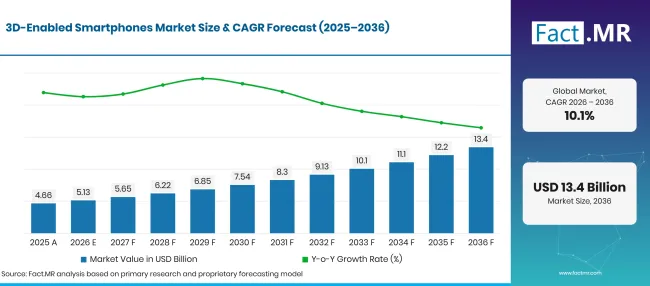
3D Enabled Smartphones Market Forecast Global | Source: Fact.MR
| Year | Basis | Market Value (USD billion) |
| 2025 | Actual | 4.63 |
| 2026 | Estimate | 5.13 |
| 2036 | Forecast | 13.4 |
| CAGR 2026 to 2036 | Forecast period | 10.1% |
Source: Fact.MR analysis. Updated Oct 27, 2026
What are the defining numbers behind 3D-Enabled Smartphones Market growth?
USD 8.3 billion absolute opportunity through 2036, with glasses-free display convenience and repeatable 3D game content shaping product choice.
- Demand Drivers in the Market
- mobile gamers value visible depth when the display and game content are designed for the same viewing experience. Real-time rendering quality and battery life still determine whether the feature suits everyday play.
- Application developers need a stable display and software specification before they invest in special 3D layouts. Without compatible titles, a depth-capable handset competes largely on conventional phone specifications.
- online retail allows customers to compare camera specifications and software support, although a glasses-free effect is difficult to judge from a flat product photograph. Hands-on demonstrations remain useful for convincing shoppers.
- Key Segments Analyzed
- By Technology: Autostereoscopic devices account for 58.7% of 2026 sales, supported by the appeal of depth viewing without dedicated glasses.
- By Operating System: Android is assigned 62.4% of 2026 sales, reflecting the scope for differentiated handset designs across hardware brands.
- By Application: Gaming accounts for 38.2% of 2026 value, since moving scenes allow viewers to notice depth cues more readily.
- By Distribution Channel: Online Stores contribute 65.3% of 2026 sales, as digital storefronts make niche handset configurations easier to find.
- Analyst Opinion at Fact.MR
- Shambhu Nath Jha, Principal Consultant at Fact.MR, states, “The commercial difference lies in content readiness per installed device, rather than in screen specifications alone. Handset brands have to align the display with games that consumers regularly use. A screen premium is easier to explain when customers experience a repeatable benefit during everyday play. This creates a useful comparison between spending on display components and spending on compatible software.”
- Strategic Implications
- display component makers should explain viewing angles and power consumption in terms that handset design teams can evaluate.
- Game developers should decide which depth effects improve gameplay before committing resources to device-specific software.
- Phone brands should keep 3D content compatible with familiar camera workflows and reliable everyday operation.
- Retailers should use clear demonstrations and accurate product labels so shoppers can distinguish 3D capture from 3D display.
Among the five profiled countries, the United States is forecast at 12.6% CAGR through 2036. The United Kingdom follows at 11.0%, Germany at 10.0%, Brazil at 9.7%, and Japan at 8.0%.
How does the 3D-Enabled Smartphones Market break down by segment?
Autostereoscopic technology: 58.7%; Android: 62.4%; Gaming: 38.2%; Online Stores: 65.3%.
Which Technology segment leads?
Autostereoscopic accounts for 58.7% of 2026 value.
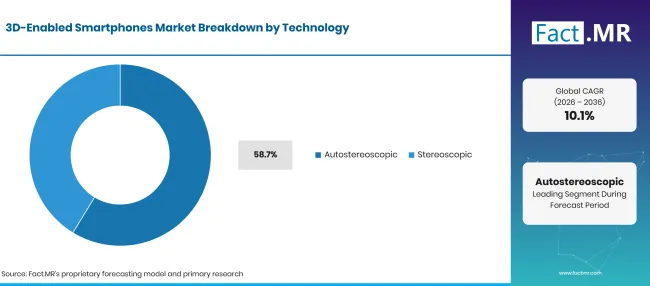
3D Enabled Smartphones Market Breakdown Technology | Source: Fact.MR
| Technology | Share (2026) |
|---|---|
| Autostereoscopic (Leading segment) | 58.7% |
| Other segments combined | 41.3% |
| Total | 100.0% |
Source: Fact.MR analysis. Updated Oct 27, 2026
Autostereoscopic viewing sends different images toward the viewer’s eyes without requiring separate glasses. Its convenience makes it relevant to phones used in short sessions throughout the day. The screen still needs careful image alignment, a useful viewing zone and software prepared for depth output. Stereoscopic formats remain relevant when accessories or paired-display setups are acceptable.
Which Operating System segment leads?
Android accounts for 62.4% of 2026 value.
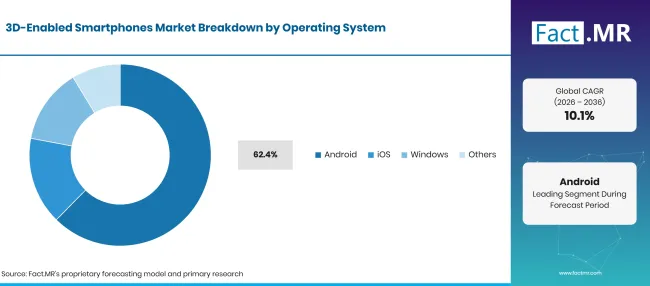
3D Enabled Smartphones Market Breakdown Operating System | Source: Fact.MR
| Operating System | Share (2026) |
|---|---|
| Android (Leading segment) | 62.4% |
| Other segments combined | 37.6% |
| Total | 100.0% |
Source: Fact.MR analysis. Updated Oct 27, 2026
Android gives manufacturers room to work with display suppliers on different hardware designs and user interfaces. The challenge is maintaining application support when competing phones use different methods to show depth. Apple’s iOS ecosystem supports spatial media capture and viewing, although that capability alone does not make an iPhone a glasses-free 3D display device.
Which Application segment leads?
Gaming accounts for 38.2% of 2026 value.
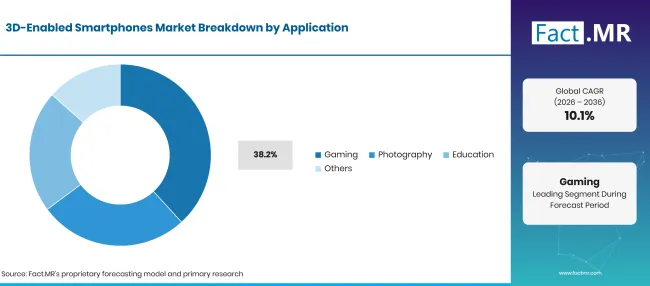
3D Enabled Smartphones Market Breakdown Application | Source: Fact.MR
| Application | Share (2026) |
|---|---|
| Gaming (Leading segment) | 38.2% |
| Other segments combined | 61.8% |
| Total | 100.0% |
Source: Fact.MR analysis. Updated Oct 27, 2026
Gaming provide moving objects and scene depth that can make a 3D screen visibly different from a flat phone. Successful adoption still depends on frame rates, battery draw and developer support. Photography adds a second use case because images can store information for later depth-based viewing. Education applications could use interactive visual models when suitable lessons are available.
Which Distribution Channel segment leads?
Online Stores accounts for 65.3% of 2026 value.
| Distribution Channel | Share (2026) |
|---|---|
| Online Stores (Leading segment) | 65.3% |
| Other segments combined | 34.7% |
| Total | 100.0% |
Source: Fact.MR analysis. Updated Oct 27, 2026
Online stores reach enthusiasts who actively search for unusual handset features. Detailed specification pages help explain supported formats, display modes and companion applications. The same channels let small product ranges reach customers without extensive physical retail distribution. Offline stores still have a special role because consumers can inspect the visible depth effect in person. In 2025, Eurostat found that 78% of EU internet users bought or ordered goods or services online [2]. This measures general online shopping, not 3D handset purchases.
What is accelerating 3D-Enabled Smartphones Market adoption, and what is holding it back?
Depth-based games and media support interest; content compatibility and display costs constrain wider adoption.
Drivers Impact Analysis
| DRIVER | (~) % IMPACT ON CAGR | GEOGRAPHIC RELEVANCE | IMPACT TIMELINE |
|---|---|---|---|
| Dedicated 3D gaming experiences | +1.4% | North America; East Asia | Medium term |
| Depth-based camera content | +1.1% | Global | Medium term |
| Glasses-free screen convenience | +0.9% | Global | Long term |
| Online specialist retail | +0.6% | Europe; North America | Short term |
| Developer tools and content access | +0.4% | Global | Long term |
Source: Fact.MR analysis. Updated Oct 27, 2026
Opportunity Impact Analysis
| OPPORTUNITY | (~) % IMPACT ON CAGR | GEOGRAPHIC RELEVANCE | IMPACT TIMELINE |
|---|---|---|---|
| Mobile-first stereoscopic games | +0.8% | Global | Medium term |
| Consumer spatial photography | +0.6% | North America; Europe | Medium term |
| Interactive visual learning | +0.4% | Asia; Europe | Long term |
Source: Fact.MR analysis. Updated Oct 27, 2026
Restraints Impact Analysis
| RESTRAINT | (~) % IMPACT ON CAGR | GEOGRAPHIC RELEVANCE | IMPACT TIMELINE |
|---|---|---|---|
| Limited native 3D content | -0.9% | Global | Short term |
| Screen cost and power demand | -0.7% | Global | Medium term |
| Viewing comfort and angles | -0.5% | Global | Long term |
Source: Fact.MR analysis. Updated Oct 27, 2026
Which countries are scaling the 3D-Enabled Smartphones Market through 2036?
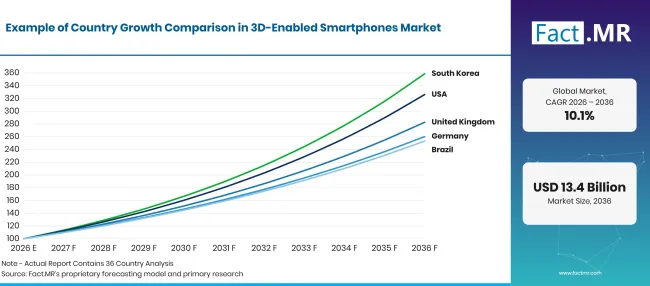
3D Enabled Smartphones Market Growth Index | Source: Fact.MR
| Country | CAGR (2026 to 2036) |
|---|---|
| United States | 12.6% |
| United Kingdom | 11.0% |
| Germany | 10.0% |
| Brazil | 9.7% |
| Japan | 8.0% |
Source: Fact.MR analysis. Updated Oct 27, 2026
What supports the United States adoption?
12.6% CAGR, linked to specialist gaming and spatial-media production.
Apple introduced spatial-photo and spatial-video recording with iPhone 17 in September 2025 [1], creating more content that consumers can experience on compatible immersive devices. Pew Research Center reported in October 2026 that 91% of U.S. adults owned a smartphone [3], demonstrating the scale of the conventional handset base for potential upgrades.
What supports the United Kingdom adoption?
11.0% CAGR, shaped by mobile screen time and platform selection.
Britain’s smartphone users spend much of their online time on handheld devices, creating an established context for testing specialist screens. Ofcom reported in December 2025 that adults spent an average of four and a half hours online per day [4]. The regulator’s 2025 technology tracking found that 54% of UK smartphone users relied mainly on Apple iPhones [4], while Android remains another platform for handset differentiation.
What supports Germany adoption?
10.0% CAGR, connected to online research and handset specifications.
German consumers frequently compare technology specifications before placing orders, making credible product information central to specialist handset sales. Autostereoscopic phone brands could use clear viewing-angle demonstrations to support selection, while familiar Android software could make specialist devices easier to assess against ordinary alternatives.
What supports Brazil adoption?
9.7% CAGR, connected to mobile coverage and digital retail reach.
Brazil’s mobile connectivity network provides the main access route for digital games and downloadable media on smartphones. Android-based designs could give device makers room to offer different specifications, while online listings can explain depth-display features to shoppers across geographically dispersed retail markets.
What supports Japan adoption?
8.0% CAGR, shaped by game-content economics and display quality.
Japanese handset customers encounter depth technology through gaming culture and electronics demonstrations, creating room for targeted glasses-free display models. The Ministry of Economy, Trade and Industry reported in August 2025 that online games accounted for JPY 1.2553 trillion of Japan’s digital consumer e-commerce during 2024 [5]. The same ministry recorded JPY 26.1 trillion in consumer e-commerce in 2024 [5], which gives specialist makers an established online purchasing channel.
Who leads the 3D-Enabled Smartphones Market?
Competition requires a distinction between active smartphone brands and companies with a confirmed 3D-display handset.
Samsung Electronics, Apple participates in the broader smartphone ecosystem. Apple’s spatial-camera functions are relevant to depth content but do not represent a glasses-free 3D iPhone. A direct display claim should be tied to a named model and official technical specification. Display design, content support and practical battery performance differentiate propositions more clearly than brand size alone.
Which companies are the key providers?
Key companies include Apple Inc.; Samsung Electronics Co., Ltd.; Huawei Technologies Co., Ltd.; HONOR Device Co., Ltd.; and ZTE Corporation.
- Apple Inc.
- Samsung Electronics Co., Ltd.
- Huawei Technologies Co., Ltd.
- HONOR Device Co., Ltd.
- ZTE Corporation
This Report Answers
- The report compares autostereoscopic and stereoscopic viewing approaches and the product requirements associated with each.
- Operating-system analysis examines compatibility issues across Android, iOS and other handset platforms.
- Application coverage assesses gaming, photography and education as distinct reasons to use depth-enabled devices.
- Distribution analysis compares online product discovery with physical demonstrations of 3D display quality.
- Country analysis reviews projected growth in the United States, the United Kingdom, Germany, Brazil and Japan.
Bibliography
- [1] Apple. (2025, September 9). Apple debuts iPhone 17. Apple Newsroom
- [2] Eurostat. (2026, April 23). Digitalisation in Europe – 2026 edition. Eurostat publication
- [3] Pew Research Center. (2026, October 19). Americans’ use of mobile devices in 2026. Pew Research Center
- [4] Ofcom. (2025). Online Nation – 2025 report. Ofcom Online Nation
- [5] Ministry of Economy, Trade and Industry. (2025, August 26). Results of FY2024 E-Commerce Market Survey Compiled. METI source
What does the 3D-Enabled Smartphones Market cover?
The market covers smartphones marketed around stereoscopic or glasses-free depth presentation. Revenue is allocated by the device’s classified technology, operating system, intended application and sales channel. Depth imaging is discussed where it supports the 3D smartphone experience.
What is included in the scope?
Autostereoscopic and stereoscopic handset configurations are included within the defined category. Devices can be distributed online or through physical retailers. Gaming, photography and education remain the application groups used for the assessment.
What is excluded from the scope?
Ordinary smartphones with dual cameras or portrait blur alone are outside the product boundary. Headsets and standalone 3D monitors are excluded, even when they can display pictures recorded on a phone. General mobile service revenue is also excluded.
How Was the Analysis Built?
The analysis draws on 120+ sources, 35+ company portfolios, 25+ countries, and more than 20 industry interviews.
- Primary Research: Primary research includes discussions with manufacturers, service providers, technology developers, distributors, end users, and subject-matter experts. These conversations examine purchasing priorities, product adoption, operational challenges, approval requirements, competitive positioning, and the factors that influence wider market acceptance.
- Desk Research: Desk research covers government statistics, regulatory publications, company filings, trade data, technical studies, industry associations, standards, public policy, and other authoritative sources. Every source used in the analysis is documented in the bibliography.
- Market Sizing and Forecasting: Market estimates combine historical performance, demand indicators, pricing and volume trends, segment shares, company participation, country-level growth, adoption patterns, investment activity, and barriers to market expansion.
- Data Validation and Update Cycle: Findings are validated by comparing primary interviews with public data, company activity, regulatory changes, trade patterns, and industry developments. Regular updates review new product launches, capacity changes, partnerships, approvals, and shifts in commercial adoption.
Segmentation
What is the report’s scope and coverage?
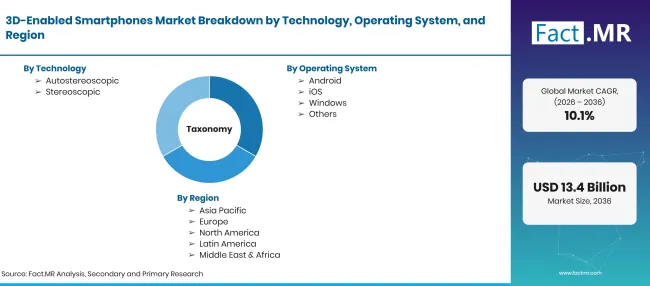
3D Enabled Smartphones Market Taxonomy 1 | Source: Fact.MR
| Attribute | Details |
|---|---|
| Quantitative units | USD billion |
| Market definition | Smartphones whose marketed functionality includes stereoscopic or autostereoscopic 3D display and associated depth-based user experiences. |
| Technology | Autostereoscopic; Stereoscopic |
| Operating system | Android; iOS; Windows; Others |
| Application | Gaming; Photography; Education; Others |
| Distribution channel | Online Stores; Offline Stores |
| Regions covered | North America; Latin America; Western Europe; Eastern Europe; East Asia; South Asia & Pacific; Middle East & Africa |
| Countries Covered | Germany; Japan; United Kingdom; United States; Brazil |
| Companies profiled | Apple Inc.; Samsung Electronics Co., Ltd.; Huawei Technologies Co., Ltd.; HONOR Device Co., Ltd.; and ZTE Corporation |
| Forecast period | 2026 to 2036 |
| Approach | Category-boundary review; application suitability; handset specification review; channel analysis; country context |
Source: Fact.MR analysis. Updated Oct 27, 2026
How is the market segmented?
-
By Technology
- Autostereoscopic
- Stereoscopic
-
By Operating System
- Android
- iOS
- Windows
- Others
-
By Application
- Gaming
- Photography
- Education
- Others
-
By Distribution Channel
- Online Stores
- Offline Stores
-
By Region
- North America
- Latin America
- Western Europe
- Eastern Europe
- East Asia
- South Asia & Pacific
- Middle East & Africa
Frequently Asked Questions
How big is the 3D-Enabled Smartphones Market in 2026?
What is the CAGR of the 3D-Enabled Smartphones Market from 2026 to 2036?
Which technology leads the 3D-Enabled Smartphones Market?
Which operating system leads the 3D-Enabled Smartphones Market?
Who are the leading companies in the 3D-Enabled Smartphones Market?
Who worked on this report


Preview the report firsthand - request a free sample
Free SampleGet the brochure for pricing and purchase details
Download PDF