- Market Value (2025): USD 38.6 Bn
- Estimated Value (2026): USD 46.8 Bn
- Forecast Value (2036): USD 317.5 Bn
- CAGR (2026-2036): 21.1%
What is the Generative AI Smartphone Market forecast to be worth by 2036?
USD 46.8 Billion in 2026 to USD 317.5 billion by 2036 at a 21.1% CAGR.
- The generative AI smartphone market surpassed a value of USD 38.6 billion in 2025.
- Demand is projected to increase from USD 46.8 billion in 2026 to USD 317.5 billion by 2036.
- The market is forecast to record a 21.1% CAGR from 2026 to 2036 as embedded assistants become part of device selection.
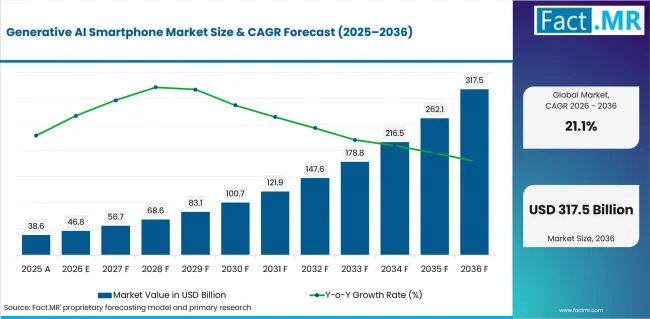
Generative Ai Smartphone Market Value Analysis | Source: Fact.MR
What are the defining numbers behind Generative AI Smartphone Market growth?
USD 270.7 billion absolute opportunity by 2036.
- Demand Drivers in the Market
- Embedded AI utilities are expected to make handset replacement easier to justify when buyers can test writing support and camera help in-store.
- On-device processing is anticipated to reduce hesitation for personal tasks where users do not want every prompt handled away from the phone.
- Premium models are likely to adopt first since stronger processors and memory arrive earlier in flagship devices.
- Key Segments Analyzed
- By AI Capability: On-Device Generative AI is expected to hold 43.0% share in 2026 due to faster responses and better control over personal data.
- By Operating System: Android is projected to account for 71.0% share in 2026 since several handset makers can add their own AI tools over a shared app base.
- By Application: AI Assistant & Productivity is anticipated to capture 31.0% share in 2026 as writing support and summarization repeat across daily use.
- Analyst Opinion at Fact.MR
- Shambhu Nath Jha, Principal Consultant at Fact.MR, states, “Revenue capture is expected to depend on durable AI use instead of feature count alone. Suppliers must show that assistants work across native applications and keep user control visible. Mid-range expansion needs efficient models and clear pricing. Enterprise conversion is expected to favor vendors that explain when data stays local.”
- Strategic Implications
- Device brands can make AI credible by showing short everyday tasks during purchase.
- Carrier and retail teams can pair AI demonstrations with plan education.
- Enterprise mobility buyers need a clean line between personal features and managed work-data use.
The USA is expected to record a 21.9% CAGR from 2026 to 2036. Japan is estimated at 20.1% and Germany is projected at 20.9%. The UK is forecast at 21.2%. Canada is anticipated to reach 21.5% with Australia at 20.6%. South Korea leads the listed group at 22.7%.
How does the Generative AI Smartphone Market break down by segment?
On-Device Generative AI is expected to lead AI Capability at 43.0% share in 2026. Android is projected to lead Operating System at 71.0% share in 2026.
Which AI Capability dominates?
On-Device Generative AI is projected to account for 43.0% share in 2026.
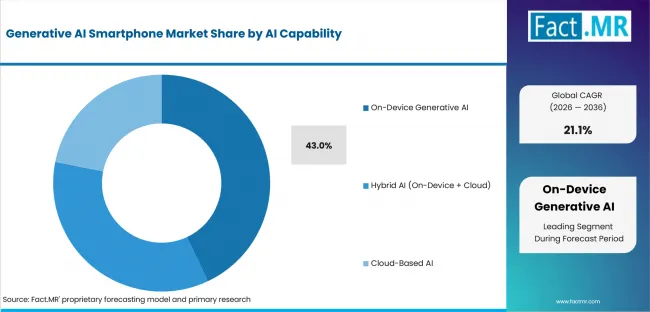
Generative Ai Smartphone Market Analysis By Ai Capability | Source: Fact.MR
Local execution gives suppliers a clear product claim through faster responses. Large Language Models remain useful when complex tasks need wider model capacity. Image Generation and Hybrid AI extend the use case base.
What leads the Operating System segment?
Android is expected to hold 71.0% share in 2026.
Android leads through its wide handset base and OEM flexibility. Samsung One UI and HyperOS can add camera and translation tools over the same application base. iOS remains important through premium users.
How does Application shape demand?
AI Assistant & Productivity is anticipated to lead with 31.0% share in 2026.
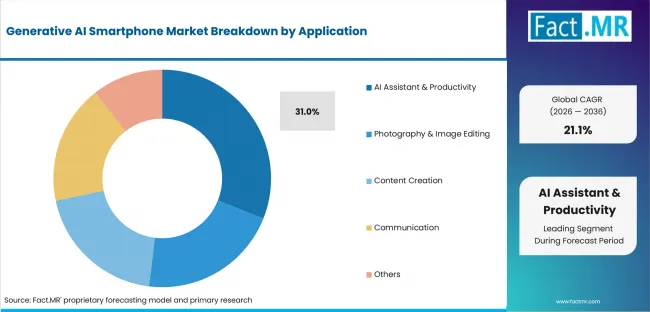
Generative Ai Smartphone Market Analysis By Application | Source: Fact.MR
Writing support and summarization recur across daily phone use. Camera and image editing tools make AI visible during retail trials. Live Translation can strengthen repeat use when language quality feels dependable.
What is accelerating Generative AI Smartphone Market adoption, and what is holding it back?
Demand is expected to rise through useful built-in AI features and stronger handset differentiation. Growth may be limited by trust concerns and hardware constraints.
Drivers Impact Analysis
| DRIVER | (~) % IMPACT ON CAGR | GEOGRAPHIC RELEVANCE | IMPACT TIMELINE |
|---|---|---|---|
| Embedded AI utilities | +4.8% | USA, South Korea, UK | Short term (<= 2 years) |
| On-device privacy positioning | +3.4% | Germany, Canada, Japan | Short term (<= 2 years) |
| Premium refresh cycle | +2.9% | South Korea and USA | Medium term (2-4 years) |
| Localized assistant experience | +2.1% | Japan, Canada, Australia | Medium term (2-4 years) |
| Mid-range model efficiency | +1.7% | Global handset portfolios | Long term (>= 4 years) |
Source: Fact.MR analysis. Updated Aug 3, 2026
- Embedded AI utilities: Handset makers are expected to make assistant and editing functions part of the upgrade reason.
- On-device privacy positioning: Local processing is anticipated to reduce buyer hesitation where personal data and work data enter the same device.
- Premium refresh cycle: Flagship buyers are likely to adopt first since new chipsets and memory capacity reach premium models earlier.
Opportunity Impact Analysis
| OPPORTUNITY | (~) % IMPACT ON CAGR | GEOGRAPHIC RELEVANCE | IMPACT TIMELINE |
|---|---|---|---|
| Hybrid device-cloud architecture | +2.2% | USA and Japan | Medium term (2-4 years) |
| Enterprise managed AI controls | +1.6% | USA, UK, Germany | Medium term (2-4 years) |
| AI camera and content tools | +1.2% | South Korea and Australia | Short term (<= 2 years) |
| Carrier-led AI service bundles | +0.9% | Canada, UK, USA | Long term (>= 4 years) |
Source: Fact.MR analysis. Updated Aug 3, 2026
- Hybrid device-cloud architecture: Device makers that balance local execution with remote compute are expected to handle complex requests without weakening responsiveness.
- Enterprise managed AI controls: Work-device approval is expected to improve where administrators can restrict data sharing and review assistant use.
- AI camera and content tools: Better editing and search workflows are expected to make AI visible before buyers understand model architecture.
Restraints Impact Analysis
| RESTRAINT | (~) % IMPACT ON CAGR | GEOGRAPHIC RELEVANCE | IMPACT TIMELINE |
|---|---|---|---|
| Trust and output reliability | -2.7% | Global | Short term (<= 2 years) |
| Feature availability gaps | -1.6% | Japan, Canada, Australia | Short term (<= 2 years) |
| Battery and thermal burden | -1.3% | Mid-range devices | Medium term (2-4 years) |
| Paid cloud-service confusion | -0.8% | USA, UK, Germany | Long term (>= 4 years) |
Source: Fact.MR analysis. Updated Aug 3, 2026
- Trust and output reliability: Users are expected to slow routine adoption when summaries or generated content need manual checking.
- Feature availability gaps: Market conversion can weaken when advertised functions launch late or work only in selected languages.
- Battery and thermal burden: Device makers must control power draw since AI tasks can expose heat and endurance limits.
Which countries are scaling Generative AI Smartphone Market fastest?
South Korea leads the listed countries. Canada and the USA follow closely. The UK remains near that group. Germany and Australia form the middle range. Japan follows a quality-led route.
- South Korea records the highest listed CAGR because domestic device leadership makes embedded AI visible at flagship launch. The USA remains near the top through premium devices and enterprise mobility review.
- Canada tracks close to the USA with bilingual use and service coverage shaping support expectations. The UK benefits from competitive retail channels and workplace policy review around assistant use.
- Germany reflects privacy-led purchasing and longer software support expectations before wider AI use. Australia shows steady demand through premium replacement and practical assistant use across travel and content tasks.
- Japan remains quality-focused as buyers place high weight on localization and interface simplicity.
Comparable CAGRs can create different market entry conditions across these countries. Commercial readiness depends on model localization and device availability. Service support and privacy communication influence routine use.
The full report provides country-level CAGR analysis across North America and Latin America. It also covers Western Europe and Eastern Europe. East Asia completes one part. South Asia and Pacific plus Middle East and Africa complete the view.
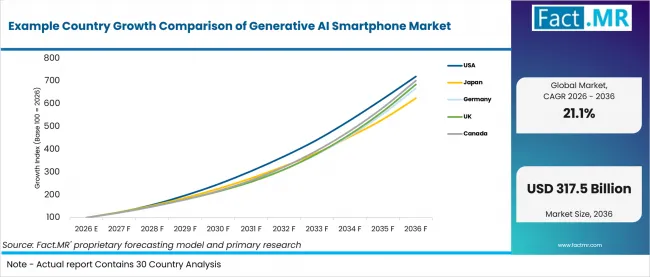
Example Country Growth Comparison Of Generative Ai Smartphone Market | Source: Fact.MR
| Country | CAGR (2026-2036) |
|---|---|
| USA | 21.9% |
| Japan | 20.1% |
| Germany | 20.9% |
| UK | 21.2% |
| Canada | 21.5% |
| Australia | 20.6% |
| South Korea | 22.7% |
Source: Fact.MR analysis. Updated Aug 3, 2026
What supports USA adoption?
21.9% CAGR, supported by premium-device depth and enterprise mobility review.
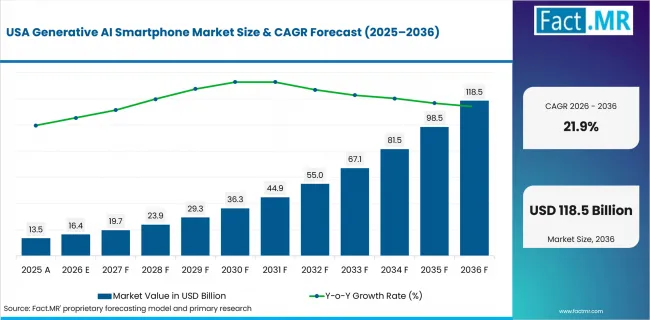
Generative Ai Smartphone Market Country Value Analysis | Source: Fact.MR
USA buyers evaluate AI smartphones through carriers and direct OEM channels. Premium users are expected to test assistant and camera features first. Enterprise teams require privacy controls before work data enters assistants.
How is Japan building demand?
20.1% CAGR, backed by localization needs and quality-focused purchasing.
Japan’s route is shaped by careful device selection and strong interface expectations. Local-language performance can decide repeat use after trial. Carrier support remains central to wider adoption.
What shapes Germany’s adoption route?
20.9% CAGR, led by privacy-led buying and software support expectations.
German buyers are expected to compare premium hardware with data controls. Device brands need to explain how AI features handle personal information. Work-device approval moves slower when governance details are unclear.
What supports UK growth?
21.2% CAGR, supported by carrier competition and workplace AI policy development.
UK consumers and business users can access AI smartphones through retail and operator channels. Consumer demand is expected to respond to writing help. Business use depends on safe assistant policies.
How does Canada perform?
21.5% CAGR, backed by bilingual use cases and service coverage needs.
Canada’s growth resembles the USA in device availability but places more weight on bilingual assistant quality. Users outside major cities value update reliability. Support clarity becomes part of the upgrade decision.
What supports Australia’s growth?
20.6% CAGR, shaped by premium replacement and practical assistant use.
Australia’s demand is expected to move through premium retail channels and operator-led upgrades. Travel and photography functions create clear trial moments. Wider adoption depends on post-purchase usefulness.
Why does South Korea lead the listed countries?
22.7% CAGR, supported by fast flagship refresh cycles and domestic platform strength.
South Korea leads because domestic device leadership makes AI features visible early in flagship launches. Dense retail channels can shorten the upgrade path. Local platform investment keeps AI features close to routines.
Who leads the Generative AI Smartphone Market?
Samsung Electronics; Apple Inc.; and Huawei Technologies show direct relevance through handset hardware and proprietary service layers.
Google LLC; Xiaomi Corporation; and HONOR Device Co., Ltd. strengthen the field through Android-scale access and device-cloud integration. OPPO; vivo; Lenovo Group Limited, through Motorola Mobility; and OnePlus broaden the provider set through practical AI functions across wider portfolios.
Which companies are the key providers?
Key companies include Samsung Electronics; Apple Inc.; Xiaomi Corporation; HONOR Device Co., Ltd.; OPPO; vivo; Google LLC; Huawei Technologies; Lenovo Group Limited, through Motorola Mobility; OnePlus.
- Samsung Electronics
- Apple Inc.
- Xiaomi Corporation
- HONOR Device Co., Ltd.
- OPPO
- vivo
- Google LLC
- Huawei Technologies
- Lenovo Group Limited, through Motorola Mobility
- OnePlus
Bibliography
- National Institute of Standards and Technology. (2024). Artificial Intelligence Risk Management Framework: Generative Artificial Intelligence Profile.
- Australian Communications and Media Authority. (2025, November 24). Majority of Australians encountering misinformation online.
- Office of Communications. (2025, June 6). Ofcom’s strategic approach to AI.
- U.S. Department of Commerce. (2025, January 16). Generative artificial intelligence and open data: Guidelines and best practices.
This Report Answers
- The report explains AI Capability and Operating System choices that shape device design.
- Segment analysis covers On-Device Generative AI and Android as 2026 leaders.
- Country outlook evaluates South Korea and the USA alongside Canada and the UK. Germany and Australia complete the comparison with Japan.
- Competitive analysis profiles Samsung Electronics and Apple Inc. It also covers Xiaomi Corporation; HONOR Device Co., Ltd.; OPPO; vivo; Google LLC; Huawei Technologies; Lenovo Group Limited, through Motorola Mobility; and OnePlus.
- Application assessment covers AI Assistant & Productivity. Live Translation and image editing complete the application view.
What does the Generative AI Smartphone Market cover?
Generative AI smartphones are new handsets that embed AI functions at the device or operating-system layer.
The Generative AI Smartphone Market covers AI assistant functions used for writing and call support. Coverage extends to translation and image editing. The mobile application helps separate app-only activity from handset revenue.
What is included in the scope?
Generative AI smartphones are used across consumer and enterprise settings where device-level AI improves communication and personal organization.
The scope includes AI Capability and Operating System. It covers Application and End User. Price Segment completes the scope.
What is excluded from the scope?
Standalone AI subscriptions and device components remain outside the scope of this market.
The scope excludes chipsets and memory modules. Displays and accessories are outside the boundary. It also excludes refurbished devices and carrier revenue. Separate cloud inference and app-store revenue remain outside the smartphone selling price.
The boundary keeps the analysis close to handset revenue. Cloud-service comparison helps separate device demand from software-only demand.
How Was the Analysis Built?
The analysis draws on 120+ sources, 35+ company portfolios, 25+ countries, and more than 20 industry interviews.
- Primary Research: Primary research includes discussions with manufacturers, service providers, technology developers, distributors, end users, procurement teams, and subject-matter experts. These conversations examine purchasing priorities, product adoption, operational challenges, approval requirements, competitive positioning, and the factors that influence wider market acceptance.
- Desk Research: Desk research covers government statistics, regulatory publications, company filings, trade data, technical studies, industry associations, standards, public policy, and other authoritative sources. Every source used in the analysis is documented in the bibliography.
- Market Sizing and Forecasting: Market estimates combine historical performance, demand indicators, pricing and volume trends, segment shares, company participation, country-level growth, adoption patterns, investment activity, and barriers to market expansion.
- Data Validation and Update Cycle: Findings are validated by comparing primary interviews with public data, company activity, regulatory changes, trade patterns, and industry developments. Regular updates review new product launches, capacity changes, partnerships, approvals, procurement trends, and shifts in commercial adoption.
Segmentation
What is the report’s scope and coverage?
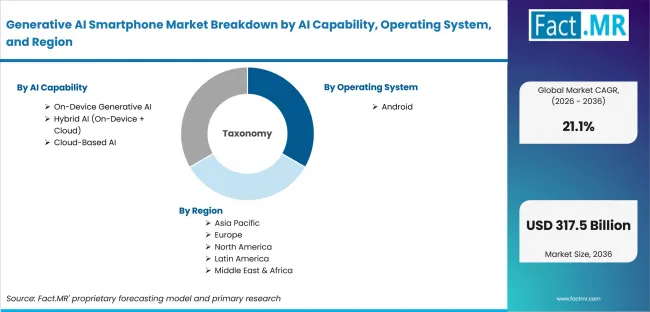
Generative Ai Smartphone Market Breakdown By Ai Capability, Operating System, And Region | Source: Fact.MR
| Attribute | Details |
|---|---|
| Quantitative Units | USD billion |
| Market Definition | Revenue from new smartphones sold within the defined segmentation universe when generative AI functions are integrated at the device, operating-system, or hybrid device-cloud layer. |
| AI Capability | On-Device Generative AI; Large Language Models; Image Generation; Hybrid AI (On-Device + Cloud) |
| Operating System | Android; Samsung One UI; HyperOS; iOS |
| Application | AI Assistant & Productivity; Live Translation; Smart Assistant; Photography & Image Editing |
| End User | Consumer; Personal Users; Content Creators; Enterprise |
| Price Segment | Premium (Above USD 800); Flagship Smartphones; Ultra Premium Models; Mid-Range (USD 400-800) |
| Regions Covered | North America; Latin America; Western Europe; Eastern Europe; East Asia; South Asia and Pacific; Middle East and Africa |
| Countries Covered | USA; Japan; Germany; UK; Canada; Australia; South Korea |
| Key Companies Profiled | Samsung Electronics; Apple Inc.; Xiaomi Corporation; HONOR Device Co., Ltd.; OPPO; vivo; Google LLC; Huawei Technologies; Lenovo Group Limited, through Motorola Mobility; OnePlus |
| Forecast Period | 2026 to 2036 |
| Approach | Hybrid top-down and bottom-up approach using new-device revenue; AI-capable portfolio mix; price segments; operating systems; shipment patterns; local feature availability; hardware requirements; country adoption conditions; company portfolio review |
Source: Fact.MR analysis. Updated Aug 3, 2026
How is the market segmented?
-
By AI Capability:
- On-Device Generative AI
- Large Language Models
- Image Generation
- Hybrid AI (On-Device + Cloud)
- AI Assistants
- Cloud Inference
- Cloud-Based AI
- Generative Services
- Remote AI Processing
- On-Device Generative AI
-
By Operating System:
- Android
- Samsung One UI
- HyperOS
- iOS
- Apple Intelligence
- iOS AI Features
- Android
-
By Application:
- AI Assistant & Productivity
- Live Translation
- Smart Assistant
- Photography & Image Editing
- AI Camera
- Image Enhancement
- Content Creation
- Text Generation
- Video Generation
- Communication
- Call Summaries
- Real-Time Translation
- Others
- Gaming
- Accessibility
- AI Assistant & Productivity
-
By End User:
- Consumer
- Personal Users
- Content Creators
- Enterprise
- Business Users
- Field Workforce
- Consumer
-
By Price Segment:
- Premium (Above USD 800)
- Flagship Smartphones
- Ultra Premium Models
- Mid-Range (USD 400–800)
- AI-Enabled Mid-Range Phones
- Performance Devices
- Budget (Below USD 400)
- Entry-Level AI Phones
- Value Smartphones
- Premium (Above USD 800)
-
By Region:
- North America
- Latin America
- Western Europe
- Eastern Europe
- East Asia
- South Asia and Pacific
- Middle East and Africa
Frequently Asked Questions
Which AI Capability leads the market?
Which Operating System leads the market?
Which Application leads the market?
Which country records the highest listed CAGR?
What is the main restraint?
Who worked on this report


Preview the report firsthand - request a free sample
Free SampleGet the brochure for pricing and purchase details
Download PDF