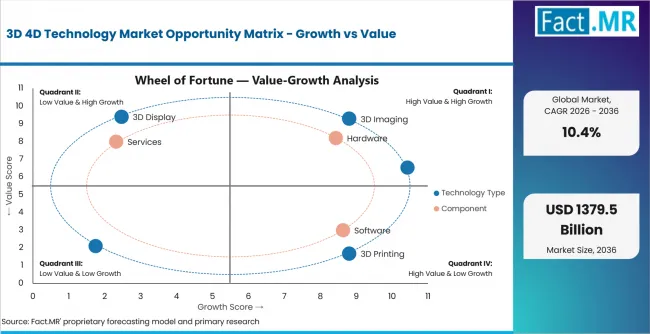
3D 4D Technology Market Size, Share, Growth and Forecast (2026 - 2036)
The 3D 4D Technology Market is Segmented by Technology Type (3D Imaging, 3D Printing, 3D Display, 3D Sensors, 4D Printing), by Component (Hardware, Software, Services), by Application, by End User, and by Sales Channel (Direct Sales, Distributor Sales, Online Sales, System Integrators), and Region. Forecast for 2026 to 2036.
Fact.MR notes that 3D 4D technology demand is shifting toward design visualization and immersive production workflows. Manufacturers need improved product simulation. Healthcare users need advanced imaging and 3D printed models.
3D 4D Technology Market Size, Market Forecast and Outlook by Fact.MR
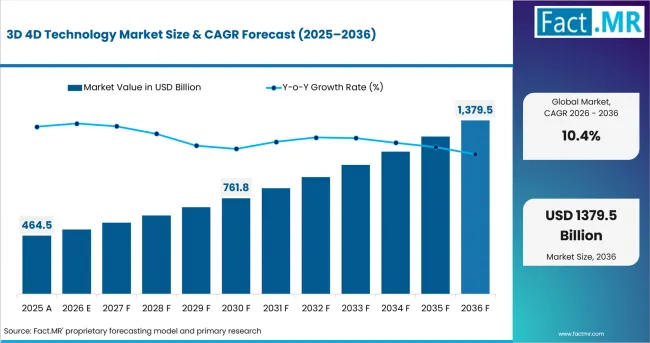
- The 3D 4D technology market was valued at USD 464.5 billion in 2025.
- Demand is projected to rise from USD 512.9 billion in 2026 to USD 1,379.5 billion by 2036.
- The market is forecast to record 10.4% CAGR from 2026 to 2036 as 3D design and immersive media gain wider commercial use.
| Metric | Details |
|---|---|
| Industry Size 2026 | USD 512.9 billion |
| Industry Value 2036 | USD 1,379.5 billion |
| CAGR 2026 to 2036 | 10.4% |
Summary of 3D 4D Technology Market
- Demand Drivers in the Market
- Digital Design Need: Product developers need 3D tools that improve design review and engineering collaboration.
- Industrial Digital Twins: Enterprises use digital twin platforms to plan factories and supply chains before making physical changes.
- Additive Manufacturing: 3D Systems reported aerospace and defense growth in its 2025 business update. [3]
- Key Segments Analyzed
- By Technology Type: 3D imaging is expected to hold 32.0% share in 2026 because scanning and visualization support many workflows.
- By Component: Hardware leads system spending as cameras and printers carry 54.0% share in 2026.
- By Application: Industrial manufacturing is projected to hold 31.0% share in 2026 since design validation and prototyping need 3D workflows.
- By End User: Enterprises lead commercial deployment with 36.0% share in 2026 as digital twins enter operations.
- By Sales Channel: Direct sales are expected to hold 42.0% share in 2026 because enterprise systems need installation support.
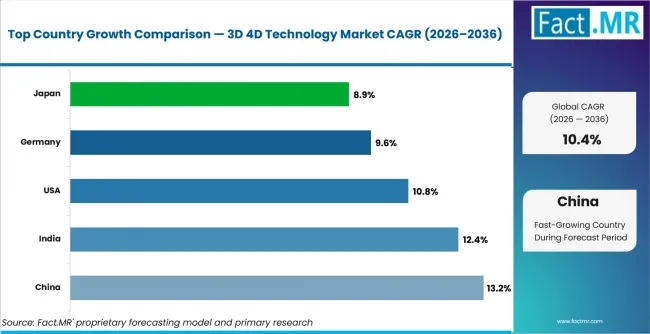
- By Geography: China leads the country outlook with 13.2% CAGR through 2036 as industrial digitization expands.
- Analyst Opinion at Fact.MR
- Shambhu Nath Jha, Principal Consultant at Fact.MR, notes, “3D 4D technology is becoming a workflow investment. Buyers need reliable capture and accurate simulation with simple handoff into production. Suppliers that connect hardware with usable software will gain stronger enterprise accounts.”
- Strategic Implications
- Workflow Integration: Suppliers need tools that connect capture with design review and production planning.
- Validation Support: Users should test 3D outputs in real engineering and clinical conditions before wider use.
- Service Depth: Enterprise users will value setup support and application training more than product claims.
3D 4D technology demand is becoming more workflow-led. Enterprises need systems that connect design work with production review. Autodesk’s 2025 State of Design & Make report covers digital transformation among design and manufacturing leaders. [1] NVIDIA says Omniverse helps enterprises build and improve digital twins of factories and supply chains. [2] This supports demand for tools that connect design work with simulation and factory planning.
China is projected to record 13.2% CAGR by 2036 as industrial digitization and consumer electronics support demand. India is likely to post 12.4% CAGR from 2026 to 2036 as manufacturing and healthcare imaging adoption expand. The United States is expected to register 10.8% CAGR through 2036 because digital twins and additive manufacturing support advanced production. Germany is forecast to advance at 9.6% CAGR through 2036 as automotive engineering and industrial automation use 3D workflows. Japan is forecast to record 8.9% CAGR from 2026 to 2036 since electronics and precision manufacturing sustain adoption.
Segmental Analysis
3D 4D Technology Market Analysis by Technology Type
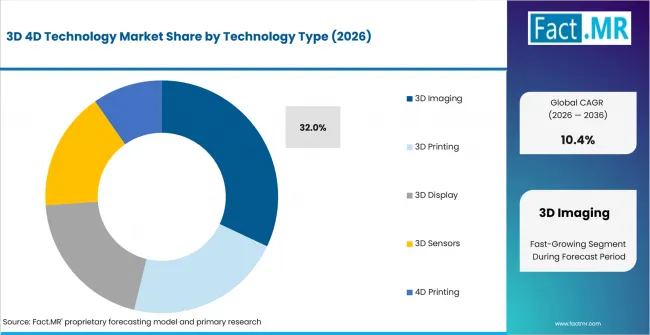
3D imaging is expected to hold 32.0% share in 2026 because scanning and visualization support industrial inspection and digital twin creation. 3D printing supports prototyping and production parts. 3D display helps immersive media and training. 3D sensors support machine vision and robotics. 4D printing remains smaller because material response is still in early commercial use.
- Imaging Base: 3D imaging helps users capture objects and environments for design review or inspection.
- Printing Utility: 3D printing supports prototypes and low-volume parts with complex geometry requirements.
- Sensor Role: 3D sensors improve spatial perception for robots and automated inspection systems.
3D 4D Technology Market Analysis by Component
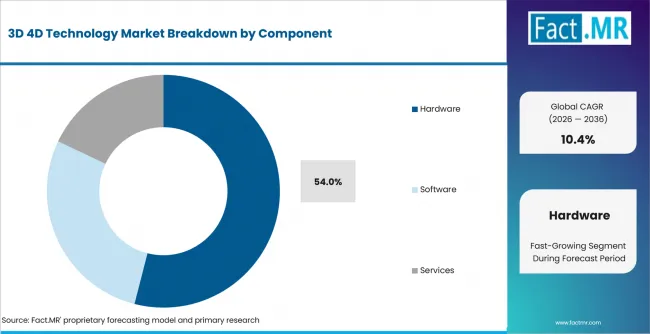
Hardware carries the largest spending base as users need scanners and display systems before software can deliver value. Software connects design and data visualization. Services help enterprises install systems and train users. Hardware leads with 54.0% share in 2026 as most deployments need physical capture or output devices. Stratasys notes that its 3D printing systems support additive manufacturing workflows. [4]
- Hardware Base: Printers and scanners create the physical foundation for 3D workflow adoption.
- Software Control: Software helps users manage models and convert spatial data into usable outputs.
- Service Support: Services reduce setup delays and improve system use after installation.
3D 4D Technology Market Analysis by Application
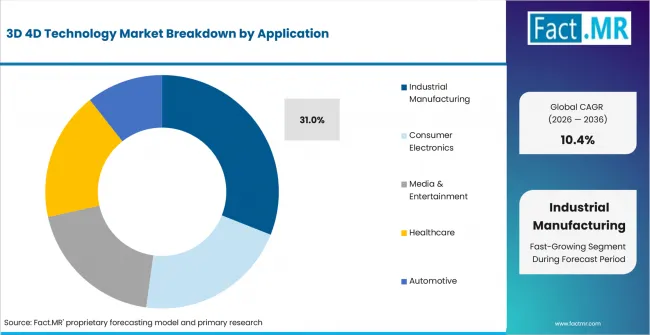
Industrial manufacturing is projected to hold 31.0% share in 2026 because design validation and inspection need 3D workflows. Healthcare uses 3D imaging and printed models for planning. Automotive users need design simulation and virtual twins. Media and entertainment use immersive 3D content. Consumer electronics need sensors and spatial imaging.
- Factory Planning: Industrial users apply 3D tools to test layouts and production changes.
- Healthcare Models: Medical users apply 3D imaging for surgical planning and device design.
- Media Output: Entertainment studios use 3D content for immersive scenes and visual effects.
3D 4D Technology Market Analysis by End User
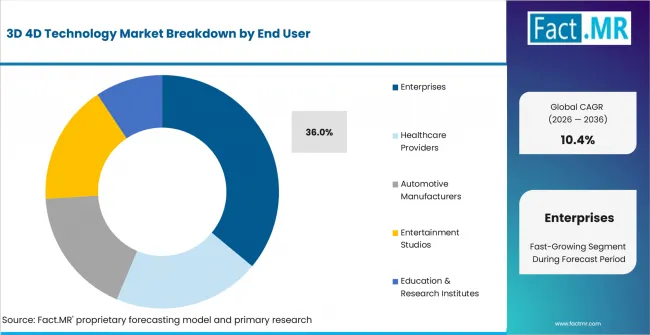
Enterprises lead commercial deployment because large organizations use 3D tools for design and maintenance. Healthcare providers use advanced imaging and printed models. Automotive manufacturers apply 3D and virtual twin systems across vehicle development. Entertainment studios need immersive content tools. Education and research institutes support early 4D printing and material research. Enterprises are expected to hold 36.0% share in 2026 as digital twin projects expand.
- Enterprise Use: Large organizations use 3D systems for design review and operational planning.
- Automotive Engineering: Vehicle makers use virtual models to reduce physical prototype cycles.
- Research Demand: Institutes support 4D material testing and next-generation printing methods.
3D 4D Technology Market Analysis by Sales Channel
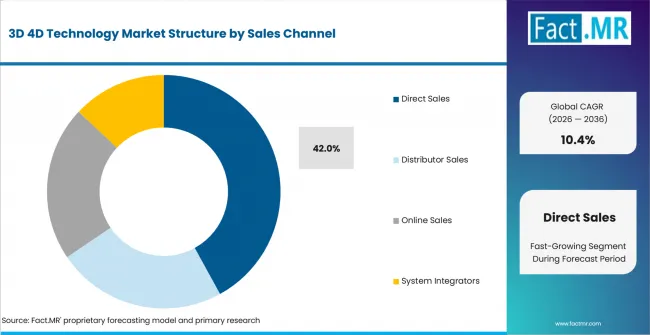
Direct sales are expected to hold 42.0% share in 2026 because enterprise systems often need consulting and workflow alignment. Distributor sales support regional firms and smaller users. Online sales serve software tools and lower-cost devices. System integrators help large customers combine hardware and software.
- Direct Engagement: Direct sales help vendors manage complex enterprise setup and training needs.
- Distributor Reach: Distributors improve access for smaller firms and regional industrial users.
- Integrator Role: System integrators connect multiple platforms into working enterprise workflows.
3D 4D Technology Market Drivers, Restraints, and Opportunities

Digital workflow modernization is the main driver for 3D 4D technology demand. Siemens announced in January 2025 that Teamcenter Digital Reality Viewer would use NVIDIA Omniverse to support high-quality photorealistic visualization of large engineering and manufacturing datasets [5]. Manufacturers need better design review and fewer physical prototypes. Healthcare users need imaging and model support for planning. Media firms need immersive content systems.
High system cost can limit adoption. Firms may need hardware and data storage at the same time. Small firms can delay purchases when return on investment is unclear. Complex file standards also create integration pressure. 4D printing faces slower adoption because responsive materials need more validation.
Opportunities in the 3D 4D Technology Market
- Digital Twin Platforms: Vendors can serve factories that need spatial models for monitoring and simulation.
- Medical Modeling: Healthcare suppliers can expand 3D printing and imaging tools for planning.
- Industrial Training: Firms can use 3D environments to improve operator training and safety review.
Regional Analysis
Based on regional analysis, the 3D 4D technology market is segmented into North America, Latin America, Europe, East Asia, South Asia & Oceania and Middle East and Africa.
.webp)
| Country | CAGR 2026 to 2036 |
|---|---|
| China | 13.2% |
| India | 12.4% |
| United States | 10.8% |
| Germany | 9.6% |
| Japan | 8.9% |
East Asia 3D 4D Technology Market Analysis
East Asia demand comes from electronics and consumer device production. China leads regional growth because factories and electronics firms need 3D design and inspection tools. Japan supports demand through precision manufacturing and imaging technology.
- China: China is projected to record 13.2% CAGR from 2026 to 2036 as industrial digitization and electronics manufacturing support 3D tools. Local factories need 3D imaging for inspection and design validation. Automotive and consumer device producers will add demand. Suppliers with local service support will gain better access.
- Japan: Japan's precision manufacturing base supports steady demand for 3D and 4D technology. Electronics and robotics users need spatial sensors and high-quality imaging. Japan is forecast to record 8.9% CAGR by 2036 as automation and replacement demand continue. Enterprise users will focus on reliability and system compatibility.
South Asia & Oceania 3D 4D Technology Market Analysis
South Asia demand is supported by manufacturing modernization and healthcare imaging investment. India leads regional growth because local industries adopt 3D design and additive manufacturing tools.
- India: Manufacturing and healthcare sectors in India support 3D technology adoption. India is likely to post 12.4% CAGR from 2026 to 2036 as local firms adopt design and prototyping tools. Medical users also need 3D imaging support. Suppliers with training and financing options will gain stronger adoption.
North America 3D 4D Technology Market Analysis
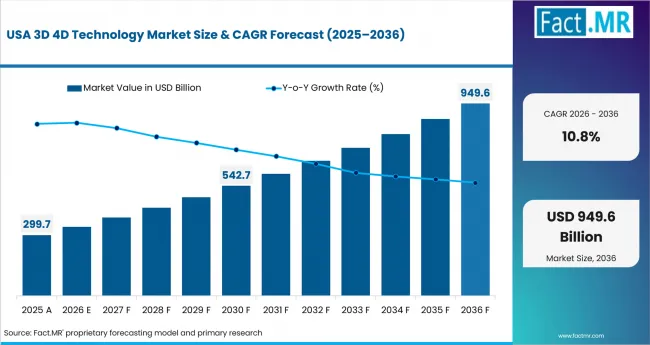
North America demand is led by the United States due to its advanced manufacturing and software base. Enterprises use 3D workflows for design review and digital twin development.
- United States: The United States has a large base of enterprise software and additive manufacturing users. Digital twins and 3D production workflows are expanding across advanced industries. The United States is forecast to record 10.8% CAGR during the forecast period. Healthcare and aerospace demand will support premium systems. Users will need strong service and integration support.
Europe 3D 4D Technology Market Analysis

Europe demand comes from automotive engineering and sustainability-led design. Germany leads regional adoption because manufacturers need 3D engineering and virtual production tools.
- Germany: Germany's automotive and industrial base supports 3D 4D technology demand. The market is forecast to advance at 9.6% CAGR from 2026 to 2036 as manufacturers use 3D design and simulation tools. Engineering users need accurate models and stable software links. Supplier support will shape enterprise selection.
Competitive Aligners for Market Suppliers

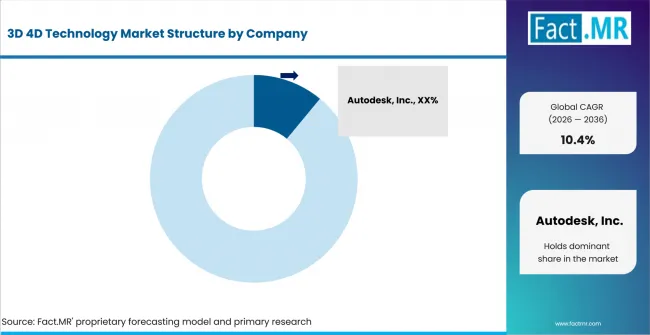
The 3D 4D technology market includes companies that help enterprises design and test products in digital environments. Autodesk, Inc. serves engineering and design users through modeling tools. Dassault Systèmes SE supports virtual twin use across industrial planning. NVIDIA Corporation strengthens simulation and real-time visualization. 3D Systems Corporation and Stratasys Ltd. bring additive manufacturing systems into the market.
Enterprise users will focus on practical use through 2036. Manufacturers need tools that connect with existing design systems and production workflows. Healthcare users will need validated output before wider clinical use. Ease of use and system reliability will guide platform choice.
Competition will depend on how well each company turns technology into daily workflow value. Software firms can gain when their platforms become central to design and simulation. Additive manufacturing companies can stand out through machine reliability and certified material support. Vendors with stronger training and service depth will have better long-term account access.
Key Companies in 3D 4D Technology Market
- Autodesk, Inc.
- Dassault Systèmes SE
- NVIDIA Corporation
- 3D Systems Corporation
- Stratasys Ltd.
Bibliography
- [1] Autodesk. (2025). 2025 State of Design & Make. Autodesk.
- [2] NVIDIA Corporation. (2025, May). 2025 NVIDIA Corporation Annual Review. NVIDIA Corporation.
- [3] 3D Systems Corporation. (2026, March 9). 3D Systems reports fourth quarter and full year 2025 financial results. 3D Systems Corporation.
- [4] Stratasys Ltd. (2026, March 5). Stratasys releases fourth quarter and full year 2025 financial results. Stratasys Ltd.
- [5] Siemens. (2025, January 7). Siemens to deliver photorealism-enhanced digital twin with NVIDIA Omniverse and Teamcenter Digital Reality Viewer. Siemens.
This Report Addresses
- Strategic intelligence on 3D 4D technology demand across technology type, component, application, end user and sales channel.
- Forecast mapping from USD 512.9 billion in 2026 to USD 1,379.5 billion by 2036.
- Segment analysis covering 3D imaging, hardware, industrial manufacturing, enterprises and direct sales.
- Regional outlook covering China, India, the United States, Germany and Japan.
- Competitive analysis of Autodesk, Inc., Dassault Systèmes SE, NVIDIA Corporation, 3D Systems Corporation, Stratasys Ltd.
- Product assessment covering 3D imaging, 3D printing, digital twins, 3D sensors and 4D printing.
- Primary interviews, supplier checks, official source review and workflow validation support the forecast.
3D 4D Technology Market Definition
The 3D 4D technology market covers tools and systems that create spatial and time-linked digital outputs. It includes 3D printing and 4D printing. The market is different from ordinary digital media because it supports spatial depth or time-based material response.
3D 4D Technology Market Inclusions
The scope includes 3D design software and 4D printing research tools. It includes hardware and services sold for industrial manufacturing and education.
3D 4D Technology Market Exclusions
The scope excludes ordinary 2D design software and standard video content. It also excludes basic photography equipment without spatial capture. Finished consumer products are outside scope unless the value relates to 3D or 4D technology input. General IT services are excluded when they do not support 3D visualization or 4D behavior.
3D 4D Technology Market Research Methodology
- Primary Research
- Primary research includes interviews with 3D software vendors and industrial imaging buyers across manufacturing projects.
- Desk Research
- Desk research reviews official company reports with product releases and platform documents for technology validation.
- Market-Sizing and Forecasting
- Forecasting uses technology demand with component adoption and end user investment across key regions through 2036.
- Data Validation and Update Cycle
- Forecasts are validated through supplier checks and buyer feedback with evidence from commercial platform deployments.
Scope of the Report

| Attribute | Details |
|---|---|
| Quantitative Units | USD 512.9 billion in 2026 to USD 1,379.5 billion by 2036 at 10.4% CAGR |
| Market Definition | Technologies used to create spatial or time-linked digital outputs for design and visualization |
| Technology Type | 3D Imaging, 3D Printing, 3D Display, 3D Sensors, 4D Printing |
| Component | Hardware, Software, Services |
| Application | Media & Entertainment, Healthcare, Automotive, Industrial Manufacturing, Consumer Electronics |
| End User | Enterprises, Healthcare Providers, Automotive Manufacturers, Entertainment Studios, Education & Research Institutes |
| Sales Channel | Direct Sales, Distributor Sales, Online Sales, System Integrators |
| Regions Covered | North America, Latin America, Europe, East Asia, South Asia & Oceania, Middle East and Africa |
| Countries Covered | China, India, United States, Germany, Japan |
| Key Companies Profiled | Autodesk, Inc., Dassault Systèmes SE, NVIDIA Corporation, 3D Systems Corporation, Stratasys Ltd. |
| Forecast Period | 2026 to 2036 |
| Approach | Hybrid top-down and bottom-up approach using technology demand, component adoption, application use and end-user validation |
3D 4D Technology Market Analysis by Segments
-
By Technology Type:
- 3D Imaging
- 3D Printing
- 3D Display
- 3D Sensors
- 4D Printing
-
By Component:
- Hardware
- Software
- Services
-
By Application:
- Media & Entertainment
- Healthcare
- Automotive
- Industrial Manufacturing
- Consumer Electronics
-
By End User:
- Enterprises
- Healthcare Providers
- Automotive Manufacturers
- Entertainment Studios
- Education & Research Institutes
-
By Sales Channel:
- Direct Sales
- Distributor Sales
- Online Sales
- System Integrators
-
Region:
- North America
- United States
- Canada
- Europe
- Germany
- United Kingdom
- France
- Italy
- Spain
- Asia Pacific
- China
- Japan
- South Korea
- Taiwan
- Singapore
- Latin America
- Brazil
- Mexico
- Argentina
- Middle East & Africa
- GCC Countries
- South Africa
- Israel
- North America
- Frequently Asked Questions -
What is the 3D 4D Technology Market size in 2026?
The 3D 4D technology market is estimated to reach USD 512.9 billion in 2026.
What will the 3D 4D Technology Market be worth by 2036?
The market is projected to reach USD 1,379.5 billion by 2036 as 3D design and digital twin use widen.
What CAGR is projected for the 3D 4D Technology Market?
The 3D 4D technology market is forecast to record 10.4% CAGR from 2026 to 2036.
Which technology type leads the market?
3D imaging leads with 32.0% share in 2026 because scanning and visualization support many commercial workflows.
Which country expands fastest in the 3D 4D Technology Market?
China is projected to record 13.2% CAGR through 2036 as industrial digitization and electronics manufacturing support demand.
How does India perform in the market?
India is likely to post 12.4% CAGR through 2036 as manufacturing and healthcare imaging adoption expand.
How does the United States perform in the market?
The United States is forecast to register 10.8% CAGR from 2026 to 2036 as additive manufacturing and digital twins expand.
What is the main driver in the market?
The main driver is digital workflow modernization. Enterprise users need better design review and fewer physical prototype cycles.
What is the main restraint in the market?
The main restraint is system cost. Enterprise users may need hardware, software, training, and data storage together.
Why is 3D imaging important?
3D imaging is important because it helps users capture objects and environments for inspection and design work.
Why is industrial manufacturing important?
Industrial manufacturing is important because factories use 3D tools for product design and production planning.
Table of Content
- Executive Summary
- Global Market Outlook
- Demand to side Trends
- Supply to side Trends
- Technology Roadmap Analysis
- Analysis and Recommendations
- Market Overview
- Market Coverage / Taxonomy
- Market Definition / Scope / Limitations
- Research Methodology
- Chapter Orientation
- Analytical Lens and Working Hypotheses
- Market Structure, Signals, and Trend Drivers
- Benchmarking and Cross-market Comparability
- Market Sizing, Forecasting, and Opportunity Mapping
- Research Design and Evidence Framework
- Desk Research Programme (Secondary Evidence)
- Company Annual and Sustainability Reports
- Peer-reviewed Journals and Academic Literature
- Corporate Websites, Product Literature, and Technical Notes
- Earnings Decks and Investor Briefings
- Statutory Filings and Regulatory Disclosures
- Technical White Papers and Standards Notes
- Trade Journals, Industry Magazines, and Analyst Briefs
- Conference Proceedings, Webinars, and Seminar Materials
- Government Statistics Portals and Public Data Releases
- Press Releases and Reputable Media Coverage
- Specialist Newsletters and Curated Briefings
- Sector Databases and Reference Repositories
- Fact.MR Internal Proprietary Databases and Historical Market Datasets
- Subscription Datasets and Paid Sources
- Social Channels, Communities, and Digital Listening Inputs
- Additional Desk Sources
- Expert Input and Fieldwork (Primary Evidence)
- Primary Modes
- Qualitative Interviews and Expert Elicitation
- Quantitative Surveys and Structured Data Capture
- Blended Approach
- Why Primary Evidence is Used
- Field Techniques
- Interviews
- Surveys
- Focus Groups
- Observational and In-context Research
- Social and Community Interactions
- Stakeholder Universe Engaged
- C-suite Leaders
- Board Members
- Presidents and Vice Presidents
- R&D and Innovation Heads
- Technical Specialists
- Domain Subject-matter Experts
- Scientists
- Physicians and Other Healthcare Professionals
- Governance, Ethics, and Data Stewardship
- Research Ethics
- Data Integrity and Handling
- Primary Modes
- Tooling, Models, and Reference Databases
- Desk Research Programme (Secondary Evidence)
- Data Engineering and Model Build
- Data Acquisition and Ingestion
- Cleaning, Normalisation, and Verification
- Synthesis, Triangulation, and Analysis
- Quality Assurance and Audit Trail
- Market Background
- Market Dynamics
- Drivers
- Restraints
- Opportunity
- Trends
- Scenario Forecast
- Demand in Optimistic Scenario
- Demand in Likely Scenario
- Demand in Conservative Scenario
- Opportunity Map Analysis
- Product Life Cycle Analysis
- Supply Chain Analysis
- Investment Feasibility Matrix
- Value Chain Analysis
- PESTLE and Porter’s Analysis
- Regulatory Landscape
- Regional Parent Market Outlook
- Production and Consumption Statistics
- Import and Export Statistics
- Market Dynamics
- Global Market Analysis 2021 to 2025 and Forecast, 2026 to 2036
- Historical Market Size Value (USD Million) Analysis, 2021 to 2025
- Current and Future Market Size Value (USD Million) Projections, 2026 to 2036
- Y to o to Y Growth Trend Analysis
- Absolute $ Opportunity Analysis
- Global Market Pricing Analysis 2021 to 2025 and Forecast 2026 to 2036
- Global Market Analysis 2021 to 2025 and Forecast 2026 to 2036, By Site Type
- Introduction / Key Findings
- Historical Market Size Value (USD Million) Analysis By Site Type , 2021 to 2025
- Current and Future Market Size Value (USD Million) Analysis and Forecast By Site Type , 2026 to 2036
- On-site
- Near-site
- Off-site
- On-site
- Y to o to Y Growth Trend Analysis By Site Type , 2021 to 2025
- Absolute $ Opportunity Analysis By Site Type , 2026 to 2036
- Global Market Analysis 2021 to 2025 and Forecast 2026 to 2036, By Printing System
- Introduction / Key Findings
- Historical Market Size Value (USD Million) Analysis By Printing System, 2021 to 2025
- Current and Future Market Size Value (USD Million) Analysis and Forecast By Printing System, 2026 to 2036
- Gantry-based Systems
- Robotic Arm-based Systems
- Crane-based/Contour Crafting Systems
- Gantry-based Systems
- Y to o to Y Growth Trend Analysis By Printing System, 2021 to 2025
- Absolute $ Opportunity Analysis By Printing System, 2026 to 2036
- Global Market Analysis 2021 to 2025 and Forecast 2026 to 2036, By Element Type
- Introduction / Key Findings
- Historical Market Size Value (USD Million) Analysis By Element Type, 2021 to 2025
- Current and Future Market Size Value (USD Million) Analysis and Forecast By Element Type, 2026 to 2036
- Structural Elements
- Architectural Elements
- Structural Elements
- Y to o to Y Growth Trend Analysis By Element Type, 2021 to 2025
- Absolute $ Opportunity Analysis By Element Type, 2026 to 2036
- Global Market Analysis 2021 to 2025 and Forecast 2026 to 2036, By Application
- Introduction / Key Findings
- Historical Market Size Value (USD Million) Analysis By Application, 2021 to 2025
- Current and Future Market Size Value (USD Million) Analysis and Forecast By Application, 2026 to 2036
- Residential Housing
- Commercial & Office Buildings
- Public Infrastructure
- Industrial
- Residential Housing
- Y to o to Y Growth Trend Analysis By Application, 2021 to 2025
- Absolute $ Opportunity Analysis By Application, 2026 to 2036
- Global Market Analysis 2021 to 2025 and Forecast 2026 to 2036, By End User
- Introduction / Key Findings
- Historical Market Size Value (USD Million) Analysis By End User, 2021 to 2025
- Current and Future Market Size Value (USD Million) Analysis and Forecast By End User, 2026 to 2036
- Construction Contractors
- Prefab Producers
- Architectural and Structural Engineering Companies
- Educational & Research Institutions
- Owners
- Government & Public Sector
- Private Real Estate Developers
- Construction Contractors
- Y to o to Y Growth Trend Analysis By End User, 2021 to 2025
- Absolute $ Opportunity Analysis By End User, 2026 to 2036
- Global Market Analysis 2021 to 2025 and Forecast 2026 to 2036, By Region
- Introduction
- Historical Market Size Value (USD Million) Analysis By Region, 2021 to 2025
- Current Market Size Value (USD Million) Analysis and Forecast By Region, 2026 to 2036
- North America
- Latin America
- Western Europe
- Eastern Europe
- East Asia
- South Asia and Pacific
- Middle East & Africa
- Market Attractiveness Analysis By Region
- North America Market Analysis 2021 to 2025 and Forecast 2026 to 2036, By Country
- Historical Market Size Value (USD Million) Trend Analysis By Market Taxonomy, 2021 to 2025
- Market Size Value (USD Million) Forecast By Market Taxonomy, 2026 to 2036
- By Country
- USA
- Canada
- Mexico
- By Site Type
- By Printing System
- By Element Type
- By Application
- By End User
- By Country
- Market Attractiveness Analysis
- By Country
- By Site Type
- By Printing System
- By Element Type
- By Application
- By End User
- Key Takeaways
- Latin America Market Analysis 2021 to 2025 and Forecast 2026 to 2036, By Country
- Historical Market Size Value (USD Million) Trend Analysis By Market Taxonomy, 2021 to 2025
- Market Size Value (USD Million) Forecast By Market Taxonomy, 2026 to 2036
- By Country
- Brazil
- Chile
- Rest of Latin America
- By Site Type
- By Printing System
- By Element Type
- By Application
- By End User
- By Country
- Market Attractiveness Analysis
- By Country
- By Site Type
- By Printing System
- By Element Type
- By Application
- By End User
- Key Takeaways
- Western Europe Market Analysis 2021 to 2025 and Forecast 2026 to 2036, By Country
- Historical Market Size Value (USD Million) Trend Analysis By Market Taxonomy, 2021 to 2025
- Market Size Value (USD Million) Forecast By Market Taxonomy, 2026 to 2036
- By Country
- Germany
- UK
- Italy
- Spain
- France
- Nordic
- BENELUX
- Rest of Western Europe
- By Site Type
- By Printing System
- By Element Type
- By Application
- By End User
- By Country
- Market Attractiveness Analysis
- By Country
- By Site Type
- By Printing System
- By Element Type
- By Application
- By End User
- Key Takeaways
- Eastern Europe Market Analysis 2021 to 2025 and Forecast 2026 to 2036, By Country
- Historical Market Size Value (USD Million) Trend Analysis By Market Taxonomy, 2021 to 2025
- Market Size Value (USD Million) Forecast By Market Taxonomy, 2026 to 2036
- By Country
- Russia
- Poland
- Hungary
- Balkan & Baltic
- Rest of Eastern Europe
- By Site Type
- By Printing System
- By Element Type
- By Application
- By End User
- By Country
- Market Attractiveness Analysis
- By Country
- By Site Type
- By Printing System
- By Element Type
- By Application
- By End User
- Key Takeaways
- East Asia Market Analysis 2021 to 2025 and Forecast 2026 to 2036, By Country
- Historical Market Size Value (USD Million) Trend Analysis By Market Taxonomy, 2021 to 2025
- Market Size Value (USD Million) Forecast By Market Taxonomy, 2026 to 2036
- By Country
- China
- Japan
- South Korea
- By Site Type
- By Printing System
- By Element Type
- By Application
- By End User
- By Country
- Market Attractiveness Analysis
- By Country
- By Site Type
- By Printing System
- By Element Type
- By Application
- By End User
- Key Takeaways
- South Asia and Pacific Market Analysis 2021 to 2025 and Forecast 2026 to 2036, By Country
- Historical Market Size Value (USD Million) Trend Analysis By Market Taxonomy, 2021 to 2025
- Market Size Value (USD Million) Forecast By Market Taxonomy, 2026 to 2036
- By Country
- India
- ASEAN
- Australia & New Zealand
- Rest of South Asia and Pacific
- By Site Type
- By Printing System
- By Element Type
- By Application
- By End User
- By Country
- Market Attractiveness Analysis
- By Country
- By Site Type
- By Printing System
- By Element Type
- By Application
- By End User
- Key Takeaways
- Middle East & Africa Market Analysis 2021 to 2025 and Forecast 2026 to 2036, By Country
- Historical Market Size Value (USD Million) Trend Analysis By Market Taxonomy, 2021 to 2025
- Market Size Value (USD Million) Forecast By Market Taxonomy, 2026 to 2036
- By Country
- Kingdom of Saudi Arabia
- Other GCC Countries
- Turkiye
- South Africa
- Other African Union
- Rest of Middle East & Africa
- By Site Type
- By Printing System
- By Element Type
- By Application
- By End User
- By Country
- Market Attractiveness Analysis
- By Country
- By Site Type
- By Printing System
- By Element Type
- By Application
- By End User
- Key Takeaways
- Key Countries Market Analysis
- USA
- Pricing Analysis
- Market Share Analysis, 2025
- By Site Type
- By Printing System
- By Element Type
- By Application
- By End User
- Canada
- Pricing Analysis
- Market Share Analysis, 2025
- By Site Type
- By Printing System
- By Element Type
- By Application
- By End User
- Mexico
- Pricing Analysis
- Market Share Analysis, 2025
- By Site Type
- By Printing System
- By Element Type
- By Application
- By End User
- Brazil
- Pricing Analysis
- Market Share Analysis, 2025
- By Site Type
- By Printing System
- By Element Type
- By Application
- By End User
- Chile
- Pricing Analysis
- Market Share Analysis, 2025
- By Site Type
- By Printing System
- By Element Type
- By Application
- By End User
- Germany
- Pricing Analysis
- Market Share Analysis, 2025
- By Site Type
- By Printing System
- By Element Type
- By Application
- By End User
- UK
- Pricing Analysis
- Market Share Analysis, 2025
- By Site Type
- By Printing System
- By Element Type
- By Application
- By End User
- Italy
- Pricing Analysis
- Market Share Analysis, 2025
- By Site Type
- By Printing System
- By Element Type
- By Application
- By End User
- Spain
- Pricing Analysis
- Market Share Analysis, 2025
- By Site Type
- By Printing System
- By Element Type
- By Application
- By End User
- France
- Pricing Analysis
- Market Share Analysis, 2025
- By Site Type
- By Printing System
- By Element Type
- By Application
- By End User
- India
- Pricing Analysis
- Market Share Analysis, 2025
- By Site Type
- By Printing System
- By Element Type
- By Application
- By End User
- ASEAN
- Pricing Analysis
- Market Share Analysis, 2025
- By Site Type
- By Printing System
- By Element Type
- By Application
- By End User
- Australia & New Zealand
- Pricing Analysis
- Market Share Analysis, 2025
- By Site Type
- By Printing System
- By Element Type
- By Application
- By End User
- China
- Pricing Analysis
- Market Share Analysis, 2025
- By Site Type
- By Printing System
- By Element Type
- By Application
- By End User
- Japan
- Pricing Analysis
- Market Share Analysis, 2025
- By Site Type
- By Printing System
- By Element Type
- By Application
- By End User
- South Korea
- Pricing Analysis
- Market Share Analysis, 2025
- By Site Type
- By Printing System
- By Element Type
- By Application
- By End User
- Russia
- Pricing Analysis
- Market Share Analysis, 2025
- By Site Type
- By Printing System
- By Element Type
- By Application
- By End User
- Poland
- Pricing Analysis
- Market Share Analysis, 2025
- By Site Type
- By Printing System
- By Element Type
- By Application
- By End User
- Hungary
- Pricing Analysis
- Market Share Analysis, 2025
- By Site Type
- By Printing System
- By Element Type
- By Application
- By End User
- Kingdom of Saudi Arabia
- Pricing Analysis
- Market Share Analysis, 2025
- By Site Type
- By Printing System
- By Element Type
- By Application
- By End User
- Turkiye
- Pricing Analysis
- Market Share Analysis, 2025
- By Site Type
- By Printing System
- By Element Type
- By Application
- By End User
- South Africa
- Pricing Analysis
- Market Share Analysis, 2025
- By Site Type
- By Printing System
- By Element Type
- By Application
- By End User
- USA
- Market Structure Analysis
- Competition Dashboard
- Competition Benchmarking
- Market Share Analysis of Top Players
- By Regional
- By Site Type
- By Printing System
- By Element Type
- By Application
- By End User
- Competition Analysis
- Competition Deep Dive
- COBOD International A/S
- Overview
- Product Portfolio
- Profitability by Market Segments (Product/Age /Sales Channel/Region)
- Sales Footprint
- Strategy Overview
- Marketing Strategy
- Product Strategy
- Channel Strategy
- ICON Technology, Inc.
- Apis Cor Inc.
- CyBe Construction B.V.
- Alquist 3D
- COBOD International A/S
- Competition Deep Dive
- Assumptions & Acronyms Used
List Of Table
- Table 1: Global Market Value (USD Million) Forecast by Region, 2021 to 2036
- Table 2: Global Market Value (USD Million) Forecast by Site Type, 2021 to 2036
- Table 3: Global Market Value (USD Million) Forecast by Printing System, 2021 to 2036
- Table 4: Global Market Value (USD Million) Forecast by Element Type, 2021 to 2036
- Table 5: Global Market Value (USD Million) Forecast by Application, 2021 to 2036
- Table 6: Global Market Value (USD Million) Forecast by End User, 2021 to 2036
- Table 7: North America Market Value (USD Million) Forecast by Country, 2021 to 2036
- Table 8: North America Market Value (USD Million) Forecast by Site Type, 2021 to 2036
- Table 9: North America Market Value (USD Million) Forecast by Printing System, 2021 to 2036
- Table 10: North America Market Value (USD Million) Forecast by Element Type, 2021 to 2036
- Table 11: North America Market Value (USD Million) Forecast by Application, 2021 to 2036
- Table 12: North America Market Value (USD Million) Forecast by End User, 2021 to 2036
- Table 13: Latin America Market Value (USD Million) Forecast by Country, 2021 to 2036
- Table 14: Latin America Market Value (USD Million) Forecast by Site Type, 2021 to 2036
- Table 15: Latin America Market Value (USD Million) Forecast by Printing System, 2021 to 2036
- Table 16: Latin America Market Value (USD Million) Forecast by Element Type, 2021 to 2036
- Table 17: Latin America Market Value (USD Million) Forecast by Application, 2021 to 2036
- Table 18: Latin America Market Value (USD Million) Forecast by End User, 2021 to 2036
- Table 19: Western Europe Market Value (USD Million) Forecast by Country, 2021 to 2036
- Table 20: Western Europe Market Value (USD Million) Forecast by Site Type, 2021 to 2036
- Table 21: Western Europe Market Value (USD Million) Forecast by Printing System, 2021 to 2036
- Table 22: Western Europe Market Value (USD Million) Forecast by Element Type, 2021 to 2036
- Table 23: Western Europe Market Value (USD Million) Forecast by Application, 2021 to 2036
- Table 24: Western Europe Market Value (USD Million) Forecast by End User, 2021 to 2036
- Table 25: Eastern Europe Market Value (USD Million) Forecast by Country, 2021 to 2036
- Table 26: Eastern Europe Market Value (USD Million) Forecast by Site Type, 2021 to 2036
- Table 27: Eastern Europe Market Value (USD Million) Forecast by Printing System, 2021 to 2036
- Table 28: Eastern Europe Market Value (USD Million) Forecast by Element Type, 2021 to 2036
- Table 29: Eastern Europe Market Value (USD Million) Forecast by Application, 2021 to 2036
- Table 30: Eastern Europe Market Value (USD Million) Forecast by End User, 2021 to 2036
- Table 31: East Asia Market Value (USD Million) Forecast by Country, 2021 to 2036
- Table 32: East Asia Market Value (USD Million) Forecast by Site Type, 2021 to 2036
- Table 33: East Asia Market Value (USD Million) Forecast by Printing System, 2021 to 2036
- Table 34: East Asia Market Value (USD Million) Forecast by Element Type, 2021 to 2036
- Table 35: East Asia Market Value (USD Million) Forecast by Application, 2021 to 2036
- Table 36: East Asia Market Value (USD Million) Forecast by End User, 2021 to 2036
- Table 37: South Asia and Pacific Market Value (USD Million) Forecast by Country, 2021 to 2036
- Table 38: South Asia and Pacific Market Value (USD Million) Forecast by Site Type, 2021 to 2036
- Table 39: South Asia and Pacific Market Value (USD Million) Forecast by Printing System, 2021 to 2036
- Table 40: South Asia and Pacific Market Value (USD Million) Forecast by Element Type, 2021 to 2036
- Table 41: South Asia and Pacific Market Value (USD Million) Forecast by Application, 2021 to 2036
- Table 42: South Asia and Pacific Market Value (USD Million) Forecast by End User, 2021 to 2036
- Table 43: Middle East & Africa Market Value (USD Million) Forecast by Country, 2021 to 2036
- Table 44: Middle East & Africa Market Value (USD Million) Forecast by Site Type, 2021 to 2036
- Table 45: Middle East & Africa Market Value (USD Million) Forecast by Printing System, 2021 to 2036
- Table 46: Middle East & Africa Market Value (USD Million) Forecast by Element Type, 2021 to 2036
- Table 47: Middle East & Africa Market Value (USD Million) Forecast by Application, 2021 to 2036
- Table 48: Middle East & Africa Market Value (USD Million) Forecast by End User, 2021 to 2036
List Of Figures
- Figure 1: Global Market Pricing Analysis
- Figure 2: Global Market Value (USD Million) Forecast 2021-2036
- Figure 3: Global Market Value Share and BPS Analysis by Site Type, 2026 and 2036
- Figure 4: Global Market Y-o-Y Growth Comparison by Site Type, 2026 to 2036
- Figure 5: Global Market Attractiveness Analysis by Site Type
- Figure 6: Global Market Value Share and BPS Analysis by Printing System, 2026 and 2036
- Figure 7: Global Market Y-o-Y Growth Comparison by Printing System, 2026 to 2036
- Figure 8: Global Market Attractiveness Analysis by Printing System
- Figure 9: Global Market Value Share and BPS Analysis by Element Type, 2026 and 2036
- Figure 10: Global Market Y-o-Y Growth Comparison by Element Type, 2026 to 2036
- Figure 11: Global Market Attractiveness Analysis by Element Type
- Figure 12: Global Market Value Share and BPS Analysis by Application, 2026 and 2036
- Figure 13: Global Market Y-o-Y Growth Comparison by Application, 2026 to 2036
- Figure 14: Global Market Attractiveness Analysis by Application
- Figure 15: Global Market Value Share and BPS Analysis by End User, 2026 and 2036
- Figure 16: Global Market Y-o-Y Growth Comparison by End User, 2026 to 2036
- Figure 17: Global Market Attractiveness Analysis by End User
- Figure 18: Global Market Value (USD Million) Share and BPS Analysis by Region, 2026 and 2036
- Figure 19: Global Market Y-o-Y Growth Comparison by Region, 2026 to 2036
- Figure 20: Global Market Attractiveness Analysis by Region
- Figure 21: North America Market Incremental Dollar Opportunity, 2026 to 2036
- Figure 22: Latin America Market Incremental Dollar Opportunity, 2026 to 2036
- Figure 23: Western Europe Market Incremental Dollar Opportunity, 2026 to 2036
- Figure 24: Eastern Europe Market Incremental Dollar Opportunity, 2026 to 2036
- Figure 25: East Asia Market Incremental Dollar Opportunity, 2026 to 2036
- Figure 26: South Asia and Pacific Market Incremental Dollar Opportunity, 2026 to 2036
- Figure 27: Middle East & Africa Market Incremental Dollar Opportunity, 2026 to 2036
- Figure 28: North America Market Value Share and BPS Analysis by Country, 2026 and 2036
- Figure 29: North America Market Value Share and BPS Analysis by Site Type, 2026 and 2036
- Figure 30: North America Market Y-o-Y Growth Comparison by Site Type, 2026 to 2036
- Figure 31: North America Market Attractiveness Analysis by Site Type
- Figure 32: North America Market Value Share and BPS Analysis by Printing System, 2026 and 2036
- Figure 33: North America Market Y-o-Y Growth Comparison by Printing System, 2026 to 2036
- Figure 34: North America Market Attractiveness Analysis by Printing System
- Figure 35: North America Market Value Share and BPS Analysis by Element Type, 2026 and 2036
- Figure 36: North America Market Y-o-Y Growth Comparison by Element Type, 2026 to 2036
- Figure 37: North America Market Attractiveness Analysis by Element Type
- Figure 38: North America Market Value Share and BPS Analysis by Application, 2026 and 2036
- Figure 39: North America Market Y-o-Y Growth Comparison by Application, 2026 to 2036
- Figure 40: North America Market Attractiveness Analysis by Application
- Figure 41: North America Market Value Share and BPS Analysis by End User, 2026 and 2036
- Figure 42: North America Market Y-o-Y Growth Comparison by End User, 2026 to 2036
- Figure 43: North America Market Attractiveness Analysis by End User
- Figure 44: Latin America Market Value Share and BPS Analysis by Country, 2026 and 2036
- Figure 45: Latin America Market Value Share and BPS Analysis by Site Type, 2026 and 2036
- Figure 46: Latin America Market Y-o-Y Growth Comparison by Site Type, 2026 to 2036
- Figure 47: Latin America Market Attractiveness Analysis by Site Type
- Figure 48: Latin America Market Value Share and BPS Analysis by Printing System, 2026 and 2036
- Figure 49: Latin America Market Y-o-Y Growth Comparison by Printing System, 2026 to 2036
- Figure 50: Latin America Market Attractiveness Analysis by Printing System
- Figure 51: Latin America Market Value Share and BPS Analysis by Element Type, 2026 and 2036
- Figure 52: Latin America Market Y-o-Y Growth Comparison by Element Type, 2026 to 2036
- Figure 53: Latin America Market Attractiveness Analysis by Element Type
- Figure 54: Latin America Market Value Share and BPS Analysis by Application, 2026 and 2036
- Figure 55: Latin America Market Y-o-Y Growth Comparison by Application, 2026 to 2036
- Figure 56: Latin America Market Attractiveness Analysis by Application
- Figure 57: Latin America Market Value Share and BPS Analysis by End User, 2026 and 2036
- Figure 58: Latin America Market Y-o-Y Growth Comparison by End User, 2026 to 2036
- Figure 59: Latin America Market Attractiveness Analysis by End User
- Figure 60: Western Europe Market Value Share and BPS Analysis by Country, 2026 and 2036
- Figure 61: Western Europe Market Value Share and BPS Analysis by Site Type, 2026 and 2036
- Figure 62: Western Europe Market Y-o-Y Growth Comparison by Site Type, 2026 to 2036
- Figure 63: Western Europe Market Attractiveness Analysis by Site Type
- Figure 64: Western Europe Market Value Share and BPS Analysis by Printing System, 2026 and 2036
- Figure 65: Western Europe Market Y-o-Y Growth Comparison by Printing System, 2026 to 2036
- Figure 66: Western Europe Market Attractiveness Analysis by Printing System
- Figure 67: Western Europe Market Value Share and BPS Analysis by Element Type, 2026 and 2036
- Figure 68: Western Europe Market Y-o-Y Growth Comparison by Element Type, 2026 to 2036
- Figure 69: Western Europe Market Attractiveness Analysis by Element Type
- Figure 70: Western Europe Market Value Share and BPS Analysis by Application, 2026 and 2036
- Figure 71: Western Europe Market Y-o-Y Growth Comparison by Application, 2026 to 2036
- Figure 72: Western Europe Market Attractiveness Analysis by Application
- Figure 73: Western Europe Market Value Share and BPS Analysis by End User, 2026 and 2036
- Figure 74: Western Europe Market Y-o-Y Growth Comparison by End User, 2026 to 2036
- Figure 75: Western Europe Market Attractiveness Analysis by End User
- Figure 76: Eastern Europe Market Value Share and BPS Analysis by Country, 2026 and 2036
- Figure 77: Eastern Europe Market Value Share and BPS Analysis by Site Type, 2026 and 2036
- Figure 78: Eastern Europe Market Y-o-Y Growth Comparison by Site Type, 2026 to 2036
- Figure 79: Eastern Europe Market Attractiveness Analysis by Site Type
- Figure 80: Eastern Europe Market Value Share and BPS Analysis by Printing System, 2026 and 2036
- Figure 81: Eastern Europe Market Y-o-Y Growth Comparison by Printing System, 2026 to 2036
- Figure 82: Eastern Europe Market Attractiveness Analysis by Printing System
- Figure 83: Eastern Europe Market Value Share and BPS Analysis by Element Type, 2026 and 2036
- Figure 84: Eastern Europe Market Y-o-Y Growth Comparison by Element Type, 2026 to 2036
- Figure 85: Eastern Europe Market Attractiveness Analysis by Element Type
- Figure 86: Eastern Europe Market Value Share and BPS Analysis by Application, 2026 and 2036
- Figure 87: Eastern Europe Market Y-o-Y Growth Comparison by Application, 2026 to 2036
- Figure 88: Eastern Europe Market Attractiveness Analysis by Application
- Figure 89: Eastern Europe Market Value Share and BPS Analysis by End User, 2026 and 2036
- Figure 90: Eastern Europe Market Y-o-Y Growth Comparison by End User, 2026 to 2036
- Figure 91: Eastern Europe Market Attractiveness Analysis by End User
- Figure 92: East Asia Market Value Share and BPS Analysis by Country, 2026 and 2036
- Figure 93: East Asia Market Value Share and BPS Analysis by Site Type, 2026 and 2036
- Figure 94: East Asia Market Y-o-Y Growth Comparison by Site Type, 2026 to 2036
- Figure 95: East Asia Market Attractiveness Analysis by Site Type
- Figure 96: East Asia Market Value Share and BPS Analysis by Printing System, 2026 and 2036
- Figure 97: East Asia Market Y-o-Y Growth Comparison by Printing System, 2026 to 2036
- Figure 98: East Asia Market Attractiveness Analysis by Printing System
- Figure 99: East Asia Market Value Share and BPS Analysis by Element Type, 2026 and 2036
- Figure 100: East Asia Market Y-o-Y Growth Comparison by Element Type, 2026 to 2036
- Figure 101: East Asia Market Attractiveness Analysis by Element Type
- Figure 102: East Asia Market Value Share and BPS Analysis by Application, 2026 and 2036
- Figure 103: East Asia Market Y-o-Y Growth Comparison by Application, 2026 to 2036
- Figure 104: East Asia Market Attractiveness Analysis by Application
- Figure 105: East Asia Market Value Share and BPS Analysis by End User, 2026 and 2036
- Figure 106: East Asia Market Y-o-Y Growth Comparison by End User, 2026 to 2036
- Figure 107: East Asia Market Attractiveness Analysis by End User
- Figure 108: South Asia and Pacific Market Value Share and BPS Analysis by Country, 2026 and 2036
- Figure 109: South Asia and Pacific Market Value Share and BPS Analysis by Site Type, 2026 and 2036
- Figure 110: South Asia and Pacific Market Y-o-Y Growth Comparison by Site Type, 2026 to 2036
- Figure 111: South Asia and Pacific Market Attractiveness Analysis by Site Type
- Figure 112: South Asia and Pacific Market Value Share and BPS Analysis by Printing System, 2026 and 2036
- Figure 113: South Asia and Pacific Market Y-o-Y Growth Comparison by Printing System, 2026 to 2036
- Figure 114: South Asia and Pacific Market Attractiveness Analysis by Printing System
- Figure 115: South Asia and Pacific Market Value Share and BPS Analysis by Element Type, 2026 and 2036
- Figure 116: South Asia and Pacific Market Y-o-Y Growth Comparison by Element Type, 2026 to 2036
- Figure 117: South Asia and Pacific Market Attractiveness Analysis by Element Type
- Figure 118: South Asia and Pacific Market Value Share and BPS Analysis by Application, 2026 and 2036
- Figure 119: South Asia and Pacific Market Y-o-Y Growth Comparison by Application, 2026 to 2036
- Figure 120: South Asia and Pacific Market Attractiveness Analysis by Application
- Figure 121: South Asia and Pacific Market Value Share and BPS Analysis by End User, 2026 and 2036
- Figure 122: South Asia and Pacific Market Y-o-Y Growth Comparison by End User, 2026 to 2036
- Figure 123: South Asia and Pacific Market Attractiveness Analysis by End User
- Figure 124: Middle East & Africa Market Value Share and BPS Analysis by Country, 2026 and 2036
- Figure 125: Middle East & Africa Market Value Share and BPS Analysis by Site Type, 2026 and 2036
- Figure 126: Middle East & Africa Market Y-o-Y Growth Comparison by Site Type, 2026 to 2036
- Figure 127: Middle East & Africa Market Attractiveness Analysis by Site Type
- Figure 128: Middle East & Africa Market Value Share and BPS Analysis by Printing System, 2026 and 2036
- Figure 129: Middle East & Africa Market Y-o-Y Growth Comparison by Printing System, 2026 to 2036
- Figure 130: Middle East & Africa Market Attractiveness Analysis by Printing System
- Figure 131: Middle East & Africa Market Value Share and BPS Analysis by Element Type, 2026 and 2036
- Figure 132: Middle East & Africa Market Y-o-Y Growth Comparison by Element Type, 2026 to 2036
- Figure 133: Middle East & Africa Market Attractiveness Analysis by Element Type
- Figure 134: Middle East & Africa Market Value Share and BPS Analysis by Application, 2026 and 2036
- Figure 135: Middle East & Africa Market Y-o-Y Growth Comparison by Application, 2026 to 2036
- Figure 136: Middle East & Africa Market Attractiveness Analysis by Application
- Figure 137: Middle East & Africa Market Value Share and BPS Analysis by End User, 2026 and 2036
- Figure 138: Middle East & Africa Market Y-o-Y Growth Comparison by End User, 2026 to 2036
- Figure 139: Middle East & Africa Market Attractiveness Analysis by End User
- Figure 140: Global Market - Tier Structure Analysis
- Figure 141: Global Market - Company Share Analysis