- Market Value (2025): USD 1.2 Bn
- Estimated Value (2026): USD 1.4 Bn
- Forecast Value (2036): USD 7.6 Bn
- CAGR (2026-2036): 18.0%
What is the 3D Power Modules Market forecast to be worth by 2036?
USD 1.4 billion in 2026 to USD 7.6 billion by 2036 at 18.0% CAGR.
- The 3D Power Modules Market reached USD 1.2 billion in 2025.
- Demand is projected to increase from USD 1.4 billion in 2026 to USD 7.6 billion by 2036.
- The market is forecast to record 18.0% CAGR from 2026 to 2036 as automotive, data center and industrial design teams qualify denser module packages.
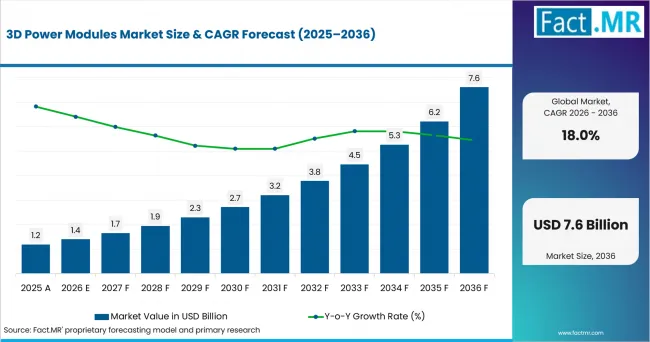
3d Power Modules Market Value Analysis | Source: Fact.MR
What are the defining numbers behind 3D Power Modules Market growth?
An absolute opportunity of USD 6.1 billion is expected between 2026 and 2036.
- Demand Drivers in the Market
- AI server power engineers need higher current density near accelerators because rack-level power loss becomes more visible as GPU utilization rises.
- Automotive inverter teams need compact SiC module layouts that reduce stray inductance and help keep traction systems within thermal limits.
- Industrial drive manufacturers need reliable power conversion modules for motors, robotics and automation equipment that operate across long duty cycles.
- Aerospace and defense electronics teams need lighter conversion hardware where space, heat spreading and qualification evidence shape design approval.
- Lawrence Berkeley National Laboratory reported in June 2026 that U.S. data centers could account for 11.8% of total U.S. electricity use by 2030, with modeled scenarios ranging from 9.5% to 15.3%.
- Key Segments Analyzed
- By Architecture: Edge AI is expected to hold 44.0% share in 2026 because accelerator boards need dense power delivery close to processors.
- By Packaging: 2.5D is projected to account for 42.0% share in 2026 as interposer and substrate routes balance density with qualification effort.
- By Function: Inference is anticipated to capture 46.0% share in 2026 since served AI requests convert power continuously during operation.
- By End Use: Automotive is estimated to represent 32.0% share in 2026 owing to inverter, onboard charger and DC-DC converter redesigns.
- Analyst Opinion at Fact.MR
- Shambhu Nath Jha, Principal Consultant at Fact.MR, states, "Package geometry now guides power-efficiency decisions in crowded AI boards and high-voltage vehicles. The market is expected to expand as AI racks and high-voltage vehicles push conversion closer to the load. Suppliers that combine thermal models, lifetime data and package compatibility have a clearer route through customer approval."
- Strategic Implications
- Module vendors should publish thermal resistance, switching-loss and power-cycling data in formats that customer engineering teams can compare quickly.
- AI hardware designers should assess vertical delivery modules before board layout freeze because late power-stage changes raise redesign cost.
- Automotive Tier 1 teams should qualify compatible SiC package families early to reduce inverter redesign work across multiple vehicle platforms.
- Infineon launched OptiMOS TDM2454xx quad-phase power modules in March 2025 with true vertical power delivery and 2 A per mm2 current density for AI data centers.
UK is anticipated to record 21.0% CAGR through 2036 supported by zero-emission vehicle uptake and semiconductor design capability. USA is projected to advance at 20.1% CAGR as AI data centers and electronics output increase demand for dense conversion. Germany is forecast to post 19.3% CAGR because industrial machinery and EV programs keep power-module qualification active. South Korea is estimated to hold 18.7% CAGR owing to semiconductor exports and electrified vehicle programs. Japan is expected to reach 14.6% CAGR with semiconductor investment and domestic power-device expertise supporting packaging development.
How does the 3D Power Modules Market break down by segment?
Edge AI leads Architecture at 44.0%; Inference leads Function at 46.0%.
Which Architecture dominates?
Edge AI is expected to hold 44.0% share in 2026.
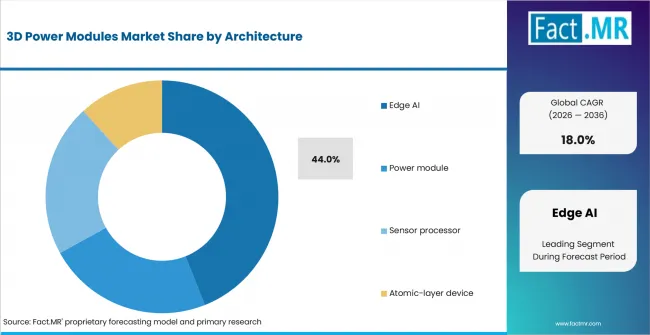
3d Power Modules Market Analysis By Architecture | Source: Fact.MR
Edge AI leads because accelerator boards place heavy current demand near processors and memory. 3D modules support short power paths and localized heat transfer within smaller layouts. This architecture remains tied to AI inference boards where voltage regulation, response time and package height are part of system design.
What leads the Packaging segment?
2.5D is projected to account for 42.0% share in 2026.
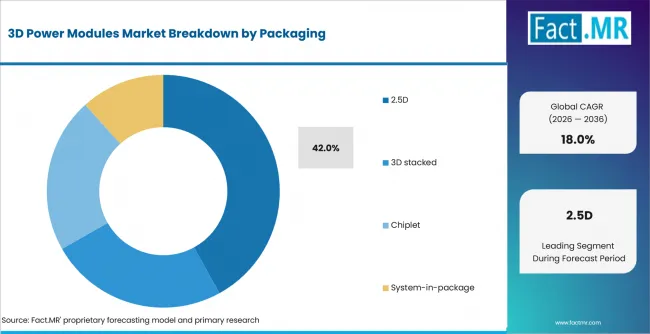
3d Power Modules Market Analysis By Packaging | Source: Fact.MR
2.5D packaging leads as it gives design teams higher interconnect density without moving directly into fully stacked packages. Mitsubishi Electric announced on April 15, 2025 that it would begin shipping samples of its Full SiC and Hybrid SiC SLIMDIP modules on April 22. The company reported that the Full SiC SLIMDIP reduces power loss by 79% compared with its current Si-based RC-IGBT SLIMDIP under Mitsubishi Electric's simulation conditions.
How does Function shape demand?
Inference is anticipated to capture 46.0% share in 2026.
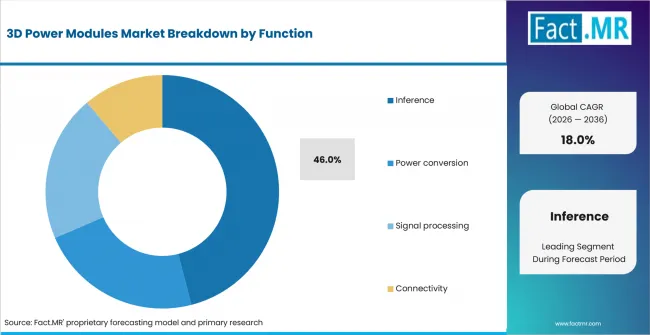
3d Power Modules Market Analysis By Function | Source: Fact.MR
Inference leads because AI servers convert power during every model request and every accelerator cycle. STMicroelectronics said in March 2026 that its 800 VDC portfolio includes 12 V and 6 V output stages for AI data center architectures. These systems favor compact power paths near high-current compute devices.
What supports Automotive within End Use?
Automotive is estimated to represent 32.0% share in 2026.
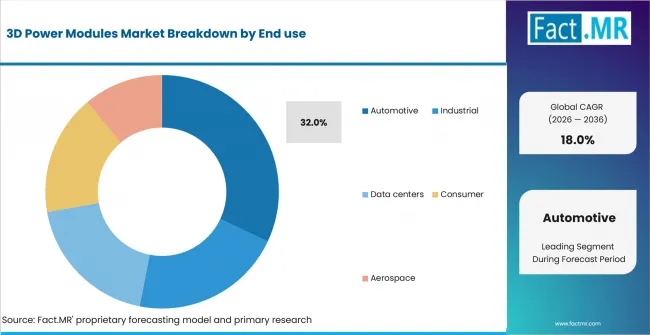
3d Power Modules Market Analysis By End Use | Source: Fact.MR
Automotive demand is shaped by inverter, onboard charger and DC-DC converter redesigns in high-voltage vehicles. SiC modules must prove thermal reliability and package compatibility before platform approval. The segment has a direct link to traction inverter systems where conversion efficiency affects range and cooling load.
What is accelerating 3D Power Modules Market adoption, and what is holding it back?
Demand is expected to rise through AI power density, EV inverter redesign and industrial efficiency needs.
Drivers Impact Analysis
| DRIVER | (~) % IMPACT ON CAGR | GEOGRAPHIC RELEVANCE | IMPACT TIMELINE |
|---|---|---|---|
| AI rack power-density requirements | +2.0% | USA, Europe, East Asia | Short term (<= 2 years) |
| High-voltage EV inverter redesign | +1.7% | USA, Germany, South Korea, Japan | Medium term (2-4 years) |
| SiC and GaN module qualification | +1.2% | Japan, Germany, South Korea | Medium term (2-4 years) |
| Industrial motor-drive efficiency upgrades | +0.8% | Global | Long term (>= 4 years) |
- AI rack power-density requirements: High-current accelerator boards increase pressure on point-of-load conversion. 3D power modules help shorten delivery paths and manage local heat.
- High-voltage EV inverter redesign: Automakers are moving toward compact 800 V platforms. This increases the value of low-loss SiC modules and compatible package formats.
- SiC and GaN module qualification: Wide-bandgap devices increase switching speed. The package must control heat and parasitic effects before design teams approve volume use.
- Industrial motor-drive efficiency upgrades: Factory drives and robotics require dependable conversion hardware. Longer equipment lives make package reliability evidence central to approval.
Opportunity Impact Analysis
| OPPORTUNITY | (~) % IMPACT ON CAGR | GEOGRAPHIC RELEVANCE | IMPACT TIMELINE |
|---|---|---|---|
| Vertical power delivery for AI accelerators | +1.4% | USA, UK, South Korea | Short term (<= 2 years) |
| Mechanically compatible EV modules | +1.1% | Germany, Japan, South Korea | Medium term (2-4 years) |
| Thermal simulation and design support | +0.7% | Global | Long term (>= 4 years) |
- Vertical power delivery for AI accelerators: Suppliers can win design slots by reducing board area and current-path losses around processors.
- Mechanically compatible EV modules: Standard package geometry reduces redesign work for inverter makers and improves second-source options.
- Thermal simulation and design support: Module providers can speed customer approval when they pair products with validated loss and temperature models.
Restraints Impact Analysis
| RESTRAINT | (~) % IMPACT ON CAGR | GEOGRAPHIC RELEVANCE | IMPACT TIMELINE |
|---|---|---|---|
| Long automotive qualification cycles | -0.7% | USA, Germany, Japan, South Korea | Short term (<= 2 years) |
| Thermal reliability evidence burden | -0.5% | Global | Medium term (2-4 years) |
| High package and substrate cost | -0.4% | Europe, East Asia | Medium term (2-4 years) |
- Long automotive qualification cycles: Power modules pass inverter-level testing before automakers approve platform use, which delays revenue recognition.
- Thermal reliability evidence burden: Dense modules move heat through smaller paths. Customers require lifetime and cycling data before replacing established layouts.
- High package and substrate cost: Advanced interconnects, ceramic substrates and wide-bandgap devices raise bill-of-material pressure in cost-sensitive platforms.
Which countries are scaling the 3D Power Modules Market through 2036?
- The country comparison spans 6.4 percentage points and forms three practical growth bands across the forecast period.
- UK remains 0.9 percentage point above USA through zero-emission vehicle uptake and semiconductor design depth.
- USA remains 0.8 percentage point above Germany as data center power demand and electronics production support compact conversion.
- Germany remains 0.6 percentage point above South Korea through machinery orders, automotive engineering and industrial drive demand.
- South Korea remains 4.1 percentage points above Japan as semiconductor exports keep power electronics ecosystems active.
- Japan closes the displayed range through semiconductor investment, SiC device work and domestic electronics qualification.
Comparable CAGRs create different entry conditions due to semiconductor capacity, EV platform timing, power availability and end-use qualification cycles. Full report coverage includes North America, Latin America, Western Europe, Eastern Europe, East Asia, South Asia & Pacific, Middle East & Africa.
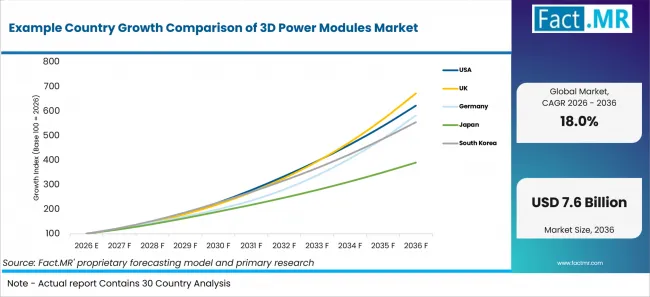
Example Country Growth Comparison Of 3d Power Modules Market | Source: Fact.MR
| Country | CAGR (2026-2036) |
|---|---|
| UK | 21.0% |
| USA | 20.1% |
| Germany | 19.3% |
| South Korea | 18.7% |
| Japan | 14.6% |
What supports UK adoption?
21.0% CAGR, supported by zero-emission vehicles and domestic semiconductor capability.
UK module demand is linked to electrified transport and compound semiconductor design work. The Department for Transport reported in April 2026 that 528,000 zero-emission vehicles were registered for the first time in the UK during 2025, up 24% from 2024.
What supports USA adoption?
20.1% CAGR, backed by data center power demand and electronics output.
3d Power Modules Market Value Analysis | Source: Fact.MR
USA adoption is shaped by AI infrastructure and domestic electronics production. The U.S. Census Bureau reported in July 2026 that new orders for computers and electronic products rose USD 0.9 billion to USD 31.1 billion in June 2026.
What supports Germany adoption?
19.3% CAGR, driven by machinery demand and automotive engineering.
Germany benefits from industrial equipment demand and deep inverter engineering capability. Destatis reported in August 2026 that manufacturing orders rose 3.1% in June 2026, with machinery and equipment orders up 12.7%.
How is South Korea scaling demand?
18.7% CAGR, supported by semiconductor exports and electrified vehicle platforms.
South Korea has a strong electronics base for power module packaging and customer qualification. MOTIR reported in January 2026 that semiconductor exports rose 22.2% year on year to USD 173.4 billion in 2025.
How does Japan perform?
14.6% CAGR, led by semiconductor investment and domestic power-device expertise.
Japan remains tied to semiconductor policy and power-device manufacturing depth. METI said in November 2025 that it intended to invest 100 billion yen allocated in the fiscal 2025 initial budget in Rapidus through the Information-technology Promotion Agency.
Who leads the 3D Power Modules Market?
Infineon Technologies AG participates through high-density power modules for AI data centers and compact conversion boards. Mitsubishi Electric Corporation is active through SiC module development for consumer, industrial and automotive power stages. Fuji Electric Co., Ltd. supports the field through SiC module packaging and 3D wiring work for electrified vehicles.
onsemi competes through EliteSiC devices and traction-inverter solutions. In August 2025, the company announced that select Xiaomi YU7 electric SUV models feature an 800 V drive platform powered by its EliteSiC M3e technology, which is integrated into the traction inverter.
STMicroelectronics participates through 800 VDC power-conversion architectures for AI data centers, while Wolfspeed supplies SiC power modules for high-voltage and high-power applications. Across these portfolios, power density, thermal performance, switching losses, package options, qualification data and engineering support are relevant competitive considerations. Comprehensive design documentation, simulation tools and compatible package families can also support customer evaluation and system integration.
Which companies are the key providers?
Key companies include Infineon Technologies AG; Mitsubishi Electric Corporation; Fuji Electric Co., Ltd.; onsemi; STMicroelectronics N.V.; and Wolfspeed, Inc.
- Infineon Technologies AG
- Mitsubishi Electric Corporation
- Fuji Electric Co., Ltd.
- onsemi
- STMicroelectronics N.V.
- Wolfspeed, Inc.
Bibliography
- U.S. Census Bureau. (2026, July 27). Monthly advance report on durable goods manufacturers’ shipments, inventories, and orders.
- Department for Transport. (2026, April 29). Vehicle licensing statistics, United Kingdom: 2025. GOV.UK.
- Federal Statistical Office (Destatis). (2026, August 6). New orders in manufacturing in June 2026: +3.1% on the previous month.
- Ministry of Trade, Industry and Resources. (2026, January 2). Korea’s annual exports reach new highs in 2025.
- Ministry of Economy, Trade and Industry. (2025, November 21). Press conference by Minister Akazawa (Excerpt).
- Infineon Technologies AG. (2025, March 10). Infineon unveils next generation of high-density power modules for vertical power delivery (VPD) in AI data centers.
- Mitsubishi Electric Corporation. (2025, April 15). Mitsubishi Electric to ship Full-SiC and Hybrid-SiC SLIMDIP samples.
- STMicroelectronics. (2026, March 17). STMicroelectronics expands 800 VDC AI datacenter power conversion portfolio with new 12V and 6V architectures in collaboration with NVIDIA.
- onsemi. (2025, August 4). onsemi powers Xiaomi’s YU7 electric SUV line-up.
- Fuji Electric Co., Ltd. (2026, May 27). Semiconductor business strategies for FY2026.
- Wolfspeed, Inc. (2026, May 21). Wolfspeed introduces new 3.3 kV SiC power modules in two industry-standard footprints to address the surging demand for energy.
This Report Answers
- The report explains where 3D power modules are used across architecture, packaging, function and end use.
- Segment analysis identifies the subsegments that carry the largest 2026 shares and the engineering reasons customers approve dense module designs.
- Country analysis examines the listed markets and the semiconductor, EV or power-demand mechanisms supporting adoption.
- Competitive analysis reviews active providers across power modules, SiC devices, data center power and automotive conversion.
- Application analysis considers how package density, thermal reliability and qualification data influence purchase decisions.
What does the 3D Power Modules Market cover?
The 3D Power Modules Market covers packaged power semiconductor modules used to improve conversion density, thermal behavior and current delivery. The scope includes module architectures linked to automotive power electronics, SiC traction modules and SiC power inverter applications where packaging affects system efficiency.
The assessment covers automotive, industrial, data center, consumer and aerospace use cases. It considers adjacent demand from automotive semiconductor, automotive electronics and electric vehicle components when the product depends on compact power conversion.
What is included in the scope?
The scope includes discrete and integrated 3D power modules, SiC modules, GaN-supported conversion boards and compact packages used in inverter, PSU and converter assemblies. It includes applications linked to traction inverter systems and digital power conversion where module packaging is part of the product value.
It includes modules used by semiconductor suppliers, power electronics manufacturers, automotive Tier 1s and equipment OEMs. Related technologies such as SiC and GaN power semiconductor devices and GPU thermal modules are covered when they directly support power module assemblies.
What is excluded from the scope?
Outside the scope are bare wafers, standalone discrete transistors and commodity passive components sold separately from a module package. General semiconductor design software and board assembly services fall outside the definition when the delivered item is outside a 3D power module product.
Battery cells, complete electric drivetrains, complete data center racks and finished consumer devices are treated as end-use indicators. They are outside the revenue boundary for 3D power modules.
How Was the Analysis Built?
The analysis draws on 120+ sources, 35+ company portfolios, 25+ countries, and more than 20 industry interviews.
- Primary Research: Primary research includes discussions with manufacturers, module suppliers, technology developers, distributors, end users, procurement teams and subject-matter experts. These conversations examine purchasing priorities, product adoption, operational hurdles, approval requirements, competitive positioning and the factors that influence wider market acceptance.
- Desk Research: Desk research covers government statistics, regulatory publications, company filings, trade data, technical studies, industry associations, standards, public policy and other authoritative material. The bibliography documents the public evidence used in the analysis.
- Market Sizing and Forecasting: Market estimates combine historical performance, demand indicators, pricing and volume trends, segment shares, company participation, country-level growth, adoption patterns, investment activity and barriers to market expansion.
- Data Validation and Update Cycle: Findings are validated by comparing primary interviews with public data, company activity, regulatory changes, trade patterns and industry developments. Regular updates review new product launches, capacity changes, partnerships, approvals, procurement trends and shifts in commercial adoption.
What is the report's scope and coverage?
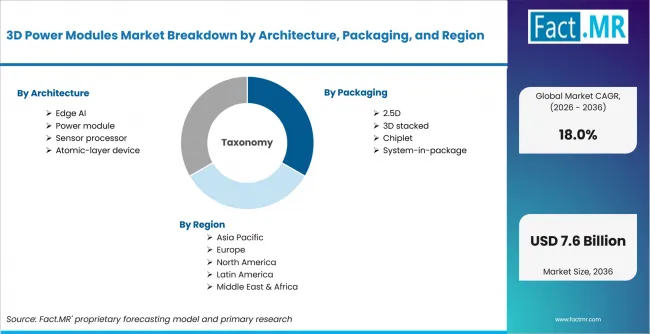
3d Power Modules Market Breakdown By Architecture, Packaging, And Region | Source: Fact.MR
| Attribute | Details |
|---|---|
| Quantitative Units | USD billion in 2026 to USD billion by 2036 at an CAGR |
| Market Definition | 3D power modules are compact power semiconductor module assemblies that use vertical, stacked, embedded or high-density packaging to improve current delivery, heat flow and conversion efficiency. |
| Architecture | Edge AI; Power module; Sensor processor; Atomic-layer device |
| Packaging | 2.5D; 3D stacked; Chiplet; System-in-package |
| Function | Inference; Power conversion; Signal processing; Connectivity |
| End Use | Automotive; Industrial; Data centers; Consumer; Aerospace |
| Regions Covered | North America; Latin America; Western Europe; Eastern Europe; East Asia; South Asia & Pacific; Middle East & Africa |
| Countries Covered | UK; USA; Germany; South Korea; Japan |
| Key Companies Profiled | Infineon Technologies AG; Mitsubishi Electric Corporation; Fuji Electric Co., Ltd.; onsemi; STMicroelectronics N.V.; Wolfspeed, Inc. |
| Forecast Period | 2026 to 2036 |
| Approach | Hybrid top-down and bottom-up approach using end-use module demand, power semiconductor portfolios, package adoption, country growth and provider activity. |
How is the market segmented?
-
By Architecture
- Edge AI
- Power module
- Sensor processor
- Atomic-layer device
-
By Packaging
- 2.5D
- 3D stacked
- Chiplet
- System-in-package
-
By Function
- Inference
- Power conversion
- Signal processing
- Connectivity
-
By End Use
- Automotive
- Industrial
- Data centers
- Consumer
- Aerospace
-
By Region
- North America
- Latin America
- Western Europe
- Eastern Europe
- East Asia
- South Asia & Pacific
- Middle East & Africa