- Base Value(2025): 3.5 Bn
- Estimated Value(2026): 4.4 Bn
- Forecast Value (2036): 36.7 Bn
- CAGR (2026 - 2036): 26.5%
3D Printing in Aerospace and Defense Market Forecast 2026 to 2036
In 2025, the 3D printing in aerospace and defense market was valued at USD 3.5 billion. Based on Fact MR's analysis, demand for 3D printing in aerospace and defense is estimated to grow to USD 4.4 billion in 2026 and USD 36.7 billion by 2036. FMR projects a CAGR of 26.5% during the forecast period.
The absolute dollar growth from 2026 to 2036 is USD 32.3 billion. This explosive growth is driven by the increasing adoption of 3D printing technologies in aerospace and defense for producing lightweight, high-strength components, reducing manufacturing costs, and accelerating production timelines. As the aerospace and defense industries push for more sustainable, efficient manufacturing solutions, 3D printing is emerging as a critical tool for innovation. However, challenges such as material limitations, high initial setup costs, and the need for skilled labor may affect growth in certain regions.
As Foster Ferguson, Vice President of the Industrial Business Unit at Stratasys, noted regarding additive manufacturing adoption in aerospace and defense,
‘By combining best-in-class performance with an established qualification framework, we’re empowering manufacturers to innovate faster and confidently deploy 3D printing for qualified end-use applications at multiple locations across an enterprise.’
The USA leads with a CAGR of 28%, driven by heavy investments in advanced manufacturing technologies and the demand for precision components in aerospace and defense. China follows with a 27% CAGR, supported by its growing aerospace and defense sectors and increasing focus on cutting-edge manufacturing techniques. India shows growth at 25%, fueled by the rapid expansion of its aerospace and defense industries. The UK grows at 24.5%, benefiting from the integration of 3D printing into defense manufacturing and aerospace innovation. Germany grows at 23%, reflecting its strong aerospace and defense industry with a focus on technological advancements in manufacturing.
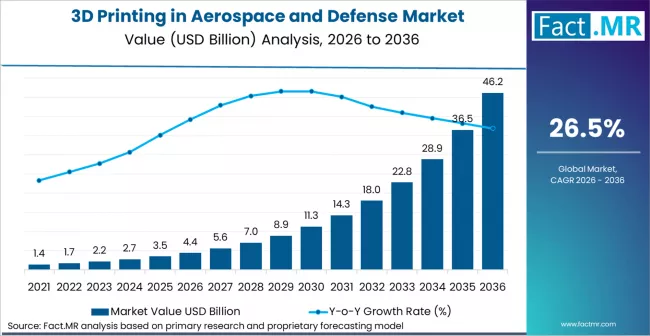
3d Printing In Aerospace And Defense Market Market Value Analysis | Source: Fact.MR
3D Printing in Aerospace and Defense Market
| Metric | Value |
|---|---|
| Estimated Value in (2026E) | USD 4.4 billion |
| Forecast Value in (2036F) | USD 36.7 billion |
| Forecast CAGR (2026 to 2036) | 26.5% |
Source: Fact.MR analysis. Updated Mar 3, 2026
3D Printing in Aerospace and Defense Market Definition
The 3D Printing in Aerospace and Defense Market involves the use and sale of additive manufacturing technologies, materials, and services to produce parts and components for aircraft, spacecraft, missiles, and defense systems, enabling lightweight design, complex geometries, and supply‑chain efficiency.
Market Inclusions
This report covers global and regional market sizes for 3D printing in aerospace and defense over a defined forecast period, including technology types (metal, polymer), application categories (structural parts, engine components, tooling), and end‑use segments (commercial aerospace, military, space).
Market Exclusions
The scope excludes 3D printing applications outside aerospace and defense, unrelated manufacturing methods, and finished systems or platforms not directly tied to additive production activities.
Research Methodology
Primary Research: Interviews were conducted with aerospace and defense engineers, additive manufacturing specialists, and procurement leads.
Desk Research: Data was sourced from industry reports, defense publications, and trade association statistics.
Market‑Sizing and Forecasting: A hybrid model combining top‑down industry demand forecasts with bottom‑up technology deployment and revenue data was used.
Data Validation and Update Cycle: Findings were validated through expert review and aligned with recent adoption and production figures.
Summary of the 3D Printing in Aerospace and Defense Market
- Market Definition
- The 3D Printing in Aerospace and Defense Market involves the use of additive manufacturing technologies to produce parts and components for aircraft, spacecraft, military systems, and defense technologies. These technologies enable the production of lightweight, complex, and high-performance components, offering advantages in design flexibility, cost reduction, and accelerated production timelines.
- Demand Drivers
- Increased Adoption of Additive Manufacturing: Aerospace and defense industries are increasingly adopting 3D printing for creating lightweight, high-strength components that offer superior performance and cost efficiency compared to traditional manufacturing methods.
- Cost-Effective Production: 3D printing reduces the need for expensive molds and tooling, thereby lowering manufacturing costs. This is particularly beneficial for military and defense sectors where component customizations are often needed.
- Sustainability Focus: The drive for more sustainable and energy-efficient manufacturing solutions has accelerated the adoption of 3D printing technologies, as they reduce material waste and energy consumption.
- Need for Precision and Complexity: 3D printing allows the creation of highly complex parts that would be impossible or prohibitively expensive to produce using traditional methods, making it invaluable for the production of aerospace and defense components.
- Key Segments Analyzed
- Application: Aircraft is projected to account for 65% of the market share by 2026, driven by demand for lightweight components in commercial, military, and business aircraft.
- Material: Alloys, particularly titanium and aluminum-based alloys, are expected to dominate the material segment with a 70% market share in 2026.
- Geography: The USA leads with a CAGR of 28%, followed by China (27%) and India (25%).
- Analyst Opinion at FMR
Shambhu Nath Jha, Principal Consultant at Fact MR, states, “The 3D printing market in aerospace and defense is poised for exponential growth. As industries look to innovate and improve manufacturing processes, additive manufacturing is emerging as a transformative tool, especially in producing lightweight and cost-efficient components.”
- Strategic Implications/Executive Takeaways
- Focus on Alloys and Materials Innovation: Manufacturers should invest in developing advanced materials, particularly high-strength alloys and specialized metals, to meet the unique demands of aerospace and defense applications.
- Increase Collaboration with OEMs and Defense Contractors: Collaboration between 3D printing companies and major OEMs in aerospace and defense can drive adoption by ensuring compatibility and meeting certification requirements.
- Expand Global Reach: As adoption increases in emerging markets, especially China and India, companies should consider expanding their presence to capture growth in these regions.
- Methodology
- Primary research through interviews with aerospace and defense engineers, additive manufacturing specialists, and procurement leads.
- Data sourced from industry reports, defense publications, and trade association statistics.
- Market sizing and forecasting using a hybrid model combining top-down industry demand with bottom-up technology deployment and revenue data.
Segmental Analysis
3D Printing in Aerospace and Defense Market Analysis by Application
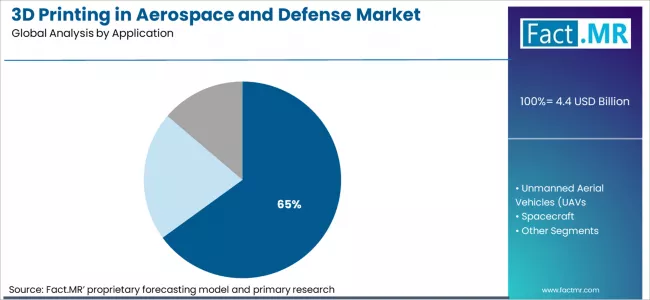
3d Printing In Aerospace And Defense Market Analysis By Application | Source: Fact.MR
- Market Overview: Aircraft is projected to capture 65% of the market share by 2026. The aerospace industry increasingly uses 3D printing for various applications in aircraft manufacturing, including lightweight parts, prototypes, and components that offer superior performance and cost efficiency.
- Demand Drivers:
- Weight Reduction and Fuel Efficiency: 3D printing allows for the creation of complex, lightweight structures that reduce the overall weight of aircraft, which is crucial for improving fuel efficiency. This is particularly valuable for commercial and military aircraft, where fuel costs are a major expense.
- Customization and Part Complexity: 3D printing enables the production of customized parts with complex geometries that would be difficult or impossible to create using traditional manufacturing methods. This capability is critical for modern aircraft design, which often requires bespoke components for optimal performance.
- Cost-Effective Production and Speed: 3D printing reduces production costs by eliminating the need for expensive molds and tooling. It also shortens production timelines, making it ideal for both prototyping and the manufacturing of final parts in the aerospace industry.
3D Printing in Aerospace and Defense Market Analysis by Material
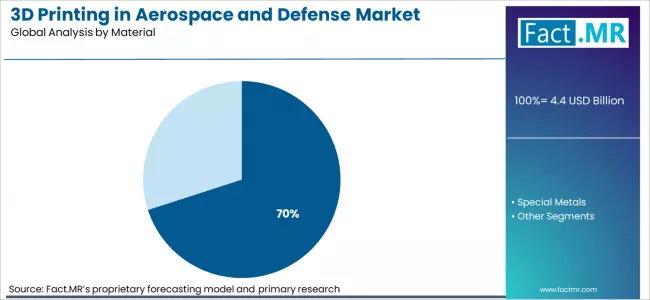
3d Printing In Aerospace And Defense Market Analysis By Material | Source: Fact.MR
- Market Overview: Alloys are expected to capture 70% of the market share by 2026. Alloys, especially titanium and aluminum-based alloys, are extensively used in 3D printing for aerospace and defense applications due to their strength, durability, and ability to withstand extreme temperatures and pressures.
- Demand Drivers:
- High Strength-to-Weight Ratio: Alloys like titanium and aluminum offer an excellent strength-to-weight ratio, making them ideal for 3D printing of critical aerospace components. These materials are necessary for parts that need to endure high stress and temperature fluctuations, such as engine parts, structural components, and frames.
- Customization for Aerospace Components: Alloys can be tailored in 3D printing to meet the specific mechanical and thermal properties required for aerospace and defense applications. This customization is a major advantage in designing advanced components like turbines, brackets, and airframes.
- Advancements in Metal 3D Printing: The ongoing development of metal 3D printing technologies, particularly for alloys, is expanding their use in aerospace and defense. These advancements allow for the production of highly durable, lightweight components that are both cost-effective and efficient.
3D Printing in Aerospace and Defense Market Drivers, Restraints, and Opportunities
FMR analysts observe that the 3D printing in aerospace and defense market is a growth‑aligned, technology‑driven segment propelled by demand for lightweight, high‑strength, and complex components that conventional manufacturing cannot efficiently produce. Historically, subtractive machining and casting were predominant; as OEMs and tier suppliers pursue weight reduction, part consolidation, and shorter lead times, structural demand emerged for additive manufacturing (AM) technologies that enable design freedom and performance optimization. The 2026 valuation reflects this shift, with adoption tied to qualification of certified AM parts, supply chain digitization, and cost‑efficiency pressure in mission‑critical programs.
While traditional manufacturing remains dominant for high‑volume legacy parts, aerospace and defense programs increasingly specify 3D‑printed components for complex geometries, rapid prototyping, and low‑volume specialized builds. These advanced AM parts and systems carry higher per‑unit pricing, contributing to net market value growth even though overall unit volumes expand in line with fleet modernization and defense procurement cycles. The market exists because 3D printing addresses design challenges, reduces material waste, and supports production agility where conventional methods face limitations.
- Performance & Weight Optimization: Airframers and defense OEMs adopt 3D printing to produce intricate, lightweight parts that replace heavier, traditionally machined components.
- Certification & Standards Influence: Aviation and defense qualification frameworks push adoption of certified additive parts that meet strict mechanical and traceability criteria.
- Regional Defense Investment Trends: In North America and Europe, high aerospace and defense R&D and procurement activity drive stronger uptake of AM technologies than in regions with lower defense spending.
Regional Analysis
The market analysis covers key global regions, including North America, East Asia, South Asia, and Western Europe. It is segmented geographically, with specific market dynamics for each region. The full report provides a detailed market attractiveness analysis.
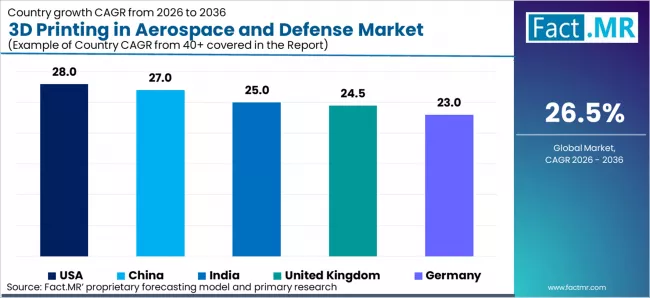
3d Printing In Aerospace And Defense Market Cagr Analysis By Country | Source: Fact.MR
| Country | CAGR (2026-2036) |
|---|---|
| USA | 28% |
| China | 27% |
| India | 25% |
| United Kingdom | 24.5% |
| Germany | 23% |
Source: Fact.MR analysis. Updated Mar 3, 2026
Source: Fact MR (FMR) analysis, based on proprietary forecasting model and primary research.
North America
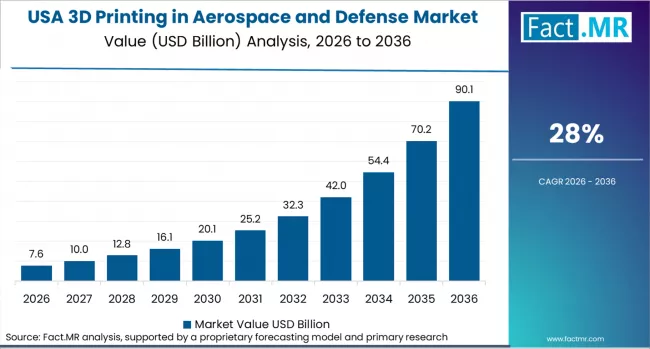
3d Printing In Aerospace And Defense Market Country Value Analysis | Source: Fact.MR
In North America, the USA is the leading market for 3D printing in aerospace and defense, driven by the country's advanced aerospace sector, increasing adoption of additive manufacturing technologies, and continuous investment in defense technologies.
- USA: Demand for 3D printing in aerospace and defense in the U.S. is projected to rise at 28% CAGR through 2036. The USA’s strong aerospace and defense industry and rapid adoption of 3D printing technologies for prototyping and manufacturing continue to drive market growth.
East Asia
In East Asia, China is a major player in the 3D printing market for aerospace and defense, supported by the country’s growing aerospace industry, increasing investments in defense technologies, and the adoption of advanced manufacturing solutions.
- China: Demand for 3D printing in aerospace and defense in China is projected to rise at 27% CAGR through 2036. China’s growing aerospace manufacturing capabilities and increased defense spending contribute to the strong growth of the 3D printing market.
South Asia
In South Asia, India is experiencing rapid growth in the 3D printing market for aerospace and defense, driven by technological advancements, government initiatives, and increasing investments in defense and aerospace sectors.
- India: Demand for 3D printing in aerospace and defense in India is projected to rise at 25% CAGR through 2036. India’s expanding aerospace sector and increasing adoption of additive manufacturing technologies continue to fuel market growth.
Western Europe
In Western Europe, the United Kingdom and Germany are significant markets for 3D printing in aerospace and defense, supported by strong industrial sectors, rising demand for innovation in defense, and the adoption of additive manufacturing for parts production.
- United Kingdom: Demand for 3D printing in aerospace and defense in the UK is projected to rise at 24.5% CAGR through 2036. The UK’s aerospace and defense industry and increased interest in 3D printing for lightweight parts production contribute to steady market growth.
- Germany: Demand for 3D printing in aerospace and defense in Germany is projected to rise at 23% CAGR through 2036. Germany’s advanced manufacturing capabilities and rising demand for additive manufacturing technologies in aerospace and defense applications continue to support market growth.
Fact MR's analysis of the 3D Printing in Aerospace and Defense Market in North America, East Asia, South Asia, Western Europe consists of country-wise assessments that include the USA, China, India, the United Kingdom, and Germany. Readers can find detailed trends, regulatory updates, and company-specific investments shaping the market’s growth in these countries.
How Are Key Players Competing in the 3D Printing in Aerospace and Defense Market?
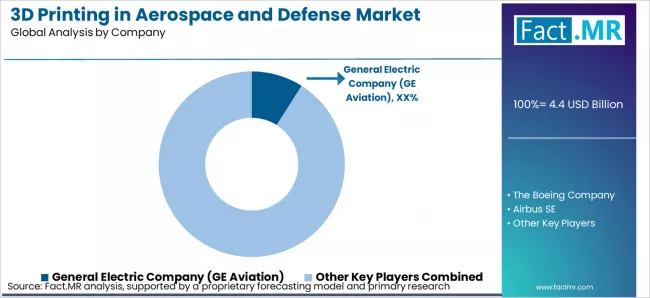
3d Printing In Aerospace And Defense Market Analysis By Company | Source: Fact.MR
In the 3D printing in aerospace and defense market, major players like General Electric (GE Aviation), Boeing, and Airbus are leveraging 3D printing for rapid prototyping, customized parts production, and weight reduction in aircraft manufacturing. Companies like Honeywell and Safran focus on improving the efficiency and performance of aircraft components through additive manufacturing, while Raytheon Technologies and L3Harris utilize 3D printing to produce specialized defense components and systems. MTU Aero Engines and American Additive Manufacturing emphasize the development of advanced turbine components and aerospace materials, using 3D printing for complex geometries. Leading companies like Lockheed Martin and Northrop Grumman are investing in innovative 3D printing techniques to produce lighter, stronger, and more reliable defense equipment. Meanwhile, Rolls-Royce and Spirit AeroSystems focus on integrating 3D-printed components into their aircraft engines. Companies like GKN Aerospace, Materialise NV, and Stratasys provide key 3D printing solutions, including software and hardware for the aerospace and defense sectors. Competitors differentiate themselves through materials innovation, speed, cost-efficiency, and the ability to produce complex parts that are difficult or impossible to achieve with traditional manufacturing methods.
Recent Industry Developments
- 3D Systems Air Force Contract and NDAA Tailwinds
- In August 2025, 3D Systems secured a $7.65 million contract from the U.S. Air Force to advance its large-format metal 3D printer (GEN-IIDMP-1000). By January 2026, the company projected its A&D segment would become its fastest-growing business, driven by the FY 2026 NDAA, which restricts foreign-sourced 3D printing systems for DoD programs.
- Supernova Industries Corp. Military Energetics Contract
- In January 2025, the American Center for Manufacturing & Innovation (ACMI) awarded Supernova Industries Corp. a $2 million contract to supply 3D-printed military energetic materials. This project utilizes Viscous Lithography Manufacturing (VLM) to produce safer and more consistent solid rocket motors and countermeasure flares.
- MadeHere K.K. U.S. Marine Corps MRO Contract
- In February 2026, Japanese service provider MadeHere K.K. showcased its maintenance, repair, and overhaul (MRO) solution at DIPEX 2026 following a contract award from the U.S. Marine Depot Maintenance Command (MDMC). The company utilizes 3D printing to reverse-engineer and manufacture obsolete naval components in as little as seven hours.
Key Players of the 3D Printing in Aerospace and Defense Market
- General Electric Company (GE Aviation)
- The Boeing Company
- Airbus SE
- Honeywell International Inc.
- Safran SA
- Raytheon Technologies Corporation
- L3Harris Technologies, Inc. (Aerojet Rocketdyne Holdings Inc.)
- MTU Aero Engines AG
- American Additive Manufacturing LLC
- Samuel, Son & Co., Limited
- Lockheed Martin Corporation
- Northrop Grumman Corporation
- Rolls-Royce plc
- Spirit AeroSystems Holdings, Inc.
- GKN Aerospace Ltd.
- Materialise NV
- Stratasys Ltd.
- 3D Systems Corporation
- EOS GmbH
- SLM Solutions Group AG
Report Scope
| Metric | Value |
|---|---|
| Quantitative Units | USD 4.4 billion (2026) to USD 36.7 billion (2036), at a CAGR of 26.5% |
| Market Definition | The 3D Printing in Aerospace and Defense Market includes the use of 3D printing technologies to manufacture components and systems used in aircraft, unmanned aerial vehicles (UAVs), and spacecraft. |
| By Application Segmentation | Aircraft (Commercial Aircraft, Military Aircraft, Business Jets, Helicopters), Unmanned Aerial Vehicles (Military Drones, Commercial Drones), Spacecraft (Satellites, Launch Vehicles, Spacecraft Components) |
| By Material Segmentation | Alloys (Titanium Alloys, Aluminum Alloys, Steel Alloys), Special Metals (Nickel Superalloys, Cobalt-Chrome Alloys, Refractory Metals) |
| Regions Covered | North America, Latin America, Europe, East Asia, South Asia, Oceania, Middle East and Africa |
| Countries Covered | United States, Canada, Mexico, Brazil, Argentina, Germany, France, United Kingdom, Italy, Spain, China, India, Japan, South Korea, Indonesia, Australia, and 40+ countries |
| Key Companies Profiled | General Electric Company (GE Aviation), The Boeing Company, Airbus SE, Honeywell International Inc., Safran SA, Raytheon Technologies Corporation, L3Harris Technologies, Inc. (Aerojet Rocketdyne Holdings Inc.), MTU Aero Engines AG, American Additive Manufacturing LLC, Samuel, Son & Co., Limited, Lockheed Martin Corporation, Northrop Grumman Corporation, Rolls-Royce plc, Spirit AeroSystems Holdings, Inc., GKN Aerospace Ltd., Materialise NV, Stratasys Ltd., 3D Systems Corporation, EOS GmbH, SLM Solutions Group AG |
| Forecast Period | 2026 to 2036 |
| Approach | Hybrid top-down and bottom-up market modeling validated through primary interviews with manufacturers and supported by trade data benchmarking and market research. |
Source: Fact.MR analysis. Updated Mar 3, 2026
Bibliographies
- Airbus SE. (2025). Additive manufacturing integration for high-performance aircraft components. Airbus SE.
- General Electric Company (GE Aerospace). (2025). Additive manufacturing solutions for aerospace engine components and defense systems. General Electric Company.
- Honeywell International Inc. (2025). Additive manufacturing technologies for aerospace and defense applications. Honeywell International Inc.
- Raytheon Technologies Corporation (RTX). (2025). Additive manufacturing applications for defense systems and aerospace production. Raytheon Technologies Corporation.
- The Boeing Company. (2025). 3D printing technologies for aerospace manufacturing and lightweight component production. The Boeing Company.
- 3D Systems. (2026, January). Aerospace and defense positioned as fastest-growing industrial segment following Air Force engagements and NDAA support [Press release]. 3D Systems.
- Australian Defence Magazine. (2026, February). MadeHere K.K. presents additive manufacturing MRO solution for U.S. Marine Corps at DIPEX 2026 [Industry report]. Australian Defence Magazine.
- Fortune Business Insights. (2025/2026). Aerospace 3D printing market size, share, and forecast 2034 [Industry analysis]. Fortune Business Insights.
This report addresses
- Market Intelligence enabling comprehensive assessment of leading countries and service segments across the 3D Printing in Aerospace and Defense Market globally.
- Market Volume (Sales Units) estimates and 10-year revenue forecasts from 2026 to 2036, validated through manufacturer shipment data, channel partner surveys, and country-level demand modeling.
- Growth Opportunity Mapping across application categories (Aircraft, UAVs, Spacecraft), materials (Alloys, Special Metals), and regions.
- Segment and Regional Revenue Forecasts by application, material, distribution channel, and geography across 40+ countries.
- Competition Strategy Analysis covering dealer network structure, recent developments, product portfolio, USPs, and market share analysis.
- Product and Regulatory Compliance Tracking aligned with aerospace and defense standards, materials, and safety certifications.
- Regulatory Impact Analysis addressing global market compliance, technological advancements in aerospace materials, and evolving 3D printing standards.
- Report Delivery in PDF, Excel, PowerPoint, and interactive dashboard formats for executive, procurement, and operational planning use.
Segmentation
3D Printing in Aerospace and Defense Market Key Segments
-
Application
- Aircraft
- Commercial Aircraft
- Military Aircraft
- Business Jets
- Helicopters
- Unmanned Aerial Vehicles (UAVs)
- Military Drones
- Commercial Drones
- Spacecraft
- Satellites
- Launch Vehicles
- Spacecraft Components
- Aircraft
-
Material
- Alloys
- Titanium Alloys
- Aluminum Alloys
- Steel Alloys
- Special Metals
- Nickel Superalloys (Inconel)
- Cobalt-Chrome Alloys
- Refractory Metals
- Alloys
-
Region
- North America
- USA
- Canada
- Mexico
- Europe
- Germany
- UK
- France
- Italy
- Spain
- Nordic Countries
- BENELUX
- Rest of Europe
- Asia Pacific
- China
- Japan
- South Korea
- India
- Australia
- Rest of Asia Pacific
- Latin America
- Brazil
- Argentina
- Rest of Latin America
- Middle East and Africa
- Kingdom of Saudi Arabia
- United Arab Emirates
- South Africa
- Rest of Middle East and Africa
- Other Regions
- Oceania
- Central Asia
- Other Markets
- North America
Frequently Asked Questions
How large is the demand for 3D Printing in Aerospace and Defense in the global market in 2026?
What will be the market size of 3D Printing in Aerospace and Defense in the global market by 2036?
What is the expected demand growth for 3D Printing in Aerospace and Defense in the global market between 2026 and 2036?
Which material is expected to dominate the market?
Which region is expected to show the highest growth rate for 3D Printing in Aerospace and Defense?
How significant is the growth outlook for China in this market?
What is the growth outlook for the United States in the 3D Printing in Aerospace and Defense market?
What is the growth forecast for the United Kingdom in the 3D Printing in Aerospace and Defense market?
What is the growth forecast for Germany in the 3D Printing in Aerospace and Defense market?
Which company is identified as a leading player in the 3D Printing in Aerospace and Defense market?
What is 3D Printing used for in Aerospace and Defense?
What does the 3D Printing in Aerospace and Defense market include in this report?
How is the market forecast developed in this report?
What is meant by the 3D Printing in Aerospace and Defense market in this report?
Who worked on this report


Preview the report firsthand - request a free sample
Free SampleGet the brochure for pricing and purchase details
Download PDF