3D Printed Aerospace Fasteners Market (2026 - 2036)

3D Printed Aerospace Fasteners Market is segmented by Printing Technology (LPBF Metal Printing, Binder Jet Metal, DED/WAAM, and Other), Material (Titanium Alloys, Inconel/Ni Alloys, Stainless Steels, and Other), End Use (Prototyping & Qualification, Low-Volume Production, MRO/Spare Parts, and Other), Sales Channel (Service Bureaus, OEM Captive Printing, Printer OEM Ecosystem, and Other), and Region. Forecast for 2026 to 2036.

Core Findings

    3D Printed Aerospace Fasteners Market Forecast 2026 to 2036

    In 2025, the 3D printed aerospace fasteners market was valued at USD 205 million. Based on Fact MR's analysis, demand for 3D printed aerospace fasteners is estimated to grow to USD 220 million in 2026 and USD 405 million by 2036. FMR projects a CAGR of 6.3% during the forecast period.

    The absolute dollar growth from 2026 to 2036 is USD 185 million. This growth is driven by the increasing adoption of 3D printing technologies in the aerospace sector, where fasteners produced via additive manufacturing provide lightweight, customizable, and cost-effective solutions. However, challenges related to material properties, manufacturing standards, and integration into existing aerospace systems may impact growth in certain regions.

    India leads with a CAGR of 9.2%, driven by the rapid growth of aerospace manufacturing and adoption of advanced manufacturing technologies. China follows with an 8.6% CAGR, supported by its expanding aerospace sector and the adoption of 3D printing technologies. South Korea grows at 6.3%, fueled by advancements in aerospace technology and demand for lightweight fasteners. The USA grows at 6.0%, driven by increasing aerospace production and the adoption of additive manufacturing. Germany grows at 5.5%, supported by the demand for innovative aerospace solutions. France and the UK grow at 5.2% and 5.1%, respectively, as the European aerospace industry continues to adopt 3D printing for various components. Japan experiences the slowest growth at 4.6%, influenced by its mature aerospace market and gradual adoption of 3D printing.
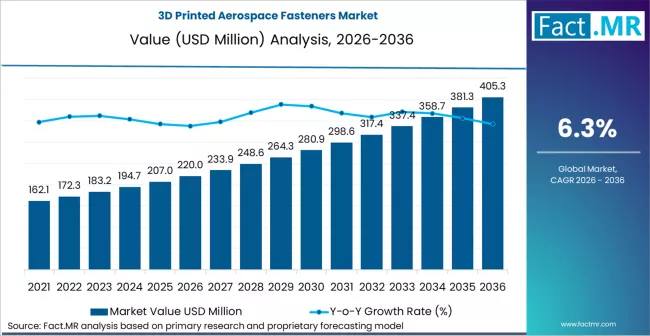
    3d Printed Aerospace Fasteners Market Market Value Analysis

    3D Printed Aerospace Fasteners Market Definition

    The 3D Printed Aerospace Fasteners Market refers to the production and sale of fastening components manufactured using additive manufacturing technologies for aerospace applications. These fasteners include bolts, nuts, clips, and bespoke connectors created layer by layer from metal powders or high‑performance polymers. Their primary function is to secure structural and systems assemblies while offering design flexibility, reduced weight, and potentially lower lead times. Key end uses include commercial and military aircraft, business jets, helicopters, satellites, and maintenance, repair, and overhaul (MRO) operations that benefit from custom or low‑volume parts.

    Market Inclusions

    This report covers global and regional market sizes for 3D printed aerospace fasteners with a defined forecast period. It includes segment breakdowns by fastener type (bolts, nuts, clips, bespoke designs), material (titanium, aluminum, high‑strength steels, advanced polymers), and aerospace application (commercial, military, general aviation, space). End users such as OEMs and MRO providers are analyzed. Pricing trends, raw material powder supply, and trade flow data are included to reflect overall market dynamics.

    Market Exclusions

    The scope excludes traditionally manufactured aerospace fasteners such as forged or machined bolts and rivets not produced via additive methods. Finished aircraft, complete assemblies, and unrelated hardware like electrical connectors or hydraulic fittings are not covered. Fasteners intended solely for non‑aerospace industries are omitted to focus strictly on additive manufacturing‑enabled aerospace joining solutions.

    Research Methodology

    • Primary Research: Interviews were conducted with additive manufacturing engineers, aerospace fastener designers, OEM procurement specialists, and MRO professionals.
    • Desk Research: Data was sourced from industry reports, aerospace manufacturing publications, and trade statistics.
    • Market‑Sizing and Forecasting: A hybrid model was used, combining top‑down aerospace fastener demand forecasts with bottom‑up shipment and revenue data.

    Data Validation and Update Cycle

    Findings were validated through expert review and aligned with recent production and trade figures, with periodic updates.

    3D Printed Aerospace Fasteners Market Summary

    3D Printed Aerospace Fasteners Market Definition

    The 3D Printed Aerospace Fasteners Market involves the production and sale of fastening components made through additive manufacturing technologies, particularly 3D printing, for aerospace applications. These fasteners, which include bolts, nuts, clips, and custom connectors, are produced layer by layer using advanced metal powders or high-performance polymers. The primary function of these fasteners is to secure structural and system assemblies in aircraft and spacecraft while offering design flexibility, reduced weight, and potentially faster production times. Key end uses for 3D printed aerospace fasteners include commercial and military aircraft, business jets, helicopters, satellites, and maintenance, repair, and overhaul (MRO) operations requiring custom or low-volume parts.

    Demand Drivers in the Market

    • Adoption of 3D Printing in Aerospace: The increasing use of additive manufacturing (AM) technologies in aerospace production is driving the market for 3D printed aerospace fasteners, as these solutions provide greater design freedom, reduced weight, and customizable features.
    • Need for Lightweight Components: The aerospace industry is increasingly focusing on reducing the weight of aircraft to improve fuel efficiency, and 3D printed fasteners made from lightweight materials like titanium alloys are increasingly popular.
    • Cost-Effectiveness and Efficiency: 3D printing offers aerospace manufacturers the ability to produce high-performance fasteners on-demand with minimal waste, significantly reducing production costs and lead times for low-volume and custom parts.
    • Regulatory and Certification Standards: With growing aerospace production, particularly in defense and commercial aircraft, the demand for certified 3D printed fasteners is rising, as they meet the stringent regulations for aerospace manufacturing and safety standards.

    Key Segments Analyzed in the FMR Report

    • Printing Technology: LPBF (Laser Powder Bed Fusion) is projected to dominate the market due to its ability to produce precise and high-strength aerospace fasteners with intricate geometries.
    • Material: Titanium alloys are expected to capture the largest market share, thanks to their superior strength-to-weight ratio and resistance to extreme temperatures, making them ideal for aerospace fasteners.
    • End Use: Low-volume production is anticipated to be the largest segment due to the growing demand for small batches of highly specialized and customized fasteners for aerospace applications.

    Analyst Opinion at FMR

    Fact MR analysts predict that "The 3D printed aerospace fasteners market will experience strong growth, driven by the adoption of 3D printing technologies for aerospace manufacturing and MRO operations, as manufacturers seek lightweight, customizable, and cost-effective fastening solutions."

    Strategic Implications/Executive Takeaways

    • Focus on Lightweight and High-Performance Fasteners: Manufacturers should prioritize producing fasteners with superior mechanical properties that reduce weight without compromising performance, especially for aerospace applications.
    • Customization and Flexibility: The ability to customize fasteners for specific aerospace components, particularly in low-volume and specialized applications, presents a significant opportunity for growth in the market.
    • Regulatory Compliance and Certification: Manufacturers must ensure that 3D printed fasteners comply with the strict regulatory standards of aviation authorities, such as the FAA and EASA, for certification and use in aerospace applications.
    • Emerging Market Opportunities: Growing aerospace industries in regions like India, China, and South Korea offer significant opportunities for the expansion of 3D printed aerospace fasteners, driven by advanced manufacturing technologies and the need for high-performance parts.

    Methodology

    • Primary Research: Interviews with aerospace engineers, additive manufacturing specialists, OEM procurement managers, and MRO professionals provided insights into the drivers and trends in the 3D printed aerospace fasteners market.
    • Desk Research: Data from industry reports, aerospace publications, and trade statistics were analyzed to supplement primary research findings.
    • Market Sizing and Forecasting: A hybrid approach, combining top-down industry demand estimates with bottom-up production data, was used to forecast market growth, validated through expert reviews and recent data on aerospace production and additive manufacturing trends.

    Segmental Analysis

    3D Printed Aerospace Fasteners Market Analysis by Printing Technology
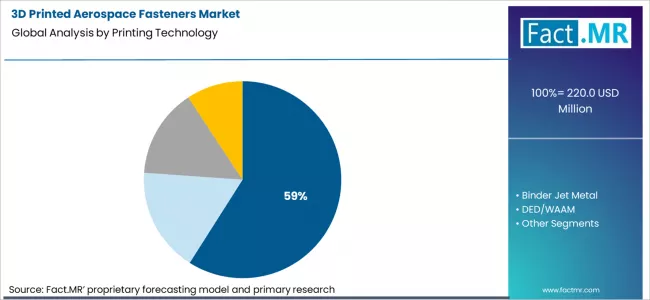
    3d Printed Aerospace Fasteners Market Analysis By Printing Technology

    • Market Overview: LPBF (Laser Powder Bed Fusion) metal printing is expected to capture 59% of the 3D printed aerospace fasteners market by 2026. LPBF is a widely used 3D printing technology in aerospace due to its ability to produce high-precision, high-strength parts with complex geometries. This method is particularly suited for fastener production, where both strength and accuracy are critical.
    • Demand Drivers:
      • Precision and Strength Requirements: LPBF is known for its ability to create highly accurate and strong parts. Aerospace fasteners, which require high mechanical performance and precise tolerances, benefit from LPBF's capabilities in producing intricate designs that are lightweight yet durable.
      • Customization and Complex Geometries: LPBF allows for the production of fasteners with complex geometries that would be difficult or impossible to manufacture with traditional methods, offering enhanced design flexibility for aerospace applications.
      • Cost-Effectiveness and Efficiency: As 3D printing technologies, particularly LPBF, become more refined, the cost of producing metal fasteners is decreasing. This is making it an increasingly attractive option for aerospace manufacturers looking for cost-effective, on-demand production solutions.

    3D Printed Aerospace Fasteners Market Analysis by Material
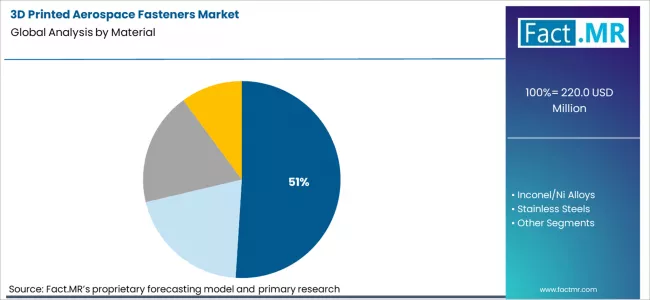
    3d Printed Aerospace Fasteners Market Analysis By Material

    • Market Overview: Titanium alloys are projected to hold 51% of the market share by 2026. Titanium alloys are known for their high strength-to-weight ratio, corrosion resistance, and ability to withstand extreme temperatures, making them ideal for aerospace fasteners, especially in applications where durability and performance are critical.
    • Demand Drivers:
      • High Performance in Extreme Conditions: Titanium alloys offer superior strength, lightweight properties, and resistance to heat and corrosion, making them essential for aerospace applications, particularly in engines and structural components where performance under extreme conditions is a priority.
      • Growing Demand for Lightweight Components: The aerospace industry continues to focus on reducing aircraft weight to improve fuel efficiency. Titanium alloys, due to their excellent strength-to-weight ratio, are increasingly being used in 3D printed aerospace fasteners to help meet these goals.
      • Durability and Longevity: Titanium alloys are highly durable and resistant to wear and corrosion, which ensures that fasteners made from these materials can withstand the harsh environments and high stresses found in aerospace applications.

    3D Printed Aerospace Fasteners Market Drivers, Restraints, and Opportunities

    FMR analysts observe that the 3D printed aerospace fasteners market is a growth‑transition segment tied to gradual adoption of additive manufacturing (AM) in aerospace production and MRO (maintenance, repair, overhaul) workflows. Historically, traditional subtractive machining supplied most fasteners; as aerospace OEMs and tier suppliers pursue weight optimization, part consolidation, and lead‑time reduction, AM emerged as a structural enabler for low‑volume, high‑complexity fasteners. The 2026 valuation reflects this shift, where AM is moving from prototyping toward certified production for select fastener types, even though conventional manufacturing still dominates.

    While demand for traditionally manufactured fasteners remains large, aerospace‑certified 3D printed fasteners are gaining share in niche, performance‑driven applications where design freedom and material efficiency matter. These AM fasteners command higher per‑unit prices, contributing to net market value growth even though volume share is modest. The market exists at its current size because regulators and OEMs require rigorous qualification and testing for 3D printed hardware, slowing broad replacement of legacy fastener inventories despite clear efficiency drivers.

    • Additive Manufacturing Adoption: Aerospace OEMs and MRO providers are specifying 3D printed fasteners to reduce part count, shorten lead times, and optimize designs for strength‑to‑weight in specialized assemblies.
    • Regulatory Certification Standards: Aviation regulators such as FAA and EASA require extensive testing and material certification for AM components, pushing manufacturers toward certified 3D printed fasteners that meet defined fatigue, strength, and traceability criteria.
    • Regional Aerospace Innovation: In North America and Europe, where aerospace AM programs and certification support are stronger, uptake of 3D printed fasteners outpaces regions where conventional manufacturing remains predominant.

    Regional Analysis

    The market analysis covers key global regions, including South Asia and Pacific, East Asia, North America, Western Europe, and Germany. It is segmented geographically, with specific market dynamics for each region. The full report provides a detailed market attractiveness analysis.
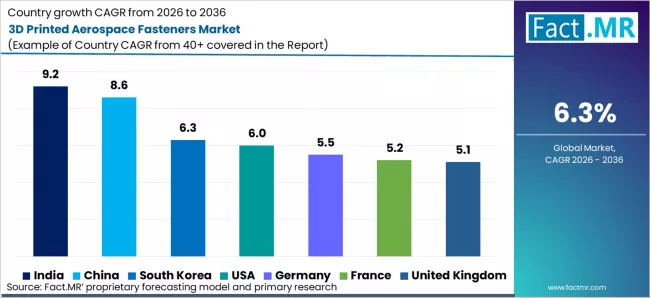
    3d Printed Aerospace Fasteners Market Cagr Analysis By Country

    Country CAGR (2026-2036)
    India 9.2%
    China 8.6%
    South Korea 6.3%
    USA 6.0%
    Germany 5.5%
    France 5.2%
    United Kingdom 5.1%
    Japan 4.6%

    Source: Fact MR (FMR) analysis, based on proprietary forecasting model and primary research.

    South Asia and Pacific:

    South Asia and Pacific are "emerging markets" for 3D printed aerospace fasteners, particularly driven by India and China, where aerospace industries are rapidly advancing, fueling the demand for advanced manufacturing technologies like 3D printing.

    • India: Demand for 3D printed aerospace fasteners in India is projected to rise at 9.2% CAGR through 2036. India’s growing aerospace and defense sector, combined with the adoption of advanced manufacturing technologies, such as 3D printing, supports strong growth in this market.
    • China: Demand for 3D printed aerospace fasteners in China is projected to rise at 8.6% CAGR through 2036. China’s large-scale aerospace production and advancements in 3D printing technologies continue to drive market demand for these fasteners.

    East Asia:

    East Asia remains a "key region for aerospace manufacturing," with strong demand for 3D printed aerospace fasteners driven by the region's focus on technological advancements in aerospace production.

    • South Korea: Demand for 3D printed aerospace fasteners in South Korea is projected to rise at 6.3% CAGR through 2036. South Korea’s growing aerospace sector and investment in advanced manufacturing solutions contribute to increasing demand for 3D printed fasteners.
    • Japan: Demand for 3D printed aerospace fasteners in Japan is projected to rise at 4.6% CAGR through 2036. Japan’s aerospace innovation and focus on lightweight, high-performance materials support steady demand for 3D printed aerospace fasteners.

    North America:

    North America, particularly the USA, continues to be a significant market for 3D printed aerospace fasteners, driven by growing adoption of additive manufacturing in aerospace and defense applications.

    • USA: Demand for 3D printed aerospace fasteners in the U.S. is projected to rise at 6.0% CAGR through 2036. The expansion of the aerospace and defense sectors and the growing adoption of additive manufacturing in production processes continue to drive the demand for 3D printed fasteners.

    Western Europe:

    In Western Europe, countries like Germany, France, and the UK remain "mature markets" for 3D printed aerospace fasteners, supported by strong aerospace industries and increasing demand for high-performance, lightweight materials.

    • Germany: Demand for 3D printed aerospace fasteners in Germany is projected to rise at 5.5% CAGR through 2036. Germany’s aerospace industry and its focus on advanced manufacturing techniques continue to support market growth for 3D printed fasteners.
    • France: Demand for 3D printed aerospace fasteners in France is projected to rise at 5.2% CAGR through 2036. France’s aerospace sector and growing adoption of 3D printing in aircraft production continue to drive demand for these fasteners.
    • United Kingdom: Demand for 3D printed aerospace fasteners in the UK is projected to rise at 5.1% CAGR through 2036. The UK’s aerospace innovation and focus on lightweight materials contribute to steady market growth.

    Fact MR's analysis of the 3D Printed Aerospace Fasteners Market in South Asia and Pacific, East Asia, North America, Western Europe, and Germany consists of country-wise assessments that include India, China, South Korea, the USA, France, Germany, the United Kingdom, and Japan. Readers can find detailed trends, regulatory updates, and company-specific investments shaping the market’s growth in these countries.

    How Are Key Players Competing in the 3D Printed Aerospace Fasteners Market?
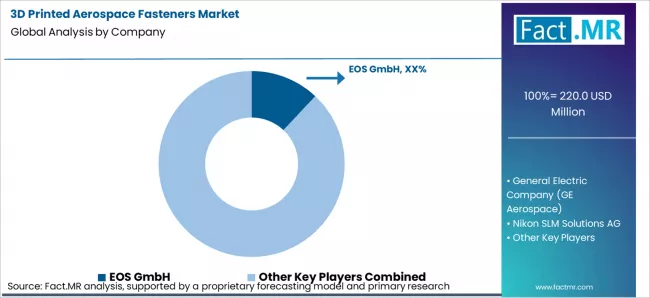
    3d Printed Aerospace Fasteners Market Analysis By Company

    The 3D printed aerospace fasteners market is driven by the increasing demand for lightweight, customizable, and high-strength components in aerospace applications. EOS GmbH and 3D Systems Corporation lead with their advanced 3D printing technologies that enable precision manufacturing of aerospace fasteners with high performance and complex geometries. General Electric Company (GE Aerospace) and GKN Aerospace Ltd. (GKN Additive) are focused on integrating additive manufacturing into their aerospace supply chains, enhancing speed and cost-efficiency. Stratasys Ltd. and Nikon SLM Solutions AG provide cutting-edge materials and 3D printing solutions for producing aerospace fasteners with optimized designs. Materialise NV and Renishaw plc focus on software and additive manufacturing platforms that ensure precision and reliability in aerospace fastener production. Velo3D, Inc. specializes in producing metal 3D printed parts that meet aerospace standards, while Carpenter Technology Corporation (Carpenter Additive) focuses on high-quality metal powders for 3D printing aerospace components. These companies compete by developing innovative materials, expanding production capabilities, and offering customizable solutions that meet the evolving demands of the aerospace sector.

    Recent Industry Developments

    • ASTM International (Committee F42) | New Business Case Standard F3774 | September 2025 ASTM approved a new standard (F3774) designed to provide a "digital thread" for the procurement and validation of additive manufactured parts, allowing aerospace agencies to standardize data package requirements across the global supply chain.
    • NIST (National Institute of Standards and Technology) | AM Bench 2025 Results | November 2025 NIST conducted its 2025 Additive Manufacturing Benchmark (AM Bench) series, releasing critical measurement data on high-cycle fatigue for Nickel Alloy 718, which serves as a 2026 baseline for modelers to predict the structural integrity of printed fasteners.
    • EASA & FAA | Joint Additive Manufacturing Workshop | October 2025 EASA and the FAA held their annual joint workshop in Cologne, specifically forming Working Group 2 (WG2) to develop a technical white paper on tailored Fatigue and Damage Tolerance (F&DT) methodologies for metal AM parts used in airframes and propulsion.

    Key Players of the 3D Printed Aerospace Fasteners Market

    • EOS GmbH
    • General Electric Company (GE Aerospace)
    • Nikon SLM Solutions AG
    • 3D Systems Corporation
    • Stratasys Ltd.
    • Materialise NV
    • Renishaw plc
    • Velo3D, Inc.
    • Carpenter Technology Corporation (Carpenter Additive)
    • GKN Aerospace Ltd. (GKN Additive)

    Report Scope

    Metric Value
    Quantitative Units USD 220 million (2026) to USD 405 million (2036), at a CAGR of 6.3%
    Market Definition The 3D Printed Aerospace Fasteners Market includes fasteners manufactured using 3D printing technologies, offering benefits such as design flexibility, reduced weight, and optimized performance for aerospace applications.
    By Printing Technology LPBF Metal Printing, Binder Jet Metal, DED/WAAM, Other
    By Material Titanium Alloys, Inconel/Ni Alloys, Stainless Steels, Other
    By End Use Prototyping & Qualification, Low-Volume Production, MRO/Spare Parts, Other
    By Sales Channel Service Bureaus, OEM Captive Printing, Printer OEM Ecosystem, Other
    Regions Covered North America, Latin America, Europe, East Asia, South Asia, Oceania, Middle East and Africa
    Countries Covered United States, Canada, Mexico, Brazil, Argentina, Germany, France, United Kingdom, Italy, Spain, China, India, Japan, South Korea, Indonesia, Australia, and 40+ countries
    Key Companies Profiled EOS GmbH, General Electric Company (GE Aerospace), Nikon SLM Solutions AG, 3D Systems Corporation, Stratasys Ltd., Materialise NV, Renishaw plc, Velo3D, Inc., Carpenter Technology Corporation (Carpenter Additive), GKN Aerospace Ltd. (GKN Additive)
    Forecast Period 2026 to 2036
    Approach Hybrid top-down and bottom-up market modeling validated through primary interviews with manufacturers and supported by trade data benchmarking and market research.

    3D Printed Aerospace Fasteners Market Key Segments

    • By Printing Technology :

      • LPBF Metal Printing
      • Binder Jet Metal
      • DED/WAAM
      • Other
    • By Material :

      • Titanium Alloys
      • Inconel/Ni Alloys
      • Stainless Steels
      • Other
    • By End Use :

      • Prototyping & Qualification
      • Low-Volume Production
      • MRO/Spare Parts
      • Other
    • By Sales Channel :

      • Service Bureaus
      • OEM Captive Printing
      • Printer OEM Ecosystem
      • Other
    • Region :

      • North America
        • USA
        • Canada
        • Mexico
      • Europe
        • Germany
        • UK
        • France
        • Italy
        • Spain
        • Nordic Countries
        • BENELUX
        • Rest of Europe
      • Asia Pacific
        • China
        • Japan
        • South Korea
        • India
        • Australia
        • Rest of Asia Pacific
      • Latin America
        • Brazil
        • Argentina
        • Rest of Latin America
      • Middle East and Africa
        • Kingdom of Saudi Arabia
        • United Arab Emirates
        • South Africa
        • Rest of Middle East and Africa
      • Other Regions
        • Oceania
        • Central Asia
        • Other Markets

    Bibliographies

    • ASTM International. (2025, September). ASTM F3774: Standard framework for procurement and validation of additive manufactured parts. ASTM International.
    • National Institute of Standards and Technology. (2025). AM Bench 2025 measurements and challenge problems. U.S. Department of Commerce, National Institute of Standards and Technology.
    • European Union Aviation Safety Agency. (2025, October). Joint EASA-FAA additive manufacturing workshop 2025: Qualification and certification of additive manufactured parts. European Union Aviation Safety Agency.
    • EOS GmbH. (2025). Additive manufacturing technologies for aerospace applications. EOS GmbH.
    • General Electric Company (GE Aerospace). (2025). Additive manufacturing technologies in aerospace component production. GE Aerospace.
    • Nikon SLM Solutions AG. (2025). Selective laser melting solutions for aerospace metal applications. Nikon SLM Solutions AG.
    • 3D Systems Corporation. (2025). Additive manufacturing technologies for precision aerospace components. 3D Systems Corporation.

    Table of Content

    1. Executive Summary
      • Global Market Outlook
      • Demand to side Trends
      • Supply to side Trends
      • Technology Roadmap Analysis
      • Analysis and Recommendations
    2. Market Overview
      • Market Coverage / Taxonomy
      • Market Definition / Scope / Limitations
    3. Research Methodology
      • Chapter Orientation
      • Analytical Lens and Working Hypotheses
        • Market Structure, Signals, and Trend Drivers
        • Benchmarking and Cross-market Comparability
        • Market Sizing, Forecasting, and Opportunity Mapping
      • Research Design and Evidence Framework
        • Desk Research Programme (Secondary Evidence)
          • Company Annual and Sustainability Reports
          • Peer-reviewed Journals and Academic Literature
          • Corporate Websites, Product Literature, and Technical Notes
          • Earnings Decks and Investor Briefings
          • Statutory Filings and Regulatory Disclosures
          • Technical White Papers and Standards Notes
          • Expert Input and Fieldwork (Primary Evidence)
            • Primary Modes
              • Qualitative Interviews and Expert Elicitation
              • Quantitative Surveys and Structured Data Capture
              • Blended Approach
            • Why Primary Evidence is Used
            • Field Techniques
              • Interviews
              • Surveys
              • Focus Groups
              • Observational and In-context Research
              • Social and Community Interactions
            • Stakeholder Universe Engaged
              • C-suite Leaders
              • Board Members
              • Presidents and Vice Presidents
              • R&D and Innovation Heads
              • Technical Specialists
              • Domain Subject-matter Experts
              • Scientists
              • Physicians and Other Healthcare Professionals
            • Governance, Ethics, and Data Stewardship
              • Research Ethics
              • Data Integrity and Handling
          • Tooling, Models, and Reference Databases
        • Data Engineering and Model Build
          • Data Acquisition and Ingestion
          • Cleaning, Normalisation, and Verification
          • Synthesis, Triangulation, and Analysis
        • Quality Assurance and Audit Trail
      • Market Background
        • Market Dynamics
          • Drivers
          • Restraints
          • Opportunity
          • Trends
        • Scenario Forecast
          • Demand in Optimistic Scenario
          • Demand in Likely Scenario
          • Demand in Conservative Scenario
        • Opportunity Map Analysis
        • Product Life Cycle Analysis
        • Supply Chain Analysis
        • Investment Feasibility Matrix
        • Value Chain Analysis
        • PESTLE and Porter’s Analysis
        • Regulatory Landscape
        • Regional Parent Market Outlook
        • Production and Consumption Statistics
        • Import and Export Statistics
      • Global Market Analysis 2021 to 2025 and Forecast, 2026 to 2036
        • Historical Market Size Value (USD Million) Analysis, 2021 to 2025
        • Current and Future Market Size Value (USD Million) Projections, 2026 to 2036
          • Y to o to Y Growth Trend Analysis
          • Absolute $ Opportunity Analysis
      • Global Market Pricing Analysis 2021 to 2025 and Forecast 2026 to 2036
      • Global Market Analysis 2021 to 2025 and Forecast 2026 to 2036, By Printing Technology
        • Introduction / Key Findings
        • Historical Market Size Value (USD Million) Analysis By Printing Technology , 2021 to 2025
        • Current and Future Market Size Value (USD Million) Analysis and Forecast By Printing Technology , 2026 to 2036
          • LPBF Metal Printing
          • Binder Jet Metal
          • DED/WAAM
          • Other
        • Y to o to Y Growth Trend Analysis By Printing Technology , 2021 to 2025
        • Absolute $ Opportunity Analysis By Printing Technology , 2026 to 2036
      • Global Market Analysis 2021 to 2025 and Forecast 2026 to 2036, By Material
        • Introduction / Key Findings
        • Historical Market Size Value (USD Million) Analysis By Material, 2021 to 2025
        • Current and Future Market Size Value (USD Million) Analysis and Forecast By Material, 2026 to 2036
          • Titanium Alloys
          • Inconel/Ni Alloys
          • Stainless Steels
          • Other
        • Y to o to Y Growth Trend Analysis By Material, 2021 to 2025
        • Absolute $ Opportunity Analysis By Material, 2026 to 2036
      • Global Market Analysis 2021 to 2025 and Forecast 2026 to 2036, By Region
        • Introduction
        • Historical Market Size Value (USD Million) Analysis By Region, 2021 to 2025
        • Current Market Size Value (USD Million) Analysis and Forecast By Region, 2026 to 2036
          • North America
          • Latin America
          • Western Europe
          • Eastern Europe
          • East Asia
          • South Asia and Pacific
          • Middle East & Africa
        • Market Attractiveness Analysis By Region
      • North America Market Analysis 2021 to 2025 and Forecast 2026 to 2036, By Country
        • Historical Market Size Value (USD Million) Trend Analysis By Market Taxonomy, 2021 to 2025
        • Market Size Value (USD Million) Forecast By Market Taxonomy, 2026 to 2036
          • By Country
            • USA
            • Canada
            • Mexico
          • By Printing Technology
          • By Material
        • Market Attractiveness Analysis
          • By Country
          • By Printing Technology
          • By Material
        • Key Takeaways
      • Latin America Market Analysis 2021 to 2025 and Forecast 2026 to 2036, By Country
        • Historical Market Size Value (USD Million) Trend Analysis By Market Taxonomy, 2021 to 2025
        • Market Size Value (USD Million) Forecast By Market Taxonomy, 2026 to 2036
          • By Country
            • Brazil
            • Chile
            • Rest of Latin America
          • By Printing Technology
          • By Material
        • Market Attractiveness Analysis
          • By Country
          • By Printing Technology
          • By Material
        • Key Takeaways
      • Western Europe Market Analysis 2021 to 2025 and Forecast 2026 to 2036, By Country
        • Historical Market Size Value (USD Million) Trend Analysis By Market Taxonomy, 2021 to 2025
        • Market Size Value (USD Million) Forecast By Market Taxonomy, 2026 to 2036
          • By Country
            • Germany
            • UK
            • Italy
            • Spain
            • France
            • Nordic
            • BENELUX
            • Rest of Western Europe
          • By Printing Technology
          • By Material
        • Market Attractiveness Analysis
          • By Country
          • By Printing Technology
          • By Material
        • Key Takeaways
      • Eastern Europe Market Analysis 2021 to 2025 and Forecast 2026 to 2036, By Country
        • Historical Market Size Value (USD Million) Trend Analysis By Market Taxonomy, 2021 to 2025
        • Market Size Value (USD Million) Forecast By Market Taxonomy, 2026 to 2036
          • By Country
            • Russia
            • Poland
            • Hungary
            • Balkan & Baltic
            • Rest of Eastern Europe
          • By Printing Technology
          • By Material
        • Market Attractiveness Analysis
          • By Country
          • By Printing Technology
          • By Material
        • Key Takeaways
      • East Asia Market Analysis 2021 to 2025 and Forecast 2026 to 2036, By Country
        • Historical Market Size Value (USD Million) Trend Analysis By Market Taxonomy, 2021 to 2025
        • Market Size Value (USD Million) Forecast By Market Taxonomy, 2026 to 2036
          • By Country
            • China
            • Japan
            • South Korea
          • By Printing Technology
          • By Material
        • Market Attractiveness Analysis
          • By Country
          • By Printing Technology
          • By Material
        • Key Takeaways
      • South Asia and Pacific Market Analysis 2021 to 2025 and Forecast 2026 to 2036, By Country
        • Historical Market Size Value (USD Million) Trend Analysis By Market Taxonomy, 2021 to 2025
        • Market Size Value (USD Million) Forecast By Market Taxonomy, 2026 to 2036
          • By Country
            • India
            • ASEAN
            • Australia & New Zealand
            • Rest of South Asia and Pacific
          • By Printing Technology
          • By Material
        • Market Attractiveness Analysis
          • By Country
          • By Printing Technology
          • By Material
        • Key Takeaways
      • Middle East & Africa Market Analysis 2021 to 2025 and Forecast 2026 to 2036, By Country
        • Historical Market Size Value (USD Million) Trend Analysis By Market Taxonomy, 2021 to 2025
        • Market Size Value (USD Million) Forecast By Market Taxonomy, 2026 to 2036
          • By Country
            • Kingdom of Saudi Arabia
            • Other GCC Countries
            • Turkiye
            • South Africa
            • Other African Union
            • Rest of Middle East & Africa
          • By Printing Technology
          • By Material
        • Market Attractiveness Analysis
          • By Country
          • By Printing Technology
          • By Material
        • Key Takeaways
      • Key Countries Market Analysis
        • USA
          • Pricing Analysis
          • Market Share Analysis, 2025
            • By Printing Technology
            • By Material
        • Canada
          • Pricing Analysis
          • Market Share Analysis, 2025
            • By Printing Technology
            • By Material
        • Mexico
          • Pricing Analysis
          • Market Share Analysis, 2025
            • By Printing Technology
            • By Material
        • Brazil
          • Pricing Analysis
          • Market Share Analysis, 2025
            • By Printing Technology
            • By Material
        • Chile
          • Pricing Analysis
          • Market Share Analysis, 2025
            • By Printing Technology
            • By Material
        • Germany
          • Pricing Analysis
          • Market Share Analysis, 2025
            • By Printing Technology
            • By Material
        • UK
          • Pricing Analysis
          • Market Share Analysis, 2025
            • By Printing Technology
            • By Material
        • Italy
          • Pricing Analysis
          • Market Share Analysis, 2025
            • By Printing Technology
            • By Material
        • Spain
          • Pricing Analysis
          • Market Share Analysis, 2025
            • By Printing Technology
            • By Material
        • France
          • Pricing Analysis
          • Market Share Analysis, 2025
            • By Printing Technology
            • By Material
        • India
          • Pricing Analysis
          • Market Share Analysis, 2025
            • By Printing Technology
            • By Material
        • ASEAN
          • Pricing Analysis
          • Market Share Analysis, 2025
            • By Printing Technology
            • By Material
        • Australia & New Zealand
          • Pricing Analysis
          • Market Share Analysis, 2025
            • By Printing Technology
            • By Material
        • China
          • Pricing Analysis
          • Market Share Analysis, 2025
            • By Printing Technology
            • By Material
        • Japan
          • Pricing Analysis
          • Market Share Analysis, 2025
            • By Printing Technology
            • By Material
        • South Korea
          • Pricing Analysis
          • Market Share Analysis, 2025
            • By Printing Technology
            • By Material
        • Russia
          • Pricing Analysis
          • Market Share Analysis, 2025
            • By Printing Technology
            • By Material
        • Poland
          • Pricing Analysis
          • Market Share Analysis, 2025
            • By Printing Technology
            • By Material
        • Hungary
          • Pricing Analysis
          • Market Share Analysis, 2025
            • By Printing Technology
            • By Material
        • Kingdom of Saudi Arabia
          • Pricing Analysis
          • Market Share Analysis, 2025
            • By Printing Technology
            • By Material
        • Turkiye
          • Pricing Analysis
          • Market Share Analysis, 2025
            • By Printing Technology
            • By Material
        • South Africa
          • Pricing Analysis
          • Market Share Analysis, 2025
            • By Printing Technology
            • By Material
      • Market Structure Analysis
        • Competition Dashboard
        • Competition Benchmarking
        • Market Share Analysis of Top Players
          • By Regional
          • By Printing Technology
          • By Material
      • Competition Analysis
        • Competition Deep Dive
          • EOS GmbH
            • Overview
            • Product Portfolio
            • Profitability by Market Segments (Product/Age /Sales Channel/Region)
            • Sales Footprint
            • Strategy Overview
              • Marketing Strategy
              • Product Strategy
              • Channel Strategy
          • General Electric Company (GE Aerospace)
          • Nikon SLM Solutions AG
          • 3D Systems Corporation
          • Stratasys Ltd.
          • Materialise NV
          • Renishaw plc
          • Velo3D, Inc.
          • Carpenter Technology Corporation (Carpenter Additive)
          • GKN Aerospace Ltd. (GKN Additive)
    4. Assumptions & Acronyms Used

    List Of Table

    • Table 1: Global Market Value (USD Million) Forecast by Region, 2021 to 2036
    • Table 2: Global Market Value (USD Million) Forecast by Printing Technology, 2021 to 2036
    • Table 3: Global Market Value (USD Million) Forecast by Material, 2021 to 2036
    • Table 4: North America Market Value (USD Million) Forecast by Country, 2021 to 2036
    • Table 5: North America Market Value (USD Million) Forecast by Printing Technology, 2021 to 2036
    • Table 6: North America Market Value (USD Million) Forecast by Material, 2021 to 2036
    • Table 7: Latin America Market Value (USD Million) Forecast by Country, 2021 to 2036
    • Table 8: Latin America Market Value (USD Million) Forecast by Printing Technology, 2021 to 2036
    • Table 9: Latin America Market Value (USD Million) Forecast by Material, 2021 to 2036
    • Table 10: Western Europe Market Value (USD Million) Forecast by Country, 2021 to 2036
    • Table 11: Western Europe Market Value (USD Million) Forecast by Printing Technology, 2021 to 2036
    • Table 12: Western Europe Market Value (USD Million) Forecast by Material, 2021 to 2036
    • Table 13: Eastern Europe Market Value (USD Million) Forecast by Country, 2021 to 2036
    • Table 14: Eastern Europe Market Value (USD Million) Forecast by Printing Technology, 2021 to 2036
    • Table 15: Eastern Europe Market Value (USD Million) Forecast by Material, 2021 to 2036
    • Table 16: East Asia Market Value (USD Million) Forecast by Country, 2021 to 2036
    • Table 17: East Asia Market Value (USD Million) Forecast by Printing Technology, 2021 to 2036
    • Table 18: East Asia Market Value (USD Million) Forecast by Material, 2021 to 2036
    • Table 19: South Asia and Pacific Market Value (USD Million) Forecast by Country, 2021 to 2036
    • Table 20: South Asia and Pacific Market Value (USD Million) Forecast by Printing Technology, 2021 to 2036
    • Table 21: South Asia and Pacific Market Value (USD Million) Forecast by Material, 2021 to 2036
    • Table 22: Middle East & Africa Market Value (USD Million) Forecast by Country, 2021 to 2036
    • Table 23: Middle East & Africa Market Value (USD Million) Forecast by Printing Technology, 2021 to 2036
    • Table 24: Middle East & Africa Market Value (USD Million) Forecast by Material, 2021 to 2036

    List Of Figures

    • Figure 1: Global Market Pricing Analysis
    • Figure 2: Global Market Value (USD Million) Forecast 2021 to 2036
    • Figure 3: Global Market Value Share and BPS Analysis by Printing Technology, 2026 and 2036
    • Figure 4: Global Market Y to o to Y Growth Comparison by Printing Technology, 2026 to 2036
    • Figure 5: Global Market Attractiveness Analysis by Printing Technology
    • Figure 6: Global Market Value Share and BPS Analysis by Material, 2026 and 2036
    • Figure 7: Global Market Y to o to Y Growth Comparison by Material, 2026 to 2036
    • Figure 8: Global Market Attractiveness Analysis by Material
    • Figure 9: Global Market Value (USD Million) Share and BPS Analysis by Region, 2026 and 2036
    • Figure 10: Global Market Y to o to Y Growth Comparison by Region, 2026 to 2036
    • Figure 11: Global Market Attractiveness Analysis by Region
    • Figure 12: North America Market Incremental Dollar Opportunity, 2026 to 2036
    • Figure 13: Latin America Market Incremental Dollar Opportunity, 2026 to 2036
    • Figure 14: Western Europe Market Incremental Dollar Opportunity, 2026 to 2036
    • Figure 15: Eastern Europe Market Incremental Dollar Opportunity, 2026 to 2036
    • Figure 16: East Asia Market Incremental Dollar Opportunity, 2026 to 2036
    • Figure 17: South Asia and Pacific Market Incremental Dollar Opportunity, 2026 to 2036
    • Figure 18: Middle East & Africa Market Incremental Dollar Opportunity, 2026 to 2036
    • Figure 19: North America Market Value Share and BPS Analysis by Country, 2026 and 2036
    • Figure 20: North America Market Value Share and BPS Analysis by Printing Technology, 2026 and 2036
    • Figure 21: North America Market Y to o to Y Growth Comparison by Printing Technology, 2026 to 2036
    • Figure 22: North America Market Attractiveness Analysis by Printing Technology
    • Figure 23: North America Market Value Share and BPS Analysis by Material, 2026 and 2036
    • Figure 24: North America Market Y to o to Y Growth Comparison by Material, 2026 to 2036
    • Figure 25: North America Market Attractiveness Analysis by Material
    • Figure 26: Latin America Market Value Share and BPS Analysis by Country, 2026 and 2036
    • Figure 27: Latin America Market Value Share and BPS Analysis by Printing Technology, 2026 and 2036
    • Figure 28: Latin America Market Y to o to Y Growth Comparison by Printing Technology, 2026 to 2036
    • Figure 29: Latin America Market Attractiveness Analysis by Printing Technology
    • Figure 30: Latin America Market Value Share and BPS Analysis by Material, 2026 and 2036
    • Figure 31: Latin America Market Y to o to Y Growth Comparison by Material, 2026 to 2036
    • Figure 32: Latin America Market Attractiveness Analysis by Material
    • Figure 33: Western Europe Market Value Share and BPS Analysis by Country, 2026 and 2036
    • Figure 34: Western Europe Market Value Share and BPS Analysis by Printing Technology, 2026 and 2036
    • Figure 35: Western Europe Market Y to o to Y Growth Comparison by Printing Technology, 2026 to 2036
    • Figure 36: Western Europe Market Attractiveness Analysis by Printing Technology
    • Figure 37: Western Europe Market Value Share and BPS Analysis by Material, 2026 and 2036
    • Figure 38: Western Europe Market Y to o to Y Growth Comparison by Material, 2026 to 2036
    • Figure 39: Western Europe Market Attractiveness Analysis by Material
    • Figure 40: Eastern Europe Market Value Share and BPS Analysis by Country, 2026 and 2036
    • Figure 41: Eastern Europe Market Value Share and BPS Analysis by Printing Technology, 2026 and 2036
    • Figure 42: Eastern Europe Market Y to o to Y Growth Comparison by Printing Technology, 2026 to 2036
    • Figure 43: Eastern Europe Market Attractiveness Analysis by Printing Technology
    • Figure 44: Eastern Europe Market Value Share and BPS Analysis by Material, 2026 and 2036
    • Figure 45: Eastern Europe Market Y to o to Y Growth Comparison by Material, 2026 to 2036
    • Figure 46: Eastern Europe Market Attractiveness Analysis by Material
    • Figure 47: East Asia Market Value Share and BPS Analysis by Country, 2026 and 2036
    • Figure 48: East Asia Market Value Share and BPS Analysis by Printing Technology, 2026 and 2036
    • Figure 49: East Asia Market Y to o to Y Growth Comparison by Printing Technology, 2026 to 2036
    • Figure 50: East Asia Market Attractiveness Analysis by Printing Technology
    • Figure 51: East Asia Market Value Share and BPS Analysis by Material, 2026 and 2036
    • Figure 52: East Asia Market Y to o to Y Growth Comparison by Material, 2026 to 2036
    • Figure 53: East Asia Market Attractiveness Analysis by Material
    • Figure 54: South Asia and Pacific Market Value Share and BPS Analysis by Country, 2026 and 2036
    • Figure 55: South Asia and Pacific Market Value Share and BPS Analysis by Printing Technology, 2026 and 2036
    • Figure 56: South Asia and Pacific Market Y to o to Y Growth Comparison by Printing Technology, 2026 to 2036
    • Figure 57: South Asia and Pacific Market Attractiveness Analysis by Printing Technology
    • Figure 58: South Asia and Pacific Market Value Share and BPS Analysis by Material, 2026 and 2036
    • Figure 59: South Asia and Pacific Market Y to o to Y Growth Comparison by Material, 2026 to 2036
    • Figure 60: South Asia and Pacific Market Attractiveness Analysis by Material
    • Figure 61: Middle East & Africa Market Value Share and BPS Analysis by Country, 2026 and 2036
    • Figure 62: Middle East & Africa Market Value Share and BPS Analysis by Printing Technology, 2026 and 2036
    • Figure 63: Middle East & Africa Market Y to o to Y Growth Comparison by Printing Technology, 2026 to 2036
    • Figure 64: Middle East & Africa Market Attractiveness Analysis by Printing Technology
    • Figure 65: Middle East & Africa Market Value Share and BPS Analysis by Material, 2026 and 2036
    • Figure 66: Middle East & Africa Market Y to o to Y Growth Comparison by Material, 2026 to 2036
    • Figure 67: Middle East & Africa Market Attractiveness Analysis by Material
    • Figure 68: Global Market - Tier Structure Analysis
    • Figure 69: Global Market - Company Share Analysis

    - FAQs -

    How large is the demand for 3D Printed Aerospace Fasteners in the global market in 2026?

    Demand for 3D Printed Aerospace Fasteners in the global market is estimated to be valued at USD 220 million in 2026.

    What will be the market size of 3D Printed Aerospace Fasteners in the global market by 2036?

    The market size for 3D Printed Aerospace Fasteners is projected to reach USD 405 million by 2036.

    What is the expected demand growth for 3D Printed Aerospace Fasteners in the global market between 2026 and 2036?

    Demand for 3D Printed Aerospace Fasteners in the global market is expected to grow at a CAGR of 6.3% between 2026 and 2036.

    Which printing technology is expected to dominate the market?

    LPBF (Laser Powder Bed Fusion) Metal Printing is expected to dominate the market, accounting for 59% of the market share in 2026, due to its ability to create precise, strong aerospace fasteners with complex geometries.

    Which region is expected to show the highest growth rate for 3D Printed Aerospace Fasteners?

    India is projected to show the highest regional CAGR at 9.2% during the forecast period, driven by the growth of the aerospace manufacturing sector and the increasing adoption of 3D printing technologies in the region.

    How significant is the growth outlook for China in this market?

    China is expected to grow at a CAGR of 8.6%, reflecting the rapid expansion of its aerospace industry and increasing interest in 3D printing technologies to manufacture lightweight, high-performance fasteners for aircraft.

    What is the growth outlook for the United States in this report?

    The United States is anticipated to grow at a CAGR of 6.0% from 2026 to 2036, supported by steady demand for 3D printed fasteners in commercial and military aircraft manufacturing.

    What is the growth forecast for South Korea in the 3D Printed Aerospace Fasteners market?

    South Korea is projected to expand at a CAGR of 6.3%, driven by the increasing use of 3D printing for producing customized, lightweight aerospace components, including fasteners.

    Which European market is highlighted in this analysis?

    Germany is a key European market, with a projected CAGR of 5.5%, driven by its advanced aerospace manufacturing sector and growing demand for 3D printing technologies in the production of aerospace fasteners.

    Which company is identified as a leading player in the 3D Printed Aerospace Fasteners market?

    EOS GmbH is recognized as a leading player in this market, providing high-quality 3D printing solutions for aerospace fasteners, including those produced with LPBF technology.

    What are 3D Printed Aerospace Fasteners used for?

    3D Printed Aerospace Fasteners are used to securely attach components in aircraft and spacecraft, providing a lightweight, durable, and customizable fastening solution that meets the demanding requirements of the aerospace industry.

    What does the 3D Printed Aerospace Fasteners market include in this report?

    The market scope includes fasteners produced using 3D printing technologies, particularly LPBF metal printing, used in the aerospace industry for applications requiring precise, high-strength, and lightweight components.

    How is the market forecast developed in this report?

    The forecast is developed using historical data on aerospace production, trends in 3D printing adoption, and insights from key industry players involved in the production and supply of 3D printed aerospace fasteners.

    What is meant by the 3D Printed Aerospace Fasteners market in this report?

    The market refers to the global production, trade, and consumption of aerospace fasteners produced using 3D printing technologies, specifically focusing on fasteners made from metal alloys using LPBF technology.

    3D Printed Aerospace Fasteners Market