- Market Value (2025): USD 4.6 Bn
- Estimated Value (2026): USD 5.2 Bn
- Forecast Value (2036): USD 17.8 Bn
- CAGR (2026-2036): 13.1%
What is the GPU Heatsink and Thermal Module Market forecast to be worth by 2036?
USD 5.2 billion in 2026 to USD 17.8 billion by 2036 at 13.1% CAGR.
- The GPU heatsink and thermal module market surpassed a value of USD 4.6 billion in 2025 as AI hardware and graphics card cooling requirements expanded.
- Demand is forecast to increase from USD 5.2 billion in 2026 to USD 17.8 billion by 2036.
- The market is projected to expand at 13.1% CAGR from 2026 to 2036.
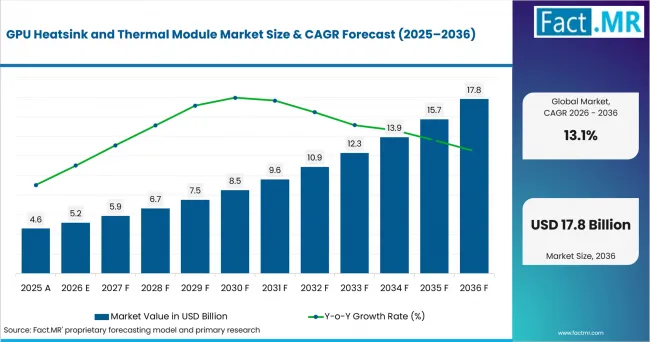
Gpu Heatsink And Thermal Module Market Value Analysis | Source: Fact.MR
What are the defining numbers behind GPU Heatsink and Thermal Module Market growth?
USD 12.6 billion absolute opportunity by 2036.
- Demand Drivers in the Market
- AI training and inference workloads are expected to raise heat loads inside dense GPU servers.
- Chiplet-based GPU designs are anticipated to increase the need for vapor chambers and cold plates.
- Dense server rack layouts are projected to lift orders for cooling parts that behave predictably during long utilization cycles.
- Key Segments Analyzed
- By Cooling Solution: Air-cooled Heatsinks are expected to hold 44.0% share in 2026 because they remain easy to qualify and integrate.
- By GPU Application: Artificial Intelligence GPUs are projected to account for 42.0% share in 2026 as high-power accelerators need tighter thermal control.
- By End-use Industry: Data Centers are anticipated to capture 41.0% share in 2026 due to rack-level GPU density and long operating hours.
- By Customer Category: GPU Manufacturers are estimated to represent 46.0% share in 2026 because cooling design begins at the board stage.
- By Thermal Technology: Vapor Chamber Cooling is forecast to hold 39.0% share in 2026 as package-level heat spreading becomes harder to manage.
- Analyst Opinion at Fact.MR
- Shambhu Nath Jha, Senior Consultant at Fact.MR, states, "GPU cooling is moving from a support component into a core design constraint. Air-cooled heatsinks still lead because they are proven and cost-effective. The next layer of growth is expected to come from vapor chambers and cold plates. Thermal interface materials are expected to support AI accelerators without disrupting server reliability."
- Strategic Implications
- Thermal module suppliers need qualification data that proves performance across GPU and memory heat zones.
- GPU manufacturers gain better layout control when heatsink and vapor chamber suppliers are involved earlier in board decisions.
- Server vendors benefit from reviewing module cooling at rack level because airflow risk extends beyond the GPU board.
- Material suppliers can strengthen buyer confidence by documenting how pads and phase-change materials perform during repeated thermal cycling.
Taiwan leads at 14.4% CAGR through foundry scale and local thermal-module supply depth. The USA follows at 13.8% as AI infrastructure spending increases demand for validated cooling parts. South Korea reaches 13.3% through memory and accelerator ecosystems. Japan records 12.7% through materials capability and precision thermal engineering. China posts 12.1%, while Germany reaches 11.6% and Singapore closes at 11.0% through regional electronics support.
How does the GPU Heatsink and Thermal Module Market break down by segment?
Air-cooled Heatsinks are expected to lead Cooling Solution at 44.0% share in 2026. Artificial Intelligence GPUs are projected to lead GPU Application at 42.0% share in 2026.
Why do Air-cooled Heatsinks lead Cooling Solution?
Air-cooled Heatsinks are expected to hold 44.0% share in 2026.
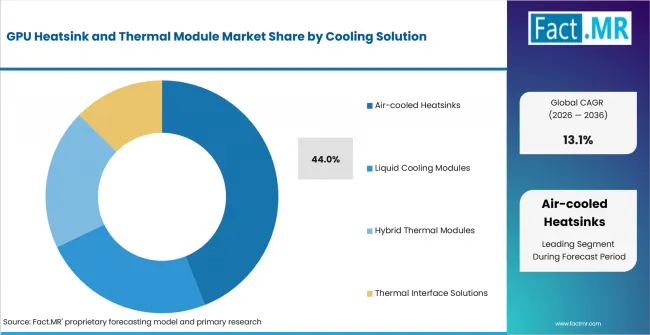
Gpu Heatsink And Thermal Module Market Analysis By Cooling Solution | Source: Fact.MR
Their lead reflects the continued use of familiar cooling structures across GPU boards and graphics cards. Buyers already understand the cost, repair path and integration needs of fins, fans, base plates and heat pipes. Liquid-assisted systems remain important for higher thermal loads, but air-cooled modules still offer the simplest qualification route for mainstream products and early server designs.
How do Artificial Intelligence GPUs shape GPU Application demand?
Artificial Intelligence GPUs are projected to account for 42.0% share in 2026.
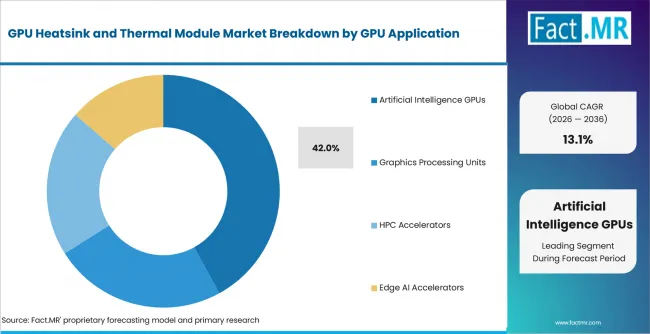
Gpu Heatsink And Thermal Module Market Analysis By Gpu Application | Source: Fact.MR
AI accelerators create stronger demand because they run through long training and inference cycles that generate sustained heat. This shifts cooling selection from basic component fit to performance protection. Module buyers look for stable heat spreading, contact pressure and interface behavior so throughput remains consistent without increasing service burden.
What supports Data Centers within End-use Industry?
Data Centers are anticipated to lead with 41.0% share in 2026.
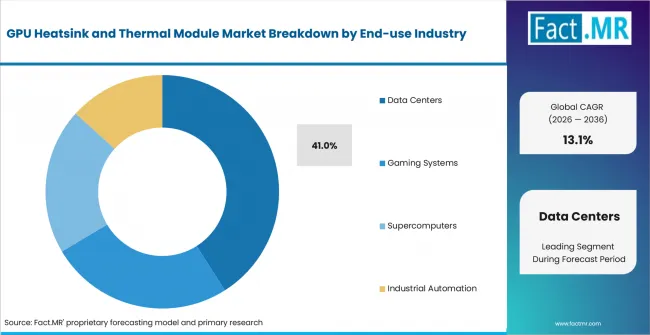
Gpu Heatsink And Thermal Module Market Analysis By End Use Industry | Source: Fact.MR
Dense server trays make thermal control a central procurement issue for data center operators. Cooling modules must support uptime, repeated deployments and hardware refresh cycles. As a result, buyers place higher value on proven geometries, serviceable designs and supplier documentation that can support large-scale GPU rollouts.
Why do GPU Manufacturers lead Customer Category?
GPU Manufacturers are estimated to represent 46.0% share in 2026.
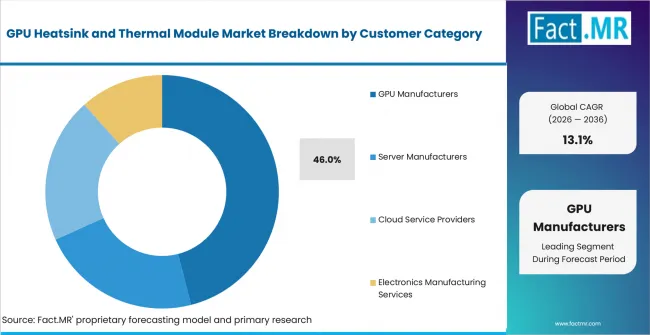
Gpu Heatsink And Thermal Module Market Analysis By Customer Category | Source: Fact.MR
This category leads because thermal choices are locked during board design and package qualification. Heatsink shape, pad thickness and mounting pressure must match the GPU and memory layout before production approval. Early supplier involvement reduces redesign risk and improves the chance of securing design wins.
How does Vapor Chamber Cooling shape Thermal Technology?
Vapor Chamber Cooling is forecast to hold 39.0% share in 2026.
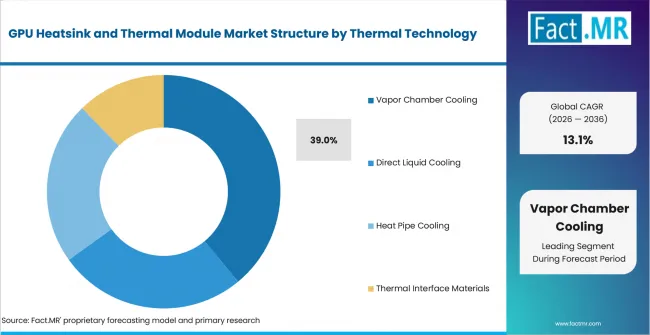
Gpu Heatsink And Thermal Module Market Analysis By Thermal Technology | Source: Fact.MR
Vapor chambers gain importance as GPU heat loads move closer to the package and local hot spots become harder to manage. Their thin heat-spreading structure helps protect GPU and memory zones better than simple metal bases. Demand also rises where thermal interface materials must maintain reliable contact during repeated operating cycles.
What is accelerating GPU Heatsink and Thermal Module Market adoption, and what is holding it back?
Demand is expected to rise through AI hardware density and stricter thermal qualification. Adoption is expected to be limited by cost pressure and package-specific engineering work.
Drivers Impact Analysis
| DRIVER | (~) % IMPACT ON CAGR | GEOGRAPHIC RELEVANCE | IMPACT TIMELINE |
|---|---|---|---|
| AI accelerator heat density | High | Taiwan, USA, South Korea | Short term (<= 2 years) |
| Vapor chamber and cold plate adoption | Medium-high | Taiwan, China, Japan | Short term (<= 2 years) |
| Data center server deployment | High | USA, Singapore, Germany | Medium term (2-4 years) |
| Thermal interface material improvement | Medium | Global GPU supply chains | Medium term (2-4 years) |
| Automotive and edge AI demand | Medium | Germany, Japan, China | Long term (>= 4 years) |
- AI accelerator heat density: GPU modules are expected to face higher thermal loads during long training and inference cycles.
- Vapor chamber and cold plate adoption: Suppliers are anticipated to gain design wins where airflow alone does not protect GPU and memory temperatures.
- Data center server deployment: Server manufacturers are expected to need repeatable cooling modules that fit rack-level service requirements.
Opportunity Impact Analysis
| OPPORTUNITY | (~) % IMPACT ON CAGR | GEOGRAPHIC RELEVANCE | IMPACT TIMELINE |
|---|---|---|---|
| Hybrid air and liquid cooling modules | Medium-high | USA and Taiwan | Medium term (2-4 years) |
| Advanced thermal interface stacks | Medium | Japan and Germany | Medium term (2-4 years) |
| AI server reference designs | Medium | Taiwan and Singapore | Long term (>= 4 years) |
| Automotive GPU thermal systems | Low-medium | Germany, Japan, China | Long term (>= 4 years) |
- Hybrid air and liquid cooling modules: Suppliers gain opportunity where modular ai racks need higher power density with serviceable cooling paths.
- Advanced thermal interface stacks: Material suppliers are expected to benefit where thermal management materials improve contact behavior between GPU packages and heat-spreading surfaces.
- AI server reference designs: Thermal module makers gain earlier placement when board and tray decisions are reviewed together.
Restraints Impact Analysis
| RESTRAINT | (~) % IMPACT ON CAGR | GEOGRAPHIC RELEVANCE | IMPACT TIMELINE |
|---|---|---|---|
| Qualification cycle length | Medium | GPU manufacturing clusters | Short term (<= 2 years) |
| Material and machining cost | Medium | Global | Short term (<= 2 years) |
| Rack integration limits | Low-medium | Data center markets | Medium term (2-4 years) |
| Service and replacement complexity | Low-medium | Enterprise and hyperscale sites | Long term (>= 4 years) |
- Qualification cycle length: New modules must pass thermal and mechanical checks before customers approve them for GPU production.
- Material and machining cost: Copper parts and vapor chambers raise material cost. Pads and precision assemblies add bill-of-material pressure.
- Rack integration limits: Some facilities delay advanced liquid options because airflow and dielectric cooling fluids planning extends beyond the GPU board.
Which countries are scaling the GPU Heatsink and Thermal Module Market fastest?
- The country comparison spans 3.4 percentage points and forms three practical growth bands across the forecast period.
- Taiwan remains 0.6 percentage points above the USA through foundry scale and local thermal-module supply depth.
- The USA remains 0.5 percentage points above South Korea because AI infrastructure spending favors validated cooling parts.
- South Korea remains 0.6 percentage points above Japan as memory and AI accelerator ecosystems require stable heat dissipation.
- Japan remains 0.6 percentage points above China through materials capability and precision electronics engineering.
- China remains 0.5 percentage points above Germany with local GPU and server programs supporting component qualification.
- Germany remains 0.6 percentage points above Singapore due to automotive electronics and industrial compute demand.
Comparable CAGRs create different entry conditions because each country combines GPU manufacturing and server integration in a different way. Electronics production and thermal-material capability change the supplier path. Full coverage includes North America; Latin America; Europe; East Asia; South Asia and Pacific; Middle East and Africa.
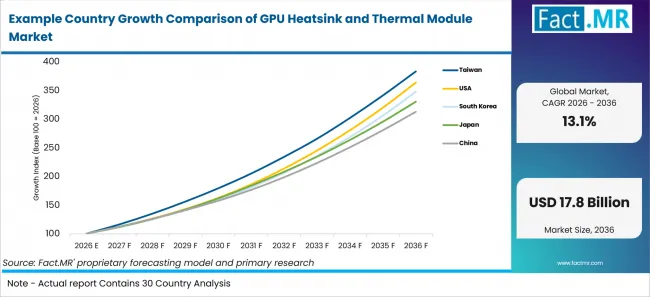
Example Country Growth Comparison Of Gpu Heatsink And Thermal Module Market | Source: Fact.MR
| Country | CAGR (2026-2036) |
|---|---|
| Taiwan | 14.4% |
| USA | 13.8% |
| South Korea | 13.3% |
| Japan | 12.7% |
| China | 12.1% |
| Germany | 11.6% |
| Singapore | 11.0% |
What supports Taiwan adoption?
14.4% CAGR, supported by foundry scale and a strong electronics component base.
Taiwan benefits from close coordination between GPU board design and server manufacturing. Thermal module suppliers get faster design feedback when engineers test heat spreaders near production lines. This supports quicker qualification for package-specific cooling parts.
How is the USA scaling demand?
13.8% CAGR, backed by AI infrastructure buildout and high-performance computing demand.
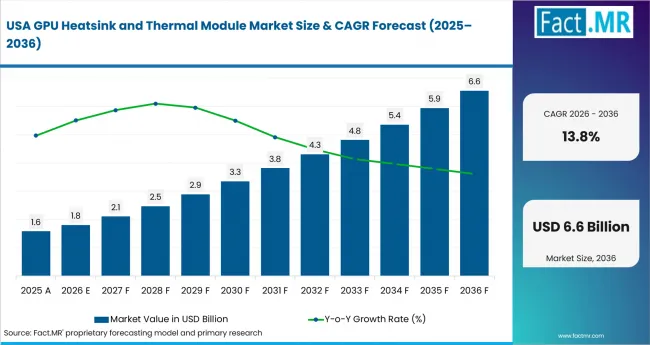
Gpu Heatsink And Thermal Module Market Country Value Analysis | Source: Fact.MR
Hyperscale and enterprise buyers in the USA evaluate cooling through uptime and service access. GPU clusters raise heat at module and rack level. Validated parts gain preference when buyers need stable performance over long operating cycles.
How is South Korea developing demand?
13.3% CAGR, driven by memory manufacturing and advanced electronics production.
South Korea’s memory base creates a strong engineering setting for high-density computing hardware. Cooling designs must protect the GPU package and memory. Power-delivery areas need the same stability. Repeatable vapor chamber and interface performance remains central to qualification.
How does Japan perform?
12.7% CAGR, led by materials capability and precision thermal engineering.
Japan’s strength comes from materials know-how and precision assembly. Local buyers often value thermal conductive sheet behavior when pressure and surface contact affect heat transfer. Supplier documentation therefore influences purchasing decisions.
What is driving China’s growth from 2026 to 2036?
12.1% CAGR, supported by domestic GPU programs and server manufacturing.
China’s demand is shaped by local hardware programs and domestic supply-chain qualification. Thermal module makers are expected to support board-level redesigns as AI server platforms diversify. Cost control remains important for high-volume assembly.
What supports Germany’s growth?
11.6% CAGR, backed by automotive electronics and industrial compute demand.
Germany’s demand comes from automotive AI processors and engineering workstations. Industrial computing systems add another demand path. Buyers focus on modules that perform reliably in constrained spaces. Documentation and material traceability improve supplier acceptance in these settings.
How is Singapore positioned?
11.0% CAGR, supported by electronics manufacturing depth and regional distribution.
Singapore serves as a compact hub for server assembly and specialty electronics. Regional logistics improve the supply response for nearby buyers. Demand remains selective but valuable when customers need technical support near Asia Pacific GPU programs.
Who leads the GPU Heatsink and Thermal Module Market?
Cooler Master and Auras Technology show the strongest fit in GPU heatsinks and thermal modules, while Foxconn Interconnect and Delta Electronics add AI server and rack-cooling relevance.
Asia Vital Components, Sunonwealth and Nidec strengthen airflow, fan and module supply. Furukawa Electric, Zaward and Henkel broaden the field through heat-transfer parts, thermal materials and interface solutions used in high-power GPU cooling designs.
Which companies are the key providers?
Key companies include Cooler Master Co., Ltd.; Auras Technology Co., Ltd.; Foxconn Interconnect Technology Limited; Delta Electronics, Inc.; Asia Vital Components Co., Ltd.; Sunonwealth Electric Machine Industry Co., Ltd.; Nidec Corporation; Furukawa Electric Co., Ltd.; Zaward Corporation; and Henkel AG & Co. KGaA.
- Cooler Master Co., Ltd.
- Auras Technology Co., Ltd.
- Foxconn Interconnect Technology Limited
- Delta Electronics, Inc.
- Asia Vital Components Co., Ltd.
- Sunonwealth Electric Machine Industry Co., Ltd.
- Nidec Corporation
- Furukawa Electric Co., Ltd.
- Zaward Corporation
- Henkel AG & Co. KGaA
Bibliography
- SEMI. (2026, April 7). SEMI reports global semiconductor equipment billings reached $135 billion in 2025, up 15% year-on-year.
- Delta Electronics, Inc. (2025, November 18). Delta's unique capability to provide cooling solutions for next-gen AI GPUs, servers, and racks highlighted at SC25.
- Hon Hai Technology Group. (2026, June 4). Hon Hai Technology Group announces strategic collaboration with Intel to advance next-generation AI rack, edge AI, and physical AI platforms.
- Hon Hai Technology Group. (2026, June 15). Hon Hai Technology Group (Foxconn) and Schneider Electric in strategic collaboration to accelerate next-generation AI data centers.
- Henkel AG & Co. KGaA. (2025, December 10). Henkel's answer to ultra-demanding electronics applications: the Bergquist TGF 10000 thermal gap filler.
This Report Answers
- The report provides strategic intelligence on the GPU Heatsink and Thermal Module Market across Cooling Solution and GPU Application choices.
- Segment analysis covers Air-cooled Heatsinks and Artificial Intelligence GPUs as the share leaders within the 2026 market.
- Country outlook evaluates Taiwan and the USA alongside South Korea and Japan. China and Germany follow in the comparison. Singapore completes the profiled set.
- Competitive analysis profiles Cooler Master Co., Ltd. and Auras Technology Co., Ltd. alongside Foxconn Interconnect Technology Limited and Delta Electronics, Inc.
- Technology assessment covers Vapor Chamber Cooling and Heat Pipe Cooling. Cold Plate Cooling and Thermal Interface Pads complete the view alongside Active Fan Cooling.
What does the GPU Heatsink and Thermal Module Market cover?
GPU heatsinks and thermal modules control heat around graphics processors and AI accelerators. Memory packages and power components are part of the same thermal path.
The GPU Heatsink and Thermal Module Market covers air-cooled heatsinks; liquid cooling modules; hybrid modules; heat pipe assemblies; fan-integrated modules; and vapor chamber systems. Coverage extends to GPU cards and AI servers. Workstations and edge AI devices are included when the cooling part is designed for GPU use. Automotive compute platforms follow the same inclusion rule.
What is included in the scope?
GPU thermal modules are used by GPU manufacturers and server OEMs. Graphics card brands and system integrators are included when they specify the cooling design. Data center operators are included when they approve GPU module requirements.
The scope includes Cooling Solution and GPU Application. End-use Industry completes part of the scope. Customer Category and Thermal Technology complete the remaining scope. Coverage spans air-cooled and liquid systems. Hybrid and heat pipe systems complete part of the product view. Fan-integrated and vapor chamber systems complete the remaining product view.
What is excluded from the scope?
General electronics cooling parts remain outside the scope when they are not designed for GPU or graphics card thermal control.
The scope excludes unrelated HVAC systems and facility cooling towers. Consumer case fans without GPU module use remain outside the market. Thermal parts for non-GPU electronics are excluded. Data center liquid infrastructure is excluded unless it directly supports GPU module thermal management.
How Was the Analysis Built?
The analysis draws on 120+ sources, 35+ company portfolios, 25+ countries, and more than 20 interviews.
- Primary Research: Interviews with manufacturers, retailers, salon operators, and experts examine purchase priorities, adoption, approval requirements, and competitive positioning.
- Desk Research: Desk research covers government statistics, regulatory publications, company filings, trade data, technical studies, industry associations, standards, and public policy.
- Market Sizing and Forecasting: Estimates combine historical performance, demand indicators, pricing, segment shares, company participation, country growth, adoption patterns, and barriers to expansion.
- Data Validation and Update Cycle: Findings are validated against public data, company activity, regulatory changes, product launches, recalls, and adoption shifts.
What is the report's scope and coverage?
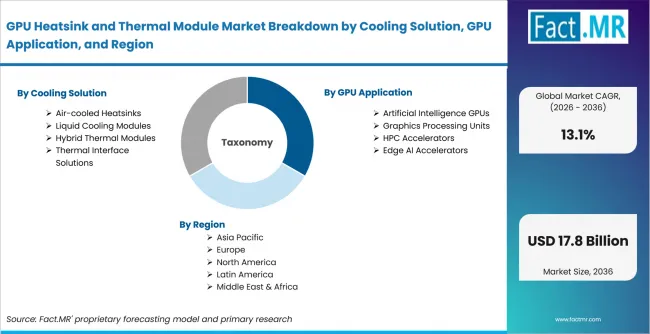
Gpu Heatsink And Thermal Module Market Breakdown By Cooling Solution, Gpu Application, And Region | Source: Fact.MR
| Attribute | Details |
|---|---|
| Quantitative Units | USD billion in 2026 to USD billion by 2036 at CAGR |
| Market Definition | GPU heatsinks and thermal modules used to move heat away from graphics processors, AI accelerators, memory packages and power components where thermal stability affects performance and service life |
| Cooling Solution | Air-cooled Heatsinks; Liquid Cooling Modules; Hybrid Cooling Modules; Heat Pipe Assemblies; Fan-integrated Modules |
| GPU Application | Artificial Intelligence GPUs; Gaming GPUs; Workstation GPUs; Edge AI GPUs; Automotive GPUs |
| End-use Industry | Data Centers; Consumer Electronics; Automotive; Industrial Computing; Defense and Aerospace |
| Customer Category | GPU Manufacturers; Server OEMs; Graphics Card Brands; System Integrators; Data Center Operators |
| Thermal Technology | Vapor Chamber Cooling; Heat Pipe Cooling; Cold Plate Cooling; Thermal Interface Pads; Active Fan Cooling |
| Regions Covered | North America; Latin America; Europe; East Asia; South Asia and Pacific; Middle East and Africa |
| Countries Covered | Taiwan; USA; South Korea; Japan; China; Germany; Singapore |
| Key Companies Profiled | Cooler Master Co., Ltd.; Auras Technology Co., Ltd.; Foxconn Interconnect Technology Limited; Delta Electronics, Inc.; Asia Vital Components Co., Ltd.; Sunonwealth Electric Machine Industry Co., Ltd.; Nidec Corporation; Furukawa Electric Co., Ltd.; Zaward Corporation; Henkel AG & Co. KGaA |
| Forecast Period | 2026 to 2036 |
| Approach | Hybrid top-down and bottom-up approach using semiconductor hardware demand; GPU application mix; cooling technology adoption; country-level growth; thermal module qualification; supplier participation; and company portfolio review |
How is the market segmented?
-
By Cooling Solution
- Air-cooled Heatsinks
- Aluminum Heatsinks
- Copper Heatsinks
- Liquid Cooling Modules
- Cold Plate Modules
- Immersion Cooling Systems
- Hybrid Thermal Modules
- Vapor Chamber with Heat Pipes
- Active Cooling Assemblies
- Thermal Interface Solutions
- Phase Change Materials
- Graphite Thermal Pads
- Air-cooled Heatsinks
-
By GPU Application
- Artificial Intelligence GPUs
- AI Training Accelerators
- AI Inference GPUs
- Graphics Processing Units
- Gaming GPUs
- Professional Visualization GPUs
- HPC Accelerators
- Exascale Computing
- Chiplet-based GPUs
- Edge AI Accelerators
- Embedded AI GPUs
- Medical Imaging GPUs
- Artificial Intelligence GPUs
-
By End-use Industry
- Data Centers
- Hyperscale Cloud Computing
- High-performance Computing
- Gaming Systems
- Gaming Hardware
- Workstations
- Supercomputers
- Research Computing
- Automotive AI Computing
- Industrial Automation
- Industrial Computing
- Healthcare Computing
- Data Centers
-
By Customer Category
- GPU Manufacturers
- Integrated Device Manufacturers
- Semiconductor OEMs
- Server Manufacturers
- Graphics Card Manufacturers
- System Integrators
- Cloud Service Providers
- High-performance Computing Integrators
- Automotive Electronics Manufacturers
- Electronics Manufacturing Services
- Industrial System Manufacturers
- Medical Equipment Manufacturers
- GPU Manufacturers
-
By Thermal Technology
- Vapor Chamber Cooling
- Copper Vapor Chamber
- Composite Vapor Chamber
- Direct Liquid Cooling
- Microchannel Cold Plate
- Immersion Cooling Technology
- Heat Pipe Cooling
- Sintered Heat Pipe
- Loop Heat Pipe
- Thermal Interface Materials
- Graphite Thermal Interface
- High Conductivity Thermal Pad
- Vapor Chamber Cooling
-
By Region
- North America
- Latin America
- Western Europe
- Eastern Europe
- East Asia
- South Asia and Pacific
- Middle East & Africa