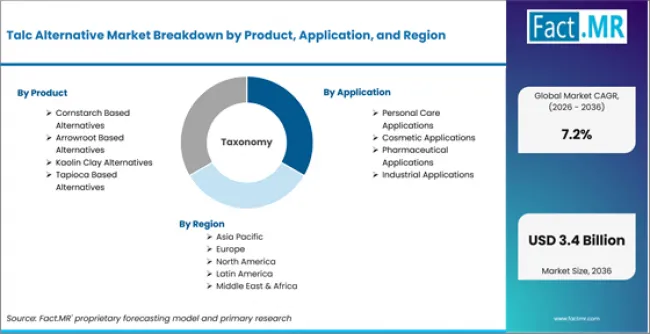
Talc Alternative Market Size, Share, Growth and Forecast (2026 - 2036)
Talc Alternative Market is segmented by Product (Cornstarch Based Alternatives, Arrowroot Based Alternatives, Kaolin Clay Alternatives, Tapioca Based Alternatives), Application (Personal Care Applications, Cosmetic Applications, Pharmaceutical Applications, Industrial Applications), End Use (Personal Care & Cosmetics Industry, Pharmaceutical Industry, Food Industry, Industrial Manufacturing), and Region. Forecast for 2026 to 2036.
Talc Alternative Market Analysis and Forecast by Fact.MR
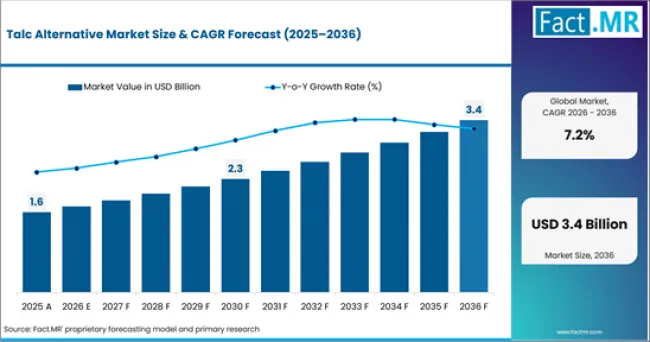
- The Talc Alternative Market is expected to grow from USD 1.7 billion in 2026 to USD 3.4 billion by 2036, at a 7.2% CAGR.
- The market is supported by talc reformulation in personal care and cosmetics, consumer preference for cornstarch and mineral-based powder alternatives, and stronger regulatory scrutiny of talc-containing products. Cornstarch-based alternatives account for 58.4% product share in 2026, while the Personal Care & Cosmetics Industry contributes 69.1% of end-use demand.
Summary of the Talc Alternative Market
- Market Snapshot
- In 2025, the global Talc Alternative Market was valued at approximately USD 1.6 billion.
- The market is estimated to reach USD 1.7 billion in 2026 and is projected to attain USD 3.4 billion by 2036.
- The market is likely to expand at a CAGR of 7.2% during the forecast period.
- The market is anticipated to create an absolute dollar opportunity of USD 1.7 billion between 2026 and 2036.
- Cornstarch Based Alternatives accounts for 58.4% of product segment share in 2026.
- China (9.7%) and India (9.0%) are the key growth markets during the forecast period.
- Demand and Growth Drivers
- Primary end-use demand creates sustained procurement for talc alternative products meeting documented performance and regulatory specifications across major application segments.
- Regulatory mandates and evolving consumer preferences create structured demand favoring products with certified safety, efficacy, and sustainability credentials.
- Product technology advancement improves performance characteristics, expands application scope, and strengthens cost-competitiveness against conventional alternatives.
- Growing health consciousness and clean-label demand support products with transparent ingredient profiles and documented safety records.
- Product and Segment View
- Cornstarch Based Alternatives accounts for 58.4% of the product segment in 2026, supported by established application performance and broad market acceptance.
- Personal Care and Cosmetics Industry represents 69.1% of end use demand in 2026, reflecting procurement concentration among primary industry buyers.
- Powder Based Formulations leads the formulation segment with 62.7% share in 2026, supported by preferred processing characteristics and end-use compatibility.
- Key segmentation includes:
- Product Type: Cornstarch Based Alternatives, Arrowroot Based Alternatives, Kaolin Clay Alternatives, and Tapioca Based Alternatives
- End Use: Personal Care & Cosmetics Industry, Pharmaceutical Industry, Food Industry, and Industrial Manufacturing
- Formulation: Powder Based Formulations, Liquid Dispersion Formulations, Gel Based Systems, Encapsulated Formulations, and Functional Modified Formulations
- These systems enable:
- Primary functional capability addressing core performance requirements across end-use applications.
- Processing flexibility and formulation compatibility supporting broad application across product categories.
- Regulatory compliance and safety documentation supporting market access in regulated industries.
- Geography and Competitive Outlook
- North America maintains a significant share supported by established demand and regulatory-driven procurement.
- Asia Pacific is the fastest-growing region, with China (9.7%) and India (9.0%) leading through industrial growth and expanding consumer demand.
- Europe maintains steady demand with Germany supported by regulatory compliance and premium product specifications.
- Key companies include Imerys S.A., Nouryon, Evonik Industries, Cabot Corporation, KaMin LLC among others.
- Analyst Opinion
- Shambhu Nath Jha, Principal Consultant at Fact.MR, says "The talc alternative market reflects structural demand growth at the intersection of end-use industry expansion, regulatory evolution, and shifting consumer preferences. The combination of performance requirements and safety or sustainability mandates is reshaping competitive dynamics, favoring manufacturers that combine product quality with comprehensive documentation. Regional growth patterns reflect market development intensity and regulatory maturity, with Asia Pacific providing stronger expansion rates while Western markets support demand through specification compliance and product innovation."
Key Growth Drivers, Constraints, and Opportunities
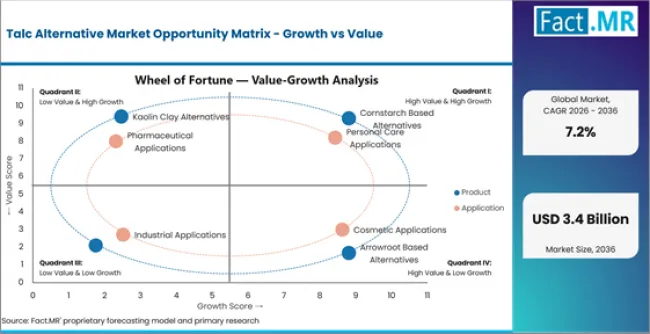
Key Factors Driving Growth
- End-use industry growth creates sustained procurement demand for talc alternative products meeting performance specifications across major applications.
- Regulatory evolution and consumer preference shifts create structured procurement favoring products with certified safety and performance documentation.
- Product formulation advancement improves performance and cost-competitiveness, expanding the addressable market into additional application segments.
Key Market Constraints
- Price premium compared to conventional alternatives limits adoption in cost-sensitive segments.
- Supply concentration among qualified producers creates availability risks during demand surges.
- Regulatory complexity across national jurisdictions increases compliance costs for manufacturers serving multiple markets.
Key Opportunity Areas
- Health and sustainability-driven demand for products with documented credentials creates premium market segments.
- Regional manufacturing expansion improves local supply availability and reduces logistics costs.
- Product innovation enabling improved performance at competitive cost expands the addressable market.
Segment-wise Analysis of the Talc Alternative Market
- Cornstarch Based Alternatives holds 58.4% of the product segment in 2026 through established performance and market acceptance.
- Personal Care and Cosmetics Industry accounts for 69.1% of end use demand in 2026, reflecting procurement concentration among primary buyers.
- Emerging product categories grow faster as technology advancement and consumer preference shifts expand application scope.
The market is segmented by product, application, end use, technology, formulation, distribution channel, and region. Lead segments maintain dominant positions through established performance, while emerging categories grow faster as market dynamics evolve.
Which Product Segment Dominates the Talc Alternative Market?
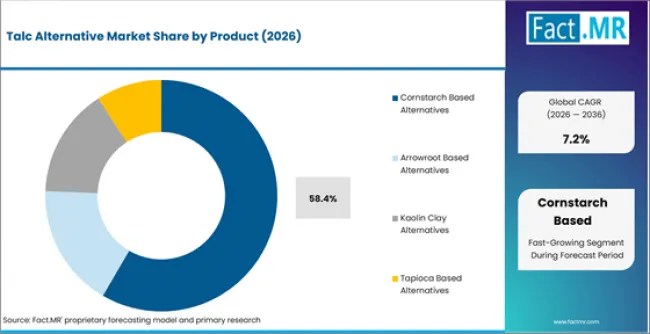
Cornstarch Based Alternatives accounts for 58.4% of the product segment in 2026. Its leadership reflects established application performance, broad market acceptance, and proven reliability. The segment benefits from long product histories and established distribution relationships.
Supporting product segments hold growing positions driven by specialized application requirements and evolving consumer or regulatory preferences that create demand for alternative product formats.
Which End-Use Segment Dominates the Talc Alternative Market?
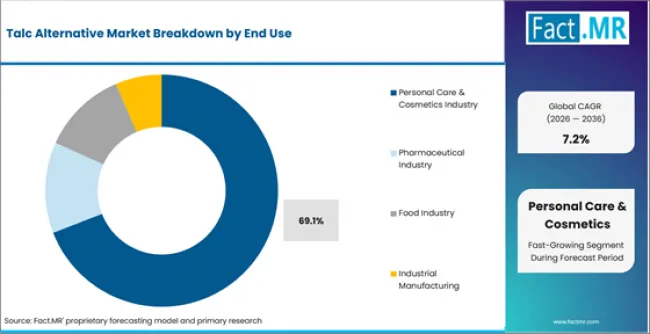
Personal Care and Cosmetics Industry is expected to lead the end use segment with a 69.1% share in 2026. This reflects procurement concentration among primary buyers managing the largest consumption volumes.
Secondary end-use channels hold growing positions as expanding awareness and distribution access create new procurement pathways beyond the primary buyer base.
Which Product Trend is Shaping the Next Phase of Growth in the Talc Alternative Market?
Product reformulation driven by regulatory requirements and consumer preference shifts is the most significant trend. Manufacturers are developing next-generation formulations with improved safety profiles, enhanced efficacy, and cleaner ingredient lists while maintaining the performance characteristics required by end-use applications. This trend creates competitive differentiation for companies investing in reformulation R&D.
The second dimension is technology-enabled product optimization that creates new application opportunities and improves cost-competitiveness, expanding the market beyond traditional application segments into adjacent categories where conventional alternatives previously dominated.
Regional Outlook Across Key Markets
- China leads growth at 9.7%, supported by industrial expansion, growing consumer demand, and increasing regulatory alignment with global standards.
- India follows at 9.0%, driven by manufacturing growth, rising health consciousness, and expanding organized retail distribution.
- North America and Europe maintain significant shares through established industries, regulatory compliance, and premium product demand.
- Key companies include Imerys S.A., Nouryon, Evonik Industries, Cabot Corporation among others.
.webp)
CAGR Table
| Country | CAGR (%) |
|---|---|
| China | 9.7% |
| India | 9.0% |
| Germany | 8.3% |
| UK | 6.1% |
| USA | 6.8% |
Source: Fact.MR analysis, based on proprietary forecasting model and primary research.
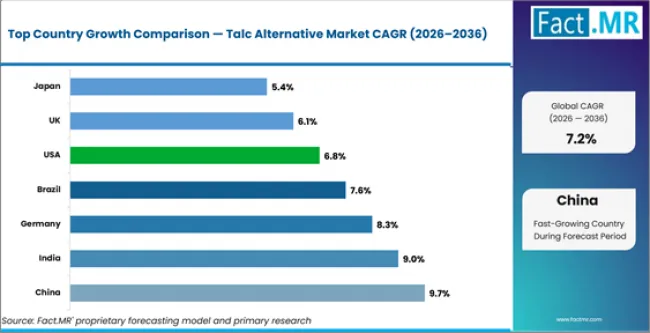
Talc Alternative Demand Trends in the United States
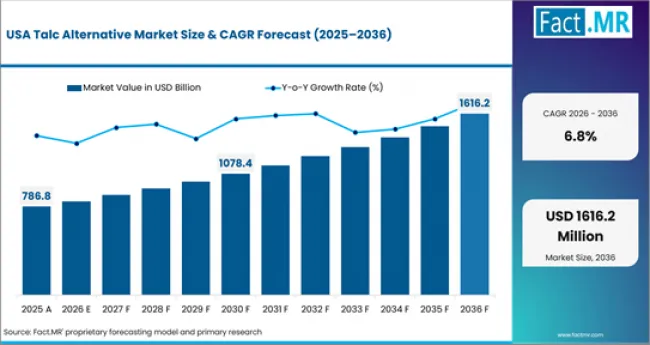
The US market is projected to grow at a CAGR of 5.8% through 2036. Demand is shaped by established end-use requirements, regulatory compliance, and growing consumer preference for products with documented safety and performance credentials.
- Established industry demand creates consistent procurement across primary segments.
- Consumer preference evolution supports growing demand for reformulated and improved product offerings.
China Talc Alternative Growth Assessment
The China market is projected to grow at a CAGR of 9.7% through 2036. Industrial expansion, domestic manufacturing capability, and growing consumer markets are the primary structural drivers.
- Industrial and consumer market expansion create high-volume procurement demand.
- Domestic production capability development provides local supply advantage.
India Talc Alternative Opportunity Outlook
The India market is projected to grow at a CAGR of 9.0% through 2036, supported by manufacturing expansion under PLI incentives and growing domestic consumption across primary and secondary application segments.
- PLI-backed manufacturing creates demand for products serving growing domestic production capacity.
- Rising consumer awareness supports broadening product adoption across retail and institutional channels.
Germany Talc Alternative Demand Analysis
The Germany market is projected to grow at a CAGR of 8.2% through 2036 as EU regulatory compliance and DIN standards favor manufacturers with certification and quality documentation.
- EU regulations create structured procurement frameworks favoring certified products.
- Premium product specifications support higher-margin positioning in the German market.
Competitive Benchmarking and Company Positioning
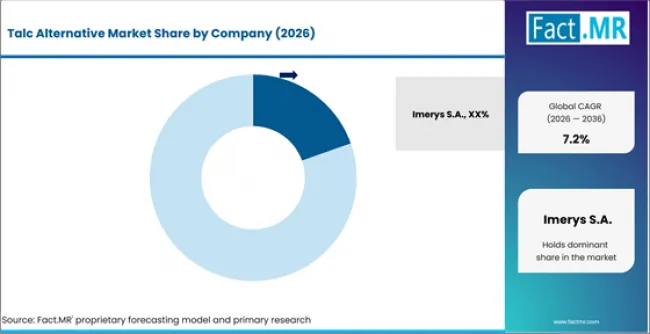
Talc Alternative Market Analysis By Company
- Leading companies hold strong positions through comprehensive portfolios, established customer relationships, and sustained investment in product development.
- Mid-tier competitors differentiate through focused categories, regional strength, and application expertise.
- Regulatory certification breadth and product innovation capability are key competitive differentiators.
The competitive landscape combines diversified manufacturers with focused specialty producers. Leading companies compete through broad portfolios and global distribution while mid-tier competitors differentiate through regional strength and specialized expertise.
Strategic priorities include expanding product portfolios, developing reformulated products meeting evolving regulatory and consumer requirements, and strengthening distribution in high-growth markets.
Key Companies in the Talc Alternative Market
- Imerys S.A., Nouryon, Evonik Industries are among the leading participants with comprehensive portfolios.
- Cabot Corporation, KaMin LLC, Minerals Technologies Inc. hold established positions through focused product categories.
Recent Industry Developments
- Imerys, Mineral Ingredients for Talc-Free Cosmetic Formulations
- Imerys is relevant to this market because it supplies mineral ingredients used in cosmetics and personal care formulations. Its portfolio includes kaolin and calcium carbonate-based ingredients that can support texture, absorption, softness, and mattifying effects.
- Nouryon, Starch-Based Ingredient for Personal Care Formulations
- Nouryon introduced Structure® Silk starch in September 2024 for personal care formulations. The ingredient is positioned for skin care, hair care, and hairstyling products that need texture and formulation support. Nouryon also lists Amaze® Native as a corn starch ingredient for oil absorption and powder-based personal care applications.
Leading Companies Shaping the Talc Alternative Market
- Imerys S.A.
- Nouryon
- Evonik Industries
- Cabot Corporation
- KaMin LLC
- Minerals Technologies Inc.
- Omya AG
Sources and Research References
- Imerys. (n.d.). Engineered minerals for cosmetics & personal care.
- Johnson’s Baby. (2026, April 6). Aloe & Vitamin E Powder. Kenvue Brands LLC.
- Nouryon. (2024, September 25). Nouryon introduces Structure® Silk starch, a readily biodegradable rheology modifier and texturizer for personal care formulations at in-cosmetics Latin America.
Key Questions This Report Addresses
- What is the current and future size of the Talc Alternative Market?
- How fast is the market expected to grow between 2026 and 2036?
- Which product type leads by 2026?
- Which end-use accounts for highest demand?
- What are the primary growth drivers?
- How is product innovation influencing the market?
- Which countries show the fastest growth?
- Who are the key companies?
- How does Fact.MR validate the forecast?
Talc Alternative Market Definition
The Talc Alternative Market covers specialized products and formulations serving primary end-use industries across commercial, industrial, and consumer applications.
Talc Alternative Market Inclusions
- The scope covers global and regional market size and forecasts for 2026 to 2036 across product type, end use, formulation, and region.
- It includes all major product grades and formulations for primary and secondary end-use applications.
- The report covers technology and regulatory trends and the competitive landscape of leading producers.
Talc Alternative Market Exclusions
- The scope excludes general-purpose products not classified within this specific market category.
- It excludes raw material supply chains and manufacturing equipment sold independently of finished products.
- The report excludes downstream assembled end-use products and services sold independently.
Talc Alternative Market Research Methodology
- The methodology combines secondary research, primary interviews, and forecast modelling.
- It draws on 90+ secondary sources and benchmarks 45+ company portfolios.
- Market sizing covers 40+ countries through a demand-side model, supported by top-down validation.
- Key inputs include end-use demand data, regulatory tracking, and product adoption rates.
- Primary validation includes 25+ interviews across producers, end users, and industry specialists.
Scope of Analysis

| Parameter | Details |
|---|---|
| Quantitative Units | USD 1.7 billion to USD 3.4 billion, at a CAGR of 7.2% |
| Market Definition | The Talc Alternative Market covers specialized products serving primary end-use industries. |
| Regions Covered | North America, Latin America, Europe, East Asia, South Asia and Pacific, Middle East and Africa |
| Countries Covered | USA, Canada, UK, Germany, China, India, 40 plus countries |
| Key Companies | Imerys S.A., Nouryon, Evonik Industries, Cabot Corporation, KaMin LLC, Minerals Technologies Inc. |
| Forecast Period | 2026 to 2036 |
| Approach | Hybrid demand-side methodology built on industry data, regulatory tracking, and primary interviews. |
Talc Alternative Market Segmentation
-
Talc Alternative Market Segmented by Product:
- Cornstarch Based Alternatives
- Refined Food Grade Starch
- Modified Corn Starch Blends
- Organic Corn Starch Powders
- Industrial Grade Starch Systems
- High Absorbency Starch Formulations
- Thermal Stable Starch Powders
- Refined Food Grade Starch
- Arrowroot Based Alternatives
- Natural Arrowroot Powders
- Cosmetic Grade Arrowroot Powder
- Pharmaceutical Arrowroot Extracts
- Processed Arrowroot Blends
- Ultra Fine Arrowroot Powders
- Blended Botanical Starch Systems
- Natural Arrowroot Powders
- Kaolin Clay Alternatives
- Purified Kaolin Systems
- Cosmetic Grade Kaolin Powder
- Medical Grade Kaolin Formulations
- Engineered Clay Blends
- Microfine Clay Particles
- Surface Treated Clay Powders
- Purified Kaolin Systems
- Tapioca Based Alternatives
- Cassava Derived Starch Systems
- Food Safe Tapioca Powders
- Industrial Absorbent Tapioca Blends
- Modified Tapioca Formulations
- High Purity Tapioca Starch
- Functional Tapioca Powder Systems
- Cassava Derived Starch Systems
- Cornstarch Based Alternatives
-
Talc Alternative Market Segmented by Application:
- Personal Care Applications
- Body Powder Applications
- Baby Care Powder Products
- Adult Hygiene Powder Products
- Skin Care Applications
- Moisture Absorption Products
- Anti Chafing Powder Systems
- Body Powder Applications
- Cosmetic Applications
- Makeup Formulation Applications
- Face Powder Bases
- Oil Control Cosmetic Systems
- Hair Care Applications
- Dry Shampoo Systems
- Scalp Oil Absorption Products
- Makeup Formulation Applications
- Pharmaceutical Applications
- Topical Drug Delivery Systems
- Dermatological Powder Formulations
- Wound Care Absorbent Systems
- Medical Hygiene Applications
- Surgical Powder Applications
- Infection Control Powder Systems
- Topical Drug Delivery Systems
- Industrial Applications
- Manufacturing Process Applications
- Lubrication Reduction Powders
- Anti Caking Industrial Agents
- Material Handling Applications
- Surface Treatment Powders
- Moisture Control Industrial Systems
- Manufacturing Process Applications
- Personal Care Applications
-
Talc Alternative Market Segmented by End Use:
- Personal Care & Cosmetics Industry
- Skincare Product Manufacturers
- Organic Skincare Brands
- Dermatology Product Companies
- Haircare Product Manufacturers
- Dry Shampoo Producers
- Scalp Treatment Brands
- Skincare Product Manufacturers
- Pharmaceutical Industry
- Topical Medicine Manufacturers
- Dermatology Drug Companies
- Wound Care Product Firms
- Healthcare Hygiene Companies
- Hospital Supply Manufacturers
- Clinical Hygiene Product Firms
- Topical Medicine Manufacturers
- Food Industry
- Food Processing Companies
- Powdered Food Ingredient Suppliers
- Starch Processing Companies
- Nutraceutical Manufacturers
- Health Supplement Brands
- Functional Food Companies
- Food Processing Companies
- Industrial Manufacturing
- Chemical Processing Companies
- Powder Handling Industries
- Bulk Material Processing Firms
- Textile & Fabric Industry
- Fabric Treatment Companies
- Textile Finishing Units
- Chemical Processing Companies
- Personal Care & Cosmetics Industry
-
Talc Alternative Market Segmented by Technology:
- Natural Mineral Processing Technology
- Refinement & Purification Systems
- Ultra Fine Milling Technology
- Contaminant Removal Systems
- Surface Modification Technology
- Hydrophobic Treatment Systems
- Particle Coating Technologies
- Refinement & Purification Systems
- Bio Based Extraction Technology
- Plant Derived Processing Systems
- Enzyme Assisted Extraction
- Cold Press Processing Systems
- Starch Modification Technology
- Cross Linked Starch Systems
- Functional Starch Engineering
- Plant Derived Processing Systems
- Clay Processing Technology
- Mineral Refinement Systems
- Nano Clay Processing Units
- Particle Size Optimization Systems
- Thermal Treatment Technology
- Calcination Processing Systems
- Heat Activated Mineral Systems
- Mineral Refinement Systems
- Formulation Enhancement Technology
- Blending & Mixing Systems
- High Precision Powder Mixing
- Uniform Dispersion Technology
- Stability Enhancement Systems
- Shelf Life Extension Technology
- Anti Caking Stabilization Systems
- Blending & Mixing Systems
- Natural Mineral Processing Technology
-
Talc Alternative Market Segmented by Formulation:
- Powder Based Formulations
- Ultra Fine Powder Systems
- Micronized Powder Formulations
- Nano Particle Powder Systems
- Blended Powder Systems
- Multi Ingredient Powder Blends
- Functional Powder Composites
- Ultra Fine Powder Systems
- Liquid Dispersion Formulations
- Suspension Based Systems
- Aqueous Dispersion Systems
- Emulsified Liquid Powders
- Gel Based Systems
- Semi Solid Powder Gels
- Hydrated Gel Formulations
- Suspension Based Systems
- Encapsulated Formulations
- Microencapsulation Systems
- Controlled Release Powders
- Protective Coated Powders
- Microencapsulation Systems
- Functional Modified Formulations
- Activated Ingredient Systems
- Enhanced Absorption Powders
- Performance Boosted Formulations
- Activated Ingredient Systems
- Powder Based Formulations
-
Talc Alternative Market Segmented by Distribution Channel:
- Direct B2B Sales
- Manufacturer Direct Supply
- Industrial Bulk Contracts
- Cosmetic Brand Agreements
- Enterprise Procurement Channels
- Pharmaceutical Supply Contracts
- Food Industry Bulk Orders
- Manufacturer Direct Supply
- Specialty Ingredient Distributors
- Cosmetic Ingredient Distributors
- Personal Care Raw Material Suppliers
- Skincare Ingredient Traders
- Industrial Chemical Distributors
- Bulk Powder Material Suppliers
- Manufacturing Raw Material Networks
- Cosmetic Ingredient Distributors
- Online B2B Platforms
- Digital Ingredient Marketplaces
- Chemical E Commerce Platforms
- Ingredient Sourcing Portals
- Manufacturer Web Stores
- Direct Ordering Systems
- Subscription Supply Platforms
- Digital Ingredient Marketplaces
- Retail Channels
- Pharmacy Chains
- Dermatology Product Pharmacies
- Health & Wellness Stores
- Supermarkets
- Personal Care Product Sections
- Natural Product Aisles
- Pharmacy Chains
- Direct B2B Sales
-
Talc Alternative Market by Region:
- North America
- USA
- Canada
- Mexico
- Latin America
- Brazil
- Chile
- Rest of Latin America
- Western Europe
- Germany
- UK
- Italy
- Spain
- France
- Nordic
- BENELUX
- Rest of Western Europe
- Eastern Europe
- Russia
- Poland
- Hungary
- Balkan & Baltic
- Rest of Eastern Europe
- East Asia
- China
- Japan
- South Korea
- South Asia and Pacific
- India
- ASEAN
- Australia & New Zealand
- Rest of South Asia and Pacific
- Middle East & Africa
- Kingdom of Saudi Arabia
- Other GCC Countries
- Turkiye
- South Africa
- Other African Union
- Rest of Middle East & Africa
- North America
- Frequently Asked Questions -
How big is the talc alternative market in 2026?
The global talc alternative market is estimated to be valued at USD 1.7 billion in 2026.
What will be the size of the talc alternative market in 2036?
The market size for the talc alternative market is projected to reach USD 3.4 billion by 2036.
What CAGR is expected for the talc alternative market between 2026 and 2036?
The talc alternative market is expected to grow at a 7.2% CAGR between 2026 and 2036.
What are the key products in the talc alternative market?
The key products in the talc alternative market are Cornstarch Based Alternatives, Arrowroot Based Alternatives, Kaolin Clay Alternatives and Tapioca Based Alternatives.
Which application segment is expected to contribute the leading share in the talc alternative market in 2026?
In terms of application, the Personal Care Applications segment is expected to command 74.6% share in the talc alternative market in 2026.
Table of Content
- Key Takeaways
- Market Size and CAGR
- Top Growth Driver
- Fastest Growing Segment
- Leading Region
- Key Companies
- Emerging Opportunities
- Executive Summary
- Global Market Outlook
- Demand-side Trends
- Supply-side Trends
- Technology Roadmap Analysis
- Analysis and Recommendations
- Analyst Perspective (What is happening? Why now? What should investors know?)
- Key Questions Answered
- How large is the market?
- What is the CAGR?
- What are key trends?
- Which region dominates?
- Who are the leaders?
- Market Overview
- Market Coverage / Taxonomy
- Market Definition / Scope / Limitations
- Research Methodology
- Chapter Orientation
- Analytical Lens and Working Hypotheses
- Market Structure, Signals, and Trend Drivers
- Benchmarking and Cross-market Comparability
- Market Sizing, Forecasting, and Opportunity Mapping
- Research Design and Evidence Framework
- Desk Research Programme (Secondary Evidence)
- Expert Input and Fieldwork (Primary Evidence)
- Tooling, Models, and Reference Databases
- Data Engineering and Model Build
- Quality Assurance and Audit Trail
- Market Background
- Market Dynamics (Drivers, Restraints, Opportunity, Trends)
- Scenario Forecast (Optimistic, Likely, Conservative)
- Impact Analysis
- AI Impact
- Sustainability Impact
- Regulatory Impact
- Technology Impact
- Consumer / Buyer Analysis
- Purchase Drivers
- Adoption Barriers
- Buyer Journey
- Opportunity Map Analysis
- Product Life Cycle Analysis
- Supply Chain Analysis
- Investment Feasibility Matrix
- Value Chain Analysis
- PESTLE and Porter's Analysis
- Regulatory Landscape
- Regional Parent Market Outlook
- Production and Consumption Statistics
- Import and Export Statistics
- Global Market Analysis and Forecast, 2021 to 2036
- Historical Market Size Value (USD Million) Analysis, 2021 to 2025
- Current and Future Market Size Value (USD Million) Projections, 2026 to 2036
- Y-o-Y Growth Trend Analysis
- Absolute $ Opportunity Analysis
- Global Market Pricing Analysis, 2021 to 2036
- Global Market Analysis and Forecast, By Product, 2021 to 2036
- Introduction / Key Findings
- Historical Market Size Value (USD Million) Analysis By Product, 2021 to 2025
- Current and Future Market Size Value (USD Million) Analysis and Forecast By Product, 2026 to 2036
- Cornstarch Based Alternatives
- Refined Food Grade Starch
- Industrial Grade Starch Systems
- Arrowroot Based Alternatives
- Natural Arrowroot Powders
- Processed Arrowroot Blends
- Kaolin Clay Alternatives
- Purified Kaolin Systems
- Engineered Clay Blends
- Tapioca Based Alternatives
- Cassava Derived Starch Systems
- Modified Tapioca Formulations
- Cornstarch Based Alternatives
- Y-o-Y Growth Trend Analysis By Product, 2021 to 2025
- Absolute $ Opportunity Analysis By Product, 2026 to 2036
- Global Market Analysis and Forecast, By Application, 2021 to 2036
- Introduction / Key Findings
- Historical Market Size Value (USD Million) Analysis By Application, 2021 to 2025
- Current and Future Market Size Value (USD Million) Analysis and Forecast By Application, 2026 to 2036
- Personal Care Applications
- Body Powder Applications
- Skin Care Applications
- Cosmetic Applications
- Makeup Formulation Applications
- Hair Care Applications
- Pharmaceutical Applications
- Topical Drug Delivery Systems
- Medical Hygiene Applications
- Industrial Applications
- Manufacturing Process Applications
- Material Handling Applications
- Personal Care Applications
- Y-o-Y Growth Trend Analysis By Application, 2021 to 2025
- Absolute $ Opportunity Analysis By Application, 2026 to 2036
- Global Market Analysis and Forecast, By End Use, 2021 to 2036
- Introduction / Key Findings
- Historical Market Size Value (USD Million) Analysis By End Use, 2021 to 2025
- Current and Future Market Size Value (USD Million) Analysis and Forecast By End Use, 2026 to 2036
- Personal Care & Cosmetics Industry
- Skincare Product Manufacturers
- Haircare Product Manufacturers
- Pharmaceutical Industry
- Topical Medicine Manufacturers
- Healthcare Hygiene Companies
- Food Industry
- Food Processing Companies
- Nutraceutical Manufacturers
- Industrial Manufacturing
- Chemical Processing Companies
- Textile & Fabric Industry
- Personal Care & Cosmetics Industry
- Y-o-Y Growth Trend Analysis By End Use, 2021 to 2025
- Absolute $ Opportunity Analysis By End Use, 2026 to 2036
- Global Market Analysis and Forecast, By Technology, 2021 to 2036
- Introduction / Key Findings
- Historical Market Size Value (USD Million) Analysis By Technology, 2021 to 2025
- Current and Future Market Size Value (USD Million) Analysis and Forecast By Technology, 2026 to 2036
- Natural Mineral Processing Technology
- Refinement & Purification Systems
- Surface Modification Technology
- Bio Based Extraction Technology
- Plant Derived Processing Systems
- Starch Modification Technology
- Clay Processing Technology
- Mineral Refinement Systems
- Thermal Treatment Technology
- Formulation Enhancement Technology
- Blending & Mixing Systems
- Stability Enhancement Systems
- Natural Mineral Processing Technology
- Y-o-Y Growth Trend Analysis By Technology, 2021 to 2025
- Absolute $ Opportunity Analysis By Technology, 2026 to 2036
- Global Market Analysis and Forecast, By Formulation, 2021 to 2036
- Introduction / Key Findings
- Historical Market Size Value (USD Million) Analysis By Formulation, 2021 to 2025
- Current and Future Market Size Value (USD Million) Analysis and Forecast By Formulation, 2026 to 2036
- Powder Based Formulations
- Ultra Fine Powder Systems
- Blended Powder Systems
- Liquid Dispersion Formulations
- Suspension Based Systems
- Gel Based Systems
- Encapsulated Formulations
- Microencapsulation Systems
- Functional Modified Formulations
- Activated Ingredient Systems
- Powder Based Formulations
- Y-o-Y Growth Trend Analysis By Formulation, 2021 to 2025
- Absolute $ Opportunity Analysis By Formulation, 2026 to 2036
- Global Market Analysis and Forecast, By Distribution Channel
- Introduction / Key Findings
- Historical Market Size Value (USD Million) Analysis By Distribution Channel, 2021 to 2025
- Current and Future Market Size Value (USD Million) Analysis and Forecast By Distribution Channel, 2026 to 2036
- Direct B2B Sales
- Manufacturer Direct Supply
- Enterprise Procurement Channels
- Specialty Ingredient Distributors
- Cosmetic Ingredient Distributors
- Industrial Chemical Distributors
- Online B2B Platforms
- Digital Ingredient Marketplaces
- Manufacturer Web Stores
- Retail Channels
- Pharmacy Chains
- Supermarkets
- Direct B2B Sales
- Y-o-Y Growth Trend Analysis By Distribution Channel, 2021 to 2025
- Absolute $ Opportunity Analysis By Distribution Channel, 2026 to 2036
- Global Market Analysis and Forecast, By Region, 2021 to 2036
- Introduction
- Historical Market Size Value (USD Million) Analysis By Region, 2021 to 2025
- Current Market Size Value (USD Million) Analysis and Forecast By Region, 2026 to 2036
- North America
- Latin America
- Western Europe
- Eastern Europe
- East Asia
- South Asia and Pacific
- Middle East & Africa
- Market Attractiveness Analysis By Region
- North America Market Analysis and Forecast, By Country, 2021 to 2036
- Historical Market Size Value (USD Million) Trend Analysis By Market Taxonomy, 2021 to 2025
- Market Size Value (USD Million) Forecast By Market Taxonomy, 2026 to 2036
- By Country
- USA
- Canada
- Mexico
- By Product
- By Application
- By End Use
- By Technology
- By Formulation
- By Distribution Channel
- By Country
- Market Attractiveness Analysis
- By Country
- By Product
- By Application
- By End Use
- By Technology
- By Formulation
- By Distribution Channel
- Key Takeaways
- Latin America Market Analysis and Forecast, By Country
- Historical Market Size Value (USD Million) Trend Analysis By Market Taxonomy, 2021 to 2025
- Market Size Value (USD Million) Forecast By Market Taxonomy, 2026 to 2036
- By Country
- Brazil
- Chile
- Rest of Latin America
- By Product
- By Application
- By End Use
- By Technology
- By Formulation
- By Distribution Channel
- By Country
- Market Attractiveness Analysis
- By Country
- By Product
- By Application
- By End Use
- By Technology
- By Formulation
- By Distribution Channel
- Key Takeaways
- Western Europe Market Analysis and Forecast, By Country
- Historical Market Size Value (USD Million) Trend Analysis By Market Taxonomy, 2021 to 2025
- Market Size Value (USD Million) Forecast By Market Taxonomy, 2026 to 2036
- By Country
- Germany
- UK
- Italy
- Spain
- France
- Nordic
- BENELUX
- Rest of Western Europe
- By Product
- By Application
- By End Use
- By Technology
- By Formulation
- By Distribution Channel
- By Country
- Market Attractiveness Analysis
- By Country
- By Product
- By Application
- By End Use
- By Technology
- By Formulation
- By Distribution Channel
- Key Takeaways
- Eastern Europe Market Analysis and Forecast, By Country
- Historical Market Size Value (USD Million) Trend Analysis By Market Taxonomy, 2021 to 2025
- Market Size Value (USD Million) Forecast By Market Taxonomy, 2026 to 2036
- By Country
- Russia
- Poland
- Hungary
- Balkan & Baltic
- Rest of Eastern Europe
- By Product
- By Application
- By End Use
- By Technology
- By Formulation
- By Distribution Channel
- By Country
- Market Attractiveness Analysis
- By Country
- By Product
- By Application
- By End Use
- By Technology
- By Formulation
- By Distribution Channel
- Key Takeaways
- East Asia Market Analysis and Forecast, By Country
- Historical Market Size Value (USD Million) Trend Analysis By Market Taxonomy, 2021 to 2025
- Market Size Value (USD Million) Forecast By Market Taxonomy, 2026 to 2036
- By Country
- China
- Japan
- South Korea
- By Product
- By Application
- By End Use
- By Technology
- By Formulation
- By Distribution Channel
- By Country
- Market Attractiveness Analysis
- By Country
- By Product
- By Application
- By End Use
- By Technology
- By Formulation
- By Distribution Channel
- Key Takeaways
- South Asia and Pacific Market Analysis and Forecast, By Country
- Historical Market Size Value (USD Million) Trend Analysis By Market Taxonomy, 2021 to 2025
- Market Size Value (USD Million) Forecast By Market Taxonomy, 2026 to 2036
- By Country
- India
- ASEAN
- Australia & New Zealand
- Rest of South Asia and Pacific
- By Product
- By Application
- By End Use
- By Technology
- By Formulation
- By Distribution Channel
- By Country
- Market Attractiveness Analysis
- By Country
- By Product
- By Application
- By End Use
- By Technology
- By Formulation
- By Distribution Channel
- Key Takeaways
- Middle East & Africa Market Analysis and Forecast, By Country
- Historical Market Size Value (USD Million) Trend Analysis By Market Taxonomy, 2021 to 2025
- Market Size Value (USD Million) Forecast By Market Taxonomy, 2026 to 2036
- By Country
- Kingdom of Saudi Arabia
- Other GCC Countries
- Turkiye
- South Africa
- Other African Union
- Rest of Middle East & Africa
- By Product
- By Application
- By End Use
- By Technology
- By Formulation
- By Distribution Channel
- By Country
- Market Attractiveness Analysis
- By Country
- By Product
- By Application
- By End Use
- By Technology
- By Formulation
- By Distribution Channel
- Key Takeaways
- Key Countries Market Analysis
- USA
- Pricing Analysis
- Market Share Analysis, 2025
- By Product
- By Application
- By End Use
- By Technology
- By Formulation
- By Distribution Channel
- Canada
- Pricing Analysis
- Market Share Analysis, 2025
- By Product
- By Application
- By End Use
- By Technology
- By Formulation
- By Distribution Channel
- Mexico
- Pricing Analysis
- Market Share Analysis, 2025
- By Product
- By Application
- By End Use
- By Technology
- By Formulation
- By Distribution Channel
- Brazil
- Pricing Analysis
- Market Share Analysis, 2025
- By Product
- By Application
- By End Use
- By Technology
- By Formulation
- By Distribution Channel
- Chile
- Pricing Analysis
- Market Share Analysis, 2025
- By Product
- By Application
- By End Use
- By Technology
- By Formulation
- By Distribution Channel
- Germany
- Pricing Analysis
- Market Share Analysis, 2025
- By Product
- By Application
- By End Use
- By Technology
- By Formulation
- By Distribution Channel
- UK
- Pricing Analysis
- Market Share Analysis, 2025
- By Product
- By Application
- By End Use
- By Technology
- By Formulation
- By Distribution Channel
- Italy
- Pricing Analysis
- Market Share Analysis, 2025
- By Product
- By Application
- By End Use
- By Technology
- By Formulation
- By Distribution Channel
- Spain
- Pricing Analysis
- Market Share Analysis, 2025
- By Product
- By Application
- By End Use
- By Technology
- By Formulation
- By Distribution Channel
- France
- Pricing Analysis
- Market Share Analysis, 2025
- By Product
- By Application
- By End Use
- By Technology
- By Formulation
- By Distribution Channel
- India
- Pricing Analysis
- Market Share Analysis, 2025
- By Product
- By Application
- By End Use
- By Technology
- By Formulation
- By Distribution Channel
- ASEAN
- Pricing Analysis
- Market Share Analysis, 2025
- By Product
- By Application
- By End Use
- By Technology
- By Formulation
- By Distribution Channel
- Australia & New Zealand
- Pricing Analysis
- Market Share Analysis, 2025
- By Product
- By Application
- By End Use
- By Technology
- By Formulation
- By Distribution Channel
- China
- Pricing Analysis
- Market Share Analysis, 2025
- By Product
- By Application
- By End Use
- By Technology
- By Formulation
- By Distribution Channel
- Japan
- Pricing Analysis
- Market Share Analysis, 2025
- By Product
- By Application
- By End Use
- By Technology
- By Formulation
- By Distribution Channel
- South Korea
- Pricing Analysis
- Market Share Analysis, 2025
- By Product
- By Application
- By End Use
- By Technology
- By Formulation
- By Distribution Channel
- Russia
- Pricing Analysis
- Market Share Analysis, 2025
- By Product
- By Application
- By End Use
- By Technology
- By Formulation
- By Distribution Channel
- Poland
- Pricing Analysis
- Market Share Analysis, 2025
- By Product
- By Application
- By End Use
- By Technology
- By Formulation
- By Distribution Channel
- Hungary
- Pricing Analysis
- Market Share Analysis, 2025
- By Product
- By Application
- By End Use
- By Technology
- By Formulation
- By Distribution Channel
- Kingdom of Saudi Arabia
- Pricing Analysis
- Market Share Analysis, 2025
- By Product
- By Application
- By End Use
- By Technology
- By Formulation
- By Distribution Channel
- Turkiye
- Pricing Analysis
- Market Share Analysis, 2025
- By Product
- By Application
- By End Use
- By Technology
- By Formulation
- By Distribution Channel
- South Africa
- Pricing Analysis
- Market Share Analysis, 2025
- By Product
- By Application
- By End Use
- By Technology
- By Formulation
- By Distribution Channel
- USA
- Market Structure Analysis
- Competition Dashboard
- Competition Benchmarking
- Market Share Analysis of Top Players
- By Regional
- By Product
- By Application
- By End Use
- By Technology
- By Formulation
- By Distribution Channel
- Emerging Startups
- Innovation Benchmarking
- Competition Analysis
- Competition Deep Dive
- Imerys S.A.
- Overview
- Product Portfolio
- Profitability by Market Segments (Product/Age /Sales Channel/Region)
- Sales Footprint
- Strategy Overview
- Marketing Strategy
- Product Strategy
- Channel Strategy
- Nouryon
- Evonik Industries
- Cabot Corporation
- Cargill
- Ingredion
- ADM
- Tate & Lyle
- Penford Food Ingredients
- BENEO
- Thai Flour
- Golden Agriculture
- Rubamin
- EverZInc
- Hindustan Zinc
- GHC
- Imerys S.A.
- Competition Deep Dive
- Case Studies
- Success Stories
- Recent Developments
- Assumptions & Acronyms Used
List Of Table
- Table 1: Global Market Value (USD Million) Forecast by Region, 2021 to 2036
- Table 2: Global Market Value (USD Million) Forecast by Product, 2021 to 2036
- Table 3: Global Market Value (USD Million) Forecast by Application, 2021 to 2036
- Table 4: Global Market Value (USD Million) Forecast by End Use, 2021 to 2036
- Table 5: Global Market Value (USD Million) Forecast by Technology, 2021 to 2036
- Table 6: Global Market Value (USD Million) Forecast by Formulation, 2021 to 2036
- Table 7: Global Market Value (USD Million) Forecast by Distribution Channel, 2021 to 2036
- Table 8: Global Market rma_anu Forecast by rma_anu, 2021 to 2036
- Table 9: North America Market Value (USD Million) Forecast by Country, 2021 to 2036
- Table 10: North America Market Value (USD Million) Forecast by Product, 2021 to 2036
- Table 11: North America Market Value (USD Million) Forecast by Application, 2021 to 2036
- Table 12: North America Market Value (USD Million) Forecast by End Use, 2021 to 2036
- Table 13: North America Market Value (USD Million) Forecast by Technology, 2021 to 2036
- Table 14: North America Market Value (USD Million) Forecast by Formulation, 2021 to 2036
- Table 15: North America Market Value (USD Million) Forecast by Distribution Channel, 2021 to 2036
- Table 16: Latin America Market Value (USD Million) Forecast by Country, 2021 to 2036
- Table 17: Latin America Market Value (USD Million) Forecast by Product, 2021 to 2036
- Table 18: Latin America Market Value (USD Million) Forecast by Application, 2021 to 2036
- Table 19: Latin America Market Value (USD Million) Forecast by End Use, 2021 to 2036
- Table 20: Latin America Market Value (USD Million) Forecast by Technology, 2021 to 2036
- Table 21: Latin America Market Value (USD Million) Forecast by Formulation, 2021 to 2036
- Table 22: Latin America Market Value (USD Million) Forecast by Distribution Channel, 2021 to 2036
- Table 23: Western Europe Market Value (USD Million) Forecast by Country, 2021 to 2036
- Table 24: Western Europe Market Value (USD Million) Forecast by Product, 2021 to 2036
- Table 25: Western Europe Market Value (USD Million) Forecast by Application, 2021 to 2036
- Table 26: Western Europe Market Value (USD Million) Forecast by End Use, 2021 to 2036
- Table 27: Western Europe Market Value (USD Million) Forecast by Technology, 2021 to 2036
- Table 28: Western Europe Market Value (USD Million) Forecast by Formulation, 2021 to 2036
- Table 29: Western Europe Market Value (USD Million) Forecast by Distribution Channel, 2021 to 2036
- Table 30: Eastern Europe Market Value (USD Million) Forecast by Country, 2021 to 2036
- Table 31: Eastern Europe Market Value (USD Million) Forecast by Product, 2021 to 2036
- Table 32: Eastern Europe Market Value (USD Million) Forecast by Application, 2021 to 2036
- Table 33: Eastern Europe Market Value (USD Million) Forecast by End Use, 2021 to 2036
- Table 34: Eastern Europe Market Value (USD Million) Forecast by Technology, 2021 to 2036
- Table 35: Eastern Europe Market Value (USD Million) Forecast by Formulation, 2021 to 2036
- Table 36: Eastern Europe Market Value (USD Million) Forecast by Distribution Channel, 2021 to 2036
- Table 37: East Asia Market Value (USD Million) Forecast by Country, 2021 to 2036
- Table 38: East Asia Market Value (USD Million) Forecast by Product, 2021 to 2036
- Table 39: East Asia Market Value (USD Million) Forecast by Application, 2021 to 2036
- Table 40: East Asia Market Value (USD Million) Forecast by End Use, 2021 to 2036
- Table 41: East Asia Market Value (USD Million) Forecast by Technology, 2021 to 2036
- Table 42: East Asia Market Value (USD Million) Forecast by Formulation, 2021 to 2036
- Table 43: East Asia Market Value (USD Million) Forecast by Distribution Channel, 2021 to 2036
- Table 44: South Asia and Pacific Market Value (USD Million) Forecast by Country, 2021 to 2036
- Table 45: South Asia and Pacific Market Value (USD Million) Forecast by Product, 2021 to 2036
- Table 46: South Asia and Pacific Market Value (USD Million) Forecast by Application, 2021 to 2036
- Table 47: South Asia and Pacific Market Value (USD Million) Forecast by End Use, 2021 to 2036
- Table 48: South Asia and Pacific Market Value (USD Million) Forecast by Technology, 2021 to 2036
- Table 49: South Asia and Pacific Market Value (USD Million) Forecast by Formulation, 2021 to 2036
- Table 50: South Asia and Pacific Market Value (USD Million) Forecast by Distribution Channel, 2021 to 2036
- Table 51: Middle East & Africa Market Value (USD Million) Forecast by Country, 2021 to 2036
- Table 52: Middle East & Africa Market Value (USD Million) Forecast by Product, 2021 to 2036
- Table 53: Middle East & Africa Market Value (USD Million) Forecast by Application, 2021 to 2036
- Table 54: Middle East & Africa Market Value (USD Million) Forecast by End Use, 2021 to 2036
- Table 55: Middle East & Africa Market Value (USD Million) Forecast by Technology, 2021 to 2036
- Table 56: Middle East & Africa Market Value (USD Million) Forecast by Formulation, 2021 to 2036
- Table 57: Middle East & Africa Market Value (USD Million) Forecast by Distribution Channel, 2021 to 2036
List Of Figures
- Figure 1: Global Market Pricing Analysis
- Figure 2: Global Market Value (USD Million) Forecast 2021 to 2036
- Figure 3: Global Market Value Share and BPS Analysis by Product, 2026 and 2036
- Figure 4: Global Market Y-o-Y Growth Comparison by Product, 2026 to 2036
- Figure 5: Global Market Attractiveness Analysis by Product
- Figure 6: Global Market Value Share and BPS Analysis by Application, 2026 and 2036
- Figure 7: Global Market Y-o-Y Growth Comparison by Application, 2026 to 2036
- Figure 8: Global Market Attractiveness Analysis by Application
- Figure 9: Global Market Value Share and BPS Analysis by End Use, 2026 and 2036
- Figure 10: Global Market Y-o-Y Growth Comparison by End Use, 2026 to 2036
- Figure 11: Global Market Attractiveness Analysis by End Use
- Figure 12: Global Market Value Share and BPS Analysis by Technology, 2026 and 2036
- Figure 13: Global Market Y-o-Y Growth Comparison by Technology, 2026 to 2036
- Figure 14: Global Market Attractiveness Analysis by Technology
- Figure 15: Global Market Value Share and BPS Analysis by Formulation, 2026 and 2036
- Figure 16: Global Market Y-o-Y Growth Comparison by Formulation, 2026 to 2036
- Figure 17: Global Market Attractiveness Analysis by Formulation
- Figure 18: Global Market Value Share and BPS Analysis by Distribution Channel, 2026 and 2036
- Figure 19: Global Market Y-o-Y Growth Comparison by Distribution Channel, 2026 to 2036
- Figure 20: Global Market Attractiveness Analysis by Distribution Channel
- Figure 21: Global Market Value (USD Million) Share and BPS Analysis by Region, 2026 and 2036
- Figure 22: Global Market Y-o-Y Growth Comparison by Region, 2026 to 2036
- Figure 23: Global Market Attractiveness Analysis by Region
- Figure 24: North America Market Incremental Dollar Opportunity, 2026 to 2036
- Figure 25: Latin America Market Incremental Dollar Opportunity, 2026 to 2036
- Figure 26: Western Europe Market Incremental Dollar Opportunity, 2026 to 2036
- Figure 27: Eastern Europe Market Incremental Dollar Opportunity, 2026 to 2036
- Figure 28: East Asia Market Incremental Dollar Opportunity, 2026 to 2036
- Figure 29: South Asia and Pacific Market Incremental Dollar Opportunity, 2026 to 2036
- Figure 30: Middle East & Africa Market Incremental Dollar Opportunity, 2026 to 2036
- Figure 31: North America Market Value Share and BPS Analysis by Country, 2026 and 2036
- Figure 32: North America Market Value Share and BPS Analysis by Product, 2026 and 2036
- Figure 33: North America Market Y-o-Y Growth Comparison by Product, 2026 to 2036
- Figure 34: North America Market Attractiveness Analysis by Product
- Figure 35: North America Market Value Share and BPS Analysis by Application, 2026 and 2036
- Figure 36: North America Market Y-o-Y Growth Comparison by Application, 2026 to 2036
- Figure 37: North America Market Attractiveness Analysis by Application
- Figure 38: North America Market Value Share and BPS Analysis by End Use, 2026 and 2036
- Figure 39: North America Market Y-o-Y Growth Comparison by End Use, 2026 to 2036
- Figure 40: North America Market Attractiveness Analysis by End Use
- Figure 41: North America Market Value Share and BPS Analysis by Technology, 2026 and 2036
- Figure 42: North America Market Y-o-Y Growth Comparison by Technology, 2026 to 2036
- Figure 43: North America Market Attractiveness Analysis by Technology
- Figure 44: North America Market Value Share and BPS Analysis by Formulation, 2026 and 2036
- Figure 45: North America Market Y-o-Y Growth Comparison by Formulation, 2026 to 2036
- Figure 46: North America Market Attractiveness Analysis by Formulation
- Figure 47: North America Market Value Share and BPS Analysis by Distribution Channel, 2026 and 2036
- Figure 48: North America Market Y-o-Y Growth Comparison by Distribution Channel, 2026 to 2036
- Figure 49: North America Market Attractiveness Analysis by Distribution Channel
- Figure 50: Latin America Market Value Share and BPS Analysis by Country, 2026 and 2036
- Figure 51: Latin America Market Value Share and BPS Analysis by Product, 2026 and 2036
- Figure 52: Latin America Market Y-o-Y Growth Comparison by Product, 2026 to 2036
- Figure 53: Latin America Market Attractiveness Analysis by Product
- Figure 54: Latin America Market Value Share and BPS Analysis by Application, 2026 and 2036
- Figure 55: Latin America Market Y-o-Y Growth Comparison by Application, 2026 to 2036
- Figure 56: Latin America Market Attractiveness Analysis by Application
- Figure 57: Latin America Market Value Share and BPS Analysis by End Use, 2026 and 2036
- Figure 58: Latin America Market Y-o-Y Growth Comparison by End Use, 2026 to 2036
- Figure 59: Latin America Market Attractiveness Analysis by End Use
- Figure 60: Latin America Market Value Share and BPS Analysis by Technology, 2026 and 2036
- Figure 61: Latin America Market Y-o-Y Growth Comparison by Technology, 2026 to 2036
- Figure 62: Latin America Market Attractiveness Analysis by Technology
- Figure 63: Latin America Market Value Share and BPS Analysis by Formulation, 2026 and 2036
- Figure 64: Latin America Market Y-o-Y Growth Comparison by Formulation, 2026 to 2036
- Figure 65: Latin America Market Attractiveness Analysis by Formulation
- Figure 66: Latin America Market Value Share and BPS Analysis by Distribution Channel, 2026 and 2036
- Figure 67: Latin America Market Y-o-Y Growth Comparison by Distribution Channel, 2026 to 2036
- Figure 68: Latin America Market Attractiveness Analysis by Distribution Channel
- Figure 69: Western Europe Market Value Share and BPS Analysis by Country, 2026 and 2036
- Figure 70: Western Europe Market Value Share and BPS Analysis by Product, 2026 and 2036
- Figure 71: Western Europe Market Y-o-Y Growth Comparison by Product, 2026 to 2036
- Figure 72: Western Europe Market Attractiveness Analysis by Product
- Figure 73: Western Europe Market Value Share and BPS Analysis by Application, 2026 and 2036
- Figure 74: Western Europe Market Y-o-Y Growth Comparison by Application, 2026 to 2036
- Figure 75: Western Europe Market Attractiveness Analysis by Application
- Figure 76: Western Europe Market Value Share and BPS Analysis by End Use, 2026 and 2036
- Figure 77: Western Europe Market Y-o-Y Growth Comparison by End Use, 2026 to 2036
- Figure 78: Western Europe Market Attractiveness Analysis by End Use
- Figure 79: Western Europe Market Value Share and BPS Analysis by Technology, 2026 and 2036
- Figure 80: Western Europe Market Y-o-Y Growth Comparison by Technology, 2026 to 2036
- Figure 81: Western Europe Market Attractiveness Analysis by Technology
- Figure 82: Western Europe Market Value Share and BPS Analysis by Formulation, 2026 and 2036
- Figure 83: Western Europe Market Y-o-Y Growth Comparison by Formulation, 2026 to 2036
- Figure 84: Western Europe Market Attractiveness Analysis by Formulation
- Figure 85: Western Europe Market Value Share and BPS Analysis by Distribution Channel, 2026 and 2036
- Figure 86: Western Europe Market Y-o-Y Growth Comparison by Distribution Channel, 2026 to 2036
- Figure 87: Western Europe Market Attractiveness Analysis by Distribution Channel
- Figure 88: Eastern Europe Market Value Share and BPS Analysis by Country, 2026 and 2036
- Figure 89: Eastern Europe Market Value Share and BPS Analysis by Product, 2026 and 2036
- Figure 90: Eastern Europe Market Y-o-Y Growth Comparison by Product, 2026 to 2036
- Figure 91: Eastern Europe Market Attractiveness Analysis by Product
- Figure 92: Eastern Europe Market Value Share and BPS Analysis by Application, 2026 and 2036
- Figure 93: Eastern Europe Market Y-o-Y Growth Comparison by Application, 2026 to 2036
- Figure 94: Eastern Europe Market Attractiveness Analysis by Application
- Figure 95: Eastern Europe Market Value Share and BPS Analysis by End Use, 2026 and 2036
- Figure 96: Eastern Europe Market Y-o-Y Growth Comparison by End Use, 2026 to 2036
- Figure 97: Eastern Europe Market Attractiveness Analysis by End Use
- Figure 98: Eastern Europe Market Value Share and BPS Analysis by Technology, 2026 and 2036
- Figure 99: Eastern Europe Market Y-o-Y Growth Comparison by Technology, 2026 to 2036
- Figure 100: Eastern Europe Market Attractiveness Analysis by Technology
- Figure 101: Eastern Europe Market Value Share and BPS Analysis by Formulation, 2026 and 2036
- Figure 102: Eastern Europe Market Y-o-Y Growth Comparison by Formulation, 2026 to 2036
- Figure 103: Eastern Europe Market Attractiveness Analysis by Formulation
- Figure 104: Eastern Europe Market Value Share and BPS Analysis by Distribution Channel, 2026 and 2036
- Figure 105: Eastern Europe Market Y-o-Y Growth Comparison by Distribution Channel, 2026 to 2036
- Figure 106: Eastern Europe Market Attractiveness Analysis by Distribution Channel
- Figure 107: East Asia Market Value Share and BPS Analysis by Country, 2026 and 2036
- Figure 108: East Asia Market Value Share and BPS Analysis by Product, 2026 and 2036
- Figure 109: East Asia Market Y-o-Y Growth Comparison by Product, 2026 to 2036
- Figure 110: East Asia Market Attractiveness Analysis by Product
- Figure 111: East Asia Market Value Share and BPS Analysis by Application, 2026 and 2036
- Figure 112: East Asia Market Y-o-Y Growth Comparison by Application, 2026 to 2036
- Figure 113: East Asia Market Attractiveness Analysis by Application
- Figure 114: East Asia Market Value Share and BPS Analysis by End Use, 2026 and 2036
- Figure 115: East Asia Market Y-o-Y Growth Comparison by End Use, 2026 to 2036
- Figure 116: East Asia Market Attractiveness Analysis by End Use
- Figure 117: East Asia Market Value Share and BPS Analysis by Technology, 2026 and 2036
- Figure 118: East Asia Market Y-o-Y Growth Comparison by Technology, 2026 to 2036
- Figure 119: East Asia Market Attractiveness Analysis by Technology
- Figure 120: East Asia Market Value Share and BPS Analysis by Formulation, 2026 and 2036
- Figure 121: East Asia Market Y-o-Y Growth Comparison by Formulation, 2026 to 2036
- Figure 122: East Asia Market Attractiveness Analysis by Formulation
- Figure 123: East Asia Market Value Share and BPS Analysis by Distribution Channel, 2026 and 2036
- Figure 124: East Asia Market Y-o-Y Growth Comparison by Distribution Channel, 2026 to 2036
- Figure 125: East Asia Market Attractiveness Analysis by Distribution Channel
- Figure 126: South Asia and Pacific Market Value Share and BPS Analysis by Country, 2026 and 2036
- Figure 127: South Asia and Pacific Market Value Share and BPS Analysis by Product, 2026 and 2036
- Figure 128: South Asia and Pacific Market Y-o-Y Growth Comparison by Product, 2026 to 2036
- Figure 129: South Asia and Pacific Market Attractiveness Analysis by Product
- Figure 130: South Asia and Pacific Market Value Share and BPS Analysis by Application, 2026 and 2036
- Figure 131: South Asia and Pacific Market Y-o-Y Growth Comparison by Application, 2026 to 2036
- Figure 132: South Asia and Pacific Market Attractiveness Analysis by Application
- Figure 133: South Asia and Pacific Market Value Share and BPS Analysis by End Use, 2026 and 2036
- Figure 134: South Asia and Pacific Market Y-o-Y Growth Comparison by End Use, 2026 to 2036
- Figure 135: South Asia and Pacific Market Attractiveness Analysis by End Use
- Figure 136: South Asia and Pacific Market Value Share and BPS Analysis by Technology, 2026 and 2036
- Figure 137: South Asia and Pacific Market Y-o-Y Growth Comparison by Technology, 2026 to 2036
- Figure 138: South Asia and Pacific Market Attractiveness Analysis by Technology
- Figure 139: South Asia and Pacific Market Value Share and BPS Analysis by Formulation, 2026 and 2036
- Figure 140: South Asia and Pacific Market Y-o-Y Growth Comparison by Formulation, 2026 to 2036
- Figure 141: South Asia and Pacific Market Attractiveness Analysis by Formulation
- Figure 142: South Asia and Pacific Market Value Share and BPS Analysis by Distribution Channel, 2026 and 2036
- Figure 143: South Asia and Pacific Market Y-o-Y Growth Comparison by Distribution Channel, 2026 to 2036
- Figure 144: South Asia and Pacific Market Attractiveness Analysis by Distribution Channel
- Figure 145: Middle East & Africa Market Value Share and BPS Analysis by Country, 2026 and 2036
- Figure 146: Middle East & Africa Market Value Share and BPS Analysis by Product, 2026 and 2036
- Figure 147: Middle East & Africa Market Y-o-Y Growth Comparison by Product, 2026 to 2036
- Figure 148: Middle East & Africa Market Attractiveness Analysis by Product
- Figure 149: Middle East & Africa Market Value Share and BPS Analysis by Application, 2026 and 2036
- Figure 150: Middle East & Africa Market Y-o-Y Growth Comparison by Application, 2026 to 2036
- Figure 151: Middle East & Africa Market Attractiveness Analysis by Application
- Figure 152: Middle East & Africa Market Value Share and BPS Analysis by End Use, 2026 and 2036
- Figure 153: Middle East & Africa Market Y-o-Y Growth Comparison by End Use, 2026 to 2036
- Figure 154: Middle East & Africa Market Attractiveness Analysis by End Use
- Figure 155: Middle East & Africa Market Value Share and BPS Analysis by Technology, 2026 and 2036
- Figure 156: Middle East & Africa Market Y-o-Y Growth Comparison by Technology, 2026 to 2036
- Figure 157: Middle East & Africa Market Attractiveness Analysis by Technology
- Figure 158: Middle East & Africa Market Value Share and BPS Analysis by Formulation, 2026 and 2036
- Figure 159: Middle East & Africa Market Y-o-Y Growth Comparison by Formulation, 2026 to 2036
- Figure 160: Middle East & Africa Market Attractiveness Analysis by Formulation
- Figure 161: Middle East & Africa Market Value Share and BPS Analysis by Distribution Channel, 2026 and 2036
- Figure 162: Middle East & Africa Market Y-o-Y Growth Comparison by Distribution Channel, 2026 to 2036
- Figure 163: Middle East & Africa Market Attractiveness Analysis by Distribution Channel
- Figure 164: Global Market - Tier Structure Analysis
- Figure 165: Global Market - Company Share Analysis