- Market Value (2025): USD 22.4 Bn
- Estimated Value (2026): USD 24.7 Bn
- Forecast Value (2036): USD 67.0 Bn
- CAGR (2026-2036): 10.5%
What is the Pulse Flour Market forecast to be worth by 2036?
USD 24.7 billion in 2026 and USD 67.0 billion by 2036, implying a 10.5% CAGR.
- The pulse flour market reached USD 22.4 billion in 2025 as packaged-food brands expanded gluten-free and plant-based recipes.
- Demand is projected to increase from USD 24.7 billion in 2026 to USD 67.0 billion by 2036.
- The market is forecast to record 10.5% CAGR from 2026 to 2036 as bakery producers and food manufacturers use pulse flours for protein, fiber, and wheat replacement.
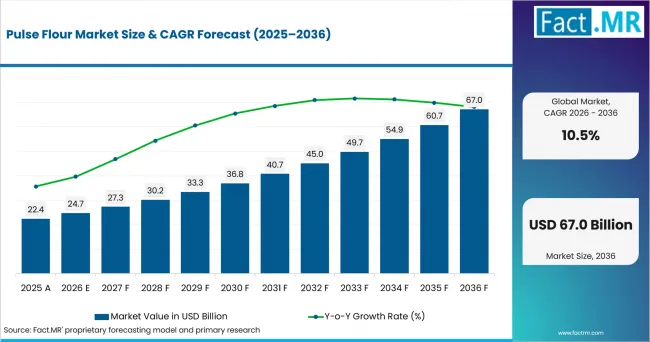
Pulse Flour Market Value Analysis | Source: Fact.MR
What are the defining numbers behind Pulse Flour Market growth?
USD 42.3 billion absolute opportunity by 2036, led by Chickpeas, Bakery and Confectionery, and Food Manufacturers.
- Demand Drivers in the Market
- Bakery manufacturers need chickpea and lentil flour for gluten-free breads, biscuits, and snack bases that still need structure without wheat.
- Food processors benefit from pulse crop availability after USDA NASS reported in January 2026 that 2025 U.S. dry edible pea production reached 18.5 million cwt.
- Product development teams use pulse flour when protein and fiber claims must stay linked to a recognizable ingredient source.
- Foodservice operators need stable batter and breading systems for plant-based snacks, fried foods, and allergen-aware menus.
- Key Segments Analyzed
- By Product: Chickpeas are expected to hold 22.5% share in 2026 owing to their role in gluten-free bakery and snack formulations.
- By Application: Bakery and Confectionery is projected to account for 33.8% share in 2026 due to use in breads, crackers, cookies, and sweet baked goods.
- By Distribution Channel: Food Chain Services are anticipated to capture 42.0% share in 2026 as ingredient procurement remains concentrated among industrial buyers and foodservice users.
- By End Use: Food Manufacturers are estimated to represent 69.4% share in 2026 because pulse flour demand is tied to packaged food reformulation.
- Analyst Opinion at Fact.MR
- Shambhu Nath Jha, Principal Analyst at Fact.MR, states, “Pulse flour suppliers are being judged less on commodity price and more on particle size, taste control, and application support. Product approval is expected to depend on predictable hydration and clean flavor across bakery and snack recipes. Suppliers should combine crop access, milling control, and formulation help so brands reduce trial-and-error costs.”
- Strategic Implications
- Ingredient buyers should test pulse flours in finished recipes before negotiating annual supply volumes.
- Millers should protect lot consistency because bakery and extrusion users reject flour that changes water absorption between batches.
- Food brands can view the UK manufacturing base as an adoption signal, with Defra reporting in July 2026 that food and drink manufacturing generated £39.3 billion in GVA in 2024.
- Investors should separate direct pulse flour exposure from broader grain milling or pulse trading revenue.
The UK Pulse Flour Market to post a 9.6% CAGR through 2036 from a small modeled base. This proprietary country forecast is not independently validated by the cited Defra statistics. Italy is projected to record 12.9% CAGR as food processors expand pulse-based plant protein use. Japan is forecast at 11.9% CAGR where health foods and wheat-flour applications keep testing active. The USA is anticipated to hold 11.5% CAGR supported by pulse crops. France is estimated at 8.9% CAGR through food-processing scale. South Korea is forecast at 6.5% CAGR as ingredient imports support food manufacturing.
How does the Pulse Flour Market break down by segment?
Chickpeas lead Product at 22.5%; Bakery and Confectionery leads Application at 33.8%.
Which product dominates?
Chickpeas are projected to account for 22.5% share in 2026.
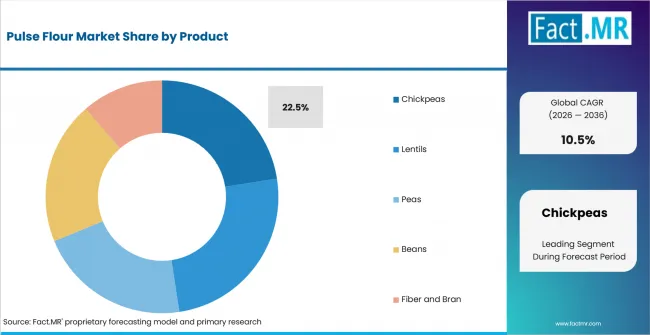
Pulse Flour Market Analysis By Product | Source: Fact.MR
Chickpea flour is expected to lead Product because it works across crackers, cookies, batters, and snack coatings. Lentil flour supports red-toned snacks and higher-protein blends. Pea flour supports neutral bakery bases and extruded applications. USDA ERS reported in July 2025 that U.S. chickpea stocks were 36.0% higher year over year in June 2025.
What leads the Application segment?
Bakery and Confectionery is expected to hold 33.8% share in 2026.
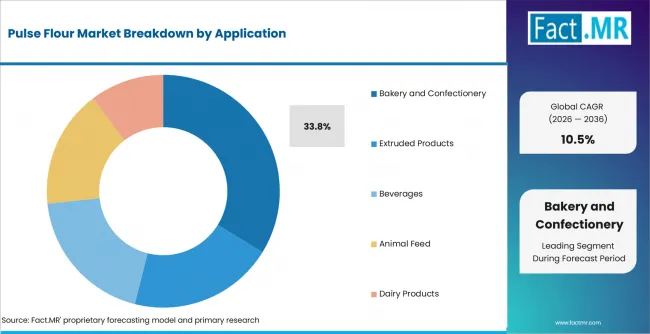
Pulse Flour Market Analysis By Application | Source: Fact.MR
Bakery and Confectionery is projected to lead Application as pulse flour replaces part of wheat flour and improves protein or fiber claims. Breads, cookies, and crackers absorb the largest early volumes because they already use dry flour blends. USDA FAS reported in April 2026 that France’s bakery industry recorded turnover of USD 17.2 billion in 2025.
How does Distribution Channel shape demand?
Food Chain Services are anticipated to lead with 42.0% share in 2026.
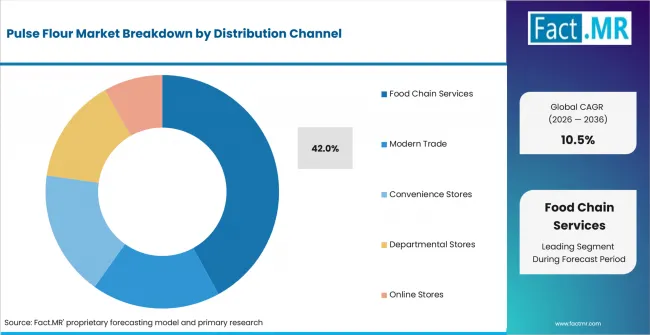
Pulse Flour Market Analysis By Distribution Channel | Source: Fact.MR
Food Chain Services are anticipated to lead Distribution Channel since restaurants and industrial buyers require repeatable flour specs. Modern trade expands branded retail packs, but the higher-volume channel remains procurement-led. USDA FAS reported in May 2026 that South Korea imported around USD 21.0 billion in consumer-oriented agricultural products in 2025. This establishes the scale of the broader imported-food channel but does not directly measure pulse-flour imports or demand.
What supports Food Manufacturers within End Use?
Food Manufacturers are estimated to represent 69.4% share in 2026.
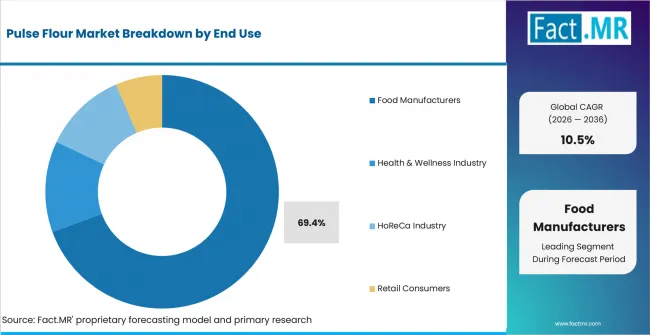
Pulse Flour Market Analysis By End Use | Source: Fact.MR
Food Manufacturers are estimated to lead End Use because most volume enters packaged foods, bakery mixes, snacks, and dry ingredient systems. Wellness companies use pulse flour for protein and fiber positioning, but industrial recipes absorb more tonnage. USDA FAS reported in April 2026 that Italy’s pulse imports rose from USD 253.0 million in 2019 to USD 406.0 million in 2025. The report also describes Italy’s food-processing industry as a major user of imported ingredients.
What is accelerating Pulse Flour Market adoption, and what is holding it back?
Bakery reformulation drives it; flavor and supply variability restrain it.
Drivers Impact Analysis
| DRIVER | (~) % IMPACT ON CAGR | GEOGRAPHIC RELEVANCE | IMPACT TIMELINE |
|---|---|---|---|
| Gluten-free bakery | +2.6% | USA, UK, Japan | Short term (<= 2 years) |
| Protein and fiber claims | +2.2% | USA, France, Italy | Short term (<= 2 years) |
| Foodservice use | +1.8% | South Korea, USA, UK | Medium term (2-4 years) |
| Pulse crop policy support | +1.4% | India, USA, Europe | Medium term (2-4 years) |
| Cleaner labels | +1.1% | Europe and East Asia | Long term (>= 4 years) |
- Gluten-free bakery: Pulse flour helps bakeries reduce wheat dependence while keeping recognizable labels. Chickpea and lentil flours suit crackers, cookies, pizza bases, and batters. Procurement is expected to favor documented particle size and microbial controls.
- Protein and fiber claims: Food manufacturers use pea, chickpea, bean, and lentil flours in food formulations to increase their protein and nutritional content. The Government of India launched the Mission for Aatmanirbharta in Pulses on October 11, 2025, with a budgetary allocation of ₹11,440 crore for 2025–26 through 2030–31.
- Foodservice use: Pulse flours help restaurants and snack makers create coatings, chips, and extruded formats. USDA FAS reported in May 2026 that South Korea’s HRI sector reached USD 145.8 billion in 2024, which gives foodservice suppliers a broad testing base.
- Cleaner labels: Retail brands use whole pulse flours to avoid complex additive lists. Ardent Mills released its 2025 flour trend guide in January 2025 and highlighted chickpea and lentil flours for protein and fiber enrichment.
Opportunity Impact Analysis
| OPPORTUNITY | (~) % IMPACT ON CAGR | GEOGRAPHIC RELEVANCE | IMPACT TIMELINE |
|---|---|---|---|
| Deflavored pulse flour | +1.5% | USA, Canada, Europe | Medium term (2-4 years) |
| Functional bakery blends | +1.2% | UK, France, Japan | Medium term (2-4 years) |
| Extruded snack applications | +0.9% | USA and South Korea | Long term (>= 4 years) |
| Industrial private label supply | +0.7% | Europe and North America | Long term (>= 4 years) |
- Functional bakery blends: Bakery brands need blends that combine chickpea, pea, and lentil flour with starches or fibers. Ingredient suppliers are anticipated to compete on test kitchen support and proof of finished-product performance.
- Extruded snack applications: Pulse flour improves expansion, protein content, and texture in extruded snacks. Suppliers with extrusion test support are expected to win trials when brands need ingredient blends that hold shape after frying or baking.
- Industrial private label supply: Retailers with private-label bakery and snack lines need stable ingredient costs. Millers with regional sourcing and clean documentation are expected to gain supplier approvals.
Restraints Impact Analysis
| RESTRAINT | (~) % IMPACT ON CAGR | GEOGRAPHIC RELEVANCE | IMPACT TIMELINE |
|---|---|---|---|
| Flavor and color limits | -1.2% | Global | Short term (<= 2 years) |
| Crop variability and import exposure | -1.0% | Europe and East Asia | Short term (<= 2 years) |
| Processing cost and allergen checks | -0.8% | Food manufacturing hubs | Medium term (2-4 years) |
| Conservative bakery recipes | -0.6% | Japan, France, Italy | Long term (>= 4 years) |
- Flavor and color limits: Chickpea, pea, and bean flours change taste and finished-product color at high inclusion rates. Brands need sensory testing before launch.
- Crop variability and import exposure: Processors depend on harvest quality and import routes. Defra reported in July 2026 that UK peas for harvesting dry covered 60 thousand hectares in 2025, down from 89 thousand hectares in 2024.
- Processing cost and allergen checks: Fine milling, heat treatment, and microbial control increase cost compared with basic grain flour. Smaller food brands are expected to delay adoption when testing budgets are limited.
- Conservative bakery recipes: Traditional wheat-based bakery remains hard to replace where taste expectations are strict. USDA FAS reported in April 2026 that Japan’s food processing sector contracted 3.0% in 2025.
Which countries are scaling Pulse Flour Market fastest?
- The country comparison spans 6.4 percentage points and forms three practical growth bands across the forecast period.
- Italy remains 1.0 percentage point above Japan through pulse imports, food-processing scale and processed-food reformulation.
- Japan remains 0.4 percentage point above the USA through health-food demand and wheat-flour applications.
- The USA remains 1.9 percentage points above the UK through domestic pulse availability and established ingredient processing.
- The UK remains 0.7 percentage point above France through bakery and snack reformulation and wheat-reduction applications.
- France remains 2.4 percentage points above South Korea through food-processing scale and healthier ingredient demand.
- South Korea closes the displayed range through imported ingredient use and high-volume packaged-food production.
Similar product claims create different entry conditions across countries due to crop access, food-processing scale, taste tolerance, and import exposure. Full report coverage includes North America, Latin America, Europe, East Asia, South Asia and Pacific, Middle East and Africa.
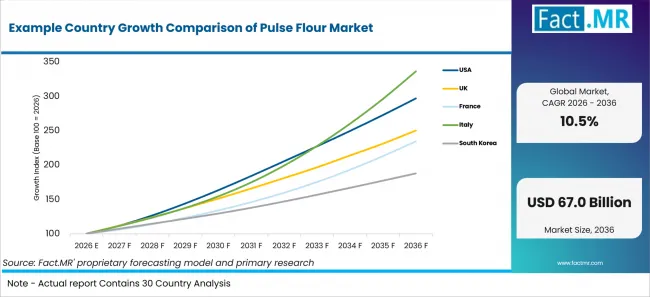
Example Country Growth Comparison Of Pulse Flour Market | Source: Fact.MR
| Country | CAGR (2026-2036) |
|---|---|
| UK | 9.6% |
| Italy | 12.9% |
| Japan | 11.9% |
| USA | 11.5% |
| France | 8.9% |
| South Korea | 6.5% |
What supports UK adoption?
9.6% CAGR, supported by bakery and snack reformulation and wheat-reduction applications.
The UK’s growth reflects a market where bakery and snack producers are testing pulse flour as a wheat-reduction ingredient. Defra reported in July 2026 that field pea production for human consumption was valued at £22.0 million in 2025, down from £28.0 million in 2024. Small crop scale still makes consistency and import coverage central to supplier selection.
How is Italy scaling demand?
12.9% CAGR, supported by pulse imports and processed food reformulation.
Italy’s food processors use pulse flour where grain alternatives need to fit pasta, bakery, snack, and free-from formats. USDA FAS reported in April 2026 that the country had more than 55,000 food processing enterprises and production value above USD 85.0 billion in 2024. Imported raw materials remain central because Italy’s strength is in processing and finished foods.
What is driving Japan’s growth from 2026 to 2036?
11.9% CAGR, backed by health foods and wheat-flour applications.
Japan’s demand is shaped by conservative texture expectations and steady interest in health-oriented foods. USDA FAS reported in April 2026 that Japan’s wheat flour category reached USD 19.54 billion in 2025 and grew 4.0% from 2024. Pulse flour suppliers are expected to win trials when they show clean taste in bakery, coatings, and dry mixes.
How is USA developing demand?
11.5% CAGR, supported by crop availability and ingredient processing.
The USA benefits from domestic pulses and established ingredient milling in the northern Plains and Pacific Northwest. USDA NASS reported in January 2026 that 2025 U.S. chickpea production reached 6.84 million cwt, up 20.0% from 2024. Food manufacturers still need flour that holds color, flavor, and hydration across commercial recipes.
How does France perform?
8.9% CAGR, supported by food-processing scale and healthier ingredient demand.
France’s opportunity is tied to bakery scale and consumer interest in healthier foods. USDA FAS reported in April 2026 that France had approximately 17,000 food processing companies in 2025 and annual revenue of USD 215 billion or more. Ingredient suppliers face tight safety, origin, and cost expectations before wide use in traditional bakery products.
What supports South Korea’s growth?
6.5% CAGR, driven by food processing and imported ingredient use.
South Korea’s demand is linked to imported food ingredients and high-volume packaged food production. USDA FAS reported in May 2026 that Korea’s food processing industry generated 111.9 trillion KRW in domestic sales in 2024. Pulse flour adoption is expected to remain selective because food makers must manage taste, labeling, and import documentation together.
Who leads the Pulse Flour Market?
Key companies include Ingredion, ADM, AGT Foods, Avena Foods and Ardent Mills as having direct flour or pulse-ingredient relevance. Scoular has broader grain-and-pulse relevance.
Ingredion participates through HOMECRAFT pulse flours that cover peas, lentils, faba beans, and chickpeas. ADM announced new protein ingredient solutions in May 2026 that included pea flour with neutral color, neutral flavor, fiber, and no allergen labeling. AGT Food and Ingredients Inc. supplies PulsePlus flours and fiber formats. Avena Foods supports oat and pulse ingredient supply, while Ardent Mills serves flour applications. Scoular supplies and processes grains and pulses, although its cited public product page does not establish a dedicated pulse-flour line.
Which companies are the key providers?
Profiled providers include Ingredion Incorporated, Archer Daniels Midland Company, AGT Food and Ingredients Inc., Avena Foods Limited, Ardent Mills, and Scoular.
- Ingredion Incorporated
- Archer Daniels Midland Company (ADM)
- AGT Food and Ingredients Inc.
- Avena Foods Limited
- Ardent Mills
- Scoular
Bibliography
- AGT Food and Ingredients Inc. (2025). [Combined ingredient sheets for PulsePlus™ pulse ingredients].
- Ardent Mills. (2025, January 21). The 2025 (and beyond) flour trend guide.
- ADM. (2026, May 20). ADM advances protein innovation with new ingredient solutions.
- Avena Foods Limited. (2025, July 21). Launching Avena Regen Ag Protocol oat and pulse ingredients.
- Department for Environment, Food & Rural Affairs. (2026, July 9). Agriculture in the United Kingdom 2025. GOV.UK.
- U.S. Department of Agriculture, Foreign Agricultural Service. (2026, April 1). Japan: Food processing ingredients annual (GAIN Report No. JA2026-0012).
- U.S. Department of Agriculture, Foreign Agricultural Service. (2026, April 2). Italy: Food processing ingredients annual (GAIN Report No. IT2026-0001).
- U.S. Department of Agriculture, Foreign Agricultural Service. (2026, April 3). France: Food processing ingredients annual (GAIN Report No. FR2026-0003).
- U.S. Department of Agriculture, Foreign Agricultural Service. (2026, May 27). South Korea: Food processing ingredients annual (GAIN Report No. KS2026-0013).
- Press Information Bureau. (2025, October 11). India’s Mission for Aatmanirbharta in Pulses: Enhancing production and farmers’ income. Government of India.
- U.S. Department of Agriculture, National Agricultural Statistics Service. (2026, January 12). Crop production 2025 summary.
This Report Answers
- The report provides strategic intelligence on Product and Application choices that shape bakery and packaged food reformulation.
- Segment analysis covers Chickpeas and Bakery and Confectionery as the 2026 share leaders.
- Country outlook evaluates the USA and UK alongside France and Italy. Japan and South Korea complete the growth comparison.
- Competitive analysis profiles Ingredion and ADM alongside AGT Foods, Avena Foods, Ardent Mills, and Scoular.
- Channel assessment covers Food Chain Services and Modern Trade. Convenience Stores, Departmental Stores, and Online Stores complete the channel view.
What does the Pulse Flour Market cover?
Pulse flour systems cover milled ingredients used in finished food formulations. Coverage is adjacent to pulse ingredients, chickpea supply, yellow pea protein, and gluten-free flour where protein, fiber, and wheat replacement overlap.
Coverage also connects with plant protein ingredients, the broader baking ingredients, and plant-based snacks because pulse flour competes in bakery, snacks, and dry mixes.
What is included in the scope?
The scope includes pulse flours used by food manufacturers, foodservice providers, wellness companies, HoReCa operators, and retail consumers. It covers chickpea, lentil, pea, bean, and fiber-based flours used for texture or nutrition.
What is excluded from the scope?
Whole pulses sold for cooking are excluded unless they are milled into flour. Isolated pulse proteins are excluded when sold mainly as isolates. General grain and wheat flours are excluded unless pulse flour is part of a blend.
How Was the Analysis Built?
The analysis draws on 120+ sources, 35+ company portfolios, 25+ countries, and more than 20 industry interviews.
- Primary Research: Primary research includes discussions with manufacturers, service providers, technology developers, distributors, end users, procurement teams, and subject-matter experts. These conversations examine purchasing priorities, product adoption, operational challenges, approval requirements, competitive positioning, and the factors that influence wider market acceptance.
- Desk Research: Desk research covers government statistics, regulatory publications, company filings, trade data, technical studies, industry associations, standards, public policy, and other authoritative sources. Every source used in the analysis is documented in the bibliography.
- Market Sizing and Forecasting: Market estimates combine historical performance, demand indicators, pricing and volume trends, segment shares, company participation, country-level growth, adoption patterns, investment activity, and barriers to market expansion.
- Data Validation and Update Cycle: Findings are validated by comparing primary interviews with public data, company activity, regulatory changes, trade patterns, and industry developments. Regular updates review new product launches, capacity changes, partnerships, approvals, procurement trends, and shifts in commercial adoption.
What is the report’s scope and coverage?
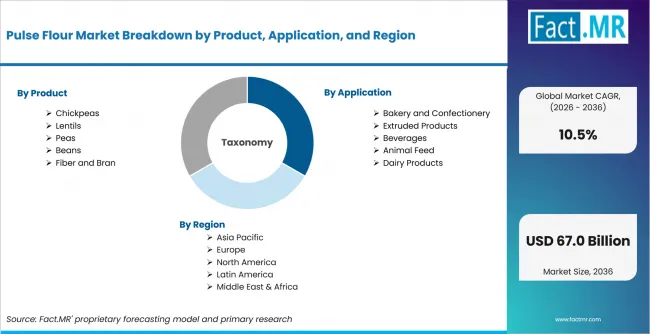
Pulse Flour Market Breakdown By Product, Application, And Region | Source: Fact.MR
| Attribute | Details |
|---|---|
| Quantitative Units | USD billion |
| Market Definition | Pulse-based flours produced from chickpeas, lentils, peas, beans, and fiber or bran fractions for food, beverage, foodservice, retail, and industrial formulation use |
| Product | Chickpeas; Lentils; Peas; Beans; Fiber and Bran |
| Application | Bakery and Confectionery; Extruded Products; Beverages; Animal Feed; Dairy Products |
| Distribution Channel | Food Chain Services; Modern Trade; Convenience Stores; Departmental Stores; Online Stores |
| End Use | Food Manufacturers; Health & Wellness Industry; HoReCa Industry; Retail Consumers |
| Regions Covered | North America; Latin America; Europe; East Asia; South Asia and Pacific; Middle East and Africa |
| Countries Covered | USA; UK; France; Italy; South Korea; Japan |
| Key Companies Profiled | Ingredion Incorporated; Archer Daniels Midland Company; AGT Food and Ingredients Inc.; Avena Foods Limited; Ardent Mills; Scoular |
| Forecast Period | 2026 to 2036 |
| Approach | Hybrid top-down and bottom-up approach using pulse crops, milling capacity, food-processing demand, bakery reformulation, procurement behavior, trade exposure, country CAGRs, and company portfolio review |
How is the market segmented?
-
By Product
- Chickpeas
- Whole Chickpeas
- Processed Chickpeas
- Functional Chickpea Ingredients
- Lentils
- Whole Lentils
- Processed Lentils
- Functional Lentil Ingredients
- Peas
- Yellow Peas
- Green Peas
- Pea Ingredients
- Beans
- Common Beans
- Processed Beans
- Functional Bean Ingredients
- Fiber and Bran
- Cereal Fiber
- Pulse Fiber
- Functional Fiber Blends
- Chickpeas
-
By Application
- Bakery and Confectionery
- Bakery Products
- Confectionery Products
- Functional Bakery
- Extruded Products
- Snack Products
- Breakfast Cereals
- Functional Extruded Products
- Beverages
- Functional Beverages
- Plant Based Beverages
- Instant Beverage Mixes
- Animal Feed
- Livestock Feed
- Pet Nutrition
- Aquaculture Feed
- Dairy Products
- Fermented Dairy
- Flavorized Dairy
- Functional Dairy
- Bakery and Confectionery
-
By Distribution Channel
- Food Chain Services
- Quick Service Restaurants
- Foodservice Providers
- Industrial Buyers
- Modern Trade
- Supermarkets
- Hypermarkets
- Specialty Retail
- Convenience Stores
- Urban Convenience Stores
- Travel Retail Stores
- Local Retail Outlets
- Departmental Stores
- Premium Departmental Stores
- Mass Market Stores
- Multi Category Retailers
- Online Stores
- E Commerce Platforms
- Subscription Platforms
- Digital Retail Services
- Food Chain Services
-
By End Use
- Food Manufacturers
- Packaged Food Companies
- Baking Industry Companies
- Health & Wellness Industry
- Nutraceutical Companies
- Diet Food Producers
- HoReCa Industry
- Hotels & Restaurants
- Catering Services
- Retail Consumers
- Household Cooking Segment
- Organic Food Buyers
- Food Manufacturers
-
By Region
- North America
- Latin America
- Western Europe
- Eastern Europe
- East Asia
- South Asia and Pacific
- Middle East & Africa