- Market Value (2025): USD 14.9 Bn
- Estimated Value (2026): USD 16.1 Bn
- Forecast Value (2036): USD 35.1 Bn
- CAGR (2026-2036): 8.1%
What is the Food Thickening Agents Market forecast to be worth by 2036?
USD 16.1 billion in 2026 to USD 35.1 billion by 2036, at 8.1% CAGR.
- The food thickening agents market crossed USD 14.9 billion in 2025 as packaged food recipes used more viscosity-control systems.
- Demand is projected to increase from USD 16.1 billion to USD 35.1 billion by 2036.
- The market is forecast to record 8.1% CAGR from 2026 to 2036 as formulators seek repeatable texture in industrial recipes.
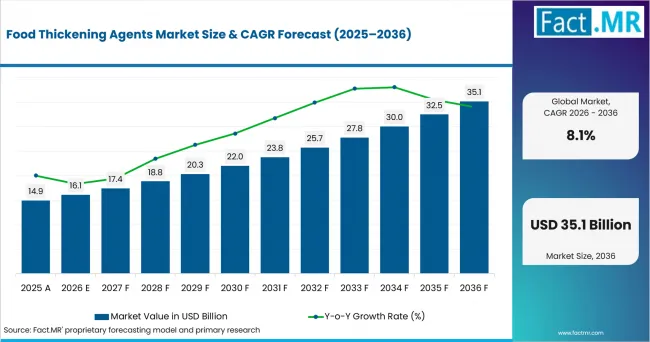
Food Thickening Agents Market Value Analysis | Source: Fact.MR
What are the defining numbers behind Food Thickening Agents Market growth?
USD 19.0 billion absolute opportunity by 2036, led by Bakery and Confectionery, Plant Based Hydrocolloids and Food Processing Industry.
- Demand Drivers in the Market
- Bakery manufacturers need thickeners that hold filling viscosity during heating and display. USDA NASS reported U.S. total flour production of 419 million hundredweight in 2025, which supports large bakery usage of starches and gums for consistent fillings and dough systems.
- Sauce and dressing formulators use gums and starches to keep pourability consistent.
- Dairy processors need stabilizers that protect texture when protein and acidity change.
- Ingredient blenders need documented hydrocolloid performance before recipe approval.
- Key Segments Analyzed
- By Application: Bakery and Confectionery is expected to hold 35.40% share in 2026 because fillings and dough systems depend on controlled viscosity.
- By Product: Plant Based Hydrocolloids are projected to account for 44% share in 2026 owing to broad use in starch and gum-based texture systems.
- By End Use: Food Processing Industry is anticipated to capture 58.60% share in 2026 as packaged food manufacturers buy thickeners in repeat production volumes.
- By Technology: Hydrocolloid Technology is estimated to represent 49.30% share in 2026 due to its direct role in gelling and viscosity control.
- Analyst Opinion at Fact.MR
- Shambhu Nath Jha, Principal Consultant at Fact.MR, states, “Food thickening agents draw attention when recipes must survive heating and storage without losing mouthfeel. Adoption is expected to favor suppliers that pair ingredient chemistry with application proof.”
- Strategic Implications
- Food manufacturers should test viscosity under real processing temperatures.
- Ingredient suppliers should document dosage, hydration and allergen status.
- Procurement teams should compare recipe cost against shelf-life performance.
The USA is projected to record 8.9% CAGR through packaged food and foodservice recipes. South Korea is anticipated to post 7.6% as food output and exports expand. France is estimated to advance at 7.2% through bakery processing. The UK is forecast to record 7.1% through private-label reformulation. Italy is projected to post 7.0% on sauces and dairy desserts. Japan is expected to reach 6.8% through convenience foods.
How does the Food Thickening Agents Market break down by segment?
Bakery and Confectionery leads Application at 35.4%; Plant Based Hydrocolloids leads Product at 43.5%.
Which Application leads demand?
Bakery and Confectionery is projected to account for 35.4% share in 2026.
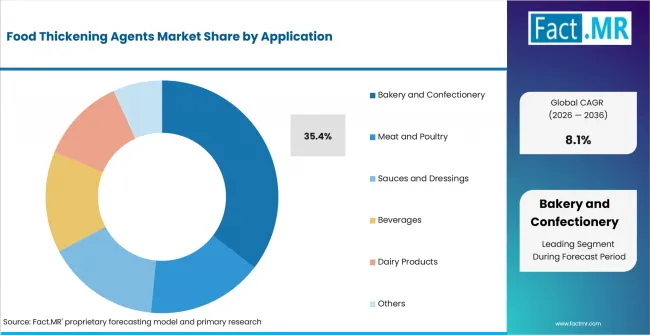
Food Thickening Agents Market Analysis By Application | Source: Fact.MR
Bakery and Confectionery is projected to lead Application as fillings and dough systems need viscosity that survives heat and storage. Bakery Products use starches and gums to hold body. Functional Bakery is expected to rise where protein or reduced sugar recipes need texture repair. In August 2025, IFF launched POWERFRESH ACE 2000 for the U.S. market to help industrial bakeries improve softness, resilience and cohesiveness through shelf life.
What leads the Product segment?
Plant Based Hydrocolloids are expected to hold 43.5% share in 2026.
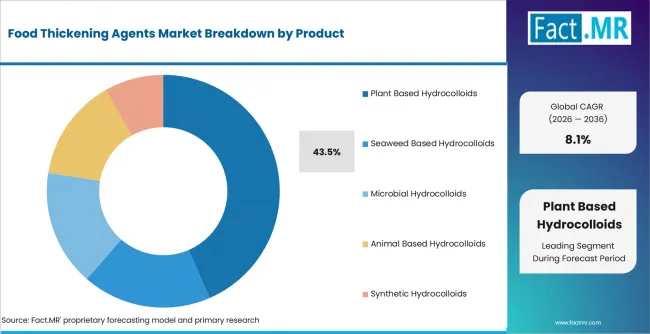
Food Thickening Agents Market Analysis By Product | Source: Fact.MR
Plant Based Hydrocolloids are expected to lead Product since guar gum and locust bean gum work across bakery, sauce and beverage systems. Seaweed hydrocolloids add carrageenan, agar and alginate. Xanthan gum and gellan gum support low-dose viscosity. In February 2025, Givaudan announced an agreement with Dole Asia Holdings to distribute Green Banana Powder, a clean-label texture ingredient that can replace gum, pectin and modified starches in soups and sauces.
How does End Use shape demand?
Food Processing Industry is anticipated to capture 58.6% share in 2026.
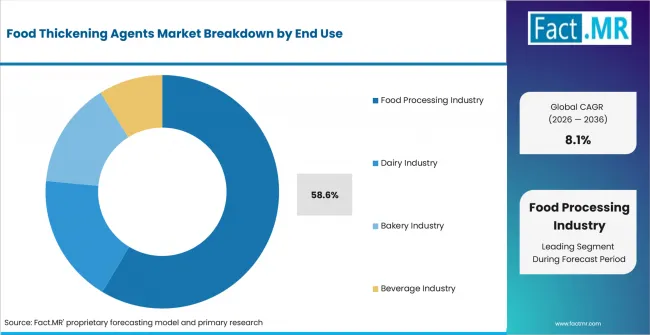
Food Thickening Agents Market Analysis By End Use | Source: Fact.MR
Food Processing Industry is anticipated to capture 58.60% share in 2026. Packaged Food Manufacturers need viscosity that holds through distribution. Ingredient blenders reduce dosing errors through premixes. Dairy and bakery processors remain visible users.
What supports Hydrocolloid Technology within Technology?
Hydrocolloid Technology is estimated to represent 49.3% share in 2026.
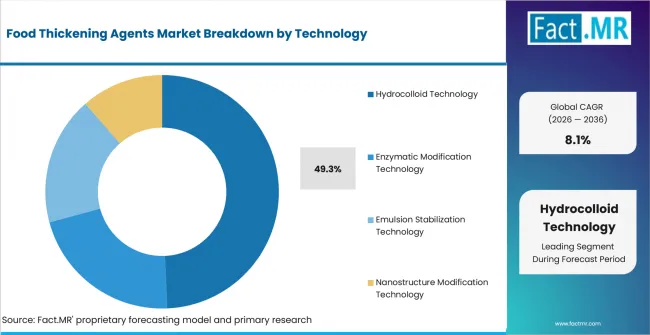
Food Thickening Agents Market Analysis By Technology | Source: Fact.MR
Hydrocolloid Technology is estimated to lead Technology because most thickening choices depend on hydration, viscosity build and gel formation. Natural Extraction Systems support plant based positions. Starch modification helps tailor texture in heat-processed recipes. In July 2025, Tate & Lyle said its IFT FIRST 2025 showcase would feature four prototypes, including a dual-texture gummy lollipop using GENU Pectin and GENUTINE Carrageenan.
What is accelerating Food Thickening Agents Market adoption, and what is holding it back?
Bakery formulation is expected to lift adoption; additive documentation and cost pressure are expected to restrain it.
Drivers Impact Analysis
| Driver | (~) % Impact on CAGR | Geographic Relevance | Impact Timeline |
|---|---|---|---|
| Bakery use | +2.1% | USA, UK, France | Short term (<= 2 years) |
| Plant hydrocolloids | +1.8% | North America, Europe | Short term (<= 2 years) |
| Packaged food scale | +1.6% | USA, South Korea | Medium term (2-4 years) |
| Sauce viscosity | +1.1% | USA, UK, Italy | Medium term (2-4 years) |
| Dairy stabilization | +0.9% | Japan, France, South Korea | Long term (>= 4 years) |
- Bakery and confectionery use: Fillings and batters need stable viscosity during heating and shelf display.
- Plant based hydrocolloid reformulation: Brands use guar gum, pectin, carrageenan and alginate for familiar texture routes.
- Packaged food manufacturing scale: Large processors use thickeners to reduce batch variation in sauces, meals, beverages and desserts.
- Sauce and dressing viscosity control: Pourability and cling shape retail acceptance when oil or particulates must stay stable.
- Dairy texture stabilization: Fermented dairy and dairy beverages need stabilizers that manage protein, acidity and suspended particles.
Opportunity Impact Analysis
| Opportunity | (~) % Impact on CAGR | Geographic Relevance | Impact Timeline |
|---|---|---|---|
| Clean label starch | +1.3% | USA, UK, Japan | Short term (<= 2 years) |
| Dairy alternatives | +1.0% | USA, South Korea, Japan | Medium term (2-4 years) |
| Reduced sugar texture | +0.8% | Europe, North America | Medium term (2-4 years) |
| Premix support | +0.6% | Global food processors | Long term (>= 4 years) |
- Dairy alternative texture repair: Plant-based dairy needs viscosity and suspension support to mimic dairy mouthfeel.
- Reduced sugar mouthfeel systems: Sugar reduction removes body from beverages, fillings and desserts.
- Premix and application support: Ingredient blenders reduce handling complexity where processors lack hydrocolloid expertise.
Restraints Impact Analysis
| Restraint | (~) % Impact on CAGR | Geographic Relevance | Impact Timeline |
|---|---|---|---|
| Additive documentation | -1.1% | Europe, Japan, USA | Short term (<= 2 years) |
| Material cost swings | -0.9% | Global | Short term (<= 2 years) |
| Hydration limits | -0.7% | Variable food lines | Medium term (2-4 years) |
| Label risk | -0.5% | Premium brands | Long term (>= 4 years) |
- Additive documentation burden: Food additive rules require evidence on identity, use levels and safety. European Commission re-evaluation work published in February 2026 keeps documentation central.
- Raw material cost swings: Gums, starches and seaweed-derived ingredients face crop, harvest and logistics variability.
- Hydration and processing limits: Some hydrocolloids clump or lose performance when shear, pH or heat is poorly controlled.
- Label perception risk: Consumers are expected to reject unfamiliar ingredient names when the additive feels too technical.
Which countries are scaling Food Thickening Agents Market fastest?
- The displayed country comparison spans 2.1 percentage points and separates the USA from mature European and East Asian markets.
- The USA remains 1.3 percentage points above South Korea through packaged food scale and foodservice recipe volume.
- South Korea remains 0.4 percentage point above France as domestic production and K-food exports support texture-system use.
- France remains 0.1 percentage point above the UK through bakery, dairy and confectionery processing depth.
- The UK remains 0.1 percentage point above Italy as private-label reformulation and bakery channels keep demand steady.
- Italy remains 0.2 percentage point above Japan through sauces, bakery fillings and dairy dessert applications.
Comparable CAGRs create different entry conditions because food culture and additive rules vary by country. Processing scale changes the pace of thickener substitutions. Coverage includes North America, Europe, East Asia, South Asia and Pacific, Latin America, Middle East and Africa.
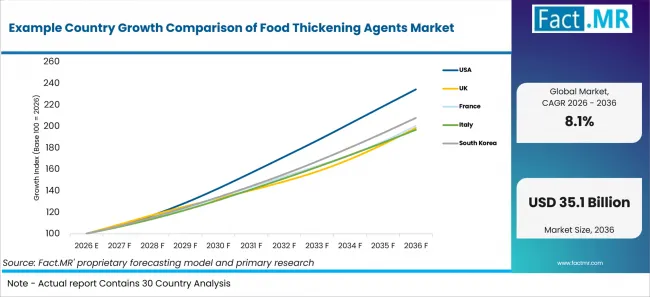
Example Country Growth Comparison Of Food Thickening Agents Market | Source: Fact.MR
| Country | CAGR |
|---|---|
| USA | 8.9% |
| South Korea | 7.6% |
| France | 7.2% |
| UK | 7.1% |
| Italy | 7.0% |
| Japan | 6.8% |
What supports USA adoption?
8.9% CAGR, supported by packaged food spending and foodservice texture needs.
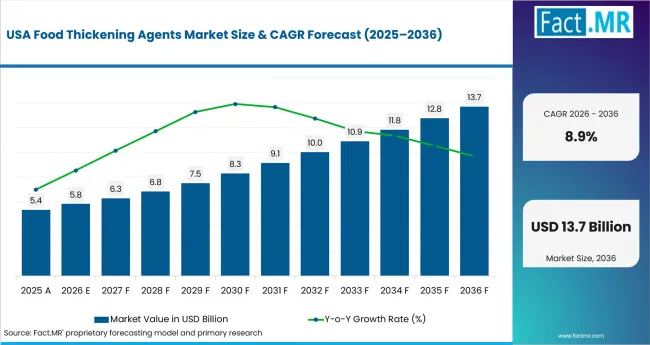
Food Thickening Agents Market Country Value Analysis | Source: Fact.MR
The USA’s growth reflects broad packaged food and foodservice demand for starches, gums and cellulose systems that maintain viscosity and shelf stability. USDA Economic Research Service reported U.S. food spending of USD 2.51 trillion in 2025. Brands continue to test texture, label fit and processing behavior, while food inflation, seasonal purchasing swings and additive checks can slow substitutions.
How is South Korea scaling demand?
7.6% CAGR, driven by food production growth and K-food exports.
South Korea’s growth is supported by expanding food production and export-oriented sauce, noodle, dairy beverage and dessert manufacturing. In May 2026, MFDS reported 2025 food industry production of KRW 119 trillion, up 4.3%. Manufacturers require thickeners that withstand heating and distribution, while imported gum costs, freight changes and limited testing support can restrain smaller processors.
What is driving France’s growth from 2026 to 2036?
7.2% CAGR, backed by food manufacturing scale and bakery strength.
France’s growth reflects a large food manufacturing base and established bakery and dairy processing activity. Dairy processors use pectin, carrageenan, starch and cellulose systems, while additive re-evaluation and strict mouthfeel expectations can extend qualification cycles.
What supports UK adoption?
7.1% CAGR, supported by bakery output and private-label reformulation.
The UK’s growth is supported by bakery production, private-label meals and continued use of starches and hydrocolloids for texture control. In July 2026, ONS reported that food manufacturing represented 22.9% of total UK manufacturers' sales in 2025. Cleaner-label reformulation supports plant-based hydrocolloids, while food inflation, imported ingredient exposure and retailer price benchmarking can limit premium adoption.
How is Italy developing demand?
7.0% CAGR, led by bakery fillings, sauces and dairy desserts.
Italy’s growth reflects demand from bakery fillings, sauces and dairy desserts that require stable body through heating and storage. In June 2026, ISTAT reported that Italy’s agri-food sector generated EUR 89 billion in value added in 2025. Export-oriented brands value repeatable viscosity, while input-cost pressure, traditional labeling preferences and the need for supplier trials can slow adoption.
How does Japan perform?
6.8% CAGR, shaped by convenience foods and strict quality expectations.
Japan’s growth is supported by convenience foods, dairy beverages and other products that require precise low-dose thickener performance under cold-chain conditions. Manufacturers value application support, while food inflation, cautious label changes and strict quality checks can extend approval cycles.
Who leads the Food Thickening Agents Market?
Cargill, Ingredion, Tate & Lyle, IFF and Ashland show the clearest thickener relevance.
Cargill supports starches and hydrocolloids used in sauces, bakery and dairy products. Ingredion brings starch, gum and clean-label texture expertise. Tate & Lyle and CP Kelco add pectin, carrageenan and specialty gums. IFF and Ashland support hydrocolloids and cellulose derivatives. In October 2025, Ashland appointed Tilley Distribution as its exclusive U.S. food and beverage ingredient distributor for cellulosic hydrocolloids including CMC, MC, HPMC and HPC.
Which companies are the key providers?
Direct and adjacent providers include starch, gum, hydrocolloid, gelatin and specialty ingredient companies.
- Cargill, Incorporated
- Archer Daniels Midland Company
- Tate & Lyle PLC, including CP Kelco
- Ingredion Incorporated, including TIC Gums
- International Flavors & Fragrances Inc.
- Darling Ingredients Inc.
- Ashland Global Holdings Inc.
- Kerry Group plc
- dsm-firmenich
- BASF SE
- Givaudan, including Naturex
- Jungbunzlauer Suisse AG
- Avebe U.A.
- Deosen Biochemical (Ordos) Ltd.
Bibliography
- Ashland Inc. (2025, October 6). Ashland announces new U.S. food and beverage ingredient distributor.
- Department for Environment, Food & Rural Affairs. (2026, July 29). Food statistics in your pocket.
- European Commission. (2026, February 18). Summary table of permitted food additives and status of their re-evaluation by EFSA (status as of 18 February 2026).
- Ministry of Agriculture, Food and Rural Affairs. (2026, January 20). Exports of K-Food Plus reached USD 13.6 billion in 2025, up 5.1% year-over-year.
- Office for National Statistics. (2026, January 21). Consumer price inflation, UK: December 2025.
- Ministry of Data and Statistics. (2025, December 31). Consumer Price Index in December 2025.
- Tate & Lyle PLC. (2025, April 1). Tate & Lyle welcomes government officials to Lille Skensved, formerly of CP Kelco, to celebrate completion of carbon reduction and energy efficiency project.
This Report Addresses
- The report reviews Application, Product, End Use and Technology choices shaping formulation.
- Segment analysis covers Bakery and Confectionery, Plant Based Hydrocolloids and Hydrocolloid Technology.
- Country outlook evaluates the USA, South Korea, France, the UK, Italy and Japan.
- Competitive analysis profiles Cargill, Ingredion, Tate & Lyle, IFF, Ashland and other direct suppliers.
- Application assessment covers bakery, sauces, beverages, dairy products and other uses.
What does the Food Thickening Agents Market cover?
Food thickening agents cover starches, gums, cellulose derivatives, gelatin and seaweed-based hydrocolloids used to change viscosity or improve texture in foods.
The market includes thickeners used in bakery fillings, confectionery gels, sauces and dressings. It also covers beverages, dairy desserts and industrial food processing where viscosity is the main function.
What is included in the scope?
The scope includes products sold to food manufacturers, ingredient blenders, dairy processors, bakeries and beverage companies.
Application scope covers Bakery and Confectionery, Meat and Poultry, Sauces and Dressings, Beverages, Dairy Products and Others. Product scope covers plant, seaweed, microbial, animal and synthetic hydrocolloids.
What is excluded from the scope?
General food ingredients are excluded when they do not provide thickening, gelling, suspension or texture-control function.
How Was the Analysis Built?
The analysis draws on 120+ sources, 35 company portfolios and 25 countries.
- Primary Research: Interviews with ingredient suppliers, food manufacturers and application teams examine texture targets and reformulation barriers.
- Desk Research: Research covers government statistics, regulatory publications, company releases and product pages.
- Market Sizing and Forecasting: Estimates combine historical values, segment shares, country rates and adoption barriers.
- Data Validation and Update Cycle: Findings are checked against company activity, public data and additive rules.
What is the report’s scope and coverage?
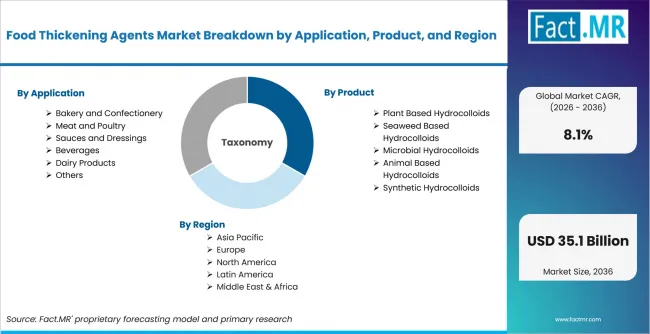
Food Thickening Agents Market Breakdown By Application, Product, And Region | Source: Fact.MR
| Attribute | Details |
|---|---|
| Quantitative Units | USD billion, 2026 to 2036 CAGR. |
| Market Definition | Food ingredients used to build viscosity, suspension, gel strength and mouthfeel. |
| Application | Bakery and Confectionery; Bakery Products; Confectionery Products; Functional Bakery; Meat and Poultry; Sauces and Dressings; Beverages; Dairy Products; Others. |
| Product | Plant, seaweed, microbial, animal and synthetic hydrocolloids. |
| End Use | Food Processing Industry; Dairy Industry; Bakery Industry; Beverage Industry. |
| Technology | Hydrocolloid, enzymatic modification, emulsion stabilization and nanostructure technologies. |
| Regions Covered | North America; Europe; East Asia; South Asia and Pacific; Latin America; Middle East and Africa. |
| Countries Covered | USA; South Korea; France; UK; Italy; Japan. |
| Companies Profiled | Cargill, Incorporated; Archer Daniels Midland Company; Tate & Lyle PLC, including CP Kelco; Ingredion Incorporated, including TIC Gums; International Flavors & Fragrances Inc.; Darling Ingredients Inc.; Ashland Global Holdings Inc.; Kerry Group plc; dsm-firmenich; BASF SE; and others. |
| Forecast Period | 2026 to 2036. |
| Approach | Hybrid sizing using food manufacturing, hydrocolloid functionality, application demand, country rates and company portfolios. |
How is the market segmented?
-
By Application
- Bakery and Confectionery
- Bakery Products
- Confectionery Products
- Functional Bakery
- Meat and Poultry
- Processed Meat
- Poultry Products
- Meat Alternatives
- Sauces and Dressings
- Savory Sauces
- Salad Dressings
- Condiment Applications
- Beverages
- Functional Beverages
- Carbonated Beverages
- Non Alcoholic Beverages
- Dairy Products
- Fermented Dairy
- Processed Dairy
- Dairy Beverages
- Others
- Food Flavoring Applications
- Animal Feed Applications
- Industrial Food Processing
- Bakery and Confectionery
-
By Product
- Plant Based Hydrocolloids
- Guar Gum
- Gum Arabic
- Locust Bean Gum
- Seaweed Based Hydrocolloids
- Carrageenan
- Agar
- Alginate
- Microbial Hydrocolloids
- Gellan Gum
- Curdlan
- Xanthan Gum
- Animal Based Hydrocolloids
- Gelatin
- Collagen Gelatin
- Functional Gelatin
- Synthetic Hydrocolloids
- Carboxy Methyl Cellulose
- Methyl Cellulose
- Modified Cellulose Blends
- Plant Based Hydrocolloids
-
By End Use
- Food Processing Industry
- Packaged Food Manufacturers
- Ingredient Blending Companies
- Dairy Industry
- Milk Processing Companies
- Fermented Dairy Producers
- Bakery Industry
- Industrial Bakeries
- Artisanal Bakeries
- Beverage Industry
- Soft Drink Manufacturers
- Alcoholic Beverage Adjacent Uses
- Food Processing Industry
-
By Technology
- Hydrocolloid Technology
- Polysaccharide Engineering
- Natural Extraction Systems
- Enzymatic Modification Technology
- Starch Modification Systems
- Protein Structuring Technology
- Emulsion Stabilization Technology
- Colloidal Stability Systems
- Interface Engineering Systems
- Nanostructure Modification Technology
- Microstructure Engineering
- Advanced Food Texture Systems
- Hydrocolloid Technology
-
By Region
- North America
- Latin America
- Western Europe
- Eastern Europe
- East Asia
- South Asia and Pacific
- Middle East & Africa