- Market Value (2025): USD 1.8 Bn
- Estimated Value (2026): USD 1.9 Bn
- Forecast Value (2036): USD 3.5 Bn
- CAGR (2026-2036): 6.3%
What is the Food Grade Magnesium Derivatives Market forecast to be worth by 2036?
USD 1.9 billion in 2026 to USD 3.5 billion by 2036, at 6.3% CAGR.
- The market crossed a valuation of USD 1.8 billion in 2025 as food, beverage, nutraceutical; and pharmaceutical formulators purchased documented food-grade magnesium ingredients.
- Demand is projected to increase from USD 1.9 billion in 2026 to USD 3.5 billion by 2036.
- The market is forecast to record a 6.3% CAGR from 2026 to 2036 as mineral fortification expands and buyers tighten grade-specific qualification.
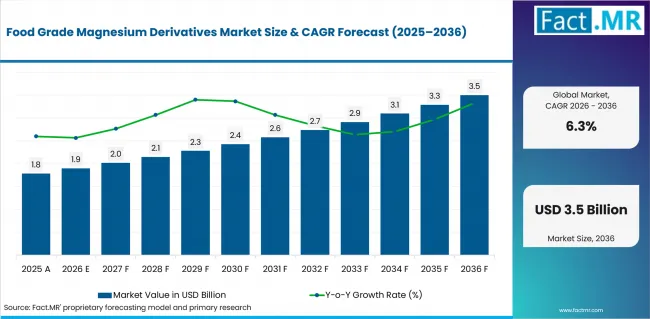
Food Grade Magnesium Derivatives Market Value Analysis | Source: Fact.MR
What are the defining numbers behind Food Grade Magnesium Derivatives Market growth?
USD 1.7 billion absolute opportunity by 2036, led by Magnesium Oxide, Food & Beverage Fortification; and Powder.
- Demand Drivers in the Market
- Food and beverage formulators need repeatable magnesium delivery because added mineral content must remain consistent through processing and shelf life.
- Dry-blend producers use magnesium oxide to combine nutrient addition with anticaking, moisture management, drying; or pH control.
- Nutraceutical and pharmaceutical buyers require food- or pharmaceutical-grade specifications, certificates of analysis, traceability; and controlled change management.
- Beverage and low-sodium product teams need magnesium forms whose dissolution and sensory behavior can be tuned to the finished matrix.
- Key Segments Analyzed
- By Product: Magnesium Oxide is projected to hold 34.0% share in 2026 because high elemental yield and dry-system stability support large-volume formulations.
- By Application: Food & Beverage Fortification is projected to hold 38.0% share in 2026 across powder mixes, dairy products, bakery goods; and functional drinks.
- By Form: Powder is projected to hold 57.0% share in 2026 because it fits premixing, dry blending, tableting; encapsulation; and controlled dissolution. Packaging and shelf-life requirements also affect the magnesium hydroxide and magnesium phosphate markets.
- By Distribution Channel: Direct qualification links ingredient suppliers with food, nutraceutical, and pharmaceutical manufacturers that require application trials and documentary review.
- By End Use: Food processors, beverage manufacturers, and functional-food producers apply different tests for flow; solubility; taste; and label fit.
- Analyst Opinion at Fact.MR
- Shambhu Nath Jha, Principal Consultant at Fact.MR, states: "Food-grade magnesium is not bought on chemistry alone. The commercial decision turns on how a grade behaves in a specific matrix; how clearly its use is documented for the destination market; and whether the supplier can hold purity and particle characteristics from lot to lot. Suppliers that solve taste; flow; dissolution; and change-control problems before scale-up will be harder to replace."
- Strategic Implications
- Suppliers should map every grade to its intended matrix, use level, country-use status; handling profile; and label position before commercial sampling.
- Beverage formulators should test dissolution, sedimentation, bitterness; and interaction with acids or sweeteners before approving a magnesium source.
- Powder-system buyers should compare particle size, bulk density, dust; hopper flow; humidity response; and blend uniformity under production conditions.
- Procurement teams should require lot-to-lot consistency, documented change notification, and backup supply plans for qualified high-volume grades.
How does the Food Grade Magnesium Derivatives Market break down by segment?
Magnesium Oxide leads Product at 34.0%, Food & Beverage Fortification leads Application at 38.0%, and Powder leads Form at 57.0%.
Why does Magnesium Oxide lead the Product segment?
Magnesium Oxide holds 34.0% share in 2026.
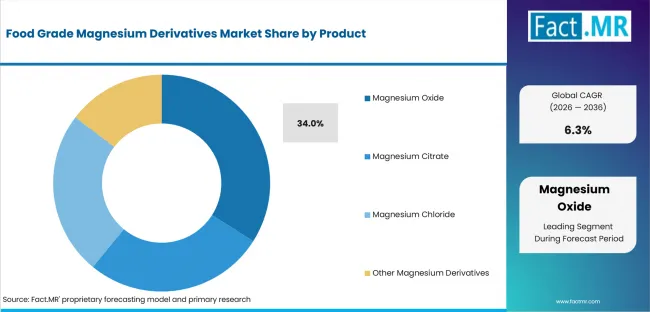
Food Grade Magnesium Derivatives Market Analysis By Product | Source: Fact.MR
Magnesium oxide leads where formulators need a concentrated mineral source that remains stable in dry systems and can also support anticaking, drying, or pH control. Its high elemental magnesium content reduces the ingredient mass required to reach a target mineral level. Light; heavy; and food-grade calcined grades let suppliers tune bulk density; reactivity; surface behavior; and handling. Magnesium citrate and chloride remain important where solubility or sensory performance outweighs elemental density; while hydroxide; lactate; and sulfate serve narrower formulation needs.
Why does Food & Beverage Fortification lead the Application segment?
Food & Beverage Fortification holds 38.0% share in 2026.
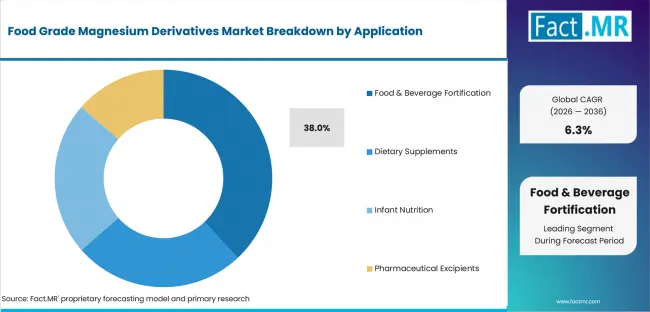
Food Grade Magnesium Derivatives Market Analysis By Application | Source: Fact.MR
Food and beverage fortification creates the widest volume base because magnesium can enter powder mixes, dairy products, bakery formulations; functional drinks; and other processed foods. The derivative is selected with the matrix; not in isolation. Beverage teams screen taste; dissolution; and sedimentation. Dairy and bakery teams focus on texture; pH; shelf stability; and interactions with other minerals. This broad range of use cases keeps fortification ahead of more concentrated supplement and pharmaceutical applications.
Why does Powder lead the Form segment?
Powder holds 57.0% share in 2026.
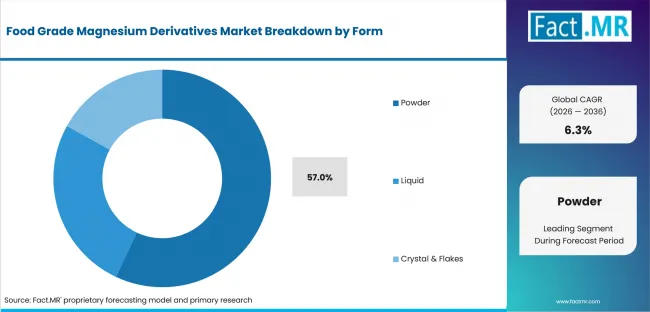
Food Grade Magnesium Derivatives Market Analysis By Form | Source: Fact.MR
Powder dominates because most food-grade magnesium derivatives enter dry blending, premixing, tableting; encapsulation; or a controlled dissolution step before final use. Fine and micronized grades can improve dispersion or surface activity; while granular grades can reduce dust and improve hopper flow. Dry forms also simplify concentration calculations; transport; and storage when the ingredient is protected from humidity.
How does the Distribution Channel shape qualification?
Direct technical engagement shortens specification review and formulation testing.
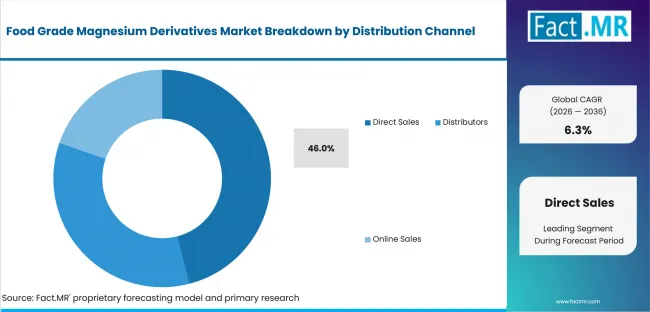
Food Grade Magnesium Derivatives Market Analysis By Distribution Channel | Source: Fact.MR
Food manufacturers, nutraceutical manufacturers, and pharmaceutical companies commonly require direct access to specifications; certificates of analysis; samples; and application support before volume approval. The channel must therefore carry technical information as reliably as physical product. Suppliers that can answer country-use; claims; particle-size; and change-control questions during the qualification window face fewer delays between laboratory work and repeat orders.
How do End Use requirements change grade selection?
Food processors, beverage manufacturers, and functional-food producers apply different acceptance tests.
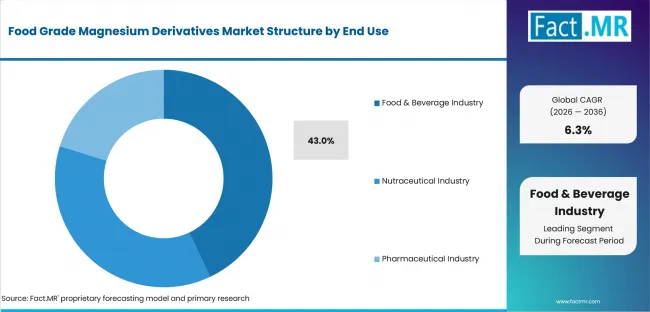
Food Grade Magnesium Derivatives Market Analysis By End Use | Source: Fact.MR
Food processors often prioritize flow, moisture behavior, and batch uniformity. Beverage manufacturers place greater weight on dissolution; taste; and sedimentation. Functional-food producers must connect the chosen derivative with a defensible serving level; label statement; and shelf-life result. These differences favor application-ready grade portfolios over one specification presented across every end use.
What is accelerating Food Grade Magnesium Derivatives Market adoption, and what is holding it back?
Mineral fortification and multifunctional processing support adoption, while dose, purity; sensory fit; and country authorization slow qualification.
Drivers Impact Analysis
| DRIVER | COMMERCIAL RELEVANCE | GEOGRAPHIC RELEVANCE | IMPACT TIMELINE |
|---|---|---|---|
| Mineral fortification across processed foods and beverages | Broad volume base | North America, Europe, and East Asia | Medium term (2-4 years) |
| Added-magnesium declaration and claims review | Qualification trigger | USA, UK, Germany; and France | Short term (2 years or less) |
| Functional processing roles in dry blends | Recurring manufacturing need | Global food processing | Medium term (2-4 years) |
| Nutraceutical and pharmaceutical ingredient qualification | Specification-intensive demand | USA, Europe, and Japan | Long term (4 years or more) |
| Low-sodium formulation using magnesium chloride | Application-specific expansion | Europe and North America | Medium term (2-4 years) |
Source: Fact.MR analysis. Updated Aug 3, 2026
- Fortification demand: The NIH Office of Dietary Supplements reports a 420 mg Daily Value for adults and children aged four years and older. It also notes that food labels must list magnesium when the mineral is added. This turns declared mineral delivery into a formulation and quality-control requirement.
- Process functionality: Magnesium oxide can support anticaking, drying, moisture control; and pH adjustment in addition to nutrient delivery. A grade that performs more than one job can remain embedded in a production formula after qualification. Channel economics connect this demand with the magnesium chelates and magnesium sulphate markets.
Opportunity Impact Analysis
| OPPORTUNITY | COMMERCIAL RELEVANCE | GEOGRAPHIC RELEVANCE | IMPACT TIMELINE |
|---|---|---|---|
| Beverage-compatible citrate and chloride grades | Matrix-specific route | USA, Japan, and UK | Medium term (2-4 years) |
| Low-sodium foods using magnesium chloride | Reformulation route | Europe and North America | Medium term (2-4 years) |
| Granular and micronized powder systems | Processing route | Global | Medium term (2-4 years) |
| Application packages with country-use documentation | Approval route | Global | Short term (2 years or less) |
Source: Fact.MR analysis. Updated Aug 3, 2026
- Beverage and low-sodium systems: Customers need controlled dissolution and taste rather than an undifferentiated magnesium salt. Chloride and citrate systems can create value where mineral delivery must fit a liquid matrix or a sodium-reduction program.
- Precision powder systems: Fine, micronized, and granular grades can be positioned around dispersion; surface activity; dust reduction; and flow. Commercial value increases when particle design is paired with use guidance and lot documentation.
Restraints Impact Analysis
| RESTRAINT | COMMERCIAL RELEVANCE | GEOGRAPHIC RELEVANCE | IMPACT TIMELINE |
|---|---|---|---|
| Serving-size and cumulative-exposure limits | Regulatory gate | Europe and UK | Short term (2 years or less) |
| Purity and lot-to-lot consistency | Supplier qualification gate | Global | Current forecast period |
| Bitterness, sedimentation, and texture change | Matrix-performance gate | Beverages, dairy, and functional foods | Medium term (2-4 years) |
| Country-specific authorization of magnesium forms | Market-access gate | Japan, UK, and European Union | Long term (4 years or more) |
Source: Fact.MR analysis. Updated Aug 3, 2026
- Dose and authorization: EFSA's 2025 tolerable upper intake summary retains a 250 mg per day adult upper level for readily dissociable magnesium salts and magnesium oxide from supplements, water, or added food; while excluding magnesium naturally present in food. Formulators must therefore manage serving size; cumulative exposure; and local rules.
- Matrix compatibility: A grade can meet a chemical specification and still fail because of taste, solubility, sedimentation; texture; dust; or flow. These issues require product-specific trials and can extend approval timelines.
Which countries are scaling the Food Grade Magnesium Derivatives Market fastest?
Japan 7.0%, UK 6.7%, USA 6.4%; Germany 6.1%; and France 5.8% through 2036.
Regional analysis covers North America, Latin America, Western Europe; Eastern Europe; East Asia; South Asia and Pacific; and the Middle East and Africa.
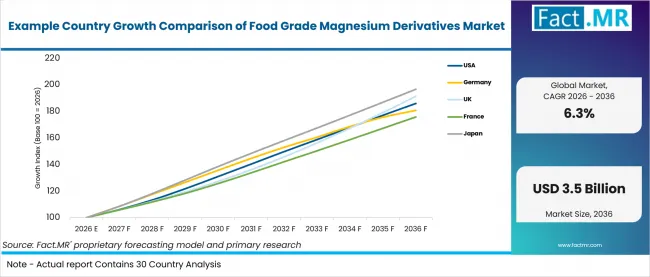
Example Country Growth Comparison Of Food Grade Magnesium Derivatives Market | Source: Fact.MR
| COUNTRY | CAGR, 2026 to 2036 |
|---|---|
| Japan | 7.0% |
| UK | 6.7% |
| USA | 6.4% |
| Germany | 6.1% |
| France | 5.8% |
Source: Fact.MR analysis. Updated Aug 3, 2026
What is shaping Japan's outlook through 2036?
7.0% CAGR through 2036, supported by exact compound screening and documentary control.
Japanese importers and manufacturers screen the precise magnesium compound, the finished product category, and the documentary status before material enters a formulation or shipment. That discipline favors suppliers with clear food-grade specifications and local regulatory support. Sales of food-grade magnesium derivatives in Japan are forecast to rise at a 7.0% CAGR from 2026 to 2036. Ingredient and processing decisions remain relevant to the bulk food ingredients and food processing ingredients markets.
What is shaping the United Kingdom's outlook through 2036?
6.7% CAGR through 2036, driven by permitted-source checks, claims review; and product safety files.
UK manufacturers and brand owners combine permitted-source checks with claims review, safety documentation, and retailer expectations before launching a fortified food or supplement. Suppliers that provide complete technical files and rapid answers during formulation review can move more efficiently through this approval chain. Demand is forecast to grow at a 6.7% CAGR through 2036.
What is shaping USA's outlook through 2036?
6.4% CAGR through 2036, supported by detailed food-grade specifications and label review.
US food, supplement, and OTC manufacturers typically approve magnesium derivatives through formulation trials; FCC-aligned specifications; certificates of analysis; and label review. The purchasing decision therefore links commercial volume with quality documentation and application proof. Demand in the USA is forecast to expand at a 6.4% CAGR from 2026 to 2036.
What is shaping Germany's outlook through 2036?
6.1% CAGR through 2036, shaped by careful assessment of use level, serving size; and exposure.
German buyers commonly require formulation files that connect use level, serving size, expected exposure; and evidence of compliance before commercial approval. The national debate around maximum levels for supplements and fortified foods reinforces this cautious approach. Sales are forecast to rise at a 6.1% CAGR through 2036.
What is shaping France's outlook through 2036?
5.8% CAGR through 2036, supported by food and nutraceutical demand under close consumer-protection expectations.
French food and nutraceutical companies frame magnesium addition against national nutrient references, product safety, and careful consumer communication. The market offers demand for fortified products; but suppliers must help customers connect the derivative; serving level; and permitted communication. Demand is estimated to expand at a 5.8% CAGR through 2036.
Who leads the Food Grade Magnesium Derivatives Market?
Competition separates food-grade formulation depth from upstream mineral scale and route-to-market access. Martin Marietta Materials, Nedmag, Konoshima Chemical; and Kyowa Chemical compete through documented food- or pharmaceutical-grade magnesium products. Grecian Magnesite; Tateho Chemical Industries; Ube Material Industries; and ICL Group bring integrated mineral or high-purity material positions. Lehmann&Voss&Co. and Compass Minerals International add specialty distribution; mineral supply; and regional customer access.
Commercial credibility rests on specification clarity, purity control, grade consistency; and the ability to support customer trials. Suppliers that maintain separate product files for food; nutraceutical; and pharmaceutical uses are better placed to manage country-specific reviews. Capacity alone does not secure a formula; the approved grade must also remain stable through change control and repeat delivery.
In November 2023, Nedmag B.V. launched the Pure Health & Earth brand and Magnesium Chloride Food Grade Crystals for food enrichment and salt-reduction applications. Buyer occasions also influence the fortified foods and dietary supplements markets.
In June 2025, Grecian Magnesite S.A. commissioned a new rotary kiln for caustic calcined magnesia. The project added more than 100 metric tons per day and raised total calcination capacity to 720 metric tons per day.
In July 2025, Martin Marietta Materials, Inc. completed the acquisition of Premier Magnesia; LLC. The transaction added magnesia-based production and distribution operations in Nevada; North Carolina; Indiana; and Pennsylvania; including magnesium sulfate capabilities.
Which companies are the key providers?
Grecian Magnesite S.A. and Martin Marietta Materials, Inc. are leading companies in the market.
- Grecian Magnesite S.A.
- Martin Marietta Materials, Inc.
- Nedmag B.V.
- Konoshima Chemical Co., Ltd.
- Lehmann&Voss&Co.
- Tateho Chemical Industries Co.
- Ltd.
- ICL Group Ltd.
- Ube Material Industries
- Kyowa Chemical Industry Co.
- Compass Minerals International
- Inc.
Bibliography
- U.S. Food and Drug Administration. (n.d.). Magnesium Oxide: Food Substances.
- National Institutes of Health, Office of Dietary Supplements. (2026, January 6). Magnesium: Fact Sheet for Health Professionals.
- European Food Safety Authority. (2025). Summary of Tolerable Upper Intake Levels.
- German Federal Institute for Risk Assessment. (2024, February 22). Updated Maximum-Level Proposals for Vitamins and Minerals in Food Supplements and Fortified Foods.
- UK Food Standards Agency. (2026, June 25). Food Supplements: Business Guidance.
This Report Addresses
- The report provides strategic intelligence on food-grade magnesium derivatives across product chemistry, application fit, physical form; channel structure; and end-use requirements.
- Segment analysis quantifies Magnesium Oxide, Food & Beverage Fortification, and Powder as the 2026 share leaders.
- Regional analysis compares Japan, UK, USA; Germany; and France through country-specific qualification and market-access conditions.
- Competitive analysis evaluates product quality and application support across active suppliers.
- Scope analysis distinguishes ingredient revenue from downstream foods, beverages, supplements; pharmaceuticals; and industrial magnesium products.
- Methodology explains the primary research, desk research, market-sizing; forecasting; and validation framework used for the assessment.
What does the Food Grade Magnesium Derivatives Market cover?
Food-grade magnesium ingredients sold for fortification, processing, supplement; and excipient use.
The Food Grade Magnesium Derivatives Market covers food-grade magnesium oxide, citrate, chloride; hydroxide; lactate; and sulfate sold as ingredients; additives; mineral sources; or pharmaceutical excipients. Commercial value is counted at the ingredient sale rather than at the downstream value of the finished food; beverage; supplement; infant-nutrition product; or medicine.
The market differs from industrial magnesia because commercial acceptance depends on food-grade purity, documentary control, intended use; and performance in a formulation. The same chemistry can sit outside the boundary when sold for refractory; feed; deicing; or other industrial purposes.
What is included in the scope?
Food-grade magnesium derivatives used across approved food, beverage, nutraceutical; and pharmaceutical applications.
The scope includes Magnesium Oxide and its light, heavy, and food-grade calcined forms; together with magnesium citrate; chloride; hydroxide; lactate; and sulfate. It covers Food & Beverage Fortification; Functional Beverages; Dairy Products; and Bakery Products. Powder formats include fine; granular; and micronized grades. Channel coverage follows direct sales to food; nutraceutical; and pharmaceutical manufacturers; while end-use coverage includes food processors; beverage manufacturers; and functional-food producers.
What is excluded from the scope?
Downstream finished products and non-food magnesium uses are outside the revenue boundary.
The scope excludes finished foods, beverages, supplements; infant-nutrition products; OTC products; and downstream pharmaceutical revenue. It also excludes industrial; refractory; feed; and deicing grades; along with adjacent or substitute products that are not sold as food-grade magnesium derivatives within the defined segmentation. Retail execution creates a related demand signal in the nutraceuticals and functional drinks markets.
How was the analysis built?
Primary research, desk research, hybrid market sizing; and cross-source validation support the forecast.
- Primary Research
- Structured consultations with food-grade magnesium derivative manufacturers, ingredient distributors, food and beverage formulators; nutraceutical and pharmaceutical procurement teams; quality managers; and subject-matter specialists examine product qualification; application needs; contract structures; sourcing risks; and replacement behavior.
- Desk Research
- Regulatory texts, government and intergovernmental publications, national nutrient guidance; company filings; first-party product specifications; trade and capacity announcements; and relevant standards are reviewed within the defined market boundary.
- Market-Sizing and Forecasting
- The model reconciles the established market values with product mix, application volume, physical form; channel economics; end-use purchasing patterns; country growth conditions; and supply-side evidence.
- Data Validation and Update Cycle
- Findings are cross-checked across regulatory, technical, supply; and commercial evidence. Reviews test scope consistency; numerical reconciliation; company relevance; and whether country narratives match the stated growth rates and qualification conditions.
Segmentation
What is the report’s scope and coverage?
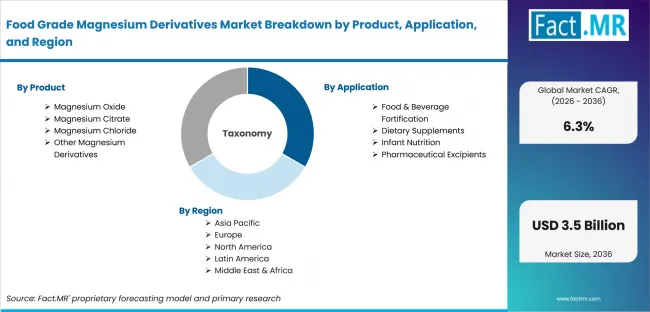
Food Grade Magnesium Derivatives Market Breakdown By Product, Application, And Region | Source: Fact.MR
| Attribute | Details |
|---|---|
| Quantitative Units | USD billion in 2026 to USD billion by 2036 at CAGR |
| Market Definition | Revenue from food-grade magnesium oxide, citrate, chloride; hydroxide; lactate; and sulfate sold as ingredients; additives; mineral sources; or pharmaceutical excipients. Downstream finished products and industrial or feed grades are excluded. |
| Product | Magnesium Oxide; Light Magnesium Oxide; Heavy Magnesium Oxide; Food-grade Calcined Magnesium Oxide |
| Application | Food & Beverage Fortification; Functional Beverages; Dairy Products; Bakery Products |
| Form | Powder; Fine Powder; Granular Powder; Micronized Powder |
| Distribution Channel | Direct Sales; Food Manufacturers; Nutraceutical Manufacturers; Pharmaceutical Companies |
| End Use | Food & Beverage Industry; Food Processors; Beverage Manufacturers; Functional Food Producers |
| Regions Covered | North America; Latin America; Western Europe; Eastern Europe; East Asia; South Asia and Pacific; Middle East and Africa |
| Countries Covered | USA; Germany; UK; France; Japan; and more than twenty-five additional countries in the full report |
| Key Companies Profiled | Grecian Magnesite S.A.; Martin Marietta Materials, Inc.; Nedmag B.V.; Konoshima Chemical Co., Ltd.; Lehmann&Voss&Co.; Tateho Chemical Industries Co.; Ltd.; ICL Group Ltd.; Ube Material Industries; Ltd.; Kyowa Chemical Industry Co.; Ltd.; Compass Minerals International; Inc. |
| Forecast Period | 2026 to 2036 |
| Approach | Hybrid bottom-up and top-down sizing that reconciles supplier revenue, product and application demand, trade and regulatory evidence; channel structure; and country-level adoption conditions within the defined revenue boundary. |
Source: Fact.MR analysis. Updated Aug 3, 2026
How is the market segmented?
-
By Product:
- Magnesium Oxide
- Light Magnesium Oxide
- Heavy Magnesium Oxide
- Food-grade Calcined Magnesium Oxide
- Magnesium Citrate
- Anhydrous Magnesium Citrate
- Trimagnesium Citrate
- Granular Magnesium Citrate
- Magnesium Chloride
- Hexahydrate Magnesium Chloride
- Anhydrous Magnesium Chloride
- Flake Magnesium Chloride
- Other Magnesium Derivatives
- Magnesium Hydroxide
- Magnesium Lactate
- Magnesium Sulfate
- Magnesium Oxide
-
By Application:
- Food & Beverage Fortification
- Functional Beverages
- Dairy Products
- Bakery Products
- Dietary Supplements
- Tablets
- Capsules
- Powder Supplements
- Infant Nutrition
- Infant Formula
- Toddler Nutrition
- Pediatric Supplements
- Pharmaceutical Excipients
- Antacid Formulations
- Mineral Preparations
- Nutraceutical Formulations
- Food & Beverage Fortification
-
By Form:
- Powder
- Fine Powder
- Granular Powder
- Micronized Powder
- Liquid
- Concentrated Solution
- Aqueous Solution
- Liquid Blend
- Crystal & Flakes
- Crystalline Form
- Flakes
- Pellets
- Powder
-
By Distribution Channel:
- Direct Sales
- Food Manufacturers
- Nutraceutical Manufacturers
- Pharmaceutical Companies
- Distributors
- Ingredient Distributors
- Chemical Distributors
- Regional Suppliers
- Online Sales
- B2B E-commerce
- Manufacturer Websites
- Digital Procurement Platforms
- Direct Sales
-
By End Use
- Food & Beverage Industry
- Food Processors
- Beverage Manufacturers
- Functional Food Producers
- Nutraceutical Industry
- Dietary Supplement Manufacturers
- Functional Nutrition Companies
- Sports Nutrition Companies
- Pharmaceutical Industry
- Generic Drug Manufacturers
- OTC Product Manufacturers
- Contract Manufacturing Organizations
- Food & Beverage Industry
-
By Region:
- North America
- Latin America
- Western Europe
- Eastern Europe
- East Asia
- South Asia and Pacific
- Middle East and Africa
- USA
- Germany
- UK
- France
- Japan
- and more than twenty-five additional countries in the full report
- North America
Frequently Asked Questions
Which Product leads the Food Grade Magnesium Derivatives Market?
Which Application leads the Food Grade Magnesium Derivatives Market?
Which Form leads the Food Grade Magnesium Derivatives Market?
Which country records the highest listed CAGR?
How does the UK perform in the Food Grade Magnesium Derivatives Market?
How does the USA perform in the Food Grade Magnesium Derivatives Market?
How does Germany perform in the Food Grade Magnesium Derivatives Market?
How does France perform in the Food Grade Magnesium Derivatives Market?
What is the primary driver in the Food Grade Magnesium Derivatives Market?
What is the main restraint in the Food Grade Magnesium Derivatives Market?
Why is Magnesium Oxide important?
Why does Powder dominate demand?
Who worked on this report


Preview the report firsthand - request a free sample
Free SampleGet the brochure for pricing and purchase details
Download PDF