- Base Value(2025): 21.4 Bn
- Estimated Value(2026): 23.1 Bn
- Forecast Value (2036): 49.8 Bn
- CAGR (2026 - 2036): 8.0%
Microwave Packaging Market Forecast and Outlook By Fact.MR
- In 2025, the microwave packaging market was valued at USD 21.4 billion.
- Based on Fact.MR analysis, demand for microwave packaging is estimated to grow to USD 23.1 billion in 2026 and USD 49.8 billion by 2036.
- FACT.MR projects a CAGR of 8.0% during the forecast period.
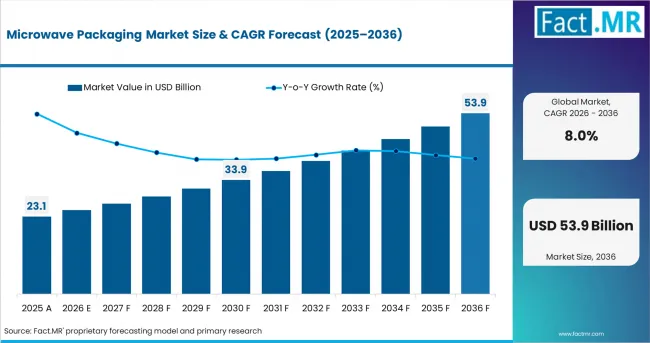
Microwave Packaging Market Market Value Analysis | Source: Fact.MR
| Metric | Value |
|---|---|
| Estimated Value in 2026 | USD 23.1 billion |
| Forecast Value in 2036 | USD 49.8 billion |
| Forecast CAGR (2026 to 2036) | 8.0% |
Source: Fact.MR analysis. Updated May 23, 2026
Summary of Microwave Packaging Market
- Market Definition
- The market covers plastic, paper, biodegradable, and aluminum microwave packaging supplied in rigid and flexible formats to household consumers, food service operators, and catering providers globally.
- Demand Drivers
- Rising global consumption of frozen and ready-to-eat meals is increasing per-household microwave packaging demand, particularly across urban populations in Asia Pacific and North America seeking convenience meal solutions.
- Expansion of organized food retail and e-commerce grocery channels is accelerating demand for safe, heat-resistant microwave packaging formats among food manufacturers supplying modern trade and direct-to-consumer delivery services.
- Sustainability mandates from major food retailers and regulatory bodies are driving demand for biodegradable and recyclable microwave packaging, creating replacement volume for conventional single-use plastics across European and North American markets.
- Key Segments Analyzed
- By Material: Plastic holds approximately 55% share in 2026, reflecting its established role in microwave-safe barrier packaging due to cost efficiency and compatibility with high-volume food manufacturing.
- By Product: Trays hold approximately 35% share in 2026, driven by their dominance in frozen meal and ready-to-eat packaging across retail and food service supply chains globally.
- By Application: Frozen Food holds approximately 50% share in 2026, anchored by global ready-to-eat meal consumption and the expanding frozen food retail category in both developed and emerging markets.
- By End-User: Household Consumers hold approximately 65% share in 2026, reflecting high retail packaged food consumption and widespread home microwave usage across developed and emerging markets.
- By Packaging Type: Rigid Packaging holds approximately 60% share in 2026, preferred for structural integrity, safe heating containment, and established retailer and food service procurement standards.
- Analyst Opinion at FACT.MR
- Shambhu Nath Jha, Principal Consultant at Fact.MR, opines, CXOs should note that the microwave packaging market is entering a consolidation phase. Material compliance and sustainability credentials are becoming as critical as pricing. Suppliers without bio-based or recyclable solutions risk exclusion from major retailer procurement programs. Sustainability targets across Europe and North America are tightening timelines.
- Strategic Implications
- Accelerate investment in recyclable and compostable microwave packaging formats to maintain retailer qualification in European and North American procurement programs aligned with 2025 and 2030 sustainability targets.
- Expand dual-ovenable tray and pouch product lines for frozen and fresh food segments to capture growing demand from meal kit and ready-to-eat food manufacturers targeting multi-channel retail distribution.
- Establish local manufacturing or sourcing partnerships in India and China to participate in rapid food processing sector growth and reduce logistics cost exposure in the two fastest-growing regional markets.
- Methodology
- Market sizing based on packaging volume shipments, average selling prices by material and format, and food category consumption benchmarks. Validated with 2024 to 2025 retail procurement and food manufacturer data.
- Supported by EU regulatory compliance records, FDA food contact material guidance, company investor disclosures from Amcor, Sealed Air, Berry Global, Mondi, and Huhtamaki, and food service procurement data.
- Forecasts incorporate frozen food volume growth projections, sustainability compliance cost trends, food retail expansion data, and urbanization-driven convenience food demand rates across Asia Pacific, Europe, and North America.
The market is set to generate USD 26.7 billion in incremental revenue over the forecast period. Growth is structurally broad-based, driven by rising convenience food consumption, expansion of organized food retail, and accelerating demand for ready-to-eat formats across urban populations globally.
Feedstock cost volatility and regulatory pressure on single-use plastics present moderate constraints. Plastic-based packaging manufacturers face rising compliance costs in Europe under the EU Single-Use Plastics Directive. Investment in alternative materials is increasing but adds near-term cost pressure across supply chains.
Procurement trends are shifting toward dual-openable and compostable formats. Amcor Plc and Sealed Air Corporation are aligning portfolios toward recyclable and sustainable microwave packaging. Both are investing in material science and barrier technology to meet retailer sustainability commitments.
Growth varies across key countries. China leads at 9.5% CAGR through 2036, driven by urbanization and food processing expansion. India follows at 9.0%, supported by middle-class growth and ready-to-eat penetration. The United States grows at 8.3%, led by advanced packaging innovation and convenience food demand. Germany records 7.0%, supported by fresh and convenience food packaging needs. Japan grows at 6.5%, with a mature but innovation-led market. Brazil posts 5.8%, driven by food retail and urban consumption.
Segmental Analysis
Microwave Packaging Market Analysis by Material
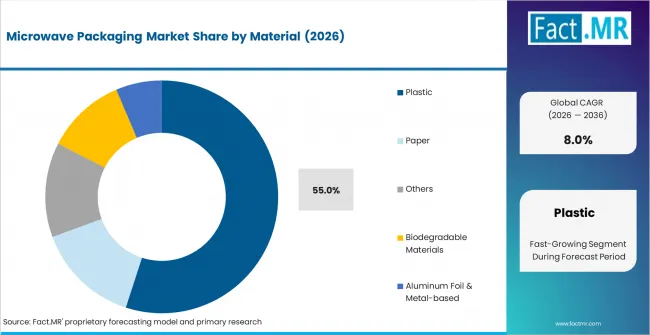
Microwave Packaging Market Analysis By Material | Source: Fact.MR
Based on FACT.MR's microwave packaging market report, consumption of Plastic is estimated to hold approximately 55% share in 2026. Plastic dominates because of its established barrier properties, heat resistance across standard microwave temperature ranges, and cost compatibility with high-volume food manufacturing supply chains.
- Amcor Recyclable Plastic Investment: Amcor Plc announced in Q2 2024 the commercial launch of its AmFiber recyclable paperboard-plastic hybrid microwave tray line for European frozen food customers, targeting retailers committed to transitioning to mono-material recyclable formats by 2025. [1]
- Biodegradable Material Development: Huhtamaki Oyj launched a new range of compostable fiber-based microwave packaging trays in Q1 2025 for European food service customers, incorporating proprietary heat-resistant barrier coatings that meet both EN 13432 composting standards and microwave food contact safety requirements. [2]
- Aluminum Foil Packaging Trend: Sealed Air Corporation expanded its aluminum-compatible microwave packaging range for shelf-stable meal applications in 2024, driven by food manufacturer demand for extended shelf-life formats that combine microwave heat performance with high-barrier protection against moisture and oxygen ingress. [3]
Microwave Packaging Market Analysis by Product
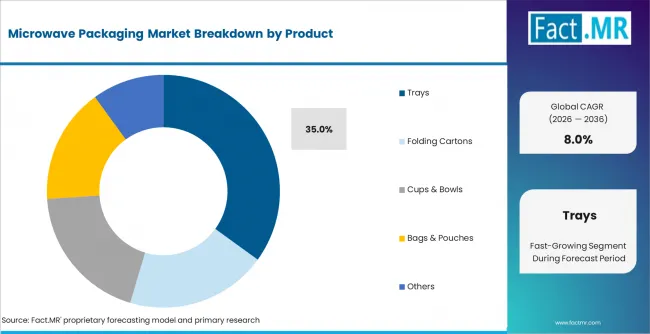
Microwave Packaging Market Analysis By Product | Source: Fact.MR
Based on FACT.MR's microwave packaging market report, Trays are estimated to hold approximately 35% share in 2026. Trays dominate because their structural design enables safe, leak-free heating of ready meals and frozen food formats across both household and food service settings globally.
- Berry Global Tray Expansion: Berry Global Group, Inc. expanded its dual-ovenable tray manufacturing capacity in the United States in Q3 2024, adding production lines dedicated to frozen meal and meal kit packaging for major food manufacturer customers supplying grocery retail and e-commerce delivery channels. [4]
- Folding Carton Innovation: Graphic Packaging International launched updated microwave-active folding carton technology in 2024 for pizza and snack food manufacturers, incorporating susceptor layer enhancements that improve crisping performance and reduce moisture retention during microwave cooking cycles. [5]
- Pouches and Bags Growth: Mondi Group reported in its 2024 annual results that flexible microwave pouch demand from European ready-to-eat meal producers increased 11% year-over-year, driven by food manufacturer shifts toward lighter, space-efficient packaging formats for e-commerce and subscription meal kit channels. [6]
Microwave Packaging Market Analysis by Application
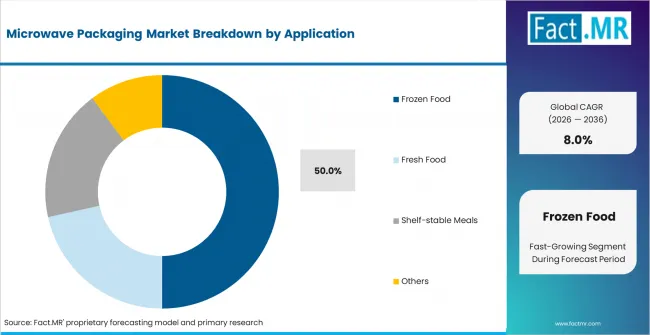
Microwave Packaging Market Analysis By Application | Source: Fact.MR
Based on FACT.MR's microwave packaging market report, Frozen Food is estimated to hold approximately 50% share in 2026. Frozen food anchors microwave packaging demand through consistent volume growth in ready-to-eat and convenience meal segments across both developed and emerging market retail channels.
- Sealed Air Frozen Food Partnership: Sealed Air Corporation announced multi-year supply agreements with North American frozen meal manufacturers in Q4 2024, providing microwave-safe barrier packaging solutions for expanded product lines targeting the growing demand for premium frozen ready-to-eat meals in grocery retail. [3]
- Shelf-Stable Meal Development: Coveris Holdings S.A. launched a new microwave-compatible retort pouch range for shelf-stable meal applications in 2024, targeting European food brands requiring extended ambient shelf life combined with microwave convenience for both retail and emergency food supply channels. [7]
- Fresh Food Packaging Growth: The British Frozen Food Federation reported in 2024 that fresh microwave meal sales in the UK grew 7% year-over-year, confirming sustained retail demand for fresh chilled microwave-ready formats alongside frozen equivalents across supermarket convenience food categories. [8]
Microwave Packaging Market Analysis by End-User
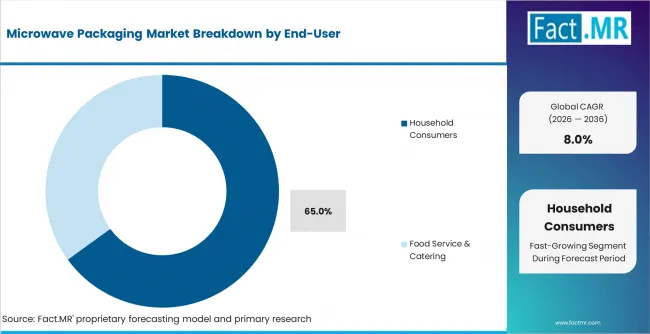
Microwave Packaging Market Analysis By End User | Source: Fact.MR
Based on FACT.MR's microwave packaging market report, Household Consumers are estimated to hold approximately 65% share in 2026. Household demand dominates because of widespread home microwave penetration and growing consumer preference for convenient, ready-to-heat meal formats across all age demographics.
- Printpack Retail Channel Expansion: Printpack Inc. expanded its retail-focused microwave packaging portfolio in 2024, launching updated barrier film formats for household frozen and fresh food applications across U.S. grocery retail chains, targeting growing consumer demand for microwaveable meal formats in convenient serving-size portions. [9]
- Food Service Demand Growth: The National Restaurant Association reported in 2024 that food service operators using microwave-safe packaging for delivery and takeaway applications increased by 9% in the United States, driven by ghost kitchen growth and delivery platform expansion requiring reliable heat-retention packaging formats. [10]
- Catering Sector Adoption: Huhtamaki Oyj reported in its Q3 2024 earnings that food service and institutional catering customers in Europe and Asia Pacific increased microwave packaging procurement by 8%, driven by airline catering, hospital food service, and corporate canteen operators converting to single-use microwaveable tray formats. [2]
Microwave Packaging Market Analysis by Packaging Type
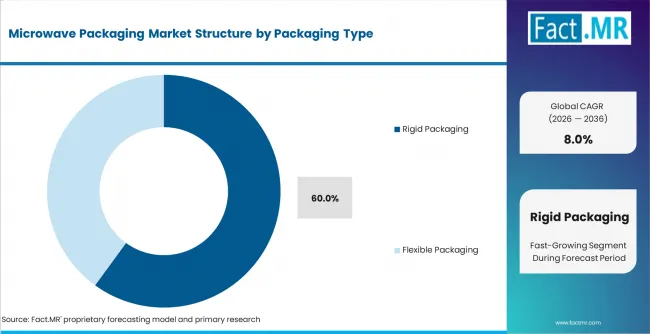
Microwave Packaging Market Analysis By Packaging Type | Source: Fact.MR
Based on FACT.MR's microwave packaging market report, Rigid Packaging is estimated to hold approximately 60% share in 2026. Rigid formats dominate because of their established role in frozen meal, ready-to-eat, and food service packaging, where structural integrity during microwave heating is a non-negotiable performance requirement.
- Sonoco Products Rigid Portfolio: Sonoco Products Company invested in expanded rigid microwave tray production at its European facilities in Q2 2024, targeting frozen food manufacturers transitioning from conventional plastic trays to fiber-reinforced dual-ovenable formats that meet retailer recyclability commitments. [11]
- Flexible Packaging Innovation: Ampac Holdings LLC developed a new co-extruded flexible microwave pouch structure in 2024 with enhanced oxygen barrier and microwave transparency properties, targeting U.S. meal kit and sous-vide food manufacturers requiring lightweight, high-performance packaging for direct-to-consumer delivery channels. [12]
- Rigid-to-Flexible Transition Trend: The Flexible Packaging Association reported in 2024 that microwave-compatible flexible packaging volume in North America grew 12% year-over-year as food manufacturers shifted portion sizes toward single-serve pouches and bags for convenience food retail, driven by consumer demand for waste reduction and compact packaging formats. [13]
Drivers, Restraints, and Opportunities
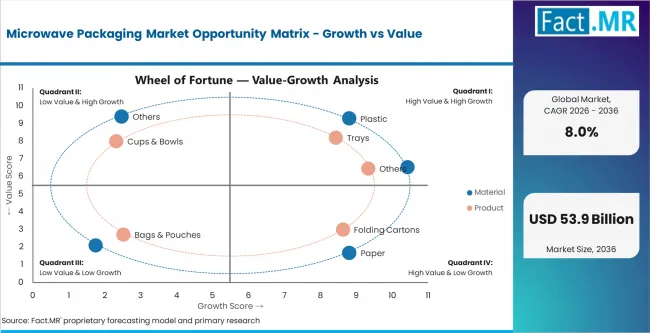
Microwave Packaging Market Opportunity Matrix Growth Vs Value | Source: Fact.MR
FACT.MR analysts view the microwave packaging market as structurally growth-driven and demand-led. Expansion is linked to food retail growth and consumer convenience trends.
The market is transitioning toward sustainable formats. Conventional single-use plastic procurement is under regulatory pressure in Europe. Biodegradable and recyclable material adoption is accelerating.
- EU Packaging Regulation Pressure: The European Commission's revised Packaging and Packaging Waste Regulation, advancing in 2024, mandates recyclability thresholds for food contact packaging by 2030. This is accelerating adoption of fiber-based and mono-material microwave packaging across European retail. Non-compliant formats face market access restrictions. [1]
- Asia Pacific Food Processing Growth: China's National Development and Reform Commission reported in 2024 a 13% increase in processed food production output. India's FSSAI expanded licensing for packaged food manufacturers in FY2024-25, adding over 60,000 new registered food businesses. Both markets are driving rapid volume growth in microwave-safe packaging consumption. [2]
- Convenience Food Consumption Rise: The International Frozen Food Association reported in 2024 that global frozen food retail sales grew 6% year-over-year, reaching a new consumption record. Ready-to-eat and frozen meal volumes are expanding fastest in urban markets across Asia Pacific and Latin America, directly increasing demand for microwave packaging formats. [8]
Regional Analysis
The microwave packaging market is assessed across Asia Pacific, North America, Europe, Latin America, and Middle East and Africa, covering 40+ countries across distinct food retail structures, sustainability regulatory environments, and convenience food consumption growth trajectories. The full report offers market attractiveness analysis by region and country.
.webp "Top Country Growth Comparison Microwave Packaging Market Cagr (2026 2036)")
Top Country Growth Comparison Microwave Packaging Market Cagr (2026 2036) | Source: Fact.MR
| Country | CAGR (2026 to 2036) |
|---|---|
| China | 9.5% |
| India | 9.0% |
| United States | 8.3% |
| Germany | 7.0% |
| Japan | 6.5% |
| Brazil | 5.8% |
Source: Fact.MR analysis. Updated May 23, 2026
Source: Fact.MR (FACT.MR) analysis, based on proprietary forecasting model and primary research
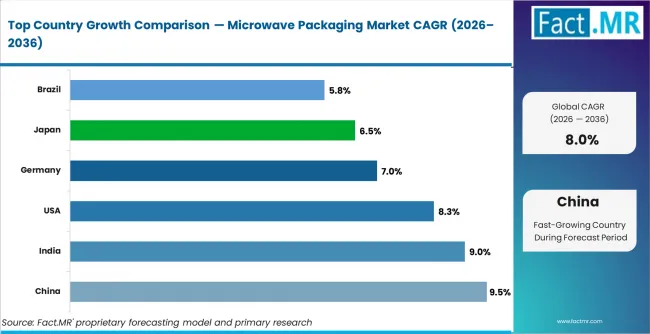
Microwave Packaging Market Cagr Analysis By Country | Source: Fact.MR
Asia Pacific Microwave Packaging Market Analysis
Asia Pacific leads global microwave packaging demand growth. China and India act as the primary expansion engines. Growth is supported by urbanization, food processing sector scale-up, and rapid penetration of organized food retail. Amcor Plc and Huhtamaki Oyj are strengthening regional manufacturing presence.
- China: Urbanization-driven food processing investment defines China's packaging demand trajectory. Growth reaches 9.5% CAGR through 2036. The National Development and Reform Commission approved 38 new food processing industrial park projects in 2024, directly expanding microwave packaging procurement pipelines. Frozen and shelf-stable meal production increased 13% in 2024.
- India: A rising middle class and rapid ready-to-eat food market expansion shape India's packaging growth profile. Growth reaches 9.0% CAGR through 2036. India's FSSAI registered over 60,000 new packaged food manufacturers in FY2024-25, each requiring compliant food contact microwave packaging. Quick-commerce and online grocery platforms expanded to 200+ cities in 2024, creating demand for safe, heat-resistant delivery-ready packaging formats.
- Japan: Innovation and demographic stability define Japan's steady market profile. Growth reaches 6.5% CAGR through 2036. Japan's Ministry of Economy, Trade and Industry reported in 2024 that convenience store ready-meal categories grew 5% in volume, sustaining consistent demand for premium microwave tray and film formats. Japanese packaging manufacturers are investing in active microwave packaging incorporating susceptor technology for crisping applications, targeting foodservice chains and convenience retail.
FACT.MR's analysis of the microwave packaging market in Asia Pacific includes China, India, Japan, South Korea, ASEAN, and Australia and New Zealand. Readers can find food retail expansion data, sustainability compliance benchmarks, and packaging format adoption trends.
North America Microwave Packaging Market Analysis
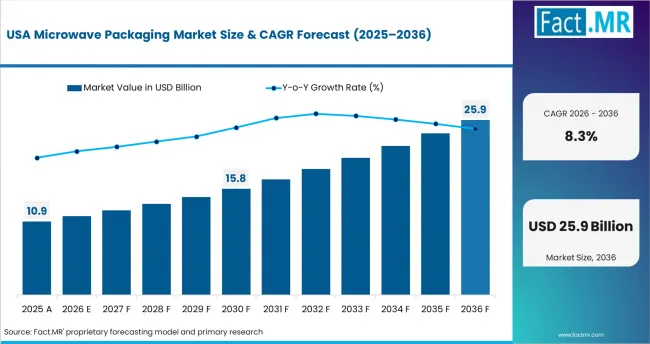
Microwave Packaging Market Country Value Analysis | Source: Fact.MR
North America remains the largest revenue-generating region. The market is shaped by advanced food retail infrastructure and strong convenience food culture. The United States drives demand through innovation in sustainable microwave formats and regulatory compliance investment. Amcor Plc, Berry Global Group, and Sealed Air Corporation dominate institutional and retail supply.
- United States: Innovation-led demand and sustainability compliance are reshaping microwave packaging procurement in the U.S. Growth stands at 8.3% CAGR through 2036. The FDA updated food contact material guidance for microwave packaging in 2024, raising safety validation requirements for recycled-content plastic formats used in direct food contact applications. Major food retailers including Kroger and Walmart advanced their 2025 sustainable packaging sourcing targets in 2024, accelerating supplier transitions to recyclable tray and pouch formats.
FACT.MR's analysis of the microwave packaging market in North America includes the United States, Canada, and Mexico. Readers can find regulatory compliance trends, sustainable packaging adoption data, and food retail procurement benchmarks.
Europe Microwave Packaging Market Analysis
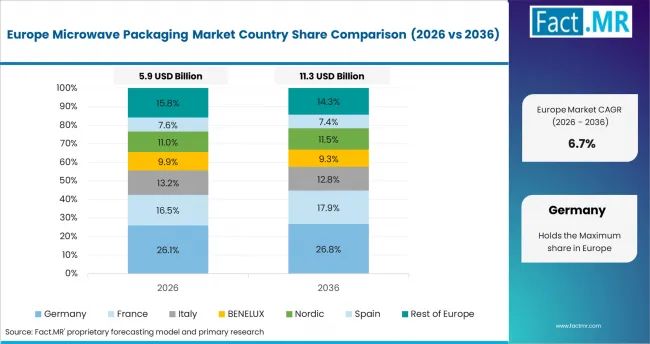
Microwave Packaging Market Europe Country Market Share Analysis, 2026 & 2036 | Source: Fact.MR
Europe operates as a compliance-driven microwave packaging market. Procurement is guided by EU packaging regulation and national sustainability mandates. The revised Packaging and Packaging Waste Regulation creates high adaptation pressure for conventional plastic packaging suppliers. Mondi Group, Coveris Holdings, and Graphic Packaging International hold established supply positions.
- Germany: Regulatory compliance and food retail demand drive Germany's packaging market evolution. Growth is 7.0% CAGR through 2036. The German government advanced implementation of the Verpackungsgesetz (Packaging Act) enforcement in 2024, increasing producer responsibility obligations for single-use food packaging. Major German food retailers including REWE and EDEKA updated their private label packaging specifications in 2024 to require recyclable or compostable microwave tray formats for own-brand chilled and frozen meal ranges.
FACT.MR's analysis of the microwave packaging market in Europe includes Germany, France, the UK, Italy, Spain, and Rest of Europe. Readers can find EU regulation compliance timelines, retailer sustainability sourcing data, and demand forecasts.
Latin America Microwave Packaging Market Analysis
Latin America is expanding steadily through food retail modernization and urban consumption growth. Private sector investment in packaged food production is a key demand driver. Brazil and Mexico lead regional demand. Organized retail expansion is increasing microwave-ready product shelf presence. Amcor and Sealed Air are strengthening regional distribution networks.
- Brazil: Food retail modernization and urban consumption growth drive microwave packaging demand in Brazil. Growth is 5.8% CAGR through 2036. Brazil's ANVISA updated food packaging safety standards for microwave food contact materials in 2024, clarifying compliance pathways for both plastic and biodegradable formats. Major Brazilian food retailers including Grupo Pao de Acucar expanded frozen and ready-to-eat category shelf space in 2024, increasing procurement demand for heat-resistant microwave packaging from domestic and international suppliers.
FACT.MR's analysis of the microwave packaging market in Latin America includes Brazil, Argentina, Mexico, and Rest of Latin America. Readers can find food retail expansion data, regulatory compliance trends, and procurement growth benchmarks.
Competitive Aligners for Market Players
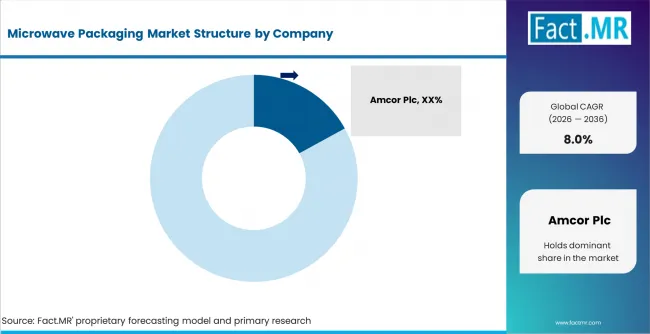
Microwave Packaging Market Analysis By Company | Source: Fact.MR
Competition in the microwave packaging market is no longer just about cost or scale. It is increasingly about how well companies can meet sustainability expectations while still delivering reliable performance. Suppliers that align early with retailer sustainability goals tend to secure stronger, longer-term positions. Companies such as Amcor Plc and Sealed Air Corporation have built this advantage by investing in material innovation and forming long-standing partnerships with food producers.
Another key differentiator is the ability to balance performance with sustainability. Packaging must handle heat efficiently in microwaves while also being recyclable or compostable. This is not easy to achieve at scale. Suppliers that can offer multiple material options, across plastic, fiber, and bio-based formats, are better placed to adapt as regulations tighten. Smooth transition for food manufacturers is also critical. If new packaging disrupts production lines, adoption slows.
Regional strategy is becoming more important. Growth opportunities in markets like India and China are tied to expanding food processing and retail sectors. Companies such as Huhtamaki Oyj and Amcor Plc are investing locally to stay competitive and manage costs. Pricing remains a balancing act. Emerging markets are highly price-sensitive, while Europe and North America reward sustainability with premium pricing. Companies that can navigate both ends of this spectrum are more likely to maintain strong market positions over time.
Key Players
- Amcor Plc
- Sealed Air Corporation
- Sonoco Products Company
- Berry Global Group, Inc.
- Coveris Holdings S.A.
- Graphic Packaging International
- Mondi Group
- Huhtamaki Oyj
- Printpack Inc.
- Ampac Holdings LLC
Bibliography
- [1] Amcor Plc. (2024). FY2024 Annual Report and Sustainability Update: AmFiber Recyclable Hybrid Microwave Tray Launch and European Retailer Sustainability Packaging Compliance Strategy. Amcor Investor Relations, June 2024. amcor.com/investors
- [2] Huhtamaki Oyj. (2024). Q3 2024 Interim Report: Compostable Fiber Microwave Tray Development, Food Service Packaging Demand Growth, and Asia Pacific Manufacturing Capacity Investment. Huhtamaki Investor Relations, October 2024. huhtamaki.com/en/investors
- [3] Sealed Air Corporation. (2024). Q4 2024 Earnings Release: North American Frozen Meal Packaging Supply Agreement Expansion and Aluminum-Compatible Microwave Barrier Packaging Portfolio Update. Sealed Air Investor Relations, February 2025. sealedair.com/investors
- [4] Berry Global Group, Inc. (2024). FY2024 Annual Report: Dual-Ovenable Tray Manufacturing Capacity Expansion in the United States and Frozen Meal Packaging Customer Portfolio Growth. Berry Global Investor Relations, November 2024. berryglobal.com/en/investors
- [5] Graphic Packaging International. (2024). 2024 Sustainability and Innovation Report: Microwave-Active Susceptor Folding Carton Technology Enhancement and Food Manufacturer Adoption Programs. Graphic Packaging, 2024. graphicpkg.com/investors
- [6] Mondi Group. (2024). 2024 Full Year Results: Flexible Microwave Pouch Demand Growth from European Ready-to-Eat Meal Producers and E-Commerce Packaging Volume Expansion. Mondi Investor Relations, February 2025. mondigroup.com/en/investors
- [7] Coveris Holdings S.A. (2024). Product Innovation Announcement: Microwave-Compatible Retort Pouch Range for Shelf-Stable Meal Applications in European Retail and Food Service Markets. Coveris Corporate Communications, 2024. coveris.com
- [8] British Frozen Food Federation. (2024). UK Frozen Food Industry Report 2024: Fresh Microwave Meal Sales Growth, Frozen Category Volume Trends, and Consumer Convenience Purchasing Behaviour. BFFF, 2024. bfff.co.uk
- [9] Printpack Inc. (2024). Company Product Innovation Update: Retail Microwave Packaging Barrier Film Launch for Household Frozen and Fresh Food Applications Across U.S. Grocery Retail Channels. Printpack Corporate, 2024. printpack.com
- [10] National Restaurant Association. (2024). 2024 State of the Restaurant Industry Report: Food Service Operator Microwave-Safe Packaging Adoption Trends, Ghost Kitchen Growth, and Delivery Platform Packaging Requirements. NRA, 2024. restaurant.org/research
This Report Addresses
- Strategic intelligence on microwave packaging demand across plastic, paper, biodegradable, and aluminum formats for household consumers, food service operators, and catering providers globally.
- Market forecast from USD 23.1 billion in 2026 to USD 49.8 billion by 2036, at a CAGR of 8.0%.
- Growth opportunity mapping across China food processing expansion, India ready-to-eat market growth, U.S. sustainable packaging compliance trends, and Brazil food retail modernization.
- Segment analysis by material, product type, application, end-user, and packaging type with leading sub-segment identification and share benchmarks.
- Regional outlook covering Asia Pacific food retail demand, North America sustainability compliance procurement, Europe EU Packaging Regulation adaptation, and Latin America urban consumption expansion.
- Competitive landscape of Amcor, Sealed Air, Berry Global, Mondi, Huhtamaki, Sonoco, Graphic Packaging, Coveris, Printpack, and Ampac covering product positioning, retailer qualification status, and sustainable packaging portfolio strategies.
- Regulatory impact analysis covering EU Packaging and Packaging Waste Regulation recyclability mandates, FDA food contact material guidance updates, India FSSAI packaging safety standards, China NDRC food processing program, and Brazil ANVISA microwave packaging registration requirements.
- Report delivered in PDF, Excel datasets, and presentation formats, supported by primary interviews, retailer procurement data, regulatory compliance records, and food consumption volume benchmarks.
Market Definition
The microwave packaging market covers containers, trays, pouches, and films engineered to withstand microwave heating without structural failure, chemical migration, or safety hazard.
Microwave Packaging Market Inclusions
Covers global and regional forecasts from 2026 to 2036. Includes plastic, paper, biodegradable, and aluminum-based microwave packaging. Segments by product type, application, end-user, and packaging type. Covers household, food service, and catering procurement across rigid and flexible formats.
Microwave Packaging Market Exclusions
Excludes conventional food packaging not rated for microwave use. Omits standalone microwave appliance accessories and non-food packaging formats. Also excludes industrial microwave processing equipment, focusing strictly on consumer and food service packaging materials and their direct supply chain intermediates.
Microwave Packaging Market Research Methodology
- Primary Research
- Interviews with packaging procurement managers, food manufacturers, retail category managers, sustainability officers, and material suppliers across the United States, Germany, India, China, Brazil, and Japan.
- Desk Research
- Uses Amcor, Sealed Air, Berry Global, and Mondi public filings. Includes EU Single-Use Plastics Directive records, FDA food contact material guidance, retail sustainability commitments, and food industry trade data from 2024 to 2025.
- Market-Sizing and Forecasting
- Hybrid top-down and bottom-up model. Based on packaging volume shipments, average selling prices by material and format, and food category consumption benchmarks segmented by end-user and geography.
- Data Validation and Update Cycle
- Validated against retail procurement data, regulatory compliance databases, and distributor earnings disclosures. Cross-checked with primary interviews and published food industry supply reports. Updated annually.
Segmentation
Scope of Report
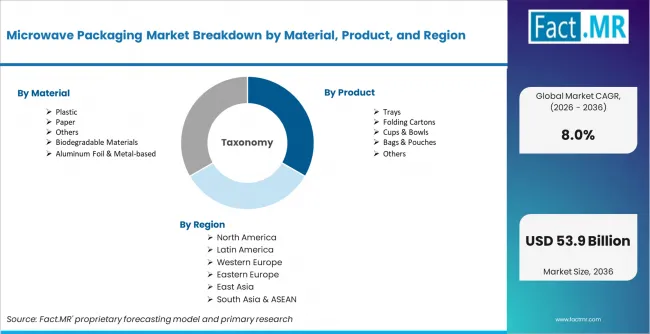
Microwave Packaging Market Breakdown By Material, Product, And Region | Source: Fact.MR
| Attribute | Details |
|---|---|
| Quantitative Units | USD 23.1 billion (2026) to USD 49.8 billion (2036), at a CAGR of 8.0% |
| Market Definition | Plastic, paper, biodegradable, and aluminum microwave packaging supplied in rigid and flexible formats to household consumers, food service operators, and catering providers globally. |
| Material Segmentation | Plastic, Paper, Others, Biodegradable Materials, Aluminum Foil & Metal-based |
| Product Segmentation | Trays, Folding Cartons, Cups & Bowls, Bags & Pouches, Others |
| Application Segmentation | Frozen Food, Fresh Food, Shelf-stable Meals, Others |
| End-User Segmentation | Household Consumers, Food Service & Catering |
| Packaging Type Segmentation | Rigid Packaging, Flexible Packaging |
| Regions Covered | North America, Europe, Asia Pacific, Latin America, Middle East and Africa |
| Countries Covered | USA, Canada, Mexico, Germany, UK, France, Italy, Spain, Nordic, BENELUX, China, Japan, South Korea, India, ASEAN, Australia and New Zealand, Brazil, Argentina, Saudi Arabia, UAE, Turkey, South Africa, Rest of MEA |
| Key Companies Profiled | Amcor Plc; Sealed Air Corporation; Sonoco Products Company; Berry Global Group, Inc.; Coveris Holdings S.A.; Graphic Packaging International; Mondi Group; Huhtamaki Oyj; Printpack Inc.; Ampac Holdings LLC |
| Forecast Period | 2026 to 2036 |
| Approach | Hybrid top-down and bottom-up model using packaging volume shipments, average selling prices by material and format, food category consumption benchmarks, retailer procurement data, and primary interviews with packaging procurement managers and food manufacturer sourcing teams. |
Source: Fact.MR analysis. Updated May 23, 2026
Microwave Packaging Market by Segments
-
By Material:
- Plastic
- Paper
- Others
- Biodegradable Materials
- Aluminum Foil & Metal-based
-
By Product:
- Trays
- Folding Cartons
- Cups & Bowls
- Bags & Pouches
- Others
-
By Application:
- Frozen Food
- Fresh Food
- Shelf-stable Meals
- Others
-
By End-User:
- Household Consumers
- Food Service & Catering
-
By Packaging Type:
- Rigid Packaging
- Flexible Packaging
-
By Region:
- North America
- United States
- Canada
- Mexico
- Latin America
- Brazil
- Argentina
- Mexico
- Rest of Latin America
- Western Europe
- Germany
- United Kingdom
- France
- Italy
- Spain
- Nordic Countries
- BENELUX
- Rest of Western Europe
- East Asia
- China
- Japan
- South Korea
- South Asia and Pacific
- India
- ASEAN
- Australia and New Zealand
- Rest of South Asia and Pacific
- Middle East and Africa
- Saudi Arabia
- UAE
- Turkey
- South Africa
- Rest of Middle East and Africa
- North America
Frequently Asked Questions
What is the microwave packaging market size?
What is the estimated value of the global microwave packaging market by 2032?
What is the predicted growth rate for the market for microwave packaging?
Which segment has the largest share in the microwave packaging market?
Why is microwave packaging in such high demand?
Who are the key players in the microwave packaging market?
Who worked on this report


Preview the report firsthand - request a free sample
Free SampleGet the brochure for pricing and purchase details
Download PDF