- Market Value (2025): USD 51.0 Bn
- Estimated Value (2026): USD 55.4 Bn
- Forecast Value (2036): USD 126.4 Bn
- CAGR (2026-2036): 8.6%
What is the Eco-Friendly Furniture Market forecast to be worth by 2036?
USD 126.4 billion by 2036 at an 8.6% CAGR.
- The Eco-Friendly Furniture Market reached approximately USD 51.0 billion in 2025.
- Demand is projected to increase from USD 55.4 billion in 2026 to USD 126.4 billion by 2036.
- The market is forecast to expand at an 8.6% CAGR from 2026 to 2036.
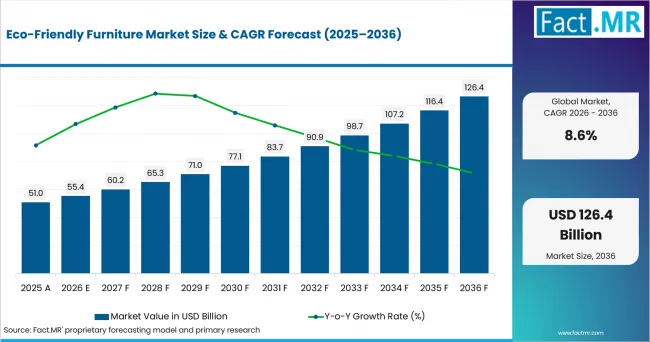
Eco Friendly Furniture Market Value Analysis | Source: Fact.MR
What are the defining numbers behind Eco-Friendly Furniture Market growth?
An absolute opportunity of USD 71.0 billion is expected between 2026 and 2036.
- Demand Drivers in the Market
- Certified wood sourcing gives manufacturers a way to substantiate environmental claims at the material level. FSC chain-of-custody certification tracks eligible forest-based material from the forest to the market and permits reclaimed material within defined requirements. Furniture producers can therefore convert sourcing documentation into a purchasing attribute for buyers that require traceable wood.
- Low-emission criteria are influencing furniture specifications in homes and public spaces. The European Commission states that EU Ecolabel furniture must use virgin wood, cork, bamboo or rattan from legal and sustainably managed forests, while hazardous substances are restricted and low formaldehyde emissions are required. These criteria support purchases of certified wood furniture and lower-emission finishes.
- Circular product rules are increasing the value of repairable and material-efficient design. Furniture is included among the priority product groups in the EU Ecodesign for Sustainable Products working plan. The framework also introduces the Digital Product Passport to improve access to information on sustainability, durability, repairability and material composition.
- Composite-wood emission rules create a direct compliance requirement in the United States. EPA rules under TSCA Title VI cover hardwood plywood, medium-density fiberboard and particleboard, together with finished goods containing them. Testing, labelling and recordkeeping requirements support investment in compliant panels and low-emission manufacturing.
- Public procurement is creating a separate demand route for documented furniture. UK government timber procurement guidance requires evidence that timber is legal and sustainable with chain-of-custody control, while Japan maintains Green Purchasing guidance specifically for office furniture. Suppliers that can present certification and product-level documentation are better placed to participate in these institutional purchases.
- Key Segments Analyzed
- Sustainable Wood Furniture accounts for 62.8% of Product in 2026 because established certification systems and broad commercial availability make sustainably sourced wood easier to specify across residential and contract furniture.
- Residential Furniture holds 54.6% of Application in 2026 as living room and bedroom purchases create recurring demand across home furniture categories where material provenance and indoor emissions can influence selection.
- Household Consumers represent 41.7% of End Use in 2026 because sustainability attributes are evaluated directly at the point of purchase for frequently used furniture in occupied living spaces.
- Sustainable Material Technology accounts for 67.9% of Technology in 2026 because renewable-material processing and recycled-material engineering form the technical basis for many environmental furniture claims.
- Bio-Based Material Formulations hold 58.3% of Formulation in 2026 because plant-derived and wood-fiber composites extend renewable feedstocks into engineered furniture components.
- Direct Furniture Sales account for 49.2% of Distribution Channel in 2026 because brands can explain sourcing, finishes and repair support directly while retaining control over product information and after-sales service.
- Analyst Opinion at Fact.MR
- Shambhu Nath Jha, Principal Consultant at Fact.MR, states, “Eco-friendly furniture purchasing is becoming more evidence-based. Buyers are comparing where the wood came from, what finishes were used, whether components can be replaced and how the product can be handled at end of life. Sustainable wood remains central because certification infrastructure is already established. Suppliers that connect material traceability with low-emission construction and repairable design can build a clearer procurement case as the market rises from USD 55.4 billion in 2026 to USD 126.4 billion by 2036.”
- Strategic Implications
- Manufacturers should connect each sustainability claim with SKU-level evidence such as chain-of-custody certificates, recycled-content documentation or emission-test results. This reduces ambiguity during procurement review.
- Brands using wood-based panels should treat formaldehyde performance and finish chemistry as product specifications, especially for residential and institutional furniture used in enclosed spaces.
- Repairability should be designed into fasteners, covers and replaceable components. Spare-part availability gives buyers a practical lifecycle benefit and can reduce replacement frequency.
- Commercial suppliers should prepare tender-ready evidence for office furniture because public and corporate buyers can require environmental standards, emissions criteria and material documentation at the contract stage.
- Material developers should test recycled polymers against durability and finish requirements before moving them into visible furniture components. The adjacent plastic furniture category shows the operational importance of weather resistance and low maintenance, while eco-friendly positioning adds recycled-content and end-of-life considerations.
- Hospitality suppliers can extend circular design into terraces and public areas where outdoor furniture must combine material efficiency with weather resistance, repairability and maintenance access.
How does the Eco-Friendly Furniture Market break down by segment?
The market is segmented by Product, Application, End Use, Technology, Formulation and Distribution Channel.
Why does Sustainable Wood Furniture lead Product?
Sustainable Wood Furniture is projected to account for a 62.8% share in 2026.
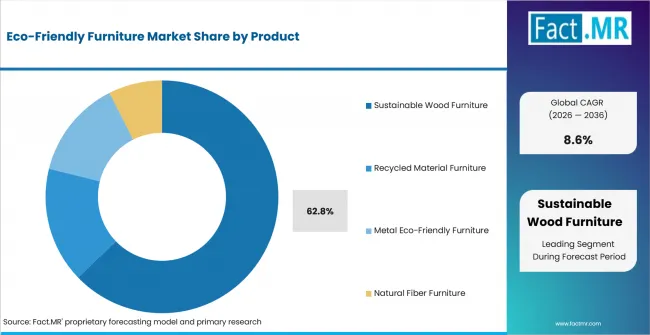
Eco Friendly Furniture Market Analysis By Product | Source: Fact.MR
Sustainable wood leads because furniture manufacturers can link the physical material to established sourcing systems. FSC chain-of-custody certification identifies eligible material through the supply chain, while reclaimed material can also enter FSC product groups under defined requirements. This gives manufacturers a documented route for both virgin and recovered wood.
The segment also fits existing furniture manufacturing processes. Solid wood, engineered panels and bamboo-based products can be used across tables, storage and seating without changing the basic product function. EU Ecolabel criteria reinforce this route by requiring sustainably managed sources for virgin wood and other specified forest-based materials.
Recycled Material Furniture, Metal Eco-Friendly Furniture and Natural Fiber Furniture remain relevant where buyers prioritize recovered inputs, weather resistance or distinct material aesthetics. Sustainable wood retains broader application depth because the same sourcing framework can serve many furniture types.
Why does Residential Furniture lead Application?
Residential Furniture is projected to account for a 54.6% share in 2026.
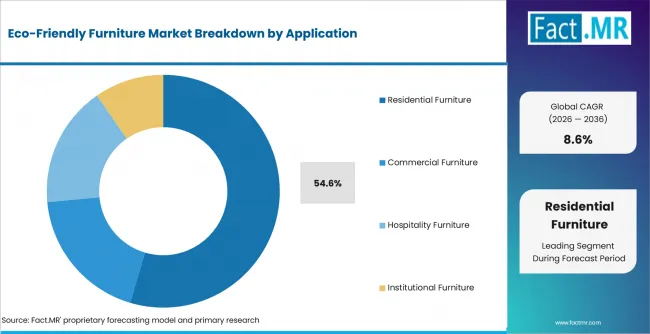
Eco Friendly Furniture Market Analysis By Application | Source: Fact.MR
Residential applications lead because a household purchases multiple furniture types across living rooms and bedrooms, creating a recurring base of chairs, storage units, beds, tables and related pieces. Material appearance remains important, while low-emission finishes and source documentation can be communicated at the same time as design and durability.
The EU Ecolabel furniture group explicitly covers furniture for homes and public spaces, including tables, shelves, cupboards, chairs and sofas. That scope aligns environmental criteria with the product categories households already purchase instead of requiring a separate furniture format.
Commercial, hospitality and institutional applications have stronger tender and compliance processes but more concentrated purchasing cycles. Residential demand is distributed across many households and replacement occasions, which supports its larger share of application demand.
Why do Household Consumers lead End Use?
Household Consumers are projected to account for a 41.7% share in 2026.
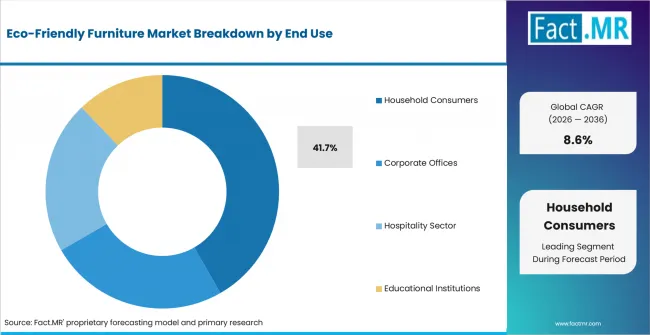
Eco Friendly Furniture Market Analysis By End Use | Source: Fact.MR
Household consumers lead because furniture is used for long periods inside occupied living spaces, so material source, surface finish and perceived indoor-air quality can influence purchase decisions. These attributes are visible in product descriptions and can be compared alongside dimensions, appearance and maintenance requirements.
Environmental labels give households a verification mechanism. The EU Ecolabel limits hazardous substances and requires low formaldehyde emissions for covered furniture. Germany’s Blue Angel also evaluates the product lifecycle and emphasizes sustainably managed wood together with low-emission wood-based materials.
Corporate offices, hospitality operators and educational institutions purchase through more formal specifications. Household buyers account for more transactions across residential furniture and can respond directly to brand-level sourcing and repair information.
Why does Sustainable Material Technology lead Technology?
Sustainable Material Technology is projected to account for a 67.9% share in 2026.
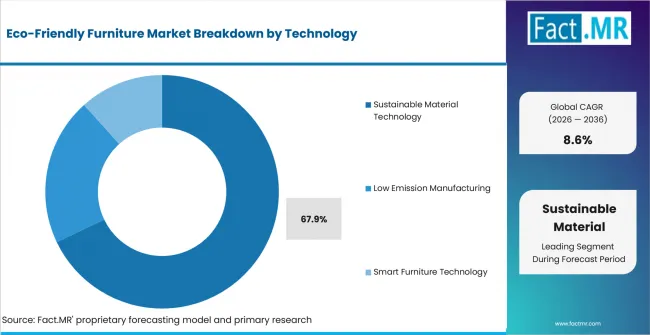
Eco Friendly Furniture Market Analysis By Technology | Source: Fact.MR
Sustainable Material Technology leads because material processing determines whether renewable or recovered inputs can meet furniture requirements for strength, surface quality and repeatable manufacturing. Renewable material processing supports certified wood and bamboo, while recycled material engineering allows recovered feedstocks to enter structural or secondary components.
Brazil’s Forest Products Laboratory identifies sustainable use in furniture, engineered wood products and bamboo valorization among its research lines. This illustrates how material technology expands the usable feedstock base rather than treating sustainability as a finish applied after the furniture has been designed.
Low Emission Manufacturing and Smart Furniture Technology address different parts of the product lifecycle. The larger technology share remains with material processing because it applies across wood, natural fibers, recycled composites and several end-use categories.
Why do Bio-Based Material Formulations lead Formulation?
Bio-Based Material Formulations are projected to account for a 58.3% share in 2026.
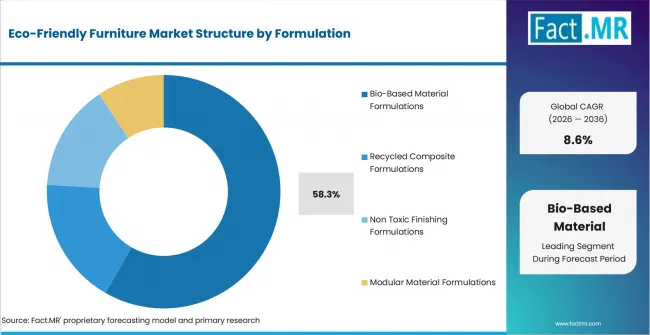
Eco Friendly Furniture Market Analysis By Formulation | Source: Fact.MR
Bio-based formulations lead because plant-derived composites and wood-fiber composites extend renewable content into engineered components where solid wood is not required. These formulations can be shaped into panels or molded parts while supporting a material-origin claim that buyers can understand.
Brazil’s Forest Products Laboratory works on sustainable furniture use, engineered products and the valorization of bamboo and other non-timber forest products. Its research direction supports the practical development of renewable feedstocks for furniture components and composite systems.
Recycled Composite Formulations and Non Toxic Finishing Formulations solve separate material and emissions needs. Bio-based systems hold the larger share because they can address core structural components as well as secondary parts across several furniture types.
Why do Direct Furniture Sales lead Distribution Channel?
Direct Furniture Sales are projected to account for a 49.2% share in 2026.
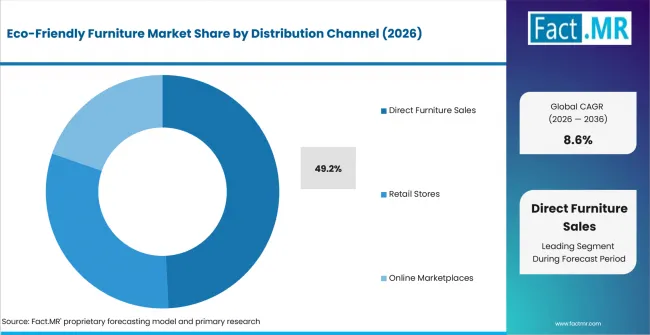
Eco Friendly Furniture Market Analysis By Distribution Channel | Source: Fact.MR
Direct sales lead because sustainability claims often require more explanation than a conventional furniture listing. Brand-owned stores and direct online channels can present wood-source information, recycled-content details, care instructions and repair options without depending on a third-party retailer to maintain the same product-level documentation.
Direct channels also support lifecycle services. Sabai, for example, provides replacement components through its Repair Don’t Replace program and operates a furniture buyback and resale program. These services are easier to coordinate when the brand retains the customer relationship after the original sale.
Retail stores and online marketplaces remain important for comparison and reach. Direct furniture sales hold the larger share because the channel can combine product storytelling with after-sales support and traceable documentation in one relationship.
What is accelerating Eco-Friendly Furniture Market adoption, and what is holding it back?
Drivers Impact Analysis
| Factor | (~) % Impact on CAGR | Geographic Relevance | Impact Timeline |
|---|---|---|---|
| Verified sustainable material sourcing | +1.4% | Global; Germany; UK | Short term (≤ 2 years) |
| Low-emission furniture requirements | +1.1% | USA; Germany; Europe | Short term (≤ 2 years) |
| Circular and repairable product design | +0.8% | Europe; Germany; UK | Medium term (2–4 years) |
| Green public procurement | +0.6% | UK; Japan; USA | Medium term (2–4 years) |
Source: Fact.MR analysis. Updated Aug 21, 2026
Opportunity Impact Analysis
| Factor | (~) % Impact on CAGR | Geographic Relevance | Impact Timeline |
|---|---|---|---|
| Repair and furniture lifecycle services | +0.7% | Europe; USA | Medium term (2–4 years) |
| Recycled material integration | +0.6% | Global | Medium term (2–4 years) |
| Institutional sustainable-furniture procurement | +0.5% | UK; Japan; USA | Medium term (2–4 years) |
| Bio-based furniture materials | +0.4% | Brazil; Europe; Global | Long term (≥ 4 years) |
Source: Fact.MR analysis. Updated Aug 21, 2026
Restraints Impact Analysis
| Factor | (~) % Impact on CAGR | Geographic Relevance | Impact Timeline |
|---|---|---|---|
| Certified material and testing costs | -0.9% | Global | Short term (≤ 2 years) |
| Material qualification and durability requirements | -0.7% | Global | Medium term (2–4 years) |
| Inconsistent sustainability documentation | -0.5% | Global; import-dependent markets | Medium term (2–4 years) |
| Limited availability of qualified sustainable inputs | -0.4% | Emerging markets; import-dependent markets | Long term (≥ 4 years) |
Source: Fact.MR analysis. Updated Aug 21, 2026
Which countries are scaling the Eco-Friendly Furniture Market through 2036?
- Germany: Blue Angel criteria for low-emission wood furniture consider the full product lifecycle and promote sustainably managed wood together with low-emission wood-based materials. This gives German buyers a recognized specification route for furniture designed around sourcing and indoor-emission performance.
- Brazil: The Brazilian Forest Service’s Forest Products Laboratory develops technologies for sustainable use of wood and other forest resources. Its current research includes furniture, engineered wood products and bamboo, supporting local material options for bio-based furniture production.
- USA: EPA’s TSCA Title VI program regulates formaldehyde emissions from hardwood plywood, medium-density fiberboard and particleboard, including finished goods that contain those materials. Compliance raises the importance of tested panels and documented supply chains in wood furniture.
- UK: Government Timber Procurement Policy guidance requires documentary evidence that timber is legal and sustainable, with chain-of-custody control from the forest source to the end user. This creates a defined procurement route for certified wood furniture supplied to public buyers.
- Japan: The Green Purchasing framework includes dedicated guidance for office furniture. The Ministry of the Environment also lists the JOIFA Green Mark for office furniture that meets Green Purchasing Law criteria, helping buyers identify compliant products.
Country CAGR (2026-2036)
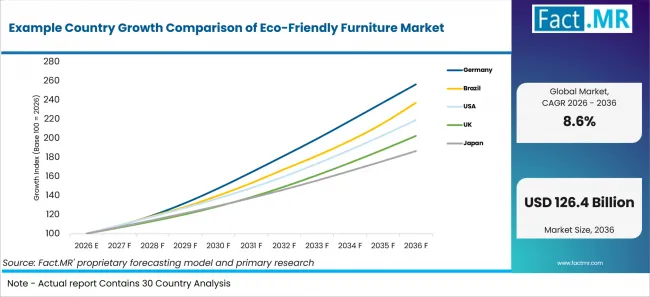
Example Country Growth Comparison Of Eco Friendly Furniture Market | Source: Fact.MR
| Country | CAGR (2026-2036) |
|---|---|
| Germany | 9.89% |
| Brazil | 9.03% |
| USA | 8.17% |
| UK | 7.31% |
| Japan | 6.45% |
Source: Fact.MR analysis. Updated Aug 21, 2026
What is driving Germany’s growth through 2036?
Germany is forecast to expand at a 9.89% CAGR from 2026 to 2036.
Germany combines a mature furniture-manufacturing base with environmental criteria that can be incorporated into product specifications. Blue Angel’s furniture criteria emphasize sustainably managed wood and low-emission wood-based materials, so suppliers can compete on documented sourcing and indoor-emission performance rather than a general environmental claim.
The policy direction is also broadening. Furniture is a priority group in the EU Ecodesign for Sustainable Products working plan, and the Digital Product Passport is intended to improve access to data on durability, repairability and material composition. German suppliers serving EU buyers will therefore have an incentive to build traceability and lifecycle information into product systems.
What is driving Brazil’s growth through 2036?
Brazil is forecast to expand at a 9.03% CAGR from 2026 to 2036.
Brazil has a direct material-development route through its forest-products research infrastructure. The Brazilian Forest Service’s Forest Products Laboratory works on wood characterization and process efficiency while promoting sustainable use of natural resources. These capabilities support furniture producers that want to qualify domestic wood species or improve material yield.
The laboratory’s current research lines include sustainable use in furniture, engineered products and bamboo valorization. This creates a technical base for bio-based formulations and natural-fiber furniture while helping manufacturers use residues and alternative forest products more efficiently.
What is driving USA’s growth through 2036?
The USA is forecast to expand at an 8.17% CAGR from 2026 to 2036.
U.S. demand is supported by environmental performance requirements that influence both materials and procurement. TSCA Title VI requires compliant labeling and testing for regulated composite wood products and finished goods, which makes panel selection and supplier documentation part of furniture quality control.
Federal sustainable-purchasing guidance adds another route. EPA’s current model contract language for furniture directs purchasers toward applicable standards and ecolabels and includes emissions requirements for covered furniture. Suppliers serving government and institutional buyers therefore have a practical reason to maintain third-party certifications and product-level environmental evidence.
What is driving UK’s growth through 2036?
The UK is forecast to expand at a 7.31% CAGR from 2026 to 2036.
The UK Timber Procurement Policy gives public buyers a defined process for checking legal and sustainable timber. The 2025 guidance recognizes FSC, PEFC and Grown in Britain as Category A evidence and requires chain-of-custody documentation through the supply chain.
This matters for furniture because public-sector contracts can ask suppliers to demonstrate sourcing systems and provide evidence at tender or contract stages. Manufacturers that maintain verified timber records can therefore reduce procurement friction when selling wood-derived furniture into government and related institutional channels.
What is driving Japan’s growth through 2036?
Japan is forecast to expand at a 6.45% CAGR from 2026 to 2036.
Japan’s Green Purchasing framework gives national institutions a structured basis for selecting lower-impact goods, with specific procurement guidance for office furniture. This turns environmental criteria into an operational purchasing requirement rather than leaving sustainability entirely to voluntary consumer choice.
The Ministry of the Environment’s label database identifies the JOIFA Green Mark as an indicator for office furniture that meets Green Purchasing Law criteria. Product categories include chairs, desks, shelves and storage furniture. Suppliers that align material and product documentation with these criteria can address public and corporate buyers seeking readily identifiable compliant options.
Who Leads the Eco-Friendly Furniture Market?
Inter IKEA Systems B.V., Ashley Furniture Industries, Inc., Cisco Brothers Corporation, Ethan Allen Global, Inc., La-Z-Boy Inc., Maiden Home, Roche Bobois, Greenington, Sabai, Vermont Woods Studios, Vestre and Williams-Sonoma, Inc. are among the companies operating in the Eco-Friendly Furniture Market.
Inter IKEA Systems B.V. has a broad home-furnishing portfolio supported by documented wood-sourcing practices. IKEA reports that 96.5% of its total wood use in FY25 was FSC-certified or recycled, while recycled wood represented approximately 19% of total wood use.
Competition across residential furniture depends increasingly on the ability to substantiate material sourcing, emissions performance and lifecycle attributes at the product level. Ashley Furniture Industries, Cisco Brothers, Ethan Allen, La-Z-Boy, Maiden Home, Roche Bobois and Williams-Sonoma compete across furniture categories where product design, material selection and customer-facing environmental documentation influence purchasing.
Greenington participates through bamboo-based furniture, while Sabai emphasizes repair and lifecycle support. Vermont Woods Studios focuses on responsibly sourced hardwood furniture, and Vestre incorporates repairability and disassembly into product design.
Competitive positioning is shaped by material traceability, low-emission performance and durability. Repair support and compliance documentation also influence procurement, particularly where buyers require evidence behind environmental claims.
Which companies are the key providers?
Key Companies includes Inter IKEA Systems B.V; Ashley Furniture Industries, Inc.; Cisco Brothers Corporation; Ethan Allen Global, Inc.; Greenington; La-Z-Boy Inc.; Maiden Home; Roche Bobois; Sabai; Vermont Woods Studios; Vestre; Williams-Sonoma, Inc.
- Inter IKEA Systems B.V
- Ashley Furniture Industries, Inc.
- Cisco Brothers Corporation
- Ethan Allen Global, Inc.
- Greenington
- La-Z-Boy Inc.
- Maiden Home
- Roche Bobois
- Sabai
- Vermont Woods Studios
- Vestre
- Williams-Sonoma, Inc.
Bibliography
- European Commission. (2026). EU Ecolabel: Furniture and Mattresses. Directorate-General for Environment.
- European Commission. (2026). The Ecodesign for Sustainable Products Regulation Moves into Implementation. Directorate-General for Environment.
- European Commission. (2025). Ecodesign for Sustainable Products and Energy Labelling Working Plan 2025-2030. Directorate-General for Environment.
- Forest Stewardship Council. (2026). Chain of Custody Certification. FSC.
- German Environment Agency and RAL gGmbH. (2026). Low-Emission Furniture and Slatted Frames Made of Wood and Wood-Based Material, DE-UZ 38. Blue Angel.
- U.S. Environmental Protection Agency. (2026). Formaldehyde Emission Standards for Composite Wood Products. U.S. EPA.
- U.S. Environmental Protection Agency. (2025). Office/Furniture Model Contract Language. Sustainable Marketplace: Greener Products and Services.
- Department for Environment, Food & Rural Affairs. (2025). Timber Procurement Policy: Prove Legality and Sustainability. UK Government.
- Department for Environment, Food & Rural Affairs. (2025). Timber Procurement Advice Note, 7th Edition. UK Government.
- Ministry of the Environment, Japan. (2026). Green Purchasing under the Green Purchasing Act. Government of Japan.
- Ministry of the Environment, Japan. (2026). JOIFA Green Mark. Environmental Label Database.
- Brazilian Forest Service. (2026). Forest Products Laboratory. Government of Brazil.
- Brazilian Forest Service. (2024). Current Research Lines of the Forest Products Laboratory. Government of Brazil.
- IKEA. (2026). The Wood We Use: FY25 Wood Sourcing Information. IKEA Global.
- Greenington. (2026). Why Bamboo. Greenington.
- Sabai Design. (2026). Sustainability and Repair Programs. Sabai.
- Vermont Woods Studios. (2026). Our Commitment to Sustainability. Vermont Woods Studios.
- Vestre. (2026). Sustainability. Vestre.
This Report Answers
- How demand differs across Product, Application, End Use, Technology, Formulation and Distribution Channel.
- Why Sustainable Wood Furniture, Residential Furniture and Household Consumers account for the stated 2026 shares.
- How material-processing technology and bio-based formulations influence furniture specification and purchasing.
- What sourcing, emissions and procurement conditions shape demand in Germany, Brazil, the USA, the UK and Japan.
- How the listed furniture companies compete through verified material sourcing, lifecycle service and product-level environmental documentation.
What does the Eco-Friendly Furniture Market cover?
The Eco-Friendly Furniture Market covers finished furniture sold with environmental attributes that can be linked to material sourcing, recycled or renewable content, low-emission manufacturing or finishing, circular design, or repairability. The assessment follows the stated Product, Application, End Use, Technology, Formulation and Distribution Channel taxonomy.
Products include sustainable wood furniture, furniture made from recycled materials, metal eco-friendly furniture and natural-fiber furniture. The market also captures the specified technology and formulation approaches used to support those products across residential, commercial, hospitality and institutional applications.
What is included in the scope?
The scope includes FSC Certified Solid Wood Furniture and Bamboo Based Furniture within Sustainable Wood Furniture. It also includes Reclaimed Wood Furniture, Recycled Plastic Furniture, Recycled Metal Furniture, Low Emission Metal Furniture, Rattan & Cane Furniture and Hemp & Jute Furniture.
Application coverage includes residential, commercial, hospitality and institutional furniture. End-use demand includes households, corporate offices, hospitality operators and educational institutions. Technology coverage includes sustainable material processing, low-emission manufacturing and smart furniture technology, while formulation coverage includes bio-based materials, recycled composites, non-toxic finishes and modular material systems.
Revenue is counted through Direct Furniture Sales, Retail Stores and Online Marketplaces when the finished furniture product fits the stated eco-friendly scope.
What is excluded from the scope?
Conventional furniture without a qualifying sustainability characteristic is excluded. Raw lumber, stand-alone wood panels, recycled polymers, metals, coatings and adhesives are outside the market when sold as inputs rather than as part of finished furniture.
Second-hand and refurbished furniture resale is excluded from market revenue unless a newly sold product within the stated segmentation includes a repair, take-back or resale service as part of its lifecycle support. Mattresses, construction joinery, flooring and decorative accessories are outside the scope when they are sold separately from the covered furniture products.
How Was the Analysis Built?
The analysis draws on more than 120 sources, over 35 company portfolios and more than 20 industry interviews across at least 25 countries.
- Primary Research: Interviews with furniture manufacturers, material suppliers, certification and compliance teams, retailers, commercial procurement teams and institutional buyers examine material selection, sourcing evidence, emissions requirements, repairability and purchasing criteria.
- Desk Research: The review covers ecolabel criteria, forest-certification systems, green procurement rules, composite-wood regulations, official forest-products research and current company sustainability disclosures. Sources used in the analysis are recorded in the bibliography.
- Market Sizing and Forecasting: Estimates combine product mix, application demand, end-use purchasing, technology and formulation adoption, distribution-channel mix, furniture pricing and country-level sustainability requirements. The model also considers substitution between certified wood, recycled materials and conventional furniture.
- Data Validation and Update Cycle: Findings are cross-checked against current supplier portfolios, public criteria and regulatory requirements. Updates account for changes in ecolabel rules, material sourcing, manufacturing technology, furniture portfolios and procurement requirements.
Segmentation
What is the report's scope and coverage?
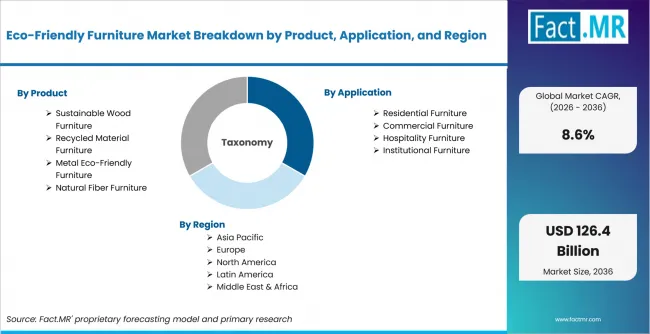
Eco Friendly Furniture Market Breakdown By Product, Application, And Region | Source: Fact.MR
| Attribute | Details |
|---|---|
| Quantitative Units | USD Billion |
| Market Definition | Finished furniture positioned on verifiable lower-impact material sourcing, recycled or renewable content, low-emission manufacturing or finishing, circular design or repairability within the stated segmentation. |
| Segments Covered | Product; Application; End Use; Technology; Formulation; Distribution Channel |
| Regions Covered | North America; Latin America; Europe; East Asia; South Asia and Pacific; Middle East and Africa |
| Countries Covered | Germany; Brazil; USA; UK; Japan |
| Key Companies Profiled | Inter IKEA Systems B.V; Ashley Furniture Industries, Inc.; Cisco Brothers Corporation; Ethan Allen Global, Inc.; Greenington; La-Z-Boy Inc.; Maiden Home; Roche Bobois; Sabai; Vermont Woods Studios; Vestre; Williams-Sonoma, Inc. |
| Forecast Period | 2026 to 2036 |
| Base Year | 2025 |
| Market Value, 2026 | USD 55.4 billion |
| Market Value, 2036 | USD 126.4 billion |
| CAGR, 2026-2036 | 8.6% |
| Absolute Opportunity | USD 71.0 billion |
| Approach | Combines product and material mix, application demand, end-use purchasing, technology and formulation adoption, distribution-channel economics, furniture pricing and country-level sustainability requirements. |
Source: Fact.MR analysis. Updated Aug 21, 2026
How is the market segmented?
-
By Product
- Sustainable Wood Furniture
- FSC Certified Solid Wood Furniture
- Bamboo Based Furniture
- Recycled Material Furniture
- Reclaimed Wood Furniture
- Recycled Plastic Furniture
- Metal Eco-Friendly Furniture
- Recycled Metal Furniture
- Low Emission Metal Furniture
- Natural Fiber Furniture
- Rattan & Cane Furniture
- Hemp & Jute Furniture
- Sustainable Wood Furniture
-
By Application
- Residential Furniture
- Living Room Furniture
- Bedroom Furniture
- Commercial Furniture
- Office Furniture
- Retail Furniture
- Hospitality Furniture
- Hotel Furniture
- Restaurant Furniture
- Institutional Furniture
- Educational Furniture
- Healthcare Furniture
- Residential Furniture
-
By End Use
- Household Consumers
- Urban Households
- Rural Households
- Corporate Offices
- IT & Tech Companies
- Financial Institutions
- Hospitality Sector
- Hotels & Resorts
- Food Service Industry
- Educational Institutions
- Schools & Colleges
- Training Centers
- Household Consumers
-
By Technology
- Sustainable Material Technology
- Renewable Material Processing
- Recycled Material Engineering
- Low Emission Manufacturing
- VOC Free Finishing Technology
- Energy Efficient Production
- Smart Furniture Technology
- Modular Design Systems
- Digital Manufacturing
- Sustainable Material Technology
-
By Formulation
- Bio-Based Material Formulations
- Plant Derived Composites
- Wood Fiber Composites
- Recycled Composite Formulations
- Plastic Wood Composites
- Metal Composite Systems
- Non Toxic Finishing Formulations
- Water Based Coatings
- Organic Oil Finishes
- Modular Material Formulations
- Hybrid Eco Materials
- Bio-Based Material Formulations
-
By Distribution Channel
- Direct Furniture Sales
- Brand Owned Stores
- Direct Online Sales
- Retail Stores
- Furniture Chains
- Independent Furniture Stores
- Online Marketplaces
- Global E-Commerce Platforms
- Specialty Online Stores
- Direct Furniture Sales
Frequently Asked Questions
What is the Eco-Friendly Furniture Market value in 2026?
At what CAGR is the market projected to grow?
What is the projected market value by 2036?
Which Product leads the market?
Which Application leads the market?
Which End Use leads the market?
Which Technology leads the market?
Which Formulation leads the market?
Which Distribution Channel leads the market?
What CAGR is listed for Germany?
Which companies are included in the market assessment?
Who worked on this report


Preview the report firsthand - request a free sample
Free SampleGet the brochure for pricing and purchase details
Download PDF