- Base Value(2025): 298.2 Bn
- Estimated Value(2026): 325.0 Bn
- Forecast Value (2036): 714.7 Bn
- CAGR (2026 - 2036): 8.2%
Lightweight Automotive Body Panels Market Forecast and Outlook 2026 to 2036
In 2025, the lightweight automotive body panels market was valued at USD 298.2 billion. Based on Fact.MR analysis, demand for lightweight automotive body panels is estimated to grow to USD 325.0 billion in 2026 and USD 714.7 billion by 2036. Fact.MR projects a CAGR of 8.2% during the forecast period.
The market is expected to generate an absolute dollar opportunity of USD 416.5 billion between 2026 and 2036. This transformational expansion reflects a structural reconfiguration of global automotive production, driven by mandatory CO2 reduction legislation in Europe, the United States, and China, combined with the irreversible electrification shift in passenger and light commercial vehicle segments.
Ignacio Martin Gonzalez, Chief Technology and Innovation Officer of Gestamp, noted regarding automotive lightweighting, ' Steel is still a high-performance product”. Suppliers are now responsible for 75 percent of vehicle value creation. For many, and especially for us, the great opportunity lies in offering cutting-edge, highly developed and cost-effective key solutions.' [1]
Country growth rates reflect electrification intensity and manufacturing scale. China leads at 11.5% CAGR under its NEV mandate, accelerating lightweight material adoption. India follows at 10.8% as FAME and PLI schemes expand EV platforms. Germany records 9.9%, driven by EU Regulation 2019/631 fleet CO₂ penalties. France posts 8.9% supported by domestic EV incentives and OEM compliance. The United Kingdom grows at 8.0%, backed by its zero-emission vehicle mandate and continued emission standard alignment.
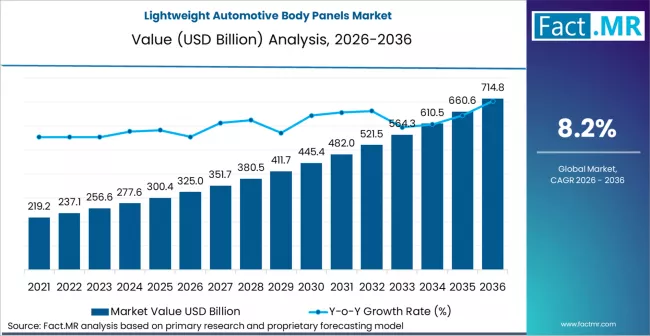
Lightweight Automotive Body Panels Market Market Value Analysis | Source: Fact.MR
| Metric | Value |
|---|---|
| Estimated Value in 2026 | USD 325.0 billion |
| Forecast Value in 2036 | USD 714.7 billion |
| Forecast CAGR (2026 to 2036) | 8.2% |
Source: Fact.MR analysis. Updated Feb 26, 2026
Market Definition
The lightweight automotive body panels market covers exterior and structural vehicle components designed to reduce weight compared to mild steel. Materials include aluminum, carbon fiber composites, glass fiber composites, advanced high-strength steel, magnesium alloys, and thermoplastics. Applications span body-in-white, closures, hoods, roofs, doors, and fenders across passenger vehicles, light commercial vehicles, and battery electric vehicles.
Market Inclusions
The report analyzes global and regional revenues from 2026 to 2036 by material, application, process, and vehicle type. It assesses panel pricing trends, aluminum versus composite cost evolution, and regulatory compliance economics in the EU, US, and China. Country analysis includes China, India, Germany, France, and the United Kingdom, with regional coverage across North America, Europe, Asia Pacific, Latin America, and the Middle East and Africa.
Market Exclusions
The study excludes complete vehicles, full body assemblies for collision repair, and aftermarket replacement panels. Structural frames and sub frames are excluded unless supplied as lightweight body-in-white substitutes. Motorsport panels without scalable production tooling and standalone paints, adhesives, and surface treatments are also excluded.
Research Methodology
- Primary Research: Interviews were conducted with OEM procurement managers, tier-one supplier engineers, material specialists, and automotive analysts across Asia Pacific, Europe, and North America.
- Desk Research: Secondary sources included EU Regulation 2019/631, NHTSA CAFE filings, China NEV policies, IEA EV Outlook 2024, ACEA data, and company releases from Novelis, Gestamp, Constellium, and Toray Industries.
- Market Sizing and Forecasting: A hybrid model combined top-down vehicle production and regulatory cost inputs with bottom-up panel material costs, yield rates, and margin structures.
- Data Validation and Update Cycle: Findings were validated against ACEA CO2 data, IEA EV statistics, company reports, and ACMA demand data. Forecasts are reviewed annually with quarterly regulatory monitoring.
Summary
- Market Definition
- Lightweight automotive body panels are reduced-mass structural and exterior components made from aluminum, composites, advanced steel, and thermoplastics that replace conventional steel in passenger and electric vehicles.
- Demand Drivers
- EU fleet CO2 targets and penalty mechanisms are driving OEM mass reduction strategies.
- Heavier BEV architectures require 100 to 200 kg of weight offset in body structures.
- China’s NEV mandate is accelerating aluminum and composite integration among domestic automakers.
- Key Segments Analyzed
- By Material: Aluminum and metal alloys account for about 42% of 2025 market value due to recyclability, established stamping infrastructure, and strong strength-to-weight performance.
- By Application: Body-in-White represents about 30.2% of volume, driven by structural safety and mass compliance needs.
- By Geography: Asia Pacific leads market share due to China’s EV scale, India’s manufacturing incentives, and strong OEM presence in Japan and South Korea.
- Analyst Opinion at FACT.MR
- Shambhu Nath Jha, Principal Consultant at Fact.MR, opines, ‘CXOs will find this report essential for understanding how EU CAFE enforcement, China’s NEV quota system, and BEV weight dynamics are compressing the timeline for large-scale material substitution.
- Strategic Implications / Executive Takeaways
- Manufacturers reliant on mild-steel stamping must accelerate investment in hot-stamping and gigastamping. This is critical to defend margins against aluminium and composite substitution in BEV body-in-white platforms.
- Aluminium sheet suppliers should expand closed-loop recycling partnerships with OEMs. Scrap recovery lowers net material costs and strengthens sustainability credentials required in supplier qualification.
- Composite panel specialists should focus on closures, hoods, and lift gates for premium BEVs. In these segments, strict weight targets justify CFRP and GFRP price premiums over aluminium.
- Methodology
- Market sizing used global vehicle production forecasts by segment and region, weighted by penetration rates of lightweight materials by panel type and vehicle class.
- Segment shares were benchmarked using OEM material content disclosures, ACEA fleet data, ACMA composite demand records, and primary supplier interviews.
- Regional projections incorporated EU regulatory compliance modelling, China NEV mandate production quotas, India PLI scheme adoption targets, and NHTSA CAFE standard trajectories.
Segmental Analysis
Lightweight Automotive Body Panels Market Analysis by Material
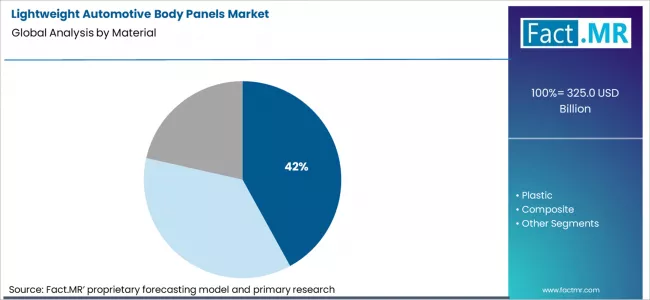
Lightweight Automotive Body Panels Market Analysis By Material | Source: Fact.MR
Metal and alloy panels are projected to hold 42% share in 2025. Aluminium dominates due to stamping compatibility, crash performance, and strong recycling systems. It offers the best balance of strength, weight, and cost at volume scale.
- Novelis Automotive Aluminium Capacity and BMW Contract: Novelis operates 33 facilities and supplies over 315 vehicle models. In 2025, it produced a 100 percent recycled automotive aluminum coil for Europe. [6] BMW Group signed a multi-year supply agreement in December 2024 for next-generation EV platforms. [7]
- Gestamp Gig Stamping Technology and EV Body Structures: Gestamp showcased Gigastamping at the Automotive Engineering Exposition 2024. [1] Its One Piece Rear Frame integrates the rear body into a single hot-stamped unit, cutting weight and assembly cost.
- ACMA Composite Demand Record and Manufacturing Scale: ACMA reported record composite demand of 4.9 billion pounds in 2024. [3] This signals mainstream automotive adoption.
Lightweight Automotive Body Panels Market Analysis by Application
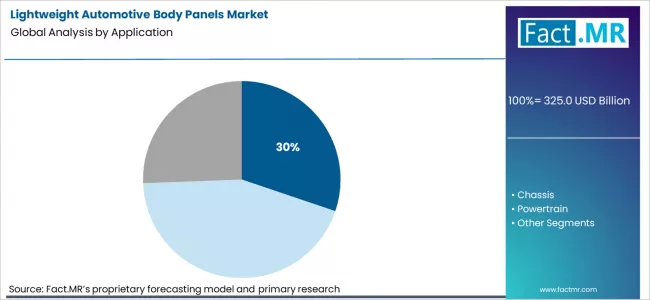
Lightweight Automotive Body Panels Market Analysis By Application | Source: Fact.MR
Body in White is expected to hold 30.2% share in 2025. BIW forms the structural backbone of vehicles and directly impacts crash safety and weight targets. OEMs prioritise BIW light weighting to reduce CO2 exposure and extend BEV range.
- Toray and Hyundai Joint R&D for Structural Composite BIW: In April 2024, Toray Industries and Hyundai Motor Group partnered to develop carbon-fibre and composite BIW structures. [8] The focus is on safe, lightweight solutions for next-generation BEVs.
- Li Auto and Ianlon Technology Lightweight Materials Joint Lab: In February 2025, Li Auto and Ianlon Technology launched a joint lab in Changzhou. [9] The collaboration develops ultra-high-strength steel, lightweight alloys, and composites for structural BIW use.
- EU Product Carbon Footprint Mandates for BIW Suppliers: Since early 2024, suppliers must provide product carbon footprint data with BIW quotations. [3] This ties supplier approval to lifecycle emissions performance and supports recycled aluminium and bio-composite adoption in Europe.
Drivers, Restraints, and Opportunities
Fact.MR values the lightweight automotive body panels market at USD 298.2 billion in 2025. Growth is driven by stricter emission rules, rising BEV adoption, and improved aluminium recycling economics. Aluminium leads due to established infrastructure and cost efficiency at scale. Composites and thermoplastics are expanding from premium models into mass-market BEVs.
The main challenge is balancing compliance pressure with material cost. EU penalties of EUR 95 per excess CO2 gram can translate into hundreds of millions in fines. This makes aluminium and composites viable despite 15 to 40 percent premiums over steel. BEV battery packs add around 500 kg, forcing OEMs to offset weight through lighter panels. Multi-material suppliers gain advantage, while pure steel players face risk.
- EU CAFE Enforcement and Penalty Economics: Regulation (EU) 2019/631 set a 93.6 g CO2/km fleet target from 2025. [2] OEMs exceeding this pay EUR 95 per excess gram per vehicle. This strongly supports lightweight panel adoption even at higher unit costs.
- BEV Platform Architecture and Body Weight Recovery: BEVs are heavier than ICE vehicles. ACMA reported 4.9 billion pounds of lightweight composites demand in 2024. [3] OEMs must reduce body mass to protect driving range, sustaining aluminium and composite demand.
- China NEV Mandate and Asia Pacific Manufacturing Expansion: China’s NEV quotas push higher EV production. [4] OEMs are adopting aluminium, magnesium, and carbon fibre panels. LyondellBasell partnered with Hunan Huda Aisheng Group at ChinaPlas 2024 to develop lightweight plastic hoods for premium NEVs. [5]
Regional Analysis
The lightweight automotive body panels market is analysed across North America, Europe, Asia Pacific, Latin America, and Middle East and Africa. Each region is assessed by regulatory framework intensity, OEM production volume, EV adoption trajectory, and supply chain localisation depth. Country-level coverage includes China, India, Germany, France, and the United Kingdom. The full report provides market attractiveness analysis benchmarked against CO2 compliance economics, material cost competitiveness by region, and OEM platform electrification timelines.
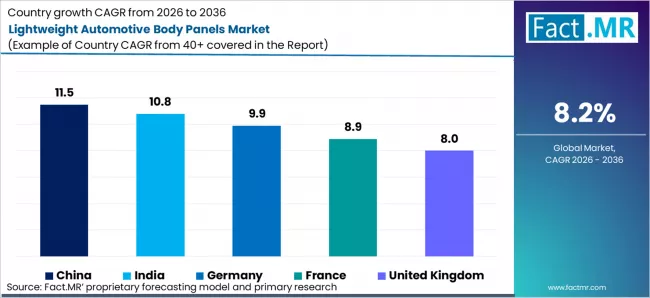
Lightweight Automotive Body Panels Market Cagr Analysis By Country | Source: Fact.MR
| Country | CAGR (2026 to 2036) |
|---|---|
| China | 11.5% |
| India | 10.8% |
| Germany | 9.9% |
| France | 8.9% |
| United Kingdom | 8.0% |
Source: Fact.MR analysis. Updated Feb 26, 2026
Source: Fact.MR (FACT.MR) analysis, based on proprietary forecasting model and primary research
Asia Pacific Lightweight Automotive Body Panels Market Analysis
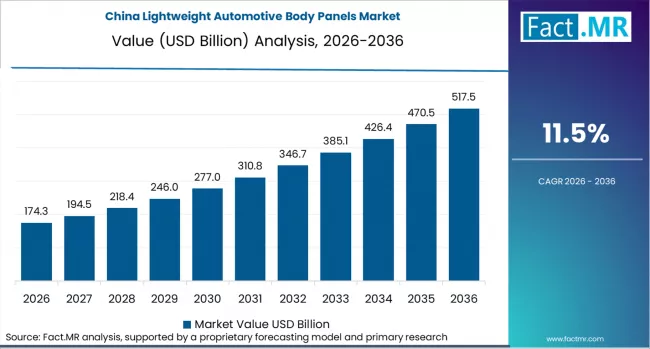
Lightweight Automotive Body Panels Market Country Value Analysis | Source: Fact.MR
Asia Pacific is the largest production hub for lightweight automotive body panels. Growth is anchored by China’s EV scale, India’s expanding OEM base, and Japan and South Korea’s advanced stamping and materials expertise. Novelis operates integrated rolling and recycling facilities in Zhenjiang and Changzhou to support closed-loop aluminium demand. Gestamp has built 13 plants in China since 2007, with the country contributing 14 percent of its global revenue by 2024. BASF and Covestro supply advanced polymer composites to regional OEM programmes.
- China: Demand in China is projected to grow at 11.5% CAGR through 2036. Growth is driven by NEV quotas that encourage aluminium, magnesium, and carbon fibre panels to offset battery weight. China produced over 27 million vehicles in 2023, with EVs representing nearly 30 percent of output. The April 2024 LyondellBasell and Hunan Huda Aisheng partnership at ChinaPlas introduced a lightweight plastic engine hood for domestic NEVs. [5]
- India: Demand in India is projected to rise at 10.8% CAGR through 2036. Government support through FAME and the INR 25,938 crore PLI scheme promotes EV production. [10] Bharat Stage VI norms also sustain lightweight demand in ICE vehicles. Domestic suppliers are expanding aluminium stamping capacity, while global firms like Gestamp and Novelis are strengthening local operations. The March 2024 expansion of Planet Electric in Gurugram highlights composite adoption in EV freight vehicles.
FACT.MR covers China, India, Japan, South Korea, Australia and New Zealand, ASEAN, and Rest of Asia Pacific. The report details regulatory trends, material adoption rates, OEM electrification timelines, and aluminium supply chain developments by country.
Europe Lightweight Automotive Body Panels Market Analysis
Europe is the regulatory benchmark for automotive CO2 compliance. Regulation (EU) 2019/631 directly links vehicle weight to financial penalties. Aluminium and advanced steel supply is led by Novelis, Constellium, and ThyssenKrupp, while Gestamp dominates hot-stamped structural panels. The December 2025 EU Automotive Package introduced revised CO2 rules and super-credits for EU-made affordable EVs, supporting continued lightweight panel investment.
- Germany: Demand in Germany is projected to grow at 9.9% CAGR through 2036. Major OEMs including Volkswagen, BMW, Mercedes-Benz, and Porsche operate under a 93.6 g/km fleet CO2 target from 2025, with EUR 95 per excess gram penalties. [2] BMW signed a multi-year aluminium supply deal with Novelis in December 2024.
- France: Demand in France is projected to grow at 8.9% CAGR through 2036. Renault and Stellantis drive compliance-led demand for aluminum and composite panels. Regulation (EU) 2025/1214 introduced a three-year CO2 averaging window for 2025 to 2027. This allows phased material substitution rather than immediate penalties.
- United Kingdom: Demand in the UK is projected to grow at 8.0% CAGR through 2036. The Zero Emission Vehicle mandate requires 22 percent zero-emission sales in 2024, rising to 100 percent by 2035. This accelerates BEV platform rollout at Jaguar Land Rover and Nissan Sunderland. JLR operates closed-loop aluminum recycling with Novelis and Constellium. Nissan partnered with Constellium in June 2024 to develop recycled aluminum BEV panels. [7]
FACT.MR covers Germany, France, United Kingdom, Italy, Spain, Netherlands, Nordics, and Rest of Europe. The report includes EU CAFE penalty modelling, carbon footprint compliance requirements, and OEM aluminum and composite sourcing strategies.
Competitive Aligners for Market Players
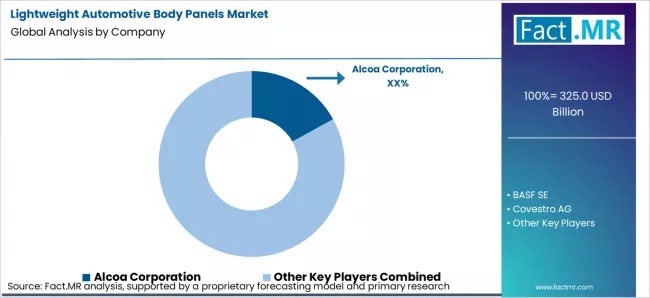
Lightweight Automotive Body Panels Market Analysis By Company | Source: Fact.MR
The global lightweight automotive body panels market shows moderate concentration in aluminum sheet and advanced steel, while composite and polymer panels remain fragmented. Gestamp holds about 22 percent of the premium stamped structural panel segment, supported by hot stamping expertise and long term contracts with major OEMs. Novelis leads automotive aluminium sheet supply, with products used in more than 315 vehicle models. Constellium and Alcoa are active in structural aluminum panels and extrusions. In composites, Toray Industries and Covestro supply carbon fibre and engineering polymers, though no composite supplier matches the scale of metal panel leaders.
Vertically integrated players hold clear cost and compliance advantages. Novelis operates 33 recycling facilities and reported USD 17.1 billion in fiscal 2025 sales. Its closed loop partnerships with BMW, Jaguar Land Rover, and Ford lower material cost and support EU compliant sourcing. Gestamp’s gig stamping integrates multiple parts into one unit, cutting tooling cost and weight.
OEM procurement follows long vehicle platform cycles. Suppliers are selected years before production under multiyear contracts. Scale, regulatory compliance, and multi material capability are critical to winning and retaining share.
Recent Development
- In February 2025, Li Auto and Ianlon Technology launched a joint lab in Changzhou for advanced steel, aluminium, and composite BEV structures. This reflects deeper domestic investment in lightweight material innovation.
- In December 2024, BMW Group secured a major multi-year contract with Novelis to supply advanced aluminium sheet for next-generation EV platforms.
Key Players
- Alcoa Corporation
- BASF SE
- Covestro AG
- ThyssenKrupp AG
- LyondellBasell Industries Holdings B.V.
- Novelis Inc.
- Constellium N.V.
- Gestamp Automocion S.A.
- UBQ Materials
- Bcomp Ltd.
- Toray Industries Inc.
- Magna International Inc.
This Report Addresses
- Market intelligence for strategic planning: Provides OEM procurement teams, tier-one suppliers, and material innovators with demand quantification, segment share, and competitive positioning data needed to prioritise R&D and capital investment across a rapidly transitioning light weighting landscape.
- Market size and forecast to 2036: Delivers validated revenue forecasts from USD 325.0 billion in 2026 to USD 714.7 billion by 2036 at 8.2% CAGR, with annual projections by material, application, manufacturing process, and vehicle type.
- Growth opportunity mapping: Identifies highest-growth segment combinations BEV body-in-white aluminum and composite panels across Asia Pacific and provides absolute dollar opportunity estimates for each segment pair by region.
- Segment and regional forecasts: Delivers individual CAGR and value projections for China (11.5%), India (10.8%), Germany (9.9%), France (8.9%), and the United Kingdom (8.0%), with supporting regulatory and platform adoption analysis specific to each market.
- Competition strategy assessment: Profiles Alcoa, Novelis, Constellium, Gestamp, Toray, Covestro, BASF, ThyssenKrupp, LyondellBasell, UBQ Materials, Bcomp, and Magna International with competitive positioning, recent developments, and supply chain integration analysis.
- Product and compliance tracking: Tracks aluminum closed-loop recycling programme adoption, composite panel cost trajectory, gig stamping technology deployment, and multi-material BEV platform design across the covered companies and geographies.
- Regulatory impact analysis: Quantifies the penalty economics of EU Regulation 2019/631, China NEV mandate production requirements, India FAME and PLI scheme demand creation, and NHTSA CAFE standard trajectories to model the compliance-driven light weighting investment cycle through 2036.
- Delivery formats: Available as PDF, PowerPoint, and Excel dataset. Includes customization options for specific OEM platform analysis, country-level deep dives, and five-year segment scenario modelling on request.
Segmentation
Scope of Report
| Items | Values |
|---|---|
| Quantitative Units | USD 325.0 billion (2026) to USD 714.7 billion (2036), at a CAGR of 8.2% |
| Market Definition | Lightweight automotive body panels encompass all reduced-mass exterior and structural vehicle body components manufactured from aluminum alloys, advanced high-strength steel, carbon fibre and glass fibre reinforced composites, thermoplastic polymers, rubber-hybrid panels, and magnesium alloys used in passenger vehicles, light commercial vehicles, and battery electric vehicles globally. |
| Material Segmentation | Metal & Alloys (Aluminium Alloys, AHSS, Magnesium Alloys), Plastic (Thermoplastic, Engineering Polymers), Composite (CFRP, GFRP, Natural Fibre), Rubber (Structural Rubber, Rubber-Metal Hybrid) |
| Application Segmentation | Body in White / BIW (Structural Panels, Closures), Chassis (Subframe Panels, Floor Structures), Powertrain (Engine Bay Covers, Battery Enclosure Panels), Interior (Instrument Panel Carriers, Seat Structural Panels) |
| Vehicle Segmentation | Passenger Vehicles: Internal Combustion Engine Vehicle (ICEV), Battery Electric Vehicle (BEV), Hybrid Electric Vehicle (HEV) |
| Manufacturing Process Coverage | Casting, Extrusion, Forging, Forming (including Stamping, Hot Stamping, Hydroforming, Roll Forming) |
| Application Coverage | CO2 regulatory compliance material substitution, BEV range optimization light weighting, crashworthiness and structural safety, closed-loop recycled material content, multi-material body structure design |
| Regions Covered | Asia Pacific, Europe, North America, Latin America, Middle East and Africa |
| Countries Covered | China, India, Japan, South Korea, Australia and New Zealand, ASEAN, Rest of Asia Pacific, Germany, France, United Kingdom, Italy, Spain, Netherlands, Nordics, Rest of Europe, United States, Canada, Mexico, Brazil, Colombia, Argentina, Chile, Rest of Latin America, Kingdom of Saudi Arabia, United Arab Emirates, South Africa, Nigeria, Rest of Middle East and Africa |
| Key Companies Profiled | Alcoa Corporation, BASF SE, Covestro AG, ThyssenKrupp AG, LyondellBasell Industries Holdings B.V., Novelis Inc., Constellium N.V., Gestamp Automocion S.A., UBQ Materials, Bcomp Ltd., Toray Industries Inc., Magna International Inc. |
| Forecast Period | 2026 to 2036 |
| Approach | A hybrid top down and bottom up model was used. It incorporated IEA EV Outlook data, ACEA CO2 records, China NEV quota modelling, EU and US CAFE cost frameworks, and regional per panel material benchmarks. Estimates were validated through interviews with OEM procurement leaders, tier one suppliers, and materials experts. Findings were cross checked against ACMA demand data and company disclosures from Novelis and Gestamp. |
Source: Fact.MR analysis. Updated Feb 26, 2026
Lightweight Automotive Body Panels Market by Segment
-
By Material
- Metal & Alloys
- Aluminium Alloys
- Advanced High-Strength Steel (AHSS)
- Magnesium Alloys
- Plastic
- Thermoplastic Polymers
- Engineering Polymers
- Composite
- Carbon Fibre Reinforced Polymer (CFRP)
- Glass Fibre Reinforced Polymer (GFRP)
- Natural Fibre Composites
- Rubber
- Structural Rubber Panels
- Rubber-Metal Hybrid Components
- Metal & Alloys
-
By Application
- Body in White (BIW)
- Structural Panels
- Closures (Doors, Hoods, Tailgates)
- Chassis
- Subframe Panels
- Floor Structures
- Powertrain
- Engine Bay Covers
- Battery Enclosure Panels
- Interior
- Instrument Panel Carriers
- Seat Structural Panels
- Body in White (BIW)
-
By Manufacturing Process
- Casting
- Extrusion
- Forging
- Forming
- Stamping
- Hot Stamping
- Hydroforming
-
By Vehicle
- Passenger Vehicles
- Internal Combustion Engine Vehicle (ICEV)
- Battery Electric Vehicle (BEV)
- Hybrid Electric Vehicle (HEV)
- Passenger Vehicles
-
By Region
- North America
- United States
- Canada
- Mexico
- Europe
- Germany
- France
- United Kingdom
- Italy
- Spain
- Netherlands
- Nordics
- Rest of Europe
- Asia Pacific
- China
- India
- Japan
- South Korea
- Australia and New Zealand
- ASEAN
- Rest of Asia Pacific
- Latin America
- Brazil
- Mexico
- Argentina
- Colombia
- Rest of Latin America
- Middle East and Africa
- Kingdom of Saudi Arabia
- United Arab Emirates
- South Africa
- Nigeria
- Rest of Middle East and Africa
- North America
Frequently Asked Questions
How large is the lightweight automotive body panels market in 2026?
What will the lightweight automotive body panels market size be by 2036?
What is the expected CAGR for the lightweight automotive body panels market from 2026 to 2036?
Which material segment is poised to lead the lightweight automotive body panels market?
How significant is the Body in White application segment in this market?
Which country is the fastest-growing market for lightweight automotive body panels?
Who worked on this report


Preview the report firsthand - request a free sample
Free SampleGet the brochure for pricing and purchase details
Download PDF