- Base Value(2025): 228.4 Mn
- Estimated Value(2026): 236.2 Mn
- Forecast Value (2036): 329.9 Mn
- CAGR (2026 - 2036): 3.40%
Demand for Fog Lights in UK Size, Market Forecast and Outlook By Fact.MR
The demand for fog lights in uk was valued at USD 228.4 million in 2025, projected to reach USD 236.2 million in 2026, and is forecast to expand to USD 329.9 million by 2036 at a 3.40% CAGR. The UK climate, characterized by frequent fog, heavy rainfall, and reduced winter daylight hours, sustains baseline demand for front fog lights as both a safety requirement and a consumer expectation on new vehicles. LED technology migration is accelerating because LED fog lights offer superior colour temperature, lower power consumption, and longer service life compared to halogen alternatives, aligning with vehicle electrical load reduction targets.
The absolute dollar opportunity between 2026 and 2036 amounts to approximately USD 93.76 million. Growth is steady, reflecting the mature lighting component category where demand correlates with new vehicle production and aftermarket replacement cycles. LED fog lights lead the technology segment because their performance advantages and falling LED chip costs make them the default OEM specification on new vehicle platforms. Fact.MR analysts note that the OEM channel holds a narrow lead because fog lights are standard or optional equipment on most UK vehicle models, but the aftermarket generates proportional revenue from replacement bulbs, lens assemblies, and upgrade kits.
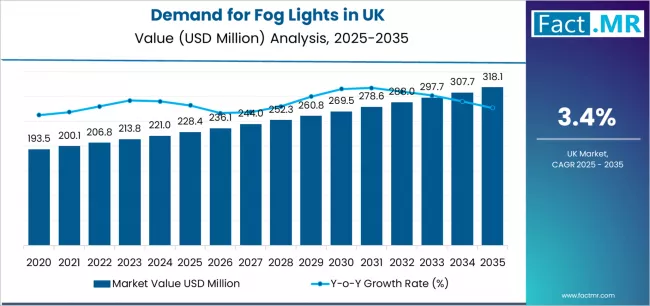
Demand For Fog Lights In Uk Market Value Analysis | Source: Fact.MR
Demand for Fog Lights in UK Key Takeaways
| Metric | Details |
|---|---|
| Industry Size (2026) | USD 236.2 million |
| Industry Value (2036) | USD 329.9 million |
| CAGR (2026 to 2036) | 3.40% |
Source: Fact.MR analysis. Updated Mar 26, 2026
The UK market is projected to grow at a 3.4% CAGR during 2026 to 2036, driven by LED technology migration on new vehicle platforms and aftermarket replacement demand from the existing halogen-equipped vehicle fleet.
Summary of Demand for Fog Lights in UK
- Demand for Fog Lights in UK Definition
- Fog lights in the UK are auxiliary forward lighting units producing wide, low-mounted beam patterns for reduced-visibility driving, with demand sustained by the UK climate, LED technology migration, and vehicle production and replacement cycles.
- Demand Drivers
- UK climate conditions including frequent fog, heavy rain, and low winter visibility sustain baseline consumer and OEM demand for front fog lights as a standard or near-standard vehicle feature.
- LED technology migration driven by superior luminous efficacy, lower power draw, and extended service life is replacing halogen fog lights on new vehicle platforms, generating a technology upgrade cycle across OEM specifications.
- Aftermarket demand from the existing UK vehicle fleet for fog light replacement due to lens damage, bulb failure, and halogen-to-LED upgrade conversions provides a recurring revenue stream.
- Key Segments Analyzed in the Fact.MR Report
- LED Fog Lights: 44.6% share in 2026.
- OEM: 52.7% share in 2026.
- UK: 3.4% compound growth.
- Analyst Opinion at Fact.MR
- The UK fog light market is a climate-driven lighting component category where the country's weather patterns create a natural demand floor that does not exist in drier, clearer-sky markets. LED fog lights are displacing halogen units on new vehicles because their whiter light output improves driver visibility perception and their lower power consumption contributes to the vehicle electrical budget optimization that OEMs require to support growing ADAS sensor and infotainment loads. The OEM and aftermarket channels are nearly balanced in revenue share, which is unusual for automotive lighting components where OEM typically dominates, reflecting the high aftermarket replacement rate driven by UK road conditions that expose fog lights to stone chip damage and moisture ingress more frequently than in continental European markets.
- Strategic Implications / Executive Takeaways
- Lighting manufacturers should prioritize compact, sealed LED fog light modules that resist the moisture ingress and stone chip damage prevalent in UK driving conditions to reduce warranty claims and extend field service life.
- Aftermarket retailers should stock both LED upgrade kits and halogen replacement bulbs to serve the bifurcated UK fleet of newer LED-equipped and older halogen-equipped vehicles.
- OEM specification teams should evaluate integrated fog light and cornering light designs that provide additional low-speed turning illumination, adding a functional differentiation that justifies standard fitment across vehicle trim levels.
Why is the UK Fog Lights Industry Growing?
Growth within the UK fog-lighting ecosystem is supported primarily by the rising need for visibility-enhancing components suitable for unpredictable and fog-prone weather. The UK experiences recurrent low-visibility episodes across seasons, prompting higher adoption of auxiliary lighting systems to support safe driving conditions. This foundation reinforces stable demand from both original-installation cycles and the aftermarket ecosystem.
A second key growth driver relates to the evolving technological landscape of automotive lighting. Vehicle owners increasingly prefer LED-based visibility systems for their low power consumption, extended service life, and consistent illumination quality. These attributes enhance reliability for daily commuting and long-route driving, contributing to heightened adoption across passenger and commercial vehicles. As AUX lighting becomes part of broader vehicle-safety discussions, fog-lighting components retain their relevance across model categories.
Furthermore, the UK’s regulatory structure, which includes stringent MOT examinations, stimulates steady replacement requirements. Faulty auxiliary lamps frequently emerge during inspection cycles, compelling vehicle owners to undertake timely replacements. This ensures a predictable influx of component turnover. Together, these elements reinforce a stable long-term pathway for fog-lighting demand across diverse vehicle classes.
Segmental Analysis
Fog-lighting demand in the UK is assessed across three major segments: LED fog lights, halogen fog lights, and OEM vs. aftermarket channels. Each of these categories contributes differently to the evolving consumption structure, shaped by technological shifts, affordability considerations, and vehicle-age distribution.
LED variants represent the largest share due to rapid adoption, while halogen systems maintain a strong presence across older vehicles and cost-sensitive replacement cycles. The OEM–aftermarket divide continues to influence purchasing patterns across model years and vehicle categories.
Which Fog-Lighting Technology Holds the Leading Share in the UK?
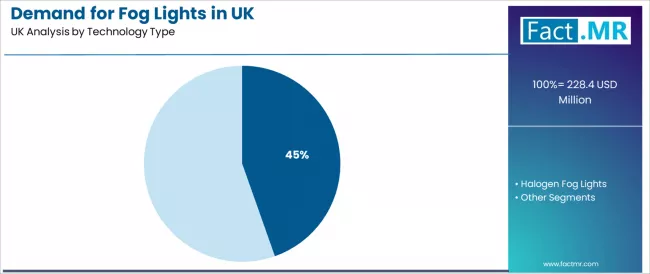
Demand For Fog Lights In Uk Analysis By Technology Type | Source: Fact.MR
LED fog lights hold the leading share in the UK due to growing consumer preference for efficiency, longevity, and improved beam consistency. A market share of 44.6% is projected for the industry in the UK in 2025. Their lower thermal output and extended service life make them a preferred option for both passenger and commercial vehicles.
Adoption has expanded notably across newer vehicle models, where manufacturers increasingly integrate LED auxiliary lighting to align with energy-efficient lighting architectures. In the aftermarket ecosystem, LED variants continue to replace older halogen systems as drivers look for components that withstand frequent nighttime driving and adverse weather. The reduced need for frequent replacements enhances overall cost efficiency over the lifetime of the vehicle.
LED fog-light penetration is also supported by electrification trends, as EV manufacturers integrate LED systems to optimise power consumption across lighting subsystems. Beyond functional benefits, the aesthetic appeal of LED-based auxiliary lighting contributes to demand from vehicle owners seeking improved styling and modernised visibility features. Retrofit kits have also improved compatibility, making LED adoption feasible even for older vehicles.
Key Findings
- LED systems account for 44.60% of total UK demand.
- High energy efficiency and long service life reinforce adoption.
- EV-aligned lighting architectures accelerate LED intake.
- Retrofit compatibility enhances uptake across older vehicles.
Why do Halogen Fog Lights Continue to Maintain a Strong Presence?
Halogen fog lights continue to hold a significant share of 36.20%, sustained by the UK’s extensive fleet of older vehicles and the affordability of halogen replacements. A large proportion of vehicles over seven years old still operate on halogen-based lighting systems, making this segment structurally important for the UK’s replacement ecosystem. The familiarity and simplicity of halogen installation reinforce stable usage among drivers prioritising low upfront cost and ease of maintenance.
Replacement intensity remains higher for halogen units due to faster filament wear and greater susceptibility to moisture, vibration, and sediment exposure, conditions often encountered across rural and semi-urban routes. Independent workshops and service centres consistently stock halogen fog lights, ensuring easy access for vehicle owners seeking routine replacements. This wide fitment compatibility supports continuous turnover despite the gradual long-term shift toward LED technologies.
Halogen fog lights also appeal to users with older wiring systems or limited tolerance for retrofit adjustments. Their straightforward alignment requirements and low installation complexity contribute to their ongoing relevance, particularly across light-commercial fleets and budget-oriented passenger vehicles.
Key Findings
- Halogen fog lights remain essential for the older UK vehicle fleet.
- Frequent filament replacement cycles sustain aftermarket demand.
- Low upfront cost ensures continuity across budget-oriented users.
- Widespread availability maintains segment stability.
Which Channel Drives the Highest Volume of Fog-Light Replacements?
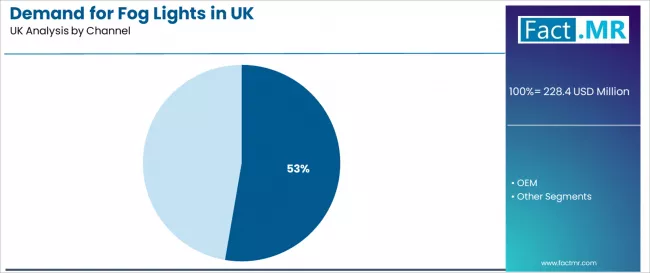
Demand For Fog Lights In Uk Analysis By Channel | Source: Fact.MR
The aftermarket replacement channel dominates the UK fog-lighting landscape with a leading share of 52.70%, reflecting the nation’s strong MOT-linked compliance culture and the high frequency of component wear associated with fog, drizzle, road debris, and seasonal visibility challenges. Drivers frequently replace fog-lighting components after MOT advisories, impact damage, or progressive beam attenuation, giving the aftermarket a structurally critical role.
The UK’s service architecture, including garages, independent workshops, regional distributors, and national service chains, maintains broad inventory coverage for both LED and halogen fog lights. This accessibility reinforces consumer reliance on the aftermarket for quick, affordable replacements. The UK's higher-than-average vehicle age compared with many Western European regions amplifies this trend, as older vehicles naturally cycle through fog-light components more often.
Fleet operators also contribute significantly to aftermarket turnover, as periodic inspections reveal fog-light wear, misalignment, or moisture ingress. These conditions prompt immediate replacement to maintain compliance and ensure safe navigation across low-visibility routes. The combination of component accessibility, widespread workshop coverage, and consistent annual turnover solidifies the aftermarket as the most influential channel in the UK fog-lighting ecosystem.
Key Findings
- Aftermarket channels drive a majority share of component replacements.
- MOT-related compliance issues frequently trigger new installations.
- The UK's older vehicle fleet sustains aftermarket visibility-component demand.
- Broad product availability supports recurring annual turnover.
What are the Drivers, Restraints and Key Trends in the UK Fog Lights Industry?
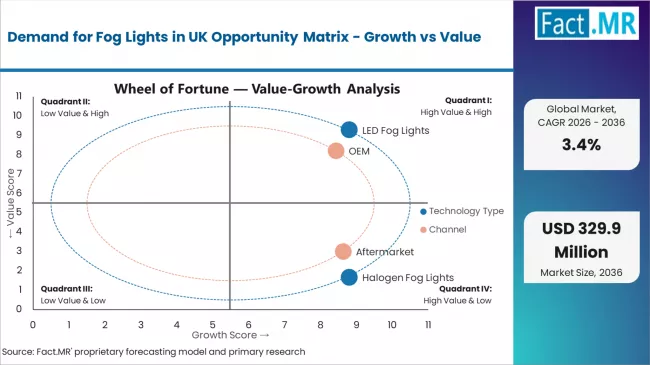
Demand For Fog Lights In Uk Opportunity Matrix Growth Vs Value | Source: Fact.MR
One of the primary drivers of fog-lighting demand in the UK is the prevalence of weather conditions that impair visibility, including fog, mist, drizzle, and prolonged winter darkness. These conditions heighten the importance of auxiliary lighting systems across vehicle categories. Additionally, increased adoption of LED technologies with lower energy consumption and longer service life further strengthens growth prospects. Improved manufacturing processes have made LED systems more accessible, enabling broader adoption across new vehicles and retrofitted older models.
Restraints include the higher upfront cost of LED fog-light systems relative to halogen alternatives, which may deter price-sensitive consumers. Compatibility issues can arise when retrofitting LED components into older vehicles that lack appropriate wiring or support housings. Moreover, variations in installation quality can affect beam alignment, potentially compromising performance or MOT compliance. These challenges create friction for seamless transition to next-generation fog-lighting options.
Key trends shaping the UK fog-lighting landscape include the rise of adaptive-lighting technologies, where fog-light beams adjust based on driving speed, steering angle, and environmental conditions. Additionally, increased interest in integrated front-lighting modules that combine fog lighting with daytime running lights (DRLs) and cornering illumination is influencing OEM design pathways. The aftermarket is witnessing growth of hybrid LED–halogen replacement kits, appealing to users seeking affordable upgrades without extensive modifications.
Analysis of the UK Fog Lights Industry by Key Countries
.webp "Top Country Growth Comparison Demand For Fog Lights In Uk Cagr (2026 2036)")
Top Country Growth Comparison Demand For Fog Lights In Uk Cagr (2026 2036) | Source: Fact.MR
| Country | CAGR (2026 to 2036) |
|---|---|
| England | 3.40% |
| Scotland | 3.20% |
| Wales | 3.10% |
| Northern Ireland | 3.00% |
Source: Fact.MR analysis. Updated Mar 26, 2026
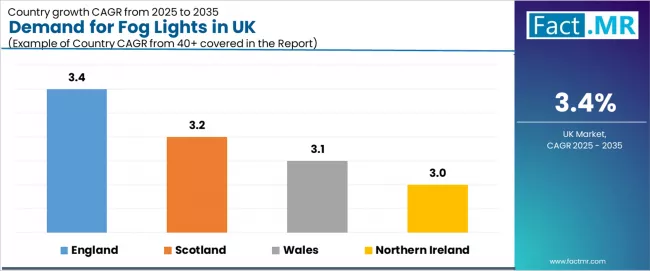
Demand For Fog Lights In Uk Cagr Analysis By Country | Source: Fact.MR
The fog-lighting landscape across the United Kingdom is shaped by distinct climatic conditions, road-network characteristics, and vehicle-usage patterns that influence auxiliary-lighting behaviour in each country. While England holds the largest share due to its extensive vehicle population and dense transportation corridors, Scotland, Wales, and Northern Ireland also contribute meaningfully through strong replacement cycles supported by fog-prone routes, rural-road exposure, and region-specific visibility challenges. These variations create a multi-layered growth structure, with each country demonstrating a trajectory aligned with its local transportation dynamics and maintenance protocols.
Regional climate plays a central role in defining fog-lighting utilisation. Scotland’s prolonged winter darkness and frequent fog episodes across highland, coastal, and valley regions raise the importance of robust visibility components. In Wales, the combination of mountainous terrain and maritime weather leads to recurrent mist conditions that heighten auxiliary-lighting dependency, particularly in narrow valley routes. Northern Ireland experiences steady fog formation across rural and coastal zones, which contributes to consistent annual replacement activity. These weather-related patterns, though varying in intensity, collectively support stable long-term demand.
Differences in vehicle age also shape replacement behaviours across countries. England’s diverse fleet composition includes a significant share of newer vehicles equipped with LED fog-lighting systems, whereas Wales and Northern Ireland retain a higher proportion of older vehicles reliant on halogen variants. Scotland displays a mixed profile, with rural regions leaning on halogen replacements while urban centres gradually adopt LED systems for improved longevity and beam consistency. These distinctions influence component turnover, technology adoption rates, and consumption structures across the UK fog-lighting ecosystem.
Why does England Lead Fog-Lighting Consumption in the UK?
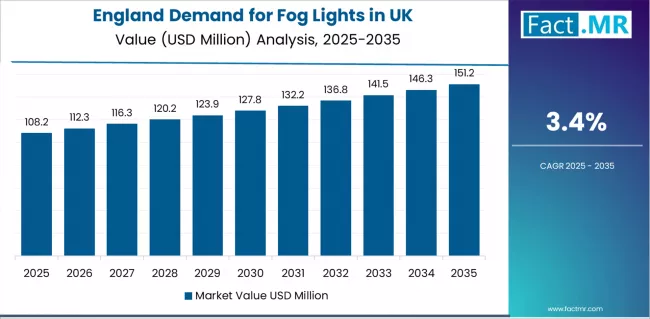
Demand For Fog Lights In Uk Country Value Analysis | Source: Fact.MR
Rising at a 3.4% CAGR, England leads fog-lighting demand due to its large vehicle population, dense commuting corridors, and recurrent weather-related visibility challenges across regions such as the Midlands, South-East, and North-West. High passenger-vehicle volumes contribute significantly to fog-lighting replacements, especially in urban and suburban areas with frequent MOT checks and routine service cycles. England’s strong automotive-service infrastructure further reinforces component availability.
Fog prevalence in morning and evening periods, particularly during late autumn and winter, supports consistent utilisation of auxiliary lighting. Weather instability across coastal areas and densely populated fog zones reinforces the importance of reliable visibility systems for daily commuters. This has contributed to rising adoption of LED fog-lighting variants that offer better beam control and reduced maintenance frequency.
Technological integration is also progressing rapidly across England, driven by the region’s higher uptake of new vehicle models and electrified vehicles that commonly feature LED auxiliary lighting as standard. As the UK transitions toward sustainable mobility pathways, England’s large EV base is expected to play a major role in shaping overall adoption patterns.
Key Findings
- England maintains the largest vehicle population in the UK.
- MOT-linked replacement cycles contribute to strong component turnover.
- Weather-induced visibility issues reinforce auxiliary-lighting reliance.
- LED adoption accelerates through growing EV penetration.
How does Scotland’s Climate Influence Fog-Light Adoption?
Scotland exhibits strong fog-lighting demand shaped by extended winter periods, long hours of darkness, and frequent fog events across the Highlands, Central Belt, and coastal regions. The country exhibits a CAGR of 3.2%. Harsh weather conditions elevate the functional importance of auxiliary lighting systems, contributing to consistent aftermarket turnover throughout the year.
Scotland’s road network includes a significant share of rural and semi-urban routes where low-visibility driving is common. Drivers often rely on fog-lighting systems for enhanced safety during early morning commutes, long-distance travel, and winter travel conditions. This contributes to sustained uptake of both LED and halogen variants depending on vehicle age and USAge patterns.
While Scotland’s vehicle population is smaller than England’s, the influence of climate severity and terrain-specific visibility requirements results in higher per-vehicle replacement intensity. Trends also indicate a gradual increase in LED adoption driven by longer component lifespan and weather-resistant design structures.
Key Findings
- Scotland’s harsh climate reinforces auxiliary-lighting dependence.
- Rural-route visibility challenges increase replacement frequency.
- High per-vehicle turnover intensity supports stable demand.
- LED adoption expands through climate-resistant design benefits.
How do Weather Patterns in Wales Affect Fog-Lighting Requirements?
Rising at a 3.1% CAGR, Wales contributes a steady share of fog-lighting demand influenced by coastal weather patterns, mountainous terrain, and recurrent mist formation across rural and valley regions. Visibility issues are especially common during early morning and late-evening travel, prompting consistent use of auxiliary lighting for safe navigation on narrow, winding roads.
Replacement cycles in Wales are predominantly driven by the ageing vehicle population, where halogen variants remain widely used across older passenger vehicles and commercial fleets. However, LED penetration is rising as vehicle owners recognise the performance advantages of energy-efficient lighting solutions suited for frequent low-visibility driving.
While Wales has a smaller base of automotive workshops than England, its service ecosystem remains robust enough to support year-round aftermarket circulation of fog-lighting components. Seasonal fluctuations in fog density contribute to cyclical increases in component replacement activity.
Key Findings
- Fog and mist conditions widely prevalent across valleys and uplands.
- Older vehicle profiles sustain halogen-based replacement cycles.
- LED adoption grows in areas with persistent visibility concerns.
- Seasonal fog variations influence aftermarket turnover patterns.
Why does Northern Ireland Maintain Consistent Fog-Light Replacement Needs?
Northern Ireland maintains consistent fog-lighting demand shaped by coastal fog activity, cross-seasonal mist conditions, and significant rural-route utilisation across counties such as Antrim, Down, and Derry. A CAGR of 3.0% is expected for the industry in Ireland. Drivers frequently encounter low-visibility zones along arterial routes, necessitating reliable fog-lighting systems for safe travel.
The aftermarket ecosystem in Northern Ireland benefits from well-distributed service centres and garages that support regular maintenance cycles. Older vehicles remain common across suburban and rural regions, reinforcing demand for halogen fog-light variants. Meanwhile, LED adoption is gradually rising as owners of newer vehicles prioritise lighting performance and durability.
Replacement activity also intensifies during winter months when daylight hours shorten and fog frequency increases. This contributes to predictable seasonal spikes, reinforcing the stable year-round demand profile for fog-lighting components across the region.
Key Findings
- Coastal and inland fog patterns contribute to steady component USAge.
- High rural-route dependence increases demand for robust visibility systems.
- Aftermarket networks ensure reliable access to replacement components.
- LED adoption gradually expands across newer vehicle models.
Competitive Landscape of the UK Fog Lights Industry
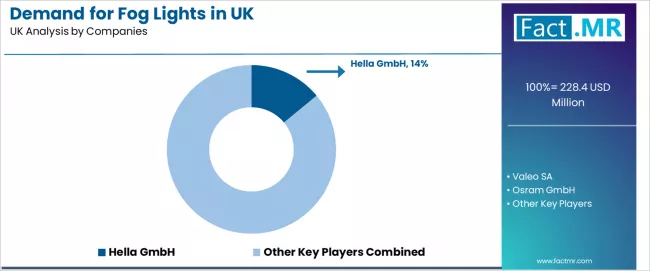
Demand For Fog Lights In Uk Analysis By Company | Source: Fact.MR
The UK's fog-lighting ecosystem is shaped by competition among established automotive-lighting manufacturers, aftermarket component suppliers, and integrated lighting-systems specialists. Companies compete based on component durability, beam quality, compatibility with multiple vehicle models, and pricing structures.
Leading companies maintain a strong presence across both OEM and aftermarket channels, offering extensive product portfolios that include LED, halogen, hybrid, and retrofit fog-lighting solutions. Integration of weather-resistant materials enhanced optical performance, and vibration-resistant structures strengthens brand positioning, particularly within the UK’s demanding weather conditions. The increasing shift toward LED variants further intensifies competition, as manufacturers diversify their product lines to address growing consumer interest in efficient and long-lasting lighting systems.
Hella GmbH, holds an estimated 14.20% share of the UK fog-lighting landscape. The company maintains strong partnerships with vehicle manufacturers and aftermarket distributors, supported by its wide array of LED and halogen auxiliary-lighting solutions. Its focus on performance consistency and compatibility supports broad installation across both new and existing vehicles.
Competition is also characterised by the presence of Japanese, Korean, and European lighting suppliers that emphasise innovation in beam precision, water-resistant casing materials, and extended service life. These companies continue investing in modular lighting technologies that integrate fog, cornering, and daytime running lights into compact assemblies, aligning with evolving vehicle design standards. As the landscape intensifies, reliability, cost efficiency, and multi-model compatibility remain the key differentiators that guide purchasing preferences across UK consumers.
UK Fog Lights Industry: Stakeholder Contribution Framework
The UK fog-lighting ecosystem supports safe mobility across urban, suburban, and rural routes by ensuring reliable visibility solutions under fog, mist, and low-light conditions. Continued advancement depends on coordinated actions across government agencies, industry bodies, lighting manufacturers, vehicle operators, service firms, engineers, and investors. Below is a country-specific contribution framework tailored to the UK environment.
How Could the UK Government Accelerate Infrastructure Modernisation and Industry Competitiveness?
- Visibility-Safety Improvement Grants: Introduce grant schemes through the Department for Transport (DfT) encouraging adoption of long-life LED fog-lighting technologies, especially for fleets operating in fog-dense regions such as the Scottish Highlands, Welsh valleys, and coastal zones.
- Incentives for Low-Energy Vehicle Lighting: Provide tax credits for installations that reduce electrical load—useful for EVs where energy efficiency directly affects range.
- Safety and Compliance Standardisation: Strengthen national beam-alignment and visibility-testing standards to reduce MOT failure rates related to misaligned auxiliary lamps.
- Fast-Track Approvals for LED Retrofits: Simplify regulatory processes allowing older vehicles to adopt certified LED fog-lighting systems without complex inspections, improving visibility across ageing fleets.
- National Fog-Safety Programmes: Support awareness campaigns on the importance of well-maintained fog-lighting systems during seasonal fog events, reducing collision risks across high-incidence regions.
How Could UK Industry Bodies Strengthen Sector Coordination and Technical Leadership?
- Unified Fitment Standards: Develop standardised guidelines for LED and halogen fog-light retrofits to ensure compatibility across diverse vehicle models and reduce installation errors.
- Skill-Development Programmes: Partner with automotive-training organisations to certify technicians in advanced LED retrofitting, diagnostic assessment, and beam-pattern optimisation.
- Collaborative R&D Networks: Encourage joint initiatives between lighting manufacturers, universities, and automotive engineering institutes to develop fog-lighting solutions tailored to UK weather conditions.
- Central Visibility-Performance Repository: Establish a national database documenting fog-light performance across climates, enabling continuous refinement of lighting standards.
How Could Lighting Manufacturers and Technology Suppliers Capture Value and Drive Innovation?
- Climate-Adaptive Lighting Designs: Develop fog-lighting systems optimised for UK-specific variables—coastal salt exposure, Scottish highland mist, and frequent drizzle in England and Wales.
- LED Reliability Enhancement: Invest in LED thermal management to ensure consistent performance during prolonged winter operation or heavy fog conditions.
- Expanded Retrofit Product Lines: Create retrofit-ready LED kits with universal harness options for older UK vehicles, improving ease of installation across garages and independent workshops.
- Digital Traceability: Implement QR-coded component verification for authenticity assurance, helping workshops identify correct replacements and avoid counterfeits.
How Could Vehicle Operators and Fleet Owners Optimise Efficiency and Safety?
- Scheduled Visibility Inspections: Establish quarterly fog-light assessments for fleets operating in high-risk areas such as Scottish motorways, Welsh rural corridors, and coastal logistics routes.
- Phased LED Transition: Gradually replace halogen fog lights in delivery vans, taxis, and commercial fleets with LED units to reduce maintenance frequency and improve beam consistency.
- Driver Awareness Programmes: Train drivers on correct fog-light USAge, ensuring proper operation during low-visibility events while preventing misuse in clear conditions.
How Could Automotive Service Firms Lead Cross-Sector Visibility Integration?
- Smart Diagnostic Integration: Equip service centres with tools that assess beam alignment, moisture ingress, and lumen output to enable efficient identification of failing fog-light components.
- Rapid Replacement Protocols: Introduce same-day replacement frameworks for fog-lighting failures detected during MOT checks, reducing downtime for vehicle owners.
- Regional Advisory Programmes: Provide visibility maintenance guidance tailored to local conditions—coastal salt intrusion, upland fog intensity, or urban pollution effects on lens clarity.
How Could Engineering and Design Firms Unlock Application Innovation?
- Modular Lighting Architectures: Develop compact modules integrating fog lights with DRLs and cornering lamps, reducing installation complexity for OEMs.
- Advanced Optical Engineering: Create beam patterns specifically calibrated for UK rural roads, where fog layering behaves differently across valley floors and coastal plains.
- Vehicle-Integrated Moisture-Barrier Solutions: Design improved sealing systems preventing moisture ingress into fog-light housings, enhancing durability under UK humidity levels.
How Could Investors and Financial Enablers Support Technology Scalability?
- Funding for LED Innovation Startups: Support UK-based lighting technology firms working on weather-adaptive optical systems, smart auxiliary lighting, and advanced LED chips.
- Capital for Retrofit Infrastructure Expansion: Enable large-scale distribution networks supplying retrofit LED fog lights to UK workshops, improving accessibility nationwide.
- Performance-Linked Financing: Offer financing incentives tied to reductions in fog-related visibility incidents for fleets adopting upgraded lighting solutions.
- Support for Domestic Manufacturing: Back investments in UK-based lighting component production to reduce dependence on imports and improve supply security.
Key Players in the UK Fog Lights Industry
- Hella GmbH
- Valeo SA
- Osram GmbH
- Stanley Electric Co. Ltd.
- Koito Manufacturing Co. Ltd.
- Philips Automotive Lighting
- Ring Automotive
- Marelli Automotive Lighting
- ZKW Group
- Bosch Automotive Components
Bibliography
- United Nations Economic Commission for Europe. (2024). UNECE Regulation No. 19: Uniform provisions concerning the approval of power-driven vehicle front fog lamps. UNECE.
- Driver and Vehicle Standards Agency. (2024). DVSA MOT inspection manual: Lighting equipment, fog lamp fitment and alignment requirements. DVSA.
- Society of Motor Manufacturers and Traders. (2024). SMMT vehicle specification data: Standard and optional lighting equipment fitment rates. SMMT.
- British Standards Institution. (2024). BS AU 148a: Motor vehicle lighting, front fog lamp specifications and photometric requirements. BSI.
- European Commission. (2024). Regulation (EU) 2024/xxx: General safety requirements for motor vehicles, updated lighting standards. EC.
- International Organization for Standardization. (2024). ISO 19458: Road vehicles, front fog lamp systems, test methods and performance requirements. ISO.
This bibliography is provided for reader reference. The full Fact.MR report contains the complete reference list with primary research documentation.
This Report Addresses
- Market sizing and forecast metrics for demand for fog lights in uk through 2036.
- Segmentation analysis across technology type, channel categories.
- Regulatory compliance assessment shaping procurement specifications.
- Competitive landscape evaluation of leading participants.
- Strategic guidance for market positioning through the forecast period.
- Supply chain risk analysis identifying sourcing constraints.
- Custom data delivery formats including dashboards, Excel, and PDF reports.
Demand for Fog Lights in UK Definition
Fog lights in the UK market are auxiliary forward-facing vehicle lighting units designed to produce a wide, low-mounted beam pattern that illuminates the road surface immediately ahead of the vehicle during fog, heavy rain, and low-visibility driving conditions. The market covers LED and halogen fog light technologies distributed through OEM vehicle manufacturing and aftermarket retail channels.
Demand for Fog Lights in UK Inclusions
The report covers LED and halogen fog light technologies. Channel segmentation spans OEM and aftermarket distribution within the UK market for 2026 to 2036.
Demand for Fog Lights in UK Exclusions
Main beam headlights, dipped beam headlights, daytime running lights, rear fog lamps, and interior vehicle lighting are excluded. Lighting control modules, wiring harnesses, and headlamp leveling motors sold separately fall outside the analytical scope.
Demand for Fog Lights in UK Research Methodology
- Primary Research: Analysts engaged with procurement directors and operations leads across the demand for fog lights in uk value chain.
- Desk Research: Regulatory filings, standards records, and corporate reports from allowed sources were aggregated.
- Market-Sizing and Forecasting: Hybrid top-down and bottom-up approach with region-specific curves projects demand through 2036.
- Data Validation and Update Cycle: Projections cross-validated against public financial guidance and industry benchmarks.
Segmentation
Scope of the Report
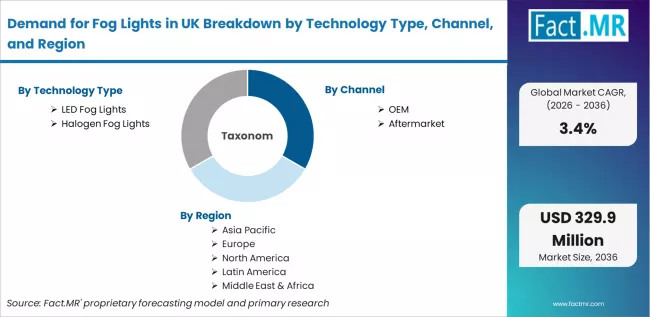
Demand For Fog Lights In Uk Breakdown By Technology Type, Channel, And Region | Source: Fact.MR
| Metric | Value |
|---|---|
| Quantitative Units | USD 236.2 million to USD 329.9 million, at a CAGR of 3.40% |
| Market Definition | Fog lights in the UK are auxiliary forward lighting units producing wide, low-mounted beam patterns for reduced-visibility driving, with demand sustained by the UK climate, LED technology migration, and vehicle production and replacement cycles. |
| Technology Type Segmentation | LED Fog Lights, Halogen Fog Lights |
| Channel Segmentation | OEM, Aftermarket |
| Key Companies Profiled | Hella GmbH, Valeo SA, Osram GmbH, Stanley Electric Co. Ltd., Koito Manufacturing Co. Ltd., Philips Automotive Lighting, Ring Automotive, Marelli Automotive Lighting, ZKW Group, Bosch Automotive Components |
| Forecast Period | 2026 to 2036 |
| Approach | Hybrid top-down and bottom-up methodology, cross-validated against primary research and public industry filings. |
Source: Fact.MR analysis. Updated Mar 26, 2026
UK Fog Lights Industry Key Segments
-
Technology Type :
- LED Fog Lights
- Halogen Fog Lights
-
Channel :
- OEM
- Aftermarket
-
Countries :
- England
- Scotland
- Wales
- Northern Ireland
Frequently Asked Questions
How large is the demand for fog lights in uk in 2026?
What will the size be by 2036?
What is the expected CAGR?
Which technology type segment leads in 2026?
What methodology does Fact.MR use?
Which companies are profiled?
Who worked on this report


Preview the report firsthand - request a free sample
Free SampleGet the brochure for pricing and purchase details
Download PDF