- Base Value(2025): 1.2 Bn
- Estimated Value(2026): 1.2 Bn
- Forecast Value (2036): 1.9 Bn
- CAGR (2026 - 2036): 4.6%
Patient Positioning System Market Analysis and Forecast by Fact.MR
- The global market for patient positioning systems is estimated at USD 1.2 billion in 2026 and is forecast to expand at a CAGR of 4.6% to reach USD 1.9 billion by 2036.
- The market covers positioning accessories (head, body, limb supports), operating table systems (electro-hydraulic, mechanical, hybrid), radiolucent positioning systems, radiation therapy positioning systems, and specialty positioning devices.
- Growth is shaped by rising surgical volumes, expanding radiation therapy treatment capacity, increasing demand for imaging-compatible positioning, and growing emphasis on patient safety and surgical ergonomics.
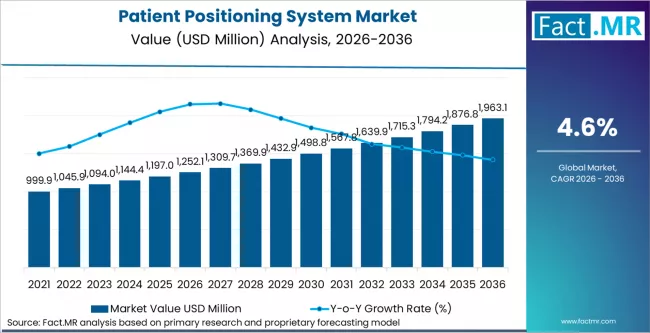
Patient Positioning System Market Market Value Analysis | Source: Fact.MR
Summary of Patient Positioning System Market
- Market Snapshot
- In 2025, the global Patient Positioning System Market was valued at approximately USD 1.2 billion.
- The market is estimated to reach USD 1.2 billion in 2026 and is projected to attain USD 1.9 billion by 2036.
- The patient positioning system market is likely to expand at a CAGR of 4.6% during the forecast period.
- The market is anticipated to create an absolute dollar opportunity of USD 0.7 billion between 2026 and 2036.
- Positioning accessories account for 28.9% of the product type share in 2026.
- India (6.9%) and Germany (6.3%) are the key growth markets during the forecast period.
- Demand and Growth Drivers
- Rising global surgical volumes across orthopedic, cardiovascular, and neurosurgical procedures are increasing demand for precision positioning systems in operating rooms.
- Growing radiation therapy treatment capacity in oncology centers is expanding procurement of immobilization and positioning devices for treatment alignment.
- Increasing demand for imaging-compatible positioning systems, including radiolucent tables and carbon fiber boards, is driven by growth in image-guided surgical and diagnostic procedures.
- Hospital emphasis on patient safety, pressure injury prevention, and surgical ergonomics is driving investment in advanced positioning accessories.
- Expansion of ambulatory surgical centers is creating procurement demand for compact, versatile operating table systems with quick-changeover positioning capabilities.
- Product and Segment View
- Positioning accessories account for 28.9% of the product type segment in 2026, driven by replacement demand and growing use of specialized head, body, and limb support systems across surgical specialties.
- Surgical procedures account for 41.6% of the application segment in 2026, with orthopedic, cardiovascular, neurosurgery, and general surgery acting as the primary demand channels.
- Hospitals account for 52.4% of the end use segment in 2026, supported by the concentration of operating room infrastructure and radiation therapy equipment in hospital settings.
- Key segmentation includes:
- Product Type: Positioning Accessories, Operating Table Systems, Radiolucent Positioning Systems, Radiation Therapy Positioning Systems, Specialty Positioning Systems
- Application: Surgical Procedures, Diagnostic Procedures, Radiation Therapy, Critical Care Positioning
- End Use: Hospitals, Ambulatory Surgical Centers, Diagnostic Imaging Centers, Cancer Treatment Centers, Academic and Research Institutes
- Technology: Electromechanical Systems, Manual Positioning Systems, Digital and Smart Positioning Systems, Radiation Therapy Immobilization Technology
- Material: Metal-Based Systems, Composite Materials, Radiolucent Materials
- Mobility: Fixed Systems, Mobile Systems
- These systems enable:
- Precise patient alignment during surgical procedures to support clinical accuracy and procedural safety.
- Radiation therapy immobilization and treatment positioning for accurate dose delivery in oncology settings.
- Imaging-compatible positioning that enables real-time diagnostic guidance during interventional procedures.
- Geography and Competitive Outlook
- North America remains a leading regional market, supported by high surgical volumes, established operating room infrastructure, and growing adoption of digital positioning technologies.
- Europe shows steady demand shaped by aging demographics, surgical volume growth, and increasing investment in radiation therapy treatment capacity.
- Asia Pacific is a growth region, with India leading through hospital expansion, rising surgical access, and growing oncology treatment infrastructure.
- India (6.9%) and Germany (6.3%) are the key growth markets, while the USA, France, and UK maintain established demand patterns.
- Key players include Stryker Corporation, Hill-Rom Holdings Inc., Getinge AB, Steris plc, Smith & Nephew plc, Mizuho OSI, C-RAD AB, and Elekta AB.
- Analyst Opinion
- Shambhu Nath Jha, Principal Consultant at Fact.MR, says 'The patient positioning system market is moving beyond basic table and accessory procurement toward integrated positioning ecosystems that connect with imaging, navigation, and treatment planning systems. Hospitals are increasingly evaluating positioning equipment on its compatibility with intraoperative imaging, its ability to reduce surgical setup time, and its impact on patient safety outcomes. Companies that offer platform-level positioning solutions with imaging integration and digital workflow compatibility will gain a structural advantage as operating room design evolves.'
Key Growth Drivers, Constraints, and Opportunities
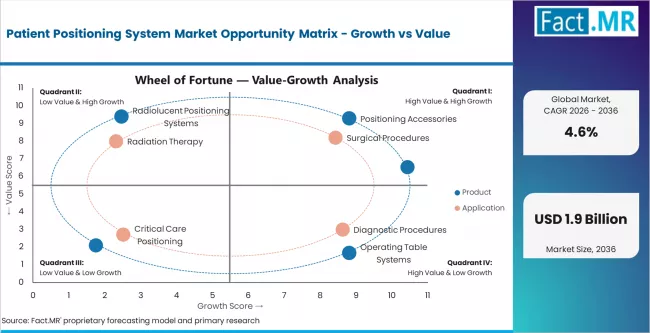
Patient Positioning System Market Opportunity Matrix Growth Vs Value | Source: Fact.MR
Key Factors Driving Growth
- Rising surgical volumes across orthopedic, cardiovascular, and neurosurgical specialties are increasing demand for precision positioning equipment in operating rooms.
- Growing radiation therapy treatment capacity in oncology centers is expanding procurement of immobilization masks, body frames, and treatment alignment systems.
- Increasing demand for imaging-compatible positioning, including radiolucent tables and carbon fiber boards, is driven by growth in image-guided surgical procedures.
Key Market Constraints
- High capital cost of advanced operating table systems and integrated positioning platforms limits procurement frequency, especially in budget-constrained hospital environments.
- Long equipment replacement cycles for operating tables reduce the frequency of new system procurement in mature markets with established installed bases.
- Limited standardization across operating room design and equipment interfaces creates integration challenges for positioning systems in multi-vendor surgical environments.
Key Opportunity Areas
- Growth in ambulatory surgical centers is creating demand for compact, versatile positioning systems that support multiple surgical specialties with quick-changeover capability.
- Advances in digital and smart positioning systems with sensor integration and programmable alignment are creating premium product tiers in hospital operating room procurement.
- Expansion of radiation therapy treatment capacity in emerging markets is driving first-time procurement of immobilization and positioning systems for oncology departments.
Segment-wise Analysis of the Patient Positioning System Market
- Positioning accessories hold 28.9% of the product type segment in 2026, supported by ongoing replacement demand and growing use of specialized positioning supports across surgical specialties.
- Surgical procedures represent 41.6% of the application segment in 2026, with orthopedic, cardiovascular, neurosurgery, and general surgery acting as the primary demand channels.
- Digital and smart positioning systems are growing faster in percentage terms, with adoption rising as hospitals invest in sensor-integrated and programmable positioning technologies.
The patient positioning system market is segmented by product type, application, end use, technology, material, mobility, and region. By product type, the market covers positioning accessories, operating table systems, radiolucent systems, radiation therapy systems, and specialty systems. By application, coverage includes surgical procedures, diagnostic procedures, radiation therapy, and critical care positioning. Positioning accessories lead by replacement frequency, while operating table systems account for the highest per-unit value across the product mix.
Which Product Type Segment Leads the Patient Positioning System Market?
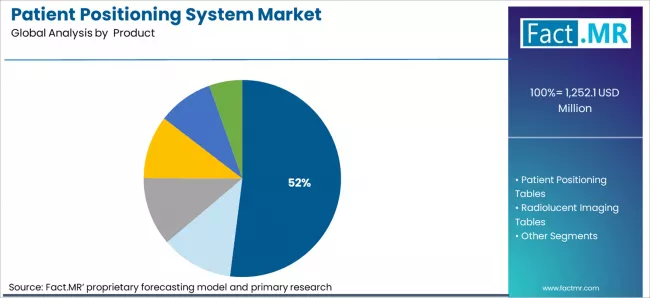
Patient Positioning System Market Analysis By Product | Source: Fact.MR
Positioning accessories are expected to account for 28.9% of the product type segment in 2026, supported by ongoing replacement cycles and growing use of specialized head, body, and limb support systems across surgical specialties. Accessories include neurosurgical headrests, lateral positioners, prone positioners, arm supports, and leg supports used across a wide range of operating room procedures.
Operating table systems follow as a significant product segment, with electro-hydraulic tables commanding the highest per-unit prices. Growth in hybrid operating tables with imaging compatibility is creating a premium tier of demand, especially in hospitals investing in integrated surgical suites for minimally invasive and image-guided procedures.
Which Application Segment Leads the Patient Positioning System Market?
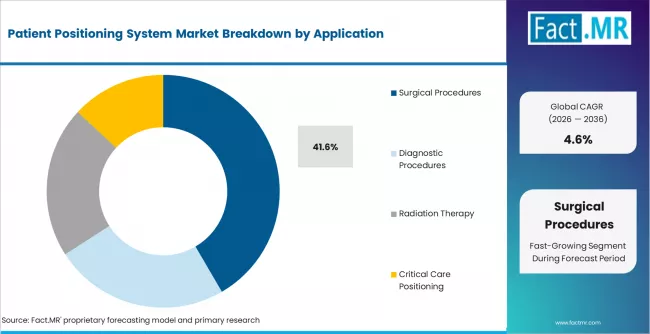
Patient Positioning System Market Analysis By Application | Source: Fact.MR
Surgical procedures are expected to account for 41.6% of the application segment in 2026. Demand is shaped by rising procedure volumes across orthopedic surgery, cardiovascular surgery, neurosurgery, and general surgery, with each specialty requiring specific positioning configurations for optimal surgical access and patient safety.
Radiation therapy is the second largest application segment, supported by growing oncology treatment capacity and increasing demand for precision immobilization during dose delivery. Image-guided radiation therapy positioning requirements are creating higher-value procurement opportunities for immobilization masks, vacuum cushions, and 3D treatment alignment systems.
Which Technology Segment Leads the Patient Positioning System Market?
Patient Positioning System Market Analysis By Technology | Source: Fact.MR
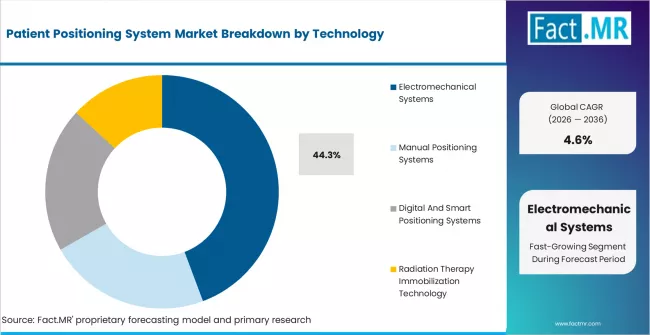
Electromechanical systems are expected to account for 44.3% of the technology segment in 2026, reflecting the dominance of motorized operating tables and hydraulic lift systems in hospital surgical suites. These systems offer precision height, tilt, and lateral adjustment capabilities required for complex surgical procedures.
Digital and smart positioning systems are the fastest-growing technology segment, with adoption rising as hospitals invest in sensor-integrated tables, programmable positioning platforms, and imaging-integrated alignment systems. Growth in this segment is driven by demand for operating room efficiency improvements and integration with surgical navigation and treatment planning workflows.
Which Product Trend is Shaping the Next Phase of Growth in the Patient Positioning System Market?
Digital and smart positioning systems are not yet the largest technology segment, but they are emerging as the fastest-growing capability in the market. Their adoption is projected to rise as hospitals invest in operating room modernization programs that integrate positioning equipment with imaging systems, surgical navigation platforms, and treatment planning software.
The shift toward smart positioning reflects a broader change in how operating rooms are designed and operated. Surgical teams are moving from manual, procedure-specific table adjustments toward programmable positioning presets that reduce setup time, improve reproducibility, and enhance integration with intraoperative imaging. As operating room efficiency becomes a greater priority for hospital administrators, positioning systems that contribute to workflow optimization are attracting higher procurement budgets.
Regional Outlook Across Key Markets
.webp "Top Country Growth Comparison Patient Positioning System Market Cagr (2026 2036)")
Top Country Growth Comparison Patient Positioning System Market Cagr (2026 2036) | Source: Fact.MR
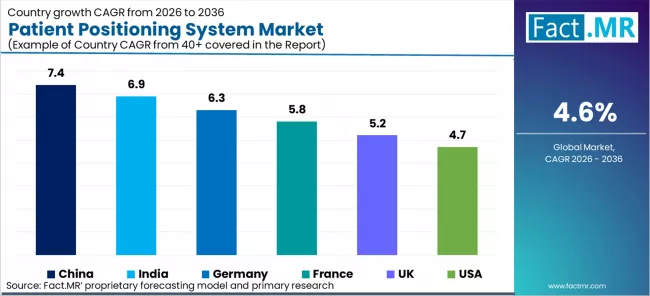
- India leads growth at 6.9%, supported by hospital expansion, rising surgical volumes, and growing oncology treatment infrastructure.
- Germany follows at 6.3%, driven by operating room modernization, radiation therapy capacity expansion, and demand for imaging-compatible positioning systems.
- France at 5.8% benefits from hospital infrastructure investment, growing surgical volumes, and increasing radiation therapy treatment capacity.
- The U.S. at 4.7% reflects steady growth driven by surgical volume increases, operating room renovation cycles, and ambulatory surgical center expansion.
CAGR Table
| Country | CAGR (%) |
|---|---|
| India | 6.9% |
| Germany | 6.3% |
| France | 5.8% |
| UK | 5.2% |
| USA | 4.7% |
Source: Fact MR (FMR) analysis, based on proprietary forecasting model and primary research.
Patient Positioning System Market Cagr Analysis By Country | Source: Fact.MR
Market Outlook for Patient Positioning Systems in the United States
Patient Positioning System Market Country Value Analysis | Source: Fact.MR
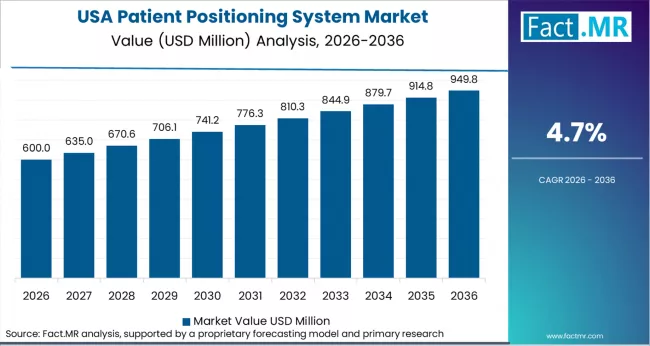
The U.S. patient positioning system market is projected to grow at a CAGR of 4.7% through 2036. Demand is shaped by high surgical volumes, operating room modernization programs, and growing ambulatory surgical center capacity.
- Operating room modernization supports premium positioning system procurement.
- Ambulatory surgical center growth creates demand for compact, versatile systems.
- Surgical volume growth sustains replacement and accessory demand.
India Patient Positioning System Market Growth Assessment
The India patient positioning system market is projected to grow at a CAGR of 6.9% through 2036, making it the fastest-growing country in the study. Growth is supported by hospital expansion, rising surgical access, and growing oncology treatment infrastructure.
- Hospital expansion drives first-time positioning equipment procurement.
- Rising surgical access increases demand across orthopedic and cardiovascular specialties.
- Oncology infrastructure development creates demand for radiation therapy positioning systems.
Patient Positioning System Demand Trends in Germany
The Germany patient positioning system market is projected to grow at a CAGR of 6.3% through 2036. Demand is supported by operating room modernization, radiation therapy capacity expansion, and growing demand for imaging-compatible positioning solutions.
- Operating room modernization drives premium system procurement.
- Radiation therapy expansion increases immobilization device demand.
- Imaging-compatible positioning is a growing procurement requirement.
France Patient Positioning System Market Demand Analysis
The France patient positioning system market is projected to grow at a CAGR of 5.8% through 2036. Demand is shaped by hospital infrastructure investment, surgical volume growth, and expanding radiation therapy treatment capacity.
- Hospital infrastructure investment supports positioning equipment procurement.
- Surgical volume growth sustains demand for operating table systems and accessories.
- Radiation therapy expansion drives immobilization system procurement.
United Kingdom Patient Positioning System Market Growth Outlook
The UK patient positioning system market is projected to grow at a CAGR of 5.2% through 2036. Demand is shaped by NHS operating room modernization, growing surgical volumes, and expanding cancer treatment capacity.
- NHS modernization supports operating room equipment upgrades.
- Growing surgical volumes sustain positioning accessory demand.
- Cancer treatment capacity expansion drives radiation therapy positioning procurement.
Competitive Benchmarking and Company Positioning
Patient Positioning System Market Analysis By Company | Source: Fact.MR
Patient Positioning System Market Analysis By Company
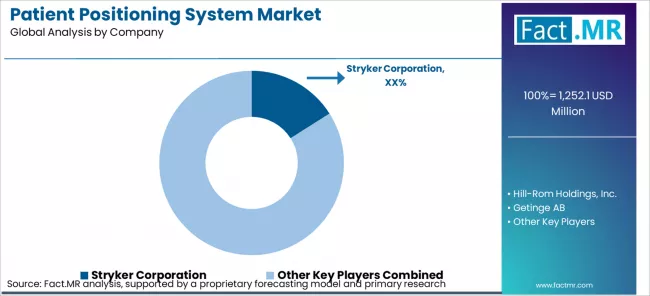
- Stryker Corporation, Hill-Rom Holdings Inc., Getinge AB, and Steris plc hold strong positions in the global patient positioning system market through broad product portfolios, established hospital procurement relationships, and operating room integration capabilities.
- Smith & Nephew plc, Mizuho OSI, and C-RAD AB compete through specialized product offerings in surgical positioning, radiation therapy immobilization, and niche clinical applications.
- Operating room integration capability and compatibility with imaging systems create important barriers to differentiation, especially for positioning platforms used in image-guided surgical environments.
The competitive landscape is moderately concentrated, with Stryker and Getinge leading in operating table systems while specialized companies like Mizuho OSI and C-RAD compete in surgical positioning accessories and radiation therapy immobilization respectively.
Strategic priorities include expanding imaging-compatible positioning portfolios, developing digital and smart positioning capabilities, strengthening ambulatory surgical center distribution, and building integrated operating room solutions that connect positioning with surgical navigation and treatment planning platforms.
Key Companies in the Patient Positioning System Market
- Stryker Corporation, Hill-Rom Holdings Inc., Getinge AB, and Steris plc are among the leading players globally, supported by comprehensive operating table portfolios and established hospital procurement networks.
- Smith & Nephew plc, Mizuho OSI, and C-RAD AB hold established positions in specialized positioning segments including surgical accessories and radiation therapy immobilization.
- Elekta AB, Medline Industries Inc., and other companies compete through focused product offerings, regional distribution strength, and niche technology capabilities in specific positioning applications.
- Recent Industry Developments
- Stryker Corporation / Digital Operating Room Investment / Smart Positioning Integration (2025)
- Stryker expanded its digital operating room ecosystem with enhanced integration between its positioning platforms and intraoperative imaging systems, targeting hospitals investing in integrated surgical suite modernization programs.
- C-RAD AB / Radiation Therapy Positioning System Update (2025)
- C-RAD AB introduced updates to its surface-guided radiation therapy positioning platform, improving alignment accuracy and workflow integration for oncology treatment centers using advanced treatment delivery systems.
- Getinge AB / Operating Table Portfolio Enhancement (2025)
- Getinge AB expanded its operating table portfolio with enhanced imaging-compatible positioning capabilities, targeting hospital procurement programs focused on hybrid operating room development.
Leading Companies Shaping the Patient Positioning System Market
- Stryker Corporation
- Hill-Rom Holdings Inc.
- Getinge AB
- Steris plc
- Smith & Nephew plc
- Mizuho OSI
- C-RAD AB
- Elekta AB
- Medline Industries Inc.
Sources and Research References
- Stryker Corporation. Operating room and positioning equipment portfolio updates.
- Getinge AB. Operating table system and surgical positioning product announcements.
- C-RAD AB. Radiation therapy positioning technology and platform updates.
- World Health Organization (WHO). Global surgical volume data and safe surgery guidelines.
- International Atomic Energy Agency (IAEA). Radiation therapy treatment capacity and equipment data.
- Primary interviews with positioning equipment manufacturers, hospital procurement teams, surgical directors, radiation therapy departments, and operating room designers.
- This bibliography is provided for reader reference and is not exhaustive. The full report contains the complete reference list and detailed citations.
Key Questions This Report Addresses
- What is the current and future size of the patient positioning system market?
- How fast is the market expected to grow between 2026 and 2036?
- Which product type is likely to lead the market by 2026?
- Which application segment is expected to account for the highest demand by 2026?
- What factors are driving demand for patient positioning systems globally?
- How is imaging compatibility influencing positioning system design?
- Why are India and Germany the fastest-growing markets?
- How is radiation therapy treatment expansion affecting positioning demand?
- Which countries are projected to show the fastest growth through 2036?
- Who are the key companies active in the patient positioning system market?
- What role do digital positioning technologies play in operating room modernization?
- How does Fact.MR estimate and validate the market forecast?
Patient Positioning System Market Definition
The patient positioning system market covers medical devices and accessories used to support, align, and immobilize patients during surgical, diagnostic, and radiation therapy procedures. It includes operating tables, positioning accessories, radiolucent systems, radiation therapy immobilization devices, and specialty systems for bariatric and pediatric applications, used across hospitals, ambulatory surgical centers, imaging centers, and cancer treatment facilities.
Patient Positioning System Market Inclusions
- The scope covers global and regional market size and forecasts for 2026 to 2036 across product type, application, end use, technology, material, mobility, and region.
- It includes regional demand analysis based on surgical volumes, radiation therapy capacity, imaging procedure growth, hospital infrastructure investment, and operating room renovation cycles.
- The report includes pricing and cost analysis across operating table systems, positioning accessories, and specialty devices, including equipment lifecycle and service costs.
- It covers technology trends, market drivers and constraints, and the competitive landscape, including product portfolios, distribution reach, and imaging integration capabilities of leading players.
Patient Positioning System Market Exclusions
- The scope excludes hospital beds, patient transport devices, and furniture not designed for surgical, diagnostic, or therapeutic positioning applications.
- It excludes surgical instruments, implants, and consumables used during procedures but not classified as positioning equipment.
- The report excludes rehabilitation and physiotherapy positioning devices used outside acute care surgical and diagnostic settings.
- It also excludes custom-built research positioning equipment not commercially available for clinical procurement.
Patient Positioning System Market Research Methodology
- The methodology combines secondary research, primary interviews, and forecast modelling.
- It draws on 110+ secondary sources and benchmarks 50+ company product portfolios.
- Market sizing covers 30+ countries through a demand-side model, supported by top-down validation.
- Key inputs include surgical procedure volumes, radiation therapy capacity data, operating room construction and renovation data, and imaging equipment installation rates.
- The model cross-checks demand with equipment shipments, pricing trends, distribution channel data, and product launch timelines.
- Primary validation includes 20+ interviews across positioning equipment manufacturers, hospital procurement teams, surgical directors, and radiation therapy departments.
- Final estimates go through equipment-flow checks, installation-pattern review, and sensitivity testing.
Scope of Analysis
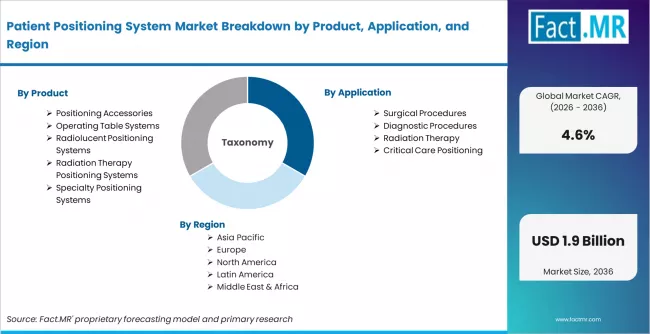
Patient Positioning System Market Breakdown By Product, Application, And Region | Source: Fact.MR
| Parameter | Details |
|---|---|
| Quantitative Units | USD 1.2 billion to USD 1.9 billion, at a CAGR of 4.6% |
| Market Definition | The patient positioning system market covers medical devices and accessories used to support, align, and immobilize patients during surgical, diagnostic, and radiation therapy procedures, including operating tables, positioning accessories, radiolucent systems, immobilization devices, and specialty systems used across hospitals, ambulatory surgical centers, imaging centers, and cancer treatment facilities. |
| Regions Covered | North America, Latin America, Europe, East Asia, South Asia and Pacific, Middle East and Africa |
| Countries Covered | India, Germany, France, UK, USA, 30 plus countries |
| Key Companies | Stryker Corporation, Hill-Rom Holdings Inc., Getinge AB, Steris plc, Smith & Nephew plc, Mizuho OSI, C-RAD AB, Elekta AB, Medline Industries Inc. |
| Forecast Period | 2026 to 2036 |
| Approach | Hybrid demand-side and top-down methodology built on country-level surgical volumes, radiation therapy capacity, imaging procedure growth, hospital infrastructure data, and primary interviews across positioning equipment manufacturers, hospital procurement teams, surgical directors, and radiation therapy specialists |
Patient Positioning System Market Segmentation
-
Patient Positioning System Market Segmented by Product:
- Positioning Accessories
- Head Positioning Systems
- Neurosurgical Headrests
- Adjustable Head Frames
- Body Positioning Systems
- Lateral Positioners
- Prone Positioners
- Limb Positioning Systems
- Arm Supports
- Leg Supports
- Head Positioning Systems
- Operating Table Systems
- Electro Hydraulic Operating Tables
- Mechanical Operating Tables
- Hybrid Operating Tables
- Imaging Compatible Operating Tables
- Radiolucent Positioning Systems
- Radiolucent Tables
- Carbon Fiber Positioning Boards
- Imaging Accessory Systems
- Radiation Therapy Positioning Systems
- Immobilization Masks
- Thermoplastic Masks
- Body Frames
- Vacuum Cushions
- Immobilization Masks
- Specialty Positioning Systems
- Bariatric Positioning Systems
- Pediatric Positioning Systems
- Positioning Accessories
-
Patient Positioning System Market Segmented by Application:
- Surgical Procedures
- Orthopedic Surgery
- Cardiovascular Surgery
- Neurosurgery
- General Surgery
- Diagnostic Procedures
- Imaging Procedures
- Cath Lab Procedures
- Radiology Positioning
- Radiation Therapy
- Oncology Treatment Positioning
- Precision Radiation Delivery
- Critical Care Positioning
- Intensive Care Units
- Trauma Care Positioning
- Surgical Procedures
-
Patient Positioning System Market Segmented by End Use:
- Hospitals
- Operating Rooms
- Imaging Departments
- Oncology Departments
- Ambulatory Surgical Centers
- Day Care Surgery Units
- Minimally Invasive Centers
- Diagnostic Imaging Centers
- Radiology Clinics
- Cath Labs
- Cancer Treatment Centers
- Radiotherapy Centers
- Oncology Hospitals
- Academic And Research Institutes
- Medical Training Centers
- Clinical Research Facilities
- Hospitals
-
Patient Positioning System Market Segmented by Technology:
- Electromechanical Systems
- Motorized Tables
- Hydraulic Lift Systems
- Manual Positioning Systems
- Mechanical Adjustment Systems
- Basic Support Systems
- Digital And Smart Positioning Systems
- Programmable Positioning Tables
- Sensor Integrated Systems
- Imaging Integrated Positioning
- Radiation Therapy Immobilization Technology
- Image Guided Positioning
- 3D Treatment Alignment Systems
- Electromechanical Systems
-
Patient Positioning System Market Segmented by Material:
- Metal Based Systems
- Stainless Steel Frames
- Aluminum Frames
- Composite Materials
- Carbon Fiber Boards
- Lightweight Polymers
- Radiolucent Materials
- Low Attenuation Materials
- Imaging Transparent Surfaces
- Metal Based Systems
-
Patient Positioning System Market Segmented by Mobility:
- Fixed Systems
- Floor Mounted Tables
- Ceiling Supported Systems
- Mobile Systems
- Wheeled Positioning Devices
- Portable Support Systems
- Fixed Systems
-
Patient Positioning System Market by Region:
- North America
- USA
- Canada
- Mexico
- Latin America
- Brazil
- Chile
- Rest of Latin America
- Western Europe
- Germany
- UK
- Italy
- Spain
- France
- Nordic
- BENELUX
- Rest of Western Europe
- Eastern Europe
- Russia
- Poland
- Hungary
- Balkan & Baltic
- Rest of Eastern Europe
- East Asia
- China
- Japan
- South Korea
- South Asia and Pacific
- India
- ASEAN
- Australia & New Zealand
- Rest of South Asia and Pacific
- Middle East & Africa
- Kingdom of Saudi Arabia
- Other GCC Countries
- Turkiye
- South Africa
- Other African Union
- Rest of Middle East & Africa
- North America