- Base Value(2025): 6.2 Bn
- Estimated Value(2026): 8.1 Bn
- Forecast Value (2036): 85 Bn
- CAGR (2026 - 2036): 26.5%
5G IoT Market Forecast 2026 to 2036
In 2025, the 5G IoT market was valued at USD 6.2 billion. Based on FMR analysis, demand for 5G IoT solutions is estimated to grow to USD 8.1 billion in 2026 and USD 85 billion by 2036. FMR projects a CAGR of 26.5% during the forecast period.
The absolute dollar growth from 2026 to 2036 is USD 76.9 billion. This significant growth is driven by the accelerating adoption of 5G technologies, which enable faster, more reliable communication for IoT devices across various industries including manufacturing, healthcare, transportation, and smart cities. The need for real-time data, automation, and connected devices is fueling the demand for 5G IoT solutions. However, challenges such as infrastructure costs, spectrum availability, and security concerns may affect growth in some regions.
As Cristiano Amon, President and Chief Executive Officer of Qualcomm Incorporated, noted regarding 5G IoT connectivity and industry adoption,
‘We are excited by the launch of the Qualcomm 315 5G IoT modem which addresses the specific needs for massive bandwidth, reliability, and purpose-built connectivity for next generation IoT applications.’
China leads with a CAGR of 30.5%, driven by its aggressive rollout of 5G infrastructure and its strong manufacturing and technology sectors. India follows with 28.0%, supported by rapid digitalization, government initiatives, and growing demand for connected devices. The UK grows at 26.5%, benefiting from strong investments in smart city projects and industrial automation. Germany grows at 25.0%, reflecting high demand in automotive and industrial sectors for IoT applications. The USA grows at 22.0%, driven by its leadership in tech innovation and smart city deployments. Japan grows at 20.0%, with steady investments in technology and IoT infrastructure. Australia shows growth at 18.5%, supported by advancements in smart cities and connected devices across industries.
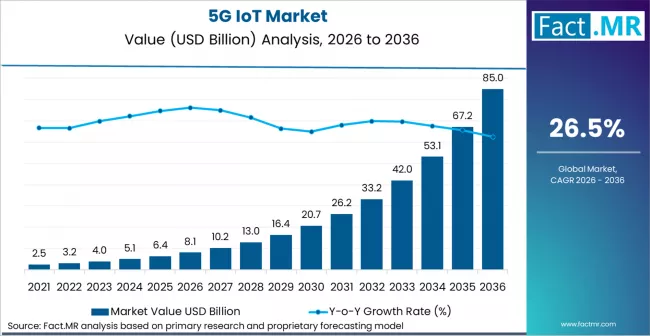
5g Iot Market Market Value Analysis | Source: Fact.MR
| Metric | Value |
|---|---|
| Estimated Value in (2026E) | USD 8.1 billion |
| Forecast Value in (2036F) | USD 85 billion |
| Forecast CAGR (2026 to 2036) | 26.5% |
Source: Fact.MR analysis. Updated Mar 3, 2026
5G IoT Market Definition
The 5G IoT Market involves the deployment and sale of Internet of Things (IoT) devices, connectivity solutions, and services that leverage 5G networks to enable high‑speed, low‑latency, and massive device‑scale connectivity across industries.
Market Inclusions
This report covers global and regional market sizes for 5G IoT over a defined forecast period, including connectivity types (cellular IoT, NB‑IoT, eMBB), application segments (smart cities, industrial automation, healthcare, transportation), and end‑use verticals.
Market Exclusions
The scope excludes non‑5G IoT technologies (such as legacy 3G/4G/LTE IoT deployments), general network infrastructure not tied to 5G IoT services, and unrelated consumer electronics without IoT connectivity.
Research Methodology
- Primary Research: Interviews were conducted with network operators, IoT solution providers, and industry analysts.
- Desk Research: Data was sourced from industry reports, telecom publications, and trade association data.
- Market‑Sizing and Forecasting: A hybrid model combining top‑down connectivity adoption forecasts with bottom‑up device and service revenue data was used.
- Data Validation and Update Cycle: Findings were validated through expert review and aligned with recent production, adoption, and revenue statistics.
Summary of the 5G IoT Market
- Market Definition
- The 5G IoT Market focuses on the integration of Internet of Things (IoT) devices and connectivity solutions with 5G networks, enabling high-speed, low-latency, and large-scale connectivity across multiple industries. The market is driven by the growing demand for IoT solutions in sectors like manufacturing, healthcare, automotive, and smart cities. Key components include hardware, platforms, connectivity, and services that support a wide range of applications and industries.
- Demand Drivers
- Enhanced Connectivity: The demand for real-time data exchange and automation in IoT applications requires the enhanced performance of 5G networks, which offer faster speeds and lower latency compared to previous technologies.
- IoT Growth: The increasing adoption of IoT devices across industries such as healthcare, manufacturing, and transportation is accelerating the demand for 5G connectivity to support seamless communication between devices.
- Government Initiatives: Governments worldwide are rolling out 5G infrastructure, which is driving the adoption of IoT in public and private sectors, particularly in smart city initiatives, industrial automation, and healthcare.
- Key Segments Analyzed
- Network Type: 5G Standalone (SA) is projected to dominate the market, accounting for 60.3% of the market share by 2026. It provides a dedicated end-to-end 5G network without relying on 4G infrastructure, offering ultra-low latency and high reliability.
- Component: Hardware is expected to represent 46.7% of the market by 2026, driven by the need for 5G-enabled IoT devices, edge computing hardware, and networking infrastructure.
- Geography: China, India, and the USA are leading the 5G IoT market, with China showing the highest growth at a 30.5% CAGR.
- Analyst Opinion at Fact MR
- Shambhu Nath Jha, Principal Consultant at Fact MR, emphasized the potential for 5G IoT technologies, stating, "The adoption of 5G IoT is expected to revolutionize industries by providing faster, more reliable connectivity and enabling the next generation of smart applications."
- Strategic Implications/Executive Takeaways
- Focus on Innovation: Companies must invest in 5G infrastructure and IoT device technologies to stay competitive and support the demand for real-time, connected solutions.
- Geographical Focus: Expansion in high-growth markets like China and India, where government support for digitalization and IoT adoption is accelerating, offers strong growth opportunities.
- IoT Integration: Organizations should focus on developing and deploying IoT solutions that leverage 5G networks, particularly in smart cities, industrial automation, and connected healthcare applications.
- Methodology
- Primary research was conducted with network operators, IoT solution providers, and industry analysts.
- Desk research sourced from industry reports, telecom publications, and trade association data.
- Market sizing and forecasting used top-down connectivity adoption projections and bottom-up device and service revenue data.
Segmental Analysis
5G IoT Market Analysis by Network Type
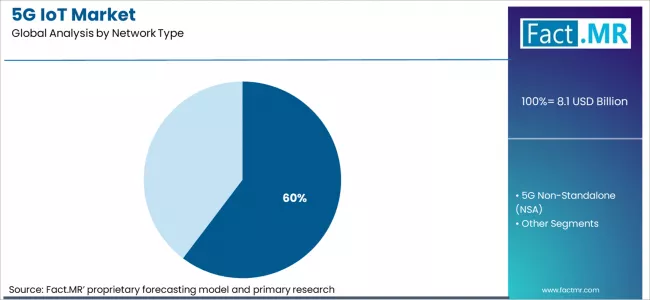
5g Iot Market Analysis By Network Type | Source: Fact.MR
- Market Overview: 5G Standalone (SA) is projected to capture 60.3% of the 5G IoT market by 2026. 5G SA provides the full potential of 5G technology, offering dedicated, end-to-end 5G networks without relying on existing 4G infrastructure. This makes it ideal for enabling advanced IoT applications that require ultra-low latency, high reliability, and higher data throughput.
- Demand Drivers:
- Ultra-Low Latency and High Speed: 5G SA networks provide significantly lower latency and faster data speeds compared to non-standalone networks, making them crucial for time-sensitive and data-intensive IoT applications such as autonomous vehicles, smart cities, and industrial automation.
- Enabling Advanced IoT Applications: 5G SA is better suited for applications requiring massive connectivity, such as smart manufacturing, smart grids, and healthcare monitoring, as it can support a larger number of devices with consistent performance and reliability.
- End-to-End 5G Connectivity: Unlike 5G NSA, which relies on 4G infrastructure for certain operations, 5G SA offers a fully integrated 5G network, providing more efficient and consistent performance for IoT solutions, especially in industries that rely heavily on continuous and real-time data.
5G IoT Market Analysis by Component
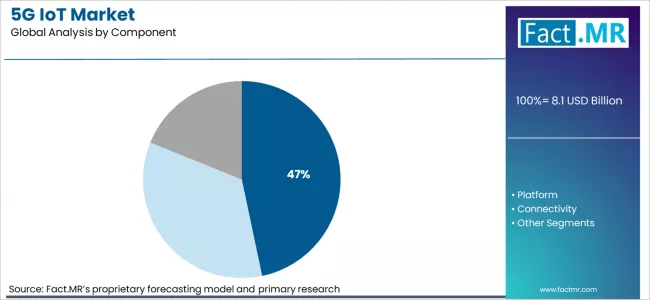
5g Iot Market Analysis By Component | Source: Fact.MR
- Market Overview: Hardware is expected to account for 46.7% of the market share by 2026. Hardware components, such as IoT sensors, 5G-enabled devices, edge computing hardware, and other networking infrastructure, are essential for enabling the deployment of 5G IoT solutions.
- Demand Drivers:
- Expansion of 5G Infrastructure: As 5G networks are deployed globally, the demand for hardware components such as 5G antennas, routers, and IoT sensors increases. These hardware elements are necessary to connect IoT devices to the 5G network and enable the full capabilities of 5G IoT.
- Growth in IoT Device Adoption: The increasing number of IoT devices, including wearables, sensors, and smart home products, is driving the demand for specialized hardware components. These devices require high-performance connectivity and hardware that can support the high speeds and low latency of 5G networks.
- Edge Computing and Data Processing: With the rise of edge computing, which allows for processing data closer to the source, the need for high-performance hardware to manage IoT data locally is growing. This is crucial in industries like manufacturing, where real-time data analysis is critical.
5G IoT Market Drivers, Restraints, and Opportunities
FMR analysts observe that the 5G IoT market is a growth‑aligned, connectivity‑driven segment shaped by broader adoption of high‑speed mobile networks and the increasing need for real‑time, low‑latency data exchange across connected devices. Historically, 3G/4G technologies supported basic IoT deployments; as 5G infrastructure scales globally, structural demand has emerged for enhanced IoT applications in smart manufacturing, autonomous systems, healthcare monitoring, and smart cities that require ultra‑reliable, massive device connectivity. The 2026 valuation reflects this transition, with 5G IoT becoming foundational to next‑generation digital ecosystems rather than a niche connectivity option.
While legacy LPWAN and 4G LTE IoT solutions remain relevant in cost‑sensitive uses, 5G‑enabled IoT deployments are gaining share where higher performance-lower latency, greater bandwidth, and network slicing-is essential. These advanced implementations often carry higher integration and service costs, contributing to net market value growth even as device volumes scale with digital transformation strategies. The market exists at its current size because enterprises and governments increasingly prioritize connected, data‑driven operations that 5G uniquely enables.
- High‑Performance Connectivity Demand: Industries adopt 5G IoT for real‑time automation, remote monitoring, and latency‑sensitive applications that less capable networks cannot support.
- Standards & Spectrum Regulation: 5G NR standards and national spectrum allocation policies push carriers and enterprises to deploy 5G infrastructure that enables advanced IoT use cases.
- Regional Deployment Dynamics: In Asia‑Pacific and North America, rapid 5G rollout and strong industrial digitalization drive higher 5G IoT uptake compared with regions where network investment is earlier‑stage.
Regional Analysis
The market analysis covers key global regions, including East Asia, South Asia, Western Europe, North America, and Australia. It is segmented geographically, with specific market dynamics for each region. The full report provides a detailed market attractiveness analysis.
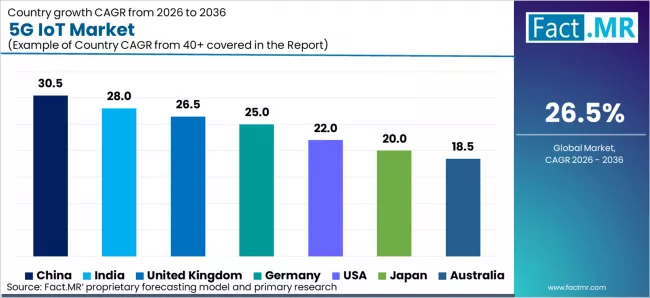
5g Iot Market Cagr Analysis By Country | Source: Fact.MR
| Country | CAGR (2026-2036) |
|---|---|
| China | 30.5% |
| India | 28.0% |
| United Kingdom | 26.5% |
| Germany | 25.0% |
| USA | 22.0% |
| Japan | 20.0% |
| Australia | 18.5% |
Source: Fact.MR analysis. Updated Mar 3, 2026
Source: Fact MR (FMR) analysis, based on proprietary forecasting model and primary research.
East Asia
In East Asia, China is the leading market for 5G IoT, driven by the country’s rapid 5G rollout, government support for smart city initiatives, and growing demand for IoT devices across various sectors such as healthcare, automotive, and manufacturing.
- China: Demand for 5G IoT in China is projected to rise at 30.5% CAGR through 2036. China’s large-scale 5G deployment, focus on smart city development, and increased industrial IoT adoption continue to propel market growth.
- Japan: Demand for 5G IoT in Japan is projected to rise at 20.0% CAGR through 2036. Japan’s high-tech industries, strong government support for 5G innovation, and growing IoT applications across manufacturing and healthcare contribute to steady growth in the market.
South Asia
In South Asia, India leads the demand for 5G IoT, supported by the country’s ambitious 5G deployment plans, increasing investments in smart infrastructure, and rising adoption of IoT devices across industrial and consumer applications.
- India: Demand for 5G IoT in India is projected to rise at 28.0% CAGR through 2036. India’s growing digital transformation, government initiatives for smart cities, and rising adoption of IoT in sectors like agriculture, healthcare, and transportation continue to drive robust market growth.
Western Europe
In Western Europe, the United Kingdom and Germany are prominent markets for 5G IoT, fueled by investments in smart infrastructure, high adoption of IoT in automotive and manufacturing, and government policies supporting digital transformation.
- United Kingdom: Demand for 5G IoT in the UK is projected to rise at 26.5% CAGR through 2036. The UK’s strong digital infrastructure, government commitment to 5G rollout, and growing adoption of smart IoT solutions in automotive and healthcare contribute to strong market growth.
- Germany: Demand for 5G IoT in Germany is projected to rise at 25.0% CAGR through 2036. Germany’s focus on Industry 4.0, high adoption of IoT in manufacturing, and advancements in IoT solutions for smart cities continue to drive demand for 5G IoT technologies.
North America
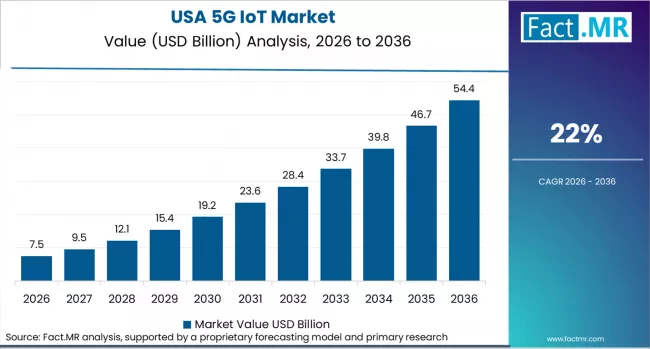
5g Iot Market Country Value Analysis | Source: Fact.MR
In North America, the USA is a leading market for 5G IoT, driven by high investments in smart infrastructure, automotive innovations, and the rising use of IoT devices across various industries including healthcare, agriculture, and logistics.
- USA: Demand for 5G IoT in the U.S. is projected to rise at 22.0% CAGR through 2036. The USA’s rapid 5G deployment, high demand for industrial IoT applications, and increased use of connected devices continue to fuel market growth.
Australia
In Australia, the demand for 5G IoT is supported by government initiatives, increasing demand for smart city solutions, and the growing adoption of IoT in agriculture, mining, and healthcare.
- Australia: Demand for 5G IoT in Australia is projected to rise at 18.5% CAGR through 2036. Australia’s expanding IoT ecosystem, government push for smart city developments, and use of IoT in resource-rich industries contribute to market growth.
Fact MR's analysis of the 5G IoT Market in East Asia, South Asia, Western Europe, North America, and Australia consists of country-wise assessments that include China, India, the United Kingdom, Germany, the USA, Japan, and Australia. Readers can find detailed trends, regulatory updates, and company-specific investments shaping the market’s growth in these countries.
How Are Key Players Competing in the 5G IoT Market?
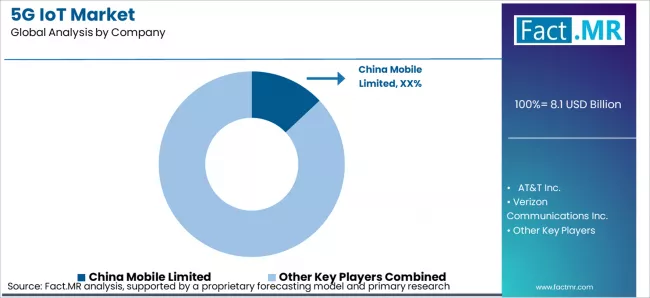
5g Iot Market Analysis By Company | Source: Fact.MR
The 5G IoT Market is witnessing intense competition, with China Mobile, AT&T, and Verizon leading the telecommunications sector by providing extensive 5G connectivity for IoT applications. These players focus on offering robust infrastructure, ensuring wide coverage, and enhancing network speeds to support IoT devices across industries. Companies like T-Mobile, Vodafone, and Orange are expanding 5G IoT services globally, targeting both consumer and enterprise markets. Ericsson, Huawei, and Nokia are dominating the equipment and technology space, supplying critical infrastructure and 5G components for IoT ecosystems. Tech giants such as Qualcomm, Intel, and Cisco focus on innovation in semiconductor and network technologies to enhance 5G connectivity and edge computing capabilities. Microsoft, Amazon Web Services, and Google are positioning themselves in the cloud and data management segment, offering advanced analytics and AI for IoT. Meanwhile, companies like Sierra Wireless and Telit Communications specialize in IoT modules and connectivity solutions, driving the adoption of 5G-enabled devices across industries.
Recent Industry Developments
- T-Mobile 5G-Advanced and Dynamic Slicing
- In early 2026, T-Mobile announced plans to launch "at least half a dozen" new 5G-Advanced features. This includes the rollout of dynamic network slicing, allowing enterprise customers to create custom, end-to-end virtual network slices "with just a credit card." The service targets high-demand IoT applications such as 5G smartwatches and location trackers using RedCap technology.
- Qualcomm Dragonwing™ Q-Series Launch
- At CES 2026, Qualcomm unveiled its expanded Industrial and Embedded IoT (IE-IoT) portfolio, centered on the new Dragonwing Q-series processors. The flagship Q-8750 delivers 77 TOPS of AI performance and supports on-device Large Language Models (LLMs) with up to 11 billion parameters, enabling autonomous drones and vision systems to process complex data without cloud dependency.
- Quectel 5G-Advanced Automotive Module
- In January 2026, Quectel launched the AR588MA, the world's first 5G-Advanced automotive-grade cellular module. Compliant with 3GPP Release 18, the module integrates Non-Terrestrial Network (NTN) satellite connectivity and Dual SIM Dual Active (DSDA) technology, ensuring that connected vehicles maintain a "never-offline" status for safety-critical automated driving systems.
Key Players of the 5G IoT Market
- China Mobile Limited
- AT&T Inc.
- Verizon Communications Inc.
- T-Mobile US, Inc.
- Vodafone Group Plc
- Orange S.A.
- Telefónica, S.A.
- Deutsche Telekom AG
- Ericsson AB
- Huawei Technologies Co., Ltd.
- Nokia Corporation
- Samsung Electronics Co., Ltd.
- Qualcomm Technologies, Inc.
- Intel Corporation
- Cisco Systems, Inc.
- Microsoft Corporation
- Amazon Web Services, Inc.
- Google LLC
- Sierra Wireless, Inc.
- Telit Communications plc
Report Scope
| Metric | Value |
|---|---|
| Quantitative Units | USD 8.1 billion (2026) to USD 85 billion (2036), at a CAGR of 26.5% |
| Market Definition | The 5G IoT Market includes the use of 5G technology in Internet of Things applications, enabling improved connectivity and data transfer speeds across various industries. |
| By Component | Hardware, Platform, Connectivity, Services |
| By Network Type | 5G Standalone (SA), 5G Non-Standalone (NSA) |
| By End-User | Manufacturing, Healthcare, Energy and Utilities, Automotive and Transportation, Supply Chain and Logistics, Government and Public Safety, Agriculture, Others (Retail, Mining, etc.) |
| Regions Covered | North America, Latin America, Europe, East Asia, South Asia, Oceania, Middle East and Africa |
| Countries Covered | United States, Canada, Mexico, Brazil, Argentina, Germany, France, United Kingdom, Italy, Spain, China, India, Japan, South Korea, Indonesia, Australia, and 40+ countries |
| Key Companies Profiled | China Mobile Limited, AT&T Inc., Verizon Communications Inc., T-Mobile US, Inc., Vodafone Group Plc, Orange S.A., Telefónica, S.A., Deutsche Telekom AG, Ericsson AB, Huawei Technologies Co., Ltd., Nokia Corporation, Samsung Electronics Co., Ltd., Qualcomm Technologies, Inc., Intel Corporation, Cisco Systems, Inc., Microsoft Corporation, Amazon Web Services, Inc., Google LLC, Sierra Wireless, Inc., Telit Communications plc |
| Forecast Period | 2026 to 2036 |
| Approach | Hybrid top-down and bottom-up market modeling validated through primary interviews with manufacturers and supported by trade data benchmarking and market research. |
Source: Fact.MR analysis. Updated Mar 3, 2026
Bibliographies
- AT&T Inc. (2025). 5G connectivity and IoT services for industrial, healthcare, and smart city applications. AT&T Inc.
- China Mobile Limited. (2025). 5G infrastructure and IoT solutions supporting large-scale device connectivity. China Mobile Limited.
- Qualcomm Technologies, Inc. (2025). 5G IoT chipsets, modems, and edge computing solutions. Qualcomm Technologies, Inc.
- Telefonaktiebolaget LM Ericsson. (2025). 5G network infrastructure and IoT enablement platforms for enterprise applications. Telefonaktiebolaget LM Ericsson.
- Verizon Communications Inc. (2025). 5G IoT connectivity solutions for real-time and mission-critical applications. Verizon Communications Inc.
- Fierce Network. (2025/2026, December). T-Mobile outlines 2026 5G-Advanced deployment and dynamic network slicing strategy [Industry report]. Fierce Network.
- IoT Business News. (2026, January). Quectel launches AR588MA 5G-Advanced automotive-grade IoT module [Industry coverage]. IoT Business News.
- Qualcomm. (2026, January). Qualcomm introduces Dragonwing™ Q-Series platform for industrial and edge AI IoT expansion [Press release]. Qualcomm.
This report addresses
- Market Intelligence enabling comprehensive assessment of leading countries and service segments across the 5G IoT Market globally.
- Market Volume (Sales Units) estimates and 10-year revenue forecasts from 2026 to 2036, validated through connectivity type adoption data, end-use industry modeling, and regional demand analysis.
- Growth Opportunity Mapping across network types (5G Standalone, Non-Standalone), components (hardware, platform, connectivity), and regions.
- Segment and Regional Revenue Forecasts by network type, component, end user, and geography across 40+ countries.
- Competition Strategy Analysis covering telecom operator capabilities, technology partnerships, service portfolios, and market share analysis.
- Product and Regulatory Compliance Tracking aligned with global 5G standards, IoT service certification, and spectrum regulations.
- Regulatory Impact Analysis addressing global compliance, 5G standards, and government policies for enabling widespread 5G IoT deployments.
- Report Delivery in PDF, Excel, PowerPoint, and interactive dashboard formats for executive, procurement, and operational planning use.
Segmentation
5G IoT Market Key Segments
-
Component
- Hardware
- 5G Modules
- Sensors
- Gateways
- Edge Devices
- Base Stations (Small Cells)
- Platform
- Device Management
- Connectivity Management
- Application Enablement
- Connectivity
- Public 5G Networks
- Private 5G Networks
- Services
- Professional Services (Consulting, Integration)
- Managed Services
- Hardware
-
Network Type
- 5G Standalone (SA)
- Network Slicing
- Ultra-Reliable Low-Latency Communication (URLLC)
- Massive Machine-Type Communication (mMTC)
- 5G Non-Standalone (NSA)
- 5G Standalone (SA)
-
End User
- Manufacturing
- Factory Automation
- Predictive Maintenance
- Collaborative Robotics
- Quality Control
- Healthcare
- Remote Patient Monitoring
- Telemedicine
- Ambulance Connectivity
- Asset Tracking
- Energy and Utilities
- Smart Grid
- Remote Monitoring
- Predictive Maintenance
- Automotive and Transportation
- Connected Vehicles
- Autonomous Driving
- Fleet Management
- Traffic Management
- Supply Chain and Logistics
- Warehouse Automation
- Asset Tracking
- Fleet Optimization
- Government and Public Safety
- Smart Cities
- Public Safety Networks
- Infrastructure Monitoring
- Agriculture
- Precision Agriculture
- Livestock Monitoring
- Equipment Automation
- Others (Retail, Mining, etc.)
- Manufacturing
-
Region
- North America
- United States
- Canada
- Mexico
- Latin America
- Brazil
- Argentina
- Chile
- Colombia
- Rest of Latin America
- Europe
- Germany
- United Kingdom
- France
- Italy
- Spain
- Russia
- Nordic
- Benelux
- Rest of Europe
- East Asia
- China
- Japan
- South Korea
- South Asia & Pacific
- India
- Indonesia
- Thailand
- Vietnam
- Malaysia
- Australia
- New Zealand
- Rest of South Asia & Pacific
- Middle East & Africa
- Saudi Arabia
- UAE
- South Africa
- Rest of Middle East & Africa
- North America
Frequently Asked Questions
How large is the demand for 5G IoT in the global market in 2026?
What will be the market size of 5G IoT in the global market by 2036?
What is the expected demand growth for 5G IoT in the global market between 2026 and 2036?
Which network type is expected to dominate the market?
Which region is expected to show the highest growth rate for 5G IoT?
How significant is the growth outlook for India in this market?
What is the growth outlook for the United Kingdom in the 5G IoT market?
What is the growth forecast for Germany in the 5G IoT market?
What is the growth forecast for the United States in the 5G IoT market?
What is the growth forecast for Japan in the 5G IoT market?
What is the growth forecast for Australia in the 5G IoT market?
Which company is identified as a leading player in the 5G IoT market?
What is 5G IoT used for?
What does the 5G IoT market include in this report?
How is the market forecast developed in this report?
What is meant by the 5G IoT market in this report?
Who worked on this report


Preview the report firsthand - request a free sample
Free SampleGet the brochure for pricing and purchase details
Download PDF