- Base Value(2025): 503 Bn
- Estimated Value(2026): 663.5 Bn
- Forecast Value (2036): 8029 Bn
- CAGR (2026 - 2036): 31.9%
5G in Defense Market Forecast 2026 to 2036
In 2025, the 5G in defense market was valued at USD 503 billion. Based on Fact MR's analysis, demand for 5G technologies in defense is estimated to grow to USD 663.5 billion in 2026 and USD 8,029 billion by 2036. FMR projects a CAGR of 31.9% during the forecast period.
The absolute dollar growth from 2026 to 2036 is USD 7,365.5 billion. This rapid growth is driven by the increasing adoption of 5G technology to enhance military communications, real-time data processing, and the development of autonomous systems, drones, and smart defense technologies. The speed, reliability, and low latency of 5G are critical for defense operations, including command and control, surveillance, and intelligence. However, challenges such as security concerns, infrastructure investments, and geopolitical factors may impact growth in some regions.
As Christopher Ling, Chief Executive Officer of Ericsson Federal Technologies Group, noted regarding 5G’s role in modern defense, ‘As the DoD looks to connect under one secure, unified communication system, I believe 5G is the solution to keep America secure and competitive.’
India leads with a CAGR of 22.1%, driven by its expanding defense modernization efforts and increasing investments in communication technologies. China follows with a 20.4% CAGR, supported by its significant defense initiatives and technological advancements in military communication systems. The USA grows at 18.6%, reflecting strong demand for 5G in enhancing military capabilities and defense infrastructure. Brazil shows growth at 17.2%, fueled by increasing defense investments. The UK grows at 16.4%, benefiting from initiatives to modernize defense communication systems. Germany grows at 15.8%, reflecting its efforts to integrate 5G technology into defense applications.
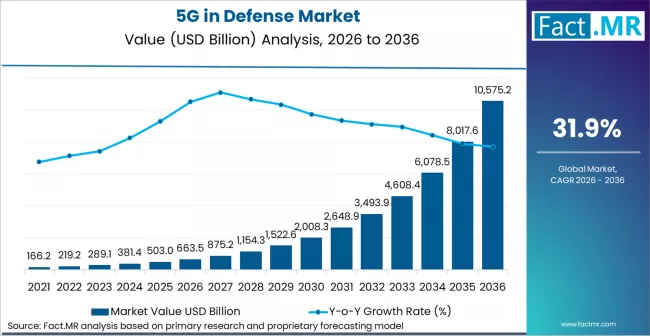
5g In Defense Market Market Value Analysis | Source: Fact.MR
| Metric | Value |
|---|---|
| Estimated Value in (2026E) | USD 663.5 billion |
| Forecast Value in (2036F) | USD 8,029 billion |
| Forecast CAGR (2026 to 2036) | 31.9% |
Source: Fact.MR analysis. Updated Mar 3, 2026
5G in Defense Market Definition
The 5G in Defense Market involves the deployment and sale of fifth‑generation wireless technologies and related infrastructure tailored to military and defense applications to enable secure, high‑speed, low‑latency communications and data exchange.
Market Inclusions
This report covers global and regional market sizes for 5G in defense over a defined forecast period, including technology segments (network equipment, spectrum solutions, edge computing), application areas (command and control, autonomous systems, ISR, logistics), and deployment models.
Market Exclusions
The scope excludes commercial 5G deployments outside defense use, general IT infrastructure not tied to 5G capability, and unrelated communication systems (legacy radios, non‑5G satellite links).
Research Methodology
- Primary Research: Interviews were conducted with defense communications engineers, 5G technology providers, and military planners.
- Desk Research: Data was sourced from defense reports, telecom industry analyses, and standards publications.
- Market‑Sizing and Forecasting: A hybrid model combining top‑down defense tech investment forecasts with bottom‑up deployment and revenue data was used.
- Data Validation and Update Cycle: Findings were validated through expert review and aligned with recent adoption, procurement, and deployment data.
Summary of the 5G in Defense Market
- Market Definition
- The 5G in Defense Market encompasses the deployment and integration of 5G wireless technologies tailored for defense and military applications. This includes infrastructure like small cells, radio access networks (RAN), and core network technologies such as SDN, fog computing, and mobile edge computing. 5G technologies are critical in enhancing military communication systems, supporting real-time data processing, autonomous systems, drones, and smart defense technologies.
- Demand Drivers
- Military Modernization: 5G enables enhanced communication, faster data transfer, and more reliable network operations, vital for modern defense forces.
- Security and Speed: The low latency and high-speed capabilities of 5G are essential for mission-critical operations such as surveillance, command and control, and intelligence gathering.
- Increased Adoption of Autonomous Systems: Drones and other unmanned systems, which require real-time connectivity, are a significant driver for 5G integration.
- Regulatory Mandates: Many countries are moving towards adopting 5G for defense systems to enhance operational security and situational awareness.
- Key Segments Analyzed
- Communication Infrastructure: Small cells, which are compact, low-powered cellular nodes, are expected to capture 47.6% of the market share by 2026.
- Core Network Technology: Software-defined networking (SDN) is projected to hold 33.4% of the market share, offering flexibility, scalability, and enhanced control over defense networks.
- Geography: China, India, and the USA are expected to lead the market, with projected growth rates of 20.4%, 22.1%, and 18.6%, respectively.
- Strategic Implications/Executive Takeaways
- Government and Military Focus: Defense organizations should prioritize 5G for enhancing network security, increasing operational flexibility, and enabling faster, more resilient communication.
- Investment in 5G Integration: Invest in SDN, fog computing, and small cell technologies to ensure secure, flexible communication networks.
- Global Expansion: As emerging markets like India and China ramp up defense modernization, global players should expand their presence to capture rising demand.
- Methodology
- Primary research conducted via interviews with defense engineers, military planners, and 5G technology providers.
- Desk research from defense publications and telecom industry sources.
- Market sizing using a hybrid model that integrates top-down industry forecasts with bottom-up technology deployment data.
Segmental Analysis
5G in Defense Market Analysis by Communication Infrastructure
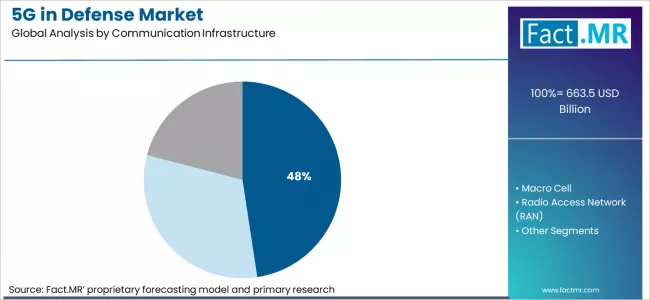
5g In Defense Market Analysis By Communication Infrastructure | Source: Fact.MR
- Market Overview: Small cell technology is expected to capture 47.6% of the 5G in defense market by 2026. Small cells, which are compact, low-powered cellular nodes, are ideal for providing coverage in areas where macro cells are impractical, such as in military bases, camps, and remote defense installations.
- Demand Drivers:
- Enhanced Coverage in Remote Locations: Small cells are ideal for military and defense applications because they can be deployed in remote and temporary locations, providing robust 5G connectivity in areas where traditional infrastructure may not be feasible.
- Higher Capacity and Lower Latency: Small cells allow for more targeted coverage, which means more efficient use of spectrum and reduced latency. This is crucial for defense applications that require rapid, real-time communication and data transfer.
- Flexibility and Mobility: In defense settings, the ability to quickly deploy and reposition small cells offers flexibility and mobility for military operations. This makes them a preferred solution for dynamic environments where communication infrastructure needs to be rapidly set up and adjusted.
5G in Defense Market Analysis by Core Network Technology
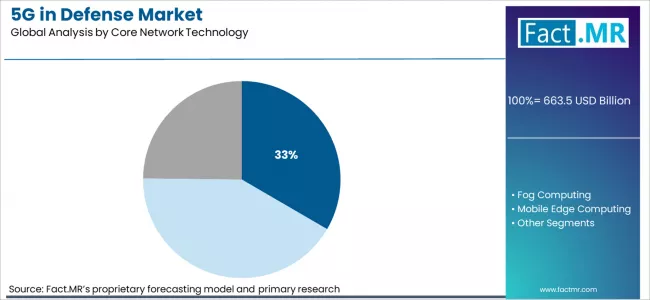
5g In Defense Market Analysis By Core Network Technology | Source: Fact.MR
- Market Overview: Software-Defined Networking (SDN) is projected to hold 33.4% of the market share by 2026. SDN technology allows for greater flexibility, scalability, and control over network resources, which is essential for defense applications that require dynamic, secure, and efficient communication networks.
- Demand Drivers:
- Enhanced Network Flexibility and Control: SDN offers centralized control over network traffic and resource allocation, which is crucial for defense networks that require quick reconfiguration in response to changing operational needs. This flexibility is a significant driver for SDN adoption in military settings.
- Improved Security and Management: SDN helps enhance security by allowing for the centralized monitoring of network traffic and the ability to quickly implement security measures across the entire network. This is crucial for defense applications where secure, encrypted communication is paramount.
- Integration with 5G Networks: As 5G technology rolls out, SDN can efficiently manage the increased complexity and demands of next-generation networks. This integration is vital for defense operations, where high-speed, low-latency communication is required for tasks such as surveillance, real-time data sharing, and tactical communications.
5G in Defense Market Drivers, Restraints, and Opportunities
FMR analysts observe that the 5G in defense market is a growth‑aligned, capability‑expansion segment driven by the need for faster, more resilient, and network‑centric operations across military communications, situational awareness, and autonomous systems. Historically, defense networks relied on legacy tactical radios and point‑to‑point links; as modern battlefields emphasize data‑intensive applications, real‑time sensor fusion, and distributed command and control, structural demand has emerged for 5G capabilities that support low‑latency connectivity and secure data transfer. The 2026 valuation reflects this shift, with defense adoption tied to modernization strategies and integration of 5G into secure communications and mission‑critical systems rather than simple mobile connectivity.
While traditional military communication systems remain essential for baseline operations, 5G‑enabled solutions, such as private networks, edge computing, and interoperable platforms, are gaining share in advanced defense programs. These high‑performance solutions carry higher implementation costs, contributing to net market value growth even as unit deployments scale with phased modernization cycles. The market exists because defense forces require assured, resilient connectivity that supports distributed operations, real‑time information dominance, and integration with next‑generation platforms.
- Network‑Centric Operations Demand: Defense agencies adopt 5G to support high‑data applications, low latency communications, and real‑time situational awareness that legacy systems cannot deliver.
- Standards & Security Requirements: Defense standards for secure, resilient networks and 5G compliance specifications push adoption of certified private 5G infrastructures tailored for operational security.
- Regional Defense Modernization Trends: In North America and Europe, strong defense R&D and investment in networked warfare systems drive higher 5G integration, while other regions follow as defense modernization priorities and budgets expand.
Regional Analysis
The market analysis covers key global regions, including North America, East Asia, South Asia, and Western Europe. It is segmented geographically, with specific market dynamics for each region. The full report provides a detailed market attractiveness analysis.
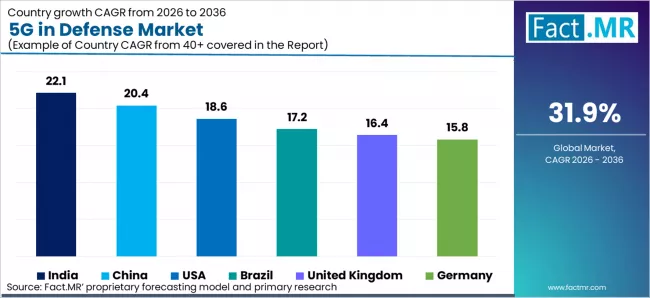
5g In Defense Market Cagr Analysis By Country | Source: Fact.MR
| Country | CAGR (2026-2036) |
|---|---|
| USA | 18.6% |
| China | 20.4% |
| India | 22.1% |
| Brazil | 17.2% |
| United Kingdom | 16.4% |
| Germany | 15.8% |
Source: Fact.MR analysis. Updated Mar 3, 2026
Source: Fact MR (FMR) analysis, based on proprietary forecasting model and primary research.
North America
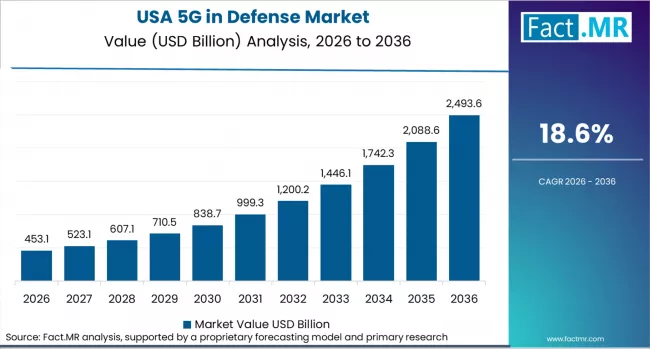
5g In Defense Market Country Value Analysis | Source: Fact.MR
In North America, the USA is leading the demand for 5G in defense, driven by significant investments in defense modernization, increasing demand for high-speed communication systems, and a growing need for secure and reliable military networks.
- USA: Demand for 5G in defense in the U.S. is projected to rise at 18.6% CAGR through 2036. The USA’s substantial defense budget, focus on secure and fast communications for military operations, and investment in 5G-based defense technologies continue to drive market growth.
East Asia
In East Asia, China is a key market for 5G in defense, driven by the country’s rapid technological advancements, large-scale defense modernization initiatives, and increasing military reliance on high-speed, secure communications.
- China: Demand for 5G in defense in China is projected to rise at 20.4% CAGR through 2036. China’s growing defense capabilities, focus on 5G technology for military applications, and expanding military modernization efforts continue to propel market demand.
South Asia
In South Asia, India is experiencing significant growth in the 5G in defense market, supported by its military modernization efforts, increasing investments in technology, and the strategic importance of secure and advanced communications for defense operations.
- India: Demand for 5G in defense in India is projected to rise at 22.1% CAGR through 2036. India’s growing defense budget, focus on advanced communication systems, and increased military reliance on 5G technologies continue to fuel market growth.
Western Europe
In Western Europe, the United Kingdom and Germany are prominent markets for 5G in defense, driven by increasing investments in defense technology, rising demand for fast and secure communication systems, and the growing importance of 5G for defense applications.
- United Kingdom: Demand for 5G in defense in the UK is projected to rise at 16.4% CAGR through 2036. The UK’s emphasis on enhancing military communication systems and growing adoption of 5G technology in defense operations continue to drive market demand.
- Germany: Demand for 5G in defense in Germany is projected to rise at 15.8% CAGR through 2036. Germany’s growing investment in defense technology and increased demand for secure and high-speed communication networks continue to support market growth.
Latin America
In Latin America, Brazil is the leading market for 5G in defense, supported by increasing investments in military technology and the growing need for secure communications within the defense sector.
- Brazil: Demand for 5G in defense in Brazil is projected to rise at 17.2% CAGR through 2036. Brazil’s strategic focus on modernizing defense technologies and increasing reliance on 5G for defense communications contribute to steady market growth.
Fact MR's analysis of the 5G in Defense Market in North America, East Asia, South Asia, Western Europe, and Latin America consists of country-wise assessments that include the USA, China, India, Brazil, the United Kingdom, and Germany. Readers can find detailed trends, regulatory updates, and company-specific investments shaping the market’s growth in these countries.
How Are Key Players Competing in the 5G in Defense Market?
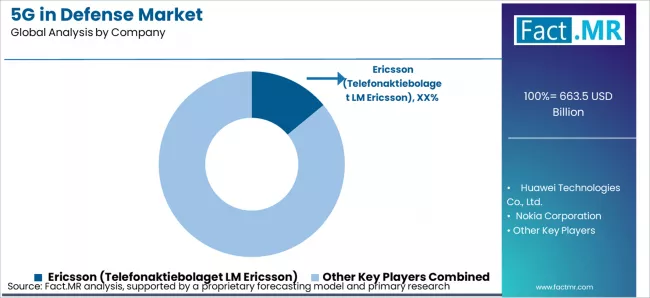
5g In Defense Market Analysis By Company | Source: Fact.MR
In the 5G in Defense market, industry leaders like Ericsson, Huawei, and Nokia are competing to provide advanced telecommunications infrastructure and solutions tailored to military needs. Samsung Electronics and NEC are also establishing strong positions by offering 5G network solutions for secure and high-speed data transfer in defense applications. Thales, L3Harris, and Raytheon Technologies are leveraging their expertise in defense electronics and systems to integrate 5G technology for enhanced communication, situational awareness, and operational efficiency. Lockheed Martin, Northrop Grumman, and General Dynamics are incorporating 5G for secure military communications, data sharing, and battlefield connectivity. Meanwhile, Qualcomm, Intel, and IBM focus on developing specialized chipsets, edge computing, and AI-powered solutions to support 5G networks. Companies like BAE Systems and Cisco are exploring the use of 5G in defense cybersecurity and IoT applications, while Microsoft and Wind River are integrating cloud and software solutions to enhance military network capabilities. Competition is intense as players aim to provide next-gen secure communication solutions for defense sectors globally.
Recent Industry Developments
- Pentagon Release of Open-Source 5G/6G Stack
- On March 1, 2026, the Pentagon’s FutureG office announced it would publish the first version of its Open Centralized Unit Distributed Unit (OCUDU) radio access network project to GitHub in April. This open-source software stack is designed to allow the military and defense contractors to develop custom, secure network solutions, breaking the reliance on "black box" commercial 5G hardware.
- RTX BBN "Smart Spectrum Manager" Contract
- In February 2026, RTX (formerly Raytheon) BBN Technologies was awarded a contract by the Department of War to develop a "Smart Spectrum Manager." This AI-powered prototype addresses the critical 3.1&-3.45 GHz band, allowing defense radars and commercial 5G networks to coexist without interference by automatically shifting 5G traffic in seconds when a radar is detected.
- USAF "Flying 5G Tower" Demonstration
- On January 14, 2026, the U.S. Air Force awarded a contract to Skydweller Aero, in partnership with Nokia Federal Solutions, to demonstrate a rapidly deployable airborne private network. The project uses a solar-powered, perpetual-flight unmanned aircraft to serve as a "flying 5G cell tower," providing persistent, high-bandwidth connectivity for manned and unmanned systems in contested environments.
Key Players of the 5G in Defense Market
- Ericsson (Telefonaktiebolaget LM Ericsson)
- Huawei Technologies Co., Ltd.
- Nokia Corporation
- Samsung Electronics Co., Ltd.
- NEC Corporation
- Thales Group
- L3Harris Technologies, Inc.
- Raytheon Technologies Corporation
- Ligado Networks LLC
- Wind River Systems, Inc.
- Northrop Grumman Corporation
- Lockheed Martin Corporation
- The Boeing Company
- General Dynamics Corporation
- BAE Systems plc
- Cisco Systems, Inc.
- Qualcomm Technologies, Inc.
- Intel Corporation
- International Business Machines Corporation (IBM)
- Microsoft Corporation
Report Scope
| Metric | Value |
|---|---|
| Quantitative Units | USD 663.5 billion (2026) to USD 8,029 billion (2036), at a CAGR of 31.9% |
| Market Definition | The 5G in Defense Market includes the deployment and use of 5G technologies for communication infrastructure, core network technology, and platforms designed to enhance defense operations across land, naval, and airborne units. |
| By Communication Infrastructure | Small Cell, Macro Cell, Radio Access Network (RAN) |
| By Core Network Technology | Software-Defined Networking (SDN), Fog Computing (FC), Mobile Edge Computing (MEC), Network Functions Virtualization (NFV) |
| By Platform | Land, Naval, Airborne |
| By End User | Military, Homeland Security |
| By Network Type | Enhanced Mobile Broadband (eMBB), Ultra-Reliable Low-Latency Communications (URLLC), Massive Machine Type Communications (MMTC) |
| By Chipset | Radio Frequency Integrated Circuit (RFIC) Chipset, Millimetre Wave (mm-Wave) Chipset |
| By Operational Frequency | Low, Medium, High |
| By Installation | New Implementation, Upgradation |
| Regions Covered | North America, Latin America, Europe, East Asia, South Asia, Oceania, Middle East and Africa |
| Countries Covered | United States, Canada, Mexico, Brazil, Argentina, Germany, France, United Kingdom, Italy, Spain, China, India, Japan, South Korea, Indonesia, Australia, and 40+ countries |
| Key Companies Profiled | Ericsson (Telefonaktiebolaget LM Ericsson), Huawei Technologies Co., Ltd., Nokia Corporation, Samsung Electronics Co., Ltd., NEC Corporation, Thales Group, L3Harris Technologies, Inc., Raytheon Technologies Corporation, Ligado Networks LLC, Wind River Systems, Inc., Northrop Grumman Corporation, Lockheed Martin Corporation, The Boeing Company, General Dynamics Corporation, BAE Systems plc, Cisco Systems, Inc., Qualcomm Technologies, Inc., Intel Corporation, International Business Machines Corporation (IBM), Microsoft Corporation |
| Forecast Period | 2026 to 2036 |
| Approach | Hybrid top-down and bottom-up market modeling validated through primary interviews with manufacturers and supported by trade data benchmarking and market research. |
Source: Fact.MR analysis. Updated Mar 3, 2026
Bibliographies
- Huawei Technologies Co., Ltd. (2025). 5G network infrastructure and communication technologies for enterprise and defense applications. Huawei Technologies Co., Ltd.
- NEC Corporation. (2025). Integration of 5G communication technologies for mission-critical and defense networks. NEC Corporation.
- Nokia Corporation. (2025). End-to-end 5G solutions for secure industrial and defense communication systems. Nokia Corporation.
- Samsung Electronics Co., Ltd. (2025). 5G network technologies supporting high-performance communication systems. Samsung Electronics Co., Ltd.
- Telefonaktiebolaget LM Ericsson. (2025). 5G communication infrastructure and secure network solutions for public sector and defense applications. Telefonaktiebolaget LM Ericsson.
- DefenseScoop. (2026, March 1). Pentagon to publish open-source software stack for 5G and 6G innovation [News report]. DefenseScoop.
- RTX News. (2026, February 10). RTX BBN Technologies demonstrates secure real-time spectrum coexistence for 5G and defense radar systems [Press release]. RTX News.
- Skydweller Aero. (2026, January 14). USAF contracts Skydweller Aero, Nokia Federal, and Tangram Flex for rapid-deployment airborne 5G network demonstration [Press release]. Skydweller Aero.
This report addresses
- Market Intelligence enabling comprehensive assessment of leading countries and service segments across the 5G in Defense Market globally.
- Market Volume (Sales Units) estimates and 10-year revenue forecasts from 2026 to 2036, validated through deployment data, defense sector demand surveys, and country-level forecasting.
- Growth Opportunity Mapping across communication infrastructures (Small Cell, Macro Cell, RAN), core network technologies (SDN, MEC, NFV), and regions.
- Segment and Regional Revenue Forecasts by application, technology, platform, chipset, and geography across 40+ countries.
- Competition Strategy Analysis covering dealer network structure, recent developments, product portfolio, USPs, and market share analysis.
- Product and Regulatory Compliance Tracking aligned with defense communication standards, 5G technology, and security certifications.
- Regulatory Impact Analysis addressing global market compliance, technological advancements in defense communications, and evolving 5G standards.
- Report Delivery in PDF, Excel, PowerPoint, and interactive dashboard formats for executive, procurement, and operational planning use.
Segmentation
5G in Defense Market Key Segments
-
Communication Infrastructure
- Small Cell
- Macro Cell
- Radio Access Network (RAN)
-
Core Network Technology
- Software-Defined Networking (SDN)
- Fog Computing (FC)
- Mobile Edge Computing (MEC)
- Network Functions Virtualization (NFV)
-
Platform
- Land
- Command Centers
- Armored Vehicles
- Mobile Communication Units
- Naval
- Ships
- Submarines
- Naval Bases
- Airborne
- Drones/UAVs
- Aircraft
- Satellites
- Land
-
End User
- Military
- Army
- Navy
- Air Force
- Space Force
- Homeland Security
- Military
-
Network Type
- Enhanced Mobile Broadband (eMBB)
- Ultra-Reliable Low-Latency Communications (URLLC)
- Massive Machine Type Communications (MMTC)
-
Chipset
- Radio Frequency Integrated Circuit (RFIC) Chipset
- Millimetre Wave (mm-Wave) Chipset
-
Operational Frequency
- Low
- Medium
- High
-
Installation
- New Implementation
- Upgradation
-
Region
- North America
- United States
- Canada
- Latin America
- Brazil
- Mexico
- Rest of Latin America
- Europe
- Germany
- France
- United Kingdom
- Italy
- Spain
- Rest of Europe
- Asia Pacific
- China
- India
- Japan
- South Korea
- Australia
- Rest of Asia Pacific
- Middle East & Africa
- Saudi Arabia
- UAE
- South Africa
- Rest of Middle East & Africa
- North America
Frequently Asked Questions
How large is the demand for 5G in Defense in the global market in 2026?
What will be the market size of 5G in Defense in the global market by 2036?
What is the expected demand growth for 5G in Defense in the global market between 2026 and 2036?
Which communication infrastructure is expected to dominate the market?
Which region is expected to show the highest growth rate for 5G in Defense?
How significant is the growth outlook for China in this market?
What is the growth outlook for the United States in the 5G in Defense market?
What is the growth forecast for Brazil in the 5G in Defense market?
What is the growth forecast for the United Kingdom in the 5G in Defense market?
What is the growth forecast for Germany in the 5G in Defense market?
Which company is identified as a leading player in the 5G in Defense market?
What is 5G in Defense used for?
What does the 5G in Defense market include in this report?
How is the market forecast developed in this report?
What is meant by the 5G in Defense market in this report?
Who worked on this report


Preview the report firsthand - request a free sample
Free SampleGet the brochure for pricing and purchase details
Download PDF