- Base Value(2025): 4.9 Bn
- Estimated Value(2026): 5.0 Bn
- Forecast Value (2036): 6.5 Bn
- CAGR (2026 - 2036): 2.7%
Computer Rental & Leasing Market Outlook (2022 to 2032)
- The computer rental and leasing market was valued at USD 4.9 billion in 2025. According to Fact.MR, demand is projected to reach USD 5.0 billion in 2026 and expand to USD 6.5 billion by 2036, reflecting a CAGR of 2.7% during the forecast period.
- The market is projected to generate USD 1.5 billion in absolute opportunity between 2026 and 2036.
- Growth is supported by device refresh pressure, distributed workforces, and event-based computer use.
- Leasing of electronic equipment is already recognized in government buying channels for computers and related IT hardware [3]. This supports formal demand where organizations prefer flexible access over upfront asset purchase.
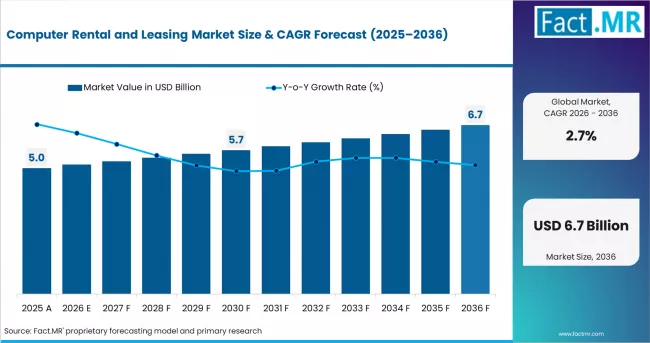
Computer Rental And Leasing Market Market Value Analysis | Source: Fact.MR
Summary of Computer Rental and Leasing Market
- Market Definition
- The market includes computer rental and leasing services that give customers temporary or contracted access to end-user computing hardware.
- Demand Drivers
- IT asset managers use rentals to equip project teams without adding permanent assets.
- Event technology managers need short-term laptop fleets for training, testing, and conferences.
- Education technology coordinators use leasing to manage device refresh without large upfront spending.
- Key Segments Analyzed
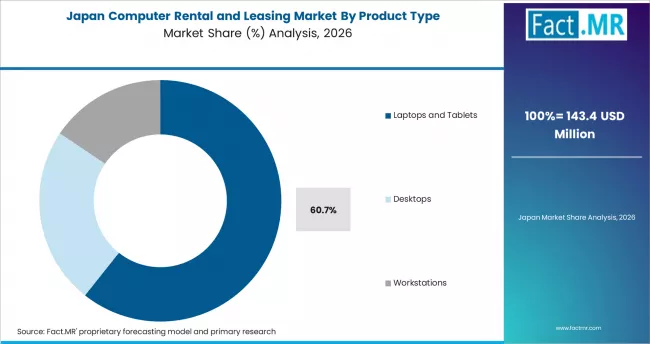
- By Product Type: Laptops and tablets are estimated to lead with 61.0% share in 2026, supported by mobile work and training deployments.
- By Rental Tenure: Long-term leasing is expected to account for 54.0% share in 2026 because enterprises prefer predictable device refresh cycles.
- By Customer Type: Enterprises are projected to hold 66.0% share in 2026 due to larger fleets and structured IT asset control.
- By Service Model: Managed device rental is expected to hold 57.0% share in 2026, supported by configuration and support requirements.
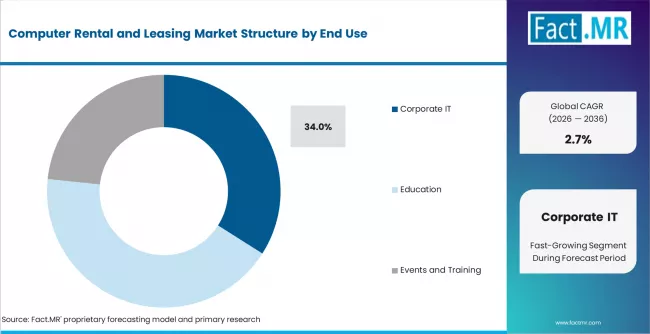
- By End Use: Corporate IT is projected to account for 34.0% share in 2026 because distributed teams need flexible device access.
- Analyst Opinion at Fact.MR
- Shambhu Nath Jha, Senior Analyst at Fact.MR, opines, “Computer rental and leasing is no longer a stopgap for temporary hardware shortage. Buyers want predictable device access, secure return processes, and refresh flexibility. Suppliers that treat rental fleets as managed IT assets will be better placed than firms offering hardware alone.”
- Strategic Implications
- Rental providers should strengthen data wiping, device tracking, and replacement workflows.
- Enterprise-focused suppliers need flexible contract terms for hybrid teams and project-based work.
- Regional expansion should focus on countries where training activity and office modernization are increasing.
- Methodology
- Sizing Base: Market sizing uses rental fleet value, contract duration, device mix, and average revenue per unit.
- Evidence Inputs: Analysis includes NIST guidance, GSA equipment leasing scope, EPA electronics reuse guidance, and company device-as-a-service material.
- Forecast Design: Forecasts account for laptop refresh cycles, hybrid work adoption, event demand, and secure asset recovery needs.
| Metric | Value |
|---|---|
| Estimated Value in 2026 | USD 5.0 billion |
| Forecast Value in 2036 | USD 6.5 billion |
| Forecast CAGR (2026 to 2036) | 2.7% |
Source: Fact.MR analysis. Updated May 15, 2026
Device security is becoming a stronger buyer filter. NIST media sanitization guidance supports practical decisions around clearing, purging, and destroying data-bearing media before equipment reuse. Rental providers that can document secure device return, storage reset, and redeployment workflows gain a stronger position with enterprise clients. EPA guidance on electronics reuse and recycling also supports device life extension through responsible reuse and recovery [2].
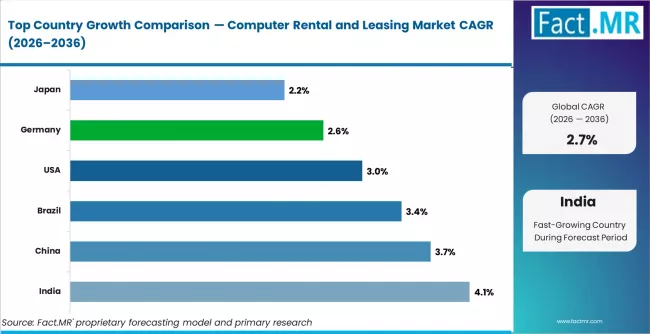
India is projected to grow at 4.1% CAGR through 2036. China follows at 3.7% CAGR, supported by business services and education technology demand. Brazil grows at 3.4% CAGR, driven by event-based rentals and corporate training. The United States records 3.0% CAGR, supported by mature device-as-a-service programs. Germany grows at 2.6% CAGR, linked to IT refresh discipline. Japan advances at 2.2% CAGR, supported by enterprise continuity needs.
Segmental Analysis
Computer Rental and Leasing Market Analysis by Product Type
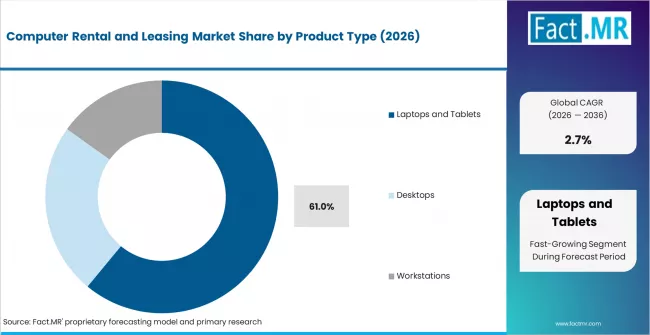
Computer Rental And Leasing Market Analysis By Product Type | Source: Fact.MR
Laptops and tablets are estimated to hold 61.0% share in 2026, as mobile devices serve enterprise teams, education programs, and temporary staff deployments better than fixed desktops. Hybrid work has increased the need for portable computers that can be configured and returned without permanent ownership. Rental operators also prefer laptop fleets because utilization can be spread across corporate projects and event assignments. Desktops still serve training labs and controlled office environments. Workstations are used for design teams and technical projects where standard laptops cannot handle workload needs. Buyers that delay laptop fleet access can face onboarding delays and weaker project readiness.
- Mobile Deployment: Laptops and tablets support fast rollout across project teams.
- Training Lab Use: Desktops stay relevant where controlled rooms need stable setups.
- Technical Workloads: Workstations serve design and engineering users with higher performance needs.
Computer Rental and Leasing Market Analysis by Rental Tenure
Contract planning is becoming more important as IT teams balance device cost with workforce movement. Long-term leasing is expected to account for 54.0% share in 2026 because enterprises prefer predictable monthly payments and planned refresh cycles. Short-term rentals are important for events, exams, and temporary training. Medium-term contracts support seasonal projects and expansion teams. Long-term leasing has stronger value because suppliers can bundle device maintenance and replacement into a planned contract. Customers using only short rental windows often face higher unit pricing and lower device choice during peak event periods.
- Refresh Planning: Long-term leasing helps enterprises align device use with replacement cycles.
- Event Peaks: Short-term rental serves exams, training sessions, and conferences.
- Project Coverage: Medium-term contracts help teams avoid permanent device purchases.
Computer Rental and Leasing Market Analysis by Customer Type
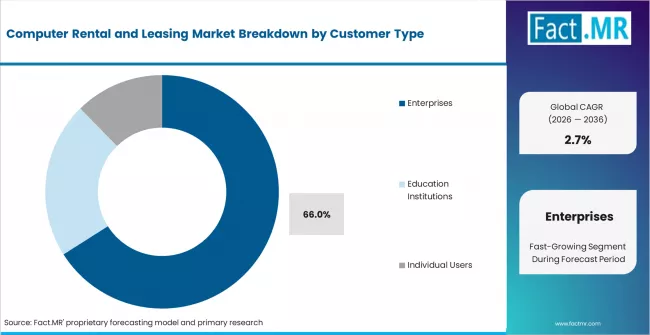
Computer Rental And Leasing Market Analysis By Customer Type | Source: Fact.MR
Enterprises are projected to hold 66.0% share over the assessment period. This customer group leads because larger organizations need managed devices for hiring waves, office moves, temporary teams, and IT refresh programs. Enterprise users are more likely to require configuration support, asset tagging, secure return, and helpdesk coordination. Education institutions use rentals for exams and digital classroom needs. Government and public sector buyers use leasing where contracts need controlled equipment access, including computers and related hardware covered under public buying channels. Individual users remain a smaller base because consumer rental demand is more price-sensitive and less contract-driven.
- Enterprise Fleet Needs: Large employers need repeat device access for changing team sizes.
- Education Cycles: Schools and training providers rent computers for exams and labs.
- Public Sector Use: Government buyers use formal channels for leased IT equipment.
Computer Rental and Leasing Market Analysis by Service Model
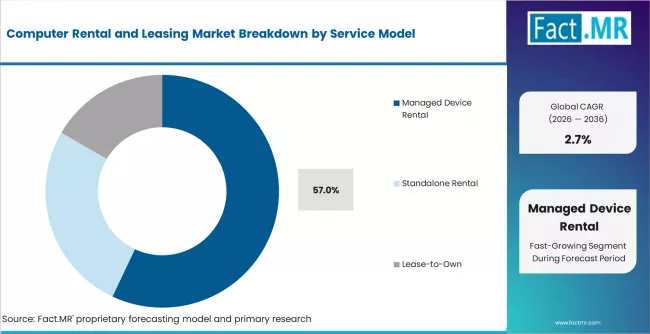
Computer Rental And Leasing Market Analysis By Service Model | Source: Fact.MR
Managed device rental is expected to hold 57.0% share in 2026. Customers increasingly want setup, delivery, replacement, and secure return included in the rental arrangement. Standalone rental remains useful when buyers only need devices for short durations. Lease-to-own options fit smaller organizations that want to convert rental equipment into owned assets later. Subscription-based leasing is gaining attention because Dell, HP, and Lenovo offer device-as-a-service models that combine hardware with lifecycle services. [4] Managed rental leads because customers want fewer internal tasks between device request and redeployment.
- Lifecycle Support: Managed rental reduces internal work for configuration and return.
- Simple Access: Standalone rental fits short events and limited device counts.
- Flexible Ownership: Lease-to-own supports buyers that may retain devices after use.
Computer Rental and Leasing Market Analysis by End Use
Computer Rental And Leasing Market Analysis By End Use | Source: Fact.MR
Corporate IT is projected to account for 34.0% share in 2026, as employers need computers for hybrid teams, contractors, onboarding, and temporary project groups. Corporate IT teams value predictable device access because delays can slow employee productivity. Education remains important because schools and training providers use rental fleets for labs and exams. Events and training create peak demand around conferences and certification programs. BFSI and healthcare users need stronger security controls because rented devices may handle sensitive information. NIST media sanitization guidance is relevant where devices move between users and clients.
- Workforce Flexibility: Corporate IT uses rental devices for changing team needs.
- Education Access: Training providers use computer fleets for classes and assessments.
- Secure Turnover: BFSI and healthcare users require stronger return controls.
Computer Rental and Leasing Market Drivers, Restraints, and Opportunities
Computer Rental And Leasing Market Opportunity Matrix Growth Vs Value | Source: Fact.MR
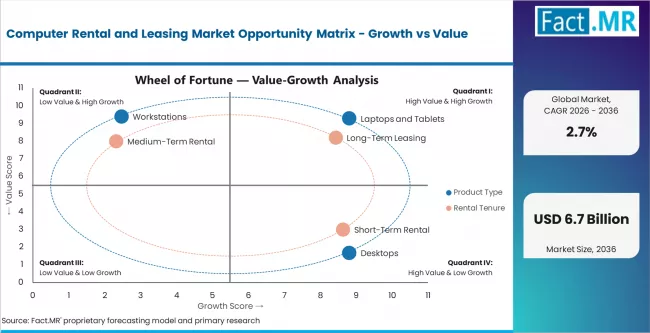
Fact.MR analysts observe that computer rental and leasing demand is supported by flexible workforce planning and higher device lifecycle complexity. Enterprises need computers for temporary staff, project teams, training programs, and distributed work. Government equipment leasing channels show that computers, laptops, desktops, and peripherals can be formally leased under IT hardware arrangements. Device-as-a-service offerings from major technology companies are also making monthly device access more familiar to enterprise buyers. [5]
Device security and asset condition remain the main restraints. Every returned computer needs data wiping, inspection, refurbishment, and redeployment before reuse. NIST media sanitization guidance makes data removal a structured process, which adds operating discipline for rental providers. Fleet operators also face residual value risk when devices age faster than expected. Customers may delay rentals if delivery schedules, replacement terms, or support response are unclear.
Opportunities in the Computer Rental and Leasing Market
- Secure Return Services: Providers can win enterprise clients by offering documented wiping and redeployment records.
- Managed Fleet Programs: Rental firms can bundle devices with tracking and helpdesk support.
- Education Deployment: Schools and training providers create demand for ready-to-use laptop pools.
Regional Analysis
.webp "Top Country Growth Comparison Computer Rental And Leasing Market Cagr (2026 2036)")
Top Country Growth Comparison Computer Rental And Leasing Market Cagr (2026 2036) | Source: Fact.MR
The computer rental and leasing market is assessed across North America, Europe, Asia Pacific, Latin America, and Middle East and Africa, covering 40+ countries with demand profiles shaped by enterprise IT budgets, rental fleet availability, device refresh cycles, and secure asset recovery requirements.
| Country | CAGR (2026 to 2036) |
|---|---|
| India | 4.1% |
| China | 3.7% |
| Brazil | 3.4% |
| USA | 3.0% |
| Germany | 2.6% |
| Japan | 2.2% |
Source: Fact.MR analysis. Updated May 15, 2026
Source: Fact.MR analysis, based on proprietary forecasting model and primary research
Computer Rental And Leasing Market Cagr Analysis By Country | Source: Fact.MR
Asia Pacific Computer Rental and Leasing Market Analysis
Computer Rental And Leasing Market Japan Market Share Analysis By Product Type | Source: Fact.MR
Asia Pacific records faster growth because enterprise hiring, training programs, and digital education are expanding device needs. India benefits from IT services growth and large training volumes. China supports demand through business services and education technology use. Japan is more stable because large enterprises already have formal device management systems. Regional suppliers need fleet depth, fast delivery, and device support capabilities.
- India: Computer rental and leasing demand in India is projected to grow at 4.1% CAGR by 2036. IT services firms, training centers, and examination providers create steady demand for laptop fleets. Tier-one cities account for a large share, but smaller business hubs are adding rental needs as hybrid work spreads. Buyers prefer suppliers that can configure devices quickly and handle returns without disrupting project timelines.
- China: China’s demand is linked to business services, education technology, and temporary office expansion. Enterprises need computer fleets for project staffing and training activity across large cities. The market is projected to expand at 3.7% CAGR from 2026 to 2036. Domestic device availability helps rental operators maintain fleet supply. Customers are likely to prefer vendors that can support fast replacement and secure device handling across multi-site operations.
- Japan: Japan has a stable enterprise base that supports steady leasing demand. Many large employers already use structured device management, which limits faster expansion. Computer rental and leasing in Japan is expected to register 2.2% CAGR over the study period, demand comes from office continuity, temporary project teams, and event technology needs. Suppliers compete through reliability, service quality, and clean return workflows.
North America Computer Rental and Leasing Market Analysis
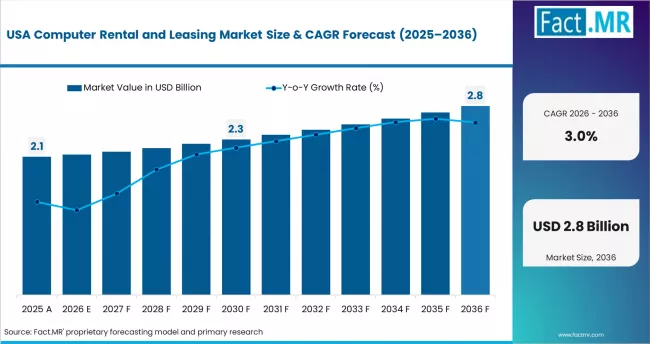
Computer Rental And Leasing Market Country Value Analysis | Source: Fact.MR
North America remains a high-value region because enterprise device management is well established. The United States drives most regional revenue through corporate IT leasing, event technology demand, and device-as-a-service adoption. Public sector leasing channels also support formal demand for computers and electronic equipment. Buyers expect clear service-level terms, fast replacement, and secure data handling.
- USA: The U.S. computer rental and leasing market is forecast to reach 3.0% CAGR through 2036. Enterprise IT teams use rentals for temporary employees, office moves, and project-based work. Device-as-a-service programs from major vendors make monthly device access more familiar to buyers [6]. Event organizers and training providers add short-term demand. Vendor success depends on contract flexibility, device availability, and return security.
Europe Computer Rental and Leasing Market Analysis
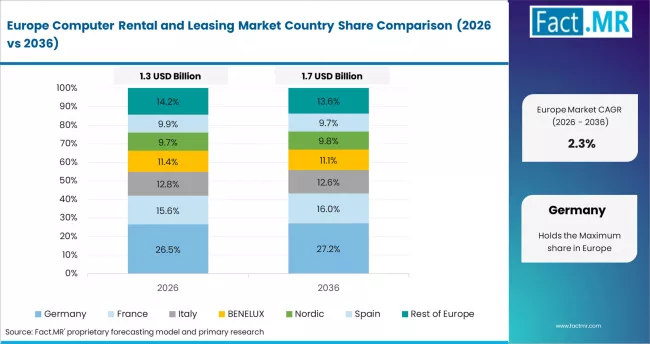
Computer Rental And Leasing Market Europe Country Market Share Analysis, 2026 & 2036 | Source: Fact.MR
Europe grows through structured IT refresh cycles and higher attention to electronics reuse. Germany leads regional demand because enterprise customers value documented device handling and reliable service terms. EPA and NIST sources are U.S.-based, but their reuse and sanitization logic reflects broader buyer expectations for returned electronics and data-bearing devices. European buyers often expect strong documentation before expanding rental relationships.
- Germany: Germany’s computer rental and leasing demand is supported by disciplined IT refresh cycles and enterprise service expectations. Business users need reliable laptops for hybrid work, training, and project teams. The market is projected to record 2.6% CAGR from 2026 to 2036, buyers place weight on secure return handling and device condition. Suppliers need strong documentation, predictable replacement terms, and consistent service coverage across major business centers.
Latin America Computer Rental and Leasing Market Analysis
Latin America grows through event technology, business training, and flexible enterprise device access. Brazil remains the key country because large urban centers have stronger demand for rented computer fleets. Cost control is a major reason buyers choose leasing over ownership. Suppliers need enough fleet depth to serve short-term peaks without sacrificing device quality.
- Brazil: Brazil’s demand is tied to corporate training, events, and flexible IT spending. Urban business centers account for most rental activity because device availability and service support are better developed there. Computer rental and leasing is projected to expand at 3.4% CAGR by 2036. Buyers compare monthly cost with the burden of owning and maintaining devices. Suppliers with reliable delivery and quick replacement can gain repeat contracts.
Competitive Aligners for Market Players
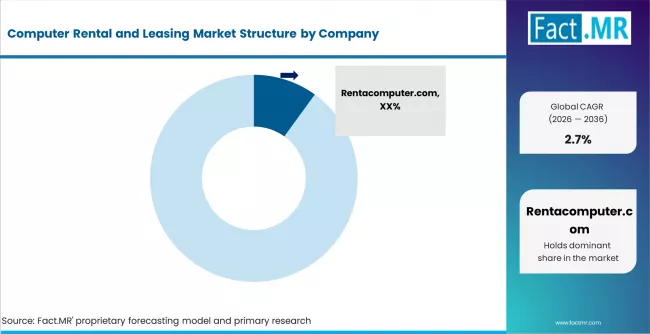
Computer Rental And Leasing Market Analysis By Company | Source: Fact.MR
The computer rental and leasing market is moderately fragmented. Local rental firms serve events, training rooms, and short-term business needs. Larger technology providers and device-as-a-service vendors compete where enterprise clients want structured lifecycle support. Competition depends on fleet availability, support speed, data wiping proof, and contract flexibility.
Competitive advantage is tied to service execution rather than hardware access alone. Many suppliers can source laptops, but fewer can deliver configured devices at scale and recover them securely after use. NIST-aligned sanitization workflows and clear asset records can reduce buyer hesitation in sectors handling sensitive data. Providers that treat returned devices as controlled assets are better positioned for enterprise contracts.
The market is divided between short-term rental specialists and managed leasing providers. Event suppliers compete on speed and local inventory. Enterprise leasing providers compete on service integration and device refresh planning. Dell, HP, and Lenovo have strengthened device-as-a-service positioning, which increases buyer awareness of access-based computing models.
Key Players in Computer Rental and Leasing Market
- Rentacomputer.com
- SmartSource Rentals
- Vernon Computer Source
- Hamilton Rentals
- Electro Rent Corporation
- CSI Leasing, Inc.
- Dell Technologies
- HP Inc.
- Lenovo Group Limited
- CompuCom Systems, Inc.
- Flex IT Rent
- HardSoft Computers
Bibliography
- [1]. National Institute of Standards and Technology. Guidelines for Media Sanitization, SP 800-88 Rev. 1. NIST.
- [2]. U.S. Environmental Protection Agency. Sustainable Management of Electronics and Batteries. EPA.
- [3]. U.S. General Services Administration. Leasing of New Electronic Equipment. GSA.
- [4]. Dell Technologies. Dell APEX PC as a Service. Dell Technologies.
- [5]. HP Inc. Managed Device Services. HP.
- [6]. Lenovo Group Limited. TruScale Device as a Service. Lenovo.
This Report Addresses
- Strategic intelligence on computer rental and leasing demand across enterprise IT refresh cycles, hybrid workforce deployment, education device access, event technology needs, and short-term project computing requirements.
- Market forecast from USD 5.0 billion in 2026 to USD 6.5 billion by 2036 at a CAGR of 2.7%.
- Segment analysis by product type, rental tenure, customer type, service model, and end use, covering laptops and tablets, long-term leasing, enterprises, managed device rental, and corporate IT demand.
- Regional outlook covering Asia Pacific training and IT services demand, North America enterprise device leasing, Europe structured IT refresh cycles, and Latin America event-based computer rental needs.
- Competitive analysis of Rentacomputer.com, SmartSource Rentals, Vernon Computer Source, Hamilton Rentals, Electro Rent, CSI Leasing, Dell Technologies, HP, Lenovo, CompuCom, Flex IT Rent, and HardSoft Computers.
- Report delivered with market sizing, segment forecasts, regional outlook, and competitive assessment. Supported by primary interviews, rental fleet indicators, government IT leasing guidance, device-as-a-service material, and media sanitization references.
Computer Rental & Leasing Market Definition
The market covers rental and leasing services for computers and related end-user computing equipment. It includes laptops, tablets, desktops, workstations, servers, monitors, keyboards, docking stations, and peripheral bundles supplied for temporary or contracted use. The market is defined by access-based use of computing equipment rather than permanent ownership by the customer.
Computer Rental Leasing Market Inclusions
The market includes short-term rentals for events and training, medium-term project deployments, and long-term leasing for enterprise refresh cycles. It covers standalone device rental, managed device rental, lease-to-own options, and subscription-based leasing. Services such as configuration, delivery, device tracking, replacement, and secure return support are included when tied to computer rental or leasing contracts.
Computer Rental Leasing Market Exclusions
The market excludes outright computer sales, software-only subscriptions, cloud infrastructure services, mobile phone rental, and consumer electronics rental outside computer use. It does not include leasing of networking infrastructure unless bundled with computer deployment. General IT consulting is outside scope unless offered as part of a device rental or leasing agreement.
Computer Rental Leasing Market Research Methodology
- Primary Research: Interviews with IT asset managers, enterprise device administrators, rental fleet operators, event technology managers, and education technology coordinators.
- Desk Research: Review includes government IT leasing channels, NIST sanitization guidance, electronics reuse guidance, device-as-a-service offerings, and company service documentation. [1]
- Market-Sizing and Forecasting: The model uses installed rental fleet size, average contract duration, device replacement cycles, rental pricing, and enterprise refresh activity.
- Data Validation and Update Cycle: Forecasts are validated using supplier fleet signals, public IT leasing guidance, company disclosures, and channel interviews.
Segmentation
Scope of Report
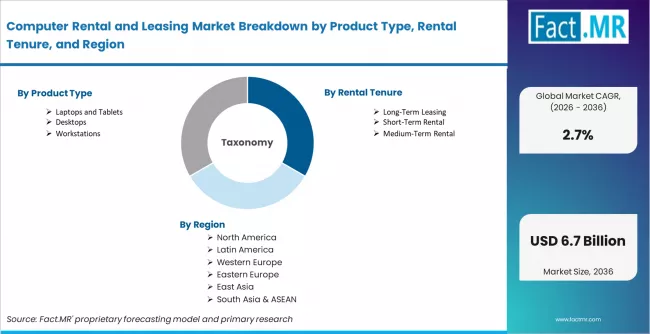
Computer Rental And Leasing Market Breakdown By Product Type, Rental Tenure, And Region | Source: Fact.MR
| Attribute | Details |
|---|---|
| Quantitative Units | USD 5.0 billion (2026) to USD 6.5 billion (2036), at a CAGR of 2.7% |
| Market Definition | Rental and leasing services for computers and related end-user computing equipment supplied for temporary or contracted use. |
| Product Type Segmentation | Laptops and Tablets, Desktops, Workstations, Servers, Peripheral Bundles |
| Rental Tenure Segmentation | Short-Term Rental, Medium-Term Rental, Long-Term Leasing |
| Customer Type Segmentation | Enterprises, Education Institutions, Government and Public Sector, Events and Training Providers, Individual Users |
| Service Model Segmentation | Standalone Rental, Managed Device Rental, Lease-to-Own, Subscription-Based Leasing |
| End Use Segmentation | Corporate IT, Education, Events and Training, BFSI, Healthcare, Creative and Media |
| Regions Covered | North America, Europe, Asia Pacific, Latin America, Middle East and Africa |
| Countries Covered | USA, Canada, Mexico, Germany, UK, France, Italy, Spain, China, Japan, India, ASEAN, Australia and New Zealand, Brazil, GCC, South Africa, and Rest of World |
| Key Companies Profiled | Rentacomputer.com, SmartSource Rentals, Vernon Computer Source, Hamilton Rentals, Electro Rent, CSI Leasing, Dell Technologies, HP Inc., Lenovo Group, CompuCom, Flex IT Rent, HardSoft Computers |
| Forecast Period | 2026 to 2036 |
| Approach | Hybrid top-down and bottom-up model using rental fleet value, contract duration, device mix, replacement cycles, and interviews with IT rental operators. |
Source: Fact.MR analysis. Updated May 15, 2026
Computer Rental and Leasing Market by Segments
-
By Product Type:
- Laptops and Tablets
- Desktops
- Workstations
- Servers
- Peripheral Bundles
-
By Rental Tenure:
- Short-Term Rental
- Medium-Term Rental
- Long-Term Leasing
-
By Customer Type:
- Enterprises
- Education Institutions
- Government and Public Sector
- Events and Training Providers
- Individual Users
-
By Service Model:
- Standalone Rental
- Managed Device Rental
- Lease-to-Own
- Subscription-Based Leasing
-
By End Use:
- Corporate IT
- Education
- Events and Training
- BFSI
- Healthcare
- Creative and Media
-
By Region:
- North America
- United States
- Canada
- Mexico
- Latin America
- Brazil
- Argentina
- Chile
- Rest of Latin America
- Western Europe
- Germany
- France
- United Kingdom
- Italy
- Spain
- Nordic Countries
- BENELUX
- Rest of Western Europe
- Eastern Europe
- Russia
- Poland
- Hungary
- Balkan and Baltic
- Rest of Eastern Europe
- East Asia
- China
- Japan
- South Korea
- South Asia and Pacific
- India
- ASEAN
- Australia and New Zealand
- Rest of South Asia and Pacific
- Middle East and Africa
- Kingdom of Saudi Arabia
- Other GCC Countries
- Turkey
- South Africa
- Rest of Middle East and Africa
- North America
Frequently Asked Questions
How large is the computer rental and leasing market in 2026?
What will the computer rental and leasing market be valued at by 2036?
What CAGR is projected from 2026 to 2036?
Which product type leads the market?
Which rental tenure leads demand?
Which customer type holds the largest share?
Which service model leads the market?
Which end use accounts for the highest share?
Which country grows fastest through 2036?
Why do laptops and tablets lead product demand?
Why does long-term leasing hold a high share?
Why are enterprises the leading customer group?
Why is managed device rental gaining preference?
What is the main restraint for the market?
How does NIST guidance affect rental providers?
Why is India growing faster than developed markets?
Why is Japan growing at a slower rate?
Why do events create rental demand?
What supports education-sector demand?
What shapes supplier success in this market?
How do device-as-a-service models affect the market?
What does the report measure across segments?
Who worked on this report


Preview the report firsthand - request a free sample
Free SampleGet the brochure for pricing and purchase details
Download PDF