- Base Value(2025): 681.5 Mn
- Forecast Value (2035): 1186.4 Mn
- CAGR (2035): 5.7%
Automotive Fifth Wheel Coupling Market Outlook (2025 to 2035)
The global automotive fifth wheel coupling market is projected to increase from USD 681.5 million in 2025 to USD 1,186.4 million by 2035, with a CAGR of 5.7%, driven by rising demand in heavy-duty logistics, expanding freight transport, and vehicle fleet modernization.
Increasing use of semi-trailers in logistics, construction, and mining industries, along with stricter government safety regulations and retrofitting in the aftermarket, continues to support sustained demand for fifth wheel coupling systems.
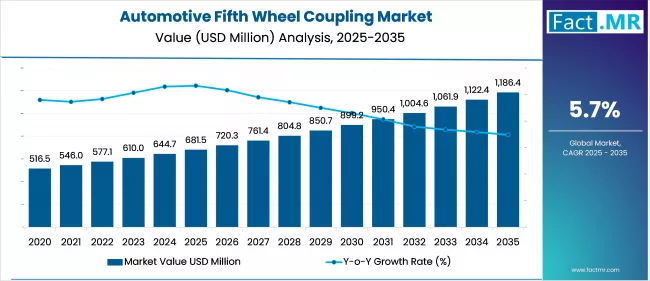
Automotive Fifth Wheel Coupling Market By Market Value Analysis | Source: Fact.MR
What are the Drivers of the Automotive Fifth Wheel Coupling Market?
The automotive fifth wheel coupling market mainly grows as the freight, logistics, and construction industries expand their use of articulated heavy vehicles. As global road freight volumes rise, demand for couplings that offer safe load transfer and efficient detachment continues to grow. These couplings are critical for ensuring trailer stability and vehicle maneuverability under heavy load conditions.
Expansion of logistics hubs beyond traditional regions such as North America, Germany, and China has created new opportunities for coupling system manufacturers. Countries like Mexico, Vietnam, and Poland are experiencing increased trailer production, driving OEM demand for advanced coupling solutions with better fatigue and corrosion resistance.
The introduction of forged steel, alloy-treated cast iron, and hybrid locking mechanisms has improved coupling strength and reliability. These materials support longer service life and higher load thresholds, meeting the evolving standards of defense, mining, and heavy goods sectors. Moreover, the rising adoption of modular trailer platforms further increases the need for versatile coupling designs.
Digitization in fleet management and the growing use of connected telematics have led to higher interest in sensor-enabled fifth wheel systems. These smart couplings can detect wear, misalignment, or locking failures in real time, helping operators reduce downtime and avoid trailer disengagement risks. As sustainability and safety regulations tighten, demand for robust, intelligent fifth wheel couplings is set to increase over the next decade.
What are the Regional Trends of the Automotive Fifth Wheel Coupling Market?
Asia-Pacific dominates the automotive fifth wheel coupling market due to its extensive commercial vehicle production hubs in China, India, and Japan. Strong growth in logistics, industrial output, and cross-border freight activity has fueled OEM and aftermarket demand for durable and lightweight coupling solutions.
In North America, the U.S. leads with high trailer-to-truck ratios and strict towing safety norms. Infrastructure investment and fleet replacement cycles, especially in long-haul logistics and mining, are key factors behind the region’s consistent market expansion. Canada also supports growth through the demand for construction equipment.
Germany, Poland, and the Netherlands are driving demand across Europe, supported by trailer manufacturing clusters and growing freight traffic under EU cross-border trade. Emission and weight regulations are pushing for forged, corrosion-resistant materials, aiding innovation across the regional supply chain.
Latin America and Southeast Asia are emerging as promising markets, especially in agricultural and mid-duty transport applications. Government-backed logistics corridor development in Brazil, Vietnam, and Indonesia is encouraging investments in towing-capable trucks and component upgrades, boosting coupling system installations.
What are the Challenges and Restraining Factors of the Automotive Fifth Wheel Coupling Market?
A major challenge in the fifth wheel coupling market is the high cost of forged steel and alloy components, which increases the initial investment in premium-grade couplings. This makes advanced systems less attractive for operators focused on budget fleets, especially in cost-sensitive regions.
Meeting stringent safety certifications like SAE J2638, ISO 3842, and ECE R55 adds to development and compliance costs. Ensuring correct fitment, durability testing, and load validation often delays product rollouts, particularly for newer entrants or Tier II suppliers lacking testing infrastructure.
Supply chain volatility also impacts the market. Fluctuations in steel prices, lead times for precision-machined parts, and limited availability of corrosion-resistant coatings can disrupt manufacturing timelines and increase total project costs for OEMs and retrofitting contractors.
Inconsistent mounting standards and trailer configurations across geographies pose interoperability issues. This leads to added costs for multi-platform compatibility, complicating procurement for fleet operators working across borders or using a mix of vehicle classes.
Country-Wise Outlook
China Drives Fifth-Wheel Coupling Demand with Surging Commercial Truck and Zero-Emission Fleet Expansion
The automotive fifth-wheel coupling market in China is advancing rapidly due to its strong commercial vehicle production base. In 2024, the country manufactured around 31.28 million vehicles, including 3.80 million commercial vehicles. This scale supports a consistent demand for coupling systems in logistics, mining, and long-haul transportation.
The push toward zero-emission freight transport is accelerating the adoption of advanced coupling technologies. In 2024 alone, China sold over 230,000 zero-emission medium- and heavy-duty trucks, with tractor-trailers accounting for the majority. These vehicles require more durable and reliable fifth-wheel systems to handle higher loads and longer duty cycles.
As China exported nearly 4.86 million vehicles by October 2024, OEMs such as FAW, Dongfeng, and Sinotruk are upgrading fifth-wheel coupling designs to meet global performance and safety benchmarks. This includes investing in smart locking mechanisms and lightweight alloys to enhance export competitiveness.
Supportive policies and regulatory frameworks are reinforcing the shift to high-specification couplings. Nationwide efforts to modernize fleet infrastructure and reduce emissions are driving local manufacturers to meet stricter standards in material strength, corrosion resistance, and coupling efficiency for both domestic and global applications.
Germany’s Fifth-Wheel Coupling Market Advances with Electrification and Smart Infrastructure
The fifth-wheel coupling market in Germany is gaining momentum, driven by consistent growth in commercial vehicle deployment. In 2024, the country registered 316,928 new trucks, marking a 9% year-over-year increase. As of January 1, 2025, Germany's total truck fleet reached 3,827,663 registered trucks, marking a 2.4% increase year-over-year and underscoring robust demand in logistics and freight operations.
The shift toward electrification is reshaping coupling system demands. In 2023, electric truck sales surged 35%, totaling about 54,000 units globally, with major deployment in logistics hubs rather than just cars (IEA, Global EV Outlook 2024). These heavy-duty EVs require advanced fifth-wheel couplings built for increased load and integrated electronics to support robust performance and energy efficiency.
Investments in charging infrastructure are supporting this transition. Germany’s fast-charging network now covers 95% of federal highways, facilitating long-haul electric trucking. Fleet operators such as Amazon have begun integrating eActros 600s, indicating growing demand for compatible, high-performance fifth-wheel couplings.
German OEMs like Daimler Truck, MAN, and Mercedes-Benz are developing advanced coupling systems for electric and long-haul trucks. These include low-mount couplers with smart locking mechanisms and corrosion-resistant finishes. As EU climate policies push for a 65% CO₂ reduction by 2035, such innovations are expected to fuel sustained market growth.
U.S. Fifth-Wheel Coupling Market Grows with Class 8 Truck Orders and Electric Tractor Adoption
The U.S. heavy-duty truck fleet is central to its fifth-wheel coupling market. In 2024, the U.S. saw around 2.8 million new commercial vehicle registrations, including approximately 231,000 Class 8 trucks, indicating a large base for coupling demand.
Electrification and fleet modernization are reshaping coupling specifications. Hybrid and electric commercial trucks surged from 4,000 to 87,000 registrations between 2019 and 2024, with electric Class 8 tractors gaining particular traction.
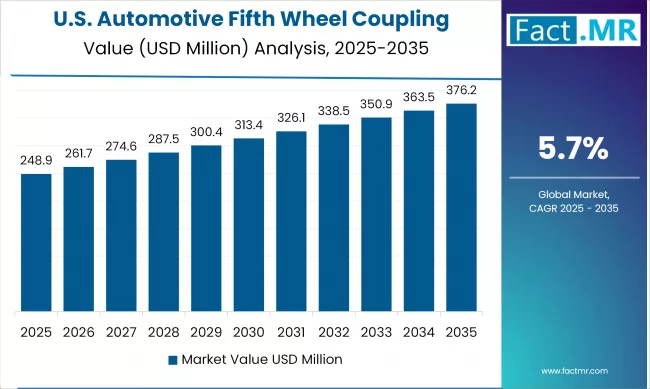
Automotive Fifth Wheel Coupling Market By Country Value Analysis | Source: Fact.MR
Major OEMs Freightliner (Daimler), Tesla, Nikola, and Toyota/Hino are deploying new electric Class 8 models like the eCascadia, Tesla Semi, and Hino Tern. Federal and state incentives under the ACT regulation support these launches, underscoring the growing demand for compatible fifth-wheel couplings.
This transition is supported by robust Class 8 order activity and increasing zero-emission vehicle adoption. By the end of 2024, full-year Class 8 truck orders reached approximately 279,872 units, marking an 11% year‑over‑year increase, alongside over 1,300 ZEV heavy-duty truck registrations in H1 2024, reflecting OEM focus on advanced coupling systems for heavy-duty and electric vehicles.
Category-wise Analysis
Compensating to Exhibit Leading by Product
The compensating fifth wheel coupling segment holds the largest share of the global automotive fifth wheel coupling market. Its dominance is attributed to its wide adoption in heavy-duty trucks and trailers due to its ability to efficiently distribute load stress and enhance vehicle stability during transit.
These couplings offer superior weight distribution and alignment capabilities, making them ideal for long-haul transportation and challenging terrains. Their robust design and high load-bearing capacity make them a preferred choice among fleet operators and logistics providers, especially in regions with high freight movement such as North America and Europe.
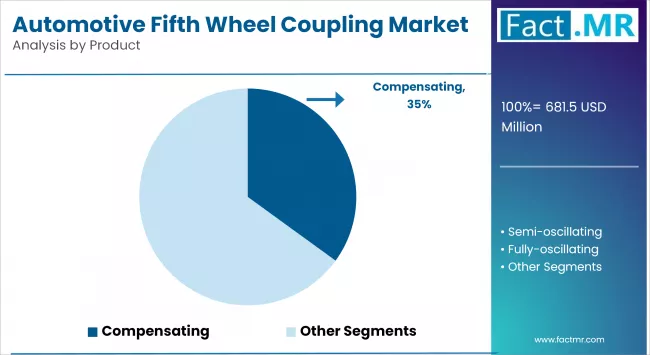
Automotive Fifth Wheel Coupling Market By Product | Source: Fact.MR
The fully-oscillating fifth wheel coupling segment is expected to be the fastest-growing segment during the forecast period. This growth is driven by increasing demand for improved maneuverability and safety in uneven terrain and off-road applications. Fully-oscillating couplings provide greater flexibility and articulation between the tractor and trailer, making them suitable for construction, mining, and other specialized applications.
Additionally, as logistics operations expand into remote and difficult-to-access areas, the need for advanced coupling systems with enhanced adaptability is accelerating the adoption of fully oscillating products.
Mechanical to Exhibit Leading by Actuation
The pneumatic actuators segment holds the largest share of the global automotive fifth wheel coupling market. This dominance is primarily due to their widespread use in commercial vehicles for their reliability, ease of operation, and compatibility with existing air brake systems.
Pneumatic actuators offer efficient control, require less maintenance, and are well-suited for heavy-duty applications where consistent and responsive coupling and decoupling are essential. Their cost-effectiveness and ability to provide strong force output further contribute to their high adoption across major trucking fleets worldwide.
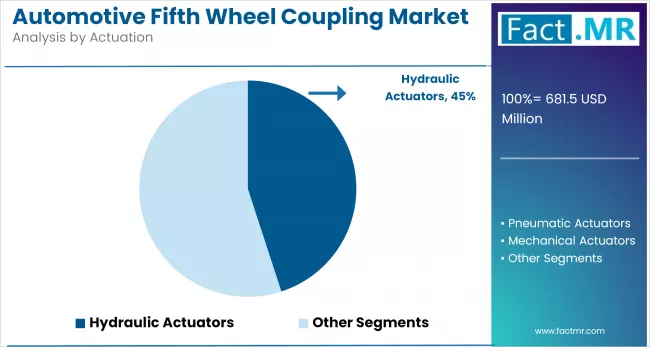
Automotive Fifth Wheel Coupling Market By Actuation | Source: Fact.MR
The hydraulic actuators segment is projected to be the fastest-growing during the forecast period. This growth is fueled by increasing demand for precise and powerful actuation in high-load and off-road applications.
Hydraulic actuators offer superior force and control, making them ideal for use in specialized vehicles operating under extreme conditions such as construction, mining, and defense. As the need for advanced coupling systems with enhanced safety and performance grows, hydraulic solutions are gaining traction in regions focusing on infrastructure development and industrial transportation.
2144 Tons to Exhibit Leading by Tonnage
The 2144 tons segment holds the largest share of the global automotive fifth wheel coupling market. This segment dominates due to its extensive use in medium to heavy commercial vehicles for regional and long-haul freight transportation.
These couplings strike a balance between payload capacity and operational efficiency, making them ideal for logistics, construction, and industrial applications. Their versatility and compatibility with a wide range of trailers contribute to their high demand, particularly in transportation hubs across North America, Europe, and Asia-Pacific.
The segment exceeding 75 tons is expected to be the fastest-growing during the forecast period. The rising need for heavy-load transport solutions in sectors such as mining, oil and gas, and infrastructure development drives this growth. Vehicles in this category require high-capacity fifth wheel couplings that can withstand extreme loads and harsh operating conditions.
As global infrastructure projects expand and demand for bulk material transportation increases, the adoption of robust and high-tonnage coupling systems is anticipated to surge, particularly in emerging economies and resource-rich regions.
Heavy-Duty to Exhibit Leading by Application
The heavy-duty segment holds the largest share of the global automotive fifth wheel coupling market. This dominance is due to the widespread use of heavy-duty trucks and trailers in industries such as logistics, construction, mining, and long-haul freight transportation.
Heavy-duty fifth wheel couplings are designed to handle high loads and provide reliable performance under extreme conditions, making them essential for large commercial fleets. Their robust construction, durability, and ability to ensure safe and efficient towing contribute significantly to their high market demand.
The medium-duty segment is expected to be the fastest-growing during the forecast period. This growth is driven by the rising demand for regional and intra-city transportation, particularly in emerging economies.
Medium-duty vehicles are increasingly being used for urban deliveries, distribution, and industrial applications, where maneuverability, fuel efficiency, and moderate load capacity are key requirements. As e-commerce and urban logistics continue to expand, the need for reliable fifth wheel couplings in the medium-duty segment is projected to grow rapidly.
Competitive Analysis
Competition in the automotive fifth‑wheel coupling market is becoming increasingly competitive, with leading firms striving for differentiation through innovation, production precision, and adherence to safety standards. Manufacturers like SAF‑Holland, JOST Werke, Fontaine, RSB Group, Tulga, and Guangdong Fuwa dominate due to strong R&D investment and global distribution networks.
Precision manufacturing characterized by CNC machining, lightweight alloys, and reinforced components is increasingly standard. For example, Fontaine’s SmartConnect won the Heavy-duty Trucking Top 20 Products Award in 2024, underscoring how sensor-enabled couplings add value via lock-status alerts and predictive maintenance.
Companies lacking certified supply chains or IoT-backed tracking systems face barriers to entry. The expense of uncontrolled downtime in fleets makes digital monitoring indispensable; smart couplings now include load/distribution sensors and telematics to support uptime and reduce operating risk.
Material innovation and sustainability are becoming competitive differentiators. Top players are developing corrosion-resistant alloys and composite materials to reduce weight and enhance durability, key considerations for fuel efficiency and regulatory compliance as environmental standards tighten globally.
Recent Development
- In September 2024, Fontaine Fifth Wheel Europe showcased its latest fifth-wheel couplings at Automechanika in Frankfurt and IAA in Hanover, Germany. The highlight of these exhibitions was the presentation of their patented TechLock® system and TechLock-equipped 170CI and 3000 series fifth-wheel couplings. These innovations represent a significant advancement in safety, reliability, and efficiency for both long-haul and off-road trucking applications.
- In November 2023, Fontaine Fifth Wheel, a global leader in fifth wheel manufacturing, introduced its first smart coupling system, SmartConnect. The system verifies secure locking and alerts fleets about potential maintenance needs, enhancing safety and operational efficiency for commercial vehicle operators.
Segmentation
Segmentation of the Automotive Fifth Wheel Coupling Market
-
By Product :
- Compensating
- Semi-oscillating
- Fully-oscillating
- Others
-
By Actuation :
- Hydraulic Actuators
- Pneumatic Actuators
- Mechanical Actuators
- Others
-
By Tonnage :
- 6-20 Tons
- 21-44 Tons
- 45 Tons -75 Tons
- More than 75 Above
-
By Application :
- Light Duty
- Medium Duty
- Heavy Duty
-
By Region :
- North America
- Latin America
- Western Europe
- Eastern Europe
- East Asia
- South Asia & Pacific
- Middle East & Africa
Frequently Asked Questions
What is the Global Automotive Fifth Wheel Coupling Market size in 2025?
What is the Estimated Valuation of the Automotive Fifth Wheel Coupling Market by 2035?
Who are the Key Players in the Automotive Fifth Wheel Coupling Market?
What Value CAGR Did the Automotive Fifth Wheel Coupling Market Exhibit Over the Last Five Years?
Who worked on this report


Preview the report firsthand - request a free sample
Free SampleGet the brochure for pricing and purchase details
Download PDF