Kiteboarding Equipment Market Size, Share, Growth and Forecast (2026 - 2036)

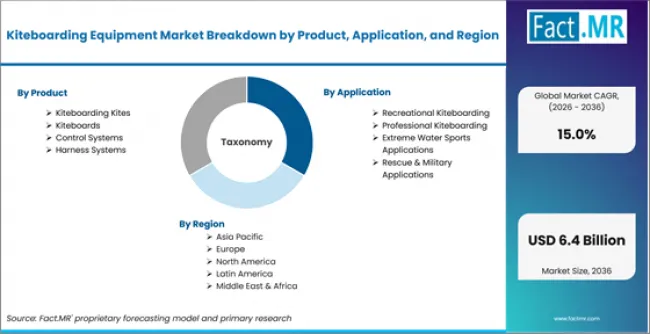
Kiteboarding Equipment Market is segmented by Product (Kiteboarding Kites, Kiteboards, Control Systems, Harness Systems), Application (Recreational Kiteboarding, Professional Kiteboarding, Extreme Water Sports Applications, Rescue & Military Applications), End Use (Individual Consumers, Sports Training Institutes, Tourism & Adventure Operators, Defense & Rescue Organizations), and Region. Forecasts from 2026 to 2036.

Kiteboarding Equipment Market Analysis and Forecast by Fact.MR

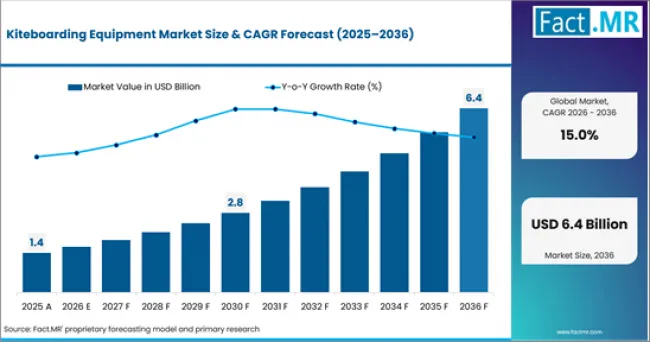
  • The Kiteboarding Equipment Market is expected to grow from USD 1.6 billion in 2026 to USD 6.4 billion by 2036, at a 15.0% CAGR.
  • driven by accelerating global participation in wind-powered water sports, growing school and coaching infrastructure that lowers entry barriers for new riders, and rising adoption of hydrofoil-compatible equipment that extends rideable wind ranges, with kiteboarding kites accounting 48.7% share and recreational kiteboarding contributing 52.9% share as brands prioritize aerodynamic performance, material durability, and safety system refinement.
Kiteboarding Equipment Market Value Analysis

Summary of Kiteboarding Equipment Market

  • Market Snapshot
    • In 2025, the global Kiteboarding Equipment Market was valued at approximately USD 1.4 billion.
    • The market is estimated to reach USD 1.6 billion in 2026 and is projected to attain USD 6.4 billion by 2036.
    • The kiteboarding equipment market is likely to expand at a CAGR of 15.0% during the forecast period.
    • The market is anticipated to create an absolute dollar opportunity of USD 4.8 billion between 2026 and 2036.
    • Kiteboarding kites account for 48.7% of product segment share in 2026.
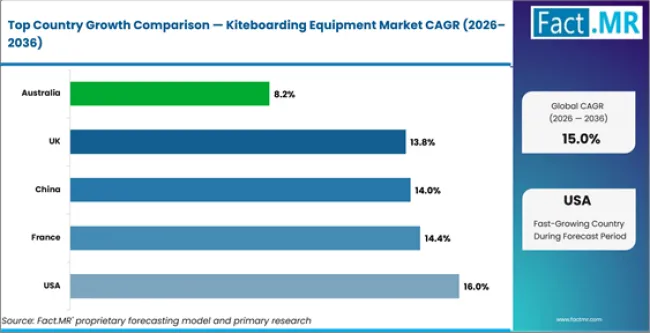
    • USA (16.0%) and France (14.4%) are the key growth markets during the forecast period.
  • Demand and Growth Drivers
    • Inclusion of Formula Kite in the Paris 2024 Olympic Games increased visibility for competitive kite-powered water sports.
    • The emergence of kite schools and coaching certification schemes is reducing the barriers to entry for beginners in coastal tourist destinations across Europe, Southeast Asia and Latin America.
    • Hydrofoil-friendly gear expands the usable wind range, allowing riders to kite in lighter winds and to extend the riding season in temperate climates.
    • Social media and content creation within action sports is fueling interest, with kiteboarding content consistently performing well across visual platforms for the younger demographic.
    • Advanced kite constructions using lighter materials and improved aerodynamics are commanding higher price points, supporting growth in revenues from premium equipment trade-up cycles among experienced riders.
  • Product and Segment View
    • The product segment of kiteboarding kites is 48.7% in 2026. This means that kiteboarding kites are the single highest value component in a kiteboarding setup.
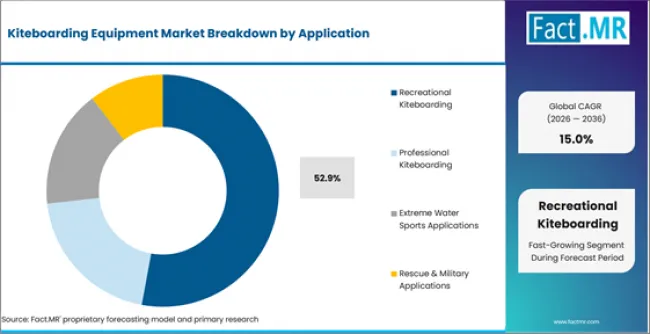
    • The recreational kiteboarding segment holds 52.9% share of the application in 2026. The increasing coastal tourism and organized school programs for entry-level riders are supporting the market growth.
    • The inflatable kite systems segment holds a 58.3% share of the formulation segment, valued for their relaunch capability, versatility in wind range, and durability in varied water conditions.
    • Key segmentation includes:
      • Product: Kiteboarding Kites, Kiteboards, Control Systems, Harness Systems, Safety Gear, Accessories
      • Applications: Recreation, Kiteboarding, Professional Kiteboarding, Extreme Water Sports, Training & Education
      • End Use: Individual Consumers, Sports Training Institutes, Tourism & Adventure Operators, Defence & Rescue Organizations
      • Distribution Channel: Sports Store, Internet Store, Brand Direct Sales
    • These products enable:
      • Wind propulsion on water, snow and land surfaces using aerodynamic kite designs
      • Gradual skill development in safety systems, depower capabilities, and trainer kite programs
      • Lightweight materials, responsive control bars and foil compatible boards for competitive performance
  • Geography and Competitive Outlook
    • North America leads growth at 16.0% for the USA, driven by expanding coastal participation, kite school development, and growing competitive infrastructure along Atlantic and Pacific shorelines.
    • Europe is the most established market, with France at 14.4% benefiting from strong coastal culture, proximity to premium wind locations, and a well-developed school and event ecosystem.
    • Asia Pacific shows emerging demand through coastal tourism in Southeast Asia and Australia (8.2%), where wind conditions and tourism infrastructure support year-round riding activity.
    • Key players include Duotone, North Kiteboarding, F-One, Cabrinha Kites, Slingshot Sports, Naish International, and Core Kiteboarding GmbH.
  • Analyst Opinion
    • Shambhu Nath Jha, Principal Consultant at Fact.MR, says 'The kiteboarding equipment market is at an inflection point. Olympic visibility has moved the sport from a niche action category into a recognized competitive discipline, and school infrastructure is converting that visibility into participant growth. Hydrofoil adoption is the most important product trend because it fundamentally changes the wind threshold needed to ride, which directly extends the addressable riding population and geographic range. Brands investing in foil-compatible kite and board platforms are positioning for a structural shift in how the sport is practiced, not just a short-term product cycle.'

Key Growth Drivers, Constraints, and Opportunities
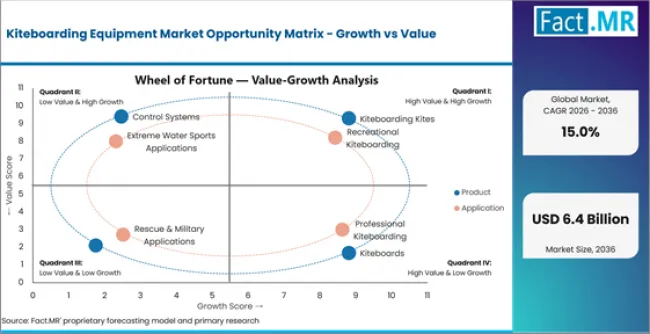
Kiteboarding Equipment Market Opportunity Matrix Growth Vs Value

Key Factors Driving Growth

  • Olympic recognition has accelerated national federation investment in kiteboarding programs, creating structured pathways from beginner enrollment through competitive selection that sustain equipment procurement at every skill level.
  • Hydrofoil technology is extending the rideable wind range below traditional thresholds, enabling sessions in conditions previously considered too light, which directly increases the number of usable riding days per location per year.
  • Coastal tourism development in Southeast Asia, the Caribbean, and the Mediterranean is embedding kiteboarding into resort and destination activity offerings, generating trial participation that converts into equipment purchases.

Key Market Constraints

  • The cost of entry for a full kiteboarding setup will usually be well over USD 2,000 for a beginner package. This limits the conversion rate from trialers to equipment owners in price sensitive markets.
  • Weather and wind dependency leads to a geographic concentration of activity. Demand is heavily skewed toward locations with stable wind resources and developed infrastructure for beach access.
  • Perceived safety is still a barrier to mainstream adoption. Kiteboarding is perceived as riskier than adjacent water sports, limiting growth in participation among older demographics and family segments.

Key Opportunity Areas

  • Kite school-to-purchase conversion programs are developing a structured sales pipeline tied to growth in training enrollment, with kite schools partnering with equipment brands to offer discounted starter packages to graduating students.
  • A related wind-powered water sport, wing foiling, using handheld inflatable wings is growing the kiteboarding brand ecosystem and bringing new consumers to wind-powered riding who may cross-over to kiteboarding.
  • Second hand and rental equipment markets are lowering effective entry costs, enabling growth in participation in price sensitive regions while supporting demand for new equipment as experienced riders upgrade.

Segment-wise Analysis of the Kiteboarding Equipment Market

  • Kiteboarding kites will account for 48.7% of the product segment in 2026, as they are the highest-value and most performance-critical component in a riding setup.
  • Recreational kiteboarding is expected to account for 52.9% of the application segment in 2026, aided by coastal tourism, school enrollment, and increased mainstream visibility via social media and Olympic coverage.
  • Sports retail stores represented the largest share of 63.9% in the distribution channel segment, as a personal consultation about products, sizing, and the local community play a significant role in the purchase of the equipment.

Market segmentation of kiteboarding equipment by product type, application, end use, technology, formulation, distribution channel and region. The market also includes kites, boards, control systems, harnesses, safety equipment and accessories as a by product. The coverage is applicable to recreational, professional, extreme sports and training use cases. Kites are the most expensive single component, leading the way in value, with boards and control systems adding the next largest shares.

Which Product Segment Dominates the Kiteboarding Equipment Market?
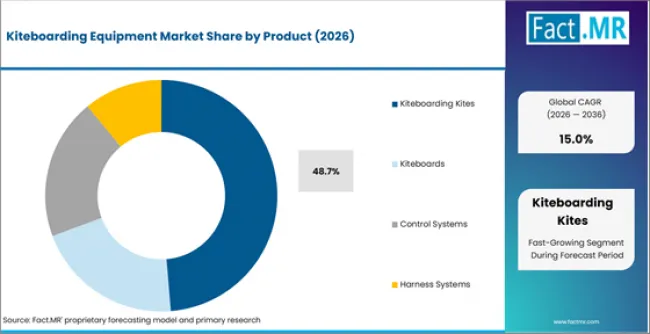
Kiteboarding Equipment Market Analysis By Product

Kiteboarding Kites is 48.7% of the product segment in 2026. They are the highest unit price point and the most common replacement cycle of all kiteboarding equipment categories. Kites are the primary factor in riding performance; aerodynamic design, material construction and size range directly influence wind range, turning speed and depower characteristics. Advanced constructions using D/Lab and SLS materials from brands such as Duotone attract premium prices but offer advantages in terms of weight and reactivity.

The balance of product share is kiteboards, control systems and harness systems. Boards are the second largest category by value. Foil boards are the fastest growing sub-category of boards as hydrofoil adoption accelerates. Control bars and safety systems are important, but they are cheaper components that tend to be replaced less frequently than kites, making smaller individual contributions to revenue.

Which Application Segment Dominates the Kiteboarding Equipment Market?
Kiteboarding Equipment Market Analysis By Application

In 2026, recreational kiteboarding is anticipated to lead the application segment with a 52.9% share. This section is for entry level through intermediate riders who kite for enjoyment, fitness and social activity, not competitive performance. Growth is also being fueled by the development of school infrastructure in coastal tourist destinations where beginners can get certified instruction and rent equipment before they buy.

But professional kiteboarding is a smaller share that affects product development and brand perception through riders competing and sponsored athletes. Some niche segments include use of extreme water sports applications and rescue and military use cases. The recreational kiteboarding leadership is expected to consolidate as mainstream visibility and school accessibility lower participation barriers.

Which Product Trend is Shaping the Next Phase of Growth in the Kiteboarding Equipment Market?

The biggest product shift in the kiteboarding market is hydrofoil-compatible equipment. Foil boards have a submerged hydrofoil wing that holds the rider above the water, which reduces drag. Foil boards can be ridden in far lighter winds than traditional twin-tip or directional boards. This technology extends the usable wind window from approximately 12 knots down to 8 knots or less, which directly translates into an increase in the number of days per year that can be ridden at most locations.

Commercial impact works both ways. First, there is a trade-up cycle spurred by foil adoption as experienced riders add foil boards and foil-optimized kites to their quivers, creating incremental equipment purchases. 2. You can kiteboard in lighter winds. This opens up the range of potentially suitable kiteboarding locations, broadening the sport into areas that were once marginal for wind-powered water sports. Brands that build kites specifically for foils and match them with boards to match are riding this structural wave of how and where the sport is practiced.

Regional Outlook Across Key Markets

  • The USA leads growth at 16.0%, driven by expanding coastal participation along the Outer Banks, Hood River, South Padre, and Florida coastlines, with growing school infrastructure and competitive event calendars.
  • France at 14.4% benefits from established kite culture along the Atlantic coast, strong school networks, and proximity to premium European wind destinations that support year-round participation.
  • China is emerging at 14.0% through coastal resort development, domestic manufacturing of entry-level equipment and government sports tourism investment in provinces such as Hainan and Shandong.
  • Backed by strong coastal wind resources, a robust culture of outdoor sports and a reliance on imports that skews the market towards the mid-range and premium segments, Australia is estimated to account for 8.2%.

Top Country Growth Comparison Kiteboarding Equipment Market Cagr (2026 2036)

Country CAGR (%)
USA 16.0%
France 14.4%
China 14.0%
United Kingdom 13.8%
Australia 8.2%

Source: Fact.MR analysis, based on proprietary forecasting model and primary research.
Kiteboarding Equipment Market Cagr Analysis By Country

Market Outlook for Kiteboarding Equipment in the United States
Kiteboarding Equipment Market Country Value Analysis

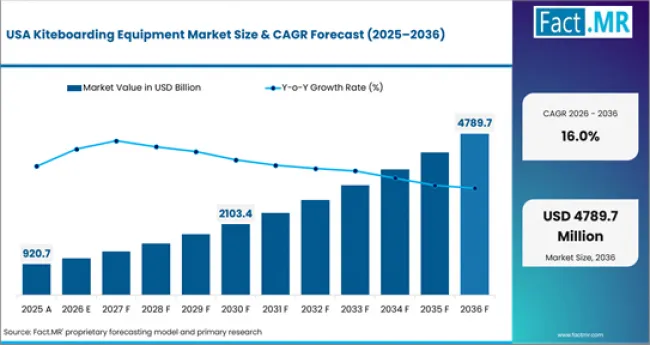
The U.S. kiteboarding equipment market is projected to grow at a CAGR of 16.0% through 2036. Demand is concentrated along established coastal corridors where consistent wind resources, beach access infrastructure, and organized school operations support both beginner enrollment and experienced rider activity. IRA provisions and state-level sports tourism incentives are indirectly supporting coastal recreation infrastructure that benefits kiteboarding access and facility development.

  • Expanding school and certification infrastructure along Atlantic, Gulf, and Pacific coastlines is converting trial participants into equipment buyers at accelerating rates.
  • Reshoring of sports equipment retail through direct-to-consumer brand channels is enabling U.S.-based riders to access new product lines at launch pricing without import lag.

France Kiteboarding Equipment Demand Trends

Kite culture gained traction along the French Atlantic coast, with a 14.4% CAGR for France expected through 2036. Leucate, La Baule and Ile de Re are seasonal training and racing bases that draw riders from all over Europe. Government-sponsored sports federation programs offer a clear pathway from beginner training to competitive selection, guaranteeing demand for equipment at all skill levels.

  • Federation-run coaching certification guarantees uniformity of instruction quality, resulting in better beginner-to-buyer conversion rates than in unregulated markets.
  • Close to Mediterranean and Atlantic wind spots that guarantees riding activity and equipment use all year round, and less seasonal demand concentration.

China Kiteboarding Equipment Market Growth Assessment

Coastal resort development is opening up kiteboarding destinations in provinces like Hainan and Shandong, supporting the China market at a projected 14.0% CAGR through 2036. Government investment in sports tourism and the domestic production of entry-level kites and boards are helping to reduce the cost barriers to entry for new entrants. E-commerce platforms are expanding availability for domestic and imported equipment in coastal and inland pools of buyers.

  • Pricing for entry level and mid-range kites is at a lower price point than imported options, so there is an opportunity to grow participation among price sensitive new riders.
  • Hainan Province is aiming to be a watersports tourism hub, generating concentrated demand for rental equipment, school operations and retail infrastructure at beach destinations.

United Kingdom Kiteboarding Equipment Market Outlook

For instance, due to regulatory standards for imported sports equipment post-Brexit, the UK kiteboarding industry is expected to grow at a CAGR of 13.8% through 2036 with different certification processes. Demand is high on the south and east coasts for areas with consistent wind resources and active riding communities such as Camber Sands, Hunstanton and the Scottish Highlands. The main channel for buying equipment is online retail, as the specialized kiteboarding retail footprint remains limited outside of coastal towns.

  • It also depends on the local building regulations and coastal access regulations that are being updated and where the kite schools can be situated.
  • Increased adoption of wing foiling among UK riders is expanding the wind-powered water sports buyer base, with crossover to kiteboarding creating incremental equipment demand.

Australia Kiteboarding Equipment Market Opportunity Analysis

This is driven by consistent coastal wind resources in Queensland, Victoria, and Western Australia. Australia is expected to grow at an 8.2% CAGR through 2036. AS/NZS compliance standards impact equipment safety specs and import dependency, with no major kiteboarding brands manufacturing in country, results in freight cost and lead time considerations that skew the market to mid-range and premium product tiers.

  • WA's mining and resources sector has created employment patterns that foster a buyer demographic with high disposable income and proximity to prime coastal wind locations.
  • All major equipment brands are imported, with pricing premiums of 15 to 25% over European retail prices. Purchases are focused on mid-range and premium tiers and away from entry level.

Competitive Benchmarking and Company Positioning
Kiteboarding Equipment Market Analysis By Company

Kiteboarding Equipment Market Analysis By Company

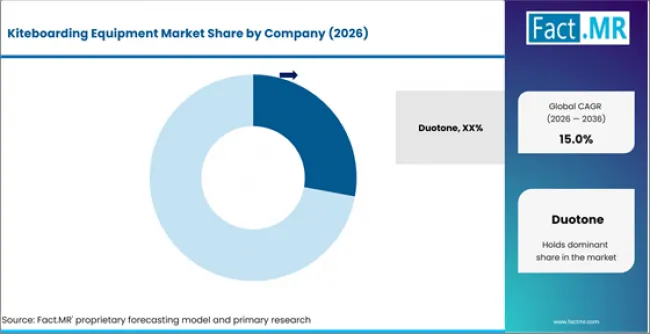
  • Duotone, North Kiteboarding, and F-One lead the global market through advanced kite design, broad product portfolios spanning kites, boards, and foils, and strong brand equity built through professional rider sponsorship and competitive event presence.
  • Cabrinha Kites, Slingshot Sports, Naish International and Core Kiteboarding compete through focused product positioning, regional distribution strength and targeted innovation in specific product categories such as foil boards and control systems.
  • The integration of the brand-rider-school ecosystem creates competitive differentiation, as brands that support school networks with demo equipment, instructor partnerships and certification programs benefit from structured conversion pathways from beginner to buyer.

It’s a close contest among a select group of established action sports brands that dominate kite design, board production and accessory ecosystems. Through its parent company Boards and More GmbH, Duotone has the biggest market share worldwide, D/Lab and SLS material technologies, a complete range of products and a large portfolio of sponsored riders. North Kiteboarding and F-One compete with aerodynamic design and strong European distribution.

The North American and Asia Pacific markets are well served by Cabrinha, Naish and Slingshot, thanks to brand heritage, partnerships with kite schools and the early investment in hydrofoil-ready product lines. Core Kiteboarding targets a performance niche with German engineering credentials, and a growing foil equipment range.

The use of hydrofoils is pushing more and more competition. Brands designing kites specifically for foils, dedicated foil boards and control systems are winning the fastest-growing product sub-categories. The merging of school brands, with equipment makers supporting instructor training and demo programs, is also becoming a competitive lever for beginner market share.

Key Companies in the Kiteboarding Equipment Market

  • Duotone, North Kiteboarding, F-One, and Cabrinha Kites are among the leading global players, supported by advanced kite design, broad product ecosystems, and strong competitive rider sponsorship programs that drive brand visibility and product development.
  • Slingshot Sports, Naish International, Core Kiteboarding GmbH, Best Kiteboarding, Airush Kiteboarding, CrazyFly, Eleveight, Roberto Ricci Designs, and Nobile Sports compete across regional markets and specific product categories, reinforcing a fragmented but active competitive environment.

Recent Industry Developments

  • Cabrinha Expands Performance Kite Portfolio with Moto X Apex Series (2024)

    Cabrinha expanded its premium kite lineup through the introduction of the Moto X Apex Series, featuring Ultra HT materials and lightweight construction technologies designed to improve responsiveness, efficiency, and durability. The launch reflects ongoing innovation in high-performance kiteboarding equipment and increasing demand for advanced materials in kite design.

  • North Kiteboarding Unveils 2026 Big Air Collection Featuring Redesigned Orbit Kite (August 2025)

    North Kiteboarding launched its 2026 Big Air Collection, headlined by a completely redesigned Orbit Big Air Kite along with the new Atmos Pro, Atmos, and Astra twin-tip boards. The new Orbit features a higher aspect ratio, updated N-Max2 airframe technology, slimmer leading edge, and enhanced aerodynamic design to improve lift, hangtime, responsiveness, and rider control.

  • F-One, Product Launch, Hydrofoil Equipment Range Expansion (2026)

    F-One expanded its hydrofoil equipment portfolio with updated foil boards, masts, and wing sets designed for kiteboarding and wing foiling applications. The expansion reinforces F-One's position in the fastest-growing equipment sub-category and supports its strategy of multi-discipline wind-powered water sports coverage.

Leading Companies Shaping the Kiteboarding Equipment Market

  • Duotone
  • Cabrinha Kites
  • North Kiteboarding
  • F-One
  • Core Kiteboarding GmbH
  • Naish International
  • Slingshot Sports

Sources and Research References

  • Kite Wing & Foil. (2024). Top 5 reasons to choose the Cabrinha Moto X for your next adventure.
  • Sail-World. (2025, August 7). North unveils the 2026 Big Air Collection.
  • King of Watersports. (2026). F-One 2026 foil range.

This bibliography is provided for reader reference and is not exhaustive. The full report contains the complete reference list and detailed citations.

Key Questions This Report Addresses

  • What is the current and future size of the Kiteboarding Equipment Market?
  • How fast is the Kiteboarding Equipment Market expected to grow between 2026 and 2036?
  • Which product type is likely to lead the market by 2026?
  • Which application segment is expected to account for the highest demand by 2026?
  • What factors are driving demand for kiteboarding equipment globally?
  • How is hydrofoil technology influencing product development and market expansion?
  • Why is the USA emerging as the fastest-growing market?
  • How is Olympic recognition influencing sport participation and equipment demand?
  • Which countries are projected to show the fastest growth through 2036?
  • Who are the key companies active in the Kiteboarding Equipment Market?
  • How does Fact.MR estimate and validate the market forecast?

Kiteboarding Equipment Market Definition

The kiteboarding equipment market covers kites, boards, control systems, harness systems, safety equipment, and accessories designed for wind-powered riding across water, land, and snow surfaces. It includes inflatable kite systems, foil kite systems, hybrid designs, twin-tip boards, directional boards, and hydrofoil setups distributed through sports retail, online platforms, and direct brand channels.

Kiteboarding Equipment Market Inclusions

  • The scope covers global and regional market size and forecasts for 2026 to 2036 across product type, application, end use, technology, formulation, distribution channel, and region.
  • It includes regional demand analysis based on coastal access, wind conditions, tourism infrastructure, competitive event calendars, and school and coaching capacity.
  • The report covers pricing and cost analysis across entry-level, intermediate, and premium equipment tiers, including materials, construction methods, and brand positioning factors.

Kiteboarding Equipment Market Exclusions

  • The scope excludes windsurfing, sailing, and stand-up paddleboard equipment not designed for kite-powered use.
  • It excludes general watersport apparel, wetsuits, and accessories not specific to kiteboarding activity.
  • The report excludes paragliding, hang gliding, and power kiting equipment not designed for water-surface riding.

Kiteboarding Equipment Market Research Methodology

  • The methodology combines secondary research, primary interviews, and forecast modelling.
  • It draws on 80+ secondary sources and benchmarks 40+ company product portfolios.
  • Market sizing covers 25+ countries through a demand-side model, supported by top-down validation.
  • Important inputs are coastal tourism data, wind resource maps, school enrollment trends, participation in competitive events, and e-commerce penetration.
  • The model then compares demand to production data, pricing trends, channel mix and brand launch cycles.
  • Primary validation includes 20+ interviews across manufacturers, school operators, distributors, and professional riders.
  • Final estimates go through trade-flow checks, sales-pattern review, and sensitivity testing.

Scope of Analysis

Kiteboarding Equipment Market Breakdown By Product, Application, And Region

Parameter Details
Quantitative Units USD 1.6 billion to USD 6.4 billion, at a CAGR of 15.0%
Market Definition The Kiteboarding Equipment Market covers kites, boards, control systems, harnesses, safety equipment, and accessories for wind-powered riding across water, land, and snow surfaces.
Regions Covered North America, Latin America, Europe, East Asia, South Asia and Pacific, Middle East and Africa
Countries Covered USA, France, China, UK, Australia, 25 plus countries
Key Companies Duotone, North Kiteboarding, F-One,  Cabrinha Kites,  Slingshot Sports, Naish International, Core Kiteboarding GmbH, Airush Kiteboarding
Forecast Period 2026 to 2036
Approach Hybrid demand-side and top-down methodology built on coastal tourism data, wind resource assessment, school enrollment trends, product benchmarking, pricing analysis, and primary interviews across manufacturers, school operators, distributors, and professional riders

Kiteboarding Equipment Market Segmentation

  • Kiteboarding Equipment Market Segmented by Product:

    • Kiteboarding Kites
      • Inflatable Leading Edge Kites
        • Freeride Kites
        • Wave Riding Kites
      • Foil Kites
        • Light Wind Foil Kites
        • High Performance Foil Kites
    • Kiteboards
      • Twin Tip Boards
        • Freestyle Twin Tip Boards
        • Beginner Twin Tip Boards
      • Directional Boards
        • Wave Surf Boards
        • Hydrofoil Boards
    • Control Systems
      • Kite Control Bars
        • Depower Control Bars
        • Adjustable Line Bars
      • Safety Release Systems
        • Quick Release Mechanisms
        • Emergency Depower Systems
    • Harness Systems
      • Seat Harnesses
        • Recreational Seat Harnesses
        • Professional Seat Harnesses
      • Waist Harnesses
        • Freestyle Waist Harnesses
        • Wave Riding Waist Harnesses
  • Kiteboarding Equipment Market Segmented by Application:

    • Recreational Kiteboarding
      • Beach Leisure Sports
        • Casual Water Riding Activities
        • Weekend Adventure Sports
      • Travel Based Kiteboarding
        • Tourism Water Sports Activities
        • Vacation Adventure Experiences
    • Professional Kiteboarding
      • Competitive Sports Applications
        • Kiteboarding Racing Events
        • Freestyle Competition Events
      • Training & Coaching Applications
        • Professional Skill Development
        • Instructor Training Programs
    • Extreme Water Sports Applications
      • Wave Riding Applications
        • Ocean Surf Kiteboarding
        • Coastal Wave Sports Activities
      • Big Air Applications
        • High Altitude Jumping Sports
        • Aerial Trick Performance Sports
    • Rescue & Military Applications
      • Water Rescue Operations
        • Coastal Emergency Response
        • Flood Rescue Operations
      • Military Training Applications
        • Water Mobility Training
        • Coastal Patrol Training
  • Kiteboarding Equipment Market Segmented by End Use:

    • Individual Consumers
      • Recreational Users
        • Beginner Kiteboarders
        • Intermediate Hobby Riders
      • Professional Athletes
        • Competition Riders
        • Sponsored Sports Athletes
    • Sports Training Institutes
      • Water Sports Academies
        • Kiteboarding Schools
        • Adventure Sports Institutes
      • Professional Coaching Centers
        • Certification Training Centers
        • Advanced Skill Development Centers
    • Tourism & Adventure Operators
      • Water Sports Tourism Companies
        • Beach Activity Operators
        • Resort Adventure Centers
      • Adventure Travel Companies
        • Extreme Sports Tour Operators
        • Coastal Experience Providers
    • Defense & Rescue Organizations
      • Coastal Security Agencies
        • Maritime Patrol Units
        • Lifeguard Rescue Teams
      • Disaster Response Units
        • Flood Relief Teams
        • Emergency Water Rescue Teams
  • Kiteboarding Equipment Market Segmented by Technology:

    • Kite Aerodynamic Design Technology
      • Inflation Structure Technology
        • Leading Edge Inflation Systems
        • Air Chamber Stability Systems
      • Wing Shape Optimization Technology
        • High Lift Kite Profiles
        • Low Drag Kite Structures
    • Control System Technology
      • Dynamic Tension Control Systems
        • Real Time Line Adjustment Systems
        • Auto Depower Mechanisms
      • Safety Release Technology
        • Instant Release Trigger Systems
        • Load Based Safety Activation Systems
    • Material Engineering Technology
      • High Strength Fabric Technology
        • Ripstop Nylon Enhancement Systems
        • UV Resistant Material Coatings
      • Composite Reinforcement Technology
        • Carbon Reinforced Kite Structures
        • Lightweight Polymer Frame Systems
  • Kiteboarding Equipment Market Segmented by Formulation:

    • Inflatable Kite Systems
      • Single Chamber Systems
        • Basic Recreational Kite Structures
        • Entry Level Training Kites
      • Multi Chamber Systems
        • Advanced Stability Kites
        • High Wind Resistance Kites
    • Foil Kite Systems
      • Closed Cell Foil Designs
        • Light Wind Performance Kites
        • Long Distance Riding Kites
      • Open Cell Foil Designs
        • Freestyle Performance Kites
        • Agile Maneuver Kites
    • Hybrid Kite Systems
      • Mixed Structure Kites
        • Wave + Freeride Hybrid Kites
        • Competition Grade Hybrid Kites
      • Adaptive Performance Systems
        • Wind Variable Adjustment Kites
        • Multi Terrain Riding Kites
  • Kiteboarding Equipment Market Segmented by Distribution Channel:

    • Sports Retail Stores
      • Specialty Water Sports Stores
        • Kiteboarding Equipment Shops
        • Surf & Water Sports Retailers
      • Outdoor Adventure Stores
        • Extreme Sports Equipment Stores
        • Adventure Gear Retail Chains
    • Online Retail Platforms
      • E Commerce Marketplaces
        • Global Sports Equipment Platforms
        • Direct Brand Online Stores
      • Specialized Online Stores
        • Kiteboarding Gear Websites
        • Niche Water Sports Platforms
    • Direct Brand Sales
      • Manufacturer Direct Sales
        • Premium Kiteboarding Brands
        • Professional Gear Manufacturers
      • Sponsored Athlete Sales Channels
        • Pro Rider Equipment Supply
        • Competition Gear Distribution
  • Kiteboarding Equipment Market by Region:

    • North America
      • USA
      • Canada
      • Mexico
    • Latin America
      • Brazil
      • Chile
      • Rest of Latin America
    • Western Europe
      • Germany
      • UK
      • Italy
      • Spain
      • France
      • Nordic
      • BENELUX
      • Rest of Western Europe
    • Eastern Europe
      • Russia
      • Poland
      • Hungary
      • Balkan & Baltic
      • Rest of Eastern Europe
    • East Asia
      • China
      • Japan
      • South Korea
    • South Asia and Pacific
      • India
      • ASEAN
      • Australia & New Zealand
      • Rest of South Asia and Pacific
    • Middle East & Africa
      • Kingdom of Saudi Arabia
      • Other GCC Countries
      • Turkiye
      • South Africa
      • Other African Union
      • Rest of Middle East & Africa

- Frequently Asked Questions -

How big is the kiteboarding equipment market in 2026?

The global kiteboarding equipment market is estimated to be valued at USD 1.6 billion in 2026.

What will be the size of the kiteboarding equipment market in 2036?

The market size for the kiteboarding equipment market is projected to reach USD 6.4 billion by 2036.

How much will be the kiteboarding equipment market growth between 2026 and 2036?

The kiteboarding equipment market is expected to grow at a 15.0% CAGR between 2026 and 2036.

What are the key products in the kiteboarding equipment market?

The key products in kiteboarding equipment market are Kiteboarding Kites, Kiteboards, Control Systems and Harness Systems.

Which application segment is expected to contribute significant share in the kiteboarding equipment market in 2026?

In terms of application, recreational kiteboarding segment is expected to command 52.9% share in the kiteboarding equipment market in 2026.

Table of Content

  1. Key Takeaways
    • Market Size and CAGR
    • Top Growth Driver
    • Fastest Growing Segment
    • Leading Region
    • Key Companies
    • Emerging Opportunities
  2. Executive Summary
    • Global Market Outlook
    • Demand-side Trends
    • Supply-side Trends
    • Technology Roadmap Analysis
    • Analysis and Recommendations
    • Analyst Perspective (What is happening? Why now? What should investors know?)
    • Key Questions Answered
      • How large is the market?
      • What is the CAGR?
      • What are key trends?
      • Which region dominates?
      • Who are the leaders?
  3. Market Overview
    • Market Coverage / Taxonomy
    • Market Definition / Scope / Limitations
  4. Research Methodology
    • Chapter Orientation
    • Analytical Lens and Working Hypotheses
      • Market Structure, Signals, and Trend Drivers
      • Benchmarking and Cross-market Comparability
      • Market Sizing, Forecasting, and Opportunity Mapping
    • Research Design and Evidence Framework
      • Desk Research Programme (Secondary Evidence)
      • Expert Input and Fieldwork (Primary Evidence)
      • Tooling, Models, and Reference Databases
    • Data Engineering and Model Build
    • Quality Assurance and Audit Trail
  5. Market Background
    • Market Dynamics (Drivers, Restraints, Opportunity, Trends)
    • Scenario Forecast (Optimistic, Likely, Conservative)
    • Impact Analysis
      • AI Impact
      • Sustainability Impact
      • Regulatory Impact
      • Technology Impact
    • Consumer / Buyer Analysis
      • Purchase Drivers
      • Adoption Barriers
      • Buyer Journey
    • Opportunity Map Analysis
    • Product Life Cycle Analysis
    • Supply Chain Analysis
    • Investment Feasibility Matrix
    • Value Chain Analysis
    • PESTLE and Porter's Analysis
    • Regulatory Landscape
    • Regional Parent Market Outlook
    • Production and Consumption Statistics
    • Import and Export Statistics
  6. Global Market Analysis and Forecast, 2021 to 2036
    • Historical Market Size Value (USD Million) Analysis, 2021 to 2025
    • Current and Future Market Size Value (USD Million) Projections, 2026 to 2036
      • Y-o-Y Growth Trend Analysis
      • Absolute $ Opportunity Analysis
  7. Global Market Pricing Analysis, 2021 to 2036
  8. Global Market Analysis and Forecast, By Product, 2021 to 2036
    • Introduction / Key Findings
    • Historical Market Size Value (USD Million) Analysis By Product, 2021 to 2025
    • Current and Future Market Size Value (USD Million) Analysis and Forecast By Product, 2026 to 2036
      • Kiteboarding Kites
        • Inflatable Leading Edge Kites
        • Foil Kites
      • Kiteboards
        • Twin Tip Boards
        • Directional Boards
      • Control Systems
        • Kite Control Bars
        • Safety Release Systems
      • Harness Systems
        • Seat Harnesses
        • Waist Harnesses
    • Y-o-Y Growth Trend Analysis By Product, 2021 to 2025
    • Absolute $ Opportunity Analysis By Product, 2026 to 2036
  9. Global Market Analysis and Forecast, By Application, 2021 to 2036
    • Introduction / Key Findings
    • Historical Market Size Value (USD Million) Analysis By Application, 2021 to 2025
    • Current and Future Market Size Value (USD Million) Analysis and Forecast By Application, 2026 to 2036
      • Recreational Kiteboarding
        • Beach Leisure Sports
        • Travel Based Kiteboarding
      • Professional Kiteboarding
        • Competitive Sports Applications
        • Training & Coaching Applications
      • Extreme Water Sports Applications
        • Wave Riding Applications
        • Big Air Applications
      • Rescue & Military Applications
        • Water Rescue Operations
        • Military Training Applications
    • Y-o-Y Growth Trend Analysis By Application, 2021 to 2025
    • Absolute $ Opportunity Analysis By Application, 2026 to 2036
  10. Global Market Analysis and Forecast, By End Use, 2021 to 2036
    • Introduction / Key Findings
    • Historical Market Size Value (USD Million) Analysis By End Use, 2021 to 2025
    • Current and Future Market Size Value (USD Million) Analysis and Forecast By End Use, 2026 to 2036
      • Individual Consumers
        • Recreational Users
        • Professional Athletes
      • Sports Training Institutes
        • Water Sports Academies
        • Professional Coaching Centers
      • Tourism & Adventure Operators
        • Water Sports Tourism Companies
        • Adventure Travel Companies
      • Defense & Rescue Organizations
        • Coastal Security Agencies
        • Disaster Response Value (USD Million)s
    • Y-o-Y Growth Trend Analysis By End Use, 2021 to 2025
    • Absolute $ Opportunity Analysis By End Use, 2026 to 2036
  11. Global Market Analysis and Forecast, By Technology, 2021 to 2036
    • Introduction / Key Findings
    • Historical Market Size Value (USD Million) Analysis By Technology, 2021 to 2025
    • Current and Future Market Size Value (USD Million) Analysis and Forecast By Technology, 2026 to 2036
      • Kite Aerodynamic Design Technology
        • Inflation Structure Technology
        • Wing Shape Optimization Technology
      • Control System Technology
        • Dynamic Tension Control Systems
        • Safety Release Technology
      • Material Engineering Technology
        • High Strength Fabric Technology
        • Composite Reinforcement Technology
    • Y-o-Y Growth Trend Analysis By Technology, 2021 to 2025
    • Absolute $ Opportunity Analysis By Technology, 2026 to 2036
  12. Global Market Analysis and Forecast, By Formulation, 2021 to 2036
    • Introduction / Key Findings
    • Historical Market Size Value (USD Million) Analysis By Formulation, 2021 to 2025
    • Current and Future Market Size Value (USD Million) Analysis and Forecast By Formulation, 2026 to 2036
      • Inflatable Kite Systems
        • Single Chamber Systems
        • Multi Chamber Systems
      • Foil Kite Systems
        • Closed Cell Foil Designs
        • Open Cell Foil Designs
      • Hybrid Kite Systems
        • Mixed Structure Kites
        • Adaptive Performance Systems
    • Y-o-Y Growth Trend Analysis By Formulation, 2021 to 2025
    • Absolute $ Opportunity Analysis By Formulation, 2026 to 2036
  13. Global Market Analysis and Forecast, By Distribution Channel
    • Introduction / Key Findings
    • Historical Market Size Value (USD Million) Analysis By Distribution Channel, 2021 to 2025
    • Current and Future Market Size Value (USD Million) Analysis and Forecast By Distribution Channel, 2026 to 2036
      • Sports Retail Stores
        • Specialty Water Sports Stores
        • Outdoor Adventure Stores
      • Online Retail Platforms
        • E Commerce Marketplaces
        • Specialized Online Stores
      • Direct Brand Sales
        • Manufacturer Direct Sales
        • Sponsored Athlete Sales Channels
    • Y-o-Y Growth Trend Analysis By Distribution Channel, 2021 to 2025
    • Absolute $ Opportunity Analysis By Distribution Channel, 2026 to 2036
  14. Global Market Analysis and Forecast, By Region, 2021 to 2036
    • Introduction
    • Historical Market Size Value (USD Million) Analysis By Region, 2021 to 2025
    • Current Market Size Value (USD Million) Analysis and Forecast By Region, 2026 to 2036
      • North America
      • Latin America
      • Western Europe
      • Eastern Europe
      • East Asia
      • South Asia and Pacific
      • Middle East & Africa
    • Market Attractiveness Analysis By Region
  15. North America Market Analysis and Forecast, By Country, 2021 to 2036
    • Historical Market Size Value (USD Million) Trend Analysis By Market Taxonomy, 2021 to 2025
    • Market Size Value (USD Million) Forecast By Market Taxonomy, 2026 to 2036
      • By Country
        • USA
        • Canada
        • Mexico
      • By Product
      • By Application
      • By End Use
      • By Technology
      • By Formulation
      • By Distribution Channel
    • Market Attractiveness Analysis
      • By Country
      • By Product
      • By Application
      • By End Use
      • By Technology
      • By Formulation
      • By Distribution Channel
    • Key Takeaways
  16. Latin America Market Analysis and Forecast, By Country
    • Historical Market Size Value (USD Million) Trend Analysis By Market Taxonomy, 2021 to 2025
    • Market Size Value (USD Million) Forecast By Market Taxonomy, 2026 to 2036
      • By Country
        • Brazil
        • Chile
        • Rest of Latin America
      • By Product
      • By Application
      • By End Use
      • By Technology
      • By Formulation
      • By Distribution Channel
    • Market Attractiveness Analysis
      • By Country
      • By Product
      • By Application
      • By End Use
      • By Technology
      • By Formulation
      • By Distribution Channel
    • Key Takeaways
  17. Western Europe Market Analysis and Forecast, By Country
    • Historical Market Size Value (USD Million) Trend Analysis By Market Taxonomy, 2021 to 2025
    • Market Size Value (USD Million) Forecast By Market Taxonomy, 2026 to 2036
      • By Country
        • Germany
        • UK
        • Italy
        • Spain
        • France
        • Nordic
        • BENELUX
        • Rest of Western Europe
      • By Product
      • By Application
      • By End Use
      • By Technology
      • By Formulation
      • By Distribution Channel
    • Market Attractiveness Analysis
      • By Country
      • By Product
      • By Application
      • By End Use
      • By Technology
      • By Formulation
      • By Distribution Channel
    • Key Takeaways
  18. Eastern Europe Market Analysis and Forecast, By Country
    • Historical Market Size Value (USD Million) Trend Analysis By Market Taxonomy, 2021 to 2025
    • Market Size Value (USD Million) Forecast By Market Taxonomy, 2026 to 2036
      • By Country
        • Russia
        • Poland
        • Hungary
        • Balkan & Baltic
        • Rest of Eastern Europe
      • By Product
      • By Application
      • By End Use
      • By Technology
      • By Formulation
      • By Distribution Channel
    • Market Attractiveness Analysis
      • By Country
      • By Product
      • By Application
      • By End Use
      • By Technology
      • By Formulation
      • By Distribution Channel
    • Key Takeaways
  19. East Asia Market Analysis and Forecast, By Country
    • Historical Market Size Value (USD Million) Trend Analysis By Market Taxonomy, 2021 to 2025
    • Market Size Value (USD Million) Forecast By Market Taxonomy, 2026 to 2036
      • By Country
        • China
        • Japan
        • South Korea
      • By Product
      • By Application
      • By End Use
      • By Technology
      • By Formulation
      • By Distribution Channel
    • Market Attractiveness Analysis
      • By Country
      • By Product
      • By Application
      • By End Use
      • By Technology
      • By Formulation
      • By Distribution Channel
    • Key Takeaways
  20. South Asia and Pacific Market Analysis and Forecast, By Country
    • Historical Market Size Value (USD Million) Trend Analysis By Market Taxonomy, 2021 to 2025
    • Market Size Value (USD Million) Forecast By Market Taxonomy, 2026 to 2036
      • By Country
        • India
        • ASEAN
        • Australia & New Zealand
        • Rest of South Asia and Pacific
      • By Product
      • By Application
      • By End Use
      • By Technology
      • By Formulation
      • By Distribution Channel
    • Market Attractiveness Analysis
      • By Country
      • By Product
      • By Application
      • By End Use
      • By Technology
      • By Formulation
      • By Distribution Channel
    • Key Takeaways
  21. Middle East & Africa Market Analysis and Forecast, By Country
    • Historical Market Size Value (USD Million) Trend Analysis By Market Taxonomy, 2021 to 2025
    • Market Size Value (USD Million) Forecast By Market Taxonomy, 2026 to 2036
      • By Country
        • Kingdom of Saudi Arabia
        • Other GCC Countries
        • Turkiye
        • South Africa
        • Other African Union
        • Rest of Middle East & Africa
      • By Product
      • By Application
      • By End Use
      • By Technology
      • By Formulation
      • By Distribution Channel
    • Market Attractiveness Analysis
      • By Country
      • By Product
      • By Application
      • By End Use
      • By Technology
      • By Formulation
      • By Distribution Channel
    • Key Takeaways
  22. Key Countries Market Analysis
    • USA
      • Pricing Analysis
      • Market Share Analysis, 2025
        • By Product
        • By Application
        • By End Use
        • By Technology
        • By Formulation
        • By Distribution Channel
    • Canada
      • Pricing Analysis
      • Market Share Analysis, 2025
        • By Product
        • By Application
        • By End Use
        • By Technology
        • By Formulation
        • By Distribution Channel
    • Mexico
      • Pricing Analysis
      • Market Share Analysis, 2025
        • By Product
        • By Application
        • By End Use
        • By Technology
        • By Formulation
        • By Distribution Channel
    • Brazil
      • Pricing Analysis
      • Market Share Analysis, 2025
        • By Product
        • By Application
        • By End Use
        • By Technology
        • By Formulation
        • By Distribution Channel
    • Chile
      • Pricing Analysis
      • Market Share Analysis, 2025
        • By Product
        • By Application
        • By End Use
        • By Technology
        • By Formulation
        • By Distribution Channel
    • Germany
      • Pricing Analysis
      • Market Share Analysis, 2025
        • By Product
        • By Application
        • By End Use
        • By Technology
        • By Formulation
        • By Distribution Channel
    • UK
      • Pricing Analysis
      • Market Share Analysis, 2025
        • By Product
        • By Application
        • By End Use
        • By Technology
        • By Formulation
        • By Distribution Channel
    • Italy
      • Pricing Analysis
      • Market Share Analysis, 2025
        • By Product
        • By Application
        • By End Use
        • By Technology
        • By Formulation
        • By Distribution Channel
    • Spain
      • Pricing Analysis
      • Market Share Analysis, 2025
        • By Product
        • By Application
        • By End Use
        • By Technology
        • By Formulation
        • By Distribution Channel
    • France
      • Pricing Analysis
      • Market Share Analysis, 2025
        • By Product
        • By Application
        • By End Use
        • By Technology
        • By Formulation
        • By Distribution Channel
    • India
      • Pricing Analysis
      • Market Share Analysis, 2025
        • By Product
        • By Application
        • By End Use
        • By Technology
        • By Formulation
        • By Distribution Channel
    • ASEAN
      • Pricing Analysis
      • Market Share Analysis, 2025
        • By Product
        • By Application
        • By End Use
        • By Technology
        • By Formulation
        • By Distribution Channel
    • Australia & New Zealand
      • Pricing Analysis
      • Market Share Analysis, 2025
        • By Product
        • By Application
        • By End Use
        • By Technology
        • By Formulation
        • By Distribution Channel
    • China
      • Pricing Analysis
      • Market Share Analysis, 2025
        • By Product
        • By Application
        • By End Use
        • By Technology
        • By Formulation
        • By Distribution Channel
    • Japan
      • Pricing Analysis
      • Market Share Analysis, 2025
        • By Product
        • By Application
        • By End Use
        • By Technology
        • By Formulation
        • By Distribution Channel
    • South Korea
      • Pricing Analysis
      • Market Share Analysis, 2025
        • By Product
        • By Application
        • By End Use
        • By Technology
        • By Formulation
        • By Distribution Channel
    • Russia
      • Pricing Analysis
      • Market Share Analysis, 2025
        • By Product
        • By Application
        • By End Use
        • By Technology
        • By Formulation
        • By Distribution Channel
    • Poland
      • Pricing Analysis
      • Market Share Analysis, 2025
        • By Product
        • By Application
        • By End Use
        • By Technology
        • By Formulation
        • By Distribution Channel
    • Hungary
      • Pricing Analysis
      • Market Share Analysis, 2025
        • By Product
        • By Application
        • By End Use
        • By Technology
        • By Formulation
        • By Distribution Channel
    • Kingdom of Saudi Arabia
      • Pricing Analysis
      • Market Share Analysis, 2025
        • By Product
        • By Application
        • By End Use
        • By Technology
        • By Formulation
        • By Distribution Channel
    • Turkiye
      • Pricing Analysis
      • Market Share Analysis, 2025
        • By Product
        • By Application
        • By End Use
        • By Technology
        • By Formulation
        • By Distribution Channel
    • South Africa
      • Pricing Analysis
      • Market Share Analysis, 2025
        • By Product
        • By Application
        • By End Use
        • By Technology
        • By Formulation
        • By Distribution Channel
  23. Market Structure Analysis
    • Competition Dashboard
    • Competition Benchmarking
    • Market Share Analysis of Top Players
      • By Regional
      • By Product
      • By Application
      • By End Use
      • By Technology
      • By Formulation
      • By Distribution Channel
      • Emerging Startups
      • Innovation Benchmarking
    • Competition Analysis
      • Competition Deep Dive
        • Duotone
          • Overview
          • Product Portfolio
          • Profitability by Market Segments (Product/Age /Sales Channel/Region)
          • Sales Footprint
          • Strategy Overview
            • Marketing Strategy
            • Product Strategy
            • Channel Strategy
        • North Kiteboarding
        • F-One
        • Best Kiteboarding
        • Cabrinha Kites
        • RICCI INTERNATIONAL SRL
        • Go Foil Inc.
        • Slingshot Sports
        • Naish International
        • Peter Lynn Kiteboarding
        • Nobile Sports Sp. z.o.o
        • Airush Kiteboarding
        • Fly Surfer Kiteboarding
        • Crazy Fly s.r.o
        • Eleveight
        • Switch Kiteboarding
        • Core Kiteboarding GmbH
        • Kite Attitude
        • Fletcher Chouinard Designs Inc.
        • Lite Wave Designs
    • Case Studies
    • Success Stories
    • Recent Developments
  24. Assumptions & Acronyms Used

List Of Table

  • Table 1: Global Market Value (USD Million) Forecast by Region, 2021 to 2036
  • Table 2: Global Market Value (USD Million) Forecast by Product, 2021 to 2036
  • Table 3: Global Market Value (USD Million) Forecast by Application, 2021 to 2036
  • Table 4: Global Market Value (USD Million) Forecast by End Use, 2021 to 2036
  • Table 5: Global Market Value (USD Million) Forecast by Technology, 2021 to 2036
  • Table 6: Global Market Value (USD Million) Forecast by Formulation, 2021 to 2036
  • Table 7: Global Market Value (USD Million) Forecast by Distribution Channel, 2021 to 2036
  • Table 8: Global Market rma_anu Forecast by rma_anu, 2021 to 2036
  • Table 9: North America Market Value (USD Million) Forecast by Country, 2021 to 2036
  • Table 10: North America Market Value (USD Million) Forecast by Product, 2021 to 2036
  • Table 11: North America Market Value (USD Million) Forecast by Application, 2021 to 2036
  • Table 12: North America Market Value (USD Million) Forecast by End Use, 2021 to 2036
  • Table 13: North America Market Value (USD Million) Forecast by Technology, 2021 to 2036
  • Table 14: North America Market Value (USD Million) Forecast by Formulation, 2021 to 2036
  • Table 15: North America Market Value (USD Million) Forecast by Distribution Channel, 2021 to 2036
  • Table 16: Latin America Market Value (USD Million) Forecast by Country, 2021 to 2036
  • Table 17: Latin America Market Value (USD Million) Forecast by Product, 2021 to 2036
  • Table 18: Latin America Market Value (USD Million) Forecast by Application, 2021 to 2036
  • Table 19: Latin America Market Value (USD Million) Forecast by End Use, 2021 to 2036
  • Table 20: Latin America Market Value (USD Million) Forecast by Technology, 2021 to 2036
  • Table 21: Latin America Market Value (USD Million) Forecast by Formulation, 2021 to 2036
  • Table 22: Latin America Market Value (USD Million) Forecast by Distribution Channel, 2021 to 2036
  • Table 23: Western Europe Market Value (USD Million) Forecast by Country, 2021 to 2036
  • Table 24: Western Europe Market Value (USD Million) Forecast by Product, 2021 to 2036
  • Table 25: Western Europe Market Value (USD Million) Forecast by Application, 2021 to 2036
  • Table 26: Western Europe Market Value (USD Million) Forecast by End Use, 2021 to 2036
  • Table 27: Western Europe Market Value (USD Million) Forecast by Technology, 2021 to 2036
  • Table 28: Western Europe Market Value (USD Million) Forecast by Formulation, 2021 to 2036
  • Table 29: Western Europe Market Value (USD Million) Forecast by Distribution Channel, 2021 to 2036
  • Table 30: Eastern Europe Market Value (USD Million) Forecast by Country, 2021 to 2036
  • Table 31: Eastern Europe Market Value (USD Million) Forecast by Product, 2021 to 2036
  • Table 32: Eastern Europe Market Value (USD Million) Forecast by Application, 2021 to 2036
  • Table 33: Eastern Europe Market Value (USD Million) Forecast by End Use, 2021 to 2036
  • Table 34: Eastern Europe Market Value (USD Million) Forecast by Technology, 2021 to 2036
  • Table 35: Eastern Europe Market Value (USD Million) Forecast by Formulation, 2021 to 2036
  • Table 36: Eastern Europe Market Value (USD Million) Forecast by Distribution Channel, 2021 to 2036
  • Table 37: East Asia Market Value (USD Million) Forecast by Country, 2021 to 2036
  • Table 38: East Asia Market Value (USD Million) Forecast by Product, 2021 to 2036
  • Table 39: East Asia Market Value (USD Million) Forecast by Application, 2021 to 2036
  • Table 40: East Asia Market Value (USD Million) Forecast by End Use, 2021 to 2036
  • Table 41: East Asia Market Value (USD Million) Forecast by Technology, 2021 to 2036
  • Table 42: East Asia Market Value (USD Million) Forecast by Formulation, 2021 to 2036
  • Table 43: East Asia Market Value (USD Million) Forecast by Distribution Channel, 2021 to 2036
  • Table 44: South Asia and Pacific Market Value (USD Million) Forecast by Country, 2021 to 2036
  • Table 45: South Asia and Pacific Market Value (USD Million) Forecast by Product, 2021 to 2036
  • Table 46: South Asia and Pacific Market Value (USD Million) Forecast by Application, 2021 to 2036
  • Table 47: South Asia and Pacific Market Value (USD Million) Forecast by End Use, 2021 to 2036
  • Table 48: South Asia and Pacific Market Value (USD Million) Forecast by Technology, 2021 to 2036
  • Table 49: South Asia and Pacific Market Value (USD Million) Forecast by Formulation, 2021 to 2036
  • Table 50: South Asia and Pacific Market Value (USD Million) Forecast by Distribution Channel, 2021 to 2036
  • Table 51: Middle East & Africa Market Value (USD Million) Forecast by Country, 2021 to 2036
  • Table 52: Middle East & Africa Market Value (USD Million) Forecast by Product, 2021 to 2036
  • Table 53: Middle East & Africa Market Value (USD Million) Forecast by Application, 2021 to 2036
  • Table 54: Middle East & Africa Market Value (USD Million) Forecast by End Use, 2021 to 2036
  • Table 55: Middle East & Africa Market Value (USD Million) Forecast by Technology, 2021 to 2036
  • Table 56: Middle East & Africa Market Value (USD Million) Forecast by Formulation, 2021 to 2036
  • Table 57: Middle East & Africa Market Value (USD Million) Forecast by Distribution Channel, 2021 to 2036

List Of Figures

  • Figure 1: Global Market Pricing Analysis
  • Figure 2: Global Market Value (USD Million) Forecast 2021 to 2036
  • Figure 3: Global Market Value Share and BPS Analysis by Product, 2026 and 2036
  • Figure 4: Global Market Y-o-Y Growth Comparison by Product, 2026 to 2036
  • Figure 5: Global Market Attractiveness Analysis by Product
  • Figure 6: Global Market Value Share and BPS Analysis by Application, 2026 and 2036
  • Figure 7: Global Market Y-o-Y Growth Comparison by Application, 2026 to 2036
  • Figure 8: Global Market Attractiveness Analysis by Application
  • Figure 9: Global Market Value Share and BPS Analysis by End Use, 2026 and 2036
  • Figure 10: Global Market Y-o-Y Growth Comparison by End Use, 2026 to 2036
  • Figure 11: Global Market Attractiveness Analysis by End Use
  • Figure 12: Global Market Value Share and BPS Analysis by Technology, 2026 and 2036
  • Figure 13: Global Market Y-o-Y Growth Comparison by Technology, 2026 to 2036
  • Figure 14: Global Market Attractiveness Analysis by Technology
  • Figure 15: Global Market Value Share and BPS Analysis by Formulation, 2026 and 2036
  • Figure 16: Global Market Y-o-Y Growth Comparison by Formulation, 2026 to 2036
  • Figure 17: Global Market Attractiveness Analysis by Formulation
  • Figure 18: Global Market Value Share and BPS Analysis by Distribution Channel, 2026 and 2036
  • Figure 19: Global Market Y-o-Y Growth Comparison by Distribution Channel, 2026 to 2036
  • Figure 20: Global Market Attractiveness Analysis by Distribution Channel
  • Figure 21: Global Market Value (USD Million) Share and BPS Analysis by Region, 2026 and 2036
  • Figure 22: Global Market Y-o-Y Growth Comparison by Region, 2026 to 2036
  • Figure 23: Global Market Attractiveness Analysis by Region
  • Figure 24: North America Market Incremental Dollar Opportunity, 2026 to 2036
  • Figure 25: Latin America Market Incremental Dollar Opportunity, 2026 to 2036
  • Figure 26: Western Europe Market Incremental Dollar Opportunity, 2026 to 2036
  • Figure 27: Eastern Europe Market Incremental Dollar Opportunity, 2026 to 2036
  • Figure 28: East Asia Market Incremental Dollar Opportunity, 2026 to 2036
  • Figure 29: South Asia and Pacific Market Incremental Dollar Opportunity, 2026 to 2036
  • Figure 30: Middle East & Africa Market Incremental Dollar Opportunity, 2026 to 2036
  • Figure 31: North America Market Value Share and BPS Analysis by Country, 2026 and 2036
  • Figure 32: North America Market Value Share and BPS Analysis by Product, 2026 and 2036
  • Figure 33: North America Market Y-o-Y Growth Comparison by Product, 2026 to 2036
  • Figure 34: North America Market Attractiveness Analysis by Product
  • Figure 35: North America Market Value Share and BPS Analysis by Application, 2026 and 2036
  • Figure 36: North America Market Y-o-Y Growth Comparison by Application, 2026 to 2036
  • Figure 37: North America Market Attractiveness Analysis by Application
  • Figure 38: North America Market Value Share and BPS Analysis by End Use, 2026 and 2036
  • Figure 39: North America Market Y-o-Y Growth Comparison by End Use, 2026 to 2036
  • Figure 40: North America Market Attractiveness Analysis by End Use
  • Figure 41: North America Market Value Share and BPS Analysis by Technology, 2026 and 2036
  • Figure 42: North America Market Y-o-Y Growth Comparison by Technology, 2026 to 2036
  • Figure 43: North America Market Attractiveness Analysis by Technology
  • Figure 44: North America Market Value Share and BPS Analysis by Formulation, 2026 and 2036
  • Figure 45: North America Market Y-o-Y Growth Comparison by Formulation, 2026 to 2036
  • Figure 46: North America Market Attractiveness Analysis by Formulation
  • Figure 47: North America Market Value Share and BPS Analysis by Distribution Channel, 2026 and 2036
  • Figure 48: North America Market Y-o-Y Growth Comparison by Distribution Channel, 2026 to 2036
  • Figure 49: North America Market Attractiveness Analysis by Distribution Channel
  • Figure 50: Latin America Market Value Share and BPS Analysis by Country, 2026 and 2036
  • Figure 51: Latin America Market Value Share and BPS Analysis by Product, 2026 and 2036
  • Figure 52: Latin America Market Y-o-Y Growth Comparison by Product, 2026 to 2036
  • Figure 53: Latin America Market Attractiveness Analysis by Product
  • Figure 54: Latin America Market Value Share and BPS Analysis by Application, 2026 and 2036
  • Figure 55: Latin America Market Y-o-Y Growth Comparison by Application, 2026 to 2036
  • Figure 56: Latin America Market Attractiveness Analysis by Application
  • Figure 57: Latin America Market Value Share and BPS Analysis by End Use, 2026 and 2036
  • Figure 58: Latin America Market Y-o-Y Growth Comparison by End Use, 2026 to 2036
  • Figure 59: Latin America Market Attractiveness Analysis by End Use
  • Figure 60: Latin America Market Value Share and BPS Analysis by Technology, 2026 and 2036
  • Figure 61: Latin America Market Y-o-Y Growth Comparison by Technology, 2026 to 2036
  • Figure 62: Latin America Market Attractiveness Analysis by Technology
  • Figure 63: Latin America Market Value Share and BPS Analysis by Formulation, 2026 and 2036
  • Figure 64: Latin America Market Y-o-Y Growth Comparison by Formulation, 2026 to 2036
  • Figure 65: Latin America Market Attractiveness Analysis by Formulation
  • Figure 66: Latin America Market Value Share and BPS Analysis by Distribution Channel, 2026 and 2036
  • Figure 67: Latin America Market Y-o-Y Growth Comparison by Distribution Channel, 2026 to 2036
  • Figure 68: Latin America Market Attractiveness Analysis by Distribution Channel
  • Figure 69: Western Europe Market Value Share and BPS Analysis by Country, 2026 and 2036
  • Figure 70: Western Europe Market Value Share and BPS Analysis by Product, 2026 and 2036
  • Figure 71: Western Europe Market Y-o-Y Growth Comparison by Product, 2026 to 2036
  • Figure 72: Western Europe Market Attractiveness Analysis by Product
  • Figure 73: Western Europe Market Value Share and BPS Analysis by Application, 2026 and 2036
  • Figure 74: Western Europe Market Y-o-Y Growth Comparison by Application, 2026 to 2036
  • Figure 75: Western Europe Market Attractiveness Analysis by Application
  • Figure 76: Western Europe Market Value Share and BPS Analysis by End Use, 2026 and 2036
  • Figure 77: Western Europe Market Y-o-Y Growth Comparison by End Use, 2026 to 2036
  • Figure 78: Western Europe Market Attractiveness Analysis by End Use
  • Figure 79: Western Europe Market Value Share and BPS Analysis by Technology, 2026 and 2036
  • Figure 80: Western Europe Market Y-o-Y Growth Comparison by Technology, 2026 to 2036
  • Figure 81: Western Europe Market Attractiveness Analysis by Technology
  • Figure 82: Western Europe Market Value Share and BPS Analysis by Formulation, 2026 and 2036
  • Figure 83: Western Europe Market Y-o-Y Growth Comparison by Formulation, 2026 to 2036
  • Figure 84: Western Europe Market Attractiveness Analysis by Formulation
  • Figure 85: Western Europe Market Value Share and BPS Analysis by Distribution Channel, 2026 and 2036
  • Figure 86: Western Europe Market Y-o-Y Growth Comparison by Distribution Channel, 2026 to 2036
  • Figure 87: Western Europe Market Attractiveness Analysis by Distribution Channel
  • Figure 88: Eastern Europe Market Value Share and BPS Analysis by Country, 2026 and 2036
  • Figure 89: Eastern Europe Market Value Share and BPS Analysis by Product, 2026 and 2036
  • Figure 90: Eastern Europe Market Y-o-Y Growth Comparison by Product, 2026 to 2036
  • Figure 91: Eastern Europe Market Attractiveness Analysis by Product
  • Figure 92: Eastern Europe Market Value Share and BPS Analysis by Application, 2026 and 2036
  • Figure 93: Eastern Europe Market Y-o-Y Growth Comparison by Application, 2026 to 2036
  • Figure 94: Eastern Europe Market Attractiveness Analysis by Application
  • Figure 95: Eastern Europe Market Value Share and BPS Analysis by End Use, 2026 and 2036
  • Figure 96: Eastern Europe Market Y-o-Y Growth Comparison by End Use, 2026 to 2036
  • Figure 97: Eastern Europe Market Attractiveness Analysis by End Use
  • Figure 98: Eastern Europe Market Value Share and BPS Analysis by Technology, 2026 and 2036
  • Figure 99: Eastern Europe Market Y-o-Y Growth Comparison by Technology, 2026 to 2036
  • Figure 100: Eastern Europe Market Attractiveness Analysis by Technology
  • Figure 101: Eastern Europe Market Value Share and BPS Analysis by Formulation, 2026 and 2036
  • Figure 102: Eastern Europe Market Y-o-Y Growth Comparison by Formulation, 2026 to 2036
  • Figure 103: Eastern Europe Market Attractiveness Analysis by Formulation
  • Figure 104: Eastern Europe Market Value Share and BPS Analysis by Distribution Channel, 2026 and 2036
  • Figure 105: Eastern Europe Market Y-o-Y Growth Comparison by Distribution Channel, 2026 to 2036
  • Figure 106: Eastern Europe Market Attractiveness Analysis by Distribution Channel
  • Figure 107: East Asia Market Value Share and BPS Analysis by Country, 2026 and 2036
  • Figure 108: East Asia Market Value Share and BPS Analysis by Product, 2026 and 2036
  • Figure 109: East Asia Market Y-o-Y Growth Comparison by Product, 2026 to 2036
  • Figure 110: East Asia Market Attractiveness Analysis by Product
  • Figure 111: East Asia Market Value Share and BPS Analysis by Application, 2026 and 2036
  • Figure 112: East Asia Market Y-o-Y Growth Comparison by Application, 2026 to 2036
  • Figure 113: East Asia Market Attractiveness Analysis by Application
  • Figure 114: East Asia Market Value Share and BPS Analysis by End Use, 2026 and 2036
  • Figure 115: East Asia Market Y-o-Y Growth Comparison by End Use, 2026 to 2036
  • Figure 116: East Asia Market Attractiveness Analysis by End Use
  • Figure 117: East Asia Market Value Share and BPS Analysis by Technology, 2026 and 2036
  • Figure 118: East Asia Market Y-o-Y Growth Comparison by Technology, 2026 to 2036
  • Figure 119: East Asia Market Attractiveness Analysis by Technology
  • Figure 120: East Asia Market Value Share and BPS Analysis by Formulation, 2026 and 2036
  • Figure 121: East Asia Market Y-o-Y Growth Comparison by Formulation, 2026 to 2036
  • Figure 122: East Asia Market Attractiveness Analysis by Formulation
  • Figure 123: East Asia Market Value Share and BPS Analysis by Distribution Channel, 2026 and 2036
  • Figure 124: East Asia Market Y-o-Y Growth Comparison by Distribution Channel, 2026 to 2036
  • Figure 125: East Asia Market Attractiveness Analysis by Distribution Channel
  • Figure 126: South Asia and Pacific Market Value Share and BPS Analysis by Country, 2026 and 2036
  • Figure 127: South Asia and Pacific Market Value Share and BPS Analysis by Product, 2026 and 2036
  • Figure 128: South Asia and Pacific Market Y-o-Y Growth Comparison by Product, 2026 to 2036
  • Figure 129: South Asia and Pacific Market Attractiveness Analysis by Product
  • Figure 130: South Asia and Pacific Market Value Share and BPS Analysis by Application, 2026 and 2036
  • Figure 131: South Asia and Pacific Market Y-o-Y Growth Comparison by Application, 2026 to 2036
  • Figure 132: South Asia and Pacific Market Attractiveness Analysis by Application
  • Figure 133: South Asia and Pacific Market Value Share and BPS Analysis by End Use, 2026 and 2036
  • Figure 134: South Asia and Pacific Market Y-o-Y Growth Comparison by End Use, 2026 to 2036
  • Figure 135: South Asia and Pacific Market Attractiveness Analysis by End Use
  • Figure 136: South Asia and Pacific Market Value Share and BPS Analysis by Technology, 2026 and 2036
  • Figure 137: South Asia and Pacific Market Y-o-Y Growth Comparison by Technology, 2026 to 2036
  • Figure 138: South Asia and Pacific Market Attractiveness Analysis by Technology
  • Figure 139: South Asia and Pacific Market Value Share and BPS Analysis by Formulation, 2026 and 2036
  • Figure 140: South Asia and Pacific Market Y-o-Y Growth Comparison by Formulation, 2026 to 2036
  • Figure 141: South Asia and Pacific Market Attractiveness Analysis by Formulation
  • Figure 142: South Asia and Pacific Market Value Share and BPS Analysis by Distribution Channel, 2026 and 2036
  • Figure 143: South Asia and Pacific Market Y-o-Y Growth Comparison by Distribution Channel, 2026 to 2036
  • Figure 144: South Asia and Pacific Market Attractiveness Analysis by Distribution Channel
  • Figure 145: Middle East & Africa Market Value Share and BPS Analysis by Country, 2026 and 2036
  • Figure 146: Middle East & Africa Market Value Share and BPS Analysis by Product, 2026 and 2036
  • Figure 147: Middle East & Africa Market Y-o-Y Growth Comparison by Product, 2026 to 2036
  • Figure 148: Middle East & Africa Market Attractiveness Analysis by Product
  • Figure 149: Middle East & Africa Market Value Share and BPS Analysis by Application, 2026 and 2036
  • Figure 150: Middle East & Africa Market Y-o-Y Growth Comparison by Application, 2026 to 2036
  • Figure 151: Middle East & Africa Market Attractiveness Analysis by Application
  • Figure 152: Middle East & Africa Market Value Share and BPS Analysis by End Use, 2026 and 2036
  • Figure 153: Middle East & Africa Market Y-o-Y Growth Comparison by End Use, 2026 to 2036
  • Figure 154: Middle East & Africa Market Attractiveness Analysis by End Use
  • Figure 155: Middle East & Africa Market Value Share and BPS Analysis by Technology, 2026 and 2036
  • Figure 156: Middle East & Africa Market Y-o-Y Growth Comparison by Technology, 2026 to 2036
  • Figure 157: Middle East & Africa Market Attractiveness Analysis by Technology
  • Figure 158: Middle East & Africa Market Value Share and BPS Analysis by Formulation, 2026 and 2036
  • Figure 159: Middle East & Africa Market Y-o-Y Growth Comparison by Formulation, 2026 to 2036
  • Figure 160: Middle East & Africa Market Attractiveness Analysis by Formulation
  • Figure 161: Middle East & Africa Market Value Share and BPS Analysis by Distribution Channel, 2026 and 2036
  • Figure 162: Middle East & Africa Market Y-o-Y Growth Comparison by Distribution Channel, 2026 to 2036
  • Figure 163: Middle East & Africa Market Attractiveness Analysis by Distribution Channel
  • Figure 164: Global Market - Tier Structure Analysis
  • Figure 165: Global Market - Company Share Analysis

Kiteboarding Equipment Market

Buy Report Now