- Base Value(2025): 2.1 Bn
- Estimated Value(2026): 2.1 Bn
- Forecast Value (2036): 3.2 Bn
- CAGR (2026 - 2036): 4.2%
Wheelchair Accessible Vehicle Market Analysis and Forecast by Fact.MR
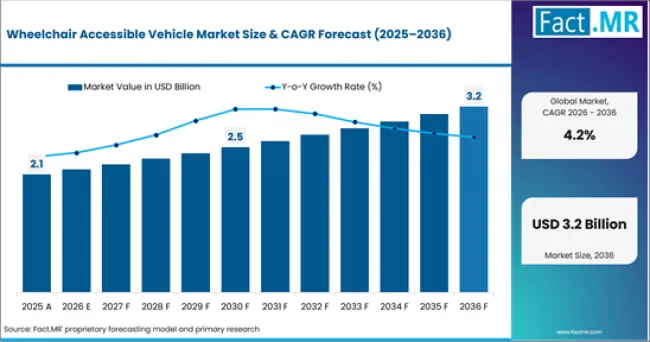
- The Wheelchair Accessible Vehicle Market is expected to grow from USD 2.1 billion in 2026 to USD 3.2 billion by 2036, at a 4.2% CAGR.
- Growth is driven by tightening accessibility legislation, aging population demographics, and expanding paratransit and non-emergency medical transport fleet investment.
- Ramp conversion vehicles are expected to account for 68.4% share in 2026, while public transportation services are projected to contribute 54.6% share as fleet operators prioritize compliance, passenger dignity, and operating efficiency.
Wheelchair Accessible Vehicle Market Value Analysis | Source: Fact.MR
Summary of Wheelchair Accessible Vehicle Market
- Market Snapshot
- In 2025, the global Wheelchair Accessible Vehicle Market was valued at approximately USD 2.1 billion.
- The market is estimated to reach USD 2.1 billion in 2026 and is projected to attain USD 3.2 billion by 2036.
- The wheelchair accessible vehicle market is likely to expand at a CAGR of 4.2% during the forecast period.
- The market is anticipated to create an absolute dollar opportunity of USD 1.1 billion between 2026 and 2036.
- Ramp conversion vehicles account for 68.4% of product segment share in 2026.
- China (5.7%) and India (5.3%) are the key growth markets during the forecast period.
- Demand and Growth Drivers
- Aging population demographics across developed markets are increasing the user base for wheelchair accessible vehicles, with individuals over 65 representing the fastest-growing mobility-impaired demographic segment.
- ADA compliance mandates in the U.S. and equivalent accessibility legislation in Europe, Japan, and Australia require public transit fleets and paratransit operators to maintain accessible vehicle ratios.
- Non-emergency medical transportation (NEMT) fleet expansion is creating steady procurement demand for wheelchair accessible minivans and full-size vans used in patient transfer services.
- Ride-hailing and shared mobility platforms are beginning to incorporate accessible vehicle options, creating a new demand channel beyond traditional fleet procurement.
- Government grant and subsidy programs for accessible vehicle conversion and procurement reduce effective purchase cost for individual buyers and fleet operators.
- Product and Segment View
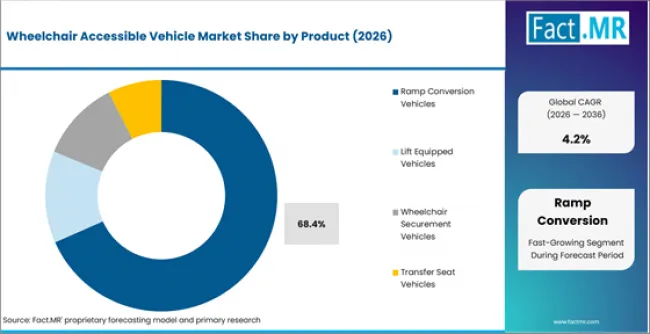
- Ramp conversion vehicles account for 68.4% of the product segment in 2026, preferred for their simpler entry mechanism, lower conversion cost, and broader vehicle platform compatibility.
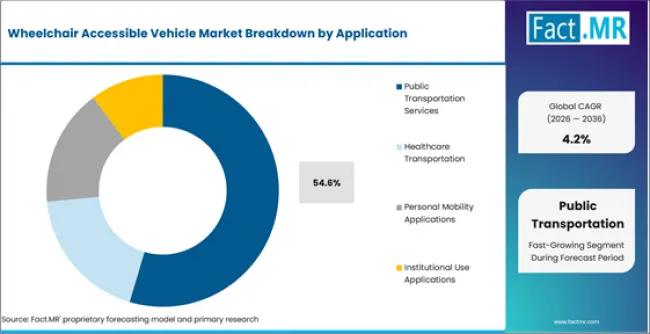
- Public transportation services represent 54.6% of the application segment in 2026, driven by transit authority fleet compliance requirements and paratransit service mandates.
- Government and public transport authorities account for 61.7% of end-use demand in 2026, reflecting the role of accessibility legislation in driving fleet-level procurement.
- Key segmentation includes:
- Product: Ramp Conversion Vehicles, Lift Equipped Vehicles, Wheelchair Securement Vehicles, Transfer Seat Vehicles
- Application: Public Transportation Services, Healthcare Transportation, Personal Mobility Applications, Institutional Use Applications
- End Use: Government and Public Transport Authorities, Healthcare and Institutional Fleet Operators, Individual Consumers, Ride-Hailing and Shared Mobility Providers
- Distribution Channel: OEM Direct Sales, Conversion Specialist Dealers, Government Procurement Programs, Online and Direct Consumer Sales
- These vehicles enable:
- Independent or assisted wheelchair entry and exit through ramp, lift, or lowered floor access mechanisms
- Compliant public transit and paratransit service delivery meeting ADA and equivalent international accessibility standards
- Dignified personal mobility for wheelchair users through consumer-grade vehicle conversions available across minivan and SUV platforms
- Geography and Competitive Outlook
- North America is the largest market, driven by ADA compliance requirements, strong paratransit infrastructure, and established dealer networks for wheelchair accessible vehicle conversions.
- Asia Pacific shows the fastest growth, with China at 5.7% and India at 5.3% supported by expanding disability rights legislation, government accessible transit investment, and urban public transport modernization.
- Europe maintains steady demand, with Germany at 4.8% supported by EU accessibility directives, public transit fleet compliance requirements, and healthcare transport procurement.
- Key players include BraunAbility, Vantage Mobility International / Revability legacy, Revability, AMS Vans, and Brotherwood Automobility.
- Analyst Opinion
- Shambhu Nath Jha, Principal Consultant at Fact.MR, says "The wheelchair accessible vehicle market is driven by regulatory compliance rather than consumer preference, which gives it demand stability that discretionary automotive segments lack. The aging population trend across North America, Europe, and East Asia is expanding the user base structurally, not cyclically. The most important market development is the entry of ride-hailing platforms into accessible mobility, which creates a new fleet procurement channel beyond traditional transit authorities and NEMT operators. Conversion manufacturers that can reduce turnaround time and expand platform compatibility will capture share as fleet operators diversify their accessible vehicle options beyond the traditional minivan format."
Key Growth Drivers, Constraints, and Opportunities
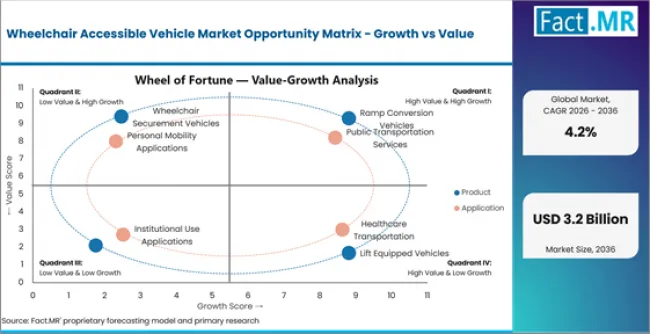
Wheelchair Accessible Vehicle Market Opportunity Matrix Growth Vs Value | Source: Fact.MR
Key Factors Driving Growth
- ADA compliance mandates in the U.S. and equivalent European Accessibility Act provisions require paratransit operators and public fleet managers to maintain and expand wheelchair accessible vehicle availability within their service areas.
- Aging population demographics in North America, Europe, and East Asia are increasing the number of individuals requiring mobility-adapted vehicles, creating sustained demand independent of economic cycles.
- NEMT fleet expansion supported by Medicare and Medicaid reimbursement in the U.S. and NHS patient transport contracts in the UK generates predictable procurement demand tied to healthcare spending.
Key Market Constraints
- High conversion costs, typically USD 15,000 to USD 40,000 above base vehicle price, limit individual consumer adoption and create dependency on government subsidies and fleet procurement programs.
- Limited vehicle platform compatibility restricts conversion options, with most conversions concentrated on a small number of minivan platforms that offer the required interior dimensions and floor structure.
- Long lead times for custom conversions create delivery bottlenecks, particularly during fleet procurement cycles when multiple transit authorities place orders simultaneously.
Key Opportunity Areas
- Ride-hailing and shared mobility platforms incorporating accessible vehicle categories are creating a new fleet demand channel as companies like Uber and Lyft expand WAV service availability to meet regulatory requirements.
- SUV and crossover platform conversions, exemplified by the BraunAbility Chevy Traverse, are expanding the accessible vehicle format beyond traditional minivans, offering consumers vehicle choices that align with mainstream styling preferences.
- Factory-built accessible vehicles, where OEMs integrate accessibility features during production rather than post-production conversion, offer improved structural integrity and reduced conversion costs at scale.
Segment-wise Analysis of the Wheelchair Accessible Vehicle Market
- In 2026, ramp conversion vehicles will comprise 68.4% of the product segment, driven by simpler entry mechanisms, lower conversion costs and broad compatibility across minivan and van platforms.
- In 2026, transit authority fleet compliance mandates and paratransit service requirements will drive public transportation services to account for 54.6% of the application segment.
- Factory-built accessible vehicles make up 73.6% of the formulation segment, indicative of the increasing demand for accessibility in production as opposed to aftermarket conversion.
The wheelchair accessible vehicle market is segmented by product type, application, end use, technology, formulation, distribution channel, and region. Ramp conversion vehicles lead because they offer the most cost-effective and widely compatible wheelchair entry solution across available vehicle platforms.
Which Product Segment Dominates the Wheelchair Accessible Vehicle Market?
Wheelchair Accessible Vehicle Market Analysis By Product | Source: Fact.MR
Ramp conversion vehicles are expected to account for 68.4% of product segment share in 2026. They are driven by simpler mechanical design, lower conversion costs when compared to lift-equipped alternatives and wider compatibility with vehicle platforms. The market is dominated by rear- and side-entry ramp conversions on minivan platforms, particularly the Toyota Sienna and Chrysler Pacifica. Ramp systems are more intuitive for independent wheelchair users and are less maintenance intensive than hydraulic lifts.
Lift conversion vehicles are used in applications where the ability to accommodate heavier power wheelchairs is required and in cases where ramp gradient would be impractical. Lowered floor vehicles have the lowest entry threshold, but require larger vehicle modifications. For most personal and fleet applications, ramp conversion vehicles will continue to be the most accessible and cost-effective solution.
Which Application Segment Dominates the Wheelchair Accessible Vehicle Market?
Wheelchair Accessible Vehicle Market Analysis By Application | Source: Fact.MR
Public transportation services are expected to lead with 54.6% share in 2026. The largest procurement channels are transit authority paratransit fleets, non-emergency medical transport operators and government-subsidized accessible transit programs. The ADA and other similar international regulations require public transportation providers to provide wheelchair accessible service This is a compliance driven demand, and is not influenced by the general vehicle market
Personal mobility is the second largest segment. People with wheelchairs or their families buy or lease converted vehicles for personal transportation. NEMT and institutional health care transport also add to fleet demand. With accessibility mandates increasing globally and the aging population creating demand for services, public transit is expected to remain the preferred mode of transportation.
Which Product Trend is Shaping the Next Phase of Growth in the Wheelchair Accessible Vehicle Market?
The key product trend in the wheelchair accessible vehicle market is the broadening of the platform away from the traditional minivan format. Historically, the Toyota Sienna and Chrysler Pacifica have been the primary conversion base vehicles due to their interior dimensions and floor structure. The format range is greatly expanded with the addition of the BraunAbility Chevy Traverse, an SUV platform wheelchair accessible vehicle. The conversion of an SUV offers wheelchair users a vehicle that blends in with the styling preferences of the majority, rather than being limited to minivans.
The commercial value is higher than the consumer preference. Platform diversification decreases the market dependence on a few base vehicle models and increases the addressable buyer pool by including consumers who may otherwise avoid wheelchair accessible vehicles due to minivan stigma. With OEMs and conversion specialists offering accessible variants of more SUV and crossover platforms the market can tap into demand from those in non-accessible vehicles with portable ramp solutions. The format expansion is expected to generate incremental market growth beyond fleet procurement and demographic trends alone.
Regional Outlook Across Key Markets
- China accelerates growth at 5.7% with increased disability rights legislation, government investment in accessible transit and urban public transport modernization programs with wheelchair accessible vehicles.
- India is at 5.3% due to increasing awareness of accessibility, enforcement of the Rights of Persons with Disabilities Act and expanding public transit systems requiring accessible vehicles.
- Germany, 4.8% is driven by the implementation of the EU Accessibility Act, the compliance requirements of public transport fleets and the procurement of healthcare transport under statutory health insurance schemes.
- The US at 4.0% is a mature but growing market with consistent demand for procurement spurred by ADA compliance, NEMT fleet expansion, and mandates for ride-hailing accessible service.
.webp "Top Country Growth Comparison Wheelchair Accessible Vehicle Market Cagr (2026 2036)")
Top Country Growth Comparison Wheelchair Accessible Vehicle Market Cagr (2026 2036) | Source: Fact.MR
| Country | CAGR (%) |
|---|---|
| China | 5.7% |
| India | 5.3% |
| Germany | 4.8% |
| Brazil | 4.4% |
| USA | 4.0% |
Source: Fact.MR analysis. Updated Jun 13, 2026
Source: Fact.MR analysis, based on proprietary forecasting model and primary research.
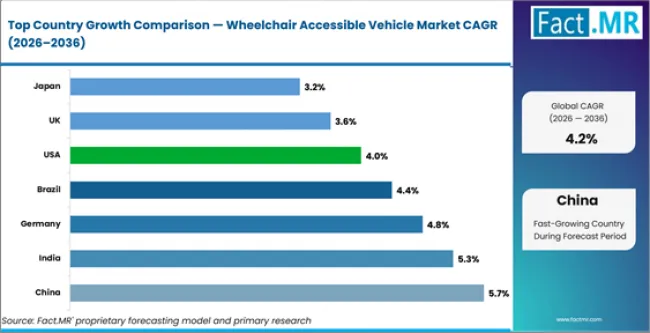
Wheelchair Accessible Vehicle Market Cagr Analysis By Country | Source: Fact.MR
Market Outlook for Wheelchair Accessible Vehicles in the United States
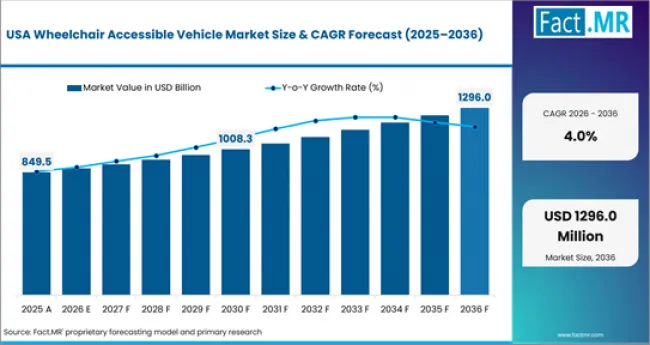
Wheelchair Accessible Vehicle Market Country Value Analysis | Source: Fact.MR
The market for wheelchair accessible vehicles in the U.S. is forecast to grow at a CAGR of 4.0% in the next ten years. Continued procurement of paratransit fleets driven by ADA compliance and predictable demand for van conversions driven by expansion of NEMT services supported by Medicare and Medicaid reimbursement. Regulatory pressure on ride-hailing platforms to increase WAV availability is mounting, paving the way for a new source of fleet demand. The BraunAbility Chevy Traverse launch is a step toward diversifying the platform beyond traditional minivan conversions.
- Medicare and Medicaid NEMT reimbursement guarantees ongoing demand for fleet purchases of wheelchair accessible minivans and full size van conversions.
- Ride-hailing platforms Regulatory requirements for WAV service availability are creating an additional fleet demand channel as companies invest in accessible vehicle capacity.
China Wheelchair Accessible Vehicle Market Growth Assessment
Government accessible transit investment and expanding disability rights legislation are the primary drivers for the China market at a 5.7% CAGR through 2036. Urban public transport modernization programs in tier-1 and tier-2 cities are incorporating wheelchair accessible paratransit services alongside metro and bus network expansion. Domestic vehicle manufacturers are beginning to develop purpose-built accessible vehicle platforms for government fleet procurement.
- Urban public transport modernization in tier-1 cities is incorporating dedicated paratransit services that require wheelchair accessible fleet procurement.
- Domestic manufacturers are developing accessible vehicle platforms targeting government procurement specifications, reducing dependency on imported conversion technology.
India Wheelchair Accessible Vehicle Demand Trends
India is projected to grow at 5.2% CAGR through 2036, supported by Rights of Persons with Disabilities Act enforcement and healthcare transport expansion. In the public transit systems of Delhi, Mumbai and Bangalore, dedicated accessible paratransit vehicles are beginning to appear. For the cost-effectiveness requirements in public procurement, ramp-equipped vehicles are preferred over the more expensive lift-equipped vehicles, in agreement with the prevailing global product segment.
- Enforcement of the Rights of Persons with Disabilities Act is leading to gradual improvement in compliance with accessibility requirements in public transit and government fleets.
- Public transit expansion in Tier-2 cities is opening new demand for accessible vehicles in procurement in previously underserved metro areas.
Germany Wheelchair Accessible Vehicle Market Analysis
EU Accessibility Act requirements and GKV statutory health insurance transport reimbursement will determine procurement specifications for the German market with a 4.8% CAGR through 2036. Public transport agencies maintain accessible vehicle ratios as required by EU directives. Healthcare transport providers buy wheelchair accessible vehicles for patient transfer services. Technical specifications that impact the design and certification of conversion solutions are covered in the DIN standards for vehicle accessibility modifications.
- GKV statutory health insurance reimbursement for patient transport helps to procure healthcare fleet wheelchair accessible conversion cars.
- Incremental procurement demand is spurred by requirements from the EU Accessibility Act that increase accessibility ratios for public transit fleets beyond existing fleet replacement timelines.
Brazil Wheelchair Accessible Vehicle Market Opportunity Analysis
The Brazil market is supported by urban transit modernization initiatives, and the increasing disability rights awareness, at a 4.4% CAGR through 2036. Federal accessibility mandates for public transit are sparking a wave of compliance-based procurement in major metropolitan areas. Conversion technology import dependence results in premium pricing, while domestic adaptation of simpler ramp conversion designs serves the volume market for paratransit and institutional applications.
- Compliance-driven procurement for public transit in the metropolitan transit systems of Sao Paulo, Rio de Janeiro and Brasilia driven by federal accessibility requirements for public transit.
- Reliance on import for advanced conversion systems offers scope for domestic manufacturers to develop simpler, cost-effective ramp conversion solutions.
Competitive Benchmarking and Company Positioning
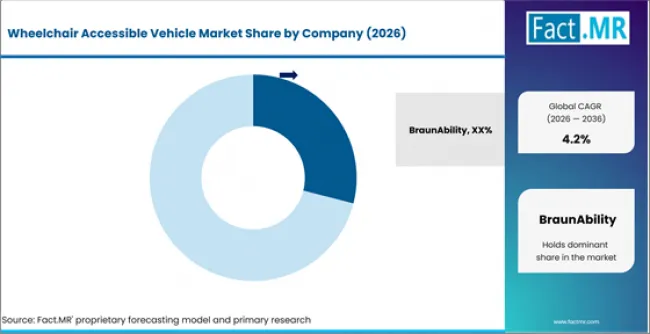
Wheelchair Accessible Vehicle Market Analysis By Company | Source: Fact.MR
Wheelchair Accessible Vehicle Market Analysis By Company
- The leading North American wheelchair accessible vehicle market players are BraunAbility, Vantage Mobility International (VMI), and REV Group, supported by extensive conversion portfolios, established dealer networks, and strong brand recognition from both fleet operators and individual consumers.
- Brotherwood Automobility and Allied Vehicles compete in the European market through expertise in vehicle platforms, regulatory compliance and existing relationships with public sector fleets.
- Platform diversification, where conversion specialists are developing accessible versions of SUVs and crossovers outside of the traditional minivan formats, is creating competitive differentiation in a market that has historically been limited to a narrow range of base vehicles.
The competitive landscape is regionally concentrated with North American market leaders operating through specialized dealer networks offering vehicle consultation, conversion customization and aftermarket service. BraunAbility has the largest share of the market, because it has the most complete line of conversions, including rear entry, side entry and now, SUV-platform accessible vehicles. VMI is competing on quality focus and strategic acquisitions that expanded its product portfolio.
OEM partnerships also shape competition. BraunAbility has partnered with Chevrolet on the Traverse and Toyota on the Sienna to offer factory certified conversion programs backed by OEM warranty support. These partnerships create competitive advantages that are hard for smaller conversion specialists to duplicate.
Key Companies in the Wheelchair Accessible Vehicle Market
- BraunAbility, Vantage Mobility International / Revability legacy, and Revability are among the leading players in the North American market, supported by broad conversion portfolios and established dealer networks.
- AMS Vans, Brotherwood Automobility, Allied Vehicles, Gowrings Mobility Group, MobilityWorks, and Toyota Motor Corporation (through OEM partnership programs) compete across specific regions, vehicle platforms, and customer segments.
Recent Industry Developments
- BraunAbility Product Launch BraunAbility Chevy Traverse Accessible SUV (November 2025) BraunAbility 2026
- BraunAbility announced the launch of the 2026 BraunAbility Chevy Traverse Accessible SUV, expanding its lineup of wheelchair accessible vehicles into the world of SUVs. The vehicle is built on an accessible SUV platform with an in-floor ramp system and an extended interior.
- MobilityWorks, Toyota Sienna Hybrid FlexMaxx Rear-Entry Conversion, Product Launch (July 2025)
- MobilityWorks unveiled the Toyota Sienna Hybrid FlexMaxx Rear-Entry Conversion on July 1, 2025. It blends Toyota hybrid technology with wheelchair access and flexible seating arrangements for personal and commercial mobility applications.
- MobilityWorks, Corporate Recognition, Newsweek America’s Greatest Workplaces 2025 (June 2025)
- MobilityWorks Named to Newsweek’s America’s Greatest Workplaces 2025, Celebrating Company’s Workplace Culture and Employee Satisfaction Initiatives.
Key Companies in the Wheelchair Accessible Vehicle Market
- BraunAbility
- Vantage Mobility International / Revability legacy
- Revability
- AMS Vans
- Brotherwood Automobility
- Allied Vehicles
- Gowrings Mobility Group
- MobilityWorks
- Toyota Motor Corporation
Sources and Research References
[1] General Motors. (2025, November 20). Chevrolet honors an American hero with a new wheelchair accessible SUV, BraunAbility Traverse. General Motors.
[2] BraunAbility. (2026). Chevy Traverse wheelchair accessible SUV. BraunAbility.
[3] MobilityWorks. (2025, July 1). MobilityWorks launches exclusive Toyota Sienna Hybrid FlexMaxx® Rear-Entry Conversion. MobilityWorks.
[4] MobilityWorks. (2025, June 4). MobilityWorks named one of Newsweek’s America’s Greatest Workplaces for 2025. MobilityWorks.
This bibliography is provided for reader reference and is not exhaustive. The full report contains the complete reference list and detailed citations.
Key Questions This Report Addresses
- What is the current and future size of the Wheelchair Accessible Vehicle Market?
- How fast is the WAV Market expected to grow between 2026 and 2036?
- Which product type is likely to lead the market by 2026?
- Which application segment is expected to account for the highest demand by 2026?
- What factors are driving demand for wheelchair accessible vehicles globally?
- How is platform diversification beyond minivans reshaping the accessible vehicle market?
- Why are China and India emerging as the fastest-growing markets?
- How are ride-hailing platforms influencing accessible vehicle fleet procurement?
- Which countries are projected to show the fastest growth through 2036?
- Who are the key companies active in the Wheelchair Accessible Vehicle Market?
- How does Fact.MR estimate and validate the market forecast?
Wheelchair Accessible Vehicle Market Definition
The wheelchair accessible vehicle market covers vehicles modified or purpose-built to accommodate wheelchair users, including ramp conversions, lift conversions, lowered floor vehicles, and side-entry adaptations. It spans minivans, full-size vans, SUVs, and purpose-built accessible transit vehicles used in public transportation, personal mobility, non-emergency medical transport, and institutional applications.
Wheelchair Accessible Vehicle Market Inclusions
- The scope covers global and regional market size and forecasts for 2026 to 2036 across product type, application, end use, technology, formulation, distribution channel, and region.
- It includes regional demand analysis based on disability population statistics, accessibility legislation, transit fleet compliance requirements, and NEMT spending.
- The report covers pricing analysis across OEM-modified and aftermarket conversion vehicles, including base vehicle cost, conversion cost, and government subsidy offsets.
Wheelchair Accessible Vehicle Market Exclusions
- The scope excludes standard vehicles with minor accessibility features such as grab handles or wider door openings not classified as wheelchair accessible conversions.
- It excludes powered wheelchairs, mobility scooters, and personal mobility devices not classified as vehicles.
- The report excludes public transit buses and rail vehicles designed for wheelchair accessibility as part of mass transit systems.
Wheelchair Accessible Vehicle Market Research Methodology
- The methodology combines secondary research, primary interviews, and forecast modelling.
- It draws on 90+ secondary sources and benchmarks 35+ company product portfolios.
- Market sizing covers 25+ countries through a demand-side model, supported by top-down validation.
- Key inputs include disability population data, accessibility legislation timelines, transit fleet compliance ratios, and NEMT service spending.
- The model cross-checks demand with conversion production data, fleet registration records, and government procurement contract values.
- Primary validation includes 20+ interviews across conversion manufacturers, fleet operators, transit authorities, and accessibility advocacy organizations.
- Final estimates go through fleet-composition checks, procurement-cycle validation, and sensitivity testing.
Segmentation
Scope of Analysis
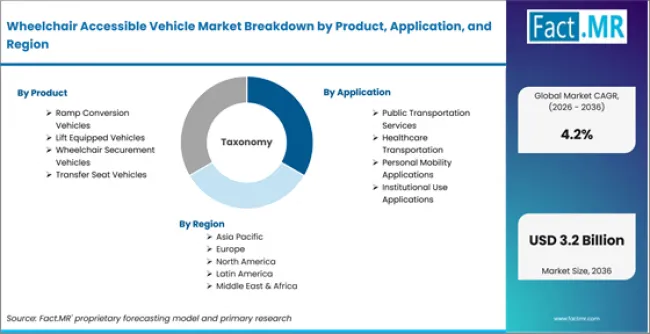
Wheelchair Accessible Vehicle Market Breakdown By Product, Application, And Region | Source: Fact.MR
| Parameter | Details |
|---|---|
| Quantitative Units | USD 2.1 billion to USD 3.2 billion, at a CAGR of 4.2% |
| Market Definition | The Wheelchair Accessible Vehicle Market covers vehicles modified or purpose-built to accommodate wheelchair users, including ramp, lift, lowered floor, and side-entry conversions for public transit, personal mobility, and healthcare transport. |
| Regions Covered | North America, Latin America, Europe, East Asia, South Asia and Pacific, Middle East and Africa |
| Countries Covered | USA, China, India, Germany, Brazil, 25 plus countries |
| Key Companies | BraunAbility, REV Group, Vantage Mobility International, Revability, AMS Vans, Brotherwood Automobility, Allied Vehicles, Gowrings Mobility Group, MobilityWorks, Toyota Motor Corporation |
| Forecast Period | 2026 to 2036 |
| Approach | Hybrid demand-side and top-down methodology built on disability population data, accessibility legislation timelines, transit fleet compliance ratios, NEMT spending, and primary interviews across conversion manufacturers, fleet operators, and transit authorities |
Source: Fact.MR analysis. Updated Jun 13, 2026
Wheelchair Accessible Vehicle Market Segmentation
-
Wheelchair Accessible Vehicle Market Segmented by Product:
- Ramp Conversion Vehicles
- Fold-Out Ramp Systems Vehicles
- Side Entry Ramp Vans
- Rear Entry Ramp Vans
- Manual Ramp Conversion Kits
- Portable Folding Ramp Units
- Low Floor Entry Ramp Systems
- Fold-Out Ramp Systems Vehicles
- Lift Equipped Vehicles
- Hydraulic Lift Vehicles
- Under Vehicle Lift Systems
- External Platform Lift Vehicles
- Electric Lift Vehicles
- Powered Wheelchair Lifts
- Automatic Lift Deployment Systems
- Hydraulic Lift Vehicles
- Wheelchair Securement Vehicles
- Tie Down Restraint Vehicles
- Manual Wheelchair Lock Systems
- Automatic Restraint Lock Systems
- Docking Securement Vehicles
- Front Docking Systems
- Rear Docking Systems
- Tie Down Restraint Vehicles
- Transfer Seat Vehicles
- Swivel Seat Vehicles
- 360 Degree Rotating Seats
- Power Sliding Seat Systems
- Lowered Floor Vehicles
- Full Floor Lowering Systems
- Partial Floor Modification Systems
- Swivel Seat Vehicles
- Ramp Conversion Vehicles
-
Wheelchair Accessible Vehicle Market Segmented by Application:
- Public Transportation Services
- Paratransit Services
- Municipal Accessible Transit
- On Demand Shuttle Services
- Bus & Fleet Services
- City Accessible Bus Fleets
- Regional Transport Fleets
- Paratransit Services
- Healthcare Transportation
- Hospital Transport Services
- Patient Transfer Vehicles
- Non Emergency Medical Transport
- Rehabilitation Transport Services
- Physiotherapy Travel Services
- Elder Care Mobility Transport
- Hospital Transport Services
- Personal Mobility Applications
- Private Ownership Vehicles
- Family Adapted Vehicles
- Individual Mobility Vans
- Rental Mobility Services
- Short Term Accessible Rentals
- Tourism Mobility Rentals
- Private Ownership Vehicles
- Institutional Use Applications
- Nursing Home Transport
- Assisted Living Mobility Vehicles
- Senior Care Transport Fleets
- Educational Institution Transport
- Special Needs Student Transport
- School Accessibility Vans
- Nursing Home Transport
- Public Transportation Services
-
Wheelchair Accessible Vehicle Market Segmented by End Use:
- Government & Public Transport Authorities
- Municipal Transport Agencies
- City Mobility Departments
- Urban Transit Authorities
- Regional Transport Bodies
- State Mobility Programs
- National Accessibility Initiatives
- Municipal Transport Agencies
- Healthcare Institutions
- Hospitals & Clinics
- Rehabilitation Hospitals
- General Hospitals Transport Units
- Long Term Care Facilities
- Nursing Homes Transport Services
- Elder Care Centers
- Hospitals & Clinics
- Private Mobility Operators
- Transport Service Providers
- Private Paratransit Companies
- Accessible Taxi Operators
- Rental Fleet Operators
- Short Term Vehicle Rental Firms
- Tourism Mobility Providers
- Transport Service Providers
- Individual Consumers
- Family Owned Vehicles
- Disabled Driver Owned Vehicles
- Caregiver Supported Vehicles
- Independent Mobility Users
- Adult Disabled Users
- Senior Independent Users
- Family Owned Vehicles
- Government & Public Transport Authorities
-
Wheelchair Accessible Vehicle Market Segmented by Technology:
- Hydraulic Conversion Technology
- Low Pressure Hydraulic Systems
- Compact Lift Hydraulic Units
- Vehicle Integrated Hydraulic Modules
- High Capacity Hydraulic Systems
- Heavy Load Wheelchair Lift Systems
- Stability Enhanced Hydraulic Platforms
- Low Pressure Hydraulic Systems
- Electronic Mobility Control Systems
- Vehicle Automation Controls
- Smart Entry Control Systems
- Remote Vehicle Access Systems
- Assisted Driving Controls
- Joystick Driving Systems
- Adaptive Driving Interfaces
- Vehicle Automation Controls
- Structural Modification Technology
- Chassis Reconfiguration Systems
- Low Floor Conversion Platforms
- Reinforced Vehicle Frame Systems
- Interior Mobility Design Systems
- Space Optimization Vehicle Layouts
- Ergonomic Interior Conversion Systems
- Chassis Reconfiguration Systems
- Safety & Restraint Technology
- Wheelchair Lock Systems
- Automatic Docking Mechanisms
- Mechanical Restraint Systems
- Crash Safety Systems
- Impact Absorption Structures
- Safety Reinforced Cabin Systems
- Wheelchair Lock Systems
- Hydraulic Conversion Technology
-
Wheelchair Accessible Vehicle Market Segmented by Formulation:
- Factory Built Accessible Vehicles
- OEM Integrated Conversion Vehicles
- Pre Manufactured Ramp Vehicles
- Standardized Lift Equipped Models
- Fully Integrated Mobility Vans
- End to End Accessible Platforms
- Built In Accessibility Architecture
- OEM Integrated Conversion Vehicles
- Aftermarket Conversion Systems
- Ramp Installation Kits
- Modular Ramp Conversion Units
- Vehicle Retrofit Ramp Systems
- Lift Installation Kits
- Hydraulic Lift Retrofit Kits
- Electric Lift Retrofit Modules
- Ramp Installation Kits
- Modular Conversion Systems
- Interior Modular Kits
- Seat Replacement Modules
- Floor Modification Modules
- External Mobility Modules
- Attachable Ramp Systems
- Portable Accessibility Units
- Interior Modular Kits
- Hybrid Conversion Systems
- Partial OEM Modification Systems
- Factory Plus Retrofit Models
- Custom Hybrid Build Vehicles
- Adaptive Conversion Systems
- User Specific Vehicle Builds
- Special Needs Custom Vans
- Partial OEM Modification Systems
- Factory Built Accessible Vehicles
-
Wheelchair Accessible Vehicle Market Segmented by Distribution Channel:
- OEM Direct Sales
- Automotive Manufacturer Channels
- Vehicle OEM Accessibility Programs
- Factory Built Mobility Vehicle Sales
- Fleet Procurement Contracts
- Government Fleet Purchases
- Institutional Fleet Orders
- Automotive Manufacturer Channels
- Authorized Dealers
- Automotive Dealership Networks
- Accessibility Vehicle Dealers
- Specialized Mobility Dealers
- Conversion Specialists
- Vehicle Conversion Workshops
- Accessibility Retrofit Centers
- Automotive Dealership Networks
- Online Mobility Platforms
- Digital Vehicle Marketplaces
- Mobility Vehicle Listing Portals
- Accessible Vehicle E Commerce Platforms
- Manufacturer Online Sales
- Direct Booking Platforms
- Customization Order Portals
- Digital Vehicle Marketplaces
- Rental & Leasing Providers
- Short Term Rental Services
- Accessible Vehicle Rental Fleets
- Mobility Tourism Rentals
- Long Term Leasing Services
- Corporate Mobility Leasing
- Healthcare Fleet Leasing Programs
- Short Term Rental Services
- OEM Direct Sales
-
Wheelchair Accessible Vehicle Market by Region:
- North America
- USA
- Canada
- Mexico
- Latin America
- Brazil
- Chile
- Rest of Latin America
- Western Europe
- Germany
- UK
- Italy
- Spain
- France
- Nordic
- BENELUX
- Rest of Western Europe
- Eastern Europe
- Russia
- Poland
- Hungary
- Balkan & Baltic
- Rest of Eastern Europe
- East Asia
- China
- Japan
- South Korea
- South Asia and Pacific
- India
- ASEAN
- Australia & New Zealand
- Rest of South Asia and Pacific
- Middle East & Africa
- Kingdom of Saudi Arabia
- Other GCC Countries
- Turkiye
- South Africa
- Other African Union
- Rest of Middle East & Africa
- North America
Frequently Asked Questions
How big is the wheelchair accessible vehicle market in 2026?
What will be the size of wheelchair accessible vehicle market in 2036?
How much will be the wheelchair accessible vehicle market growth between 2026 and 2036?
What are the key product in the wheelchair accessible vehicle market?
Which application segment is expected to contribute significant share in the wheelchair accessible vehicle market in 2026?
Who worked on this report


Preview the report firsthand - request a free sample
Free SampleGet the brochure for pricing and purchase details
Download PDF