- Base Value(2025): 27.0 Bn
- Estimated Value(2026): 28.1 Bn
- Forecast Value (2036): 41.6 Bn
- CAGR (2026 - 2036): 4.0%
Orthopedic Implant Market Analysis and Forecast by Fact.MR
- The global orthopedic implant market is estimated at USD 28.1 billion in 2026 and has been forecast to expand at a CAGR of 4.0% to reach USD 41.6 billion by 2036.
- Orthopedic implants cover joint reconstruction devices for hip, knee, shoulder, elbow, and ankle replacement, spinal implants including fusion and non-fusion systems, trauma fixation hardware such as plates, screws, intramedullary nails, and wires, dental implants, and orthobiologic products.
- Growth is shaped by rising surgical volumes tied to population aging, expanding access to joint replacement in emerging markets, growth of ambulatory surgical center procedures, and adoption of robotic-assisted and patient-specific implant technologies.
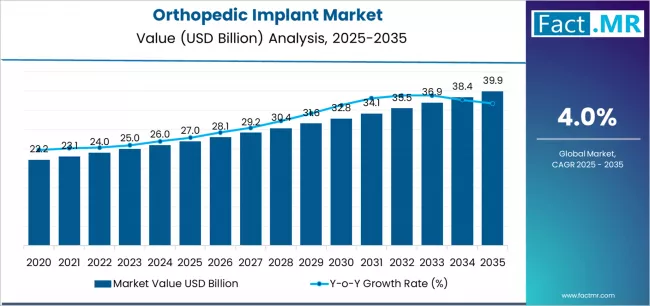
Orthopedic Implant Market Market Value Analysis | Source: Fact.MR
Summary of Orthopedic Implant Market
- Market Snapshot
- In 2025, the global Orthopedic Implant Market was valued at approximately USD 27.0 billion.
- The market is estimated to reach USD 28.1 billion in 2026 and is projected to attain USD 41.6 billion by 2036.
- The orthopedic implant market is likely to expand at a CAGR of 4.0% during the forecast period.
- The market is anticipated to create an absolute dollar opportunity of USD 13.5 billion between 2026 and 2036.
- Joint reconstruction implants account for 42.5% of product segment share in 2026, led by knee and hip replacement systems.
- India (5.3%) and China (5.1%) are the key growth markets during the forecast period.
- Demand and Growth Drivers
- Aging global population is increasing the prevalence of osteoarthritis, osteoporosis, and degenerative joint conditions that require surgical implant interventions.
- Expanding access to joint replacement surgery in emerging markets, supported by hospital infrastructure development and growing middle-class health insurance coverage, is creating new procedure volumes.
- Robotic-assisted surgery adoption is improving surgical precision, patient outcomes, and recovery times, supporting premium implant and technology platform demand.
- Growth of ambulatory surgical center-based orthopedic procedures is creating cost-efficient delivery channels that expand patient access and increase implant utilization.
- Development of patient-specific and 3D-printed implants is enabling customized surgical solutions that improve fit, reduce revision rates, and support premium product positioning.
- Product and Segment View
- Joint reconstruction implants account for 42.5% of the product segment in 2026, led by knee and hip replacement systems that serve the largest surgical volume categories in orthopedics.
- Osteoarthritis represents 31.6% of the application segment in 2026, reflecting the highest prevalence degenerative joint condition requiring implant-based surgical intervention.
- Hospitals hold 63.2% of the end use segment in 2026, maintaining the primary surgical delivery setting for major joint replacement and complex trauma procedures.
- Key segmentation includes:
- Product: Joint reconstruction implants (hip, knee, shoulder, elbow, ankle), Spinal implants (fusion, non-fusion, vertebral compression fracture devices), Trauma implants (plates, screws, intramedullary nails, wires and pins), Dental implants, Orthobiologics
- Application: Osteoarthritis, Rheumatoid arthritis, Trauma and fractures, Spinal disorders, Sports injuries, Deformity correction
- Material: Metallic biomaterials (titanium, stainless steel, cobalt chromium), Ceramic biomaterials, Polymeric biomaterials (polyethylene, PEEK)
- Surgery Type: Minimally invasive surgery, Open surgery
- These systems enable:
- Surgical restoration of joint function through total and partial replacement of damaged articular surfaces
- Fracture stabilization and bone healing support through internal fixation hardware and biologic augmentation
- Spinal decompression, fusion, and motion preservation for degenerative disc disease and spinal deformity correction
- Geography and Competitive Outlook
- North America remains the largest regional market, anchored by the USA where high surgical volumes, strong reimbursement frameworks, and early adoption of robotic-assisted orthopedic platforms sustain premium implant demand.
- Europe shows steady growth led by Germany and the UK, supported by established joint registry programs, universal healthcare access, and growing ASC-based orthopedic procedure volumes.
- Asia Pacific is the fastest-growing region as India, China, and Japan expand orthopedic surgical access through hospital infrastructure investments, growing insurance coverage, and rising demand for joint replacement among aging populations.
- India (5.3%) and China (5.1%) lead country-level growth, while USA (4.8%), Germany (4.5%), and Japan (4.2%) maintain steady expansion.
- Leading companies include Stryker Corporation, DePuy Synthes (Johnson & Johnson), Zimmer Biomet, Smith+Nephew, Medtronic, NuVasive / Globus Medical, Arthrex Inc., Acumed LLC, and Paragon Medical (AMETEK).
- Analyst Opinion
- Shambhu Nath Jha, Principal Consultant at Fact.MR, says 'The orthopedic implant market is being redefined by the convergence of robotic-assisted surgery, 3D-printed patient-specific implants, and the migration of procedures from hospitals to ambulatory surgical centers. These shifts are creating new competitive dynamics where technology platform ownership matters as much as implant design. Companies that can combine surgical robotics, digital preoperative planning, and differentiated implant portfolios within integrated ecosystems are positioned to capture premium pricing and stronger surgeon loyalty. Emerging markets in Asia Pacific represent the fastest volume growth as joint replacement access expands alongside aging demographics and healthcare infrastructure development.'
Key Growth Drivers, Constraints, and Opportunities
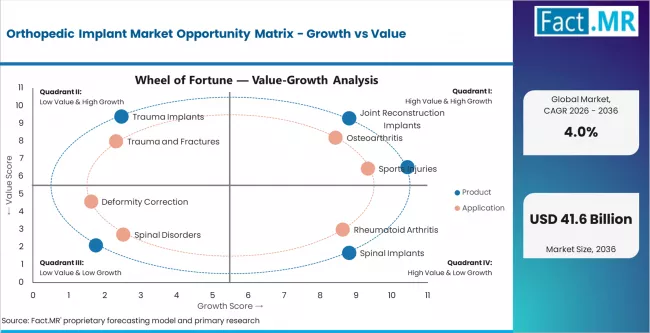
Orthopedic Implant Market Opportunity Matrix Growth Vs Value | Source: Fact.MR
Key Factors Driving Growth
- Global population aging is increasing the prevalence of osteoarthritis and osteoporosis, with the WHO estimating over 500 million people affected by osteoarthritis, creating sustained demand for joint replacement and fixation implants.
- Robotic-assisted surgical platforms are improving implant positioning accuracy and patient outcomes, supporting premium pricing and driving upgrade cycles across hospital and ASC settings.
- Migration of orthopedic procedures to ambulatory surgical centers is reducing per-procedure costs and expanding patient access, creating new high-volume implant consumption channels.
Key Market Constraints
- Reimbursement pressure in mature markets, particularly in bundled payment models that cap total episode costs, is compressing implant pricing and pushing manufacturers toward value-based contracting.
- Supply chain concentration in specialty metals and ceramics creates periodic material availability constraints, particularly during demand surges or geopolitical trade disruptions.
- Implant recall risks and product liability exposure create significant financial and reputational risks for manufacturers, requiring continuous quality system investment.
Key Opportunity Areas
- Emerging market joint replacement access expansion, particularly in India, China, Brazil, and Saudi Arabia, represents the fastest procedure volume growth opportunity as healthcare infrastructure and insurance coverage improve.
- Patient-specific and 3D-printed implants represent a premium product opportunity, with growing evidence supporting improved fit, reduced revision rates, and shorter recovery times.
- Robotic surgical platform expansion beyond hip and knee into shoulder, spine, and trauma applications is creating new technology-driven growth pathways for integrated implant-robot ecosystems.
Segment-wise Analysis of the Orthopedic Implant Market
- Joint reconstruction implants hold 42.5% of the product segment in 2026, led by knee and hip replacement systems that serve the highest surgical volume categories in orthopedic practice.
- Osteoarthritis represents 31.6% of the application segment in 2026, reflecting the most prevalent degenerative joint condition and the primary clinical indication driving joint replacement demand.
- Minimally invasive surgery accounts for 57.1% of the surgery type segment in 2026, supported by growing robotic-assisted platform adoption and patient preference for shorter recovery procedures.
The orthopedic implant market is segmented by product type, application, material, end use, surgery type, distribution channel, and region. By product, the market covers joint reconstruction implants, spinal implants, trauma implants, dental implants, and orthobiologics. By application, coverage includes osteoarthritis, rheumatoid arthritis, trauma and fractures, spinal disorders, sports injuries, and deformity correction. Joint reconstruction implants lead by value because of high unit pricing and large procedure volumes, while trauma implants maintain significant volume through emergency and acute care demand.
Which Product Segment Dominates the Orthopedic Implant Market?
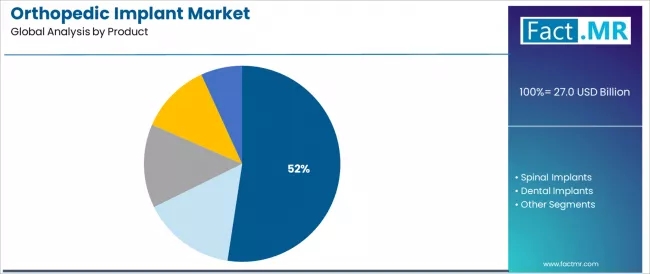
Orthopedic Implant Market Analysis By Product | Source: Fact.MR
Joint reconstruction implants are expected to account for 42.5% of the product segment value in 2026. This leadership reflects the high procedure volumes and unit pricing of knee and hip replacement systems, which together represent the largest surgical categories in orthopedics. Total knee replacement alone accounts for over 1 million annual procedures in the United States, while total hip replacement continues to grow as patient eligibility criteria expand to younger and older demographics.
Within joint reconstruction, knee implants including total, partial, and revision systems represent the largest sub-category, followed by hip implants spanning total and partial replacement platforms. Shoulder implants, particularly reverse total shoulder arthroplasty, are the fastest-growing sub-segment as surgical indications expand and patient awareness increases. The product mix is shifting toward premium platforms that integrate with robotic surgical systems and offer patient-specific sizing options.
Which Application Segment Dominates the Orthopedic Implant Market?
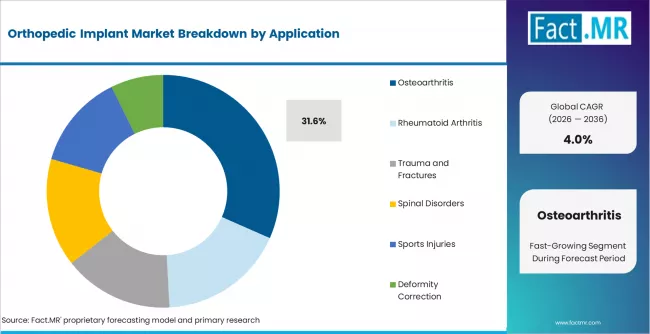
Orthopedic Implant Market Analysis By Application | Source: Fact.MR
Osteoarthritis is expected to hold 31.6% of the application segment value in 2026. This dominance reflects the condition's status as the most prevalent degenerative joint disease globally, affecting over 500 million people according to WHO estimates. Osteoarthritis is the primary clinical indication for total joint replacement in the hip, knee, and shoulder.
Trauma and fractures represent the second largest application area, driven by road traffic injuries, falls in elderly populations, and sports-related injuries that require internal fixation hardware. Spinal disorders maintain significant demand for fusion and decompression implants, while sports injuries and rheumatoid arthritis contribute additional procedure volumes across joint reconstruction and specialized implant categories.
Which Product Trend is Shaping the Next Phase of Growth in the Orthopedic Implant Market?
Robotic-assisted surgical platforms integrated with implant ecosystems are the defining product trend shaping market growth. Zimmer Biomet's ROSA Knee with OptimiZe upgrade, cleared by the FDA in 2025, represents the most advanced iteration of its flagship robotic knee system. Stryker's Mako platform continues to expand surgical indications, while newer entrants are developing AI-driven planning and intraoperative guidance capabilities that promise further precision improvements.
The commercial significance of robotic platforms extends beyond the capital equipment itself. Robotic systems create surgeon training investments, institutional workflow integration, and implant compatibility requirements that strengthen manufacturer lock-in and support premium implant pricing. In 2025, Zimmer Biomet completed acquisitions of Paragon 28 (foot and ankle) and Monogram Technologies (AI-driven robotics), signaling the industry's strategic direction toward integrated technology ecosystems. As ASC-based robotic procedures expand and emerging markets begin adopting these platforms, the competitive advantage of offering a combined robot-implant solution will increasingly differentiate market leaders from implant-only competitors.
Regional Outlook Across Key Markets
.webp "Top Country Growth Comparison Orthopedic Implant Market Cagr (2026 2036)")
Top Country Growth Comparison Orthopedic Implant Market Cagr (2026 2036) | Source: Fact.MR
- India leads growth at 5.3%, supported by expanding hospital infrastructure, growing middle-class insurance coverage, and increasing demand for joint replacement among its aging population.
- China maintains a 5.1% CAGR, driven by healthcare reform expanding surgical access, domestic implant manufacturing growth, and volume-based procurement programs that broaden patient reach.
- USA at 4.8% reflects steady growth driven by aging demographics, robotic surgery adoption, and ASC migration, while Germany (4.5%) and Japan (4.2%) grow through established orthopedic infrastructure.
- Brazil (3.9%) and Saudi Arabia (3.4%) represent emerging market opportunities supported by public health investment and growing orthopedic surgical capacity.
CAGR Table
| Country | CAGR (%) |
|---|---|
| India | 5.3% |
| China | 5.1% |
| USA | 4.8% |
| Germany | 4.5% |
| Japan | 4.2% |
| Brazil | 3.9% |
| Saudi Arabia | 3.4% |
Source: Fact.MR analysis. Updated May 8, 2026
Source: Fact MR (FMR) analysis, based on proprietary forecasting model and primary research.
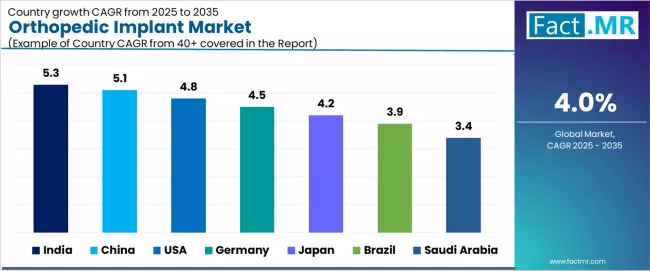
Orthopedic Implant Market Cagr Analysis By Country | Source: Fact.MR
Market Outlook for Orthopedic Implants in the United States
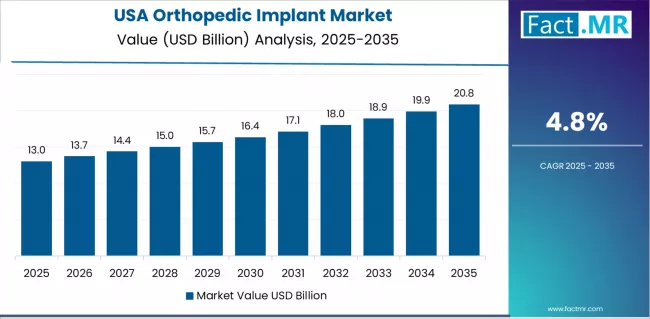
Orthopedic Implant Market Country Value Analysis | Source: Fact.MR
The US orthopedic implant market is projected to grow at a CAGR of 4.8% through 2036. Demand is supported by high joint replacement volumes, strong reimbursement frameworks, and leading adoption of robotic-assisted surgical platforms across both hospital and ASC settings.
- Robotic surgery adoption supports premium implant and platform demand.
- ASC migration creates cost-efficient high-volume procedure channels.
- Aging demographics sustain growing joint replacement and trauma implant demand.
Orthopedic Implant Demand Trends in India
The India orthopedic implant market is projected to grow at a CAGR of 5.3% through 2036, the fastest among countries studied. Growth is supported by expanding hospital infrastructure, rising insurance coverage, and increasing demand for joint replacement surgery among India's aging population.
- Hospital infrastructure expansion is broadening surgical access.
- Insurance coverage growth is reducing out-of-pocket barriers to surgery.
- Domestic implant manufacturing is improving cost-competitive product availability.
China Orthopedic Implant Market Growth Assessment
The China orthopedic implant market is projected to grow at a CAGR of 5.1% through 2036. Growth is driven by healthcare reform expanding orthopedic surgical access, volume-based procurement programs, and domestic manufacturing investments in joint reconstruction and trauma fixation products.
- Volume-based procurement is accelerating implant access across hospital tiers.
- Domestic manufacturers are gaining share through cost-competitive offerings.
- Aging demographics are increasing demand for joint replacement procedures.
Germany Orthopedic Implant Market Outlook
The Germany orthopedic implant market is projected to grow at a CAGR of 4.5% through 2036. Demand is supported by established joint registry programs, high surgical volumes per capita, and growing adoption of robotic-assisted and patient-specific implant solutions.
- Joint registry programs support evidence-based implant selection and quality.
- Robotic surgery adoption is expanding across major orthopedic centers.
- Universal healthcare access sustains high per-capita procedure volumes.
Japan Orthopedic Implant Market Demand Analysis
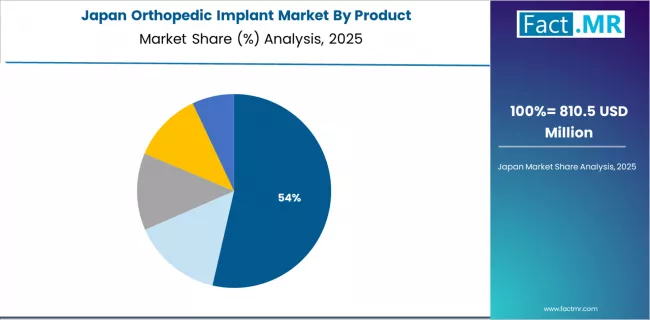
Orthopedic Implant Market Japan Market Share Analysis By Product | Source: Fact.MR
The Japan orthopedic implant market is projected to grow at a CAGR of 4.2% through 2036. Demand is supported by one of the world's most rapidly aging populations, advanced surgical infrastructure, and adoption of new technology platforms including iodine-treated infection prevention implants.
- Rapidly aging population drives sustained joint replacement demand.
- Advanced surgical infrastructure supports adoption of new implant technologies.
- PMDA regulatory approvals enable early access to next-generation products.
Competitive Benchmarking and Company Positioning
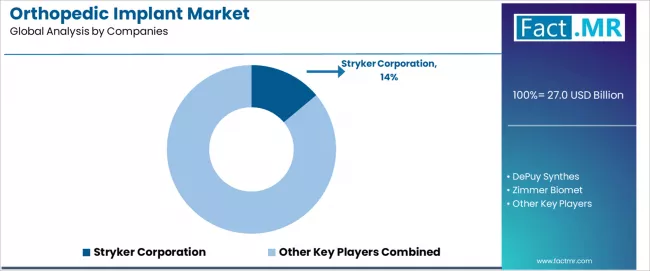
Orthopedic Implant Market Analysis By Company | Source: Fact.MR
Orthopedic Implant Market Analysis By Company
- Stryker Corporation, DePuy Synthes (Johnson & Johnson), and Zimmer Biomet hold the strongest global positions through integrated implant-robotics ecosystems, broad product portfolios spanning joints, spine, and trauma, and deep surgeon training and institutional relationships.
- Smith+Nephew, Medtronic, and NuVasive / Globus Medical compete across specific product categories and surgical specialties, with differentiation shaped by clinical evidence, technology platform capabilities, and regional distribution strength.
- Competition is increasingly defined by the ability to offer integrated robotic-implant ecosystems, patient-specific solutions, and value-based outcomes data that support institutional procurement decisions and surgeon loyalty.
The competitive landscape is moderately concentrated, with Stryker Corporation maintaining an estimated 14% global market share through its Mako robotic platform, comprehensive joint reconstruction portfolio, and strong trauma and spine offerings. Stryker's integrated ecosystem strategy, combining robotic surgery, digital preoperative planning, and implant compatibility, creates significant competitive advantages in institutional procurement.
Zimmer Biomet, with approximately 13% market share, made significant strategic moves in 2025 by acquiring Paragon 28 (foot and ankle) and Monogram Technologies (AI robotics), while launching its ROSA Knee with OptimiZe upgrade and the world's first iodine-treated hip implants in Japan. DePuy Synthes (J&J) competes through its broad portfolio breadth and strong institutional relationships, with recent additions including the Inhance shoulder system and expanded Attune Knee platform.
Smith+Nephew, Medtronic, and the combined NuVasive/Globus Medical entity compete in specific surgical categories, with Smith+Nephew focusing on sports medicine and wound management adjacencies, Medtronic maintaining spine leadership, and Globus Medical expanding its robotic spine surgery platform.
Strategic priorities across the market include expanding robotic surgical platform capabilities and indications, developing 3D-printed and patient-specific implant solutions, building ASC-focused distribution and workflow offerings, and pursuing emerging market access through cost-competitive product lines and distribution partnerships.
Key Companies in the Orthopedic Implant Market
- Stryker Corporation, DePuy Synthes (Johnson & Johnson), and Zimmer Biomet are among the leading players globally, supported by integrated implant-robotics platforms, comprehensive product portfolios, and deep institutional relationships.
- Smith+Nephew, Medtronic, and NuVasive / Globus Medical hold established positions across specific surgical specialties, supported by clinical innovation, technology platform development, and targeted geographic expansion.
- Arthrex Inc., Acumed LLC, and Paragon Medical (AMETEK) compete through focused product offerings in sports medicine, upper extremity, and specialty implant categories, reinforcing their relevance in targeted surgical segments.
Recent Industry Developments
- Zimmer Biomet, Acquisition of Paragon 28 and Monogram Technologies (2025)
- Zimmer Biomet completed acquisitions of Paragon 28 (foot and ankle implants) and Monogram Technologies (AI-driven robotic orthopedic surgery), expanding into high-growth segments and strengthening its digital surgery ecosystem.
- Zimmer Biomet, ROSA Knee with OptimiZe FDA Clearance (2025)
- Zimmer Biomet received FDA clearance for the ROSA Knee with OptimiZe, the most advanced upgrade to its flagship robotic knee system since its 2019 launch. The platform enhances surgical planning and intraoperative guidance for total knee arthroplasty.
- Zimmer Biomet, World First Iodine-Treated Hip Procedure in Japan (2025)
- Zimmer Biomet enabled the world's first iodine-treated hip procedure in Japan using its iTaperloc Complete and iG7 Acetabular Hip Systems, addressing infection management by inhibiting biofilm formation on implant surfaces.
- Amcor and Berry Global, Packaging Industry Consolidation (April 2025)
- Ball Corporation acquired Florida Can Manufacturing in February 2025 to strengthen its domestic aluminum can supply network, while advancing its Oklahoma smelter project slated for late 2026 operation.
Leading Companies Shaping the Orthopedic Implant Market
- Stryker Corporation
- DePuy Synthes (Johnson & Johnson)
- Zimmer Biomet
- Smith+Nephew
- Medtronic
- NuVasive / Globus Medical
- Arthrex, Inc.
- Acumed LLC
- Paragon Medical (AMETEK)
- Globus Medical
Sources and Research References
- Stryker Corporation. Product portfolio updates, Mako robotic platform data, and financial filings.
- Zimmer Biomet. ROSA platform updates, acquisition disclosures, and product launch announcements.
- DePuy Synthes (Johnson & Johnson). Attune Knee and Inhance shoulder product data.
- World Health Organization. Osteoarthritis prevalence data and musculoskeletal health publications.
- National joint replacement registries and surgical volume databases.
- Primary interviews with orthopedic surgeons, hospital procurement officers, ASC administrators, and device manufacturers.
This bibliography is provided for reader reference and is not exhaustive. The full report contains the complete reference list and detailed citations.
Key Questions This Report Addresses
- What is the current and future size of the Orthopedic Implant Market?
- How fast is the market expected to grow between 2026 and 2036?
- Which product type is likely to lead the market by 2026?
- Which application segment is expected to account for the highest demand?
- How is robotic-assisted surgery influencing the market?
- What factors are driving demand for orthopedic implants globally?
- Why are India and China the fastest-growing markets?
- How is ASC migration reshaping orthopedic implant demand?
- Which countries are projected to show the fastest growth through 2036?
- Who are the key companies active in the market?
- How does Fact.MR estimate and validate the market forecast?
Orthopedic Implant Market Definition
The orthopedic implant market covers medical devices designed for surgical implantation to restore, support, or replace musculoskeletal structures, including joint reconstruction systems, spinal implants, trauma fixation hardware, dental implants, and orthobiologic products used across hospital, clinic, and ambulatory surgical center settings.
Orthopedic Implant Market Inclusions
- The scope covers global and regional market size and forecasts for 2026 to 2036 across product type, application, material, end use, surgery type, distribution channel, and region.
- It includes regional demand analysis based on surgical volumes, aging demographics, reimbursement frameworks, and orthopedic infrastructure development.
- The report covers pricing and cost analysis across implant categories, including ASP trends, robotic platform economics, and institutional procurement benchmarks.
- It includes technology trends, regulatory developments, and the competitive landscape of leading orthopedic implant manufacturers.
Orthopedic Implant Market Exclusions
- The scope excludes non-implantable orthopedic devices such as braces, supports, external fixators used without internal implant components, and rehabilitation equipment.
- It excludes surgical instruments, power tools, and operating room capital equipment sold independently of implant systems.
- The report excludes veterinary orthopedic implants and research-grade prototype devices not cleared for human clinical use.
- It also excludes orthopedic pharmaceutical products, pain management devices, and physical therapy services without implant components.
Orthopedic Implant Market Research Methodology
- The methodology combines secondary research, primary interviews, and forecast modelling.
- It draws on 160+ secondary sources and benchmarks 70+ company product portfolios.
- Market sizing covers 30+ countries through a demand-side model, supported by top-down validation.
- Key inputs include surgical procedure volumes, aging demographic projections, reimbursement coverage, ASC penetration rates, and implant pricing trends.
- The model cross-checks demand with device shipments, pricing data, joint registry statistics, and product launch timelines.
- Primary validation includes 30+ interviews across device manufacturers, orthopedic surgeons, hospital procurement officers, and ASC administrators.
- Final estimates go through trade-flow checks, sales-pattern review, and sensitivity testing.
Segmentation
Scope of Analysis
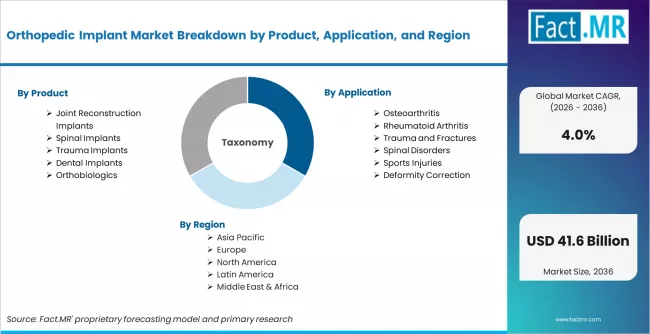
Orthopedic Implant Market Breakdown By Product, Application, And Region | Source: Fact.MR
| Parameter | Details |
|---|---|
| Quantitative Units | USD 28.1 billion to USD 41.6 billion, at a CAGR of 4.0% |
| Market Definition | The Orthopedic Implant Market covers medical devices for surgical implantation to restore or replace musculoskeletal structures, including joint reconstruction, spinal, trauma, dental, and orthobiologic implant categories. |
| Regions Covered | North America, Latin America, Europe, East Asia, South Asia and Pacific, Middle East and Africa |
| Countries Covered | USA, India, China, Germany, Japan, Brazil, Saudi Arabia, 30 plus countries |
| Key Companies | Stryker Corporation, DePuy Synthes, Zimmer Biomet, Smith+Nephew, Medtronic, NuVasive / Globus Medical, Arthrex, Acumed, Paragon Medical |
| Forecast Period | 2026 to 2036 |
| Approach | Hybrid demand-side and top-down methodology built on surgical procedure volumes, aging demographics, reimbursement analysis, implant pricing benchmarks, and primary interviews across manufacturers, orthopedic surgeons, and hospital procurement officers |
Source: Fact.MR analysis. Updated May 8, 2026
Orthopedic Implant Market Segmentation
-
Orthopedic Implant Market Segmented by Product:
- Joint Reconstruction Implants
- Hip Implants
- Total Hip Replacement
- Partial Hip Replacement
- Knee Implants
- Total Knee Replacement
- Partial Knee Replacement
- Revision Knee Replacement
- Shoulder Implants
- Anatomic Shoulder Implants
- Reverse Shoulder Implants
- Elbow Implants
- Ankle Implants
- Hip Implants
- Spinal Implants
- Spinal Fusion Implants
- Non Fusion Implants
- Vertebral Compression Fracture Devices
- Trauma Implants
- Plates
- Locking Plates
- Non Locking Plates
- Screws
- Cortical Screws
- Cancellous Screws
- Intramedullary Nails
- Femoral Nails
- Tibial Nails
- Humeral Nails
- Wires and Pins
- Plates
- Dental Implants
- Endosteal Implants
- Subperiosteal Implants
- Zygomatic Implants
- Orthobiologics
- Bone Grafts
- Autografts
- Allografts
- Bone Graft Substitutes
- Synthetic Substitutes
- Demineralized Bone Matrix
- Stem Cell Based Products
- Bone Grafts
- Joint Reconstruction Implants
-
Orthopedic Implant Market Segmented by Application:
- Osteoarthritis
- Rheumatoid Arthritis
- Trauma and Fractures
- Spinal Disorders
- Sports Injuries
- Deformity Correction
-
Orthopedic Implant Market Segmented by Material:
- Metallic Biomaterials
- Titanium
- Stainless Steel
- Cobalt Chromium
- Ceramic Biomaterials
- Polymeric Biomaterials
- Polyethylene
- Polyether Ether Ketone
- Metallic Biomaterials
-
Orthopedic Implant Market Segmented by End Use:
- Hospitals
- Orthopedic Clinics
- Ambulatory Surgical Centers
-
Orthopedic Implant Market Segmented by Surgery Type:
- Minimally Invasive Surgery
- Open Surgery
-
Orthopedic Implant Market Segmented by Distribution Channel:
- Direct Sales
- Distributor Sales
- Online Sales
-
Orthopedic Implant Market by Region:
- North America
- USA
- Canada
- Mexico
- Latin America
- Brazil
- Chile
- Rest of Latin America
- Western Europe
- Germany
- UK
- Italy
- Spain
- France
- Nordic
- BENELUX
- Rest of Western Europe
- Eastern Europe
- Russia
- Poland
- Hungary
- Balkan & Baltic
- Rest of Eastern Europe
- East Asia
- China
- Japan
- South Korea
- South Asia and Pacific
- India
- ASEAN
- Australia & New Zealand
- Rest of South Asia and Pacific
- Middle East & Africa
- Kingdom of Saudi Arabia
- Other GCC Countries
- Turkiye
- South Africa
- Other African Union
- Rest of Middle East & Africa
- North America
Frequently Asked Questions
How big is the orthopedic implant market in 2025?
What will be the size of the orthopedic implant market in 2036?
How much will the orthopedic implant market grow between 2026 and 2036?
What are the key product types in the orthopedic implant market?
Which product segment will contribute significant share in the orthopedic implant market in 2026?
Which are the fastest-growing countries in the orthopedic implant market?
Who worked on this report


Preview the report firsthand - request a free sample
Free SampleGet the brochure for pricing and purchase details
Download PDF