- Base Value(2025): 5.5 Bn
- Estimated Value(2026): 6.6 Bn
- Forecast Value (2036): 41.8 Bn
- CAGR (2026 - 2036): 19%
Smart Implants Market Forecast 2026 to 2036
In 2025, the smart implants market was valued at USD 5.5 billion. Based on Future Market Insights' analysis, demand for smart implants is estimated to grow to USD 6.6 billion in 2026 and USD 41.8 billion by 2036. FMI projects a CAGR of 19% during the forecast period.
The absolute dollar growth from 2026 to 2036 is USD 35.2 billion. This rapid growth is driven by advancements in medical technology, where smart implants offer the potential for enhanced monitoring, real-time data collection, and improved treatment outcomes for patients. The increasing adoption of smart healthcare devices, along with the growing focus on personalized and remote healthcare, is further supporting the market’s expansion. However, challenges such as high costs, regulatory hurdles, and the need for continuous technological advancements may limit growth in some regions.
Summary of the Smart Implants Market
- Market Definition
- The Smart Implants Market involves the development and sale of implantable medical devices embedded with sensors and communication technology that monitor physiological parameters, enable adaptive therapy, and transmit data for improved patient outcomes.
- Demand Drivers
- Advancements in medical technology, allowing for enhanced monitoring, real-time data collection, and improved patient outcomes.
- Growing adoption of smart healthcare devices, supporting the trend towards personalized and remote healthcare solutions.
- Increasing demand for advanced, minimally invasive treatments and remote patient monitoring solutions.
- The rise of chronic diseases and an aging population, driving the need for continuous care and real-time data to optimize treatment.
- Key Segments Analyzed
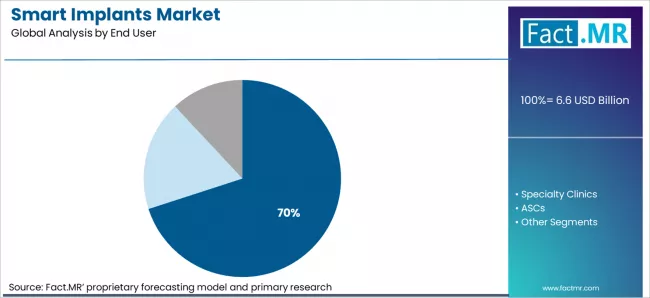
- End User: Hospitals are expected to capture 70% of the smart implants market by 2026 due to their central role in the adoption of advanced medical technologies.
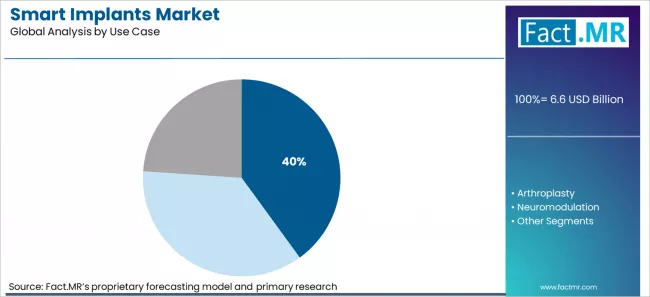
- Use Case: Cardiac rhythm management is projected to hold 40% of the market share by 2026, driven by the growing need for pacemakers and defibrillators in the management of cardiovascular conditions.
- Geography: China leads with a high growth rate, followed by India, the USA, the UK, and Germany.
- Analyst Opinion at FMR
- Shambhu Nath Jha, Principal Consultant at Fact MR, notes, "The smart implants market is poised for remarkable growth, fueled by ongoing advancements in medical technology and a shift toward more personalized, data-driven healthcare. The convergence of sensing, connectivity, and therapy in implants is creating new opportunities for improved patient outcomes, with hospitals leading the charge in adoption."
- Strategic Implications/Executive Takeaways
- Invest in the development of connected implants that offer real-time monitoring, particularly for high-demand areas such as cardiac and orthopedic treatments.
- Focus on expanding the market for smart implants in emerging economies where healthcare infrastructure is improving and demand for advanced medical devices is rising.
- Explore partnerships with healthcare providers to integrate smart implants into comprehensive healthcare systems for personalized care and remote monitoring.
- Methodology
- Primary research through interviews with clinicians, biomedical engineers, and device manufacturers.
- Data sourced from clinical trials databases, industry reports, and regulatory filings.
- Market sizing and forecasting using a hybrid model combining top-down healthcare technology adoption forecasts with bottom-up device shipment and revenue data.
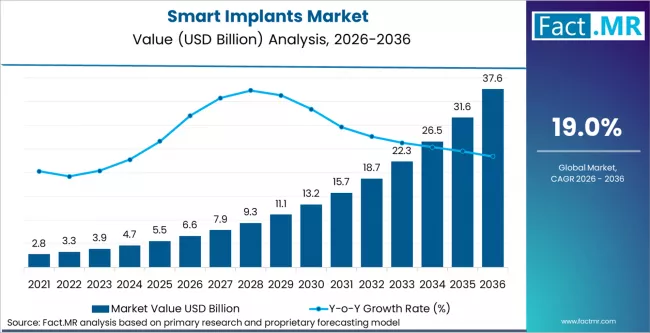
Smart Implants Market Market Value Analysis | Source: Fact.MR
China leads with a CAGR of 15.7%, driven by a large aging population, increased healthcare investment, and growing demand for innovative medical technologies. India follows with a 14.5% CAGR, fueled by expanding healthcare infrastructure and a rising number of patients requiring advanced implant solutions. The USA grows at 9.9%, supported by steady demand in a mature healthcare market with a focus on cutting-edge medical technology. The UK grows at 11.0%, reflecting strong healthcare investments and adoption of advanced medical devices. Germany grows at 13.3%, benefiting from a robust healthcare system and high demand for innovative implant technologies.
Smart Implants Market
| Metric | Value |
|---|---|
| Estimated Value in (2026E) | USD 6.6 billion |
| Forecast Value in (2036F) | USD 41.8 billion |
| Forecast CAGR (2025 to 2036) | 19% |
Source: Fact.MR analysis. Updated Mar 2, 2026
Smart Implants Market Definition
The smart implants market involves the development and sale of implantable medical devices embedded with sensors and communication technology that monitor physiological parameters, enable adaptive therapy, and transmit data for improved patient outcomes.
Market Inclusions
This report covers global and regional market sizes for smart implants over a defined forecast period, including device types (orthopedic, cardiovascular, neurostimulators), connectivity technology (Bluetooth, RFID, wireless telemetry), and end‑use settings (hospitals, ambulatory centers, home care).
Market Exclusions
The scope excludes traditional implants without embedded sensing or communication functions, unrelated implantable accessories, and external monitoring systems not integral to the implant.
Research Methodology
- Primary Research: Interviews were conducted with clinicians, biomedical engineers, and device manufacturers.
- Desk Research: Data was sourced from clinical trials databases, industry reports, and regulatory filings.
- Market‑Sizing and Forecasting: A hybrid model combining top‑down healthcare technology adoption forecasts with bottom‑up device shipment and revenue data was used.
- Data Validation and Update Cycle: Findings were validated through expert review and aligned with recent production, adoption, and clinical utilization statistics.
Segmental Analysis
Smart Implants Market Analysis by End User
Smart Implants Market Analysis By End User | Source: Fact.MR
- Market Overview: Hospitals are expected to capture 70% of the smart implants market by 2026. Hospitals play a central role in the adoption of smart implants, as they are the primary setting for surgeries, post-operative care, and patient monitoring, making them key consumers of advanced medical technologies, including implants with integrated smart features.
- Demand Drivers:
- Technological Advancements in Medical Care: Hospitals are increasingly adopting smart implants due to advancements in medical technology, which enable better patient outcomes through real-time monitoring, data collection, and feedback. These implants help track recovery, optimize treatment plans, and reduce complications.
- Comprehensive Healthcare Solutions: Hospitals provide a comprehensive environment for the surgical implantation and follow-up care needed for smart implants. Their integration into the hospital’s existing infrastructure and patient care systems promotes widespread use of these devices.
- Increased Focus on Patient Monitoring: With a growing focus on personalized healthcare, hospitals are increasingly using smart implants for continuous monitoring, allowing for real-time adjustments to patient treatment plans, reducing recovery time, and improving overall care quality.
Smart Implants Market Analysis by Use Case
Smart Implants Market Analysis By Use Case | Source: Fact.MR
- Market Overview: Cardiac rhythm management is projected to hold 40% of the market share by 2026. Smart implants used in cardiac rhythm management, such as pacemakers and defibrillators, are increasingly being used to monitor and regulate heart rhythms, particularly in patients with arrhythmias, heart failure, and other cardiovascular conditions.
- Demand Drivers:
- Aging Population and Cardiovascular Diseases: The increasing prevalence of heart-related conditions, particularly among the aging population, is driving demand for smart implants in cardiac rhythm management. These implants provide continuous monitoring and can deliver therapeutic interventions, such as pacing or shocks, to manage abnormal heart rhythms.
- Advances in Cardiac Care Technology: Advances in implantable devices, such as remote monitoring, wireless capabilities, and battery life, are making smart cardiac implants more attractive to healthcare providers and patients. These technologies enable physicians to track heart health and intervene proactively to prevent complications.
- Improved Patient Quality of Life: Smart implants in cardiac rhythm management help patients live healthier lives with fewer hospital visits and interventions, as these devices can adjust to changes in a patient's condition and provide early warnings of potential issues.
Smart Implants Market Drivers, Restraints, and Opportunities
FMR analysts observe that the smart implants market is a growth‑aligned, technology‑driven segment anchored in the convergence of implantable medical devices with sensing, connectivity, and data analytics. Historically, passive implants (e.g., traditional orthopedic hardware) met basic structural needs; as clinicians and patients have demanded real‑time monitoring, adaptive therapy, and improved outcomes, structural demand emerged for sensor‑equipped, connected implants that support personalized care and long‑term tracking. The 2026 valuation reflects this shift, with adoption tied to rising chronic disease prevalence, aging populations, and healthcare systems integrating remote patient monitoring into care pathways.
While demand for standard implants remains large, advanced smart implants with embedded sensors and wireless connectivity are gaining share. These higher‑value devices command premium pricing, contributing to net market value growth even as overall procedure volumes grow moderately. The market exists because improved clinical insight and remote monitoring can reduce complications and cost of care, and regulatory frameworks increasingly support digital health integration with implantable technologies.
- Clinical Insight Demand: Surgeons and care teams adopt smart implants that provide real‑time physiological data, replacing traditional hardware limited to structural function.
- Regulatory & Standards Pressure: Healthcare standards and device regulations for safety, interoperability, and data security (e.g., ISO 13485 quality frameworks) push certified smart implant adoption.
- Regional Healthcare Dynamics: In North America and Europe, advanced healthcare infrastructure and reimbursement support drive higher uptake of smart implants compared with regions where basic implant adoption dominates.
Regional Analysis
The market analysis covers key global regions, including East Asia, South Asia, Western Europe, and North America. It is segmented geographically, with specific market dynamics for each region. The full report provides a detailed market attractiveness analysis.
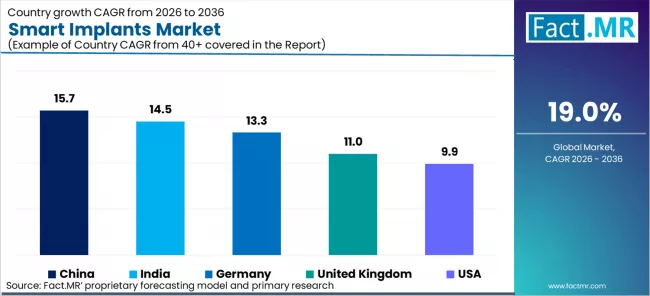
Smart Implants Market Cagr Analysis By Country | Source: Fact.MR
| Country | CAGR (%) |
|---|---|
| China | 15.7% |
| India | 14.5% |
| USA | 9.9% |
| United Kingdom | 11.0% |
| Germany | 13.3% |
Source: Fact.MR analysis. Updated Mar 2, 2026
Source: Fact MR (FMR) analysis, based on proprietary forecasting model and primary research.
East Asia:
In East Asia, China is the leading market for smart implants, supported by the rapid development of healthcare infrastructure, a growing aging population, and increasing demand for advanced medical devices.
- China: Demand for smart implants in China is projected to rise at 15.7% CAGR through 2036. China’s large population, increasing focus on healthcare technology, and expanding healthcare infrastructure continue to drive strong growth in the smart implants market.
South Asia:
In South Asia, India is experiencing significant growth in the smart implants market, driven by increasing healthcare awareness, demand for advanced medical treatments, and rising disposable incomes.
- India: Demand for smart implants in India is projected to rise at 14.5% CAGR through 2036. India’s rapidly expanding healthcare sector and growing adoption of advanced medical technologies continue to drive market growth.
North America:
In North America, the USA is a dominant market for smart implants, fueled by advancements in medical technology, a large patient population, and increasing healthcare expenditure.
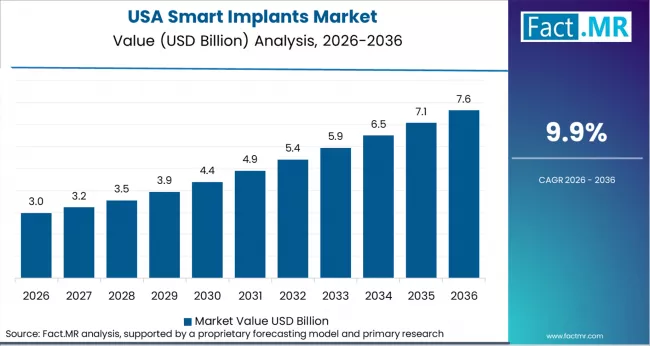
Smart Implants Market Country Value Analysis | Source: Fact.MR
- USA: Demand for smart implants in the U.S. is projected to rise at 9.9% CAGR through 2036. The USA’s advanced healthcare system, rising demand for minimally invasive surgeries, and high adoption of smart technologies in healthcare continue to support steady growth in the market
Western Europe:
In Western Europe, both the United Kingdom and Germany are key markets for smart implants, driven by strong healthcare systems, rising healthcare needs, and an increasing focus on aging populations.
- United Kingdom: Demand for smart implants in the UK is projected to rise at 11.0% CAGR through 2036. The UK’s focus on advanced healthcare technologies and growing need for orthopedic and dental implants continue to contribute to steady market growth.
- Germany: Demand for smart implants in Germany is projected to rise at 13.3% CAGR through 2036. Germany’s well-established healthcare infrastructure and demand for high-quality medical implants contribute to robust market expansion.
Fact MR's analysis of the Smart Implants Market in East Asia, South Asia, Western Europe, North America consists of country-wise assessments that include China, India, the USA, the United Kingdom, and Germany. Readers can find detailed trends, regulatory updates, and company-specific investments shaping the market’s growth in these countries.
Competitive Landscape
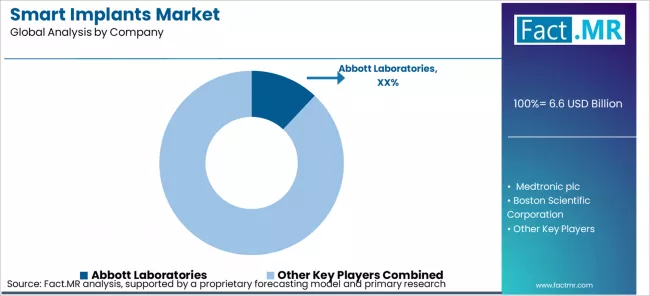
Smart Implants Market Analysis By Company | Source: Fact.MR
How Are Key Players Competing in the Smart Implants Market?
The Smart Implants Market is evolving with advancements in medical technology and healthcare. Medtronic plc and Abbott Laboratories lead the charge, focusing on next-generation implantable devices for cardiac and neurological treatments. Boston Scientific Corporation and Stryker Corporation are expanding their portfolios with smart implants designed for pain management, orthopedics, and minimally invasive surgeries. Companies like Cochlear Limited and Biotronik SE & Co. KG focus on implantable devices for hearing loss and cardiovascular applications. Senseonics Holdings, Inc. and NeuroPace, Inc. are gaining traction with continuous monitoring technologies, particularly in the diabetic and neurological treatment sectors. The competition is driven by innovation in real-time health monitoring, remote control of implants, and enhancing patient outcomes through data-driven insights.
Recent Industry Developments
- Medtronic BrainSense™ Adaptive DBS Best Invention Award
- In October 2025, TIME named Medtronic’s BrainSense™ Adaptive Deep Brain Stimulation (aDBS) system as one of the Best Inventions of 2025 for its ability to sense and automatically adjust therapy based on real-time brain activity.
- Zimmer Biomet Persona IQ® AAOS 2026 Data Release
- On February 25, 2026, Zimmer Biomet announced it will unveil new clinical data at the AAOS 2026 meeting regarding its Persona IQ® "Smart Knee," specifically focusing on the relationship between gait decline and periprosthetic joint infections
- Medtronic Altaviva™ FDA Approval for Incontinence
- Medtronic secured FDA approval on September 19, 2025, for the Altaviva™ device, an implantable tibial neuromodulation (ITNM) system designed to treat urge urinary incontinence via a minimally invasive smart lead.
Key Players of the Smart Implants Market
- Abbott Laboratories
- Medtronic plc
- Boston Scientific Corporation
- Stryker Corporation
- Zimmer Biomet Holdings, Inc.
- Cochlear Limited
- Biotronik SE & Co. KG
- Senseonics Holdings, Inc.
- ALEVA Neurotherapeutics SA
- Nevro Corp.
- NeuroPace, Inc.
Report Scope
| Metric | Value |
|---|---|
| Quantitative Units | USD 6.6 billion (2026) to USD 41.8 billion (2036), at a CAGR of 19% |
| Market Definition | The Smart Implants Market includes medical implants with embedded sensors or electronic systems designed for patient monitoring and therapeutic interventions in areas such as cardiology, orthopedics, and neurology. |
| By Implant | Pacemakers, CRTs, ICDs, Knee Replacement, I-CGM, Cochlear Implants, Sacral Neuromodulators, DRG Neurostimulators, Spinal Cord Stimulators, Others |
| By Use Case | Cardiac Rhythm Management, Arthroplasty, Neuromodulation, Continuous Glucose Monitoring, Hearing, Others |
| By End User | Hospitals, Specialty Clinics, ASCs |
| Regions Covered | North America, Latin America, Europe, East Asia, South Asia, Oceania, Middle East and Africa |
| Countries Covered | United States, Canada, Mexico, Brazil, Argentina, Germany, France, United Kingdom, Italy, Spain, China, India, Japan, South Korea, Indonesia, Australia, and 40+ countries |
| Key Companies Profiled | Abbott Laboratories, Medtronic plc, Boston Scientific Corporation, Stryker Corporation, Zimmer Biomet Holdings, Inc., Cochlear Limited, Biotronik SE & Co. KG, Senseonics Holdings, Inc., ALEVA Neurotherapeutics SA, Nevro Corp., NeuroPace, Inc. |
| Forecast Period | 2026 to 2036 |
| Approach | Hybrid top-down and bottom-up market modeling validated through primary interviews with manufacturers and supported by trade data benchmarking and market research. |
Source: Fact.MR analysis. Updated Mar 2, 2026
Bibliographies
- Zimmer Biomet. (2026, February 25). Zimmer Biomet to unveil new clinical data on Persona IQ® at AAOS 2026 [Press release]. Zimmer Biomet.
- Abbott Laboratories. (2024). Innovative smart implant solutions for a range of medical applications. Abbott Laboratories.
- Biotronik SE & Co. KG. (2024). Smart implants for cardiovascular applications and implantable devices. Biotronik SE & Co. KG.
- Boston Scientific Corporation. (2024). Smart implants for pain management and minimally invasive procedures. Boston Scientific Corporation.
- Cochlear Limited. (2024). Implantable devices for hearing loss treatment and rehabilitation. Cochlear Limited.
- Medtronic plc. (2024). Next-generation implantable devices for cardiac and neurological treatments. Medtronic plc.
This report addresses
- Market Intelligence enabling comprehensive assessment of leading countries and service segments across the Smart Implants Market globally.
- Market Volume (Sales Units) estimates and 10-year revenue forecasts from 2026 to 2036, validated through manufacturer shipment data, channel partner surveys, and country-level demand modeling.
- Growth Opportunity Mapping across implant types (Pacemakers, CRTs, ICDs, Knee Replacement, I-CGM, Cochlear Implants, Spinal Cord Stimulators, and others), use cases (Cardiac Rhythm Management, Neuromodulation, Continuous Glucose Monitoring, etc.), end users (Hospitals, Specialty Clinics, ASCs), and regions.
- Segment and Regional Revenue Forecasts by implant, use case, end user, and geography across 40+ countries.
- Competition Strategy Analysis covering dealer network structure, recent developments, product portfolio, USPs, and market share analysis.
- Product and Regulatory Compliance Tracking aligned with industry standards, sensor technologies, and regulatory frameworks.
- Regulatory Impact Analysis addressing global market compliance, data security standards, and evolving smart implant technologies.
- Report Delivery in PDF, Excel, PowerPoint, and interactive dashboard formats for executive, procurement, and operational planning use.
Segmentation
Smart Implants Market Key Segments
-
Implant
- Pacemakers
- CRTs
- ICDs
- Knee Replacement
- I-CGM
- Cochlear Implants
- Sacral Neuromodulators
- DRG Neurostimulators
- Spinal Cord Stimulators
- Others
-
Use Case
- Cardiac Rhythm Management
- Arthroplasty
- Neuromodulation
- Continuous Glucose Monitoring
- Hearing
- Others
-
End-User
- Hospitals
- Specialty Clinics
- ASCs
-
Region
- North America
- USA
- Canada
- Mexico
- Europe
- Germany
- UK
- France
- Italy
- Spain
- Nordic Countries
- BENELUX
- Rest of Europe
- Asia Pacific
- China
- Japan
- South Korea
- India
- Australia
- Rest of Asia Pacific
- Latin America
- Brazil
- Argentina
- Rest of Latin America
- Middle East and Africa
- Kingdom of Saudi Arabia
- United Arab Emirates
- South Africa
- Rest of Middle East and Africa
- Other Regions
- Oceania
- Central Asia
- Other Markets
- North America
Frequently Asked Questions
How large is the demand for Smart Implants in the global market in 2026?
What will be the market size of Smart Implants in the global market by 2036?
What is the expected demand growth for Smart Implants in the global market between 2026 and 2036?
Which end user is expected to dominate the market?
Which region is expected to show the highest growth rate for Smart Implants?
How significant is the growth outlook for India in this market?
What is the growth outlook for the United States in the Smart Implants market?
What is the growth forecast for the United Kingdom in the Smart Implants market?
What is the growth forecast for Germany in the Smart Implants market?
Which company is identified as a leading player in the Smart Implants market?
What are Smart Implants used for?
What does the Smart Implants market include in this report?
How is the market forecast developed in this report?
What is meant by the Smart Implants market in this report?
Who worked on this report


Preview the report firsthand - request a free sample
Free SampleGet the brochure for pricing and purchase details
Download PDF