- Market Value (2025): USD 402.3 Mn
- Estimated Value (2026): USD 434.3 Mn
- Forecast Value (2036): USD 934.2 Mn
- CAGR (2026-2036): 8.0%
What is the Abrasion-Resistant Polyurethane Formulations Market forecast to be worth by 2036?
USD 434.3 million in 2026 to USD 934.2 million by 2036 at an 8.0% CAGR.
- Fact.MR estimates that the abrasion-resistant polyurethane formulations market was valued at USD 402.3 million in 2025.
- demand is projected to increase from USD 434.3 million in 2026 to USD 934.2 million by 2036.
- the forecast indicates an 8.0% CAGR from 2026 to 2036 as industrial users seek durable polyurethane materials for wear-intensive applications.
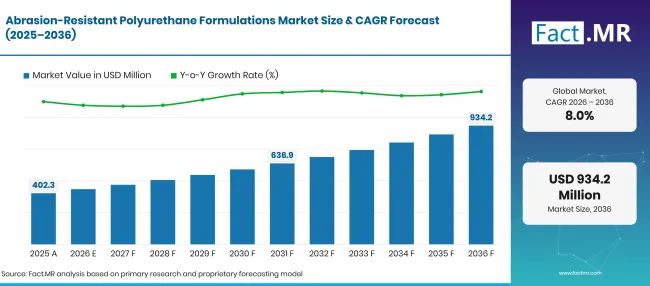
Abrasion Resistant Polyurethane Formulations Forecast Global | Source: Fact.MR
| Year | Basis | Market Value (USD million) |
|---|---|---|
| 2025 | Actual | 402.3 |
| 2026 | Estimate | 434.3 |
| 2036 | Forecast | 934.2 |
| CAGR 2026 to 2036 | Forecast period | 8.0% |
Source: Fact.MR analysis. Updated Nov 9, 2026
What are the defining numbers behind Abrasion-Resistant Polyurethane Formulations Market growth?
USD 499.9 million in additional market value between 2026 and 2036.
- Demand Drivers in the Market
- Demand for durable automotive components supports the market. Automotive component manufacturers need materials that tolerate repeated friction, vibration and contact without premature surface failure. Abrasion-resistant polyurethane formulations combine elastic recovery with mechanical strength, making them suitable for seals, suspension bushings, rollers and protective coatings.
- Rising use in construction and infrastructure has increased the demand for the abrasion-resistant polyurethane formulations market. Construction projects expose flooring, expansion joints and protective linings to foot traffic, equipment movement and abrasive debris. Polyurethane systems provide resilient and wear-resistant surfaces while accommodating substrate movement. The U.S. Census Bureau estimated total construction spending at a seasonally adjusted annual rate of USD 2,203.1 billion in August 2026, 0.9% above the revised July estimate [1].[1]
- Increasing requirements for industrial equipment protection supports the growth of the abrasion-resistant polyurethane formulations market. Industrial machinery operates under repeated movement and surface contact that can accelerate component wear. Cast polyurethane elastomers and specialized coatings offer abrasion resistance alongside flexibility and load-bearing capacity. India's Ministry of Statistics and Programme Implementation reported that the Index of Industrial Production for capital goods increased by 14.6% in March 2026 compared with March 2025 [2]. [2]
- The development of application-specific polyurethane formulations creates opportunities for manufacturers. Suppliers are expanding formulation options to address different processing conditions and performance requirements. Castable liquids, two-component systems, coatings, films and pellets allow processors to select suitable materials for specific production methods.
- Key Segments Analyzed
- By PU Formulation Type: Cast Elastomer is projected to represent 33.1% of the market in 2026, driven by its suitability for applications requiring mechanical strength and resistance to repeated wear.
- By Supply / Product Format: Paste / Gel leads with a 24.6% share in 2026, reflecting its suitability for customized coating, sealing, and surface-protection applications.
- By Manufacturing / Cure Process: Moisture / Ambient curing is projected to hold 29.0% share in 2026 because it can support applications where conventional room-temperature processing is practical.
- By Industrial End Use: Automotive segment represent 25.3% of the market in 2026, supported by demand for durable materials in vehicle components and protective applications.
- Analyst Opinion at Fact.MR
- Shambhu Nath Jha, Principal Consultant at Fact.MR, states, “Abrasion-resistant polyurethane formulations are gaining importance as industrial manufacturers seek materials that can maintain performance under repeated friction and mechanical stress. Suppliers should focus on application-specific formulations, consistent processing characteristics, and documented wear performance to strengthen their position across automotive, construction, and industrial equipment applications.”
- Strategic Implications
- Manufacturers should optimize polyurethane chemistry to deliver consistent abrasion resistance while retaining tensile strength, elongation and tear resistance. Formulation selection should account for contact pressure, sliding velocity, surface roughness and operating temperature.
- Automotive suppliers need to establish rigorous material qualification protocols for polyurethane components exposed to continuous friction and vibration. Testing should evaluate abrasion loss, compression set, fatigue resistance and dimensional stability under representative operating conditions.
- Construction material providers can develop polyurethane coatings and elastomeric systems for flooring, joints and protective surfaces exposed to heavy traffic. Product selection should consider substrate adhesion, hardness, slip resistance, moisture exposure and resistance to mechanical wear.
- Industrial equipment manufacturers need to assess polyurethane grades against expected loads and environmental exposure before selecting materials. Key parameters include Shore hardness, rebound resilience, tear strength, abrasion loss and hydrolysis resistance.
- Distributors should provide detailed product documentation covering material specifications, mixing ratios, pot life, curing temperatures and substrate preparation. Guidance on moisture sensitivity and chemical compatibility can help processors avoid application defects.
China is set to record a 9.9% CAGR through 2036. India is projected to register the fastest growth among the listed countries at 10.5%, followed by the USA at 8.5%. Germany is estimated to advance at 8.0%, while Japan is forecast to record a 7.3% CAGR.
How does the Abrasion-Resistant Polyurethane Formulations Market break down by segment?
Fact.MR finds that Cast Elastomer leads PU Formulation Type at 33.1%; Paste / Gel leads Supply / Product Format at 24.6%; Moisture / Ambient leads Manufacturing / Cure Process at 29.0%; and Automotive Leads Industrial End Use at 25.3%.
Which PU Formulation Type dominates?
Cast Elastomer is set to hold a 33.1% share in 2026.
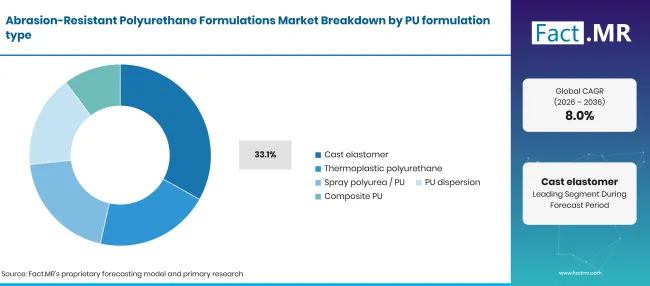
Abrasion Resistant Polyurethane Formulations Breakdown Pu Formulation Type | Source: Fact.MR
| PU Formulation Type | Share (2026) |
|---|---|
| Cast Elastomer (Leading segment) | 33.1% |
| Other segments combined | 66.9%* |
| Total | 100.0% |
Source: Fact.MR analysis. Updated Nov 9, 2026
Cast elastomers are used in applications that require a combination of wear resistance, load-bearing capability, and mechanical durability. Their formulation flexibility makes them suitable for industrial rollers, wheels, liners, and protective components. Thermoplastic polyurethane serves applications requiring melt processing and repeatable manufacturing, while spray polyurea / PU systems support protective surface applications. PU dispersions and composite polyurethane formulations address additional requirements involving coating characteristics, material compatibility, and specialized performance.
What leads the Supply / Product Format segment?
Paste / Gel is set to represent a 24.6% share in 2026.
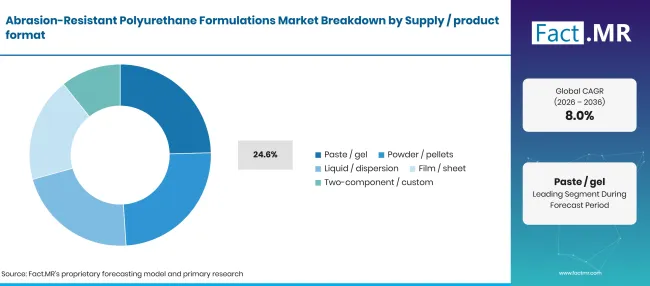
Abrasion Resistant Polyurethane Formulations Breakdown Supply Product Format | Source: Fact.MR
| Supply / Product Format | Share (2026) |
|---|---|
| Paste / Gel (Leading segment) | 24.6% |
| Other segments combined | 75.4%* |
| Total | 100.0% |
Source: Fact.MR analysis. Updated Nov 9, 2026
Paste and gel formats support customized application requirements, particularly where materials need controlled placement, surface coverage, or specific application consistency. Powder and pellet formats are relevant to manufacturing processes involving compounding and melt processing. Liquid dispersions support coating and surface-treatment applications, while films and sheets offer preformed material options. Two-component and custom systems provide flexibility in applications requiring controlled mixing and performance characteristics.
How does Manufacturing / Cure Process shape demand?
Moisture / Ambient curing is likely to account for a 29.0% share in 2026.
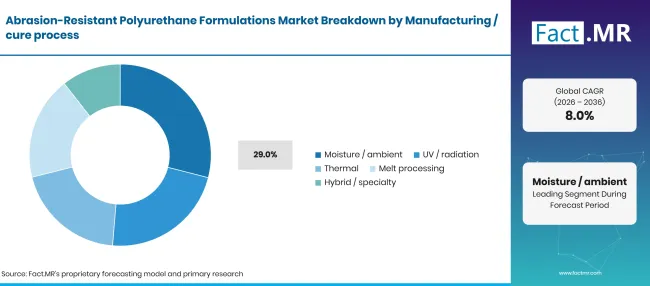
Abrasion Resistant Polyurethane Formulations Breakdown Manufacturing Cure Process | Source: Fact.MR
| Manufacturing / Cure Process | Share (2026) |
|---|---|
| Moisture / Ambient (Leading segment) | 29.0% |
| Other segments combined | 71.0%* |
| Total | 100.0% |
Source: Fact.MR analysis. Updated Nov 9, 2026
Moisture and ambient curing systems offer processing flexibility where manufacturers need materials that cure under practical environmental conditions. UV and radiation curing systems can support production processes requiring controlled curing and shorter processing cycles. Thermal curing is relevant to applications that require heat-assisted material development, while melt processing supports thermoplastic polyurethane manufacturing. Hybrid and specialty processes address formulations with more specific performance or processing requirements.
Which Industrial End Use accounts for the largest share?
Automotive is projected to account for 25.3% share in 2026.
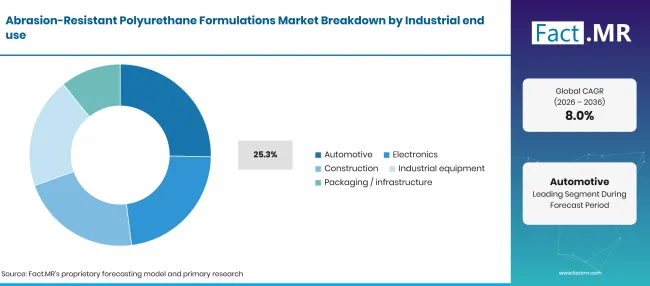
Abrasion Resistant Polyurethane Formulations Breakdown Industrial End Use | Source: Fact.MR
| Industrial End Use | Share (2026) |
|---|---|
| Automotive (Leading segment) | 25.3% |
| Other segments combined | 74.7%* |
| Total | 100.0% |
Source: Fact.MR analysis. Updated Nov 9, 2026
Automotive manufacturers use polyurethane materials in components exposed to friction, vibration, and repeated mechanical movement. Abrasion-resistant formulations can support applications involving protective surfaces, seals, interior components, and other wear-sensitive parts. Construction applications require durable materials for flooring, coatings, and infrastructure protection. Industrial equipment manufacturers use polyurethane formulations in rollers, conveyor systems, protective linings, and mechanical components. Packaging and infrastructure applications create additional demand for materials with suitable surface durability and processing characteristics.
What is accelerating Abrasion-Resistant Polyurethane Formulations Market adoption, and what is holding it back?
Growing requirements for durable industrial materials and longer component service life support demand, while formulation costs and processing requirements can limit adoption. Drivers Impact Analysis
| DRIVER | (~) % IMPACT ON CAGR | GEOGRAPHIC RELEVANCE | IMPACT TIMELINE |
|---|---|---|---|
| Demand for wear-resistant automotive components | +1.0% | China, USA, Germany | Medium term (2–4 years) |
| Expansion of industrial equipment manufacturing | +0.9% | China, India, Japan | Medium term (2–4 years) |
| Demand for durable construction coatings | +0.7% | Global | Long term (≥ 4 years) |
| Replacement of conventional rubber and metal components | +0.6% | Global | Medium term (2–4 years) |
| Development of specialized PU formulations | +0.5% | USA, Germany, Japan | Long term (≥ 4 years) |
Source: Fact.MR analysis. Updated Nov 9, 2026
Opportunity Impact Analysis
| OPPORTUNITY | (~) % IMPACT ON CAGR | GEOGRAPHIC RELEVANCE | IMPACT TIMELINE |
|---|---|---|---|
| Customized cast polyurethane elastomers | +0.8% | Global | Medium term (2–4 years) |
| High-performance automotive applications | +0.7% | China, India, Germany | Long term (≥ 4 years) |
| Advanced abrasion-resistant protective coatings | +0.6% | USA, China | Medium term (2–4 years) |
| Environmentally compatible PU formulations | +0.5% | Europe, North America | Long term (≥ 4 years) |
| Specialized thermoplastic polyurethane grades | +0.4% | Japan, China | Medium term (2–4 years) |
Source: Fact.MR analysis. Updated Nov 9, 2026
Restraints Impact Analysis
| RESTRAINT | (~) % IMPACT ON CAGR | GEOGRAPHIC RELEVANCE | IMPACT TIMELINE |
|---|---|---|---|
| Fluctuating raw material prices | -0.8% | Global | Short term (≤ 2 years) |
| High costs of specialty formulations | -0.6% | Global | Medium term (2–4 years) |
| Processing and curing complexity | -0.5% | Global | Short term (≤ 2 years) |
| Compatibility limitations across substrates | -0.4% | Global | Medium term (2–4 years) |
| Competition from alternative wear-resistant materials | -0.3% | Global | Long term (≥ 4 years) |
Source: Fact.MR analysis. Updated Nov 9, 2026
Which countries are scaling the Abrasion-Resistant Polyurethane Formulations Market through 2036?
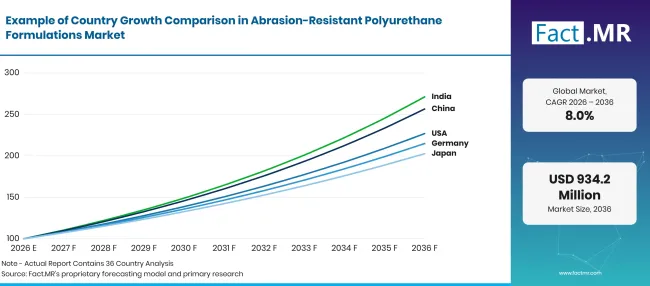
Abrasion Resistant Polyurethane Formulations Growth Index | Source: Fact.MR
| Country | CAGR (2026-2036) |
|---|---|
| India | 10.5% |
| China | 9.9% |
| USA | 8.5% |
| Germany | 8.0% |
| Japan | 7.3% |
Source: Fact.MR analysis. Updated Nov 9, 2026
What supports India adoption?
10.5% CAGR, shaped by expanding automotive manufacturing, industrial production, and infrastructure development.
India's growing automotive and industrial manufacturing base creates opportunities for abrasion-resistant polyurethane formulations. Manufacturers require durable materials for vehicle components, industrial rollers, protective coatings, and equipment parts exposed to repeated mechanical contact. Infrastructure development can also support demand for polyurethane flooring and protective surface systems. Suppliers should focus on cost-effective formulations and technical support for domestic manufacturers.
What is driving growth in the China?
9.9% CAGR, driven by large-scale automotive production, industrial manufacturing, and domestic polyurethane capacity.
China's extensive manufacturing ecosystem supports demand for polyurethane materials across automotive, construction, electronics, and industrial equipment applications. Domestic chemical producers have opportunities to supply thermoplastic polyurethane, cast elastomers, and protective coating systems. Wanhua Chemical's polyurethane and CASE portfolios provide relevant material capabilities for these applications. Manufacturers can strengthen their position through localized production, application-specific formulations, and improved material performance.
What supports United States adoption?
8.5% CAGR, supported by industrial equipment requirements, automotive component manufacturing, and protective coating applications.
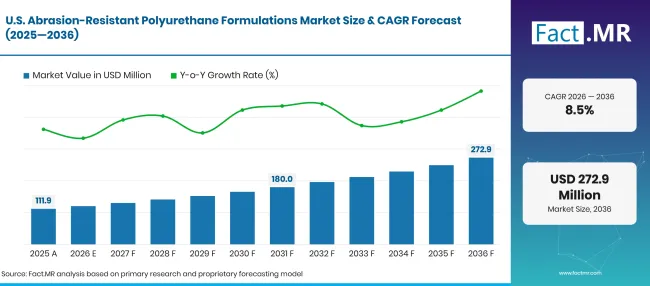
Abrasion Resistant Polyurethane Formulations Forecast Usa | Source: Fact.MR
The U.S. market benefits from demand for durable materials used in industrial machinery, automotive systems, and infrastructure protection. Manufacturers can use abrasion-resistant polyurethane in rollers, conveyor components, equipment linings, and protective coatings. Suppliers need to demonstrate material durability, processing consistency, and performance under different operating conditions to support wider industrial use.
How is Germany building adoption?
8.0% CAGR, led by automotive engineering, precision manufacturing, and demand for high-performance industrial materials.
Germany's automotive and machinery industries create opportunities for polyurethane formulations that withstand repeated friction and mechanical loading. Automotive component suppliers require materials with consistent mechanical properties, while industrial equipment manufacturers need durable rollers, seals, and protective surfaces. Formulation developers can focus on customized elastomer systems and thermoplastic polyurethane grades that meet demanding manufacturing specifications.
What supports Japan adoption?
7.3% CAGR, backed by precision manufacturing, automotive components, and advanced material development.
Japan's established automotive and electronics industries support demand for polyurethane materials that deliver reliable mechanical performance and consistent quality. Specialized thermoplastic polyurethane and elastomer grades are used in cable insulation, precision components and protective films where flexibility and resistance to surface wear are essential. Manufacturers can strengthen their position by improving processing efficiency and dimensional stability while meeting the strict quality requirements of Japan's advanced manufacturing sector.
Which companies are the key providers?
Key companies include Covestro AG, Huntsman Corporation, BASF SE, Wanhua Chemical Group Co., Ltd., Dow Inc., and UBE Corporation.
- Covestro AG
- Huntsman Corporation
- BASF SE
- Wanhua Chemical Group Co., Ltd.
- Dow Inc.
- UBE Corporation
Bibliography
- [1] U.S. Census Bureau. (2026, October 1). Monthly Construction Spending, August 2026.
- [2] Ministry of Statistics and Programme Implementation, Government of India. (2026, April 28). Quick Estimate of Index of Industrial Production and Use-Based Index for the Month of March 2026 (Base 2011–12=100)
- [3] BASF. (n.d.). Elastollan® TPU: Thermoplastic Polyurethane Material.
- [4] Wanhua Chemical Group Co., Ltd. (n.d.). Coatings, Adhesives, Sealants and Elastomers (CASE) Materials Portfolio
- [5] UBE Corporation. (n.d.). Elastomer Solutions.https://www.ube.com/ube/en/contents/chemical/urethane-systems/elastomer-solutions/
This Report Answers
- The report describes how abrasion-resistant polyurethane formulations are used across automotive, construction, electronics, industrial equipment, and packaging applications.
- Segment analysis compares the specified PU formulation types and their respective 2026 market shares.
- Supply format analysis examines paste, gel, powder, pellets, liquid dispersions, films, sheets, and customized two-component systems.
- Manufacturing analysis evaluates moisture curing, UV curing, thermal processing, melt processing, and specialty hybrid technologies.
- Country analysis discusses China, USA, Germany, Japan, and India alongside their respective market growth rates.
- The competitive overview profiles Covestro, Huntsman, BASF, Wanhua Chemical, Dow, and UBE Corporation.
What does the Abrasion-Resistant Polyurethane Formulations Market cover?
The market covers polyurethane formulations developed to withstand surface wear, friction, repeated mechanical contact, and demanding operating conditions. It includes cast polyurethane elastomers, thermoplastic polyurethane, spray polyurea / PU, polyurethane dispersions, and composite polyurethane systems. These materials are supplied in different formats and processed through various curing and manufacturing methods to serve automotive, electronics, construction, industrial equipment, and packaging applications.
What is included in the scope?
Included products comprise polyurethane formulations specifically designed or marketed for abrasion resistance and wear protection.
The value boundary covers formulation types, supply formats, and manufacturing processes identified in the market segmentation. Applications include automotive components, industrial rollers, protective coatings, equipment linings, construction surfaces, and other wear-sensitive industrial products.
What is excluded from the scope?
The analysis excludes conventional polyurethane products without a defined abrasion-resistant application or performance characteristic.
Standard polyurethane foams used solely for cushioning and insulation are outside the defined market boundary. Non-polyurethane abrasion-resistant materials, including conventional rubber, metals, ceramics, and unrelated protective coatings, are also excluded. General-purpose polyurethane raw materials without a relevant formulation or application connection are not counted as finished abrasion-resistant formulation revenue.
How Was the Analysis Built?
The analysis draws on 120+ sources, 35+ company portfolios, 25+ countries, and more than 20 industry interviews.
- Primary Research: Primary research includes discussions with polyurethane manufacturers, formulation developers, chemical suppliers, distributors, industrial equipment manufacturers, automotive suppliers, and subject-matter experts. These conversations examine purchasing priorities, material performance, formulation requirements, processing challenges, competitive positioning, and the factors influencing wider industrial acceptance.
- Desk Research: Desk research covers company portfolios, technical product documentation, regulatory publications, industrial manufacturing statistics, trade data, technical studies, industry associations, material standards, and other authoritative sources. Every source used in the analysis is documented in the bibliography.
- Market Sizing and Forecasting: Market estimates combine historical performance, demand indicators, pricing and volume trends, segment shares, company participation, country-level growth, application requirements, investment activity, and barriers to market expansion.
- Data Validation and Update Cycle: Findings are validated by comparing primary interviews with public data, company activity, product launches, manufacturing developments, and industry trends. Regular updates review new formulation launches, capacity changes, partnerships, technical improvements, and shifts in industrial adoption.
Who leads the Abrasion-Resistant Polyurethane Formulations Market?
Fact.MR identifies Covestro AG, Huntsman Corporation, BASF SE, Wanhua Chemical Group Co., Ltd., Dow Inc., and UBE Corporation as key companies participating in the polyurethane materials and formulation supply chain.
Covestro offers polyurethane raw materials and cast polyurethane elastomer systems for demanding industrial applications. Its cast polyurethane materials are recognized for abrasion resistance, tear strength, resilience, and load-bearing performance. Huntsman Corporation supplies polyurethane systems and thermoplastic polyurethane materials for applications requiring abrasion, impact, and chemical resistance. Its polyurethane business serves automotive, footwear, construction, and industrial markets.
BASF SE participates through its Elastollan thermoplastic polyurethane and Elastocoat protective coating portfolios. These materials offer wear resistance, mechanical strength, and protection for industrial applications [3]. Wanhua Chemical Group offers polyurethane materials, Wanthane TPU products, and specialized protective coating systems. Its portfolio includes products developed for abrasion resistance, flexibility, and industrial surface protection [4].
Dow Inc. participates in the broader polyurethane materials and systems supply chain. Its polyurethane activities provide relevance to the market's raw material and formulation ecosystem, although individual abrasion-resistant product applications should be assessed separately. UBE Corporation supplies cast urethane systems, including Adiprene and Vibrathane prepolymers, for applications such as mining screens, pipe linings, and industrial rollers. Its products emphasize abrasion resistance, toughness, and load-bearing capability [5].
Competitive positioning depends on formulation performance, raw material availability, processing support, and application-specific product development. Manufacturers need to demonstrate abrasion resistance under relevant operating conditions rather than relying solely on general polyurethane material specifications.
Segmentation
What is the report's scope and coverage?
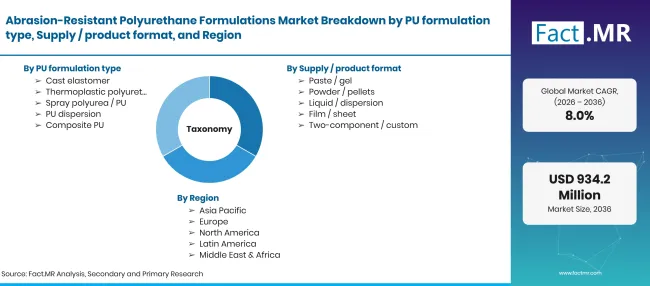
Abrasion Resistant Polyurethane Formulations Taxonomy | Source: Fact.MR
| Attribute | Details |
|---|---|
| Quantitative Units | USD million |
| Market Definition | Abrasion-resistant polyurethane formulations are specialized polymer systems engineered to withstand friction and repeated surface wear while maintaining mechanical strength and flexibility. They are used in automotive components and construction materials as well as industrial machinery and protective coatings. |
| PU Formulation Type | Cast Elastomer; Thermoplastic Polyurethane; Spray Polyurea / PU; PU Dispersion; Composite PU |
| Supply / Product Format | Paste / Gel; Powder / Pellets; Liquid / Dispersion; Film / Sheet; Two-component / Custom |
| Manufacturing / Cure Process | Moisture / Ambient; UV / Radiation; Thermal; Melt Processing; Hybrid / Specialty |
| Industrial End Use | Automotive; Electronics; Construction; Industrial Equipment; Packaging / Infrastructure |
| Regions Covered | North America; Latin America; Western Europe; Eastern Europe; East Asia; South Asia & Pacific; Middle East & Africa |
| Countries Covered | China; USA; Germany; Japan; India |
| Companies Profiled | Covestro AG; Huntsman Corporation; BASF SE; Wanhua Chemical Group Co., Ltd.; Dow Inc.; UBE Corporation |
| Forecast Period | 2026 to 2036 |
| Approach | Market segmentation and scenario-based analysis supported by industry developments, company portfolios, and application-level demand assessment |
Source: Fact.MR analysis. Updated Nov 9, 2026
How is the market segmented?
-
By PU Formulation Type
- Cast Elastomer
- Thermoplastic Polyurethane
- Spray Polyurea / PU
- PU Dispersion
- Composite PU
-
By Supply / Product Format
- Paste / Gel
- Powder / Pellets
- Liquid / Dispersion
- Film / Sheet
- Two-component / Custom
-
By Manufacturing / Cure Process
- Moisture / Ambient
- UV / Radiation
- Thermal
- Melt Processing
- Hybrid / Specialty
-
By Industrial End Use
- Automotive
- Electronics
- Construction
- Industrial Equipment
- Packaging / Infrastructure
-
By Region
- North America
- Latin America
- Western Europe
- Eastern Europe
- East Asia
- South Asia & Pacific
- Middle East & Africa
Frequently Asked Questions
How big is the Abrasion-Resistant Polyurethane Formulations Market in 2026?
What is the CAGR from 2026 to 2036?
Which PU formulation type has the largest share?
Which supply / product format leads the market?
Which manufacturing / cure process dominates?
Which industrial end use has the largest market share?
Which country is expected to grow fastest?
Which companies are covered in the market?
Who worked on this report


Preview the report firsthand - request a free sample
Free SampleGet the brochure for pricing and purchase details
Download PDF