- Market Value (2025): USD 375.2 Mn
- Estimated Value (2026): USD 395.8 Mn
- Forecast Value (2036): USD 674.8 Mn
- CAGR (2026-2036): 5.5%
What is the Flame-Retardant Thermoplastic Compounds Market forecast to be worth by 2036?
USD 395.8 million in 2026 to USD 674.8 million by 2036 at a 5.5% CAGR.
- Flame-retardant thermoplastic compound demand was worth USD 375.2 million in 2025, with electrical housings, connectors and switchgear parts taking the biggest portion of volume.
- Revenue will expand from USD 395.8 million in 2026 to USD 674.8 million by 2036 as battery systems, charging hardware and compact electronics require more flame-rated polymer per unit.
- A 5.5% CAGR reflects steady replacement of metal and thermoset parts with molded thermoplastics, plus a gradual move toward halogen-free grades that carry a price premium.
| Year | Basis | Market Value (USD million) |
|---|---|---|
| 2025 | Actual | 375.2 |
| 2026 | Estimate | 395.8 |
| 2036 | Forecast | 674.8 |
| CAGR 2026 to 2036 | Forecast period | 5.5% |
Source: Fact.MR analysis. Updated Nov 12, 2026
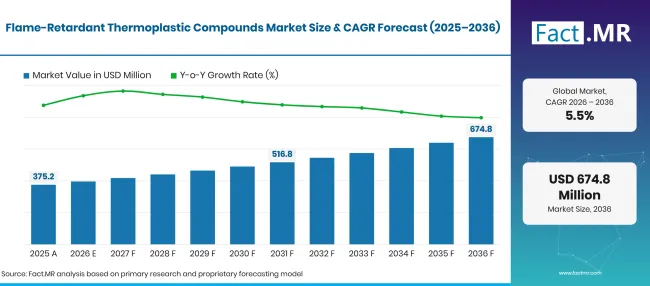
Flame Retardant Thermoplastic Compounds Forecast Global | Source: Fact.MR
What are the defining numbers behind Flame-Retardant Thermoplastic Compounds Market growth?
The 2026 to 2036 period adds USD 279.0 million in new value, concentrated in electronics, e-mobility components and halogen-free engineering grades.
- Demand Drivers in the Market
- Product safety rules for electronics keep raising the bar on enclosure and component materials. SABIC introduced a flame-retardant PBT for nano molding in July 2025 that reaches UL 94 V0 at 1.0 mm and helps customers meet the fourth edition of the IEC 62368-1 safety standard.
- Higher system voltages in electric vehicles create new demand for connector materials that resist both fire and electro-corrosion. BASF launched a polyamide 9T grade in June 2025 with a non-halogenated flame retardant that achieves UL 94 V-0 at 0.25 mm and is halide-free under EN 50642.
- Customer specifications are shifting away from brominated systems toward halogen-free chemistry. Envalior presented a halogen-free, 20% glass-reinforced PBT in May 2025 that holds UL 94 V-0 in all colors at 0.4 mm with a CTI of 600.
- Building services, cable management and electrical fittings need molded parts that pass defined fire tests while staying tough and easy to install. Flame-retardant polyolefin and polyamide compounds serve conduit fittings, junction boxes and cable accessories where installers want low weight and fast assembly.
- Key Segments Analyzed
- By Flame-Retardant Resin Base: Polypropylene will hold 20.5% share in 2026 because it gives molders a low-density, low-cost base for appliance, building and wiring parts.
- By Supply and Product Format: Powder and pellets will account for 31.3% of 2026 value, as they feed directly into injection molding and extrusion lines.
- By Manufacturing and Cure Process: Melt Processing will capture 26.4% in 2026, since thermoplastic compounds are shaped by heating, molding and cooling.
- By Industrial End Use: Electronics will take 30.8% of 2026 revenue, given the many housings, connectors and switch parts that need a flame class.
- Analyst Opinion at Fact.MR
- Shambhu Nath Jha, Principal Consultant at Fact.MR, states, “Flame performance is now judged at the exact wall thickness and voltage of the finished part, so a generic V-0 claim will no longer win a qualification. Compounders will need to show tracking resistance, color freedom and mold behavior in the same data package as the flame rating. Suppliers that can do this with halogen-free chemistry will gain ground in connectors, battery parts and compact electronics through 2036.”
- Strategic Implications
- Compound manufacturers should publish flame class, test thickness and CTI side by side for every grade, so design engineers can shortlist materials without a round of sample requests.
- Resin and additive suppliers should widen halogen-free and PFAS-free options, since electronics and e-mobility customers increasingly write these limits into purchase specifications.
- Electronics and vehicle OEMs should qualify at least two compound sources per critical part, because end-product fire testing and long approval cycles make a late material switch costly.
- Distributors should build technical service for drying, color matching and mold setup, as small molders often lack the in-house skills to run flame-retardant grades without defects.
India leads the country set at 8.8%, as a fast-growing electronics assembly base starts to source local compound grades. China follows at 7.5%, with a far bigger but more mature base in vehicles and circuits. The gap then widens: Japan at 5.0% and the United States at 4.8% grow on replacement and upgrade demand in precision electronics, batteries and buildings. Germany closes the range at 4.4%, where a slow industrial year holds back volume even though its engineers set many of the specifications that compounders worldwide follow.
How does the Flame-Retardant Thermoplastic Compounds Market break down by segment?
Polypropylene will lead Flame-Retardant Resin Base at 20.5%; Powder and pellets will head Supply and Product Format at 31.3%; Melt Processing will hold Manufacturing and Cure Process at 26.4%; Electronics will lead Industrial End Use at 30.8% in 2026.
Which Flame-Retardant Resin Base leads?
Polypropylene holds 20.5% of 2026 sales.
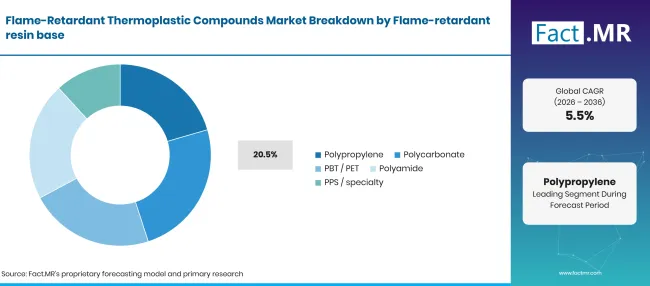
Flame Retardant Thermoplastic Compounds Breakdown Flame Retardant Resin Base | Source: Fact.MR
| Flame-Retardant Resin Base | Share (2026) |
|---|---|
| Polypropylene (Leading segment) | 20.5% |
| Other segments combined | 79.5%* |
| Total | 100.0% |
Source: Fact.MR analysis. Updated Nov 12, 2026
Appliance makers, cable accessory producers and building product firms favor polypropylene for its low density and modest price. Flame-retardant PP grades fill parts such as appliance back covers, terminal blocks and conduit fittings, where a V-2 or V-0 class at moderate thickness is enough. Polycarbonate serves transparent and impact-critical housings, while PBT and PET suit connectors and coil formers that need dimensional stability. Polyamide covers circuit breakers and battery parts, and PPS and specialty resins handle extreme heat. Interest in halogen-free flame retardant polymers is strongest in the engineering resins, where tracking resistance at high voltage is a design limit.
What supports Powder and pellets within Supply and Product Format?
Powder and pellets account for 31.3% of 2026 revenue.
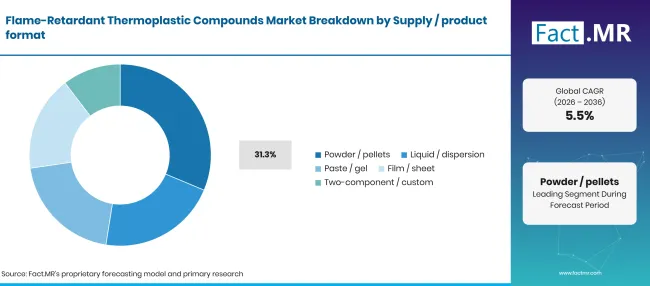
Flame Retardant Thermoplastic Compounds Breakdown Supply Product Format | Source: Fact.MR
| Supply and Product Format | Share (2026) |
|---|---|
| Powder and pellets (Leading segment) | 31.3% |
| Other segments combined | 68.7%* |
| Total | 100.0% |
Source: Fact.MR analysis. Updated Nov 12, 2026
Molders buy ready-to-use pellets because they drop straight into the hopper and give a repeatable additive dispersion in every shot. Powder forms suit compounders who blend their own masterbatches or who run sintering and rotational molding. Liquid and dispersion, paste and gel, film and sheet, and two-component or custom forms cover smaller niches such as coatings, laminates and potting. Film and sheet grades are used as insulation layers in battery modules and power supplies. Demand for these forms often follows wider trends in engineering thermoplastics, since many of them start from the same base resins.
How does Manufacturing and Cure Process shape demand?
Melt Processing captures 26.4% of 2026 value.
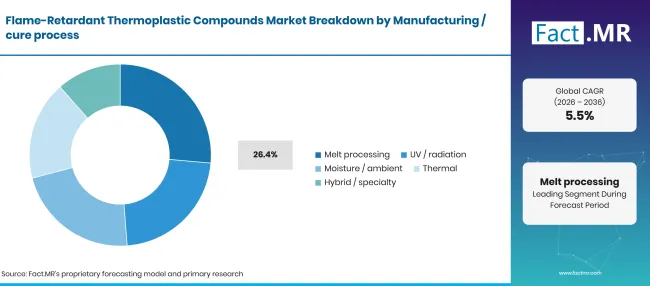
Flame Retardant Thermoplastic Compounds Breakdown Manufacturing Cure Process | Source: Fact.MR
| Manufacturing and Cure Process | Share (2026) |
|---|---|
| Melt Processing (Leading segment) | 26.4% |
| Other segments combined | 73.6%* |
| Total | 100.0% |
Source: Fact.MR analysis. Updated Nov 12, 2026
Injection molding and extrusion shape most flame-retardant thermoplastics, and both depend on how the additive package behaves at melt temperature. Envalior’s October 2025 PBT is free of halogenated ingredients and PFAS, and its additives do not release isocyanates or phosphine during injection molding. Thermal, UV and radiation, moisture and ambient, and hybrid routes apply mainly to specialty systems such as cross-linked cable jackets and coated films. These routes need extra process steps, so they stay confined to parts where cross-linking adds heat or abrasion resistance. Grades based on polybutylene terephthalate remain a common choice for melt-processed connectors.
Which Industrial End Use accounts for the biggest portion?
Electronics takes 30.8% of 2026 sales.
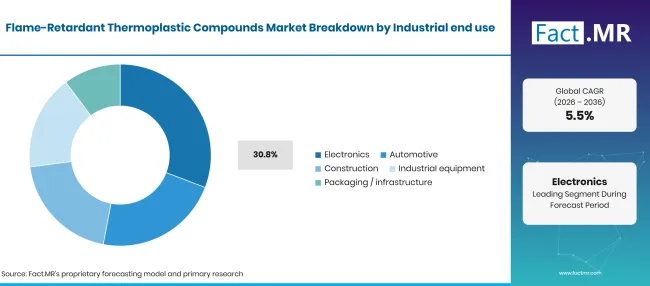
Flame Retardant Thermoplastic Compounds Breakdown Industrial End Use | Source: Fact.MR
| Industrial End Use | Share (2026) |
|---|---|
| Electronics (Leading segment) | 30.8% |
| Other segments combined | 69.2%* |
| Total | 100.0% |
Source: Fact.MR analysis. Updated Nov 12, 2026
Power supplies, chargers, circuit breakers and connectors must pass flame tests before they reach a store shelf. Each device can hold several flame-rated parts, and thinner product designs push makers toward grades rated at 0.4 mm or below. Automotive demand rises as battery packs, charging inlets and power electronics add flame-rated plastic to every electric vehicle. Specialist flame-retardant polyamide compounds now serve busbar holders and high-voltage connectors. Construction, industrial equipment, and packaging and infrastructure follow, each with its own fire code and service conditions.
What is accelerating Flame-Retardant Thermoplastic Compounds Market adoption, and what is holding it back?
Safety standards in electronics, higher voltages in electric vehicles and a shift toward halogen-free chemistry pull demand forward. On the other side, halogen-free and high-CTI grades cost more than standard compounds, and loading a resin with flame retardant can reduce impact strength and flow. Long qualification cycles at OEMs also slow the switch to new grades.
Drivers Impact Analysis
| DRIVER | (~) % IMPACT ON CAGR | GEOGRAPHIC RELEVANCE | IMPACT TIMELINE |
|---|---|---|---|
| Fire-safety standards for electrical and electronic equipment | +1.0% | Global | Medium term (2-4 years) |
| Expansion of electronics and electrical equipment output | +0.9% | Asia, North America | Medium term (2-4 years) |
| Demand for halogen-free formulations | +0.7% | Europe, Asia, North America | Long term (>=4 years) |
| Electrification and battery-related applications | +0.5% | Global | Medium term (2-4 years) |
| Application-specific compound development | +0.4% | Global | Long term (>=4 years) |
Source: Fact.MR analysis. Updated Nov 12, 2026
Opportunity Impact Analysis
| OPPORTUNITY | (~) % IMPACT ON CAGR | GEOGRAPHIC RELEVANCE | IMPACT TIMELINE |
|---|---|---|---|
| Halogen-free flame-retardant resin development | +0.8% | Europe, Asia | Long term (>=4 years) |
| Thin-wall flame-retardant grades for electronics | +0.6% | Asia, North America | Medium term (2-4 years) |
| Flame-retardant compounds for EV components | +0.5% | China, Europe, North America | Long term (>=4 years) |
| Resin-specific customized formulations | +0.4% | Global | Medium term (2-4 years) |
Source: Fact.MR analysis. Updated Nov 12, 2026
Restraints Impact Analysis
| RESTRAINT | (~) % IMPACT ON CAGR | GEOGRAPHIC RELEVANCE | IMPACT TIMELINE |
|---|---|---|---|
| Higher cost of specialized flame-retardant formulations | -0.8% | Global | Short term (<=2 years) |
| Trade-offs between flame resistance and mechanical properties | -0.6% | Global | Medium term (2-4 years) |
| Processing and formulation complexity | -0.5% | Global | Short term (<=2 years) |
| Customer qualification and testing requirements | -0.4% | Global | Medium term (2-4 years) |
Source: Fact.MR analysis. Updated Nov 12, 2026
Which countries are scaling the Flame-Retardant Thermoplastic Compounds Market through 2036?
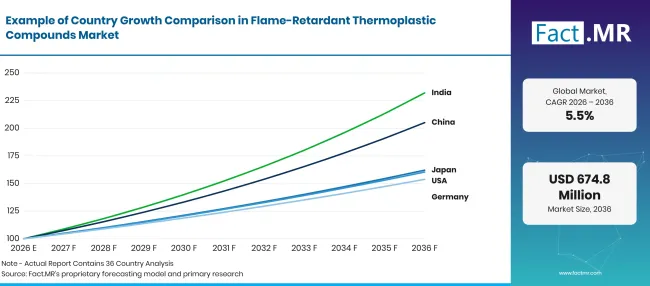
Flame Retardant Thermoplastic Compounds Growth Index | Source: Fact.MR
| Country | CAGR (2026 to 2036) |
|---|---|
| India | 8.8% |
| China | 7.5% |
| Japan | 5.0% |
| United States | 4.8% |
| Germany | 4.4% |
Source: Fact.MR analysis. Updated Nov 12, 2026
What is driving India’s market growth?
8.8% CAGR, driven by fast growth in local electronics assembly and component programs.
India’s electronics production rose from INR 1.9 lakh crore in 2014 to 2015 to INR 11.3 lakh crore in 2024 to 2025, nearly six times higher. The Electronics Components Manufacturing Scheme carries an outlay of INR 22,919 crore, and its first seven approved projects target INR 44,406 crore of production. Component plants of this kind need flame-rated plastics for connectors, chargers and housings, and many now look for local compound supply with shorter lead times.
Why is China emerging as a high-growth market?
7.5% CAGR, backed by very large vehicle and circuit output.
China produced 16.524 million new energy vehicles in 2025, up 25.1% on 2024. The same communique puts 2025 integrated circuit output at 484.28 billion units, a rise of 10.9%. Each of these products uses flame-rated polymers in battery packs, chargers and device housings. Domestic compounders compete hard on price in standard grades, so global suppliers focus on halogen-free and high-CTI materials for export-oriented makers.
What is supporting market expansion in Japan?
5.0% CAGR, helped by policy targets for electrified vehicles and batteries.
Japan’s automobile technology roadmap, updated in October 2025, sets electrified vehicles at 100% of new passenger car sales in 2035. The revised Battery and Power Industry Strategy of June 2026 targets a domestic battery manufacturing base of 150 GWh per year from 2030. Battery modules, inverters and charging parts built under these plans need compounds that combine flame class with heat and tracking resistance.
What is strengthening the United States market?
4.8% CAGR, reflecting steady demand from electrical equipment and building services.
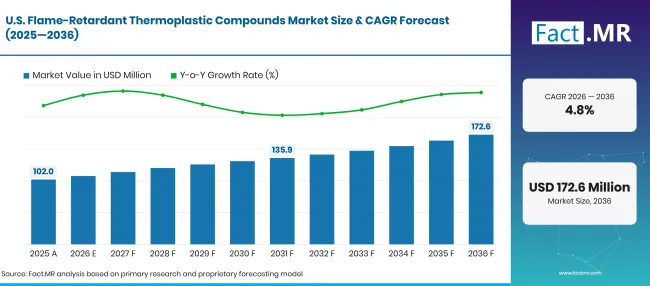
Flame Retardant Thermoplastic Compounds Forecast Usa | Source: Fact.MR
US construction spending reached USD 2,164.4 billion in 2025, 1.4% below the 2024 level. Even a flat building year needs large volumes of wiring devices, breaker housings and lighting parts made from flame-rated plastics. Compound suppliers win business here by holding UL file listings for each grade and color.
What is shaping Germany’s flame-retardant compounds market?
4.4% CAGR, as engineering demand offsets a weak industrial base.
German industrial production fell 1.1% in 2025, and output in the automotive industry dropped 1.7%. Real gross value added in manufacturing declined 1.3%, the third yearly decline in a row. Volume growth stays slow as a result, but German OEMs and Tier 1 suppliers still write many of the halogen-free and tracking-resistance specifications that compounders worldwide adopt.
Who leads the Flame-Retardant Thermoplastic Compounds Market?
Competition falls into two camps. Integrated resin producers such as BASF, Covestro, SABIC and Celanese control their own base polymers, which lets them tune flame-retardant packages inside the resin and supply global OEMs from several regions.
BASF’s 2025 polyamide 9T grade for high-voltage connectors shows how this camp targets e-mobility, and SABIC added LNP THERMOCOMP OFM compounds in July 2026 with UL 94 V0 at 0.4 mm for power modules. Specialist compounders such as Envalior and Avient compete on formulation breadth and service. Envalior’s PFAS-free PBT of October 2025 aims at charging and battery hardware, while Avient serves wire, cable and molding customers with flame-retardant polyolefin, polyamide and elastomer grades. Winning a design slot will depend on who can show flame class, CTI and processing data for the exact part, and on who can support local qualification in India, China and other growth hubs.
Which companies are the key providers?
Key companies in the Flame-Retardant Thermoplastic Compounds Market include BASF, Covestro, SABIC, Celanese, Envalior and Avient.
- BASF
- Covestro
- SABIC
- Celanese
- Envalior
- Avient
Bibliography
- BASF. (2025, June 2). Less electro-corrosion, more color: New Ultramid Advanced N for high-voltage connectors in electric cars.
- Envalior. (2025, May 13). Envalior showcases sustainable materials at "Plastics in E&E Applications" SKZ conference.
- Envalior. (2025, October 8). New PBT from Envalior, debuting at K 2025 & the Battery Show North America, sets standard for high-voltage applications.
- Federal Statistical Office of Germany (Destatis). (2026, January 15). Gross domestic product up 0.2% in 2025.
- Federal Statistical Office of Germany (Destatis). (2026, February 6). Production in December 2025: -1.9% on the previous month.
- Ministry of Economy, Trade and Industry, Japan. (2025, October). Technology Roadmap for Automobile Sector.
- Ministry of Economy, Trade and Industry, Japan. (2026, June 2). "Battery Industry Strategy" Revised as the "Battery and Power Industry Strategy".
- National Bureau of Statistics of China. (2026, February 28). Statistical Communique of the People’s Republic of China on the 2025 National Economic and Social Development.
- Press Information Bureau, Government of India. (2025, October 11). India’s Electronics Leap.
- Press Information Bureau, Government of India. (2025, October 27). Driving India’s Electronics Future.
- SABIC. (2025, July 16). SABIC debuts first FR PBT nano molding material with good bonding & mechanical performance.
- SABIC. (2026, July 12). SABIC’s New LNP Thermocomp OFM Compounds Help Enable High-Voltage Power Modules.
- U.S. Census Bureau. (2026, February 27). Monthly Construction Spending, December 2025.
This Report Answers
- How much value flame-retardant thermoplastic compounds will add between 2026 and 2036, and in which resin bases.
- Why polypropylene keeps the top resin position while polyamide and PBT gain in high-voltage parts.
- Which supply formats and processing routes molders prefer, and where film, sheet and cross-linked forms fit.
- How India, China, Japan, the United States and Germany differ in growth and in what drives local demand.
- What separates integrated resin producers from specialist compounders in winning design slots.
- Where halogen-free, PFAS-free and thin-wall grades open new revenue for suppliers.
What does the Flame-Retardant Thermoplastic Compounds Market cover?
This market covers thermoplastic compounds that carry flame-retardant additives or systems and are sold as ready-to-process materials. Base resins include polypropylene, polycarbonate, PBT and PET, polyamide, and PPS and other specialty polymers.
Value is measured at the compound producer’s selling price in USD million. Each grade is counted once, at the point where it leaves the compounder or resin maker for a molder, extruder or converter.
What is included in the scope?
Flame-retardant compounds in pellet, powder and other listed formats are included, whether halogenated or halogen-free.
Grades for injection molding, extrusion and the other listed processing routes are counted, including film and sheet used as electrical insulation.
Compounds sold into electronics, automotive, construction, industrial equipment, and packaging and infrastructure uses fall within the count.
Flame-retardant masterbatches are counted when sold as part of a complete compound, and mineral systems based on alumina trihydrate are counted once compounded into a thermoplastic.
What is excluded from the scope?
Thermoset materials such as epoxy, phenolic and unsaturated polyester molding compounds are not counted.
Standalone flame-retardant additives sold to compounders, before they enter a thermoplastic, are left out to avoid double counting.
Finished electrical devices, vehicle parts and molding equipment are excluded, as are unmodified thermoplastic resins without flame-retardant function.
Static-dissipative grades such as conductive plastic compounds are excluded unless they also carry a flame-retardant rating as their main purpose.
How Was the Analysis Built?
The analysis draws on 120+ sources, 35+ company portfolios, 25+ countries, and more than 20 industry interviews.
- Primary Research: Primary research includes discussions with manufacturers, service providers, technology developers, distributors, end users, and subject-matter experts. These conversations examine purchasing priorities, product adoption, operational challenges, approval requirements, competitive positioning, and the factors that influence wider market acceptance.
- Desk Research: Desk research covers government statistics, regulatory publications, company filings, trade data, technical studies, industry associations, standards, public policy, and other authoritative sources. Every source used in the analysis is documented in the bibliography.
- Market Sizing and Forecasting: Market estimates combine historical performance, demand indicators, pricing and volume trends, segment shares, company participation, country-level growth, adoption patterns, investment activity, and barriers to market expansion.
- Data Validation and Update Cycle: Findings are validated by comparing primary interviews with public data, company activity, regulatory changes, trade patterns, and industry developments. Regular updates review new product launches, capacity changes, partnerships, approvals, and shifts in commercial adoption.
Segmentation
What is the report’s scope and coverage?
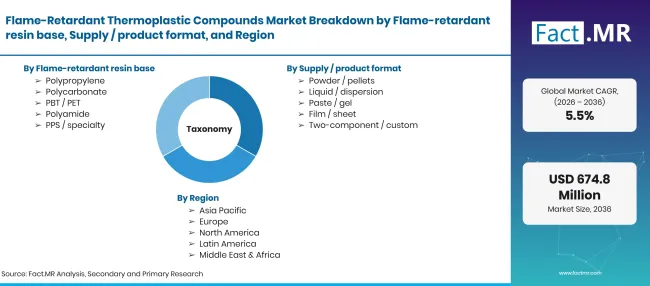
Flame Retardant Thermoplastic Compounds Taxonomy | Source: Fact.MR
| Attribute | Details |
|---|---|
| Quantitative Units | USD million |
| Market Definition | Thermoplastic resins compounded with flame-retardant additives or systems so that molded or extruded parts resist ignition and limit flame spread, sold to electrical, vehicle, building and industrial users. |
| Flame-Retardant Resin Base | Polypropylene; Polycarbonate; PBT and PET; Polyamide; PPS and specialty |
| Supply and Product Format | Powder and pellets; Liquid and dispersion; Paste and gel; Film and sheet; Two-component and custom |
| Manufacturing and Cure Process | Melt Processing; UV and radiation; Moisture and ambient; Thermal; Hybrid and specialty |
| Industrial End Use | Electronics; Automotive; Construction; Industrial Equipment; Packaging and infrastructure |
| Regions Covered | North America; Latin America; Western Europe; Eastern Europe; East Asia; South Asia & Pacific; Middle East & Africa |
| Countries Covered | India; China; Japan; United States; Germany |
| Companies Profiled | BASF; Covestro; SABIC; Celanese; Envalior; Avient |
| Forecast Period | 2026 to 2036 |
| Approach | Compound volumes by resin and end use are tied to electronics, vehicle and construction output, then checked against producer grade launches and qualification activity. |
Source: Fact.MR analysis. Updated Nov 12, 2026
How is the market segmented?
-
By Flame-Retardant Resin Base
- Polypropylene
- Polycarbonate
- PBT and PET
- Polyamide
- PPS and specialty
-
By Supply and Product Format
- Powder and pellets
- Liquid and dispersion
- Paste and gel
- Film and sheet
- Two-component and custom
-
By Manufacturing and Cure Process
- Melt Processing
- UV and radiation
- Moisture and ambient
- Thermal
- Hybrid and specialty
-
By Industrial End Use
- Electronics
- Automotive
- Construction
- Industrial Equipment
- Packaging and infrastructure
-
By Region
- North America
- Latin America
- Western Europe
- Eastern Europe
- East Asia
- South Asia & Pacific
- Middle East & Africa
Frequently Asked Questions
Fact.MR values the 2026 market at USD 395.8 million, on a path to USD 674.8 million by 2036.
What growth rate will the flame-retardant thermoplastic compounds market record?
Which resin base leads?
Which supply format leads?
Which processing route leads?
Which end use leads?
Which country will grow quickest?
Who are the main companies?
What holds the market back?
Who worked on this report


Preview the report firsthand - request a free sample
Free SampleGet the brochure for pricing and purchase details
Download PDF