- Market Value (2025): USD 1.25 Bn
- Estimated Value (2026): USD 1.32 Bn
- Forecast Value (2036): USD 2.26 Bn
- CAGR (2026-2036): 5.5%
What is the Abrasive Polishing Fluid Market forecast to be worth by 2036?
USD 1.3 billion in 2026 to USD 2.3 billion by 2036 at a 5.5% CAGR.
- Abrasive polishing fluid demand came to USD 1.25 billion in 2025, with paint correction and component finishing accounting for most of the volume.
- Revenue will move from USD 1.32 billion in 2026 to USD 2.26 billion by 2036 as wafer planarization and hard-substrate polishing add higher-value grades to a steady industrial base.
- A 5.5% CAGR reflects a market where each new device node or harder substrate creates a fresh formulation requirement.
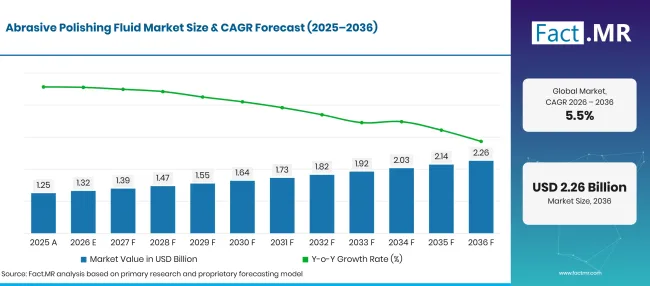
Abrasive Polishing Fluid Market Forecast Global | Source: Fact.MR
| Year | Basis | Market Value (USD billion) |
|---|---|---|
| 2025 | Actual | 1.25 |
| 2026 | Estimate | 1.32 |
| 2036 | Forecast | 2.26 |
| CAGR 2026 to 2036 | Forecast period | 5.5% |
Source: Fact.MR analysis. Updated Nov 3, 2026
What are the defining numbers behind Abrasive Polishing Fluid Market growth?
The 2026 to 2036 period will add USD 0.9 billion in new value, with water-based alumina fluids for automotive finishing and precision slurries for electronics taking most of it.
- Demand Drivers in the Market
- Chip fabrication needs ever flatter wafer surfaces between process layers. SEMI reported that global semiconductor materials revenue reached a record USD 73.2 billion in 2025, with wafer fabrication materials at USD 45.8 billion [1]. Planarization slurries belong to that fab materials pool, so every new layer adds polishing steps and consumable volume.
- Vehicle output keeps finishing lines busy across paint, glass and metal parts. Germany produced about 4.15 million passenger cars in 2025, up 2% on the year [2]. Brazil built 2.644 million vehicles in the same year, a gain of 3.5% [3]. Each body that leaves a paint shop passes through defect sanding and polishing before delivery.
- Abrasive grain supply shapes both price and formulation choice. World fused aluminum oxide capacity stood at 1.3 million tons in 2025, against 1.0 million tons for silicon carbide [4]. Chinese plants held most of that capacity, which gives fluid makers in other regions a reason to qualify more than one grain source.
- Hard materials need diamond abrasives that conventional grains cannot replace. World output of synthetic industrial diamond exceeded 15 billion carats in 2025, and US users named computer chip production and stone polishing among the main consuming sectors [5]. Silicon carbide and sapphire wafers for power and optical devices depend on these diamond slurries during lapping.
- Key Segments Analyzed
- By Type: Water-Based will hold 58.4% share in 2026, since water carriers rinse off easily and keep particles evenly dispersed.
- By Application: Automotive will account for 35.2% of 2026 value, given that paint correction and component finishing run on every vehicle line.
- By Material: Alumina will capture 31.5% of 2026 revenue, as the grain suits glass, metal and ceramic surfaces at moderate cost.
- Analyst Opinion at Fact.MR
- Shambhu Nath Jha, Principal Consultant at Fact.MR, states, “Polishing fluids are bought on the defects they prevent, not on price per liter. Through 2036 demand will shift toward slurries engineered for silicon carbide, sapphire and advanced packaging, where a single scratch can scrap a wafer. Automotive finishing will remain the volume anchor, and suppliers that serve both worlds will keep the closest customer relationships.”
- Strategic Implications
- Fluid manufacturers should publish particle size distribution, solids content, pH and viscosity for each grade so that process engineers can qualify products faster.
- Distributors should stock matched compound, pad and fluid systems for body shops, as most paint correction failures trace back to mismatched consumables.
- Electronics buyers should qualify a second slurry source for each critical layer, since grain supply is concentrated in a few countries.
- Investors should look at suppliers with ceria, colloidal silica and diamond slurry capability, where fab qualification builds long customer tenure.
Growth across the five countries depends on whether car plants or chip fabs drive local demand. Germany leads at 6.1%, where premium vehicle output and precision engineering keep finishing standards high. Brazil follows at 5.6% on the strength of rising vehicle production and machinery output. The United States posts 5.0%, with new memory chip fabs adding slurry demand to a broad industrial base. In the United Kingdom, growth of 4.5% reflects a smaller car industry offset by aerospace finishing work. Japan trails at 4.0%, as its mature electronics base grows mainly through new fab capacity that takes years to ramp.
How does the Abrasive Polishing Fluid Market break down by segment?
Water-Based will lead Type at 58.4%; Automotive will head Application at 35.2%; Alumina will hold Material at 31.5% in 2026.
Which Type leads?
Water-Based takes 58.4% of 2026 sales.
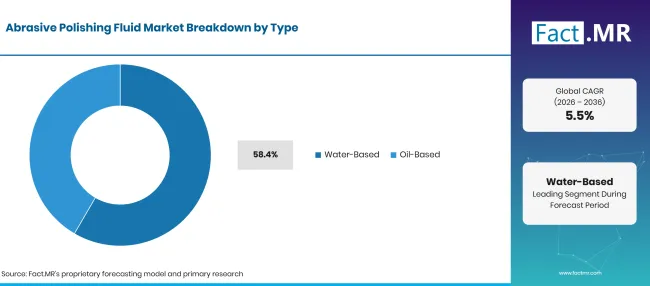
Abrasive Polishing Fluid Market Breakdown Type | Source: Fact.MR
| Type | Share (2026) |
|---|---|
| Water-Based (Leading segment) | 58.4% |
| Other segments combined | 41.6%* |
| Total | 100.0% |
Source: Fact.MR analysis. Updated Nov 3, 2026
Body shops, glass processors and chip fabs all want a fluid that rinses away without solvent cleaning. Water carriers meet that need and keep fine particles suspended between uses. Rules on solvent emissions in paint shops push the same way. Many water-based grades also share additive chemistry with metalworking fluids, which helps plants manage one wastewater stream. Oil-based fluids keep a place in lapping and in polishing metals that corrode in water. They give extra lubrication on hard steels and some ceramics. Their drawback is cleaning, since parts need a solvent or alkaline wash before the next process step.
What supports Automotive within Application?
Automotive represents 35.2% of 2026 revenue.
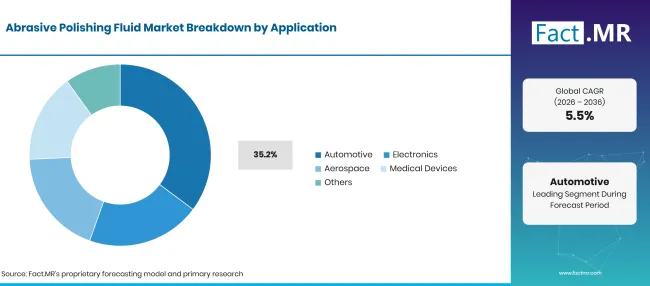
Abrasive Polishing Fluid Market Breakdown Application | Source: Fact.MR
| Application | Share (2026) |
|---|---|
| Automotive (Leading segment) | 35.2% |
| Other segments combined | 64.8%* |
| Total | 100.0% |
Source: Fact.MR analysis. Updated Nov 3, 2026
Every painted body goes through defect sanding, compounding and polishing before it reaches a dealer. Collision repair shops repeat the process on damaged panels across the fleet. Wheels, trim, lamps and engine parts add metal and plastic finishing jobs on top of paint work. Electronics use smaller volumes at much higher prices per liter, led by wafer planarization with CMP slurries. Aerospace plants polish turbine parts and structural alloys to tight roughness limits. Medical device makers finish implants and surgical tools to smooth, cleanable surfaces. Optics, glass and general industry account for the remaining applications.
How does Material shape demand?
Alumina accounts for 31.5% of 2026 value.
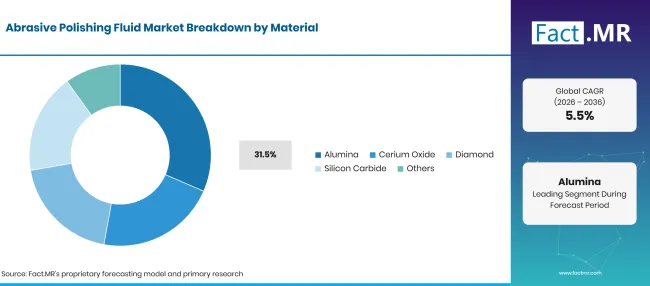
Abrasive Polishing Fluid Market Breakdown Material | Source: Fact.MR
| Material | Share (2026) |
|---|---|
| Alumina (Leading segment) | 31.5% |
| Other segments combined | 68.5%* |
| Total | 100.0% |
Source: Fact.MR analysis. Updated Nov 3, 2026
Aluminum oxide grains cut glass, metals and ceramics at a cost most finishing lines accept. Supply is broad, as world alumina output rose to about 150 million tons in 2025 [6]. A small share of that alumina goes into abrasives, ceramics and other nonmetal uses. Fluid makers grade it by particle size and crystal phase for each finish level. Cerium oxide polishes glass and oxide films through chemical action as well as abrasion. US prices for 99.5% cerium oxide averaged USD 1.71 per kilogram in 2025, and polishing remains a listed rare earth end use [7]. Interest in cerium oxide nanoparticles reflects the push for finer ceria slurries. Diamond serves the hardest substrates, while silicon carbide grain appears in selected lapping steps.
What is accelerating Abrasive Polishing Fluid Market adoption, and what is holding it back?
New fab capacity, steady vehicle output and the spread of silicon carbide and sapphire substrates keep demand moving. Finishing standards in aerospace and medical devices add precision work. High prices for diamond and ceria grades slow adoption at smaller plants. Wastewater rules and long fab qualification cycles also delay supplier switching.
Drivers Impact Analysis
| DRIVER | (~) % IMPACT ON CAGR | GEOGRAPHIC RELEVANCE | IMPACT TIMELINE |
|---|---|---|---|
| New wafer fabs adding planarization steps | +1.2% | North America, East Asia, Western Europe | Medium term (2-4 years) |
| Paint correction and component finishing on vehicle lines | +0.9% | Global | Short term (<=2 years) |
| Silicon carbide and sapphire substrates for power and optical devices | +0.7% | East Asia, North America, Western Europe | Long term (>=4 years) |
| Tighter surface finish limits in aerospace and medical devices | +0.4% | North America, Western Europe | Medium term (2-4 years) |
Source: Fact.MR analysis. Updated Nov 3, 2026
Opportunity Impact Analysis
| OPPORTUNITY | (~) % IMPACT ON CAGR | GEOGRAPHIC RELEVANCE | IMPACT TIMELINE |
|---|---|---|---|
| Slurries for hybrid bonding and advanced packaging | +0.8% | East Asia, North America | Medium term (2-4 years) |
| Low-defect water-based fluids for paint shops | +0.5% | Global | Short term (<=2 years) |
| Diamond slurries for silicon carbide wafers | +0.5% | East Asia, Western Europe, North America | Long term (>=4 years) |
| Local blending near new fabs and car plants | +0.3% | Latin America, Eastern Europe | Medium term (2-4 years) |
Source: Fact.MR analysis. Updated Nov 3, 2026
Restraints Impact Analysis
| RESTRAINT | (~) % IMPACT ON CAGR | GEOGRAPHIC RELEVANCE | IMPACT TIMELINE |
|---|---|---|---|
| High cost of diamond and ceria abrasive grades | -0.6% | Global | Short term (<=2 years) |
| Long qualification cycles at semiconductor fabs | -0.5% | East Asia, North America | Medium term (2-4 years) |
| Concentrated supply of abrasive grains | -0.3% | Global | Medium term (2-4 years) |
| Wastewater treatment and slurry disposal rules | -0.3% | Western Europe, North America, East Asia | Long term (>=4 years) |
Source: Fact.MR analysis. Updated Nov 3, 2026
Which countries are scaling the Abrasive Polishing Fluid Market through 2036?
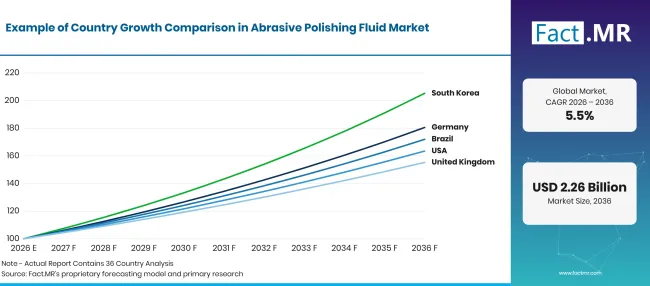
Abrasive Polishing Fluid Market Growth Index | Source: Fact.MR
| Country | CAGR (2026 to 2036) |
|---|---|
| Germany | 6.1% |
| Brazil | 5.6% |
| United States | 5.0% |
| United Kingdom | 4.5% |
| Japan | 4.0% |
Source: Fact.MR analysis. Updated Nov 3, 2026
What supports abrasive polishing fluid adoption in Germany?
6.1% CAGR, driven by premium car output and precision engineering.
German car plants built about 4.15 million passenger cars in 2025, and 3.17 million of them went to export markets [2]. Export buyers expect flawless paint, so final inspection lines polish out even small defects. Machine builders and optics firms add steady demand for fine alumina and diamond grades. Domestic chemical producers also give fluid makers short supply routes for additives.
How is Brazil developing demand?
5.6% CAGR, backed by rising vehicle production and machinery output.
IBGE data show machinery and equipment output grew 5.0% in 2025, while maintenance and repair of machinery rose 9.6% [8]. Both activities use polishing fluids on shafts, molds and housings. Vehicle registrations also reached 2.690 million units in 2025 [3]. Local blending of water-based fluids is spreading as plants seek to cut import costs.
What is supporting United States adoption?
5.0% CAGR, helped by new memory chip fab investment.
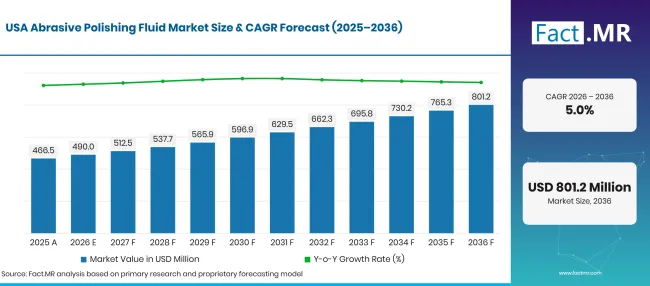
Abrasive Polishing Fluid Market Forecast Usa | Source: Fact.MR
In June 2025 the Department of Commerce announced a USD 200 billion Micron plan covering new fabs in Idaho and New York and an upgrade in Virginia [9]. Each fab uses planarization slurries on many layers. Grain supply remains import-heavy, with net import reliance above 95% for fused aluminum oxide in 2025 [4]. Automotive and aerospace finishing add a broad base of industrial demand.
How is the United Kingdom developing demand?
4.5% CAGR, reflecting aerospace finishing work and a smaller car industry.
The government’s Advanced Manufacturing Sector Plan puts aerospace turnover at GBP 34 billion and automotive GVA at GBP 21.4 billion in 2024 [10]. Turbine blades, landing gear and structural parts need polishing to tight roughness limits. The plan also sets a target of over 1.3 million vehicles by 2035. Car output growth toward that goal will lift paint finishing volumes.
What supports Japan’s adoption?
4.0% CAGR, as new fab capacity slowly adds slurry demand to a mature base.
METI’s June 2025 policy materials set a goal of over JPY 15 trillion in sales for Japanese semiconductor companies by 2030 [11]. The same document cites JPY 10 trillion in public support for AI and semiconductors. Domestic slurry makers serve both new fabs and established wafer, glass and optics lines. Growth stays measured because much of the installed base is already mature.
Who leads the Abrasive Polishing Fluid Market?
Suppliers split into two groups that seldom meet in the same tender. Semiconductor specialists including Entegris, FUJIFILM, Resonac, AGC and BASF form the first, selling CMP slurries qualified layer by layer inside fabs. They compete on purity, defect counts and the ability to tune colloidal silica and ceria particles for each film.
FUJIFILM launched a CMP slurry for advanced packaging in September 2025, and a major chipmaker adopted it to flatten hybrid bonding surfaces [12]. Resonac and AGC both run ceria slurry lines, while BASF offers its PLANAPUR range for oxide, copper and barrier layers. The second group serves industrial and automotive finishing. 3M sells Perfect-It and Finesse-it polishes to paint shops and Trizact slurries for sapphire and silicon carbide lapping. Saint-Gobain supplies diamond, alumina and ceria slurries for lapping and polishing. 3M also joined the JOINT3 packaging consortium in September 2025 [13]. Process support at the customer’s line will decide which suppliers gain share in the next cycle.
Which companies are the key providers?
Key companies in the Abrasive Polishing Fluid Market include Saint-Gobain, 3M, Entegris, FUJIFILM, AGC, Resonac and BASF.
- Saint-Gobain
- 3M
- Entegris
- FUJIFILM
- AGC
- Resonac
- BASF
Bibliography
- [1] SEMI. (2026, May 12). Global Semiconductor Materials Market Revenue Reaches Record $73.2 Billion in 2025, SEMI Reports.
- [2] Verband der Automobilindustrie. (2026, January 5). Passenger car production in 2025 slightly above previous year’s level.
- [3] Associação Nacional dos Fabricantes de Veículos Automotores. (2026, January 15). Produção e venda de autoveículos crescem em 2025 e Anfavea projeta nova alta em 2026.
- [4] U.S. Geological Survey. (2026, February). Mineral Commodity Summaries 2026: Abrasives (Manufactured).
- [5] U.S. Geological Survey. (2026, February). Mineral Commodity Summaries 2026: Diamond (Industrial).
- [6] U.S. Geological Survey. (2026, February). Mineral Commodity Summaries 2026: Bauxite and Alumina.
- [7] U.S. Geological Survey. (2026, February). Mineral Commodity Summaries 2026: Rare Earths.
- [8] Instituto Brasileiro de Geografia e Estatística. (2026, February 3). Industrial output retreats 1.2% in December.
- [9] U.S. Department of Commerce. (2025, June 12). President Trump Secures $200B Investment from Micron Technology for Memory Chip Manufacturing in the United States.
- [10] Department for Business and Trade. (2025, June 23). Advanced Manufacturing Sector Plan.
- [11] Ministry of Economy, Trade and Industry. (2025, June 3). Reference Materials for the Fourth Report of the Committee on New Direction of Economic and Industrial Policies.
- [12] FUJIFILM. (2025, September 29). Fujifilm Launches Advanced Packaging CMP Slurry.
- [13] 3M. (2025, September 30). 3M participates in JOINT3, a next-generation semiconductor packaging consortium.
This Report Answers
- How does abrasive polishing fluid revenue divide across type, application, material and end-user industry?
- Why do water-based fluids hold the bulk of demand in paint shops, glass lines and fabs?
- Which abrasive grains suit each substrate, from painted steel to silicon carbide wafers?
- Where do new fabs and vehicle plants add slurry and compound volume through 2036?
- How do Germany, Brazil, the United States, the United Kingdom and Japan differ in growth and buyer mix?
- Which suppliers serve semiconductor planarization and which serve industrial finishing?
What does the Abrasive Polishing Fluid Market cover?
This study tracks sales of ready-to-use polishing fluids, compounds in liquid form and slurries that remove material through abrasion and chemical action. Users range from automotive paint shops and component plants to wafer fabs, optics makers, aerospace suppliers and medical device producers.
Values are shown in USD billion at manufacturer selling price for 2026 to 2036. Fluids sold as part of a polishing kit are counted at the value of the fluid alone, since pads and tools belong to separate product markets.
What is included in the scope?
Water-based and oil-based polishing fluids and slurries using alumina, cerium oxide, diamond, silicon carbide and other grains.
Automotive paint correction compounds and polishes sold in liquid or paste form for factory and refinish use. CMP slurries for wafer planarization and lapping slurries for sapphire, silicon carbide and other hard substrates. Polishing fluids for glass, optics, aerospace alloys and medical implants.
What is excluded from the scope?
Dry abrasive powders and loose grain sold without a liquid carrier, together with the wider bonded and coated abrasives product range.
Polishing machines, pads, discs, belts and grinding wheels. Post-polishing cleaners and general cleaning chemicals with no abrasive function. Blasting media and grinding coolants used in processes other than polishing.
How Was the Analysis Built?
The analysis draws on 120+ sources, 35+ company portfolios, 25+ countries, and more than 20 industry interviews.
- Primary Research: Primary research includes discussions with manufacturers, service providers, technology developers, distributors, end users, and subject-matter experts. These conversations examine purchasing priorities, product adoption, operational challenges, approval requirements, competitive positioning, and the factors that influence wider market acceptance.
- Desk Research: Desk research covers government statistics, regulatory publications, company filings, trade data, technical studies, industry associations, standards, public policy, and other authoritative sources. Every source used in the analysis is documented in the bibliography.
- Market Sizing and Forecasting: Market estimates combine historical performance, demand indicators, pricing and volume trends, segment shares, company participation, country-level growth, adoption patterns, investment activity, and barriers to market expansion.
- Data Validation and Update Cycle: Findings are validated by comparing primary interviews with public data, company activity, regulatory changes, trade patterns, and industry developments. Regular updates review new product launches, capacity changes, partnerships, approvals, and shifts in commercial adoption.
Segmentation
What is the report’s scope and coverage?
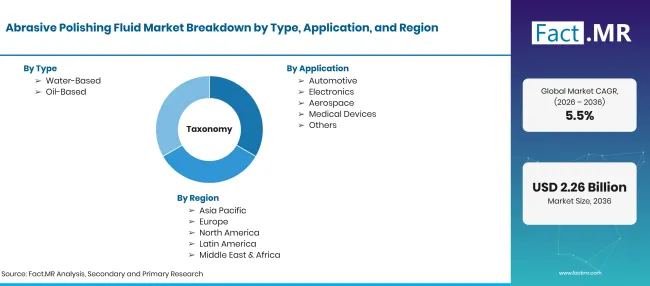
Abrasive Polishing Fluid Market Taxonomy | Source: Fact.MR
| Attribute | Details |
|---|---|
| Quantitative Units | USD billion |
| Market Definition | Liquid and slurry formulations that carry abrasive particles and chemical additives to remove material and finish surfaces to a specified smoothness. |
| Type | Water-Based; Oil-Based |
| Application | Automotive; Electronics; Aerospace; Medical Devices; Others |
| Material | Alumina; Cerium Oxide; Diamond; Silicon Carbide; Others |
| End-User Industry | Manufacturing; Construction; Automotive; Electronics; Others |
| Regions Covered | North America; Latin America; Western Europe; Eastern Europe; East Asia; South Asia & Pacific; Middle East & Africa |
| Countries Covered | Germany; Brazil; United States; United Kingdom; Japan |
| Companies Profiled | Saint-Gobain; 3M; Entegris; FUJIFILM; AGC; Resonac; BASF |
| Forecast Period | 2026 to 2036 |
| Approach | Consumption by substrate and finishing step, matched to vehicle output, fab capacity and abrasive grain supply, then checked against supplier product ranges. |
Source: Fact.MR analysis. Updated Nov 3, 2026
How is the market segmented?
-
By Type
- Water-Based
- Oil-Based
-
By Application
- Automotive
- Electronics
- Aerospace
- Medical Devices
- Others
-
By Material
- Alumina
- Cerium Oxide
- Diamond
- Silicon Carbide
- Others
-
By End-User Industry
- Manufacturing
- Construction
- Automotive
- Electronics
- Others
-
By Region
- North America
- Latin America
- Western Europe
- Eastern Europe
- East Asia
- South Asia & Pacific
- Middle East & Africa
Frequently Asked Questions
How large is the abrasive polishing fluid market in 2026?
What growth rate will the abrasive polishing fluid market record?
Which type leads?
Which application leads?
Which material leads?
Which country will grow quickest?
Who are the main companies?
What holds the market back?
Who worked on this report


Preview the report firsthand - request a free sample
Free SampleGet the brochure for pricing and purchase details
Download PDF