- Market Value (2025): USD 1.11 Bn
- Estimated Value (2026): USD 1.18 Bn
- Forecast Value (2036): USD 2.14 Bn
- CAGR (2026-2036): 6.1%
What is the Fall Arrest Lanyard Market forecast to be worth by 2036?
USD 1.2 billion in 2026 to USD 2.1 billion by 2036 at a 6.1% CAGR.
- At USD 1.11 billion in 2025, the fall arrest lanyard market drew most of its revenue from contractors replacing inspected or retired energy-absorbing units.
- Revenue will move from USD 1.18 billion in 2026 to USD 2.14 billion by 2036 as more employers write lanyard selection into site-specific fall rescue and clearance plans.
- A 6.1% CAGR reflects a replacement-heavy market in which each tightening of inspection practice brings a fresh round of purchases.
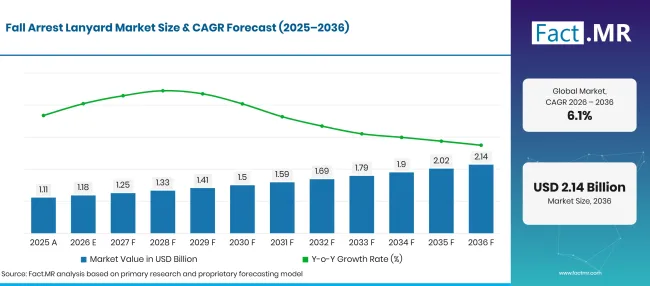
Fall Arrest Lanyard Market Forecast Global | Source: Fact.MR
| Year | Basis | Market Value (USD billion) |
|---|---|---|
| 2025 | Actual | 1.11 |
| 2026 | Estimate | 1.18 |
| 2036 | Forecast | 2.14 |
| CAGR 2026 to 2036 | Forecast period | 6.1% |
Source: Fact.MR analysis. Updated Nov 3, 2026
What are the defining numbers behind Fall Arrest Lanyard Market growth?
The 2026 to 2036 period will add USD 1.0 billion in new value, with textile lanyards for construction work taking the greater part of it.
- Demand Drivers in the Market
- Enforcement keeps fall protection at the top of the compliance agenda in the United States. OSHA’s preliminary list for fiscal year 2026 again ranks the construction fall protection standard first among its most frequently cited standards [1]. Each citation prompts contractors to audit harness and lanyard stocks on site. Many general contractors now require subcontractors to show inspection records before work starts, which pulls older lanyards out of service.
- Falls remain a leading cause of workplace deaths. The US Bureau of Labor Statistics recorded 844 fatal falls, slips and trips among 5,070 work fatalities in 2024 [2]. These figures sustain employer spending on certified energy-absorbing lanyards and compatible harnesses.
- Product choice is becoming more task-specific. Guardian Fall Protection notes that a six-foot energy-absorbing lanyard may need about 18 feet of clearance in some setups, so a worker on a 15-foot platform may need another connector [3]. Buyers therefore weigh clearance, swing fall and anchorage before ordering.
- European accident data keep work at height under scrutiny. Eurostat reported 3,298 fatal work accidents in the EU in 2023 [4]. That equals 1.63 deaths per 100,000 employed people. Labour inspectors in member states use such data to target construction and maintenance sites.
- Key Segments Analyzed
- By Product Type: Soft Goods will hold 38.2% share in 2026, since webbing and rope lanyards are the connectors workers handle every shift and replace most often.
- By Application: Construction will account for 42.1% of 2026 value, given that roofing, steel erection and scaffold work generate continuous exposure to falls from height.
- Analyst Opinion at Fact.MR
- Shambhu Nath Jha, Principal Consultant at Fact.MR, states, “Lanyard buying will be decided on site, where anchorage height and available clearance tell a contractor whether a fixed-length lanyard is safe at all. Suppliers that print clear clearance charts and inspection steps on every label will win repeat orders from safety managers. Over the forecast period, arc flash, leading-edge and heavy-worker lanyards will grow faster than general-purpose models.”
- Strategic Implications
- Manufacturers should state lanyard length, free-fall rating, deceleration distance and connector gate strength in one place on the label and the product page.
- Distributors should separate fall arrest lanyards from restraint and positioning lanyards in catalogues and counter displays to cut selection errors.
- Contractors should calculate fall clearance for each work area before choosing between a lanyard and a self-retracting device.
- Investors should look for suppliers with in-house webbing production and accredited test rigs, which shorten certification cycles.
Germany leads the country set at 6.7%, as a strong rebound in construction orders meets statutory accident insurers that audit work at height closely. Brazil follows at 6.1%, 0.6 points behind, where a record count of workplace deaths is pushing inspections on building sites. The United States at 5.5% trails Brazil by the same 0.6 points, reflecting a mature but enforcement-heavy replacement market. The United Kingdom reaches 4.9%, another 0.6 points lower, with buying tied to inspection routines more than new projects. Japan closes the range at 4.4%, half a point under the United Kingdom, since its accident counts are already at record lows.
How does the Fall Arrest Lanyard Market break down by segment?
Soft Goods will lead Product Type at 38.2%, and Construction will lead Application at 42.1% in 2026.
Which Product Type leads?
Soft Goods holds 38.2% of 2026 sales.
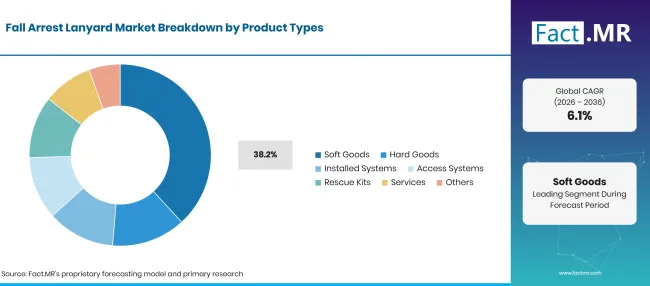
Fall Arrest Lanyard Market Breakdown Product Types | Source: Fact.MR
| Product Type | Share (2026) |
|---|---|
| Soft Goods (Leading segment) | 38.2% |
| Other segments combined | 61.8%* |
| Total | 100.0% |
Source: Fact.MR analysis. Updated Nov 3, 2026
Webbing and kernmantle rope lanyards wear out through abrasion, ultraviolet light, chemical contact and the shock of an arrested fall. Users must retire them once they show damage or have stopped a fall, which drives a short replacement cycle. Shock-pack designs with internal elastic webbing reduce trip hazards and are gaining ground on standard tubular models. Lanyards rated for hot work rely on aramid and similar fibres, which links the category to plastics in protective equipment. Hard goods cover cable lanyards, snap hooks, carabiners and rebar hooks that must match the soft goods they connect. Installed systems, access systems and rescue kits extend the same purchase into anchorage, ladders and post-fall recovery. Services include inspection, recertification and training. Most buyers source these lines together as part of a wider fall protection programme.
What supports Construction within Application?
Construction takes 42.1% of 2026 revenue.
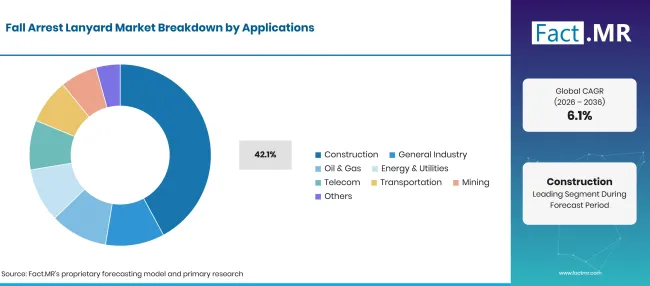
Fall Arrest Lanyard Market Breakdown Applications | Source: Fact.MR
| Application | Share (2026) |
|---|---|
| Construction (Leading segment) | 42.1% |
| Other segments combined | 57.9%* |
| Total | 100.0% |
Source: Fact.MR analysis. Updated Nov 3, 2026
Roofers, ironworkers and scaffold crews spend most of their shift near unprotected edges. US construction spending ran at a seasonally adjusted annual rate of USD 2,203.1 billion in August 2026 [5]. Spending in the first eight months of the year came to USD 1,450.4 billion. That level of activity keeps contractors buying lanyards for new crews and replacing units on active jobs. Equipment fleets on these sites also grow with the construction equipment base. General industry uses lanyards in warehouses, plant maintenance and loading bays. Oil and gas, energy and utilities, and telecom crews need tower access and arc flash models. Transportation and mining add demand for heavy-duty connectors that resist grit and moisture. Arc-rated lanyards are often bought alongside electrical safety products for utility line work.
What is accelerating Fall Arrest Lanyard Market adoption, and what is holding it back?
Steady enforcement, high fall fatality counts and fixed retirement rules keep replacement demand flowing across construction and industry. The same rules push buyers toward specialist models for leading edges and hot work. Growth is limited by the price of certified products, by smaller contractors who reuse equipment beyond its service life, and by wrong product choices where clearance is too short for a fixed lanyard.
Drivers Impact Analysis
| DRIVER | (~) % IMPACT ON CAGR | GEOGRAPHIC RELEVANCE | IMPACT TIMELINE |
|---|---|---|---|
| Construction work at height and active site enforcement | +1.2% | Global | Medium term (2-4 years) |
| Retirement of inspected, damaged or deployed lanyards | +1.0% | North America, Western Europe | Short term (<=2 years) |
| Shift to task-specific lanyards for leading edges and hot work | +0.8% | North America, Western Europe | Medium term (2-4 years) |
| Tower, utility and plant maintenance programmes | +0.6% | Global | Long term (>=4 years) |
Source: Fact.MR analysis. Updated Nov 3, 2026
Opportunity Impact Analysis
| OPPORTUNITY | (~) % IMPACT ON CAGR | GEOGRAPHIC RELEVANCE | IMPACT TIMELINE |
|---|---|---|---|
| Lightweight internal shock lanyards for all-day wear | +0.7% | Global | Medium term (2-4 years) |
| Arc flash and heavy-worker rated lanyards | +0.5% | North America | Medium term (2-4 years) |
| Bundled harness, lanyard and training kits for small contractors | +0.4% | Latin America | Long term (>=4 years) |
| Inspection and recertification services through distributors | +0.3% | Western Europe | Short term (<=2 years) |
Source: Fact.MR analysis. Updated Nov 3, 2026
Restraints Impact Analysis
| RESTRAINT | (~) % IMPACT ON CAGR | GEOGRAPHIC RELEVANCE | IMPACT TIMELINE |
|---|---|---|---|
| Price of certified energy-absorbing lanyards | -0.6% | Global | Short term (<=2 years) |
| Substitution by self-retracting devices where clearance is short | -0.5% | North America, Western Europe | Medium term (2-4 years) |
| Equipment reused beyond its service life on small sites | -0.4% | Emerging markets | Medium term (2-4 years) |
| Low awareness of clearance and anchorage rules | -0.2% | Global | Long term (>=4 years) |
Source: Fact.MR analysis. Updated Nov 3, 2026
Which countries are scaling the Fall Arrest Lanyard Market through 2036?
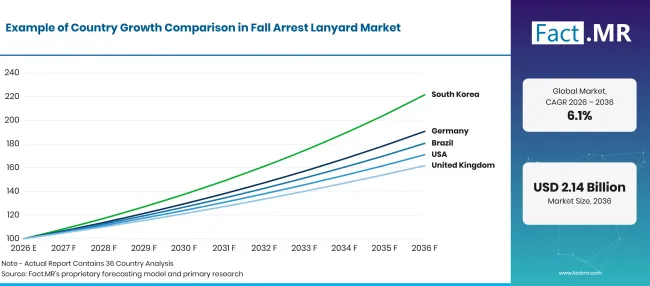
Fall Arrest Lanyard Market Growth Index | Source: Fact.MR
| Country | CAGR (2026 to 2036) |
|---|---|
| Germany | 6.7% |
| Brazil | 6.1% |
| United States | 5.5% |
| United Kingdom | 4.9% |
| Japan | 4.4% |
Source: Fact.MR analysis. Updated Nov 3, 2026
What supports fall arrest lanyard adoption in Germany?
6.7% CAGR, helped by a recovery in construction orders and close oversight by accident insurers.
German employers buy fall protection under the rules of the statutory accident insurers, which inspect sites and set prevention standards. The DGUV counted 730,598 reportable work accidents and 335 fatal ones in 2025 [6]. Real orders in the main construction trades rose 23.0% month on month in August 2026, the steepest seasonally adjusted gain since 1991 [7]. New site starts will lift lanyard purchases for scaffold and roofing crews. Buyers in Germany favour products marked to EN 355 for energy absorbers and EN 354 for lanyards, and they expect full traceability on every label.
How is Brazil developing demand?
6.1% CAGR, driven by stricter inspection after record accident counts.
Brazil’s labour ministry recorded 806,011 work accidents and 3,644 deaths in 2025 [8]. The death toll was a record for its ten-year series. Building construction alone accounted for 820 deaths between 2016 and 2025. Regulatory standard NR-35 governs work at height and requires trained workers and suitable fall arrest equipment. Distributors that offer bundled kits and local training will reach the many small contractors still working without certified lanyards. Housing and infrastructure programmes keep new sites opening across the larger states.
What is supporting United States adoption?
5.5% CAGR, backed by enforcement and a steady replacement cycle.
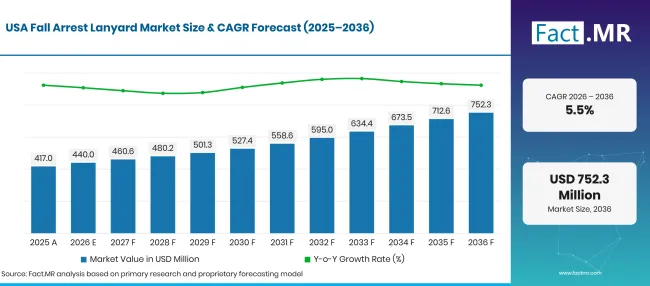
Fall Arrest Lanyard Market Forecast Usa | Source: Fact.MR
US buyers form the most mature lanyard market in the set. BLS data show 1,032 fatal injuries among construction and extraction workers in 2024 [2]. OSHA citations and insurer audits push contractors to replace worn units on schedule. Demand is shifting toward 12-foot free-fall and heavy-worker models as well as arc flash lanyards for utility crews. Large contractors also buy lanyards in bulk under annual supply agreements, which gives national distributors steady volume.
How is the United Kingdom developing demand?
4.9% CAGR, reflecting inspection-led buying on existing sites.
HSE reported 126 worker deaths in Great Britain in 2025/26, of which 31 followed falls from height [9]. Construction recorded 25 of those deaths. The Work at Height Regulations require employers to plan each task and keep equipment fit for use, so most purchases replace lanyards that fail detailed inspection. Collective protection such as edge guards is preferred where possible, which keeps personal lanyard demand moderate.
What supports Japan’s adoption?
4.4% CAGR, owing to a mature safety culture and an ageing workforce.
Japan’s Ministry of Health, Labour and Welfare recorded 700 workplace deaths in 2025, a record low [10]. Falls caused 186 of them. Construction accounted for 214 deaths. Lanyards with shock absorbers are bought to match the full-body harnesses now standard on high work. Older workers and labour shortages favour lighter lanyards that reduce fatigue. Domestic distributors sell through construction supply chains, so imported brands need local partners to reach site crews.
Who leads the Fall Arrest Lanyard Market?
The market splits into three groups. Broad safety suppliers such as 3M and MSA Safety compete on catalogue depth, certified test data and contracts with national distributors. MSA Safety used the NSC 2026 show to present its V-SERIES harnesses and V-SHOCK EDGE self-retracting lifeline, which pairs with its lanyard range on construction sites [11].
Fall protection specialists such as FallTech and Guardian Fall Protection win on task-specific designs and contractor training. FallTech published guidance in May 2025 on how buyers should comply with ANSI Z359.14-2021 for self-retracting devices [12]. A third group of focused makers serves niche users. RidgeGear produces its harnesses and lanyards at its factory in Leek, Staffordshire, and weaves its own webbing [13]. Buckingham Manufacturing builds tower and bucket truck lanyards for utility linemen. Competition will turn on clear clearance guidance, fast certification of new designs and dependable stock at distributors.
Which companies are the key providers?
Key companies in the Fall Arrest Lanyard Market include 3M, MSA Safety, FallTech, Guardian Fall Protection, RidgeGear and Buckingham Manufacturing.
- 3M
- MSA Safety
- FallTech
- Guardian Fall Protection
- RidgeGear
- Buckingham Manufacturing
Bibliography
- [1] Occupational Safety and Health Administration. (2026, October 5). Top 10 Most Frequently Cited Standards.
- [2] U.S. Bureau of Labor Statistics. (2026, February 19). Census of Fatal Occupational Injuries Summary, 2024.
- [3] Guardian Fall Protection. (2026, September 14). Choosing the Right Connector for Active Fall Protection.
- [4] Eurostat. (2025, October 14). Accidents at work claimed 3 298 lives in the EU in 2023.
- [5] U.S. Census Bureau. (2026, October 1). Monthly Construction Spending, August 2026.
- [6] Deutsche Gesetzliche Unfallversicherung. (2026, March 26). Zahl der Arbeitsunfälle sinkt in 2025.
- [7] Statistisches Bundesamt. (2026, October 23). Auftragseingang im Bauhauptgewerbe im August 2026: +23,0 % zum Vormonat.
- [8] Ministério do Trabalho e Emprego. (2026, April). Acidentes do trabalho no Brasil: 2016 a 2025.
- [9] Health and Safety Executive. (2026, June 30). Work-related fatal injuries in Great Britain.
- [10] Ministry of Health, Labour and Welfare. (2026, May 27). Publication of 2025 workplace accident statistics (令和7年の労働災害発生状況を公表).
- [11] MSA Safety. (2026, September 14). MSA Safety to Showcase Comprehensive Worker Safety Solutions at NSC 2026.
- [12] FallTech. (2025, May 16). ANSI Z359.14-2021: How to Comply with the Self-Retracting Devices Standard in 2025.
- [13] RidgeGear. (2026, May 20). Products.
This Report Answers
- How fast will fall arrest lanyard revenue grow between 2026 and 2036, and what will drive it?
- Why do soft goods hold the lead among product types, and how do hard goods fit alongside them?
- What keeps construction ahead of general industry, energy and telecom users?
- Which of Germany, Brazil, the United States, the United Kingdom and Japan will add demand most quickly?
- Where does each of the six profiled suppliers compete?
- Which restraints, from price to clearance limits, will slow adoption?
What does the Fall Arrest Lanyard Market cover?
This study tracks lanyards that connect a full-body harness to an anchorage for fall arrest, together with the hard goods, installed systems, rescue kits and services sold around them. Energy-absorbing, twin-leg, leading-edge, arc flash and tower lanyards are all counted. Products sold through distributors, rental fleets and direct contracts are included at the same price basis.
Values are stated in USD billion at manufacturer selling prices. The 2025 figure is the base year, 2026 is the first forecast year and 2036 is the last.
What is included in the scope?
Single-leg and twin-leg energy-absorbing lanyards made of webbing, rope or cable.
Lanyards rated for leading edges, hot work, arc flash and heavy workers.
Snap hooks, carabiners and rebar hooks sold as part of a lanyard assembly or kit.
Inspection, recertification and training services sold with lanyard purchases, often linked to smart PPE tracking.
What is excluded from the scope?
Tool lanyards and tethers that secure tools to prevent dropped objects.
Self-retracting lifelines sold as stand-alone devices.
Full-body harnesses sold on their own without a lanyard.
Hard hats, gloves, eyewear and other items in the wider personal protective equipment range.
How Was the Analysis Built?
The analysis draws on 120+ sources, 35+ company portfolios, 25+ countries, and more than 20 industry interviews.
- Primary Research: Primary research includes discussions with manufacturers, service providers, technology developers, distributors, end users, and subject-matter experts. These conversations examine purchasing priorities, product adoption, operational challenges, approval requirements, competitive positioning, and the factors that influence wider market acceptance.
- Desk Research: Desk research covers government statistics, regulatory publications, company filings, trade data, technical studies, industry associations, standards, public policy, and other authoritative sources. Every source used in the analysis is documented in the bibliography.
- Market Sizing and Forecasting: Market estimates combine historical performance, demand indicators, pricing and volume trends, segment shares, company participation, country-level growth, adoption patterns, investment activity, and barriers to market expansion.
- Data Validation and Update Cycle: Findings are validated by comparing primary interviews with public data, company activity, regulatory changes, trade patterns, and industry developments. Regular updates review new product launches, capacity changes, partnerships, approvals, and shifts in commercial adoption.
Segmentation
What is the report’s scope and coverage?
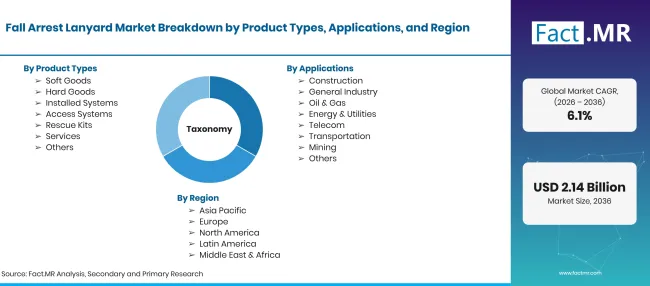
Fall Arrest Lanyard Market Taxonomy | Source: Fact.MR
| Attribute | Details |
|---|---|
| Quantitative Units | USD billion in 2026 to USD billion by 2036 at CAGR |
| Market Definition | Fall arrest lanyards are connectors, usually with an energy absorber, that link a worker’s full-body harness to an anchorage and limit the forces of an arrested fall. |
| Product Type | Soft Goods; Hard Goods; Installed Systems; Access Systems; Rescue Kits; Services; Others |
| Application | Construction; General Industry; Oil & Gas; Energy & Utilities; Telecom; Transportation; Mining; Others |
| Regions Covered | North America; Latin America; Western Europe; Eastern Europe; East Asia; South Asia & Pacific; Middle East & Africa |
| Countries Covered | Germany; Brazil; United States; United Kingdom; Japan |
| Companies Profiled | 3M; MSA Safety; FallTech; Guardian Fall Protection; RidgeGear; Buckingham Manufacturing |
| Forecast Period | 2026 to 2036 |
| Approach | Revenue modelling built on lanyard replacement cycles, construction activity and work-at-height enforcement in each country. |
Source: Fact.MR analysis. Updated Nov 3, 2026
How is the market segmented?
-
By Product Type
- Soft Goods
- Hard Goods
- Installed Systems
- Access Systems
- Rescue Kits
- Services
- Others
-
By Application
- Construction
- General Industry
- Oil & Gas
- Energy & Utilities
- Telecom
- Transportation
- Mining
- Others
-
By Region
- North America
- Latin America
- Western Europe
- Eastern Europe
- East Asia
- South Asia & Pacific
- Middle East & Africa
Frequently Asked Questions
How large is the fall arrest lanyard market in 2026?
What growth rate will the fall arrest lanyard market record?
Which product type leads?
Which application leads?
Which country will grow quickest?
Who are the main companies?
What holds the market back?
Who worked on this report


Preview the report firsthand - request a free sample
Free SampleGet the brochure for pricing and purchase details
Download PDF