- Market Value (2025): USD 2.09 Bn
- Estimated Value (2026): USD 2.22 Bn
- Forecast Value (2036): USD 4.02 Bn
- CAGR (2026-2036): 6.1%
What is the PVC Gypsum Ceiling Board Market forecast to be worth by 2036?
USD 2.2 billion in 2026 to USD 4.0 billion by 2036 at a 6.1% CAGR.
- PVC gypsum ceiling board revenue totalled USD 2.09 billion in 2025, with commercial fit-outs and contractor orders through dealers supplying most of that base.
- By 2036 the market will reach USD 4.02 billion, up from USD 2.22 billion in 2026, as office, retail and hospitality refurbishments call for washable, ready-finished ceilings.
- A 6.1% CAGR reflects steady new-build demand in growing economies and a large renovation pipeline in older building stock.
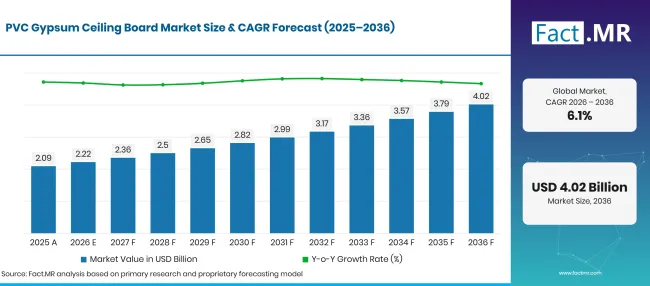
Pvc Gypsum Ceiling Board Market Forecast Global | Source: Fact.MR
| Year | Basis | Market Value (USD billion) |
|---|---|---|
| 2025 | Actual | 2.09 |
| 2026 | Estimate | 2.22 |
| 2036 | Forecast | 4.02 |
| CAGR 2026 to 2036 | Forecast period | 6.1% |
Source: Fact.MR analysis. Updated Nov 3, 2026
What are the defining numbers behind PVC Gypsum Ceiling Board Market growth?
The 2026 to 2036 period adds USD 1.8 billion in new value, concentrated in commercial interiors and 10mm boards bought through offline trade channels.
- Demand Drivers in the Market
- Self-built housing creates a large pool of small ceiling jobs. India’s Ministry of Statistics and Programme Implementation counted about 98.54 lakh households undertaking construction for their own use, along with 10.27 lakh unincorporated construction establishments, of which about 77% engaged at least one hired worker on a fairly regular basis [1]. Pre-finished boards suit these owner-managed jobs because they need no painting after fixing.
- Public housing programmes add a second channel of residential volume. Under PMAY-Urban 2.0, cumulative sanctions crossed 16.13 lakh houses after the 7th Central Sanctioning and Monitoring Committee approved over 2.13 lakh additional homes in June 2026 [2]. Each completed unit needs interior finishing, and low-maintenance laminated ceilings fit budget housing specifications.
- Renovation is taking a bigger role where new building output is weak. Eurostat reported that building construction in the euro area fell 6.5% year on year in June 2026 [3]. With fewer new projects, owners spend more on upgrading existing interiors, and a lay-in laminated board can replace a stained or sagging tile without a full ceiling rebuild.
- Hygiene rules in food, healthcare and cleanroom spaces favour washable surfaces. Vinyl-faced gypsum panels resist moisture, can be scrubbed and meet sanitary guidelines in kitchens and processing rooms, which widens their use beyond decorative ceilings.
- Key Segments Analyzed
- By Product Type: Regular will hold 38.1% of 2026 revenue, since most offices, shops and living spaces need neither elevated moisture resistance nor a special fire rating.
- By Application: Commercial will capture 42.3% share in 2026 as office, retail and hospitality fit-outs favour quick-install, finish-ready ceilings.
- By Thickness: 10mm will account for 42.0% of 2026 value, given its balance of panel rigidity and manageable weight on standard grid.
- By Distribution Channel: Offline will command 73.8% of 2026 sales, reflecting bulk, project-based orders placed through dealers and contractor networks.
- Analyst Opinion at Fact.MR
- Shambhu Nath Jha, Principal Consultant at Fact.MR, states, “PVC gypsum ceiling boards are winning work where contractors want a ceiling that is finished the moment it is fixed. Board cost against plain gypsum will remain the main hurdle, so suppliers that prove moisture and fire performance on site will convert the most specifications. Renovation of ageing offices and shops will carry growth in Europe and Japan, while new housing will drive volume in emerging economies.”
- Strategic Implications
- Manufacturers should label moisture-resistant and fire-resistant variants clearly on packs and datasheets so that architects can specify them without extra testing.
- Distributors should keep dealer and contractor relationships at the core while using online ordering for small, repeat buyers.
- Contractors should match board thickness to grid spacing and local code limits, with 10mm as the default for standard commercial bays.
- Investors should look at regional laminating capacity near growing construction markets, where freight on heavy boards erodes margins for importers.
Japan leads the country set at 7.5%, as owners replace ceilings in ageing offices and homes while new starts soften. The United Kingdom follows at 6.8%, 0.7 points behind, with steady repair and maintenance work feeding refurbishment demand. Germany trails the UK by a wider 0.9 points at 5.9%, since its rebound in permits is still recent. Brazil at 5.3% stays 0.6 points under Germany, held back by rising material costs even as urban building continues. The United States closes the range at 4.6%, 0.7 points lower, because its mature non-residential base already uses established lay-in ceiling systems.
How does the PVC Gypsum Ceiling Board Market break down by segment?
Regular will lead Product Type at 38.1%; Commercial will head Application at 42.3%; 10mm will lead Thickness at 42.0%; Offline will hold Distribution Channel at 73.8% in 2026.
Which Product Type leads?
Regular boards take 38.1% of 2026 sales.
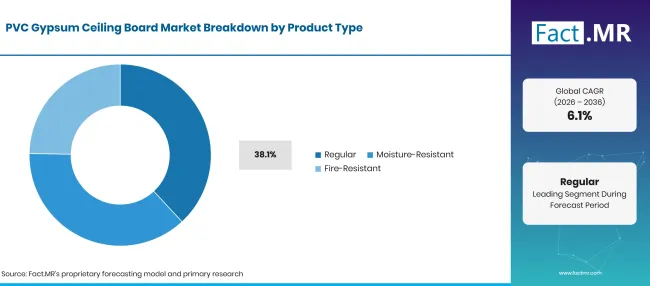
Pvc Gypsum Ceiling Board Market Breakdown Product Type | Source: Fact.MR
| Product Type | Share (2026) |
|---|---|
| Regular (Leading segment) | 38.1% |
| Other segments combined | 61.9%* |
| Total | 100.0% |
Source: Fact.MR analysis. Updated Nov 3, 2026
Standard interior ceilings in corridors, offices, classrooms and living rooms rarely face steam or strict fire classes, so buyers default to the base board. It costs less than specialist grades and carries the same laminated finish, which makes it the safe choice for large, repeat projects. Many contractors stock it as a general-purpose item alongside gypsum board for walls. Moisture-resistant boards serve bathrooms, kitchens and humid coastal sites, where a treated core limits sagging. Fire-resistant grades target escape routes and spaces covered by fire-code checks. The Others group includes antimicrobial and cleanroom variants used in food and healthcare facilities.
What supports Commercial within Application?
Commercial projects account for 42.3% of 2026 revenue.
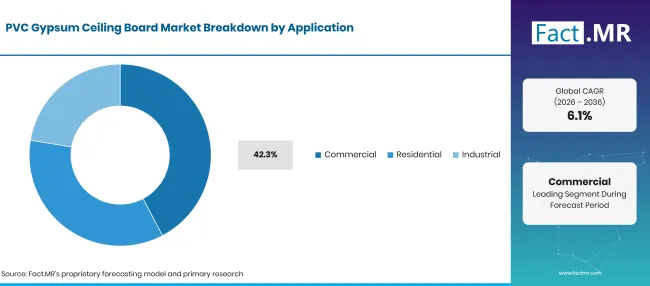
Pvc Gypsum Ceiling Board Market Breakdown Application | Source: Fact.MR
| Application | Share (2026) |
|---|---|
| Commercial (Leading segment) | 42.3% |
| Other segments combined | 57.7%* |
| Total | 100.0% |
Source: Fact.MR analysis. Updated Nov 3, 2026
Offices, malls, hotels and restaurants refurbish interiors on short cycles, and fit-out contractors are paid to finish quickly. A pre-laminated board removes the taping and painting stage, which shortens site time in occupied buildings. The same buyers often compare it with mineral fibre and acoustic ceiling tiles when sound control is a priority. Residential demand follows housing cycles, and in the United States privately owned housing starts ran at an annual rate of 1,221,000 in September 2026, 7.4% below September 2025 [4]. Industrial use is smaller and centres on food processing, warehouses and cleanrooms that need washable surfaces.
How does Thickness shape demand?
The 10mm grade captures 42.0% of 2026 value.
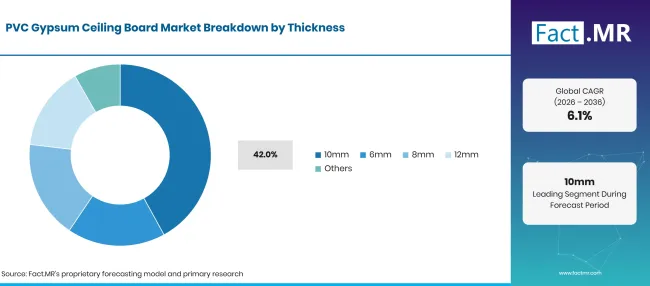
Pvc Gypsum Ceiling Board Market Breakdown Thickness | Source: Fact.MR
| Thickness | Share (2026) |
|---|---|
| 10mm (Leading segment) | 42.0% |
| Other segments combined | 58.0%* |
| Total | 100.0% |
Source: Fact.MR analysis. Updated Nov 3, 2026
Installers want a panel stiff enough to resist sagging in a 600 mm grid yet light enough for one person to place. A board of this gauge meets both needs for most office and home ceilings, which is why distributors hold it as the core stock item. Thinner 6mm and 8mm boards cut freight and weight for low-cost housing and temporary interiors. The 12mm grade suits larger spans, higher impact risk and spaces needing better acoustic or fire performance, and it often appears in the same specifications as plasterboard partition systems.
Which Distribution Channel leads?
Offline trade represents 73.8% of 2026 purchases.
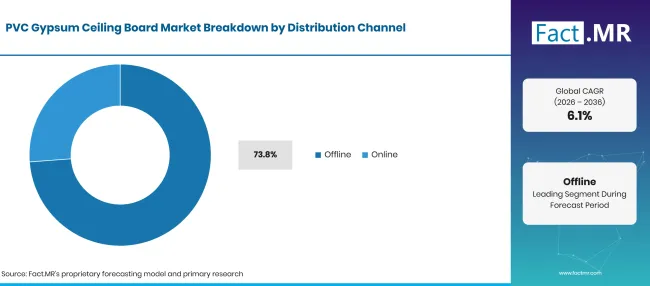
Pvc Gypsum Ceiling Board Market Breakdown Distribution Channel | Source: Fact.MR
| Distribution Channel | Share (2026) |
|---|---|
| Offline (Leading segment) | 73.8% |
| Other segments combined | 26.2%* |
| Total | 100.0% |
Source: Fact.MR analysis. Updated Nov 3, 2026
Ceiling boards are heavy, fragile and bought in project lots, so contractors rely on dealers who can advise on grid, cut lengths and delivery timing. Credit terms and site drops also keep buyers loyal to local stockists. Online orders come mainly from homeowners and small contractors replacing a few damaged tiles, where a direct-to-door option saves a trip. Manufacturer web stores and marketplace listings are widening this channel for standard sizes and white finishes.
What is accelerating PVC Gypsum Ceiling Board Market adoption, and what is holding it back?
Housing programmes, owner-led construction and renovation of older commercial stock support demand, and washable vinyl faces open food and healthcare uses. Higher prices than plain gypsum or PVC panels, low awareness among small builders and patchy availability of specialist grades slow the shift. Contractor confidence in moisture performance also shapes how fast humid regions convert.
Drivers Impact Analysis
| DRIVER | (~) % IMPACT ON CAGR | GEOGRAPHIC RELEVANCE | IMPACT TIMELINE |
|---|---|---|---|
| Residential and public housing construction | +1.2% | South Asia & Pacific, Latin America | Medium term (2-4 years) |
| Commercial interior refurbishment | +1.0% | Western Europe, East Asia, North America | Short term (<=2 years) |
| Preference for pre-finished, low-maintenance ceilings | +0.7% | Global | Short term (<=2 years) |
| Hygiene requirements in food and healthcare spaces | +0.5% | North America, Western Europe | Medium term (2-4 years) |
Source: Fact.MR analysis. Updated Nov 3, 2026
Opportunity Impact Analysis
| OPPORTUNITY | (~) % IMPACT ON CAGR | GEOGRAPHIC RELEVANCE | IMPACT TIMELINE |
|---|---|---|---|
| Moisture-resistant variants for humid climates | +0.8% | South Asia & Pacific, Middle East & Africa | Medium term (2-4 years) |
| Decorative printed and custom finishes | +0.6% | Global | Medium term (2-4 years) |
| Replacement tiles in ageing commercial buildings | +0.5% | Western Europe, North America | Long term (>=4 years) |
| Organised building-material retail and online ordering | +0.4% | Latin America, South Asia & Pacific | Short term (<=2 years) |
Source: Fact.MR analysis. Updated Nov 3, 2026
Restraints Impact Analysis
| RESTRAINT | (~) % IMPACT ON CAGR | GEOGRAPHIC RELEVANCE | IMPACT TIMELINE |
|---|---|---|---|
| Higher cost than conventional ceiling materials | -0.8% | Global | Short term (<=2 years) |
| Limited awareness among small builders and contractors | -0.6% | Emerging markets | Medium term (2-4 years) |
| Performance concerns under prolonged moisture exposure | -0.5% | Humid regions | Short term (<=2 years) |
| Thin availability of specialist grades | -0.4% | Developing markets | Medium term (2-4 years) |
Source: Fact.MR analysis. Updated Nov 3, 2026
Which countries are scaling the PVC Gypsum Ceiling Board Market through 2036?
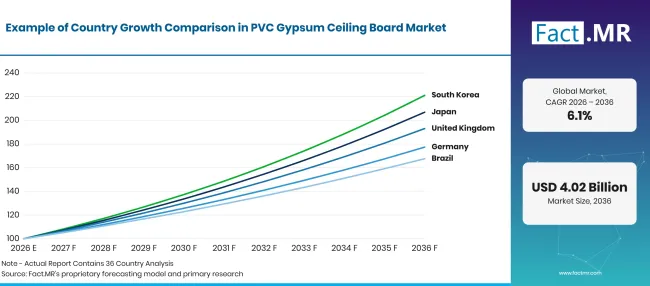
Pvc Gypsum Ceiling Board Market Growth Index | Source: Fact.MR
| Country | CAGR (2026 to 2036) |
|---|---|
| Japan | 7.5% |
| United Kingdom | 6.8% |
| Germany | 5.9% |
| Brazil | 5.3% |
| United States | 4.6% |
Source: Fact.MR analysis. Updated Nov 3, 2026
What supports PVC gypsum ceiling board adoption in Japan?
7.5% CAGR, helped by renovation of ageing buildings and demand for pre-finished interiors.
Japan’s growth comes more from refitting existing offices, shops and homes than from new floor space. The Ministry of Land, Infrastructure, Transport and Tourism reported that new housing starts fell 2.7% year on year in September 2026, while non-residential starts also declined as lower office and store building outweighed a rise in factories [5]. That pattern points owners toward ceiling replacement, where a laminated lay-in board can be swapped quickly with little disruption to tenants.
How is the United Kingdom developing demand?
6.8% CAGR, as repair and refurbishment work keeps flowing through existing buildings.
British demand rests on keeping a large, older building stock in use. The Office for National Statistics reported that repair and maintenance output grew 0.4% in August 2026 even as total construction output slipped 0.2% [6]. Refurbishment of shops, schools and offices favours boards that arrive finished and can be cleaned easily, and the ceiling tiles replacement cycle gives laminated gypsum a regular entry point.
What is supporting Germany’s adoption?
5.9% CAGR, backed by a recovery in building permits and modernisation of existing property.
German demand will follow a permit rebound into fit-out work over the next few years. Destatis reported that living floor space covered by new building permits rose 17.9% in June 2026 compared with June 2025 [7]. Eurostat data show German construction output up 1.6% year on year in the same month [3]. As these projects reach the interior stage, contractors will need ceilings that meet strict fire and hygiene codes.
How is Brazil scaling demand?
5.3% CAGR, driven by urban construction and cost-conscious interior finishing.
Brazilian builders watch input prices closely. The Brazilian Institute of Geography and Statistics reported that its national civil construction cost index rose 1.19% in June 2026, with materials up 0.92% in the month and the overall index up 7.26% over 12 months [8]. Rising costs push contractors to compare total installed cost, and a board that skips painting can offset a higher purchase price in housing and retail projects.
What is supporting United States adoption?
4.6% CAGR, reflecting a large non-residential base and ongoing interior upgrades.
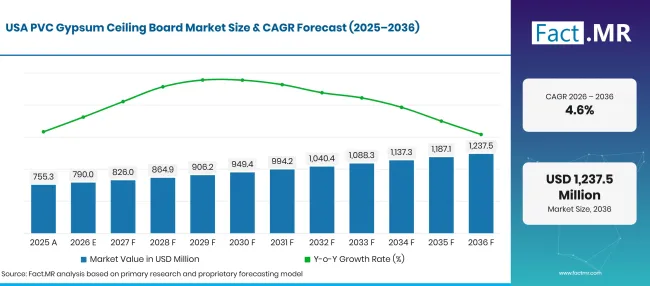
Pvc Gypsum Ceiling Board Market Forecast Usa | Source: Fact.MR
Commercial and institutional buildings across the United States form a deep stock that needs periodic ceiling upgrades. The U.S. Census Bureau estimated private non-residential construction spending at a seasonally adjusted annual rate of USD 773.0 billion in August 2026, 1.0% above the revised July estimate [9]. Vinyl-faced gypsum panels already hold a place in kitchens, food plants and cleanrooms, so growth will come from replacement and from wider use in healthcare.
Who leads the PVC Gypsum Ceiling Board Market?
Competition splits into three tiers. Global gypsum groups Saint-Gobain and Knauf compete on plant reach and brand trust with laminated tile ranges such as Gyproc Gyprex and Knauf WhiteSand, which lets them serve both emerging housing markets and specified commercial work.
North American ceiling specialists USG, National Gypsum and Armstrong World Industries compete on lay-in systems, sanitary ratings and contractor loyalty. National Gypsum introduced its EVOLVE family of lighter gypsum boards for walls and ceilings in April 2025 [10], and the line won Global Gypsum Product of the Year in October 2025 [11]. Armstrong World Industries uses its Kanopi by Armstrong store to guide buyers on vinyl-on-gypsum panels and alternative washable tiles, as set out in a March 2025 buying guide [12]. Regional producers such as Gypsemna in the United Arab Emirates supply PVC laminated gypsum tiles in 7 mm to 12 mm gauges and add price pressure in standard sizes across the Gulf. Over the forecast period, proof of moisture performance, freight-efficient local supply and dealer coverage will separate winners from price followers.
Which companies are the key providers?
Key companies in the PVC Gypsum Ceiling Board Market include Saint-Gobain, Knauf, USG, National Gypsum, Armstrong World Industries and Gypsemna.
- Saint-Gobain
- Knauf
- USG
- National Gypsum
- Armstrong World Industries
- Gypsemna
Bibliography
- [1] Ministry of Statistics and Programme Implementation. (2026, April 10). Pilot Study on Construction Activities in Unincorporated Sector Establishments and Households: Press Note.
- [2] Ministry of Housing and Urban Affairs. (2026, June 17). Government approves over 2.13 lakh additional houses under PMAY-U 2.0.
- [3] Eurostat. (2026, August 20). Production in construction down by 1.3% in the euro area and by 1.0% in the EU.
- [4] U.S. Census Bureau. (2026, October 20). Monthly New Residential Construction, September 2026.
- [5] Ministry of Land, Infrastructure, Transport and Tourism. (2026, October 30). Building Starts Statistics Survey Report: September 2026.
- [6] Office for National Statistics. (2026, October 15). Construction output in Great Britain: August 2026.
- [7] Federal Statistical Office of Germany (Destatis). (2026, August 18). Building permits, construction of new buildings.
- [8] Brazilian Institute of Geography and Statistics. (2026, July 10). National Index of Civil Construction accelerates to 1.19% in June.
- [9] U.S. Census Bureau. (2026, October 1). Monthly Construction Spending, August 2026.
- [10] National Gypsum Company. (2025, April 4). Introducing the EVOLVE Family of Products.
- [11] National Gypsum Company. (2025, October 31). EVOLVE Product Line Wins Global Gypsum Product of the Year.
- [12] Armstrong World Industries (Kanopi by Armstrong). (2025, March 3). What is Vinyl-On-Gypsum? Pros and Cons.
This Report Answers
- How large PVC gypsum ceiling board revenue will be in 2026 and 2036, and what growth rate links the two.
- Which product type, application, thickness and channel hold the lead in 2026, and why buyers favour them.
- Where Japan, the United Kingdom, Germany, Brazil and the United States differ in growth, with official construction data for each.
- What drivers, opportunities and restraints shift the CAGR, with an estimate of each effect.
- How Saint-Gobain, Knauf, USG, National Gypsum, Armstrong World Industries and Gypsemna compete across tiers.
- What falls inside and outside the product boundary used for sizing.
What does the PVC Gypsum Ceiling Board Market cover?
This study tracks gypsum boards that leave the factory with a PVC or vinyl film bonded to the face, ready to drop into a grid or fix to a frame. Valuation uses manufacturer selling prices for boards shipped to dealers, contractors and direct buyers.
Coverage spans residential, commercial and industrial interiors across four product types and four thickness grades. Adjacent finishes such as engineered wood ceilings and panels are tracked separately.
What is included in the scope?
Regular, moisture-resistant and fire-resistant PVC laminated gypsum ceiling boards.
Antimicrobial, cleanroom and food-grade vinyl-faced gypsum panels.
Plain and printed decorative laminated finishes in 6mm to 12mm thickness.
Boards sold through dealers, distributors, contractors, retail stores and online channels.
What is excluded from the scope?
Standard gypsum boards without a factory laminated face.
PVC ceiling panels made without a gypsum core.
Mineral fibre, metal and wood ceiling systems, along with laminate flooring and other interior surfaces.
Grid, hangers, installation tools and labour.
How Was the Analysis Built?
The analysis draws on 120+ sources, 35+ company portfolios, 25+ countries, and more than 20 industry interviews.
- Primary Research: Primary research includes discussions with manufacturers, service providers, technology developers, distributors, end users, and subject-matter experts. These conversations examine purchasing priorities, product adoption, operational challenges, approval requirements, competitive positioning, and the factors that influence wider market acceptance.
- Desk Research: Desk research covers government statistics, regulatory publications, company filings, trade data, technical studies, industry associations, standards, public policy, and other authoritative sources. Every source used in the analysis is documented in the bibliography.
- Market Sizing and Forecasting: Market estimates combine historical performance, demand indicators, pricing and volume trends, segment shares, company participation, country-level growth, adoption patterns, investment activity, and barriers to market expansion.
- Data Validation and Update Cycle: Findings are validated by comparing primary interviews with public data, company activity, regulatory changes, trade patterns, and industry developments. Regular updates review new product launches, capacity changes, partnerships, approvals, and shifts in commercial adoption.
Segmentation
What is the report’s scope and coverage?
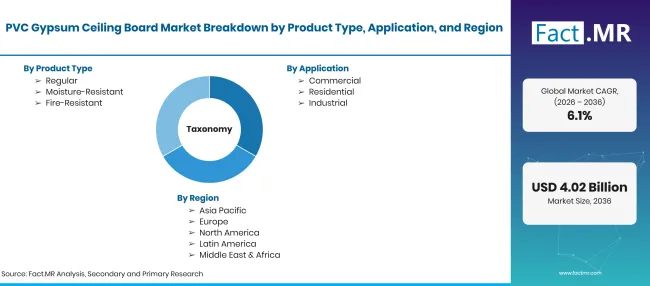
Pvc Gypsum Ceiling Board Market Taxonomy | Source: Fact.MR
| Attribute | Details |
|---|---|
| Quantitative Units | USD billion in 2026 to USD billion by 2036 at CAGR |
| Market Definition | Gypsum-core ceiling boards and tiles with a factory-applied PVC or vinyl laminated face, sold for suspended and fixed interior ceilings. |
| Product Type | Regular; Moisture-Resistant; Fire-Resistant; Others |
| Application | Commercial; Residential; Industrial |
| Thickness | 6mm; 8mm; 10mm; 12mm |
| Distribution Channel | Offline; Online |
| Regions Covered | North America; Latin America; Western Europe; Eastern Europe; East Asia; South Asia & Pacific; Middle East & Africa |
| Countries Covered | Japan; United Kingdom; Germany; Brazil; United States |
| Companies Profiled | Saint-Gobain; Knauf; USG; National Gypsum; Armstrong World Industries; Gypsemna |
| Forecast Period | 2026 to 2036 |
| Approach | Board shipments valued at manufacturer selling prices, cross-checked against construction output, housing and renovation statistics in each country. |
Source: Fact.MR analysis. Updated Nov 3, 2026
How is the market segmented?
-
By Product Type
- Regular
- Moisture-Resistant
- Fire-Resistant
- Others
-
By Application
- Commercial
- Residential
- Industrial
-
By Thickness
- 6mm
- 8mm
- 10mm
- 12mm
-
By Distribution Channel
- Offline
- Online
-
By Region
- North America
- Latin America
- Western Europe
- Eastern Europe
- East Asia
- South Asia & Pacific
- Middle East & Africa
Frequently Asked Questions
How large is the PVC gypsum ceiling board market in 2026?
What growth rate will the PVC gypsum ceiling board market record?
Which product type leads?
Which application leads?
The 10mm grade will account for 42.0% in 2026 thanks to its balance of rigidity and weight.
Which distribution channel leads?
Which country will grow quickest?
Who are the main companies?
What holds the market back?
Who worked on this report


Preview the report firsthand - request a free sample
Free SampleGet the brochure for pricing and purchase details
Download PDF